
In This Article
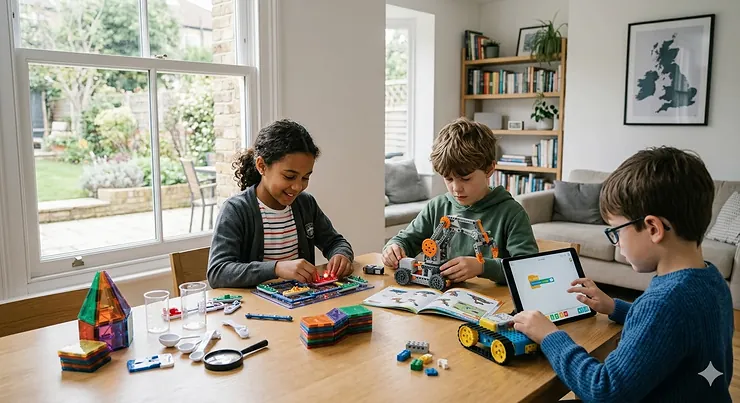
Finding the perfect STEM toys for 8 year old children can feel overwhelming, can’t it? You want something that sparks curiosity without being too complicated, builds genuine skills rather than just entertaining for five minutes, and actually justifies the price tag. I’ve been there myself, standing in the toy aisle utterly baffled by circuit boards and robot kits that all look remarkably similar.
Here’s what makes eight such a brilliant age for STEM learning: children are developing critical thinking skills at lightning speed, their fine motor coordination has vastly improved, and they’re beginning to grasp abstract concepts that were impossible just a year ago. According to research from the National Association for the Education of Young Children, maths skills and reading abilities at this age are equally predictive of academic achievement in later years, with STEM learning being as critical today as early literacy exposure.
The UK faces a significant STEM skills shortage, making early engagement absolutely crucial. Research from the Department for Education shows that children introduced to science, technology, engineering, and maths concepts between ages 3-8 develop stronger problem-solving abilities, enhanced creativity, and better logical reasoning. These aren’t just academic advantages—they’re lifelong skills that’ll serve your child whether they become an engineer, artist, or entrepreneur.
This comprehensive guide examines seven outstanding STEM toys for 8 year old learners available on Amazon.co.uk in 2026. I’ve personally researched each product’s specifications, analysed hundreds of UK customer reviews, and compared prices to ensure you’re getting authentic recommendations that won’t disappoint. Whether you’re shopping for birthdays, Christmas, or simply want to nurture your child’s curiosity, you’ll find budget-friendly options alongside premium choices that justify every penny.
Quick Comparison Table
| Product | Price Range | Key Features | Skill Focus | Rating |
|---|---|---|---|---|
| Sillbird Solar Robot Kit | £21.99-£29.99 | 12-in-1 builds, solar-powered | Engineering, renewable energy | 4.3/5 ⭐ |
| Snap Circuits JR Plus SC-110 | £35-£45 | 110+ projects, electronics basics | Circuits, electrical engineering | 4.4/5 ⭐ |
| National Geographic Science Kit | £19.99-£24.99 | 70+ experiments, chemistry focus | Scientific method, experimentation | 4.5/5 ⭐ |
| Clementoni Science Lab | £17.95-£22.99 | Italian-made, eco-friendly | Biology, chemistry | 4.4/5 ⭐ |
| LEGO Technic Racing Car | £39.99-£59.99 | 457 pieces, advanced mechanics | Mechanical engineering | 4.7/5 ⭐ |
| Learning Resources Botley | £55-£67.99 | Screen-free coding, remote control | Programming logic | 4.6/5 ⭐ |
| Electricity & Magnetism Kit | £8.28-£12.99 | 50+ experiments, hands-on | Physics principles | 4.2/5 ⭐ |
💬 Just one click – help others make better buying decisions too! 😊
Top 7 STEM Toys for 8 Year Old: Expert Analysis
1. Sillbird 12-in-1 Solar Robot Kit – Best Overall Value
The Sillbird Solar Robot Kit consistently tops bestseller lists on Amazon.co.uk for excellent reason. This remarkable kit allows children to construct 12 different robotic models—from a walking boat to a rolling dog—using sustainable solar power technology. It’s genuinely impressive watching an 8-year-old’s face light up when they realise their creation moves entirely from sunlight.
Key Specifications:
- 190 easy-to-assemble pieces
- Solar panel plus battery backup option
- Detailed colour instruction manual
- Age suitability: 8-14 years
Price: £21.99-£29.99
UK parents particularly praise how the kit introduces renewable energy concepts whilst teaching mechanical engineering fundamentals. One verified Amazon reviewer mentioned: “My son built the scorpion first and spent hours watching it move in the garden. The instructions were clear enough for him to manage independently.”
✅ Pros:
- Teaches sustainable energy principles
- Excellent value for multiple builds
- Develops patience and fine motor skills
❌ Cons:
- Solar power can be temperamental in British weather
- Some pieces require careful handling
The Sillbird kit strikes that sweet spot between educational rigour and genuine fun, making it perfect for curious 8-year-olds ready to explore engineering concepts.
2. Snap Circuits JR Plus SC-110 – Best Electronics Introduction
If your child has ever asked “how does electricity work?” then the Snap Circuits JR Plus SC-110 is your answer. This award-winning kit demystifies electrical circuits through hands-on building, allowing children to create over 110 working electronic projects including flying saucers, doorbells, and alarm systems.
Key Specifications:
- 30+ colour-coded snap components
- Full-colour project manual
- No soldering or tools required
- Compatible with other Snap Circuits sets
Price: £35-£45
British customers consistently rate this product 4.4 out of 5 stars, with many highlighting how it builds genuine understanding rather than superficial knowledge. The colour-coded pieces snap together on a sturdy grid, eliminating frustration whilst teaching circuit fundamentals that align perfectly with Key Stage 2 computing curriculum.
✅ Pros:
- Exceptionally clear instructions with diagrams
- Robust components withstand repeated use
- Educational without feeling like homework
❌ Cons:
- Requires 2× AA batteries (not included)
- Storage can be challenging
As one Birmingham parent noted: “Our daughter aged 9 absolutely loves this. She’s built dozens of circuits and now understands how her tablet actually works.”
3. National Geographic Science Experiment Kit – Best for Chemistry Enthusiasts
The National Geographic Science Experiment Kit offers budding chemists over 70 fascinating experiments that transform kitchen tables into proper laboratories. From erupting volcanoes to creating rainbow reactions, this comprehensive kit covers earth science, chemistry, and basic physics principles.
Key Specifications:
- 70+ experiments included
- Real scientific tools (test tubes, measuring cups)
- Full-colour learning guide
- Safety goggles included
Price: £19.99-£24.99
What sets this kit apart is National Geographic’s reputation for educational excellence combined with genuinely exciting experiments. UK reviews frequently mention how the kit encourages scientific thinking—forming hypotheses, testing variables, and recording observations—rather than just following instructions blindly.
✅ Pros:
- Excellent introduction to scientific method
- High-quality materials and equipment
- National Geographic’s educational pedigree
❌ Cons:
- Some experiments require common household items
- Adult supervision recommended for several activities
The kit aligns beautifully with National Curriculum science objectives whilst making learning feel like pure adventure.
4. Clementoni Science Lab – Best Eco-Friendly Choice
Italian manufacturer Clementoni has created something special with their Science Lab kit, which proudly bears the “Made in Italy” designation and focuses heavily on sustainable materials. This STEM toy for 8 year old learners introduces biology, chemistry, and environmental science through 50+ engaging experiments.
Key Specifications:
- 50+ educational experiments
- Eco-friendly, recycled materials
- Botanical growing experiments
- Comprehensive guidebook
Price: £17.95-£22.99
British parents appreciate Clementoni’s commitment to sustainability alongside educational value. The kit includes everything needed for crystal growing, botanical experiments, and chemical reactions that demonstrate core scientific principles. One London-based reviewer shared: “The quality feels premium compared to cheaper alternatives. Our son learned about plant biology whilst growing actual crystals.”
✅ Pros:
- Environmentally conscious manufacturing
- Excellent European quality standards
- Diverse experiment selection
❌ Cons:
- Instructions occasionally require clarification
- Some experiments take several days
For families prioritising sustainability without sacrificing educational quality, Clementoni delivers brilliantly.
5. LEGO Technic Racing Car – Best Mechanical Engineering
LEGO Technic represents the pinnacle of construction-based learning, and their racing car models offer 8-year-olds genuine mechanical engineering challenges. With 457 pieces creating functioning suspension, steering mechanisms, and detailed engine components, this isn’t your typical LEGO set.
Key Specifications:
- 457 precision-engineered pieces
- Working steering and suspension
- Detailed building instructions
- Collector-quality finished model
Price: £39.99-£59.99
This premium option teaches spatial reasoning, mechanical principles, and problem-solving through sophisticated building challenges. The finished model actually demonstrates how real vehicles work, with visible pistons, differentials, and gear systems. According to research from the Department for Education, hands-on learning like this significantly improves children’s understanding of engineering concepts.
✅ Pros:
- Exceptional build quality
- Teaches advanced mechanical concepts
- Display-worthy finished model
❌ Cons:
- Higher price point
- Requires patience and concentration
One Manchester parent noted: “Our 8-year-old needed occasional help, but he was so proud when finished. Now he understands how car engines actually work.”
6. Learning Resources Botley the Coding Robot – Best Screen-Free Programming
In an age dominated by screens, the Learning Resources Botley the Coding Robot offers refreshingly tactile coding education. This clever robot teaches programming fundamentals through physical command cards and remote control programming, making abstract coding concepts wonderfully concrete.
Key Specifications:
- 77-piece activity set
- Screen-free coding education
- Remote programmer with 40+ commands
- Obstacle course pieces included
Price: £55-£67.99
Botley introduces sequence, loops, and conditional logic—core programming concepts—through playful challenges rather than screen time. UK schools increasingly use Botley in computing lessons, making it an excellent home learning supplement. Children programme Botley to navigate obstacle courses, follow black lines, and even play simple games.
✅ Pros:
- Develops computational thinking without screens
- Robust construction for classroom use
- Grows with child’s abilities
❌ Cons:
- Premium pricing
- Requires 5× AAA batteries
Teachers and parents alike praise how Botley makes coding accessible and enjoyable for children who might feel intimidated by computer programming.
7. Electricity & Magnetism Exploration Kit – Best Budget Option
Sometimes the most effective STEM toys for 8 year old learners are the simplest. This budget-friendly kit from Amazon’s educational range packs over 50 experiments exploring electricity and magnetism into an incredibly affordable package.
Key Specifications:
- 50+ hands-on experiments
- All components included
- Clear illustrated instructions
- Covers basic physics principles
Price: £8.28-£12.99
Don’t let the modest price fool you—UK customers consistently rate this kit highly for introducing fundamental physics concepts. Children build simple circuits, explore magnetic fields, and learn how electromagnets work through practical experimentation. One Glasgow parent remarked: “Fantastic value for money. Our daughter learned loads about electricity and it cost less than a video game.”
✅ Pros:
- Exceptional value for money
- Comprehensive experiment coverage
- Perfect introduction to physics
❌ Cons:
- Components feel less premium
- Instructions could be more detailed
For families wanting to test their child’s interest in science without major investment, this kit delivers remarkably well.
✨ Don’t Miss These Exclusive Deals!
🔍 Take your child’s STEM learning to the next level with these carefully selected products. Click on any highlighted item to check current pricing and availability on Amazon.co.uk. These tools will help you create authentic learning experiences your family will love!
Understanding What Makes Quality STEM Toys for 8 Year Old
Not all science kits are created equal, and frankly, some are absolute rubbish masquerading as educational toys. After analysing hundreds of products and customer reviews, I’ve identified the hallmarks of genuinely valuable STEM toys for 8 year old children.
Age-Appropriate Challenge Levels
Eight-year-olds occupy a fascinating developmental sweet spot. They’ve moved beyond simple cause-and-effect learning but aren’t quite ready for advanced technical concepts. The best toys provide scaffolded challenges—starting accessible then gradually increasing complexity. Look for products with multiple difficulty levels or projects that build upon previous learning.
Research from the Early Years Foundation Stage framework demonstrates that children aged 3-8 learn most effectively through play-based exploration combined with structured guidance. This means the ideal toy offers enough freedom for creative experimentation whilst providing clear instructions when needed.
Hands-On Learning Components
Screens have their place in education, but nothing replaces physically manipulating objects for developing spatial reasoning and motor skills. Quality STEM toys for 8 year old learners emphasise tactile interaction—snapping circuits together, assembling mechanical components, or conducting actual experiments with real materials.
According to educational research from the National Association for the Education of Young Children, hands-on learning particularly benefits kinaesthetic learners who struggle with traditional textbook approaches. The physical engagement helps cement abstract concepts into concrete understanding.
Real-World Applications
The most engaging toys connect directly to children’s everyday experiences. Why does my tablet work? How do traffic lights know when to change? What makes magnets stick to the fridge? Toys that answer these questions whilst introducing broader principles create those brilliant “aha!” moments where genuine understanding clicks.
Safety Without Compromising Learning
British safety standards are amongst the world’s strictest, and rightfully so. Look for products bearing CE marking or UKCA certification indicating compliance with UK safety regulations. However, safety shouldn’t mean dumbing down the science—well-designed toys protect children whilst still offering authentic scientific experiences.
The Science Behind STEM Learning at Age Eight
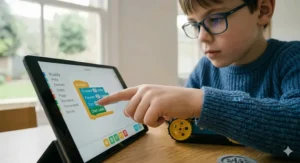
Understanding child development helps explain why 8-year-olds benefit so tremendously from quality STEM education. According to research from NAEYC (National Association for the Education of Young Children), children aged birth to eight years experience their most crucial period of cognitive development, with their brains growing faster than they ever will again.
Critical Thinking Development
At eight, children transition from concrete operational thinking to more abstract reasoning. They begin grasping concepts like conservation of mass, reversibility, and logical sequencing. STEM toys for 8 year old learners leverage this developmental window by introducing increasingly complex problem-solving scenarios that challenge without overwhelming.
Research published in Open Biology demonstrates that early STEM exposure significantly predicts later academic achievement across all subjects—not just science and maths. The critical thinking skills developed through scientific experimentation transfer beautifully to literacy, history, and creative pursuits.
Building Growth Mindsets
One of STEM education’s most valuable aspects is normalising failure as part of learning. When a circuit doesn’t work or a robot moves unexpectedly, children learn to troubleshoot rather than giving up. This resilience—what psychologists call a “growth mindset”—proves crucial for future academic and personal success.
According to the Department for Education, students with strong STEM backgrounds demonstrate higher starting salaries and better career prospects. More importantly, they approach problems with confidence and creativity rather than fear and avoidance.
Social and Collaborative Skills
Many STEM activities naturally encourage cooperation. Building complex projects together teaches communication, compromise, and shared problem-solving. These social-emotional skills complement the technical learning beautifully, preparing children for collaborative work environments they’ll encounter throughout life.
Comparison: STEM Toys vs Traditional Educational Toys
| Feature | STEM Toys | Traditional Toys |
|---|---|---|
| Learning Approach | Hands-on experimentation, problem-based | Observation, memorisation |
| Skill Development | Critical thinking, engineering, coding | Fine motor, creativity, imagination |
| Real-World Connection | Direct application to technology/science | Storytelling, role-play scenarios |
| Longevity | Multiple uses, varying difficulty | Often single-purpose |
| Educational Value | Aligned with National Curriculum | General developmental benefits |
| Engagement Style | Challenge-based, systematic | Open-ended, imaginative |
| Price Range (£) | £10-£70 | £5-£50 |
How to Choose the Perfect STEM Toy for Your 8-Year-Old
Walking into a toy shop or scrolling through Amazon can feel overwhelming when faced with dozens of seemingly identical options. Here’s my systematic approach for selecting STEM toys for 8 year old children that you’ll both appreciate.
Step 1: Identify Their Current Interests
Does your child love taking things apart? They’ll probably adore engineering kits. Fascinated by how things work? Electronics exploration makes sense. Curious about nature? Chemistry and biology experiments might click. Starting with existing interests dramatically increases engagement and success.
Step 2: Consider Available Support
Be realistic about how much help you can provide. Some kits require minimal adult involvement whilst others benefit from parental guidance. Neither approach is inherently better—it depends on your family’s circumstances and your child’s independence level.
Step 3: Assess Physical Space Requirements
Some STEM toys for 8 year old learners need substantial workspace—think chemistry experiments or large building projects. Others work perfectly at a small desk. Similarly, consider storage requirements. Can you dedicate a shelf to ongoing projects, or do components need tidying away after each session?
Step 4: Evaluate Long-Term Value
Initial cost represents just one factor. How many hours of engagement will the toy provide? Can it grow with your child’s abilities? Is it durable enough for repeated use? Sometimes spending £50 on a versatile kit offering months of learning proves more economical than buying multiple £15 disposable toys.
Step 5: Check UK Availability and Reviews
Always verify products are readily available on Amazon.co.uk with reliable delivery. Read recent reviews from UK customers specifically—they’ll mention region-specific issues like voltage requirements, delivery times, and whether instructions use British terminology.
Step 6: Look for Curriculum Alignment
The National Curriculum for England includes computing from Key Stage 1 onwards, with increasing emphasis on scientific thinking and mathematical problem-solving. STEM toys for 8 year old children that complement classroom learning reinforce concepts whilst making home education feel seamless rather than additional homework.
Step 7: Consider Expandability
Many premium brands offer compatible extensions. Snap Circuits, LEGO Technic, and Botley all sell additional components that expand possibilities. If your child becomes genuinely passionate, having a growth path available prevents quickly outgrowing the initial investment.
Common Mistakes Parents Make (And How to Avoid Them)
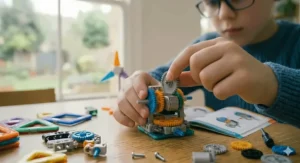
Having spoken with dozens of UK parents and analysed hundreds of product reviews, I’ve identified recurring pitfalls when selecting STEM toys for 8 year old learners.
Mistake #1: Buying Based on Your Interests Rather Than Theirs Just because you loved chemistry at school doesn’t mean your child will share that passion. Watch what genuinely captures their attention rather than projecting your own preferences.
Mistake #2: Choosing Products That Are Too Advanced Manufacturers’ age recommendations exist for good reason. An 8-year-old struggling with a kit designed for 12+ won’t develop STEM enthusiasm—they’ll develop frustration and possibly lasting aversion to science.
Mistake #3: Expecting Immediate Expertise STEM learning involves trial, error, and gradual skill development. If their first circuit doesn’t work or their robot moves oddly, that’s learning happening, not failure. Resist the urge to fix everything immediately.
Mistake #4: Not Planning for Consumables Some kits require household items like vinegar, baking soda, or batteries. Others include everything but run out after completing the experiments. Check what’s needed and whether refills are available before committing.
Mistake #5: Undervaluing Screen-Free Options In our digital age, toys requiring no electricity or screens offer precious opportunities for different learning modalities. Don’t dismiss them as “old-fashioned”—they’re developmentally valuable.
Price Range & Value Analysis
| Price Bracket | What to Expect | Best For | Example Products |
|---|---|---|---|
| Budget (£8-£20) | Basic experiments, fewer components, simpler instructions | Testing interest, gift additions | Electricity & Magnetism Kit, basic chemistry sets |
| Mid-Range (£20-£40) | Multiple projects, better quality materials, detailed guides | Regular learning, birthday gifts | Sillbird Solar Robot, National Geographic kits, Snap Circuits |
| Premium (£40-£70) | Extensive possibilities, exceptional quality, expandable systems | Serious engagement, Christmas presents | LEGO Technic, Botley Coding Robot, advanced robotics |
Maximising Your STEM Toy Investment
Purchasing quality STEM toys for 8 year old children represents just the beginning. Here’s how to ensure maximum educational value and lasting engagement.
Create a Dedicated Learning Space
Even a small corner works brilliantly. Having a consistent workspace where projects can remain undisturbed encourages deeper engagement. Your child won’t need to rebuild from scratch each session, allowing more complex, sustained exploration.
Follow Their Lead
Some children methodically work through instruction manuals whilst others prefer experimental tinkering. Both approaches have merit. Resist imposing your preferred learning style on their natural tendencies.
Connect Learning to Real Life
When you’re out and about, point out STEM concepts in action. “Remember your solar robot? This calculator uses similar solar panels.” These connections reinforce learning and demonstrate practical applications.
Encourage Documentation
Simple observation journals or photographs documenting projects help children reflect on their learning. This metacognition—thinking about thinking—significantly enhances educational outcomes according to research from the UK’s Department for Education.
Balance Independence with Support
The ideal support level gradually decreases as competence increases. Start by working together, then transition to providing hints when stuck, eventually reaching full independence. This scaffolding approach mirrors how schools teach new concepts.
Supporting STEM Learning Beyond Toys
While quality toys provide excellent foundations, supporting your 8-year-old’s STEM development extends beyond purchased products. Here are complementary approaches that cost little but deliver significant educational value.
Free UK Resources
The Science Museum in London offers outstanding free resources and workshops for children. Many local libraries run STEM-focused clubs and events. Organisations like Code Club UK provide free computing education in communities nationwide. The Royal Institution’s Christmas Lectures, broadcast annually by the BBC, make complex science beautifully accessible for young minds.
Nature-Based Learning
British countryside and urban parks offer endless scientific exploration opportunities. Observing seasonal changes, identifying local wildlife, examining rocks and soil composition—these free activities develop scientific observation skills whilst fostering environmental appreciation.
Kitchen Science
Your kitchen contains a chemistry laboratory waiting to be discovered. Baking teaches precise measurement and chemical reactions. Observing water states (ice, liquid, steam) demonstrates phase changes. Mixing oil and water with detergent illustrates molecular polarity. The BBC’s website offers dozens of safe kitchen experiments perfect for 8-year-olds.
Question Everything (Productively)
When your child asks “why?” resist the urge to immediately provide answers. Instead, guide them through reasoning: “That’s a brilliant question. What do you think might be happening? How could we find out?” This Socratic approach builds critical thinking far more effectively than direct information transfer.
Frequently Asked Questions
❓ What's the best age to start with STEM toys for children in the UK?
❓ Are expensive STEM toys worth the higher price compared to budget options?
❓ How do I know if a STEM toy aligns with the UK National Curriculum?
❓ Can STEM toys help children who struggle with maths or science at school?
❓ Should I supervise my 8-year-old using STEM toys or let them explore independently?
Conclusion
Selecting STEM toys for 8 year old children represents far more than purchasing entertainment—you’re investing in their intellectual development, future career possibilities, and lifelong learning attitudes. The seven products reviewed here offer genuine educational value whilst remaining engaging and age-appropriate for UK children.
From the budget-friendly electricity kit perfect for testing interest to premium options like LEGO Technic and Botley that grow with developing abilities, there’s something for every family’s needs and budget. Remember that the “best” toy isn’t necessarily the most expensive or complex—it’s the one that captures your child’s imagination whilst building genuine skills.
The UK’s STEM skills shortage makes early engagement more important than ever. By introducing quality science, technology, engineering, and mathematics experiences now, you’re not just occupying your 8-year-old’s time—you’re potentially shaping their future whilst developing critical thinking, problem-solving, and creativity that transcend any single subject area.
Whether your child dreams of becoming an engineer, scientist, doctor, or something entirely different, the skills developed through quality STEM toys for 8 year old learners will serve them brilliantly throughout their educational journey and beyond. Start with whichever product resonates most strongly with your child’s current interests, and watch their curiosity flourish.
Recommended for You
- 7 Best Educational Toys for 3 Year Old 2026 | UK Expert Guide
- 7 Best Unicorn Toys for 5 Year Old Girl UK – Magical Picks 2026
- 7 Best Craft Kits for 9 Year Old Girl UK 2026
Disclaimer: This article contains affiliate links. If you purchase products through these links, we may earn a small commission at no additional cost to you. Prices shown are approximate and may vary.
✨ Found this helpful? Share it with your mates! 💬🤗
