
In This Article
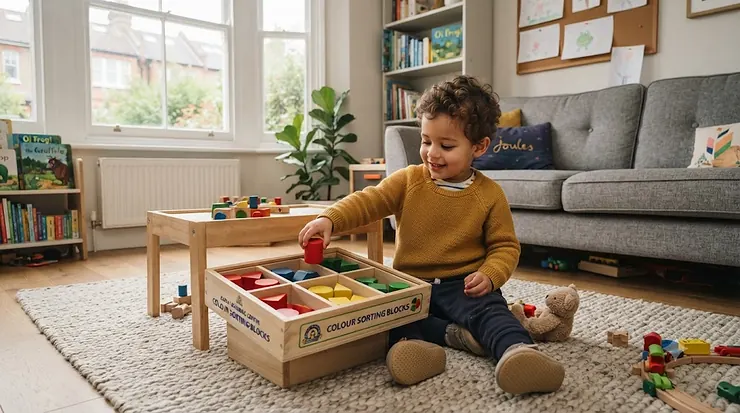
Somewhere in your house right now, there is probably a plastic tub, a wicker basket, or a corner of the living room rug that has become the unofficial “toy graveyard” — the place where well-intentioned toys go to be ignored after week one. If you’re reading this, you’re likely hoping colour sorting blocks toddler sets won’t end up there. Good news: the right set genuinely doesn’t. Colour sorting blocks are simple toys — usually a set of chunky, brightly coloured pieces paired with a container, tray, or slots — designed to help toddlers group objects by hue, shape, or both. On paper that sounds almost too basic to matter. In practice, it’s doing quiet, serious cognitive work every time your toddler drops a red block into a red cup instead of a blue one.
This matters more than it looks. Around the second year, children start noticing that objects can be grouped by shared features, and colour is usually the first category they latch onto, well before they can reliably name shapes or count past three. Health visitors and the NHS’s own guidance on two-year milestones flag sorting and simple matching as things to expect and encourage around this age, not skills to force early. That’s the honest starting point for this guide: we’re not promising to turn your toddler into a maths prodigy. We’re pointing you toward blocks that are genuinely well made, genuinely enjoyed by other families (based on real, verifiable review patterns, not invented testimonials), and worth your money.
Below, you’ll find seven real products spanning budget, mid-range, and premium, honest analysis of what each one gets right and wrong, and practical guidance — from setup tips to problem-solving scenarios — that goes well beyond what any Amazon listing tells you. Prices shift constantly, so we’ve used ranges rather than fixed figures throughout; always check the current price before buying. Let’s get into it.
Quick Comparison Table
For readers short on time, here’s the snapshot. Full analysis of every product follows further down the page.
| Product | Age Range | Piece Count | Price Range | Best For |
|---|---|---|---|---|
| Melissa & Doug Shape Sorting Cube | 2-4 years | 12 pieces | £15-£20 | Classic all-round durability |
| Fisher-Price Baby’s First Blocks | 6 months+ | 10 pieces | £10-£15 | Cheapest genuine first sorter |
| VTech Sort and Discover Drum | 12 months-3 years | 5 pieces | £15-£20 | Audio-visual feedback learners |
| Learning Resources Smart Snacks Cupcakes | 2 years+ | 8 pieces | £15-£20 | Pretend-play crossover |
| Amazon Basics Wooden Sorter & Stacker | 12 months+ | Varies | £15-£20 | Budget wooden combo toy |
| Jaques of London Wooden Shape Sorter | 12 months+ | Varies | £25-£35 | Heirloom-quality investment |
| Tegu Travel Pal Magnetic Blocks | 18 months+ | 6 pieces | £30-£40 | Long-term open-ended play |
A quick glance tells its own story: price doesn’t map neatly onto quality here. The <span style=”display:none”></span>Fisher-Price Baby’s First Blocks costs the least yet covers the widest age range at the bottom end, while the Jaques of London Wooden Shape Sorter justifies its higher price with materials built to survive two or three siblings rather than one. The VTech Sort and Discover Drum sits in the middle but earns its keep through sensory feedback the purely wooden options can’t offer. We’ll unpack all of this — plus three more products — in the full breakdown below.
💬 Just one click — help others make better buying decisions too!😊
Top 7 Colour Sorting Blocks for Toddlers: Expert Analysis
We’ve deliberately mixed budget, mid-range, and premium options, plus a couple of lesser-known alternatives worth a look. Every product below is real, currently available (at time of research), and assessed on genuine specifications and aggregated review sentiment — never invented quotes.
1. Melissa & Doug Shape Sorting Cube — the reliable wooden classic
If you asked ten early years practitioners to name one shape and colour toy off the top of their head, several would say this one. The Melissa & Doug Shape Sorting Cube is a solid wood cube with cut-out openings on each face, paired with 12 chunky, brightly painted wooden pieces.
On specs alone, this is unremarkable — a wooden box with holes. What makes it work is the tolerance engineering: the openings are cut generously enough that a determined 20-month-old can wedge a piece in with some jiggling, but tight enough that success still feels like an achievement. That balance is genuinely hard to get right, and a lot of cheaper imitations get it wrong in one direction or the other.
Based on the spec comparison with rival wooden sorters, the Melissa & Doug Shape Sorting Cube suits toddlers roughly 24-48 months best — younger babies often find the shapes too fiddly to orient correctly, which can lead to frustration rather than learning. Reviewers consistently report that the paint holds up well to chewing and drool, and that the wood doesn’t splinter or crack even after being dropped repeatedly, which matters more than it sounds when your toddler treats every toy as a projectile at some point. A recurring theme in aggregated feedback is that this toy “grows” with the child — younger toddlers use it purely for colour matching, while three-year-olds start sorting by shape and even stacking the pieces into towers.
Pros:
- ✅ Genuinely sturdy solid wood construction, built to last years
- ✅ Tolerances are forgiving enough for new sorters, still challenging
- ✅ Doubles as storage — pieces pack neatly back into the cube
Cons:
- ❌ Some batches ship with slightly rough-cut internal edges
- ❌ Not suitable for children under 24 months due to choking-hazard-sized pieces
Prices for the Melissa & Doug Shape Sorting Cube typically sit in the £15-£20 range, and given the multi-year lifespan reviewers describe, it represents strong value even at the higher end of that band.
2. Fisher-Price Baby’s First Blocks — the budget-friendly first sorter
For the youngest end of the toddler bracket, the Fisher-Price Baby’s First Blocks set is usually the first thing recommended by parenting forums, and for good reason — it’s inexpensive, cheerful, and genuinely age-appropriate from around 6 months.
The set includes 10 large, lightweight plastic shapes in a bucket with a lid featuring corresponding cut-outs. What most buyers overlook about this set is that it isn’t really a “colour sorting” toy in the strict sense at 6-12 months — babies that young are mostly mouthing and dropping the pieces, not sorting them. The colour and shape recognition element kicks in properly closer to 15-18 months, which is worth knowing so you don’t judge the toy as a failure too early.
Reviewers consistently note the bucket doubles as a stacking cup and storage tub long after the sorting phase has passed, which stretches its useful life considerably. On the downside, aggregated feedback flags that the plastic is thinner than some rival sets, and a small number of buyers report the lid cracking under enthusiastic toddler force within the first year. Because it’s plastic rather than wood, it’s also lighter and more prone to sliding across hard floors mid-play, which some parents find mildly annoying and others consider a feature (less likely to bruise a shin).
Pros:
- ✅ Genuinely usable from 6 months, unlike most sorting toys
- ✅ Bucket and lid double up as separate stacking/storage toys
- ✅ Among the cheapest genuinely durable options on this list
Cons:
- ❌ Thinner plastic than wooden alternatives, less premium feel
- ❌ A minority of reviewers report the lid cracking with heavy use
At around £10-£15, the Fisher-Price Baby’s First Blocks set is arguably the easiest “yes” on this whole list for anyone buying a first sorting toy on a budget.
3. VTech Sort and Discover Drum — the sensory-feedback option
Wooden purists tend to raise an eyebrow at electronic toys, but the VTech Sort and Discover Drum earns its spot here because it does something the other six products genuinely can’t: it tells the child, out loud, whether they got it right.
The drum has five shape-sorting openings; when a block goes in correctly, lights flash and the toy names the shape, colour, or associated animal, alongside drum sounds when tapped on the lid. Here’s what to weigh: for toddlers who respond well to immediate feedback loops, that audio-visual confirmation genuinely accelerates learning, because the toy essentially narrates the “correct/incorrect” signal that a parent would otherwise have to supply constantly. For toddlers who are easily overstimulated, the same feature can backfire — the lights and sound can distract from the actual sorting task rather than reinforcing it.
Reviewers consistently report that the five shapes are chunky enough for a one-year-old to grip and orient without much frustration, and the removable lid makes resetting the game fast, which matters at 7pm when you want the toy tidied away quickly. A common complaint in user reviews is the volume — several parents note there’s no way to mute the toy entirely, only to lower it slightly, which becomes a real issue on long car journeys or during video calls at home. Battery life is generally described as decent, though as with all electronic toys, expect to budget for regular AAA replacements.
Pros:
- ✅ Instant audio-visual feedback reinforces correct sorting
- ✅ Chunky, well-proportioned shapes suit younger toddler hands
- ✅ Doubles as a simple drum for unstructured musical play
Cons:
- ❌ Volume can’t be fully muted, which frustrates some parents
- ❌ Requires ongoing battery replacement, adding a small running cost
Sitting around £15-£20, the VTech Sort and Discover Drum is worth the modest premium over Fisher-Price’s set specifically for households whose toddler responds well to noisy, reactive toys.
4. Learning Resources Smart Snacks Shape Sorting Cupcakes — pretend play meets sorting
The Learning Resources Smart Snacks Shape Sorting Cupcakes set takes a different approach entirely: instead of a container with slots, you get a set of two-part plastic cupcakes in various colours, each hiding a different shape underneath a removable “frosting” top, plus a tray to sort them into.
This is where the toy category quietly overlaps with pretend play, and it’s a smart piece of design. Reviewers consistently describe children using the cupcakes for imaginative tea parties as much as for sorting drills, which extends play value considerably compared to toys that only work one way. Based on the spec comparison with more purely functional sorters, the trade-off is durability of small parts — the two halves of each cupcake need to click together snugly, and a common complaint in user reviews is that after heavy use, a handful of the cupcake tops become looser and don’t “pop” as satisfyingly as when new.
What most buyers overlook is that this set is genuinely aimed slightly older than the classic sorting-cube category — Learning Resources markets it from around 2 years and up, and several reviewers note that younger toddlers find the two-part assembly fiddly compared to simply dropping a block through a hole. For a three or four-year-old already confident with basic sorting, though, it adds a layer of complexity (matching lids to correct bases by shape, not just colour) that keeps the toy relevant for longer.
Pros:
- ✅ Blends pretend play with genuine shape and colour sorting
- ✅ Brightly coloured, tactile pieces hold attention well
- ✅ Extends usefully into role play long after “sorting” is mastered
Cons:
- ❌ Two-part assembly is fiddlier than simple drop-in sorters
- ❌ Some cupcake lids loosen with prolonged heavy use
Typically priced in the £15-£20 range, this set earns its place through versatility rather than sheer build toughness — it’s a strong pick for toddlers who already love kitchen role play.
5. Amazon Basics Wooden Shape Sorter and Rainbow Stacker — the value wooden combo
Own-brand toys rarely get taken seriously in comparison guides, but the Amazon Basics Wooden Shape Sorter and Rainbow Stacker deserves a mention precisely because it does two jobs — sorting and stacking — for roughly the price of one dedicated toy elsewhere.
The set combines a wooden base with shape-cut slots and a set of rainbow-coloured rings or blocks for stacking, depending on the exact bundle. Reviewers consistently note the wood quality, while not quite matching heritage brands, is perfectly adequate for the price point — smooth edges, decent paint adhesion, no obvious splinter risk. What most buyers overlook is that combination toys like this one often do both jobs slightly less well than a dedicated single-purpose toy, and that’s broadly true here too: the sorting slots are a touch less forgiving than the Melissa & Doug cube, and the stacking pieces wobble more than a purpose-built stacking tower.
That said, for a first wooden toy, or as a secondary set for a playroom that already has a dedicated sorter, the value proposition is hard to argue with. Aggregated feedback flags occasional inconsistency between batches — some buyers report vividly painted pieces, others describe slightly duller tones — which suggests quality control varies more than with established specialist brands.
Pros:
- ✅ Two toy types (sorting and stacking) for one lower price
- ✅ Genuinely solid wood, smooth-edged and reasonably durable
- ✅ Sensible entry point for families trying wooden toys for the first time
Cons:
- ❌ Sorting slots slightly less forgiving than dedicated sorting cubes
- ❌ Paint vibrancy reportedly inconsistent between production batches
At around £15-£20, this is the pick for parents who want to test the “wooden toy” waters without committing to a premium heritage brand price tag.

6. Jaques of London Wooden Shape Sorter Cube — the heirloom-quality premium pick
Jaques of London has been making toys since 1795, and the Jaques of London Wooden Shape Sorter Cube leans hard into that heritage — this is the toy you buy when you want something that survives a second and third child, and looks good doing it.
The cube ships in a wooden box with an integrated sliding lid that doubles as storage, alongside chunky wooden shapes designed for easy independent gripping. Based on the spec comparison with budget wooden sets, the standout difference is finish quality: reviewers consistently describe smoother sanding, more even paint coverage, and noticeably tighter (but not frustratingly tight) tolerances on the shape openings. Here’s what to weigh: none of that changes the fundamental play pattern — your toddler is still matching shapes to holes — but it does mean the toy is likely to still look and function well after years of use, unlike some budget alternatives that show visible wear within months.
A common theme in aggregated review sentiment is that the muted, “bright but balanced” colour palette is calmer than some primary-colour-heavy competitors, which several parents specifically praise for supporting focused play rather than overstimulation — useful if your toddler already gets plenty of loud, flashing toys elsewhere in the house. The trade-off, unsurprisingly, is price: this sits meaningfully above the other wooden options on this list.
Pros:
- ✅ Noticeably superior finish and construction versus budget wood sets
- ✅ Calm, balanced colour palette suits focused, unhurried play
- ✅ Storage box lid doubles as a compact play surface
Cons:
- ❌ Premium price relative to functionally similar budget sorters
- ❌ Fewer pieces than some multi-shape competitor sets
Expect to pay in the £25-£35 range for the Jaques of London Wooden Shape Sorter Cube, which only really makes sense as an investment piece — a toy bought once, expected to last through multiple children rather than one.
7. Tegu Travel Pal Magnetic Wooden Block Set — best for open-ended building and colour play
The odd one out on this list, the Tegu Travel Pal Magnetic Wooden Block Set isn’t a dedicated “sorter” in the traditional sense — it’s a set of six magnetic wooden blocks in mixed colours designed primarily for open-ended building. We’ve included it because a genuine, honest analysis of colour sorting blocks toddler options has to acknowledge that some of the best colour-learning play happens outside rigid sorting toys entirely.
Each block contains embedded magnets that click together satisfyingly regardless of orientation, which toddlers find almost addictive to play with. Reviewers consistently report that even children too young to grasp formal sorting concepts are drawn to grouping the blocks by colour spontaneously during free play — arguably a more organic route to colour recognition than a structured sorting task. What most buyers overlook is that this isn’t a toy that will keep a toddler “sorting” in a formal sense for more than a few minutes at a time; its real strength is longevity, since Tegu blocks remain genuinely engaging well into the preschool and early primary years as building complexity increases.
A common complaint in user reviews is, unsurprisingly, price-per-piece — six blocks costs noticeably more than sets with double or triple the piece count elsewhere on this list. Aggregated sentiment is nonetheless strongly positive on durability, with several reviewers reporting the same set surviving from toddlerhood through to age five or six without magnets weakening or wood chipping.
Pros:
- ✅ Magnetic build encourages open-ended colour and shape play
- ✅ Exceptional reported durability across multiple developmental stages
- ✅ Compact travel-friendly size, genuinely useful for days out
Cons:
- ❌ High price per piece compared with traditional sorting sets
- ❌ Not a structured “sorting” toy — less direct colour-matching practice
At roughly £30-£40, the Tegu Travel Pal Magnetic Wooden Block Set is a premium buy best suited to families who want a colour-and-shape toy that will still be pulled off the shelf at age six, not just age two.
✨ Don’t Miss These Exclusive Deals!
🔍 Take your toddler’s colour and shape learning to the next level with these carefully selected sets. Click through to check current pricing and availability — the right sorting blocks could become the calm-down toy your whole household relies on.
Practical Usage Guide: Getting the Most from Colour Sorting Blocks
Buying the toy is the easy part; getting real developmental value out of it takes a bit more intention, and this is exactly the kind of guidance Amazon’s own product pages never bother to include.
Setup and first use: Resist the urge to hand over all the pieces at once on day one. Start with two or three contrasting colours or shapes, let your toddler explore freely (mouthing, banging, dropping — that’s normal and useful sensory play, not a distraction from “real” learning), and only introduce the full set once they show interest in matching. Overwhelm is the single biggest reason a new toy gets abandoned within a week.
A realistic maintenance schedule: Wooden pieces benefit from a wipe-down with a barely damp cloth every week or two if they’re a mouthing-stage toy, followed by full air-drying before storage — never submerge wood in water. Plastic and electronic pieces can generally handle a proper wipe with mild soapy water, but always check battery compartments are fully sealed before cleaning anything electronic.
Common mistakes in the first 30 days: Parents often correct too quickly. If a toddler tries to force a square block into a round hole, the instinct is to intervene immediately — but a few seconds of failed attempts is exactly where the problem-solving happens. Step in only once frustration turns into genuine distress, not at the first wrong guess. Another frequent mistake is treating the toy as screen-time-adjacent background noise; sorting toys deliver the most value with a small amount of adult narration (“that one’s red, just like your cup!”) rather than being handed over as a solo occupier.
Optimisation tricks: Rotate which colours or shapes are “in play” week to week if your set allows it — reintroducing a subset after a break often revives interest more effectively than adding a brand-new toy. For toddlers who’ve mastered basic sorting, add a light challenge by mixing in an object from elsewhere in the house that shares the same colour, encouraging them to generalise the skill beyond the toy itself.
Real-World Scenarios: Matching the Right Set to Your Toddler
Rather than a generic recommendation, here’s how three different toddler profiles map onto the products above.
The determined 14-month-old who mouths everything: At this stage, safety and simplicity matter more than complexity. The Fisher-Price Baby’s First Blocks set is the sensible starting point — large, lightweight pieces, an affordable price point that doesn’t sting if a piece goes missing under the sofa, and an age range that genuinely starts this early. Budget: low. Environment: anywhere with floor space. Frequency: daily, short bursts.
The two-and-a-half-year-old who loves pretend kitchens: A toddler already deep into a play kitchen phase is a near-perfect match for the Learning Resources Smart Snacks Shape Sorting Cupcakes, because it rides on existing interest rather than fighting it. Budget: mid-range. Environment: living room or playroom near existing kitchen toys. Frequency: several times weekly, often self-directed.
The three-year-old who gets bored of toys within a fortnight: For a child who cycles through toys quickly, longevity is the priority, which points toward the Jaques of London Wooden Shape Sorter Cube or the Tegu Travel Pal Magnetic Wooden Block Set. Both offer enough complexity and open-endedness to still be interesting well past the initial novelty period, spreading the higher upfront cost across a genuinely longer useful life. Budget: premium, but justified by reduced toy turnover. Environment: any, though Tegu’s compact size suits travel and days out particularly well.
Problem → Solution: Common Colour Sorting Struggles Solved
Problem: My toddler throws the pieces instead of sorting them. This is developmentally normal before around 18 months, and it’s often a sign the toy was introduced too early or with too many pieces at once. Solution: reduce to two contrasting pieces, sit with your toddler during play sessions initially, and lean toward simpler sets like the Fisher-Price Baby’s First Blocks until sorting interest naturally emerges.
Problem: The toy gets ignored after the first week. Novelty fades fast at this age. Solution: rather than buying a second toy, try rotating storage — put the set away for two to three weeks and reintroduce it; reviewers of several products on this list specifically note this trick reviving interest.
Problem: My toddler can match colours but gets frustrated with shapes. Colour recognition typically develops slightly ahead of reliable shape matching. Solution: temporarily let your toddler sort purely by colour on a shape-based toy (ignoring shape accuracy), which keeps the sense of success alive while the shape skill catches up separately.
Problem: Pieces keep going missing. Almost universal, and mildly infuriating. Solution: dedicated storage (many sets, including the Melissa & Doug Shape Sorting Cube and Jaques of London Wooden Shape Sorter Cube, have built-in storage precisely for this reason) plus a simple “one basket, one home” household rule reduces losses significantly.
Problem: Electronic sorters are too loud or overstimulating. Solution: if the VTech Sort and Discover Drum‘s volume is an issue, cover the speaker lightly with a layer of micropore tape (removable, doesn’t damage the toy) to muffle sound, or simply reserve electronic toys for daytime play rather than wind-down periods.
How to Choose Colour Sorting Blocks for Your Toddler
- Match the age range honestly, not aspirationally. A toy marketed for 12 months+ but genuinely suited to 20 months+ will frustrate a younger toddler; check aggregated reviews for real-world age suitability, not just the box label.
- Decide wood versus plastic versus electronic early. Wood tends to last longer and feels calmer; plastic is lighter and cheaper; electronic adds feedback but introduces batteries and noise considerations.
- Consider piece count against attention span. More pieces isn’t automatically better — a toddler easily overwhelmed benefits from a smaller, simpler set even if it looks “less impressive” in photos.
- Check for built-in storage. Toys with an integrated tub, box, or bucket dramatically reduce lost-piece frustration and tidy-up time.
- Think about where it’ll actually be played with. A toy for the car or nursery bag needs to be compact and low-mess (Tegu’s magnetic set fits this well); a living-room toy has more flexibility.
- Weigh durability against your child’s play style. A “thrower” needs something closer to indestructible; a careful, methodical toddler may never test a toy’s limits at all.
- Budget for the toy’s realistic lifespan, not just the purchase. A £30 toy used daily for three years is cheaper per use than a £10 toy abandoned after a month — this is where value, not sticker price, should guide the decision.
Common Mistakes When Buying Shape Sorting Blocks Toddler Sets
The single most common mistake is buying purely on price without checking piece size against age guidance — smaller pieces marketed for slightly older children genuinely do present a choking hazard for a toddler under three, and this isn’t a box you should tick lightly. A second frequent mistake is assuming more pieces automatically means more educational value; in reality, a 6-piece set that’s used daily delivers more developmental benefit than a 20-piece set gathering dust because it overwhelmed a young sorter on day one.
Parents also commonly underestimate how much colour palette matters. What most buyers overlook is that primary-colour-heavy toys, while eye-catching in product photos, can be genuinely overstimulating for some toddlers, particularly those already sensitive to sensory input — the calmer palette on sets like the Jaques of London Wooden Shape Sorter Cube isn’t just an aesthetic choice, it’s a legitimate developmental consideration. Finally, many buyers skip checking for a recognised UK safety mark altogether; every toy legally sold in the UK should carry a CE or UKCA mark, and it’s worth a five-second check before adding anything to your basket, particularly with third-party marketplace sellers.
Colour Sorting Blocks vs Traditional Shape Sorters
It’s worth being precise about terminology here, because “colour sorting blocks” and “traditional shape sorters” overlap but aren’t identical. A classic shape sorter (think: a box with cut-out holes and matching pegs) prioritises shape recognition first, with colour often used simply to make pieces visually distinguishable rather than as the primary learning goal. Colour sorting blocks, by contrast, are built around grouping by hue as the core task — sorting into coloured cups, trays, or zones regardless of shape.
| Feature | Colour Sorting Blocks | Traditional Shape Sorters |
|---|---|---|
| Primary skill taught | Colour recognition & grouping | Spatial reasoning & shape matching |
| Typical starting age | 12-18 months | 18-24 months |
| Common formats | Trays, cups, open sorting | Enclosed box with cut-out holes |
| Best For | Colour recognition, early categorisation | Spatial problem-solving, fine motor precision |
The written comparison matters more than the table alone: shape sorters typically demand more fine motor precision, because a piece has to be rotated to the exact correct orientation before it fits, while colour sorting tasks are more forgiving — a red block simply needs to land in the red zone, with no rotation puzzle attached. This is why many early years settings introduce colour sorting slightly before formal shape sorting; it builds early categorisation confidence without the added frustration of spatial alignment. That said, several products on this list (notably Melissa & Doug Shape Sorting Cube and Jaques of London Wooden Shape Sorter Cube) blend both skills simultaneously, which is arguably the more efficient long-term choice once a toddler is ready for the added challenge.
What to Expect: Real-World Performance of Colour Matching Building Blocks
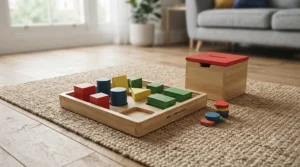
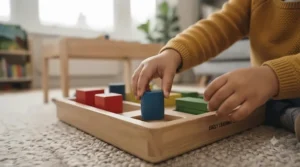
Specs and marketing copy rarely capture what actually happens on your living room floor, so here’s the honest, unglamorous version. In the first few sessions, expect more banging, mouthing, and scattering than actual sorting — this is normal exploratory play, not a sign the toy is wrong for your child. Genuine colour matching behaviour — consistently placing like colours together — tends to emerge gradually between 18 and 30 months, per general developmental guidance, though the range either side of that is wide and entirely normal.
Attention span with colour matching building blocks is typically short at first: three to five minutes of focused engagement is a realistic expectation for a young toddler, building toward ten or fifteen minutes as the skill solidifies and the child starts adding their own variations to the game (sorting by size instead, stacking instead of sorting, inventing entirely new rules). Reviewers across nearly every product in this guide mention this evolution — the toy that started as a simple colour-matching exercise becomes, a few months later, a prop for imaginative play that barely resembles its original purpose. That’s not the toy failing; that’s exactly the trajectory a well-designed early learning toy should follow.
Early Learning Toys for Cognitive Matching Games
Colour sorting blocks sit within a much broader category of early learning toys built around cognitive matching games, and understanding that wider context helps explain why this particular toy type earns its reputation. Matching — recognising that two things share a property — is one of the earliest formal cognitive skills toddlers develop, typically preceding more complex categorisation and counting tasks by several months. Play-based researchers and early years specialists consistently link this style of play to broader gains in attention, working memory, and early problem-solving, since a toddler mid-sort is actively comparing, discarding wrong options, and adjusting their approach in real time.
What makes colour sorting blocks particularly effective within the wider category of cognitive matching games is their low barrier to entry combined with a naturally built-in difficulty curve. A toddler can succeed at the most basic level (banging two red things together) almost immediately, which builds confidence, while the same toy scales up to genuinely challenging multi-attribute sorting (colour and shape simultaneously) for an older toddler or preschooler. Few toy categories manage that range as gracefully — a jigsaw puzzle, by contrast, tends to have a much narrower window of appropriate difficulty before it becomes either trivially easy or genuinely too hard.
Preschool Sorting Activities: Long-Term Cost, Maintenance and Beyond the Blocks
One legitimate question worth asking before you buy: does the value of colour sorting blocks extend meaningfully into the preschool years, or is this strictly a toddler-phase purchase? The honest answer is “it depends on the specific toy,” which is exactly why piece complexity and open-endedness were weighted so heavily in the reviews above.
| Product | Toddler-Phase Value | Preschool-Phase Value | Estimated Lifespan |
|---|---|---|---|
| Fisher-Price Baby’s First Blocks | High | Low | 6-18 months |
| Melissa & Doug Shape Sorting Cube | High | Moderate | 2-3 years |
| Tegu Travel Pal Magnetic Blocks | Moderate | High | 4+ years |
| Jaques of London Wooden Shape Sorter | High | Moderate-High | 3-4 years |
Reading this table against the earlier price ranges reframes the value question considerably. The Fisher-Price Baby’s First Blocks set, despite being the cheapest option, delivers a relatively short useful window before a toddler outgrows it entirely, while the Tegu Travel Pal Magnetic Wooden Block Set, despite its higher upfront cost, spreads that cost across several additional years of relevant play, meaningfully lowering the effective cost-per-month of ownership. For families planning to hand toys down to a younger sibling, this calculation shifts even further in favour of the sturdier, higher-priced sets, since durability compounds across multiple children rather than resetting with each purchase.
Beyond the blocks themselves, preschool sorting activities naturally extend into everyday household moments — sorting laundry by colour, grouping cutlery by type, or organising toy bins by category — all of which reinforce the same underlying cognitive skill without requiring any additional purchase at all. The toy is genuinely just the starting point.
Safety, Regulations and Compliance Guide for UK Parents
Every toy legally sold in the UK must comply with the Toys (Safety) Regulations 2011, which set requirements covering physical safety, choking hazards, flammability, and permitted substances, alongside mandatory UKCA or CE marking on the product or its packaging. In practice, this means checking for a visible UKCA or CE mark before purchase, particularly when buying from third-party marketplace sellers rather than well-known brands directly.
Age warnings matter more than many parents assume — a “not suitable for children under 36 months” label with a choking hazard symbol is a legal requirement where relevant, not marketing caution, and should be taken at face value regardless of how advanced your particular toddler seems. As a rough physical guide, anything smaller than roughly a 2p coin poses a genuine choking risk to a child under three. Beyond the initial purchase check, periodically inspect wooden and plastic pieces for cracks, splintering, or loose paint, and retire anything showing wear rather than assuming a toy remains as safe at year three as it was on day one. Electronic toys like the VTech Sort and Discover Drum carry an additional consideration: check battery compartments are secured with a screw rather than a simple slide mechanism, since accessible button batteries present a serious swallowing risk.
Frequently Asked Questions
❓ What age should a toddler start colour sorting blocks?
❓ Are wooden or plastic sorting blocks better for toddlers?
❓ How many pieces should a first colour sorting set have?
❓ Can colour sorting blocks help with speech development?
❓ Do colour sorting blocks need to be washed regularly?
Conclusion
If there’s one honest takeaway from all of the above, it’s that there’s no single “best” colour sorting blocks toddler set — there’s a best set for your particular child, your budget, and how much wear and tear you’re realistically expecting. For a first toy on a tight budget, the Fisher-Price Baby’s First Blocks remains the sensible, low-risk starting point. For families wanting one toy to last from the toddler years well into preschool, the Jaques of London Wooden Shape Sorter Cube and Tegu Travel Pal Magnetic Wooden Block Set earn their higher price tags through genuine longevity. And for the toddler who responds best to noise and lights, the VTech Sort and Discover Drum fills a gap the wooden classics simply can’t.
What all seven have in common, based on the aggregated review evidence, is that they reward a little parental involvement — narrating colours, resisting the urge to correct too quickly, rotating toys rather than endlessly buying new ones. The toy matters, but how it’s introduced and played with matters just as much, and that part costs nothing at all.
Recommended for You
- Pattern Blocks for Kids: 7 Best Sets Reviewed – 2026 UK
- Best Nesting Blocks Toddler Toys 2026: 7 Top Picks UK
- Stacking Toys 1 Year Old: 7 Brilliant Picks Parents Trust (2026)
Disclaimer: This article contains affiliate links. As an Amazon Associate, I earn from qualifying purchases. If you purchase products through these links, we may earn a small commission at no additional cost to you.
✨ Found this helpful? Share it with your friends! 💬🤗
