
In This Article
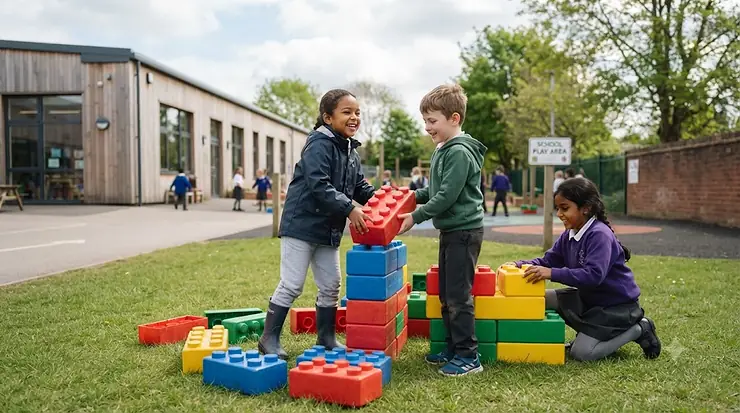
There’s a particular kind of chaos that erupts the moment a child discovers they can build something bigger than themselves. Suddenly the lawn isn’t a lawn — it’s a construction site, a castle wall, a wobbly tower daring gravity to do its worst. That’s the appeal of giant building blocks outdoor play: unlike the tiny bricks that vanish into sofa cushions and end up underfoot at 2am, these oversized pieces are designed for the garden, the patio, and the kind of full-body, muddy-kneed play that actually tires kids out.

What is giant building blocks outdoor? Giant building blocks outdoor are oversized, weather-resistant construction toys — typically made from HDPE plastic, thick cardboard, or solid wood — designed specifically for use in gardens and outdoor play areas. Unlike standard tabletop bricks, they’re built at a scale children can climb on, sit inside, and use to construct life-sized structures.
The UK market for these has genuinely grown up. What used to mean a single flimsy waffle-block set now spans budget plastic starters, mid-range cardboard systems, and heirloom-grade wooden pieces built to survive a decade of rain, mud, and enthusiastic four-year-olds. Below, I’ve dug into seven real products currently available, weighed their genuine strengths and weaknesses, and built out a proper buying framework — because a purchase this size (literally) deserves more thought than a five-star badge and a “buy now” button.
Quick Comparison Table
| Product | Material | Piece Count | Best For |
|---|---|---|---|
| Little Tikes Big Waffle Blocks | HDPE plastic | 18 | Budget toddler starter set |
| Costway Giant Waffle Block Set | HDPE plastic | 32 | Bigger builds on a budget |
| burgkidz Jumbo Building Blocks | ABS plastic | 150 | Mixed indoor/outdoor variety |
| National Geographic Jumbo Cardboard Blocks | Corrugated cardboard | 45 | Light, portable garden play |
| GIGI BLOKS Jumbo Cardboard Blocks | Corrugated cardboard | 60 | Large-scale cardboard castles |
| Craftplay GIANT Wooden Blocks | Solid wood | 26 | Durable mid-range wood set |
| Grimm’s Giant Natural Building Blocks | Alder/lime/beech wood | 19 | Premium heirloom quality |
Looking at the spread above, there’s a clear pattern: plastic wins on weatherproofing and price, cardboard wins on portability and low cost per piece but loses on rain resistance, and wood wins on longevity at a genuinely premium price point. If you’re kitting out a garden that gets used daily, the Little Tikes Big Waffle Blocks or Craftplay GIANT Wooden Blocks cover most bases, while families wanting the biggest structures for pocket money should look at the cardboard sets.
💬 Just one click — help others make better buying decisions too!😊
Top 7 Giant Building Blocks Outdoor: Expert Analysis
1. Little Tikes Big Waffle Blocks — the classic starter set that just works
There’s a reason this 18-piece set has stuck around since most of today’s parents were building with it themselves. Each block measures roughly 14 inches across and connects in every direction — up, down, sideways — so even a toddler with limited dexterity can lock pieces together without a meltdown. In practice, that means less “mummy do it” and more actual independent play, which matters more than any spec sheet admits.
Based on the spec comparison with rival waffle sets, the standout here is the moulded grip design: the interlocking teeth are chunky enough that a two-year-old can manage them, but sturdy enough that the resulting structure doesn’t collapse the moment someone leans on it. What most buyers overlook is that the set’s smaller footprint (18 pieces) is actually a feature for younger families — it’s less overwhelming to tidy up than a 150-piece haul, and small hands aren’t drowning in options.
Reviewers consistently report that the blocks survive years of outdoor abuse — left in the rain, baked in the sun, dragged across gravel — without cracking or fading badly, though a common complaint is that colours dull slightly after prolonged UV exposure. Some parents also note the set feels a little small once a child hits five or six and wants taller builds.
Pros:
- ✅ Easiest interlocking system for toddlers to manage alone
- ✅ Genuinely weatherproof HDPE construction
- ✅ Compact enough for small gardens or patios
Cons:
- ❌ Only 18 pieces limits large-scale structures
- ❌ Colours fade with heavy, prolonged sun exposure
At around £60-£75, this sits at the accessible end of the market — check current price, as it fluctuates with stock. For toddlers just starting outdoor construction play, it’s hard to beat as a first purchase.

2. Costway Giant Waffle Block Set — best for bigger builds on a budget
If the Little Tikes set is the toe-dip, this 32-piece Costway set is the next step up, roughly doubling your building capacity for a similar price bracket. The set includes 16 rectangular boards and 16 triangular ones, and that triangle-to-rectangle ratio is what actually unlocks more interesting structures — proper roofs, angled walls, and dens that don’t just look like stacked shoeboxes.
Here’s what the spec sheet won’t tell you: the extra triangular pieces make a genuine difference to how long children stay engaged. A rectangle-only set gets used for one type of build (walls, towers) and then abandoned; adding angles means children start problem-solving around gaps and slopes, which is where the real cognitive benefit of large-scale construction play kicks in. The blocks are made from the same HDPE as most waffle-style sets, so they share that easy-wipe, weatherproof quality that makes them genuinely suitable for permanent garden storage.
Aggregated customer sentiment on comparable waffle-block sets highlights that assembly can be fiddly for the very youngest builders — the snap-fit grooves need a firmer push than some three-year-olds can manage unassisted, though most children get the hang of it within a session or two.
Pros:
- ✅ Nearly double the pieces of entry-level waffle sets
- ✅ Triangular boards allow roofs and angled builds
- ✅ Waterproof surface wipes clean after garden play
Cons:
- ❌ Snap-fit grooves can be stiff for under-fours
- ❌ At 8.5kg, less portable than lighter cardboard sets
Typically priced in the £45-£65 range, it represents strong value-per-piece compared with premium alternatives, making it a sensible mid-tier pick for households wanting more building capacity without jumping to wood or a 150-piece haul.
3. burgkidz Jumbo Building Blocks — best cross-compatible variety pack
The burgkidz 150-piece set takes a different approach entirely: rather than one repeated block shape, you get 14 different shapes across 8 colours, plus doors, windows, and wheels, all packed into a lidded storage bucket that doubles as a baseplate. Crucially, these bricks are designed to be compatible with major interlocking-brick systems, which means existing brick collections can merge with this jumbo set rather than sitting in separate boxes forever.
On paper this means more building variety than any single-shape waffle set could offer, and that plays out in practice — children can move from flat walls to vehicles with wheels to houses with actual doors within one afternoon. What most buyers overlook is the storage bucket itself: after garden sessions, kids can toss everything back in and snap the lid shut, which genuinely reduces the “lost piece in the flower bed” problem that plagues loose-block sets.
Reviewers consistently note the ABS plastic feels more rigid than waffle-block HDPE, giving a slightly more premium feel underhand, though a recurring theme in feedback is that smaller connector pieces (wheels, small window frames) are easier to misplace outdoors than the larger board-style blocks in waffle sets.
Pros:
- ✅ 150 pieces across 14 shapes for genuine variety
- ✅ Compatible with major existing brick collections
- ✅ Storage bucket also functions as a baseplate
Cons:
- ❌ Smaller accessory pieces easier to lose in grass
- ❌ Less “jumbo-scale” than dedicated waffle or wood sets
Expect to pay in the mid-£30s to £40s range, making it one of the more affordable entries here — reasonable value for a set that bridges classic brick play with jumbo-scale ambitions.
4. National Geographic Jumbo Cardboard Building Blocks — best lightweight option for little arms
This 45-piece set swaps plastic for extra-thick corrugated cardboard across three sizes, and that material choice changes the entire play experience. Where plastic waffle blocks require some hand strength to snap together, these simply stack and interlock via slotted notches, meaning even a wobbly-legged toddler can lift and place a block that’s nearly as tall as they are without help.
Based on the spec comparison with other cardboard systems, the largest blocks here are rated to bear real weight, letting a child stand on a finished platform for extra reach — something genuinely useful when building taller structures. Here’s what to weigh: cardboard is dramatically lighter and cheaper per piece than plastic or wood, but it isn’t a permanent outdoor fixture. Reviewers consistently flag that these blocks handle occasional garden use fine on a dry day, but a soggy lawn or a surprise summer shower will soften the corners over time.
The included activity spinner and game cards add a structured element beyond free building, which a common theme in feedback singles out as a nice bonus for rainy-day-adjacent play that later moves outdoors once the sun returns.
Pros:
- ✅ Extremely lightweight for toddlers to lift and stack
- ✅ Largest blocks support real child bodyweight
- ✅ Comes with bonus activity cards and spinner
Cons:
- ❌ Not genuinely weatherproof — damp grass softens edges
- ❌ Cardboard wears faster than plastic or wood over years
Priced in the £30-£45 bracket, it’s a strong value pick for occasional garden play — just plan to bring the set indoors if rain looks likely, since this isn’t one to leave out overnight.
5. GIGI BLOKS Jumbo Cardboard Building Blocks — best for genuinely large-scale structures
At 60 XXL pieces, GIGI BLOKS goes bigger than most cardboard competitors, and that piece count is the entire point: this is the set built for children (and honestly, ambitious parents) who want castle walls taller than the kids themselves. The interlocking slot-and-tab design means blocks stack securely without glue or tape, and the sheer volume of pieces supports properly collaborative builds — think group projects at a birthday party rather than solo stacking.
What most buyers overlook about cardboard sets at this scale is storage logistics: 60 XXL blocks take up serious room, though GIGI BLOKS’ own guidance (stack into a tower, tuck under a bed, or use as a toy corral) is honestly one of the more practical storage solutions of any set in this roundup. The spec sheet won’t tell you this, but user reports suggest the extra-large format actually reduces frustration compared with smaller cardboard bricks, since fewer pieces are needed to reach a satisfying height.
Aggregated review sentiment is broadly positive on durability for cardboard, with reviewers noting these hold up to repeated dis- and re-assembly far better than flimsier bargain alternatives, though — as with any cardboard product — genuine weatherproofing is not part of the package.
Pros:
- ✅ 60 XXL pieces enable properly tall, collaborative builds
- ✅ Sturdier cardboard than many bargain alternatives
- ✅ Easy tower-style storage solution built into the design
Cons:
- ❌ Large box footprint needs dedicated storage space
- ❌ Requires dry conditions — not a leave-outside set
You’ll typically find this in the £50-£70 range, which lands as reasonable value given the piece count, provided you’ve got somewhere dry to store the set between sessions.

6. Craftplay GIANT Wooden Building Blocks — best mid-range wooden set with proper storage
Stepping into wood changes the calculus entirely. This 26-piece Craftplay set ships in its own carry crate, which sounds like a small thing until you’re the parent who no longer has blocks scattered across the patio every evening. The blocks themselves are solid and genuinely substantial in the hand — nothing here feels like it will splinter or crack under typical garden rough-and-tumble.
Based on the spec comparison with cardboard and plastic rivals, wood’s real advantage is longevity: these blocks are explicitly marketed for indoor and outdoor use, and unlike cardboard, a bit of rain won’t ruin an afternoon’s building session. What most buyers overlook is the tactile and sensory difference — wood simply feels different in a child’s hands, and for parents leaning into more natural, open-ended play (a genuinely popular approach in UK early-years settings), that matters as much as the spec sheet.
Reviewers consistently praise the storage crate as one of the best “tidy-up” solutions in this category, framed by parents as something that actively encourages children to pack away rather than leaving pieces strewn across the lawn — a small design choice with an outsized practical payoff.
Pros:
- ✅ Genuinely suited to indoor and outdoor use, rain or shine
- ✅ Solid wood construction feels durable for years of play
- ✅ Storage crate makes tidy-up part of the play routine
Cons:
- ❌ Fewer pieces (26) than the largest cardboard or plastic sets
- ❌ Heavier to carry outside than lightweight cardboard
Priced around the £50-£70 mark, this occupies useful middle ground — a genuine step up in durability from cardboard, without the premium heirloom pricing of natural wood specialists.
7. Grimm’s Giant Natural Building Blocks — best premium, heirloom-quality set
Grimm’s 19-piece set is the one you buy expecting it to still be in the garden shed when your grandchildren visit. Made from sustainably sourced alder, lime, beech, and maple, some individual pieces are genuinely brick-sized, and the set is specifically designed to remain stable even on the uneven ground of a real garden — a detail that matters more than it sounds, since wobbly foundations are the number-one reason outdoor towers collapse mid-build.
What the spec sheet won’t tell you, but the design clearly signals, is that this set is built for longevity across siblings and years, not a single summer. The arches are sized to combine with wagons, ride-on toys, and other wooden play pieces, extending the play value well beyond simple stacking. On paper, 19 pieces sounds modest next to a 150-piece plastic haul — but Grimm’s chunky, oversized format means far fewer blocks are needed to build something genuinely impressive.
Reviewers and Steiner/Montessori-aligned educators consistently highlight the set’s multi-purpose educational value — the pieces double as basic maths and fraction tools indoors — while the main honest drawback is straightforward: at this scale of craftsmanship, the price sits well above every plastic or cardboard alternative here.
Pros:
- ✅ Sustainably sourced solid hardwood built to last decades
- ✅ Stable on uneven garden ground, unlike lighter sets
- ✅ Doubles as an educational maths and fractions tool
Cons:
- ❌ Premium price well above plastic or cardboard sets
- ❌ Only 19 pieces despite the higher cost
Expect a premium price point, generally in the £150-£220 range depending on retailer — a genuine investment rather than an impulse buy, but one aimed squarely at families who value heirloom-quality natural toys over piece count.
Top 7 Products: Specs & Value Comparison
| Product | Material | Weather-Resistant? | Approx. Price Range | Best For |
|---|---|---|---|---|
| Little Tikes Big Waffle Blocks | HDPE | Yes | Around £60-£75 | First-time toddler builders |
| Costway Giant Waffle Block Set | HDPE | Yes | £45-£65 range | Bigger budget-friendly builds |
| burgkidz Jumbo Building Blocks | ABS | Partial (small parts) | Mid-£30s to £40s | Variety and cross-compatibility |
| National Geographic Cardboard Blocks | Cardboard | No | £30-£45 range | Lightweight, occasional use |
| GIGI BLOKS Jumbo Cardboard Blocks | Cardboard | No | £50-£70 range | Large-scale collaborative builds |
| Craftplay GIANT Wooden Blocks | Solid wood | Yes | £50-£70 range | Durable all-weather mid-range |
| Grimm’s Giant Natural Building Blocks | Hardwood | Yes | £150-£220 range | Heirloom, premium longevity |
The table makes the trade-off obvious once you see it laid out: weatherproofing and price move almost in lockstep with material, with cardboard sitting at the affordable-but-fair-weather-only end and Grimm’s anchoring the durable-but-costly end. For most UK gardens — where rain is never more than a day away — the Little Tikes Big Waffle Blocks or Craftplay GIANT Wooden Blocks offer the best balance of genuine outdoor durability against sensible pricing, while cardboard suits families who’ll mostly build on dry afternoons and store the set away overnight.
✨ Don’t Miss These Exclusive Deals!
🔍 Take your garden building blocks outdoor collection to the next level with these carefully selected sets. Click through to check current pricing and availability before stock runs low. These jumbo pieces are how real backyard adventures get built!
Benefits vs Traditional Garden Toys
| Feature | Giant Building Blocks | Traditional Garden Toys (slides, sandpits) |
|---|---|---|
| Skill development | Spatial reasoning, problem-solving, teamwork | Gross motor skills, balance |
| Flexibility of play | Endless reconfiguration, grows with imagination | Fixed function, same activity each time |
| Storage footprint | Moderate (varies by material) | Often large and permanent |
| Cost over time | One purchase, reusable indefinitely | Frequent replacement of worn parts |
Compared with fixed-function garden toys, the flexibility argument for large-scale construction play is hard to dispute: a slide is a slide every single day, whereas a set of giant blocks becomes a fort on Tuesday, a shop counter on Wednesday, and an obstacle course by the weekend. That said, traditional outdoor garden toys still win on pure physical exertion for very active children, so the two categories genuinely complement rather than compete with each other in a well-stocked garden.
Practical Usage Guide: Setting Up Your Outdoor Building Blocks
Getting real, lasting value from any of these sets comes down to a handful of habits most boxes don’t spell out. First, choose your build zone deliberately — a flat patch of lawn or patio away from flowerbeds prevents the classic scenario of a collapsing tower flattening the tulips. For plastic and wood sets, a quick wipe-down after rain keeps grooves and joints free of grit that otherwise wears down interlocking mechanisms faster than normal use ever would.
In the first 30 days, the most common mistake is over-ambitious building before children have learned the set’s specific connection method — a waffle block’s snap-fit grooves behave differently to a wooden block’s simple stacking, so a five-minute demonstration session saves a lot of frustrated tears later. For cardboard sets specifically, treat forecast checking as part of the ritual: bring blocks in before dusk if rain’s due, since even “extra-thick” corrugated card softens with repeated damp exposure.
Maintenance is refreshingly light across the board. Plastic sets can be hosed down and left to air-dry; wooden sets benefit from an occasional wipe with a barely damp cloth and a dry spot to avoid warping; cardboard sets need the least maintenance simply because they’re not designed for constant outdoor exposure in the first place. A simple end-of-session routine — five minutes of “great job, let’s pack away” — does more for longevity than any specific cleaning product ever could.
Real-World Scenarios: Matching Blocks to Your Family
The toddler-led household (ages 1-3): For families whose primary builder is still mastering fine motor skills, the Little Tikes Big Waffle Blocks or National Geographic Jumbo Cardboard Blocks make the most sense — both are light enough to lift independently and forgiving of clumsy first attempts. Budget here typically stays under £75, and frequency of use tends to be short, frequent bursts rather than marathon building sessions.
The multi-child, high-frequency garden (ages 4-8, daily use): Households with several children building most days need volume and durability in equal measure. The burgkidz Jumbo Building Blocks or GIGI BLOKS sets suit this profile well, offering enough pieces for simultaneous, separate projects without siblings squabbling over the last block.
The long-term, quality-first family: For parents planning to keep a set for a decade — perhaps passing it to younger siblings or even grandchildren — the Grimm’s Giant Natural Building Blocks or Craftplay GIANT Wooden Blocks justify their higher upfront cost through sheer longevity, particularly for families already invested in natural, open-ended toy philosophies.
How to Choose Giant Building Blocks Outdoor
- Check the material against your climate reality. If your garden sees rain most weeks (as most UK gardens do), prioritise HDPE plastic or solid wood over cardboard.
- Match piece count to available space. A 150-piece set needs more storage and build area than an 18-piece starter — measure your patio before ordering.
- Consider your child’s age and hand strength. Younger toddlers benefit from simple stack-and-slot designs over fiddly snap-fit connectors.
- Factor in storage solutions. Sets with dedicated crates or buckets get tidied away more reliably than loose piles.
- Decide your budget band upfront. Budget plastic and cardboard sets start under £50; premium natural wood sets can exceed £150.
- Think about longevity versus turnover. If younger siblings are on the way, durable wood or plastic pays for itself over years of reuse.
- Read aggregated review themes, not just star ratings. Recurring complaints (fading colour, stiff connectors, storage bulk) tell you more than an average score ever will.
Common Mistakes When Buying Large Plastic Building Blocks Garden Sets
The most frequent error is buying based on photos alone without checking real dimensions — a “giant” block in a product photo can look deceptively larger than its actual 14-inch footprint. Another common misstep is assuming all large plastic building blocks garden sets are interchangeable in durability; HDPE and ABS plastics behave differently under UV exposure, and cheaper unbranded sets sometimes use thinner-walled plastic that cracks within a season.
Buyers also frequently underestimate storage needs, ordering a 100-plus-piece set without a realistic plan for where it lives between uses — which, in practice, is how blocks end up abandoned in a damp shed rather than played with regularly. Finally, many parents skip checking the connection mechanism against their child’s actual age and dexterity, leading to early frustration that has nothing to do with the toy’s quality and everything to do with mismatched expectations.
Jumbo Blocks for Toddlers: What Actually Matters at This Age
For the youngest builders, jumbo blocks for toddlers succeed or fail on a few narrow criteria that adult buyers often overlook. Weight matters enormously — a block that’s genuinely light enough for a two-year-old to lift and place independently builds confidence far faster than one requiring adult assistance every time. Connection simplicity matters just as much: stack-and-slot cardboard or basic wooden designs suit toddlers better than snap-fit plastic systems requiring a firmer push than small hands can manage.
Rounded edges and non-toxic, water-based finishes are non-negotiable at this age, and every product featured in this roundup meets that baseline. What differs is scale-appropriateness: toddlers rarely need 150 pieces, and a smaller, simpler set like the Little Tikes waffle blocks genuinely serves this age group better than an overwhelming bulk purchase that mostly sits unused.
Outdoor Garden Toys for Specific Audiences and Use Cases
Not every garden has the same needs, and outdoor garden toys in this category flex well across different household types. Nurseries and childminders often gravitate toward larger cardboard or plastic sets that support group play across several children simultaneously, since collaborative building teaches sharing and negotiation in ways solo toys rarely manage. Grandparents buying for occasional weekend visits tend to prefer premium wooden sets like Grimm’s, valuing durability over sheer piece count since the toy needs to survive storage between visits without deteriorating.
Families in flats or smaller gardens with limited storage should lean toward the more compact 18-26 piece sets, while those with generous garden space and multiple children benefit more from the 60-150 piece ranges that support ambitious, sprawling structures.
Long-Term Cost & Maintenance
Thinking in cost-per-year rather than upfront price changes which set looks like the better deal. A £65 plastic waffle-block set that lasts five years of regular outdoor use works out to roughly £13 per year, while a £45 cardboard set that survives perhaps one to two seasons before wearing out actually costs more annually despite the lower sticker price. Grimm’s premium wooden set, at £180, amortised across a genuine 15-20 year lifespan (a realistic expectation for solid hardwood passed between siblings), works out to under £12 per year — arguably the best long-term value in this entire roundup despite having the highest upfront cost.
Maintenance costs stay minimal across all seven products: none require replacement parts, batteries, or ongoing subscriptions, and basic cleaning (hosing down plastic, wiping wood, keeping cardboard dry) costs nothing beyond a few minutes of time.
Features That Actually Matter (And Those That Don’t)
Genuinely important: weatherproof materials, rounded safety edges, and realistic storage solutions. These directly affect whether a set gets used regularly or abandoned after a damp weekend. Largely marketing fluff: exaggerated piece counts that include tiny, easily-lost accessories, and vague claims of “educational” value that aren’t backed by any specific developmental reasoning.
What’s often underrated: connection mechanism simplicity. A set with fewer, larger, easier-to-connect pieces frequently gets more actual play time than a larger set with fiddly connectors that frustrate younger children into giving up.
Safety, Regulations and Compliance Guide
All toys sold in the UK, including outdoor building block sets, must meet the requirements of the Toys (Safety) Regulations 2011, with manufacturers able to use either UKCA or CE marking to demonstrate compliance — the UK continues to recognise CE marking for products placed on the Great Britain market, giving buyers flexibility when checking labels. Look for the BSI Kitemark or Lion Mark alongside CE/UKCA symbols as an extra signal of independent testing and industry best practice, as outlined in general toy safety guidance.
Beyond product certification, garden setup matters just as much. RoSPA’s home play equipment guidance recommends checking for CE or GS marks, ensuring age-appropriate use, and keeping build zones away from hard surfaces or hazards like garden chemicals and standing water. Positioning your building zone on grass rather than paving reduces injury severity if a young builder takes a tumble mid-construction — a small setup choice that meaningfully lowers everyday risk.
Buyer’s Decision Framework
If your child is under three and building independently for the first time, choose a lightweight cardboard or small waffle-block set, because dexterity and lifting strength are still developing. If your garden is rarely dry and you want a permanent outdoor fixture, choose HDPE plastic or solid wood, because cardboard simply won’t survive repeated damp exposure. If budget is the primary constraint but you still want volume, choose a mid-range plastic set like burgkidz, because it balances piece count against price better than premium wood. If you’re buying for the long haul — multiple children, multiple years — choose solid hardwood, because the cost-per-year math consistently favours durability over a lower sticker price.
Encouraging Active, Outdoor Play
Beyond the fun factor, giant building blocks genuinely support the kind of movement the NHS recommends for young children — pre-schoolers are advised to get at least three hours of varied physical activity daily, spread across the day, and active outdoor building easily contributes toward that total through lifting, carrying, bending, and reaching. Unlike passive screen time, hauling a jumbo block across the lawn and hoisting it onto a growing tower is genuinely physical work dressed up as play, which is exactly the kind of activity guidance encourages.
🚴♂️ Build Something Bigger This Weekend!
⚡ Ready to swap screen time for garden time? Pick a set above, check current pricing, and get building before the weather turns. Your kids — and honestly, probably you too — will thank you for it.
Frequently Asked Questions
❓ Are giant building blocks suitable for very young toddlers?
❓ Can outdoor building blocks be left outside permanently?
❓ How many pieces do I actually need for a garden set?
❓ Do giant building blocks need any special maintenance?
❓ Are wooden building blocks worth the higher price over plastic?
Conclusion
Choosing the right giant building blocks outdoor set really comes down to being honest about three things: your garden’s weather exposure, your child’s current age and strength, and how many years you actually want the set to last. Budget plastic and cardboard options serve short-term, occasional builders well, while mid-range plastic and premium wood reward families planning years of regular garden play. None of the seven sets here are wrong choices — they simply suit different gardens, different children, and different stages of the building-obsessed years that, frankly, don’t last nearly as long as they feel like they will at the time.
Whichever set ends up on your lawn, the real win isn’t the toy itself — it’s the hours of muddy-kneed, screen-free imagination it buys back for your family, one wobbly tower at a time.
✨ Ready to pick your set?
🔍Check current prices on the products above and get building before summer slips away.
Recommended for You
- Colour Sorting Blocks Toddler: 7 Best Picks for 2026 (Loved by Little Hands)
- Pattern Blocks for Kids: 7 Best Sets Reviewed – 2026 UK
- Best Nesting Blocks Toddler Toys 2026: 7 Top Picks UK
Disclaimer: This article contains affiliate links. As an Amazon Associate, I earn from qualifying purchases. If you purchase products through these links, we may earn a small commission at no additional cost to you.
✨ Found this helpful? Share it with your friends! 💬🤗
