
In This Article
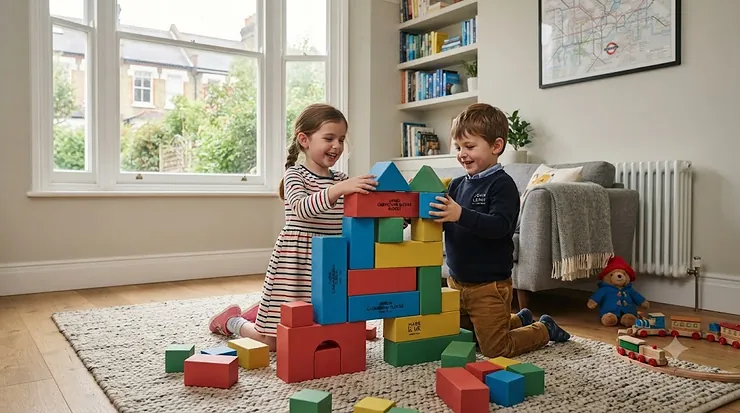
Somewhere in every parent’s search history sits the phrase “why is my toddler trying to climb the bookshelf again,” followed shortly by a much more useful one: jumbo cardboard building blocks. Put simply, jumbo cardboard building blocks are oversized, flat-packed cardboard bricks — usually extra-thick and double-walled — that fold together without glue or tape to create sturdy, lightweight blocks strong enough for a small child to stand on, stack, and gleefully demolish. They’re the toy equivalent of a blank canvas: no batteries, no screen, no single “correct” way to play.
We’ve spent time digging through the actual spec sheets, the aggregated review sentiment, and the small print on weight limits and safety markings for seven genuinely available sets, rather than just repeating the marketing copy. What follows isn’t a rewritten product listing. It’s commentary on which set suits a first-time buyer, which one survives an older sibling’s “helpful” demolition attempts, and which one is honestly overkill for a one-bedroom flat.
If you’ve already tried plastic bricks that hurt underfoot at 6am, or wooden blocks that dent the skirting board, you’ll understand the appeal here. These things are big, bold, and — crucially — forgiving when a three-year-old’s tower inevitably becomes an avalanche. Whether you’re after a compact starter set for a first birthday or a proper 200-piece haul for a shared playroom, there’s a meaningful difference between the seven sets below, and it’s rarely just the piece count.
Quick Comparison Table
| Product | Piece Count | Best For | Price Range |
|---|---|---|---|
| Bankers Box at Play Cardboard Building Blocks | 40 | Budget-conscious first buyers | under £25 |
| Melissa & Doug Deluxe Jumbo Cardboard Blocks | 24 | Small spaces, ages 2-4 | under £20 |
| GIGI Bloks Big Interlocking Cardboard Building Blocks | 30 | Toddlers who like things to actually stay up | £20-£30 range |
| Melissa & Doug Jumbo Extra-Thick Cardboard Building Blocks | 40 | All-rounder, trusted brand | £25-£35 range |
| GIGI Bloks XL Cardboard Building Blocks | 96 | Ambitious builders, siblings sharing | £45-£60 range |
| GIGI Bloks XXL Mega Cardboard Building Blocks | 200 | Nurseries, playrooms, big families | £90-£120 range |
| GIGI Bloks XXL DIY Play House Blocks | 203 | Building an actual cardboard house | £100-£140 range |
Look at that spread and a pattern jumps out fast: piece count roughly tracks price, but “best for” doesn’t track piece count at all. A determined 18-month-old will get just as much joy — arguably more — from the 24-piece Melissa & Doug Deluxe Jumbo Cardboard Blocks as an older child gets from the 200-piece GIGI Bloks XXL Mega Cardboard Building Blocks, because the smaller child’s ambitions are smaller too. The interlocking sets in this table (both GIGI Bloks ranges) consistently earn praise for structures that survive a toddler barging into them, which matters more than raw quantity if your floor space is limited.
💬 Just one click — help others make better buying decisions too!😊
Top 7 Jumbo Cardboard Building Blocks: Expert Analysis
1. Bankers Box at Play Cardboard Building Blocks — UK-made budget favourite
The standout here is straightforward: this 40-piece set is manufactured in the UK and made from FSC-certified board, which matters if provenance and sustainability are part of your buying decision, not just an afterthought. The blocks come in two large sizes across four colours, with scalloped safety edges designed to avoid nasty paper-cut-style nicks on little fingers, and a fold-together design that needs no glue or scissors. In practice, this means an adult can have the whole set assembled in the time it takes to boil a kettle, which is not something every flat-pack toy can claim.
Based on the spec comparison with other budget sets in this list, the Bankers Box range wins on trust rather than novelty — it’s a known office-supplies brand extending into play products, and that manufacturing pedigree tends to translate into consistent panel thickness, something cheaper import brands occasionally skimp on. This set suits first-time buyers who want a “toe in the water” purchase before committing to a bigger, pricier haul, and parents who specifically care about FSC sourcing and UK manufacturing. Reviewers consistently report that the blocks are lighter than they expect from the packaging photos, and a recurring theme in aggregated feedback is that the four-colour palette holds up well without fading, even after months of enthusiastic use.
Pros:
- ✅ FSC-certified, UK-manufactured cardboard
- ✅ No glue or scissors needed for assembly
- ✅ Scalloped edges reduce sharp-corner risk
Cons:
- ❌ Only two block sizes limits structural variety
- ❌ 40 pieces build up quickly, less scope to expand
At under £25, this is priced as an entry point rather than a forever set, and for a family testing whether cardboard blocks will actually get used (rather than gathering dust by week three), that’s a sensible way to find out.
2. Melissa & Doug Deluxe Jumbo Cardboard Blocks — smallest footprint, easiest storage
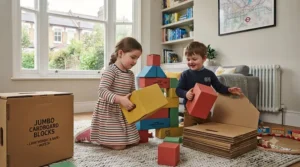
The 24-piece count is the headline feature, and it’s a genuine advantage rather than a compromise: this is the set to reach for if you live somewhere that doesn’t have a spare playroom to dedicate to block storage. Each block is extra-thick cardboard rated to hold weight well beyond what a toddler puts on it, and the three-size mix (small, medium, large) gives just enough variety to build a wobbly tower or a low tunnel without needing an entire room to do it in.
What most buyers overlook about this model is that fewer pieces doesn’t mean less play value for the target age group — Melissa & Doug pitch this at ages 2 to 5, and a two-year-old’s idea of an ambitious build rarely exceeds 24 blocks anyway. The wipe-clean surface is a small but genuinely useful detail for anyone who’s watched a toddler attempt to “paint” a cardboard tower with yoghurt. Aggregated review sentiment for this range is strongly positive on durability relative to the smaller piece count, with several reviewers specifically noting the blocks survived being sat on and stood on daily for well over a year.
Pros:
- ✅ Compact enough for small flats and bedrooms
- ✅ Wipe-clean surface handles sticky fingers
- ✅ Well-suited to the 2-4 age range specifically
Cons:
- ❌ Limited scale for ambitious multi-child builds
- ❌ Fewer shape variants than larger sets
If your priority is a first set that won’t take over the lounge, this deserves a spot on the shortlist ahead of anything with a bigger box.
3. GIGI Bloks Big Interlocking Cardboard Building Blocks — best for structures that actually stay standing
Thirty blocks doesn’t sound like much next to a 200-piece set, but the standout feature here is the interlocking mechanism, which changes the entire play experience. Rather than simply balancing block on block — and watching the tower go the way of Jenga the moment a sibling walks past — these blocks connect with a tab-and-slot system, meaning constructions hold their shape under a toddler’s typically enthusiastic, imprecise handling. The double-wall cardboard construction adds rigidity without meaningfully increasing weight, so the blocks stay light enough for small hands.
Here’s what the spec sheet won’t tell you, but user reports suggest: the interlocking system has a learning curve for very young children, who sometimes find it fiddlier than simple stacking until they get the hang of aligning the tabs. Once mastered, though, it’s the reason parents of slightly older toddlers (roughly 3+) tend to prefer this over pure stacking sets — kids get the satisfaction of building something that survives being walked around, not just built and admired for ten seconds. Reviewers consistently note the FSC-certified, 100% recyclable cardboard as a genuine selling point rather than greenwashing, and several mention appreciating the near-silent play compared with hard plastic bricks.
Pros:
- ✅ Interlocking tabs keep builds standing firm
- ✅ Double-wall cardboard adds real durability
- ✅ FSC-certified and fully recyclable material
Cons:
- ❌ Interlocking fiddly for under-2s initially
- ❌ Smaller piece count than open-stacking rivals
In the £20-£30 range, this sits as a smart mid-point purchase for a toddler who’s outgrown simple stacking and wants builds with a bit more architectural ambition.
4. Melissa & Doug Jumbo Extra-Thick Cardboard Building Blocks — the reliable all-rounder
Forty blocks across three sizes (24 small, 8 medium, 8 large) makes this the most balanced set on the list, and it’s not by accident — this is one of the longest-running, most reviewed products in the category, which counts for something when you’re trying to gauge genuine long-term durability rather than a launch-week honeymoon period. The red, yellow and blue colour scheme is deliberately simple, and the graphics are printed rather than stuck on, so they don’t peel with repeated handling the way some cheaper alternatives do.
Based on the spec comparison across all seven sets here, the extra-thick cardboard used in this range is rated to support up to 150 lbs on the largest blocks, meaning an adult can genuinely stand on a stack without it collapsing — a detail that matters more than it sounds, because it signals the blocks will comfortably tolerate a toddler climbing, sitting, or jumping on them without warping. This is the set most likely to satisfy both a two-year-old building a low wall and a five-year-old building an actual fort, which is exactly why it tends to show up on “best overall” style shortlists rather than niche budget or premium ones. Aggregated feedback repeatedly flags the fold-together assembly as quick, with most parents reporting under 30 minutes for the full 40-block set.
Pros:
- ✅ Well-balanced three-size mix suits most ages
- ✅ Largest blocks rated to 150 lbs weight capacity
- ✅ Long track record of consistent quality
Cons:
- ❌ Primary colour scheme feels basic to some
- ❌ Assembly still takes real time for 40 pieces
For a family wanting one set to cover several years of use rather than upgrading annually, this is arguably the safest bet on the entire list.
5. GIGI Bloks XL Cardboard Building Blocks — best for ambitious, large-scale builds
Ninety-six blocks changes the maths entirely: this is where jumbo cardboard building blocks stop being a toy in the corner of a bedroom and start being a genuine architectural project. The standout advantage is scale — with this many double-unit blocks available, children can build structures tall enough, and wide enough, to actually walk inside, rather than just look at from the outside. The same interlocking system from the smaller GIGI Bloks set carries over here, so bigger builds don’t sacrifice the stability smaller interlocking sets are known for.
What most buyers overlook about scaling up to this size is the storage and space commitment it represents — 96 blocks take up a genuinely noticeable footprint even when neatly stacked in a corner, so this suits households with a playroom, a large lounge, or a garage that doubles as a play space more than a compact flat. Reviewers consistently note that this is where sibling play really comes into its own, since two children can each take a “wing” of a build and work independently before combining efforts, something the smaller 24-30 piece sets simply don’t allow for. On paper, this means the set earns its higher price through genuinely extended play value rather than just more cardboard.
Pros:
- ✅ Enough scale for walk-in structures
- ✅ Interlocking system scales well to big builds
- ✅ Strong for cooperative sibling play
Cons:
- ❌ Needs real floor space to use properly
- ❌ Noticeably pricier than the 30-40 piece sets
In the £45-£60 range, this is a considered purchase rather than an impulse buy, and it rewards families who genuinely have the room to let a build stand for days rather than tidy it away each evening.
6. GIGI Bloks XXL Mega Cardboard Building Blocks — the largest open-play set
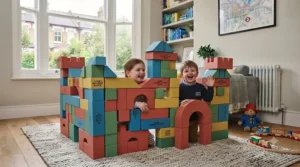
Two hundred pieces is a serious commitment, and the standout feature is exactly that scale — this set is explicitly built for shared spaces where multiple children build simultaneously, such as nurseries, larger family homes, or playrooms shared between siblings of different ages. The colour variety across the 200-piece set is broader than the smaller GIGI ranges, giving more scope for colour-sorting play alongside pure construction, which adds an educational dimension some smaller sets lack simply through lack of pieces.
Here’s what most reviews of large sets like this won’t spell out clearly: buying 200 blocks doesn’t mean you get five times the play value of a 40-piece set — it means you get a different kind of play value, oriented around scale, group building, and longer-lasting projects rather than everyday quick sessions. Based on the spec comparison with the 96-piece XL set above, the jump from 96 to 200 pieces roughly doubles the price without doubling the footprint of a single build, since much of the extra volume goes into height and complexity rather than sheer floor coverage. Aggregated review sentiment flags this as genuinely popular in nursery and childminder settings specifically because it holds up to rotating groups of children rather than one family’s wear pattern.
Pros:
- ✅ Genuinely scales to group and nursery use
- ✅ Wider colour range adds sorting play value
- ✅ Long-term durability reported across settings
Cons:
- ❌ Significant storage space required
- ❌ Premium price puts it out of reach for casual buyers
At £90-£120, this is squarely aimed at settings and households where the set will see heavy, repeated use across multiple children — a home with one toddler is unlikely to justify this over the 96-piece alternative.
7. GIGI Bloks XXL DIY Play House Blocks — best for building an actual playhouse
The standout feature here needs no interpretation: 203 blocks specifically designed and shaped to build a functioning, child-sized play house rather than an open-ended tower or wall. This is a different proposition from the other six sets on this list — it’s less “creative building toy” and more “flat-pack furniture for a three-year-old,” complete with the structural planning to make a stable, walk-in structure a realistic weekend project rather than a fantasy.
Based on the spec comparison with the open-play GIGI Bloks ranges, the DIY Play House trades some of the freeform creative flexibility of loose blocks for a guaranteed, satisfying end result — useful if you want a specific outcome (a house, not just “a pile of blocks that might become something”) and are prepared to follow instructions to get there. What the spec sheet won’t tell you, but user reports suggest, is that assembly is a genuinely bigger undertaking than any other set here; budget a proper afternoon, not a quick 20-minute job, and expect to do most of the structural work yourself before handing over decorating duties to your child. Reviewers consistently describe it as a stronger gift-occasion purchase (birthdays, Christmas) than a casual everyday toy, given the scale of both the price and the build.
Pros:
- ✅ Produces a genuine walk-in playhouse structure
- ✅ Strong gift-occasion appeal and wow factor
- ✅ Reusable panels once the house is disassembled
Cons:
- ❌ Longest, most involved assembly of any set here
- ❌ Least flexible for open-ended, freeform building
At £100-£140, this is the most specialised and priciest option on the list, best suited to a household ready to commit real time to assembly in exchange for a standout centrepiece toy.
Top 7 Products: Specs & Value Comparison
| Product | Blocks Held Together By | Weight Capacity | Ideal Age | Best For |
|---|---|---|---|---|
| Bankers Box at Play Cardboard Building Blocks | Stacking | Moderate | 3+ | UK-made, budget-first buyers |
| Melissa & Doug Deluxe Jumbo Cardboard Blocks | Stacking | Up to 150 lbs (largest block) | 2-5 | Small spaces |
| GIGI Bloks Big Interlocking Cardboard Building Blocks | Interlocking | High | 3+ | Sturdy, stable builds |
| Melissa & Doug Jumbo Extra-Thick Cardboard Building Blocks | Stacking | Up to 150 lbs (largest block) | 2-5 | Balanced all-round use |
| GIGI Bloks XL Cardboard Building Blocks | Interlocking | High | 3+ | Large, sibling-shared builds |
| GIGI Bloks XXL Mega Cardboard Building Blocks | Interlocking | High | 3+ | Nurseries, big families |
| GIGI Bloks XXL DIY Play House Blocks | Interlocking | High | 3+ | A finished playhouse structure |
Reading this table alongside the price table above, a genuine trade-off emerges between stacking sets (the two Melissa & Doug options and Bankers Box) and interlocking sets (every GIGI Bloks variant). Stacking sets are cheaper and simpler for very young toddlers who aren’t ready to line up interlocking tabs, while interlocking sets justify their higher price with builds that survive far more real-world chaos. Weight capacity is broadly similar across the extra-thick ranges, so unless a child is unusually heavy for their age, this spec matters less than piece count and interlock type when deciding.
Practical Usage Guide: Setup, Storage & Getting the Most From Your Blocks
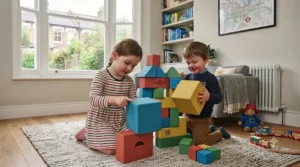
Unboxing jumbo cardboard building blocks for the first time is deceptively simple, but a few habits in the first month genuinely extend how long a set lasts. Start by assembling blocks on a flat, dry surface — carpet works better than hard flooring here, since folding cardboard panels sometimes need a firm push to click into shape, and a soft surface protects both floor and fingers. Resist the urge to assemble the entire set in one sitting if you’re short on time; a half-finished box of loose panels is far easier to store temporarily than 40 or 96 fully built blocks taking up the hallway.
A common mistake in the first 30 days is letting blocks get damp — cardboard, even the extra-thick double-walled variety used in every set on this list, softens if left near a bathroom, a leaky window, or an excitable child’s water cup. Wipe spills immediately rather than letting them soak in, and store the set somewhere genuinely dry between uses, not just “out of the way.” For sets with a wipe-clean printed surface (like both Melissa & Doug ranges), a damp cloth handles most marks, but avoid soaking the block itself.
Storage is the other overlooked optimisation trick Amazon listings rarely mention: stacking blocks neatly by size into a single tower, rather than a scattered pile, both saves space and doubles as a tidying game your toddler can join in with. For interlocking sets like the GIGI Bloks range, disassembling fully before storage isn’t necessary — many parents leave partial structures standing in a corner between play sessions, which the double-wall cardboard tolerates well provided the area stays dry. Rotate which blocks are “in play” if you own a larger set like the 200-piece GIGI Bloks XXL Mega Cardboard Building Blocks, since introducing the full quantity at once can genuinely overwhelm younger toddlers rather than delight them.
Real-World Scenarios: Which Set Actually Fits Your Family
Picture three fairly typical households, because the “best” set genuinely depends on which one sounds like you. First, a first-time parent in a two-bedroom flat with an 18-month-old just starting to enjoy stacking and knocking things down: here, the compact Melissa & Doug Deluxe Jumbo Cardboard Blocks or the budget-friendly Bankers Box at Play Cardboard Building Blocks make more sense than anything bigger, because storage space and a toddler’s genuinely modest building ambitions align with a smaller set.
Second, consider a family with two children aged three and six, sharing a playroom, both wanting to build at the same time without constantly negotiating over the same 24 blocks. The 96-piece GIGI Bloks XL Cardboard Building Blocks solves the “there aren’t enough blocks to go round” argument that smaller sets can trigger between siblings, and the interlocking system means the younger child’s contribution doesn’t collapse the older child’s more ambitious section.
Third, picture a childminder or small nursery setting with rotating groups of four or five children across a week, where a set needs to survive heavy, repeated use rather than one family’s wear pattern. The 200-piece GIGI Bloks XXL Mega Cardboard Building Blocks is genuinely built with that scenario in mind — enough volume that several children can build simultaneously without competing for pieces, and durable enough to handle daily assembly and disassembly across dozens of different small hands. None of these scenarios has a universally “best” answer; they simply have a best fit.
Problem → Solution: Fixing the Most Common Cardboard Block Frustrations
Problem: towers keep collapsing before a toddler finishes building. This is almost always a stacking-versus-interlocking issue rather than a fault with the child’s technique. Switching to an interlocking range, such as the GIGI Bloks Big Interlocking Cardboard Building Blocks, solves this directly — the tab-and-slot mechanism keeps structures upright through far more bumping and knocking than gravity-only stacking ever will.
Problem: blocks look worn or crushed after a few months. Extra-thick, double-walled cardboard (used across every set here) resists this far better than thinner alternatives, but even quality cardboard softens with repeated damp exposure. The fix is consistent, dry storage rather than a different product — see the setup guide above.
Problem: a set feels “too small” within weeks. This usually signals a genuine mismatch between piece count and the number of children playing, not a flaw in the product. Rather than buying a second identical set, consider stepping up a tier — from the 40-piece Melissa & Doug Jumbo Extra-Thick Cardboard Building Blocks to the 96-piece GIGI Bloks XL Cardboard Building Blocks, for example — since larger sets typically include more shape variety, not just more of the same block.
Problem: assembly takes longer than expected. Larger and specialty sets, particularly the GIGI Bloks XXL DIY Play House Blocks, genuinely require more time than the packaging photos suggest. Budget a proper session rather than attempting it in a spare ten minutes before bedtime, and consider assembling in stages across a weekend if the full build feels daunting.
How to Choose Jumbo Cardboard Building Blocks
Picking between seven genuinely different sets is easier with a structured approach rather than comparing price tags alone. Here’s the reasoning we’d apply in your position:
- Start with available space, not budget. A 200-piece set is wasted in a small bedroom; measure your actual play area before piece count.
- Match piece count to child age and number of children. One toddler rarely needs more than 40 blocks; two or three children sharing benefits from 96+.
- Decide between stacking and interlocking early. Under-2s often find interlocking fiddly; 3+ children generally prefer the stability it provides.
- Check the weight rating if older siblings or adults will climb on structures. Extra-thick ranges rated near 150 lbs tolerate far rougher use.
- Consider assembly time honestly. A 200-piece or playhouse-specific set is a proper project, not a five-minute unboxing.
- Factor in storage between play sessions. FSC-certified, fully recyclable ranges are easier to justify keeping (or eventually recycling) long-term.
- Think about how the set will be used in six months, not just this week. Children’s building ambitions grow quickly, and a set that feels generous now may feel modest by the following birthday.
Common Mistakes When Buying Big Building Blocks Toddler Indoor Sets
The single most common mistake is buying based on box size alone rather than piece count and interlock type — two sets can look similarly “jumbo” on a shelf while offering very different play value once assembled. A second frequent error is underestimating storage: parents often buy a 96 or 200-piece set expecting occasional use, then find the sheer volume of assembled blocks awkward to store between sessions in anything smaller than a dedicated playroom corner.
A third mistake worth flagging specifically for big building blocks toddler indoor purchases is ignoring the age gap between siblings. A set perfectly suited to a six-year-old’s ambitious builds can be genuinely frustrating for an 18-month-old who just wants to knock things over — in mixed-age households, a mid-sized interlocking set tends to satisfy both better than either extreme. Finally, some buyers assume “cardboard” automatically means “flimsy,” and either overspend on the largest available set out of unnecessary caution, or underspend on a thin, non-reinforced import that genuinely doesn’t survive daily toddler use. Sticking to extra-thick, double-walled ranges — every set reviewed in this guide qualifies — avoids that trap entirely.
Jumbo Cardboard Building Blocks vs Oversized Building Blocks Kids Made From Other Materials
It’s worth being honest about how cardboard stacks up against the other oversized building blocks kids commonly encounter: foam, wood, and hard plastic. Foam blocks are lighter still and near-silent, making them the safest option for very young babies who mouth everything, but they compress and dent permanently under sustained weight in a way cardboard’s stiffer double-wall construction resists. Wooden jumbo blocks are the most durable long-term and often feel the most “premium,” but they’re considerably heavier, harder for small hands to manoeuvre safely, and can scuff floors and skirting boards on the way down — a real consideration if a tower topples near furniture.
Hard plastic jumbo blocks, the third common alternative, are virtually indestructible and easiest to wipe clean, but they’re also the loudest by a wide margin (ask any parent who’s stepped on one at 6am) and the least sustainable, since most aren’t recyclable in standard UK household collections the way FSC-certified cardboard typically is. Cardboard occupies a genuine middle ground: lighter than wood, sturdier than foam, quieter and considerably more sustainable than plastic, though it can’t match plastic’s total imperviousness to water. For most indoor, everyday toddler play, that trade-off tips clearly in cardboard’s favour — which is exactly why the category has grown as fast as it has.
The material choice also affects long-term disposal, something rarely discussed in typical listings. According to WRAP UK, corrugated cardboard is among the most recyclable household packaging materials available, meaning a worn-out set of jumbo cardboard building blocks can genuinely be broken down and recycled at end of life, unlike most plastic or painted wooden alternatives.
What to Expect: Real-World Performance of Lightweight Building Blocks
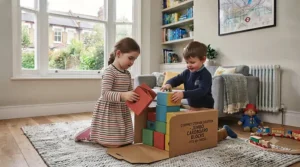
Specs on a page rarely convey what lightweight building blocks actually feel like in daily use, so here’s the honest translation. Even the largest single block across all seven sets in this guide is light enough for an average three-year-old to lift and carry unassisted, which matters enormously for independent play — a child who needs an adult to move every piece loses interest fast. That lightness is also precisely why these blocks are safer than wooden or hard plastic equivalents when towers inevitably fall on small feet or heads; the impact is genuinely negligible compared with denser materials.
What reviewers consistently flag as the pleasant surprise is how sturdy “lightweight” and “cardboard” can be simultaneously. The extra-thick, double-walled construction used across every set here means blocks resist crushing under an adult’s foot (useful when you inevitably step on one in the dark) far better than standard single-layer cardboard packaging ever would. The trade-off, honestly stated, is that lightweight blocks are more affected by wind or a boisterous dog knocking through a room than heavier wooden alternatives — not a serious issue indoors, but worth knowing if you’d hoped to use them near an open patio door in summer.
Cardboard Play Toys for Different Ages and Abilities
Cardboard play toys aren’t a one-size-fits-all category, and the age range across this guide’s seven sets — roughly 18 months to 8 years, depending on set and supervision — reflects genuinely different developmental stages. For toddlers under two, the appeal is almost entirely sensory and gross-motor: lifting, carrying, stacking two or three blocks, and the deeply satisfying crash of knocking them back down. Simple stacking sets like the Melissa & Doug Deluxe Jumbo Cardboard Blocks suit this stage best, since interlocking mechanisms ask for a level of fine motor precision most under-twos haven’t developed yet.
Between ages three and five, children typically shift toward purposeful building — houses, walls, “shops,” anything with a narrative attached — and this is where interlocking sets like the GIGI Bloks range earn their higher price, since structures need to survive being walked around and played with rather than just admired. According to guidance from Oxford Health NHS Trust, physical, goal-directed play activities like block building support gross motor skill development in toddlers and preschoolers, reinforcing that the “just play” happening with a tower of cardboard blocks is doing genuine developmental work, not simply filling time.
By age six and up, children with reasonable following-instructions ability start to genuinely benefit from specialty builds like the GIGI Bloks XXL DIY Play House Blocks, where the satisfaction comes from completing a defined project rather than open-ended stacking. For children with additional sensory sensitivities, the quiet, soft-edged nature of cardboard blocks (compared with hard, noisy plastic) is frequently cited anecdotally as more comfortable than harder alternatives, though every child’s needs differ and this shouldn’t be treated as a blanket recommendation.
Large Indoor Toys for Toddlers: Safety, Standards & Storage
Any large indoor toys for toddlers should meet the UK’s Toys (Safety) Regulations 2011, which set the baseline for physical, mechanical and chemical safety on anything sold as a children’s toy in Great Britain. In practice, this means checking that a set carries the UKCA or CE conformity marking on its packaging before purchase, since both remain currently accepted routes to market in Great Britain. Every set reviewed in this guide is sold as a toy through recognised retail channels and should display this marking; if a listing doesn’t clearly show it, that’s worth querying with the seller before buying.
Beyond formal regulation, general good practice for large indoor toys for toddlers includes checking for sharp corners regularly (cardboard can develop rough edges with heavy wear, even on scalloped-edge designs), supervising very young children around taller structures that could topple, and keeping play areas clear of trip hazards once a build sprawls across the floor. The Royal Society for the Prevention of Accidents notes that toys should be appropriate to a child’s age and kept in good repair, with damaged parts addressed rather than ignored — advice that applies just as much to a wobbling cardboard tower as to any other toy category.
On storage specifically: keep blocks dry, off damp flooring, and away from radiators that could warp panels over time. A cleared corner or a simple stacked “tower” of unused blocks tends to work better long-term than cramming a full set into a small toy box, which crushes lower layers and shortens the set’s usable life.
Long-Term Cost & Maintenance
Judged purely on upfront price, the budget sets in this guide look like the obvious value pick — but total cost of ownership tells a slightly different story once you factor in how long each set genuinely holds a child’s interest. A 24-piece starter set at under £20 offers excellent value for roughly a year of heavy toddler use, but many families find themselves buying a second, larger set within 18 months as building ambitions outgrow the original piece count. Viewed that way, a single 96-piece GIGI Bloks XL Cardboard Building Blocks purchase in the £45-£60 range can work out cheaper over a two-to-three-year window than two sequential smaller purchases, simply by avoiding a second delivery, second assembly session, and the inevitable “these don’t quite match the old set” storage headache.
| Approach | Approx. Total Spend Over 3 Years | Assembly Sessions | Best For |
|---|---|---|---|
| Single budget set only | under £25 | 1 | Very limited space/budget |
| Budget set, then upgrade | £45-£70 range total | 2 | Uncertain if blocks will be popular |
| One larger set upfront | £45-£90 range total | 1 | Confident in long-term interest |
Maintenance costs are genuinely minimal across every set here — there’s no ongoing spend on batteries, replacement parts, or consumables, which is a quiet but real advantage over many modern toys. The only real “cost” over time is space, and eventually, responsible disposal; since the cardboard used throughout this category is typically FSC-certified and fully recyclable, a worn-out set can be broken down for kerbside recycling rather than adding to landfill, keeping the long-term environmental cost low as well as the financial one.
Buyer’s Decision Framework
If you’re still torn, this simple framework should settle it. If you have limited space and one young toddler, choose a 24-40 piece stacking set, because scale beyond that goes largely unused at this stage. If you have two or more children close in age sharing a play space, choose a 90+ piece interlocking set, because piece count and structural stability both become genuinely important once multiple children build simultaneously. If your priority is a specific, guaranteed outcome — a proper playhouse, not just “some blocks” — choose the specialty DIY playhouse range and commit real assembly time upfront. And if budget is the primary constraint rather than space or ambition, start with the most affordable UK-made option and reassess in six months, once you’ve genuinely seen how much use the set gets.
Frequently Asked Questions
❓ Are jumbo cardboard building blocks safe for a one-year-old?
❓ How long do cardboard building blocks last?
❓ Can jumbo cardboard building blocks get wet?
❓ Do cardboard building blocks need assembly?
❓ Are interlocking or stacking cardboard blocks better for toddlers?
Conclusion
Seven sets, three genuinely different budgets, and one clear takeaway: the “best” jumbo cardboard building blocks aren’t the biggest or the cheapest, they’re the ones matched honestly to your space, your child’s age, and how many little hands will actually be building at once. A compact 24-piece set like the Melissa & Doug Deluxe Jumbo Cardboard Blocks genuinely outperforms a sprawling 200-piece haul in a small flat with one toddler, while a shared playroom with two or three children will get far more sustained value from the interlocking stability of something like the GIGI Bloks XL Cardboard Building Blocks.
What ties every set in this guide together is the same underlying appeal: screen-free, open-ended, genuinely physical play that supports gross motor development without a single battery or app involved. Whichever set you land on, the fundamentals from this guide hold — check the weight rating if older kids will be climbing, keep blocks dry between sessions, and be honest with yourself about how much floor space you can realistically dedicate before a piece count as tempting as 200 makes practical sense.
Recommended for You
- Giant Building Blocks Outdoor: 7 Best Jumbo Sets for 2026
- Colour Sorting Blocks Toddler: 7 Best Picks for 2026 (Loved by Little Hands)
- Pattern Blocks for Kids: 7 Best Sets Reviewed – 2026 UK
Disclaimer: This article contains affiliate links. As an Amazon Associate, I earn from qualifying purchases. If you purchase products through these links, we may earn a small commission at no additional cost to you.
✨ Found this helpful? Share it with your friends! 💬🤗
