

In This Article
Every parent has lived through the moment: you buy a toy that promises to “teach engineering,” and twenty minutes later it’s abandoned in a corner while your child goes back to staring at a screen. Building toys live or die on one thing, and it isn’t the marketing copy — it’s whether the pieces actually click together satisfyingly, whether the mechanisms genuinely move, and whether a child can look at what they’ve built and immediately understand why it works. A proper gears and motors building set clears that bar in a way flat, static building blocks simply can’t, because there’s something almost magical about turning a crank and watching a whole chain of cogs spin in sequence, each one slower or faster than the last, all because of a size difference you can actually see and touch.

Here’s what most gift-buying guides won’t tell you: not every “gears” set on Amazon is built the same way. Some are genuinely motorised, running on batteries with proper torque and speed control; others are entirely hand-cranked, relying on manual turning to demonstrate mechanical principles; and a fair few blur the line, adding a motor as an optional upgrade rather than baking it in from the start. Picking the wrong type for your child’s age or interest is the single biggest reason these sets end up gathering dust. This guide breaks down seven genuinely different, real-world sets, from an entry-level preschool gear panel through to a fully motorised LEGO Technic showpiece, so whether you’re after simple gear-based building toys for a curious five-year-old or proper battery-powered building kits for a budding engineer, you’ll know exactly what you’re getting before you spend a penny.
Quick Comparison Table
| Set | Piece Count | Motor Type | Age Range | Best For |
|---|---|---|---|---|
| Learning Resources Gears! Gears! Gears! Deluxe Beginners | 100 | Hand-crank | 3+ | First building set |
| Geomag Mechanics Motion Magnetic Gears | 96 | Magnetic (no battery) | 7+ | Teaching magnetic transmission |
| K’NEX Intro to Simple Machines: Gears Set | 198 | Hand-crank | 7+ | Real-world machine replicas |
| Learning Resources Gears! Machines in Motion | 112-116 | Hand-crank | 4/5+ | Open-ended vehicle builds |
| Engino Discovering STEM: Gears & Worm Drives | 112 | Hand-crank | 9+ | Gear ratios and torque |
| 9-in-1 Technic-Motor-Kit (battery-powered) | 9 accessories | Battery motor + remote | 8+ | Motorising existing builds |
| LEGO Technic Airbus H175 Rescue Helicopter | 2,001 | Battery-powered Control+ motor | 11+ | Premium motorised showpiece |
The split here matters more than it looks: four of these seven sets are entirely hand-cranked, which is genuinely the better starting point for younger children since it forces them to physically feel the resistance change as gear ratios shift, rather than just watching a battery do the work. The 9-in-1 Technic-Motor-Kit and LEGO Technic Airbus H175 represent the motorised end of the spectrum, where battery power introduces genuine torque, speed, and remote control — concepts that only really click once a child already understands basic gear meshing from hands-on cranking. If you’re choosing a first set, resist the urge to jump straight to something motorised; the mechanical intuition built through manual cranking pays off considerably once motors do enter the picture.
💬 Just one click — help others make better buying decisions too!😊
Top 7 Gears and Motors Building Sets: Expert Analysis
Choosing these seven wasn’t about ranking one set above the rest — it’s about covering the genuine range of ages, budgets, and learning stages that come up when parents, teachers, and grandparents go looking for a proper gears and motors building set. Every entry below includes what it actually teaches mechanically, not just what’s printed on the box.
1. Learning Resources Gears! Gears! Gears! Deluxe Beginners Building Set — best first building set for preschoolers
The standout feature is accessibility: chunky, brightly coloured translucent gears that even a three-year-old’s hands can grip and slot into place, paired with a wall panel base that lets kids build upward without everything collapsing the moment they let go. For a genuinely young first-timer, that combination of forgiving mechanics and immediate visual feedback — turn one gear, watch the whole chain spin — is precisely what keeps attention from wandering.
The 100-piece set includes a variety of gear sizes specifically chosen to demonstrate speed differences at a glance; a small gear spinning noticeably faster than a large one connected to it is a concept most adults had to be taught, and here it’s simply obvious through play. Based on the spec comparison against pricier rivals, what stands out is that Learning Resources deliberately kept this set free of small, easily lost connector pieces, favouring gears that snap directly onto pegs — a sensible design decision for the age group, where fiddly assembly kills engagement fast. It develops fine motor skills alongside the mechanical concepts, since gripping and aligning the gear teeth correctly takes real hand-eye coordination at this age.
Reviewers consistently note that it holds attention far longer than expected for a “beginner” set, with several mentioning that older siblings end up building alongside younger ones, which speaks well of its actual play value rather than just its educational framing. The main recurring theme in aggregated feedback is that this is deliberately not motorised and not meant to be — it’s built specifically as a foundation before anything battery-powered enters the picture.
Pros:
- ✅ Chunky, colourful gears are genuinely toddler-friendly to grip
- ✅ Visual speed differences make gear ratios instantly obvious
- ✅ Minimal small parts reduces frustration and lost pieces
Cons:
- ❌ No motor option, so it’s purely hand-cranked play
- ❌ Limited challenge for children who progress quickly past basics
Expect to pay in the £25-£35 range, which for a set this durable and reusable across siblings represents solid value for a first mechanical toy.

2. Geomag Mechanics Motion Magnetic Gears — best for teaching contactless magnetic transmission
What makes this genuinely different from every other entry on this list is the transmission method: instead of interlocking teeth, gears here spin each other through magnetic attraction and repulsion, meaning children build models where rotation passes from one gear to another without them ever physically touching. It’s a subtly different lesson from standard meshed gears, and one that genuinely surprises kids the first time they see it work.
The 96-piece set combines Geomag’s signature magnetic bars and steel spheres with dedicated mechanical elements — gears and ball bearings specifically engineered for this contactless system — made from recycled plastic as part of the brand’s sustainability commitment. Based on the spec comparison, what most buyers overlook is that magnetic transmission genuinely behaves differently from toothed gears under load; push too hard and the connection slips rather than jamming or breaking, which is both a useful safety feature and a genuine physics lesson about magnetic force limits. It’s aimed squarely at children aged seven and up, reflecting the slightly more abstract concept being taught compared with straightforward toothed gears.
Aggregated reviewer sentiment consistently praises build quality and the satisfying click of Geomag’s magnetic connectors, a hallmark of the brand across its whole product range, with the main criticism being that 96 pieces limits you to fairly compact builds compared with the 160-piece version available at a higher price point. For a household already invested in other Geomag sets, this integrates directly with existing pieces, extending play value considerably beyond the box contents alone.
Pros:
- ✅ Magnetic transmission teaches a genuinely different mechanical concept
- ✅ High build quality consistent with Geomag’s wider product range
- ✅ Made from recycled plastic, a genuine sustainability plus
Cons:
- ❌ 96 pieces restrict you to relatively small, compact models
- ❌ Concept is more abstract, suiting slightly older children better
You’ll typically find it priced around £20-£30, positioning it as a genuinely distinctive mid-range option rather than a like-for-like alternative to standard gear sets.
3. K’NEX Intro to Simple Machines: Gears Set — best for building real-world machine replicas
The defining feature here is authenticity: rather than abstract gear demonstrations, this set is built specifically to construct seven working replicas of genuine household machines — a fan, a blender, an eggbeater, a car window mechanism, a phonograph, a stationary bike, and a chainsaw — each one demonstrating a different real gear application children can immediately connect to something they already know.
Built from 198 classic K’NEX rods and connectors, the set uses spur, crown, chain, and sprocket gear assemblies across its seven models, giving genuinely broad coverage of different gear types rather than repeating the same mechanism seven times with different decoration. What most buyers overlook is that K’NEX’s rod-and-connector system, distinct from the peg-and-hole approach used by most gear toys, actually teaches a subtly different construction skill — spatial reasoning about triangulated structures — alongside the gear mechanics themselves, making this a genuinely two-in-one learning tool. It comes packaged in a stackable storage tray with a snap-on lid, a small but genuinely appreciated detail for households that have learned the hard way what happens when construction toy pieces go missing.
Reviewer sentiment aggregated from educational suppliers consistently highlights its classroom use, where it’s specifically designed to support two to four students working as a team — a detail that translates well to siblings building together at home too. The recurring critique is that at 198 pieces spread across seven distinct builds, individual models are fairly small once complete, so this suits methodical, one-model-at-a-time play rather than large combined constructions.
Pros:
- ✅ Builds seven genuinely different real-world machine replicas
- ✅ Covers four distinct gear types across the model range
- ✅ Sturdy storage tray keeps pieces organised long-term
Cons:
- ❌ Individual finished models are relatively small in scale
- ❌ Rod-and-connector system differs from most other gear toys
Prices generally sit in the £25-£40 range, reflecting its position as a genuinely educational, classroom-tested option that’s equally at home on a kitchen table.
4. Learning Resources Gears! Gears! Gears! Machines in Motion — best for open-ended vehicle and machine builds
The standout advantage is genuine open-endedness: rather than following a single instruction booklet toward one fixed outcome, this set includes special parts — a wrecking ball, chains, pulleys, a propeller, and treads — specifically chosen to spark a child’s own vehicle and machine designs rather than replicate a set path. For children who get more out of inventing than following instructions, this is a meaningfully different play experience from the more prescriptive sets on this list.
The 112-116 piece set is explicitly designed to interlock with other Learning Resources Gears! sets, meaning a household that already owns the Deluxe Beginners set or a Robots in Motion kit can combine collections for genuinely larger, more ambitious builds — a detail that increases long-term value considerably beyond the box’s contents alone. Based on the spec comparison, the inclusion of specifically-themed parts like a wrecking ball and propeller is a deliberate nudge toward vehicle and construction-site play themes, which reviewers note tends to hold the interest of children who might otherwise find plain interlocking gears a bit dry.
Aggregated customer sentiment consistently flags it as a strong gift option, with several reviewers specifically mentioning it holds up well as a present for both engineering-minded children and those simply drawn to trucks and machinery. A recurring point in feedback is that instructions can occasionally feel less structured than some buyers expect, though for a set explicitly designed around open-ended invention, that’s arguably by design rather than a genuine flaw.
Pros:
- ✅ Special parts encourage genuinely open-ended, creative building
- ✅ Interchangeable with other Learning Resources Gears! sets
- ✅ Vehicle and machine theming appeals beyond pure gear enthusiasts
Cons:
- ❌ Less structured guidance suits confident builders better
- ❌ Best value only realised if combined with compatible sets
Expect a price range of roughly £30-£45, with genuine added value for households planning to build out a wider Gears! collection over time.
5. Engino Discovering STEM: Mechanics – Gears & Worm Drives — best for learning gear ratios and torque
What sets this apart is depth: rather than treating gears as a single concept, this set specifically isolates and teaches the difference between standard gear meshing and worm drives, a mechanism most children have never consciously encountered despite it appearing in everything from garage door openers to guitar tuning pegs. The included booklet doesn’t just show how to build each model — it explains the actual physics behind why worm drives dramatically reduce speed while multiplying force.
Built from 112 snap-fit pieces, the set constructs up to twelve distinct working models, including a functioning crane, a gearbox, a carousel, a small helicopter, and a screw press, each isolating a different aspect of how gears and worm drives change speed, force, or direction of motion. On paper this means a genuinely progressive learning curve baked into a single box — early models teach basic meshing, while later builds like the screw press specifically demonstrate torque multiplication through worm gearing, a concept usually reserved for secondary-school physics. What most buyers overlook is that Engino’s snap-fit connection system is specifically engineered for repeated disassembly and rebuilding, meaning the set survives dozens of build-and-rebuild cycles far better than glued or friction-fit alternatives.
Reviewer sentiment aggregated across UK toy retailers consistently highlights the quality of the accompanying theory booklet as a genuine differentiator versus competitor gear sets, several specifically noting it’s detailed enough to support homeschooling or extension work alongside standard curriculum content. The main recurring criticism is pricing variation between retailers, with the same set appearing anywhere from budget-friendly to genuinely premium depending on where it’s bought, so it’s worth comparing current listings before purchase.
Pros:
- ✅ Specifically isolates and teaches worm drive mechanics
- ✅ Twelve distinct models offer a genuine progressive difficulty curve
- ✅ Durable snap-fit system built for repeated rebuilding
Cons:
- ❌ Price varies noticeably between retailers, so shop around
- ❌ Aimed at nine-plus, less suited to younger siblings
Prices typically range from around £35 up to £60 or more depending on the retailer, so checking current listings before buying is genuinely worthwhile here.

6. 9-in-1 Technic-Motor-Kit (battery-powered) — best for motorising an existing brick collection
The clever angle here is that this isn’t a standalone building set at all — it’s a dedicated motor upgrade kit, designed specifically to bolt battery-powered motion onto whatever compatible brick and gear collection a child already owns. For households that have already invested in a large compatible brick collection but never taken the leap into motorised building, this is a considerably cheaper entry point than buying an entirely new motorised set from scratch.
The kit bundles M and L-sized motors offering genuinely different torque and speed characteristics, a 2.4GHz remote control with IR receiver, a rechargeable battery box, and extension cables, giving a child real hands-on experience with the actual components that power motorised builds rather than a sealed, unmodifiable pre-built motor unit. Based on the spec comparison, what most buyers overlook is that having both M and L motors available in one kit lets children directly compare how a smaller, faster motor behaves differently from a larger, higher-torque one when driving the same gear train — a genuinely valuable hands-on lesson that a single fixed motor can’t teach.
Reviewer sentiment aggregated across listings consistently notes good value for the sheer number of components included, with the remote control function specifically praised as adding a genuinely new dimension of play compared with hand-cranked alternatives. The recurring caveat in feedback is that as a compatible accessory kit rather than an official branded product, build quality and exact compatibility can vary slightly between batches, so checking current reviews before buying is sensible.
Pros:
- ✅ Adds genuine battery-powered motion to existing brick collections
- ✅ Includes both M and L motors to compare torque and speed
- ✅ Remote control adds a meaningfully new play dimension
Cons:
- ❌ Compatible accessory rather than an official branded kit
- ❌ Requires an existing compatible gear or brick collection to use fully
You’ll generally find this in the £20-£30 range, making genuine motorised play accessible without the cost of an entirely new premium set.
7. LEGO Technic Airbus H175 Rescue Helicopter — best premium motorised showpiece build
There’s no understating the ambition here: this is a 2,001-piece model built specifically to demonstrate how a real helicopter’s mechanisms actually function, with a genuine Control+ motor driving spinning main and tail rotors, adjustable rotor pitch, retractable landing gear, and a working winch, all powered by a battery box rather than being purely decorative moving parts.
The included motor, powered by six AA batteries, drives multiple simultaneous mechanisms rather than a single simple spin, meaning the build itself teaches genuinely advanced concepts around how one motor input can be mechanically routed to power several different functions through careful gear and axle arrangement. What most buyers overlook is that the value comparison against buying LEGO’s motor and battery box separately is genuinely favourable — reviewers have specifically noted that the standalone components alone would cost a meaningful fraction of the full set’s price, meaning you’re not simply paying a premium for the helicopter shape on top of standard motor components. On paper this means a build that functions as both a serious engineering exercise and a genuinely impressive finished display piece.
Reviewer sentiment aggregated from LEGO-focused review sites consistently ranks this among the more engaging large-scale Technic builds specifically because of how many genuinely different motorised functions are packed into a single motor and battery setup, rather than one repetitive spinning action. The recurring caveat, unsurprisingly, is scale and price — at over two thousand pieces and aimed at builders eleven and up, this is a serious time and money commitment rather than a casual purchase, and availability can vary since it’s a specialist model within LEGO’s wider range.
Pros:
- ✅ Genuine Control+ motor drives multiple distinct mechanisms
- ✅ Teaches how one motor input routes power to several functions
- ✅ Strong value against buying motor components separately
Cons:
- ❌ Significant time and financial commitment at this scale
- ❌ Not suited to younger or less experienced builders
Expect a price in the £150-£200 range, firmly positioning it as the premium, milestone-build choice on this list rather than an everyday purchase.
Practical Usage Guide: Getting the Most From Any Gears Set
Assembly technique matters more than most parents expect, and it’s worth setting a few habits early rather than letting a child struggle unnecessarily. Start with the simplest single-gear-pair build shown in any instruction booklet before attempting a full multi-gear chain — children who skip straight to the most complex model in the box often end up frustrated by a jam they don’t have the conceptual grounding to diagnose, whereas starting simple builds the troubleshooting instinct needed for bigger builds later. For motorised sets specifically, the most common mistake in the first thirty days is running a motor against a jammed or misaligned gear train, which can strain the motor unnecessarily; teach children to gently test-turn a gear chain by hand first to check it spins freely before switching on any battery-powered motor.
Storage genuinely affects how often a set gets used — pieces scattered across a toy box get abandoned far faster than pieces kept in a dedicated, easily accessible container, since the friction of hunting for the right gear size kills momentum quickly for younger builders. For sets with small pieces like the Engino or K’NEX kits, a simple sorting approach by piece type rather than colour tends to speed up rebuilding considerably, since most models are assembled by function (all the gears together, all the connectors together) rather than by shade. Finally, for any battery-powered set, remove batteries during long storage gaps rather than leaving them in, since corrosion from a forgotten battery is a genuinely common reason otherwise-good motorised sets stop working after months in a cupboard.
Real-World Scenarios: Matching the Set to Your Child
Picture a curious four-year-old who’s never built anything more complex than stacking blocks, but who’s fascinated by how the washing machine door spins. For that starting point, the Learning Resources Gears! Gears! Gears! Deluxe Beginners Building Set is the sensible choice — big, forgiving pieces, immediate visual feedback, and absolutely no risk of small parts becoming a hazard or a frustration.
Now consider an eight-year-old who’s already built with LEGO for years and is asking specifically how remote-control cars work. That’s a child ready to jump past manual cranking into genuine motorised mechanics, and the 9-in-1 Technic-Motor-Kit paired with their existing brick collection, or a dedicated set like the LEGO Technic Airbus H175 if budget allows, gives them exactly the remote-control, battery-driven experience they’re specifically curious about.
Finally, picture a methodical eleven-year-old who enjoys following instructions precisely and has recently started asking genuinely technical questions — why does a bicycle have different gears, why do car windows go up smoothly rather than jerkily. For that specific curiosity about real mechanical applications, the K’NEX Intro to Simple Machines: Gears Set or the Engino Discovering STEM: Gears & Worm Drives set both connect abstract gear theory directly to machines that child already interacts with daily, which tends to land far better than an abstract, unthemed gear demonstration.
How to Choose a Gears and Motors Building Set
Choosing the right gears and motors building set comes down to matching mechanism type and complexity to your child’s current stage, rather than simply picking the set with the highest piece count or the flashiest box art.
- Start with hand-cranked before motorised. Manual cranking builds an intuitive feel for gear ratios that a motor, which does the work invisibly, simply can’t teach on its own.
- Match piece size to age realistically. Chunky pieces suit under-fives; standard-sized interlocking components generally need seven-plus fine motor control to avoid frustration.
- Check whether the set builds recognisable real-world machines. Sets that connect gears to something familiar — a blender, a crane, a helicopter — tend to hold interest longer than abstract demonstrations alone.
- Consider compatibility with sets you already own. Interchangeable systems like Learning Resources’ Gears! range or standard LEGO Technic pins extend value considerably over an isolated one-off purchase.
- Factor in supervision needs for battery-powered options. Motorised sets with remote controls are genuinely exciting but usually need more initial adult guidance around safe motor use than manual sets.
- Look for an included theory booklet if deeper learning matters to you. Sets like Engino’s Discovering STEM range explain the actual physics, not just the assembly steps, which matters if you want genuine mechanical engineering basics covered rather than pure play.
- Weigh piece count against realistic build time. A 2,000-piece premium set is a genuinely different commitment from a 100-piece starter kit, and matching that commitment to your child’s patience and attention span avoids an expensive, unfinished box.
Motorised Construction Sets for Kids vs Manual Gear Sets: What’s the Real Difference
There’s a genuine developmental distinction between motorised construction sets for kids and purely manual, hand-cranked gear toys, and understanding it helps avoid buying the wrong type for where your child actually is. Manual sets, like the Learning Resources Gears! Gears! Gears! Deluxe Beginners and K’NEX Intro to Simple Machines, require the child to be the power source, meaning every gear ratio, every speed change, and every jammed mechanism is something they physically feel through their own hand. That direct feedback loop is genuinely valuable pedagogically, since children build an intuitive, almost muscle-memory understanding of mechanical advantage before they ever encounter the term in a classroom.
Motorised sets, by contrast, introduce a layer of abstraction — the child designs the mechanism, but a battery does the actual work, which shifts the learning focus toward power transmission, torque, and control rather than raw mechanical feel. The 9-in-1 Technic-Motor-Kit and LEGO Technic Airbus H175 Rescue Helicopter both sit firmly in this category, and reviewers consistently note that children who’ve already built confidence with manual gear sets tend to get considerably more out of motorised builds than those jumping in cold, since they already understand what the motor is actually doing mechanically rather than treating it as an unexplained black box.
Gear-Based Building Toys and Cogs and Pulleys: The Mechanics Explained
Understanding what’s actually happening inside gear-based building toys helps parents answer the inevitable “but why does it work” question with something more satisfying than “it just does.” A cog, in the simplest terms, is a toothed wheel that interlocks with another toothed wheel so that turning one reliably turns the other — the key insight children discover through play is that when a small cog drives a large one, the large cog turns more slowly but with proportionally more force, and the reverse happens when a large cog drives a small one. This trade-off between speed and force is the single most important concept nearly every set on this list is built around, whether it’s demonstrated through the Geomag Mechanics Motion Magnetic Gears‘ contactless magnetic transmission or the direct toothed meshing in the K’NEX and Learning Resources sets.
Pulleys extend the same basic principle using a rope, belt, or chain around a grooved wheel rather than direct gear-tooth contact, allowing force to be transmitted across a distance rather than only between touching gears — a mechanism the Learning Resources Gears! Machines in Motion set specifically introduces through its included chain and pulley components. According to the UK primary science curriculum, children are expected to explore exactly these principles — gears changing the direction and size of a force, and the underlying mechanical relationships between connected wheels — as part of learning how simple machines make work easier (see the Oak National Academy lesson on how gears can help us for the full curriculum-aligned breakdown). Reviewers of gear-based sets consistently note that children retain these concepts far better after hands-on building than from diagrams alone, which is really the entire case for these toys existing in the first place.
Battery-Powered Building Kits: What to Know Before You Buy
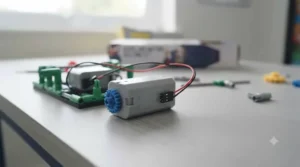
Battery-powered building kits introduce genuinely different considerations from purely mechanical sets, and it’s worth understanding them before committing to a motorised purchase. Motor strength varies considerably between products — the 9-in-1 Technic-Motor-Kit‘s smaller M-motor prioritises speed over torque, while its L-motor sacrifices some speed for pulling power, and understanding that trade-off before building helps a child choose the right motor for a given mechanism rather than being confused when a fast motor stalls under load it can’t actually turn.
Battery type and runtime matter more than they might seem: the LEGO Technic Airbus H175 Rescue Helicopter‘s Control+ motor system runs on six standard AA batteries rather than a proprietary rechargeable pack, which is genuinely convenient for replacement but means ongoing battery costs are worth factoring into the total price, particularly for a model that invites repeated play sessions. What most buyers overlook is that remote-controlled motorised sets, unlike simple push-button motorised toys, generally require a slightly more considered safety conversation with younger children around not forcing a jammed mechanism while the motor is still running, since a stalled motor under continuous power can genuinely strain both the motor and the gear train it’s driving. Based on the spec comparison across this list, sets that include both a motor and clear guidance on safe motor use, like the LEGO Technic range, tend to generate fewer frustrated “it broke” moments than generic compatible motor kits with sparser instructions — worth weighing against the genuine cost savings the latter offer.

Mechanical Engineering Basics Kids Actually Learn
It’s worth being specific about what “mechanical engineering basics” actually means in the context of a children’s building toy, since the phrase gets used loosely in a lot of marketing copy. At its core, every set on this list teaches some combination of four genuinely foundational concepts: mechanical advantage (how gear size ratios trade speed for force, and vice versa), power transmission (how rotational motion moves from one point to another, whether through meshed teeth, a chain, or magnetic coupling), directional change (how gears can reverse or redirect motion, demonstrated clearly in the K’NEX set’s car window mechanism model), and, in the more advanced sets, torque multiplication through mechanisms like worm drives, as specifically isolated in the Engino Discovering STEM: Gears & Worm Drives kit.
These aren’t abstract adult concepts imposed onto play — they map directly onto the design and technology curriculum children encounter at school, which specifically expects pupils to explore and use mechanisms including wheels, axles, and gear-based systems as part of building genuine technical knowledge (full detail available in the official gov.uk National Curriculum design and technology programme of study). For a broader technical grounding in how gears themselves are classified and engineered, the Wikipedia entry on gears covers the different gear types — spur, worm, bevel, and more — that several sets on this list, particularly the Engino and K’NEX kits, are specifically designed to demonstrate hands-on. What most buyers overlook is that a child who’s genuinely internalised these four concepts through play has a meaningful head start on GCSE-level physics topics around forces and simple machines, years before they formally encounter the terminology in a classroom.
Common Mistakes When Buying a Gears and Motors Building Set
The most common mistake is buying based on piece count alone, assuming more pieces automatically means better value — a 200-piece set spread across seven small, simple models can genuinely teach less than a 100-piece set with carefully chosen, varied gear ratios, since the learning value comes from mechanical variety rather than sheer volume. A closely related error is choosing a motorised set before a child has any hand-cranked gear experience at all; without that foundational feel for how gear ratios physically behave, a motorised build can end up feeling like a black box that simply moves when a button is pressed, rather than a genuine engineering lesson.
Buyers also frequently underestimate age recommendations, assuming a bright, engaged six-year-old will manage a nine-plus set without frustration — while some children genuinely will, the small piece sizes and multi-step assembly in sets like the Engino Discovering STEM range are calibrated for a reason, and skipping ahead too far can turn what should be an empowering build into a frustrating one requiring constant adult intervention. Finally, a genuinely underappreciated pitfall is ignoring compatibility with toys a family already owns; choosing a completely proprietary system when a household already has a substantial LEGO Technic or Learning Resources Gears! collection means missing out on meaningfully expanded build possibilities that compatible pieces would have unlocked.
Long-Term Cost & Maintenance
Total value over time looks meaningfully different once you factor in durability and expandability rather than just the upfront price tag. The Learning Resources Gears! Gears! Gears! Deluxe Beginners set and its Machines in Motion sibling are both designed to interlock with the wider Gears! range, meaning the initial £25-£45 outlay can grow into a considerably larger, more capable collection over several birthdays without any piece becoming obsolete — a genuinely sensible long-term strategy for families expecting to buy more building toys over time regardless.
Motorised sets carry different ongoing considerations: the 9-in-1 Technic-Motor-Kit‘s rechargeable battery box avoids the recurring cost of disposable batteries, while the LEGO Technic Airbus H175‘s standard AA-battery Control+ system trades that convenience for easier, universally available replacements when a battery eventually dies rather than needing a specific rechargeable pack. Snap-fit systems like Engino’s are specifically engineered for repeated disassembly, meaning a set bought today can realistically be rebuilt dozens of times across several years without the connection points wearing loose, unlike cheaper friction-fit alternatives that can loosen with heavy repeated use. As a general rule, sets from established educational brands with wide compatibility across their own product ranges tend to offer better multi-year value than one-off novelty sets, even when the initial sticker price looks similar.

Frequently Asked Questions
❓ What age is right for a gears and motors building set?
❓ Are motorised gear sets better than manual ones for learning?
❓ Do gears and motors building sets need special batteries?
❓ Can different gears and motors building sets be combined?
❓ How long do gears and motors building sets typically last?
Conclusion
Working through all seven of these sets, the clearest takeaway is that “best” depends entirely on where a child is in their mechanical understanding, not just their age in years. For a genuine first introduction, the Learning Resources Gears! Gears! Gears! Deluxe Beginners Building Set remains a sensible, low-risk starting point that builds real intuition before anything more complex enters the picture. Children ready to connect gear theory to real machines will get more out of the K’NEX Intro to Simple Machines or Engino Discovering STEM ranges, both genuinely engineered around that specific transition from abstract concept to tangible application.
And for families ready to introduce genuine battery-powered motion, whether through the budget-friendly 9-in-1 Technic-Motor-Kit or the considerably more ambitious LEGO Technic Airbus H175 Rescue Helicopter, the jump to motorised building represents a genuinely different, richer stage of mechanical learning — one best built on a foundation of hands-on gear experience rather than jumped into cold. Whichever set you choose, remember that the learning happens in the building and rebuilding, not in a single perfect assembly, so a set that survives repeated dismantling will always outlast one that doesn’t.
✨ Don’t Miss These Exclusive Deals!
🔧 Give the young engineer in your life something that genuinely earns its shelf space — click through on any of the picks above to check current pricing and availability, and turn screen time into build time!
Recommended for You
- K’NEX vs Meccano Building Sets: 7 Top Picks Compared (2026)
- K’NEX Building Set Under £40: 7 Best UK Picks for 2026
- Meccano Set for Beginners: 7 Best UK Picks for 2026
Disclaimer: This article contains affiliate links. As an Amazon Associate, I earn from qualifying purchases. If you purchase products through these links, we may earn a small commission at no additional cost to you.
✨ Found this helpful? Share it with your friends! 💬🤗
