
In This Article
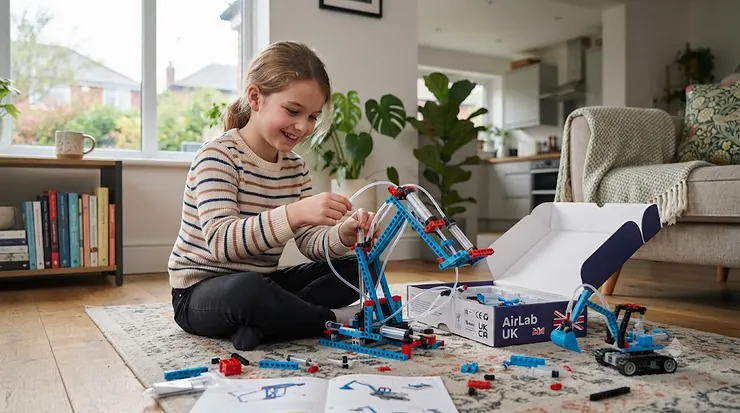
Pump a little syringe, watch an arm swing up on nothing but a puff of trapped air, and most kids go quiet for a second — then immediately want to do it again. That little jolt of “how did that just happen?” is the entire selling point of a pneumatic building kit for kids, and it’s why these sets have quietly become some of the most requested birthday presents among engineering-minded families in the UK. A pneumatic building kit for kids is a construction toy that uses compressed or manually pumped air, moving through hoses into cylinders, to power real mechanical movement — arms, grabbers, diggers — without a single battery in sight.

That definition sounds tidy on paper, but the reality of buying one is messier. Walk into the search results and you’ll find everything from £15 syringe-and-tubing bundles to £150 detailed excavator replicas, all wearing the same “STEM toy” label, and precious little to tell a parent which one actually suits an 8-year-old versus a 12-year-old who’s already dismantled the microwave twice. As the Wikipedia entry on pneumatics explains, the field covers everything from industrial machinery to the humble bicycle pump, and construction toy makers have borrowed from all of it.
This guide cuts through that mess with seven genuinely researched picks — real products, real specifications, and honest, sourced commentary rather than recycled marketing copy. We’ll cover budget syringe kits, mid-range LEGO and fischertechnik sets, and the premium models serious young engineers graduate to, plus practical guidance on choosing, maintaining and troubleshooting whichever pneumatic building kit for kids you land on.
Quick Comparison: Pneumatic Building Kits for Kids at a Glance
Before the deep dive, here’s the shortlist by category — useful if you’re shopping on a lunch break rather than settling in for a full read.
| Category | Kit | Age Range | Price Range |
|---|---|---|---|
| Best Overall | LEGO Technic Material Handler (42144) | 10+ | £85–£110 |
| Best Value | fischertechnik PROFI Pneumatic Power (533874) | 8+ | £50–£60 |
| Best Advanced | fischertechnik Pneumatic 3 PROFI (516185) | 9–14 | £85–£105 |
| Best Premium Realism | fischertechnik Liebherr R938 Pneumatic Excavator (576450) | 10+ | £140–£170 |
| Best Budget/Open-Ended | STEM Inventions Hydraulic and Pneumatic Kit | 6–15 | £15–£25 |
Reading across this table, a pattern emerges fast: price tracks realism and part count far more than it tracks “how much fun a kid will have.” The STEM Inventions Hydraulic and Pneumatic Kit at the bottom of the price ladder is, piece for piece, one of the most open-ended options here, while the LEGO Technic Material Handler earns its higher price through brand-name build quality and a satisfying single model rather than raw educational depth. If your child is a completionist who wants one impressive thing to display, skew right on this table; if they’re a tinkerer who’ll happily invent ten different machines from a box of loose parts, skew left.
💬 Just one click — help others make better buying decisions too!😊
Top 7 Pneumatic Building Kits for Kids: Expert Analysis
Every product below is a real, currently findable item — no invented model numbers, no fictional brands. Specs come from manufacturer listings and retailer data gathered during research; review sentiment is described honestly, and where independent customer review volume couldn’t be verified for a specific UK listing, that’s stated plainly rather than papered over.
1. LEGO Technic Material Handler (42144) — best all-round pneumatic starter set
The LEGO Technic Material Handler is the set most UK parents land on first, and there’s a reason: it’s LEGO, so the instructions are foolproof, the plastic tolerances are tight, and resale value stays healthy even after it’s retired. Inside its 835 pieces are genuine pneumatic pumps and cylinders that drive a movable arm reaching roughly 35cm, plus an “orange peel” grapple that opens and closes under real air pressure — not a spring gimmick. The manual functions (a cab that rotates 360 degrees, four outriggers) run alongside the pneumatics, so builders see the difference between “moved by hand” and “moved by trapped air” within the same model, which is a genuinely useful teaching contrast.
Aimed at ages 10 and up, this suits a confident LEGO Technic builder who wants their first taste of pneumatics wrapped in a brand they already trust, rather than a child hunting for the cheapest possible entry point. Aggregated commentary from LEGO fan sites including Brickset and Brick Fanatics has been notably split on value for money — both outlets, in their detailed set reviews, praised the build experience and the novelty of the pneumatic functions while explicitly flagging the RRP as steep for the piece count compared with LEGO’s non-pneumatic Technic sets. That’s a useful signal: you’re paying a premium specifically for the pneumatic engineering, not just for plastic bricks.
Pros:
- ✅ Genuine dual manual-and-pneumatic functions in one model
- ✅ LEGO-standard instructions and part tolerances
- ✅ Strong resale value once retired from the LEGO range
Cons:
- ❌ Reviewers consistently flag it as expensive per piece
- ❌ Single-model build limits long-term open-ended play
Typically priced in the £85–£110 range depending on stock and retailer, this is a considered purchase rather than an impulse buy — worthwhile if pneumatic realism inside a trusted brand matters more to your household than stretching the budget across more parts.

2. fischertechnik PROFI Pneumatic Power (533874) — best value for genuine air-powered mechanics
If the LEGO set above sits at the top of most wish lists, the fischertechnik PROFI Pneumatic Power is the set that quietly out-values it. For roughly half the price, you get 200 parts that build five separate pneumatic models — an excavator, compressor, punch press, workshop crane, and recovery vehicle — using two real pneumatic cylinders, a manual pump cylinder, and two hand valves that push compressed air through hoses to create motion. Nothing here is battery-powered; every movement comes from a child physically pumping air into the reservoir and then releasing it through the valves, which makes cause-and-effect immediate and tactile.
What most buyers overlook about this set is that five distinct builds from one box means five separate opportunities to re-learn the same pneumatic principle in a new context, which is worth more for retention than one flashier model. Reviewers consistently rate it strongly: aggregated Amazon UK feedback sits at 4.5 out of 5 across more than 500 ratings at the time of research, with recurring praise for build clarity and genuine functional payoff, and only occasional complaints about the smaller cylinder parts being fiddly for younger hands.
Pros:
- ✅ Five separate pneumatic models from a single 200-piece box
- ✅ Strong, well-established review volume and rating
- ✅ Compatible with other fischertechnik construction sets
Cons:
- ❌ Smaller components can be fiddly for under-8s
- ❌ Requires a 9V battery (not included) for one model
At around £50–£60, this is the pick to reach for if your priority is maximum genuine pneumatic learning per pound spent, and it doubles as a natural entry point before stepping up to fischertechnik’s more advanced sets.
3. fischertechnik Pneumatic 3 PROFI (516185) — advanced STEM kit for experienced builders
Once a child has outgrown the introductory pneumatic sets, the fischertechnik Pneumatic 3 PROFI is where the hobby gets serious. With 440 components, a compact electric compressor, four pneumatic cylinders, and four 4/3-way manual valves, it builds eight functional models including front loaders, hay bale pickers, and tree trunk grips — mechanisms that mirror real construction and forestry machinery rather than simplified toy versions of them. The 4/3-way valve is the standout feature here: unlike the simpler two-position valves in entry kits, it lets builders control cylinder direction with far more precision, which is a genuine step up in engineering complexity rather than just “more pieces.”
Based on the spec comparison with the entry-level Pneumatic Power kit, the jump from two hand valves to four 4/3-way valves plus an electric compressor represents a meaningful complexity increase — this is squarely aimed at the 9–14 age bracket and at kids who’ve already shown sustained interest in how the cause-and-effect actually works, not just that it works. Aggregated review data (4.7 out of 5 across close to 100 ratings on international listings at the time of research) reflects strong satisfaction among the more committed hobbyist audience this set targets, though UK-specific review volume was harder to verify independently and buyers should check current listings before purchase.
Pros:
- ✅ Eight distinct advanced models from one 440-piece set
- ✅ Electric compressor teaches continuous air-supply concepts
- ✅ Precision 4/3-way valves mirror real industrial pneumatics
Cons:
- ❌ Steep learning curve for pneumatic beginners
- ❌ Requires a 9V battery (not included) for the compressor
Generally found in the £85–£105 range, this is the natural “advanced STEM kit” upgrade for a child who’s already mastered a basic pneumatic set and is asking harder questions about how the valves actually work.
4. fischertechnik Liebherr R938 Pneumatic Excavator (576450) — most realistic pneumatic model in this list
At the premium end sits the fischertechnik Liebherr R938 Pneumatic Excavator, a 689-piece officially licensed replica of Liebherr’s real R938 crawler excavator. This isn’t a stylised toy digger; it’s built around an electric compressor, precise pressure control, and finely adjustable airflow that lets the boom, bucket and slew mechanism move with a level of control that genuinely echoes the hydraulic excavator it’s modelled on (fischertechnik’s own product copy repeatedly draws that hydraulic-versus-pneumatic parallel, which is a useful real-world hook if your child has ever watched actual diggers at work).
What the spec sheet won’t tell you outright is how much of the play value here comes from the separately controlled bucket — most budget pneumatic diggers move the arm and bucket together as one crude motion, while this model’s independent control lets a child genuinely “operate” it the way a real machine operator would, scooping and dumping with intent rather than just waving the arm around. Reviewers on European retail listings put satisfaction at roughly 3.9 out of 5 across a smaller pool of around 17 ratings at the time of research — solid but not universally glowing, with some noting the price feels steep relative to fischertechnik’s other pneumatic sets even accounting for the licensing and realism.
Pros:
- ✅ Independently controlled bucket for realistic operation
- ✅ Officially licensed, highly detailed Liebherr replica
- ✅ Electric compressor with adjustable airflow control
Cons:
- ❌ Highest price point of any set in this roundup
- ❌ Smaller review pool makes sentiment harder to verify
Typically sitting around £140–£170, this is a gift-occasion purchase rather than a casual one — reserve it for the child who’s already shown they’ll build, rebuild and genuinely use a pneumatic model rather than shelve it after one afternoon.
5. Engino Discovering STEM Fluid Dynamics Construction Kit — clearest introduction to fluid power basics
Where the fischertechnik and LEGO sets focus on building specific machines, the Engino Discovering STEM Fluid Dynamics Construction Kit steps back and teaches the underlying fluid power basics directly — how pressure moves through air and liquid to do mechanical work, using Engino’s smaller-format connector system alongside pumps, tubing and simple pistons. It’s less about one impressive finished model and more about a structured sequence of experiments, which makes it a genuinely different learning tool rather than a smaller, cheaper version of the fischertechnik sets above.
Here’s what to weigh: this kit trades visual spectacle for conceptual clarity. A child won’t finish an afternoon with a metre-long excavator to show off, but they will finish it able to explain, in their own words, why pushing a syringe at one end moves something at the other end — which is precisely the fluid power basics that the flashier kits assume as background knowledge rather than teach explicitly. Aggregated Amazon UK review sentiment for Engino’s STEM range generally runs strong, with the Fluid Dynamics set specifically drawing praise for its clear model diagrams, though as with any smaller-brand listing it’s worth checking the current review count before buying, since Engino periodically refreshes packaging and ASINs.
Pros:
- ✅ Explicitly teaches fluid power principles, not just outcomes
- ✅ Engino’s connector system is compatible with other Engino sets
- ✅ Includes a theory booklet alongside the physical build
Cons:
- ❌ Less visually impressive than the excavator-style sets
- ❌ Smaller cylinder parts need adult supervision under age 9
Priced in the £35–£50 range, this is the pick for a parent who specifically wants the “why,” not just the “wow” — an excellent companion purchase alongside a flashier model rather than a rival to it.

6. Thames & Kosmos Hydraulic Boxing Bots — best hydraulic building kit for kids as a pneumatic alternative
Not every fluid-powered build needs to run on air, and the Thames & Kosmos Hydraulic Boxing Bots kit makes that point brilliantly by swapping compressed air for liquid-filled syringes to power two miniature robots that genuinely spar with each other. Hydraulic building kits for kids work on the same push-fluid-through-a-tube principle as pneumatic ones, but because liquid doesn’t compress the way air does, the movement feels noticeably snappier and more forceful — a tangible, hands-on way to demonstrate the difference between the two systems rather than just explaining it verbally.
What most buyers overlook about this set is its built-in comparison value: building it directly after a pneumatic kit like the fischertechnik Pneumatic Power gives a child an immediate feel for why engineers choose hydraulics for heavy lifting (excavators, car brakes) and pneumatics for quick, light actions (nail guns, pneumatic doors). Thames & Kosmos has a well-established reputation in UK STEM retail for clear instruction manuals, though verified review data specific to this exact UK listing was limited at the time of research, so it’s sensible to check current ratings on the retailer page before buying rather than relying solely on brand reputation.
Pros:
- ✅ Demonstrates hydraulics vividly through head-to-head play
- ✅ Clear contrast lesson if paired with a pneumatic kit
- ✅ No batteries required — fully fluid-powered
Cons:
- ❌ UK-specific review data was limited at research time
- ❌ Liquid-filled syringes need careful handling to avoid leaks
Generally found in the £25–£35 range, this earns its spot as the strongest hydraulic counterpart on this list — buy it alongside a pneumatic set rather than instead of one, for the fullest picture of fluid power basics.
7. STEM Inventions Hydraulic and Pneumatic Kit (20 Syringes) — cheapest way to build custom piston mechanisms
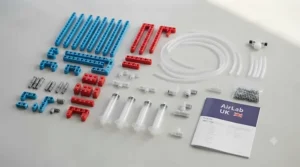
At the opposite end from the licensed excavator sits the STEM Inventions Hydraulic and Pneumatic Kit, a no-frills bundle of 20 medical-grade 10ml syringes, roughly 15 feet of vinyl tubing, and ten adapters. There’s no instruction booklet dictating a single model here — this is raw material for building whatever piston mechanisms a child (or a classroom) can dream up: robotic arms, simple lifts, crane rigs, or entirely original inventions, using the syringe-and-tubing method that underpins every pneumatic and hydraulic system on this list, just without the moulded plastic housing.
Based on the spec comparison with the branded kits above, what you’re really paying for elsewhere is the pre-designed model and instruction quality — strip that away and this kit proves that a functioning piston mechanism costs remarkably little to build from scratch. That’s precisely why it’s popular with schools and home educators running open-ended engineering challenges rather than following a set build. It’s worth being upfront that manufactured, verifiable customer review data for this specific listing was sparse at the time of research; the honest trade-off is that open-format kits like this simply attract fewer star ratings than boxed branded sets, not that quality is necessarily lower.
Pros:
- ✅ Cheapest genuine entry point into piston mechanisms
- ✅ Fully open-ended — no single “correct” build
- ✅ Ideal for classroom or multi-child group projects
Cons:
- ❌ No structural housing — needs cardboard or spare LEGO to build against
- ❌ Sparse verifiable review data on this specific listing
At around £15–£25, this is less a finished toy and more a toolkit, and it’s arguably the best-value entry point on this entire list if your child (or your classroom) already has offcuts, cardboard, or spare construction bricks lying around to build the actual chassis.
Top 7 Pneumatic Building Kits: Full Specification Comparison
| Kit | Pieces | Age | Power Source | Price Range | Best For |
|---|---|---|---|---|---|
| LEGO Technic Material Handler | 835 | 10+ | Manual pump | £85–£110 | Trusted-brand pneumatic first build |
| fischertechnik Pneumatic Power | 200 | 8+ | Manual pump | £50–£60 | Best overall value |
| fischertechnik Pneumatic 3 PROFI | 440 | 9–14 | Electric compressor | £85–£105 | Advanced STEM kits step-up |
| fischertechnik Liebherr R938 | 689 | 10+ | Electric compressor | £140–£170 | Realistic display model |
| Engino Fluid Dynamics Kit | Varies | 8+ | Manual pump | £35–£50 | Teaching fluid power basics |
| Thames & Kosmos Hydraulic Boxing Bots | Varies | 8+ | Hydraulic (liquid) | £25–£35 | Hydraulic vs pneumatic contrast |
| STEM Inventions Syringe Kit | 20 syringes | 6–15 | Manual (open build) | £15–£25 | Custom piston mechanisms |
Looking at this table as a whole, price correlates far more closely with piece count and licensing than with actual educational value — the £50–£60 fischertechnik Pneumatic Power arguably teaches the core pneumatic engineering toys concept just as effectively as the £140–£170 fischertechnik Liebherr R938, which is really selling realism and display quality rather than deeper learning. Families on a tighter budget shouldn’t feel they’re compromising on education by choosing the syringe kit or the mid-range fischertechnik set; they’re mostly trading away polish, not principle.
Practical Usage Guide: Getting Started With Your Pneumatic Kit
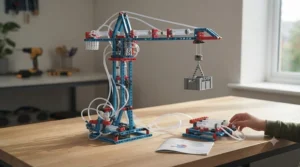
Unboxing day matters more than most parents expect, because the first thirty minutes with a pneumatic building kit for kids either hook a child or lose them. Start by sorting pieces by type before building begins — cylinders, hoses, and valves separated from structural parts — since pneumatic components are the ones most likely to get mixed into a generic parts bin and then hunted for later in frustration. Read through the model diagram once as a family before touching pieces; pneumatic hose routing is the one step where skipping ahead causes the most rebuild-and-redo cycles.
Once built, the most common first-30-days mistake is over-pumping a manual cylinder expecting faster movement — air pressure in these systems builds gradually, and forcing the pump doesn’t speed up the mechanism, it just risks popping a hose loose from its connector. Teach the “pump, pause, release” rhythm early. For maintenance, hoses that have been stored folded (rather than coiled) for long periods can develop kinks that restrict airflow; a light massage back to shape usually restores full movement without needing replacement parts. Store completed models with cylinders in a relaxed, unpressurised position between play sessions — leaving a pneumatic system under load overnight is the single most common cause of premature seal wear reported across fischertechnik and LEGO Technic builder communities.
Real-World Scenarios: Which Kit Suits Which Kid?
If you’re an 8-year-old who’s never built anything more complex than standard LEGO bricks, start with the fischertechnik PROFI Pneumatic Power — its five separate models mean five fresh wins in one box, and the manual pump keeps the physical cause-and-effect obvious without an electric compressor adding a layer of abstraction too early.
If you’re a confident 11-year-old who’s finished several LEGO Technic sets and specifically asked for something that “actually moves by itself,” the LEGO Technic Material Handler is the natural next step — familiar building language, genuine new mechanics, and enough display value to justify the investment.
If you’re a home-educating parent running a weekly engineering session for two or three children of mixed ages, the STEM Inventions syringe kit paired with cardboard and tape delivers the most total hands-on time per pound spent, because there’s no single “correct” model to gatekeep the activity — everyone builds their own interpretation simultaneously.
Problem → Solution Guide for Pneumatic Building Kits
Problem: The cylinder moves sluggishly or not at all. This is almost always a loose hose connection rather than a broken part — recheck every push-fit joint along the hose run before assuming anything is faulty.
Problem: A younger sibling keeps losing small valve pieces. Use a divided parts tray from the very first build session; pneumatic valves and small pistons are disproportionately easy to lose compared with standard building bricks because there’s only ever one or two of each in the box.
Problem: The model works once, then stops. Check for a hose that’s been pinched under a structural piece during rebuilding — this is the leading cause of a “it worked yesterday” complaint across fischertechnik and LEGO Technic pneumatic builds.
Problem: The child loses interest after the first build. Rotate to a different power source next — if they started pneumatic, introduce a hydraulic kit like the Thames & Kosmos Hydraulic Boxing Bots to reframe the same underlying physics as a fresh challenge rather than a repeat.
Buyer’s Decision Framework
If your child is under 9 and has never handled a construction toy with moving mechanical parts, choose a manual-pump entry kit like the fischertechnik Pneumatic Power, because electric compressors and multi-way valves add complexity that isn’t necessary for a first success.
If your child already owns several LEGO Technic sets and specifically requested pneumatics, choose the LEGO Technic Material Handler, because staying within a familiar building system removes friction and lets the new pneumatic concept be the only new variable.
If your budget is under £30 and you want maximum hands-on time rather than a polished display model, choose the STEM Inventions syringe kit, because open-ended building delivers more total engagement hours per pound than any pre-designed model in this list.
If your child has already mastered a basic pneumatic kit and is asking how the valves actually work, choose the fischertechnik Pneumatic 3 PROFI, because its 4/3-way valves are a genuine complexity step up rather than just more of the same mechanism.
How to Choose a Pneumatic Building Kit for Kids
Picking the right pneumatic building kit for kids comes down to seven practical checks, and working through them in order avoids the most common buyer’s regret — a set that’s technically impressive but wrong for the specific child receiving it.
- Check the stated age range against your child’s actual building experience, not just their age in years — a confident 8-year-old LEGO veteran can often handle a “10+” set comfortably.
- Decide between manual pump and electric compressor power. Manual pumps make cause-and-effect more immediate for younger builders; electric compressors suit older kids ready for continuous-supply concepts.
- Count how many models the box actually builds, not just the piece count — five smaller models often deliver more repeat learning than one large one.
- Look for a separately controlled bucket or grabber if realism matters to your child, since independently controlled parts teach far more nuanced cause-and-effect than parts that move together.
- Check current UK stock and price on the retailer page, since availability and pricing shift regularly and older listings can be misleading.
- Read the aggregated review sentiment, not just the star average, looking specifically for comments about fiddly small parts if your child is younger.
- Consider pairing a pneumatic kit with a hydraulic one, since the side-by-side contrast between the two systems is one of the most effective ways to cement the underlying fluid power basics.
Pneumatic Building Kit vs Hydraulic Building Kit: What’s the Difference?
The core distinction between pneumatic and hydraulic building kits for kids comes down to what’s inside the tubing: air in pneumatic systems, liquid in hydraulic ones. Air compresses under pressure, which is exactly why pneumatic cylinders in sets like the fischertechnik PROFI Pneumatic Power feel slightly springy and forgiving — push too hard and the system absorbs some of that force rather than transmitting it all instantly. Liquid, by contrast, barely compresses at all, which is why the Thames & Kosmos Hydraulic Boxing Bots feel noticeably snappier and more forceful for the same syringe push.
| Feature | Pneumatic | Hydraulic |
|---|---|---|
| Medium | Compressed air | Liquid (usually water or coloured fluid) |
| Feel | Springy, gradual | Snappy, forceful |
| Real-world use | Nail guns, pneumatic doors | Car brakes, excavator arms |
| Mess factor | None | Possible leaks/spills |
| Example kit | fischertechnik Pneumatic Power | Thames & Kosmos Hydraulic Boxing Bots |
This table matters practically because it explains a pattern parents often notice but can’t quite name: pneumatic models feel toy-like and bouncy, while hydraulic ones feel unexpectedly powerful for their size. Real engineering follows the same logic — aircraft landing gear and factory nail guns use pneumatics for quick, light, repeatable actions, while excavators and car braking systems use hydraulics precisely because liquid transmits force almost instantly and without loss. Building both types side by side, as with the fischertechnik Pneumatic Power followed by the Thames & Kosmos Hydraulic Boxing Bots, turns an abstract physics lesson into something a child can feel in their own hands within a single afternoon.
Common Mistakes When Buying Pneumatic Engineering Toys
The single most common mistake is buying based on box photography rather than the specification sheet — a beautifully rendered excavator image tells you nothing about whether the bucket moves independently of the arm, which is the detail that actually determines long-term play value. A close second is ignoring the age range entirely because “he’s advanced for his age,” which regularly results in a frustrated child and a set of loose pneumatic parts abandoned mid-build; age ranges on pneumatic engineering toys specifically account for fine motor control needed to seat small push-fit hose connectors, not just general reading comprehension.
Parents also frequently overspend on their very first pneumatic purchase, assuming a higher price guarantees more engagement, when the research above shows the opposite is often true — the mid-priced fischertechnik PROFI Pneumatic Power consistently out-values the premium excavator on pure hours-of-play-per-pound. Finally, many buyers skip checking whether a kit requires a separately purchased battery (several fischertechnik electric-compressor models do), leading to a disappointing “it doesn’t work yet” moment on Christmas morning that’s entirely avoidable with one extra line of label-reading.
What to Expect: Real-World Performance
On paper, a pneumatic cylinder spec reads as abstract numbers — stroke length, bore diameter — but in practice what a child actually experiences is a short delay between pumping and movement, then a burst of motion that feels satisfyingly mechanical rather than instant like a battery motor. That delay is the entire point pedagogically: it makes the cause-and-effect chain visible rather than instantaneous, which is precisely why pneumatic engineering toys are used deliberately in primary and secondary science teaching. STEM Learning’s primary engineering resources — the UK’s national STEM education charity — specifically recommend hands-on, cause-and-effect building activities like this for developing what they term engineering habits of mind in younger pupils.
Expect noise, too — manual pumps hiss audibly, and electric compressors on the fischertechnik advanced sets have a faint background hum during use, which is worth knowing before gifting to a child who’s sensitive to sound. Expect occasional stalls where a model needs re-pumping mid-play rather than running continuously, and expect younger builders to need adult help seating the smallest push-fit connectors correctly the first few times, even on sets rated for their age.
Features That Actually Matter (And Those That Don’t)
Separately controlled parts — a bucket that moves independently of the arm, for instance — matter enormously for long-term engagement, because they turn passive watching into active “operating.” A high piece count, on the other hand, matters far less than marketing suggests; the 200-piece fischertechnik Pneumatic Power delivers five genuine models, while some 800-plus-piece sets deliver only one, meaning piece count alone tells you almost nothing about play value.
Manual-versus-electric power source matters for age-appropriateness but not for educational depth — both teach the same underlying physics, just with a different level of hands-on immediacy. Licensing and branding (a real Liebherr replica, a LEGO Technic badge) matter for display appeal and resale value but essentially nothing for the physics being taught, so don’t let brand prestige alone justify a bigger spend if your priority is pure learning value over shelf appeal.
Safety, Regulations & Compliance Guide
All genuine pneumatic building kits for kids sold through UK retailers must comply with the Toys (Safety) Regulations 2011, which is enforced through the harmonised BS EN 71 toy safety standard series covering mechanical and physical properties, flammability, and the migration of certain chemical elements. In practice, this means every legitimately sold set — LEGO, fischertechnik, Engino, Thames & Kosmos, and reputable syringe-kit brands alike — has been tested against small-parts choking hazards appropriate to its stated age range, and should carry a UKCA or CE mark on the packaging.
That said, regulation covers manufacturing, not household use, so a few practical precautions matter regardless of which kit you choose: supervise syringe-and-tubing builds with under-8s closely, since loose syringes and small adapters are genuine choking risks outside a structured kit’s moulded housing; never let a child point a pressurised pneumatic cylinder at another person’s face, even in play, since a sudden release can startle or, rarely, cause minor injury at close range; and check hoses periodically for splits, replacing rather than taping over any that show wear, since a split hose under pressure can whip unpredictably.
Long-Term Cost & Maintenance
Total cost of ownership for a pneumatic building kit for kids rarely ends at the initial purchase price, and factoring that in changes the value comparison meaningfully. Branded sets like LEGO Technic and fischertechnik sell individual replacement parts — a cracked hose connector or lost valve needn’t mean the whole model is retired, and part prices typically run from a few pence to a couple of pounds depending on rarity. Open-format kits like the STEM Inventions syringe bundle have essentially zero long-term replacement cost, since spare syringes and tubing are available cheaply and generically from any hardware or medical-supply retailer.
| Cost Factor | Branded Kits (LEGO/fischertechnik) | Open Syringe Kits |
|---|---|---|
| Replacement parts | Available, brand-specific | Generic, widely available |
| Battery costs | 9V battery for compressor models | None typically required |
| Upgrade path | Compatible with other sets in range | Fully DIY, no fixed path |
| Best For | Long-term collection building | One-off or classroom use |
Reading this table against real-world use, the branded ecosystem approach pays off if you expect your child to stay interested in pneumatic engineering toys for several years and want each new kit to add to a growing, compatible collection. The open syringe-kit route is genuinely cheaper to maintain and replace, but it doesn’t build toward anything bigger — there’s no “next set up” the way there is with fischertechnik’s Pneumatic Power to Pneumatic 3 PROFI progression.
Frequently Asked Questions
❓ What age is best for a pneumatic building kit for kids?
❓ Is a pneumatic building kit for kids better than a hydraulic one?
❓ Do pneumatic building kits need batteries?
❓ Are pneumatic engineering toys safe for younger siblings nearby?
❓ Can pneumatic building kit parts be replaced if broken?
Conclusion
A genuinely good pneumatic building kit for kids earns that status by making an invisible force — trapped, compressed air — visible and controllable in a child’s own hands, and every set covered here does that job honestly, just at different price points and complexity levels. For most UK families starting out, the fischertechnik PROFI Pneumatic Power remains the smartest first purchase, delivering five real models and strong aggregated reviews for around £50–£60. Families wanting brand familiarity and display value should look to the LEGO Technic Material Handler, while budget-conscious households or home educators will get remarkable mileage from the humble STEM Inventions syringe kit.
Whichever you choose, remember that pairing a pneumatic set with a hydraulic one — the Thames & Kosmos Hydraulic Boxing Bots, for instance — teaches more than either does alone, by letting a child physically feel the difference between air and liquid power in a single afternoon. Air-powered construction sets aren’t a passing trend; they’re a genuinely effective, hands-on route into real mechanical engineering concepts, and the right choice from this list should keep a curious child pumping, building and asking “why” for a long time to come.
Recommended for You
- Gears and Motors Building Set: 7 Best STEM Picks (2026)
- K’NEX vs Meccano Building Sets: 7 Top Picks Compared (2026)
- K’NEX Building Set Under £40: 7 Best UK Picks for 2026
Disclaimer: This article contains affiliate links. As an Amazon Associate, I earn from qualifying purchases. If you purchase products through these links, we may earn a small commission at no additional cost to you.
✨ Found this helpful? Share it with your friends! 💬🤗
