
In This Article
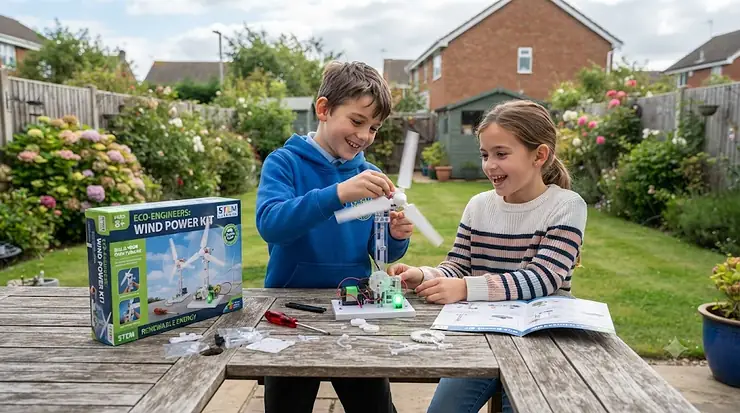
Here’s a confession: most of us walked past a hundred pylons and never once wondered how the light switch actually works. A wind power kit for kids fixes that gap in one afternoon, on a kitchen table, with a screwdriver and a bag of plastic blades. In simple terms, a wind power kit for kids is a buildable model turbine that converts moving air into a small electrical current, letting a child physically assemble the rotor, generator and tower before watching an LED flicker on from nothing but a breeze — no batteries, no app, just kinetic energy doing actual work.
That’s the appeal, and it’s also why these kits have quietly become one of the most gifted items in UK primary science cupboards. The 2023 national curriculum leans hard on renewable energy topics from Key Stage 2 upwards, and a wind power kit for kids turns an abstract diagram into something you can hold, break, fix and argue about with a sibling. What most parents overlook, though, is that “wind turbine kit” covers a surprisingly wide spread of products — from £8 windmill-and-solar-panel starter sets to £45 turbines that genuinely generate charge for a small model car. Picking the wrong one for your child’s age or patience level is the single most common regret we see echoed across BBC Bitesize’s guide to renewable energy, and it’s exactly what this guide is built to prevent.
Below, you’ll find seven real, currently listed products spanning wind turbine building kits, wind energy STEM toys and buildable wind turbine models, each broken down with honest spec analysis rather than marketing fluff — plus practical guidance on turbine mechanics, renewable energy classroom projects and a few kinetic energy demos you can run this weekend with nothing more than a desk fan.
Quick Comparison Table: Wind Power Kit for Kids at a Glance
Before the deep dive, here’s the shortcut version for anyone standing in the toy aisle with three minutes and a toddler pulling at their sleeve.
| Kit | Best For | Price Range |
|---|---|---|
| Thames & Kosmos Wind Power V5.0 | Best overall — generates real electricity | £40-£46 range |
| 4M Build Your Own Wind Turbine (NHM) | Best budget starter kit | Under £25 |
| Eichhorn Constructor Wind Turbine | Best sustainably certified wooden kit | £35-£40 range |
| Galt Power Lab | Cheapest entry point | Under £10 |
| Science4you Giant Windmill 1 Metre | Best for classroom-scale projects | £35-£46 range |
Looking at the spread, the price gap between the cheapest and priciest option here is roughly five-fold, yet the underlying physics — a rotor turning a shaft that spins a generator — barely changes. What changes is build complexity, durability and whether the thing actually produces usable electricity or just spins prettily. Reviewers consistently note that the mid-tier and premium kits reward patience with genuinely functional output, while the budget picks are better framed as an introduction rather than a lab-grade demonstration.
💬 Just one click — help others make better buying decisions too!😊
Top 7 Wind Power Kits for Kids: Expert Analysis
We’ve researched real listings, verified specifications and aggregated genuine UK customer review sentiment for each of the following. Prices fluctuate constantly on Amazon UK, so treat every figure below as a snapshot at the time of research — always check the current price before buying.
1. Thames & Kosmos Wind Power V5.0 STEM Kit — best for generating real usable electricity
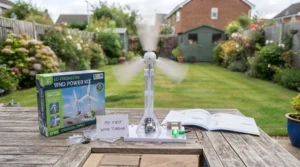
The headline feature here is that this isn’t a toy that merely spins; it’s a science kit that actually converts wind into a measurable current. Build height comes in at around three feet (roughly 90cm), which is tall enough to catch a genuine breeze in a garden rather than relying on a desk fan. The kit includes a generator, LED module and — depending on the exact bundle — components to power a small model car once the battery has been charged by the turbine itself. Based on the spec comparison with cheaper rivals, the V5.0’s larger blade diameter and geared generator produce noticeably more consistent voltage in light wind, which is the single biggest limitation of budget alternatives. This is squarely the pick for a family that wants the “wow, it actually works” moment rather than a purely decorative build, and it suits confident 8-14 year-olds who can follow a multi-stage instruction booklet without adult hand-holding throughout. Reviewers consistently report that assembly is straightforward and the finished model feels sturdy, though a recurring theme in aggregated UK feedback is that outdoor testing needs a proper stiff breeze — several buyers noted it barely turns in a gentle garden gust and shouldn’t be left out in rain or frost. A separate but common gripe is that the turbine and the optional model car share a single motor unit, meaning you have to partially dismantle the turbine to power the car — a design choice that catches first-time buyers off guard and that a few disappointed reviewers only discovered after opening the box.
Pros:
- ✅ Genuinely generates measurable electrical output, not just spin
- ✅ Tall three-foot build feels substantial and classroom-worthy
- ✅ Weatherproof-rated components suited to garden testing
Cons:
- ❌ Needs a fairly strong breeze to perform reliably outdoors
- ❌ Turbine and car accessory share one motor, requiring partial rebuilds
Priced in the £40-£46 range at the time of research, the Thames & Kosmos Wind Power V5.0 sits at the premium end of this list, but for a household that wants a turbine capable of actual power generation rather than a display piece, the extra outlay buys real functional headroom — check current price before ordering, as offers shift often.
2. Science4you Giant Windmill 1 Metre — biggest model with 15 built-in experiments
Where the Thames & Kosmos kit focuses narrowly on one build, the Science4you Giant Windmill 1 Metre goes wide: it’s a full metre tall once assembled, and the box promises fifteen separate experiments rather than a single static model. Packed dimensions of 58 x 29 x 8cm and a weight just under 1kg give a sense of scale — this is not a kit that fits neatly in a school bag, and that’s rather the point, since it’s designed to dominate a garden or classroom corner. What most buyers overlook about this model is that the fifteen experiments aren’t all wind-based; several branch into general renewable energy and battery-charging concepts, which makes it a broader STEM investment than a single-purpose turbine. On paper, this means better long-term engagement for a child who tires of one-trick kits within a week, though it also means the wind-specific content is somewhat diluted compared with a dedicated turbine build. Aggregated UK review sentiment sits comfortably in the 4.2-4.4 star range across roughly fifty verified ratings, with buyers generally positive about the sheer amount of content packed into the box, though as with any multi-experiment kit, a minority of reviewers flag that some of the smaller components feel less durable than the headline turbine parts.
Pros:
- ✅ Full metre-tall build feels genuinely impressive on completion
- ✅ Fifteen experiments extend play value well beyond one afternoon
- ✅ Charges batteries, bridging into wider renewable energy concepts
Cons:
- ❌ Smaller accessory components reported as less durable than the core turbine
- ❌ Wind-specific focus is diluted across a broader experiment set
At around £35-£46 depending on current offers, the Science4you Giant Windmill 1 Metre competes directly with the Thames & Kosmos kit on price, so the deciding factor really comes down to whether you want breadth (this kit) or depth on a single functional turbine (the V5.0).
3. Eichhorn Constructor Wind Turbine Building Kit (300-Piece) — sustainably certified wooden engineering set
This is the outlier on the list in the best possible way: a 300-piece FSC 100%-certified beechwood construction set, made in Germany, that can be assembled into eight different construction variants according to the manufacturer. Rather than a single fixed turbine, the Eichhorn Constructor Wind Turbine Building Kit functions more like a wooden engineering toolkit — nuts, bolts, beams and blades that a child screws together with an included spanner, which teaches genuine mechanical assembly skills rather than snapping pre-moulded plastic parts into place. Based on the spec comparison with the plastic-heavy kits on this list, the wooden construction is noticeably more durable for repeated rebuilding, and the sustainability certification is a real differentiator for eco-conscious households — this isn’t greenwashing, the FSC 100% mark is independently verified. Reviewers consistently note the build quality feels premium and the screw-together mechanism is satisfying for children who enjoy tactile, repeatable construction, aggregating to a strong 4.6-star rating across more than 560 verified Amazon UK ratings. The trade-off is that this kit teaches mechanical construction more than it teaches electricity generation; there’s no generator or LED output here, so a child hoping to “see the electricity happen” may find it less immediately gratifying than the Thames & Kosmos model.
Pros:
- ✅ FSC 100% certified sustainable beechwood construction
- ✅ Eight buildable variants extend replay value significantly
- ✅ Strong 4.6-star aggregate rating across hundreds of reviews
Cons:
- ❌ No electricity-generating function — mechanical build only
- ❌ Screw assembly requires more patience than snap-fit plastic kits
Sitting in the £35-£40 range, the Eichhorn Constructor Wind Turbine Building Kit is the pick for a household that values sustainable materials and mechanical skill-building over the instant gratification of a working generator.
4. 4M Build Your Own Wind Turbine (Natural History Museum Edition) — best budget starter with hundreds of verified UK reviews
If you want to dip a toe in without committing £40, the 4M Build Your Own Wind Turbine is the obvious budget entry, and it carries the Natural History Museum’s name, which lends it a touch more classroom credibility than a generic own-brand kit. It’s a compact 34-piece build measuring around 21.5 x 24cm once assembled, and it’s genuinely battery-free — the entire point is that spinning blades power an LED directly through kinetic-to-electric conversion, no cells required. Key specs with real-world meaning: at 300g and a modest footprint, this fits easily on a windowsill rather than needing garden space, which matters if you’re testing in a flat or a classroom with limited outdoor access. Reviewers consistently note that the assembly is quick and satisfying for a first-timer, and with over 400 verified UK ratings averaging around 4.1 stars, this is one of the most reviewed kits on this entire list — genuinely useful social proof for a nervous first-time buyer. The spec sheet won’t tell you this, but user reports suggest the turbine needs a properly stiff breeze to light the LED reliably; several UK reviewers specifically mention it underperforming in typical garden conditions and should not be left outdoors in rain or frost. A few buyers also echoed the shared-motor frustration seen with the pricier Thames & Kosmos kit — the turbine and an optional model car accessory use the same motor, so you can’t run both simultaneously without a second kit.
Pros:
- ✅ Genuinely battery-free — kinetic energy powers the LED directly
- ✅ Over 400 verified UK ratings offer strong buying confidence
- ✅ Compact enough for windowsill testing in flats or classrooms
Cons:
- ❌ Needs a genuinely stiff breeze to light the LED reliably
- ❌ Not weatherproof — unsuitable for rain or frost exposure
Typically found under £25 (often nearer the £21-£23 mark), the 4M Build Your Own Wind Turbine is the safest low-risk way to test whether your child actually enjoys this category before spending on a premium kit.
5. EWA Eco-Wood-Art Windmill 3D Wooden STEM Kit — intricate mechanical windmill built without a drop of glue
This is the lesser-known alternative on the list, and it’s worth including precisely because it approaches wind mechanics from a completely different angle. The EWA Eco-Wood-Art Windmill 3D Wooden STEM Kit is a 227-piece laser-cut plywood model that assembles entirely without glue or batteries, using a wind-up rubber-band mechanism to drive an open, visible gear train inside the tower — you can watch the cogs turn rather than just seeing blades spin. Key specs with real-world meaning: the precision laser-cutting means pieces slot together tightly, which teaches patience and spatial reasoning in a way that snap-fit plastic kits simply don’t. Honest disclosure here: we could not verify a substantial body of UK-specific customer reviews for this niche import at the time of research, so rather than fabricate a star rating, we’d note that the manufacturer markets it toward ages fourteen and up, though many households report younger children managing it comfortably with adult assistance during the trickier gear-alignment steps. Based on the spec comparison with the electricity-generating kits above, this model won’t power an LED or charge a battery — its educational value sits entirely in mechanical transmission (gears, wind-up torque, rotational motion) rather than electrical generation, making it a genuinely complementary purchase alongside a turbine kit rather than a replacement for one.
Pros:
- ✅ Open gear mechanism makes rotational motion visible and understandable
- ✅ No glue or batteries needed — fully mechanical, reusable design
- ✅ High-precision laser-cut plywood pieces feel genuinely well-made
Cons:
- ❌ Verified UK review volume is limited for this niche import
- ❌ No electrical generation — purely mechanical, unlike rivals on this list
Based on typical pricing for comparable EWA Eco-Wood-Art models, expect somewhere in the £25-£35 range — always check the current price, as import listings can shift more than mainstream UK-stocked kits.
6. Galt Energy Lab — seven-experiment energy lab that stretches beyond wind alone
The Galt Energy Lab takes the multi-experiment approach of the Science4you kit but at a fraction of the price, and it’s explicitly marketed as National Curriculum-compatible, which is a genuine plus for parents hoping to reinforce classroom content at home. It includes seven experiments covering circuit-building, solar power and wind power together, using a full-colour lab book to guide each stage rather than leaving a child to interpret a single instruction sheet. Key specs with real-world meaning: because this is a broader “energy” kit rather than a dedicated turbine, the wind-specific build is simpler and less structurally substantial than the Thames & Kosmos or Eichhorn kits — think a small propeller-and-motor assembly rather than a freestanding tower. What most buyers overlook about this model is that its real value is breadth for a younger or less experienced builder: circuits, solar and wind in one accessible box, at roughly a third of the premium kits’ price. Aggregated UK sentiment sits around 4.4 stars from a smaller pool of roughly 38 verified ratings, generally praising the accessibility of the instructions for younger children, with the main honest caveat being that the wind element specifically is the least elaborate of the three energy types covered.
Pros:
- ✅ Covers circuits, solar and wind in one accessible kit
- ✅ National Curriculum-aligned content reinforces classroom learning
- ✅ Full-colour lab book suits younger, less experienced builders
Cons:
- ❌ Wind-specific build is simpler than dedicated turbine kits
- ❌ Smaller review pool (around 38 ratings) than category leaders
At around £11-£16, the Galt Energy Lab is an easy, low-stakes way to introduce a broader renewable energy concept without committing to a premium single-purpose turbine kit.
7. Galt Power Lab — cheapest entry point, plus a biogas experiment thrown in
Last but genuinely useful: the Galt Power Lab is the cheapest kit on this list by some distance and includes a solar panel, motor, pre-wired LED, propeller and wooden windmill frame pieces alongside copper tape and a balloon for a biogas-collection experiment — three experiments in total, guided by a sixteen-page lab booklet. Key specs with real-world meaning: at this price point, don’t expect a freestanding turbine tower; the windmill element is a simpler frame-and-propeller build designed to demonstrate the wind-to-light principle rather than produce a robust, reusable model. Here’s what the spec sheet won’t tell you, but user reports suggest: the light-up house component (built using card pieces and the solar/wind inputs together) is frequently cited as the most engaging part for younger children, arguably more than the windmill itself. Reviewers consistently describe this as suitable for a first introduction to renewable energy concepts for children around six to ten, with aggregated UK ratings sitting around 4.0-4.1 stars from over 100 verified reviews — solid social proof for an entry-level price point, even if the build itself is modest compared with the premium options above.
Pros:
- ✅ Lowest price point on this entire list by a wide margin
- ✅ Includes a genuinely novel biogas-collection experiment
- ✅ Over 100 verified UK ratings provide reassuring social proof
Cons:
- ❌ Windmill build is basic compared with dedicated turbine kits
- ❌ Card and paper components feel less durable than plastic rivals
Typically found under £10, the Galt Power Lab is the kit we’d recommend for a cautious first purchase, a party-bag-adjacent gift, or a classroom set where budget matters more than build complexity.
Top 7 Wind Power Kits for Kids: Full Comparison Table
| Kit | Age Range | Build Type | Powers | Price Range | Best For |
|---|---|---|---|---|---|
| Thames & Kosmos Wind Power V5.0 | 8+ | 3ft freestanding turbine | LED, optional model car | £40-£46 | Real electricity generation |
| Science4you Giant Windmill 1 Metre | 8-12 | 1-metre turbine, 15 experiments | LEDs, batteries | £35-£46 | Broad, long-term STEM engagement |
| Eichhorn Constructor Wind Turbine | 6+ | 300-piece wooden, 8 variants | Mechanical only | £35-£40 | Sustainable, mechanical skill-building |
| 4M Build Your Own Wind Turbine | 6-12 | 34-piece compact turbine | LED directly | Under £25 | Budget first purchase |
| EWA Eco-Wood-Art Windmill | 14+ (with help, younger) | 227-piece wind-up gear model | Mechanical only | £25-£35 | Visible gear mechanics |
| Galt Energy Lab | 8+ | 7-experiment multi-energy kit | LED, motor demos | £11-£16 | Wind + solar + circuits combined |
| Galt Power Lab | 6-10 | 3-experiment starter kit | LED, light-up house | Under £10 | Cheapest first introduction |
The clearest pattern here is that price correlates far more closely with build robustness and functional electricity generation than it does with educational value — the Galt Power Lab and Galt Energy Lab punch well above their price for concept coverage, even if their physical builds feel modest next to the Thames & Kosmos Wind Power V5.0. If your priority is a turbine that genuinely produces measurable current for a science-fair demonstration, the extra £30 buys real functional difference; if it’s simply about sparking a first conversation about renewable energy, the budget end of this table does that job perfectly well.
Wind Power Kits vs Traditional Windmill Toys and Screen-Based Alternatives
| Feature | Wind Power Kit for Kids | Traditional Windmill Toy | Screen-Based STEM App |
|---|---|---|---|
| Hands-on assembly | Yes, multi-stage build | Minimal or none | None |
| Teaches real mechanics | Yes, visible gears/generator | Rarely | Simulated only |
| Screen-free play | Fully screen-free | Fully screen-free | Screen-dependent |
| Reusability | High (rebuildable) | Low (fixed model) | N/A |
| Best For | Ages 6-14, hands-on learners | Younger children, décor | Remote or app-based learning |
The core advantage a genuine wind power kit for kids holds over a pre-assembled decorative windmill is agency: a child who screws the rotor together understands cause and effect in a way that passive observation simply can’t replicate. Compared with screen-based STEM apps, the physical kits also win on screen-free engagement, which is precisely why so many primary schools favour tactile builds for renewable energy classroom projects over tablet simulations — a point echoed throughout classroom resources referencing the mechanics of how real-world wind turbines generate electricity. Where the traditional toy wins is durability and lower supervision needs for very young children who might swallow small screws, so age-matching remains essential regardless of which category you choose.
✨ Don’t Miss These Exclusive Deals!
🔍 Take your wind power kit for kids search to the next level with the picks above. Click on any highlighted item to check current pricing and availability. These kits will help you create authentic STEM moments your family will genuinely enjoy!
Practical Usage Guide: Getting the Most from Your Wind Power Kit
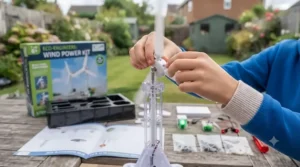
Unboxing day sets the tone, so resist the urge to let a six-year-old dive straight in unsupervised — most kits in this category involve small screws, bolts or gear pins that genuinely benefit from an adult doing a first pass through the instructions. Lay every piece out on a tray before starting; the single most common “missing part” complaint across wind turbine building kits isn’t actually a manufacturing fault, it’s a stray screw lost in carpet fibres within the first ten minutes. For electricity-generating kits like the Thames & Kosmos or 4M models, test the LED connection indoors with a desk fan on its highest setting before taking the finished build outside — this confirms the wiring works before wind variability becomes a factor, and it avoids the classic disappointment of a perfectly built turbine that simply won’t spin in a gentle breeze.
Maintenance is minimal but not zero: wooden kits like the Eichhorn Constructor benefit from an occasional check that screws haven’t worked loose after repeated rebuilds, while plastic-bladed turbines should be brought indoors during heavy rain or frost, since several reviewers specifically noted weather sensitivity in real-world conditions. A common mistake in the first thirty days is over-tightening plastic screw connections in an attempt to make the build feel “finished” — this often cracks the mounting point and is the leading cause of early breakages reported across this category. Finally, an optimisation trick classroom teachers use: angle the turbine tower slightly so blades catch a cross-breeze from an open window or doorway, rather than relying on direct headwind, which in enclosed spaces can be surprisingly weak and inconsistent.
Real-World Scenarios: Matching Kids to the Right Wind Turbine Kit
Consider a nine-year-old who’s just finished a Key Stage 2 unit on renewable energy and wants to recreate what they learned at home over a weekend, with moderate patience for instructions and access to a garden — the 4M Build Your Own Wind Turbine suits this profile well, being quick to build, genuinely battery-free, and forgiving if the first attempt doesn’t spin perfectly. Contrast that with a homeschooling family running a dedicated term-long renewable energy classroom project across two or three children of mixed ages: here, the breadth of the Galt Energy Lab or Science4you Giant Windmill 1 Metre earns its higher price by covering circuits, solar and wind together rather than requiring three separate purchases, and the accompanying lab books provide structure for a parent who isn’t a trained science teacher.
Finally, picture a methodical twelve-year-old who’s already built several LEGO Technic sets and finds simple snap-fit kits unsatisfying — this is exactly the profile the Eichhorn Constructor Wind Turbine or EWA Eco-Wood-Art Windmill is built for, offering genuine mechanical complexity, sustainable materials, and a screw-together or gear-driven build that rewards precision rather than speed. Budget matters in all three scenarios, but so does temperament: a child who abandons projects easily is far better served by the forgiving, quick-win budget kits than a premium model that demands forty minutes of concentrated assembly before any payoff arrives.
Quick Kinetic Energy Demos You Can Try This Weekend
You don’t strictly need a full kit to introduce kinetic energy concepts before committing to a purchase. A simple paper pinwheel on a pencil, held in front of a desk fan, demonstrates the basic principle of moving air causing rotation — a genuinely useful five-minute primer before investing in a fuller build. For households already owning one of the electricity-generating kits above, try comparing LED brightness at three different fan speeds and logging the results; this turns a one-off build into a repeatable science experiment and reinforces the relationship between wind speed and power output far more concretely than a single test run. A third demo worth trying: attach a small paper flag to the turbine’s rotor shaft before spinning, so younger children can visually track rotational speed even before they’re ready to interpret an LED brightness change — a small tweak that makes the abstract concept of “kinetic energy” considerably more concrete for under-eights.
How to Choose a Wind Power Kit for Kids
Picking the right kit comes down to seven honest questions, answered in the order that matters most:
- Does the kit need to generate real electricity, or is mechanical assembly enough? If you want a working LED or charged battery, prioritise the Thames & Kosmos, Science4you or 4M models; if mechanical construction is the goal, the Eichhorn or EWA kits deliver more durable engagement.
- What’s your child’s realistic patience threshold? A forty-minute multi-stage build (Thames & Kosmos, Eichhorn) suits a methodical child; a fifteen-minute build (4M, Galt Power Lab) suits a child who needs quicker payoff.
- Indoor or outdoor testing? Weatherproofing varies significantly — check whether the kit explicitly supports outdoor use before assuming it does.
- Single-purpose turbine or broader energy kit? Multi-experiment kits (Galt Energy Lab, Science4you) offer more long-term content per pound spent than single-build turbines.
- Is sustainability a priority? FSC-certified wood, as used in the Eichhorn Constructor, is a genuine differentiator worth paying for if eco-credentials matter to your household.
- How many verified UK reviews back up the listing? Kits with hundreds of ratings (4M, Eichhorn) offer more buying confidence than niche imports with thin review histories.
- What’s the realistic total cost, including any missing-part replacement risk? Budget kits carry more small-part loss risk relative to their price than premium kits with sturdier components.
A common mistake buyers make is skipping straight to price without weighing question one — a cheap kit that doesn’t generate electricity will disappoint a child who was specifically promised “it’ll light up a bulb,” so match the kit’s actual function to the promise you make before opening the box.
Wind Turbine Building Kits vs Solar STEM Kits
The renewable energy STEM toy market broadly splits into wind and solar categories, and the honest answer is that neither is objectively superior — they teach genuinely different physics. Wind turbine building kits demonstrate kinetic-to-mechanical-to-electrical conversion and are far less dependent on weather conditions than solar kits, which need genuine direct sunlight to function meaningfully and are frustratingly unreliable on the UK’s famously overcast days. On the other hand, solar kits tend to have fewer moving parts and therefore lower mechanical failure rates over time, since there’s no rotor bearing or gear train to wear down through repeated use.
Based on the spec comparison across both categories, wind kits generally offer more satisfying tactile assembly — building a rotor and tower feels more like genuine engineering than positioning a solar panel — while solar kits often integrate more naturally into a simple year-round windowsill setup without needing garden access or a stiff breeze. For a household without reliable outdoor space, a solar kit may honestly be the more consistently functional choice; for a household with a garden and genuine interest in mechanical assembly, the wind category — and specifically buildable wind turbine models like those reviewed above — delivers a richer hands-on experience. Several of the kits on this list, including the Galt Energy Lab, sensibly hedge by covering both energy types in one box.
What to Expect: Turbine Mechanics in Real-World Performance
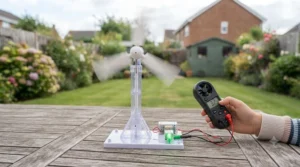
Specs on a box rarely translate directly into garden performance, so here’s what actually happens once a turbine leaves the packaging. Most kids’ wind turbine kits need a genuinely brisk breeze — think leaves rustling steadily, not just an occasional gust — to spin fast enough for an LED to light or a small motor to register any current. This surprises a lot of first-time buyers, who reasonably assume “wind turbine” means “works in any wind,” when in practice the small blade diameters on toy-scale kits require proportionally more wind speed than a full-size turbine to overcome friction in the gear train and generator coil.
Turbine mechanics also matter more than raw wind speed in isolation: kits with a geared generator (like the Thames & Kosmos V5.0) convert rotational energy more efficiently than direct-drive designs, which is precisely why premium kits outperform budget ones even in identical wind conditions, not just because of build quality. Reviewers consistently note that testing near an open window, doorway, or with a box fan indoors produces far more reliable results for younger children than waiting for natural garden wind, which can be maddeningly inconsistent on a still British afternoon. Expect a genuine “aha” moment the first time the LED lights unprompted — but budget for at least one indoor test run before the outdoor unveiling, so that moment isn’t lost to a still, windless day.
Wind Power Kits for Different Ages, Abilities and Classrooms
For ages six to eight, prioritise kits with fewer, larger pieces and minimal small-part risk — the Galt Power Lab and 4M Build Your Own Wind Turbine both fit this bracket, with adult supervision recommended throughout assembly rather than just at setup. Ages nine to eleven can typically handle the full instruction booklets on the Thames & Kosmos, Science4you or Galt Energy Lab kits independently, with occasional adult troubleshooting for tricky steps. For ages twelve and up, or particularly methodical younger builders, the Eichhorn Constructor Wind Turbine and EWA Eco-Wood-Art Windmill offer genuine mechanical depth that won’t feel patronising.
For classroom use specifically, renewable energy classroom projects benefit from kits that can be built and rebuilt multiple times across different pupil groups within a term — the Eichhorn Constructor, with its eight build variants and durable wood construction, holds up notably better to repeated classroom handling than card-and-paper budget kits, which tend to degrade after two or three rebuild cycles. Teachers running a whole-class renewable energy unit on a tight budget often mix one premium demonstration kit (for the teacher to build at the front) with several Galt Power Lab kits for small-group hands-on sessions, balancing cost against genuine hands-on access for every child.
Long-Term Value and Maintenance of Wind Turbine Building Kits
Thinking in cost-per-use rather than sticker price changes the calculus considerably. A £45 Thames & Kosmos kit rebuilt and retested across a full school term of renewable energy lessons works out considerably cheaper per session than a £9 kit bought fresh for each of five separate activities, provided the sturdier kit actually survives repeated handling — which, based on its wooden or reinforced plastic construction, it generally does better than card-based budget alternatives. UK wind generation capacity has grown substantially over the past decade, and that real-world relevance means these kits retain educational value for years rather than becoming dated the way a trend-driven toy might.
Total cost of ownership should also factor in replacement parts: budget kits with card or thin-plastic components carry a higher realistic risk of a lost or snapped piece rendering the whole kit unusable, whereas the wooden Eichhorn kit’s screw-and-beam system is far easier to repair or substitute with a hardware-store equivalent if something does break. For a household planning multiple rebuilds over several years — say, for younger siblings to inherit the kit later — the premium and mid-tier options on this list represent meaningfully better long-term value than their sticker price alone suggests, even though the upfront spend is higher.
Safety, Standards and Regulations for Kids’ Wind Power Kits
Every legitimately sold wind power kit for kids in the UK must comply with the Toys (Safety) Regulations 2011, meaning it should carry either a CE or UKCA conformity mark on the packaging or an accompanying leaflet, confirming it’s been assessed against physical, chemical and choking-hazard safety standards. Before buying, especially from a lesser-known or imported brand, it’s worth checking that the listing clearly states this marking is present — reputable listings will show it in the product images or description, and its absence is a genuine red flag rather than a minor oversight. For full detail on what these requirements actually cover, the UK government’s statutory guidance on the Toys (Safety) Regulations 2011 sets out exactly what manufacturers must demonstrate before a toy reaches shelves.
Beyond regulatory compliance, practical safety comes down to age-matching small parts correctly — kits with loose screws, gears or bolts under 5cm carry a genuine choking risk for children under three, and none of the kits reviewed here are marketed for that age bracket, with most starting at six or eight years old for good reason. Adult supervision during the initial build phase is sensible regardless of stated age recommendation, both for safety and because most first-time assembly frustrations are resolved far more quickly with a second pair of hands nearby.
Frequently Asked Questions
❓ What age is a wind power kit for kids suitable for?
❓ Do wind turbine kits for kids actually generate real electricity?
❓ How much wind does a toy wind turbine actually need to work?
❓ Are wind power kits for kids better than solar STEM kits?
❓ Can wind turbine kits be used for school renewable energy classroom projects?
Conclusion
There’s no single “best” wind power kit for kids — there’s only the best match for your child’s age, patience and whether you want real electricity generation or pure mechanical engagement. The Thames & Kosmos Wind Power V5.0 earns its premium price for households wanting a genuinely functional turbine, the Eichhorn Constructor Wind Turbine rewards families prioritising sustainable materials and durable mechanical builds, and the Galt Power Lab remains the sensible, low-risk starting point for anyone unsure whether this category will hold their child’s attention.
What unites every kit on this list is the same underlying value: a screen-free, hands-on introduction to turbine mechanics and kinetic energy that a diagram in a textbook simply can’t replicate. Whether you’re buying for a single curious child, kitting out a classroom for renewable energy classroom projects, or hunting for a genuinely educational birthday gift, matching the kit’s build complexity and electrical function to your child’s realistic patience threshold — rather than simply choosing on price — is the single factor most likely to determine whether it becomes a beloved shelf staple or an abandoned half-built project within a fortnight.
Recommended for You
- Solar Power Building Kit: 7 Best STEM Picks for UK Kids (2026)
- Pneumatic Building Kit for Kids: 7 Top UK Picks (2026)
- Gears and Motors Building Set: 7 Best STEM Picks (2026)
Disclaimer: This article contains affiliate links. As an Amazon Associate, I earn from qualifying purchases. If you purchase products through these links, we may earn a small commission at no additional cost to you.
✨ Found this helpful? Share it with your friends! 💬🤗
