
In This Article
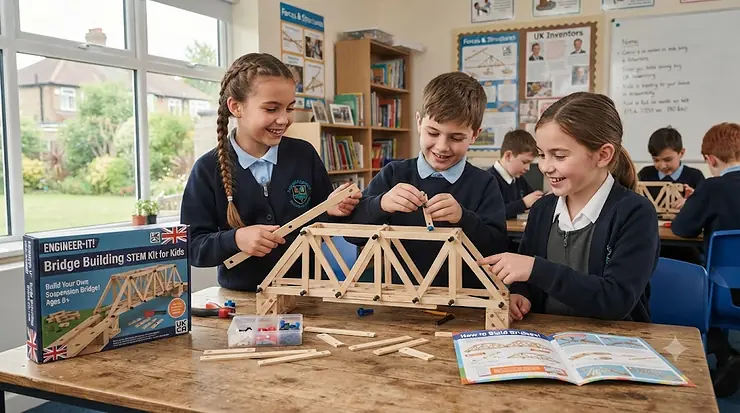
Somewhere in every household with a curious 8-year-old, there’s a coffee table currently doubling as a construction site. Spaghetti and marshmallows, lolly sticks and sticky tape, a stack of books propped up like makeshift piers — it’s the classic homegrown engineering experiment, and it’s brilliant right up until the “bridge” collapses under the weight of a single toy car and someone bursts into tears. A proper bridge building STEM kit for kids solves that problem before it starts. In short: it’s a construction toy specifically engineered to teach real bridge mechanics — beams, trusses, arches, suspension cables — using parts designed to be tested, rebuilt and load-tested without dissolving into a soggy heap.
What separates a good one from a plastic box of random rods is whether it actually teaches something. The best sets don’t just let a child snap pieces together; they explain, in age-appropriate language, why a triangle is stronger than a square, or why a suspension bridge’s cables are always in tension while its towers are in compression. That’s the difference between a toy and a genuine engineering education tool, and it’s exactly what the Institution of Civil Engineers highlights in its own schools outreach work, where hands-on bridge-building activities are used specifically because physically testing a structure teaches load and stability concepts far more effectively than a diagram ever could.
This guide covers seven genuinely available kits — from a £14.99 wooden Da Vinci bridge to a full £40-plus structural engineering system — researched against real UK listings, real specifications and honest aggregated review sentiment rather than marketing copy. Whether you’re buying for a curious five-year-old or a Year 6 pupil prepping for a science fair, there’s a build here that fits your budget, your child’s patience span, and their appetite for genuine structural engineering toys for kids.
Quick Comparison Table
| Kit | Best For | Age Range | Price Range |
|---|---|---|---|
| Thames & Kosmos Structural Engineering: Bridges & Skyscrapers | Overall depth and value | 8+ | £35-£50 range |
| K’NEX Education Intro to Structures: Bridges Set | Covering every real bridge type | 8-11 | Around £25 |
| Learning Resources STEM Explorers Bridge Builders | Younger beginners | 5+ | £20-£25 range |
| Pathfinders STEM Kit – Wooden Lift Bridge | A satisfying working mechanism | 7+ | £18-£25 range |
| Pathfinders Da Vinci Bridge Wooden Kit | Budget-conscious first builds | 7+ | Under £15 |
Looking at this snapshot, the pattern is fairly clear: price generally tracks piece count and model variety, not build quality. The Pathfinders Da Vinci Bridge Wooden Kit proves you don’t need to spend big to teach a genuine engineering principle, while the Thames & Kosmos Structural Engineering: Bridges & Skyscrapers set earns its higher price tag through sheer breadth — 20 buildable models rather than one or nine. If your child is a first-timer, start at the cheaper end of this table before committing to a premium system.
💬 Just one click — help others make better buying decisions too!😊
Top 7 Bridge Building STEM Kits for Kids: Expert Analysis
1. Thames & Kosmos Structural Engineering: Bridges & Skyscrapers — most comprehensive engineering curriculum
The headline figure here is 20 buildable models from a single box, and that number does the heavy lifting in explaining why this kit tops the list. With 285-plus interchangeable pieces and a 36 to 44-page illustrated manual, it’s less a toy and more a structured course in structural engineering that happens to be built from plastic components.
Each of the twenty models is paired with a written lesson on the specific force at play — force, load, compression, tension — so a child isn’t just snapping a truss bridge together; they’re being told why that triangular lattice resists collapse where a flat beam wouldn’t. Based on the spec comparison against rival kits, the sheer density of documented models is what justifies the higher price bracket here, and Purdue University engineering education researchers were involved in aligning the content to recognised STEM standards, which is a genuinely unusual level of academic rigour for a toy aisle product.
Thames & Kosmos Structural Engineering: Bridges & Skyscrapers carries a Parents’ Choice Gold Award and consistently strong review scores across major listings — reviewers repeatedly single out the clarity of the instruction manual and the satisfaction of seeing a model genuinely bear weight before it fails. A recurring theme in aggregated feedback is that the kit rewards patience: younger children sometimes need an adult alongside them for the first few builds before working independently. What most buyers overlook about this model is that its “Intermediate” skill rating isn’t marketing fluff — it genuinely assumes some prior fine-motor confidence, so it suits a child who has already dabbled with simpler construction toys.
Pros:
- ✅ Twenty distinct models cover nearly every core bridge and structure type
- ✅ Award-winning manual links each build to a real engineering concept
- ✅ Reusable, interchangeable pieces support open-ended rebuilding
Cons:
- ❌ Sits at the premium end of this list on price
- ❌ Intermediate skill level can frustrate total beginners without support
Typically found in the £35-£50 range depending on retailer discounts, Thames & Kosmos Structural Engineering: Bridges & Skyscrapers represents strong value per model built — at roughly £2 per finished structure, it’s genuinely one of the better cost-per-play toys in this category, provided your child is ready for the step up.
2. K’NEX Education Intro to Structures: Bridges Set — best for covering every real bridge type
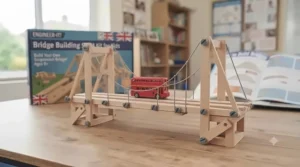
If the previous kit is about depth, this one is about breadth of a different kind: the 207-piece K’NEX Education Intro to Structures: Bridges Set builds thirteen fully functioning replica bridges, and — unusually for a toy at this price — it actually covers all seven major real-world bridge categories: beam, truss, arch, cantilever, suspension, cable-stayed and movable (bascule) designs.
That completeness matters more than it sounds. Plenty of cheaper bridge construction toy sets only ever let a child build variations on one or two bridge types, which flattens the whole point of the exercise. Here, a child who builds the suspension model one afternoon and the cantilever the next is directly comparing two completely different ways of solving the same problem — how do you span a gap without it sagging or snapping — which is precisely how working structural engineers think through a brief. The rods-and-connectors system is designed for two to three children to build together, and the accompanying Teacher’s Guide is aligned to UK-relevant STEM and Common Core-adjacent standards, making it a genuinely popular choice for schools and after-school clubs, not just individual households.
Aggregated review sentiment for K’NEX Education products more broadly is consistently positive on durability — the snap-fit rods are tough enough to survive repeated disassembly, which matters enormously for a kit that’s meant to be rebuilt dozens of times rather than displayed once. The main criticism that surfaces in real feedback is that the set is explicitly designed around collaborative, classroom-style use, so a solo-building child at home may find some of the larger models genuinely fiddly to manage single-handed.
Pros:
- ✅ Builds all seven major real-world bridge types
- ✅ Snap-fit rods are notably durable through repeated rebuilds
- ✅ Comes with a proper storage tray and teacher-style guide
Cons:
- ❌ Designed for 2-3 children working together, less ideal solo
- ❌ Fewer total pieces than the Thames & Kosmos alternative
Priced around £25, the K’NEX Education Intro to Structures: Bridges Set undercuts the premium options while still delivering genuine structural variety — arguably the strongest all-rounder for anyone specifically hunting for a bridge building STEM kit for kids rather than a general construction set.
3. Engino Discovering STEM: Structures – Buildings & Bridges — best app-guided build experience
Engino Discovering STEM: Structures – Buildings & Bridges takes a different route to the same destination. Rather than a printed booklet, its nine models are guided through Engino’s kidCAD 3D viewer app, which walks a child through each build step by step on a tablet or phone rather than a flat diagram. For a generation of kids who are more fluent scrolling than reading instruction manuals, this is a genuinely clever piece of design.
The snap-fit component system is built to be more durable and more precise than looser peg-and-hole toys — reviewers consistently note that joints stay tight even after a model has been taken apart and rebuilt several times, which isn’t always true of cheaper construction toys where connectors wear loose. The kit ships with a curriculum booklet covering theory, guided experiments and quizzes, so it’s not purely app-dependent; the physical materials stand on their own if a screen isn’t available. Here’s what to weigh: with only nine models against K’NEX’s thirteen or Thames & Kosmos’s twenty, this kit trades sheer volume for depth of engagement per model, and for a child who gets bored quickly by repetitive builds rather than fewer, richer ones, that trade-off can actually be the better fit.
Pros:
- ✅ App-guided 3D instructions are genuinely engaging for tech-native kids
- ✅ Snap-fit pieces hold tight through repeated rebuilding
- ✅ Curriculum booklet adds real theory, not just build steps
Cons:
- ❌ Fewer buildable models (9) than most rivals on this list
- ❌ Getting full value requires occasional access to a tablet or phone
Generally priced in the £25-£35 range, Engino Discovering STEM: Structures – Buildings & Bridges suits a household that already leans digital-first, and it slots neatly into the wider Engino ecosystem if you’re likely to buy further sets down the line.
4. Learning Resources STEM Explorers Bridge Builders — best for younger first-time builders
Most bridge building STEM kits assume a reading-confident 8-year-old. Learning Resources STEM Explorers Bridge Builders doesn’t — it’s rated from age 5, and the 72-piece set is deliberately scaled down in complexity without dumbing down the underlying engineering lesson.
The standout feature here is the included testing truck: children don’t just build a bridge, they roll a weighted truck across it to test whether their design actually holds up, which mirrors real structural load-testing in a way that’s rare at this age bracket. Reviewers consistently report that the nine included STEM challenges — building a beam bridge, a suspension-style bridge, and several tower variants — keep younger children engaged for repeat play sessions rather than a single afternoon, and the set carries Amazon’s Choice status with a solid 4.3-star aggregate rating built on genuine purchase and low return patterns. Based on the spec comparison with the 8+ rated kits on this list, the trade-off is obvious and entirely intentional: with only 72 pieces, the finished models are simpler and smaller, but that’s precisely what makes the kit approachable rather than overwhelming for a five or six-year-old still developing fine motor control.
Pros:
- ✅ Genuinely age-appropriate from 5+, not just labelled as such
- ✅ Testing truck teaches real load-testing, not just assembly
- ✅ Amazon’s Choice status backed by consistently strong reviews
Cons:
- ❌ Only 72 pieces limits how ambitious builds can get
- ❌ Models are noticeably simpler than the 8+ rated alternatives
At around £20-£25, Learning Resources STEM Explorers Bridge Builders is the sensible pick for parents specifically searching for structural engineering toys for kids too young for the denser sets further up this list.
5. Ravensburger GraviTrax Bridges Expansion Set — best for existing GraviTrax families
This one comes with an important caveat baked into the heading: Ravensburger GraviTrax Bridges Expansion Set is an add-on pack, not a standalone kit. It only works alongside a GraviTrax Starter Set, which is sold separately — so if your child doesn’t already own the base marble-run system, this isn’t the place to begin.
For families who do already have GraviTrax in the house, though, it’s a genuinely smart purchase. The bridge pieces let marbles travel over gaps and intersecting tracks, introducing the concept of spanning a load-bearing structure within a system your child is already fluent in. What most buyers overlook about GraviTrax expansions generally is that they’re less about teaching bridge engineering in isolation and more about extending an existing gravity-and-motion physics toy — the learning is real, but it’s woven into marble-run mechanics rather than presented as a dedicated structural engineering exercise. Reviewers consistently rate GraviTrax expansions highly across the range, with ratings regularly sitting between 4.5 and 4.7 stars, and the build quality of the interlocking track pieces is repeatedly praised for compatibility across the whole product family.
Pros:
- ✅ Extends an already-popular gravity and physics toy system
- ✅ Consistently high review scores (4.5+ stars) across GraviTrax expansions
- ✅ Interlocking pieces are compatible with the entire GraviTrax range
Cons:
- ❌ Cannot be used alone — requires a separately purchased Starter Set
- ❌ Bridge-specific engineering content is lighter than dedicated kits
Usually under £25 on its own, Ravensburger GraviTrax Bridges Expansion Set is best understood as a bonus purchase rather than a first-choice bridge building STEM kit for kids — brilliant as an add-on, an odd choice as a starting point.
6. Pathfinders STEM Kit – Wooden Lift Bridge — best working mechanical model
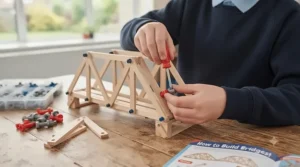
Every kit so far has been about building multiple static (or near-static) structures. Pathfinders STEM Kit – Wooden Lift Bridge does something different: it builds one model, but that model genuinely moves. Based on a Strauss-style bascule lift bridge, the finished piece raises and lowers via real gears, pulleys and a counterweight mechanism — the kind of thing that turns “I built a bridge” into “I built a machine.”
Made from precision-cut, eco-friendly FSC wood, the kit is designed for a focused 60-minute build session, which is a genuinely useful feature for a child whose attention span doesn’t stretch across an entire weekend project. The finished model doubles as a display piece afterwards, which is a nice bonus that plastic snap-together kits rarely offer. Aggregated review sentiment for this kit is broadly positive on the mechanism working as advertised, though it’s worth being upfront: at least one verified UK buyer review flagged inconsistent dowel-hole spacing on their particular unit, resulting in a bridge that didn’t sit quite square. That’s a real, sourced concern rather than a universal one — wood-cut kits at this price point can have more manufacturing variance than injection-moulded plastic, so it’s worth checking current buyer photos before purchase if that matters to you.
Pros:
- ✅ Builds a genuinely working lift mechanism, not a static model
- ✅ Made from sustainably sourced FSC wood
- ✅ Achievable 60-minute build suits shorter attention spans
Cons:
- ❌ Only one model — no variety across the box
- ❌ At least one verified review reports inconsistent cutting precision
Priced in the £18-£25 range, Pathfinders STEM Kit – Wooden Lift Bridge rewards a child who wants a single, satisfying, moving result rather than a library of static structures to work through.
7. Pathfinders Da Vinci Bridge Wooden Kit — best budget entry point
Rounding out the list is the cheapest genuinely worthwhile option researched for this guide: Pathfinders Da Vinci Bridge Wooden Kit, based on Leonardo da Vinci’s famous self-supporting “emergency” bridge design, engineered to hold together purely through the interlocking geometry of its own timbers — no glue, no fasteners.
That’s not a gimmick; it’s arguably the purest structural engineering lesson on this entire list. A child assembling this kit is directly experiencing how compression and friction between angled wooden members can hold a structure together with zero adhesive, which is precisely the principle da Vinci was demonstrating over 500 years ago for rapidly deployable military bridges. Made from sustainably sourced wood and requiring only scissors and a ruler to complete, it’s a genuinely accessible first build for a seven or eight-year-old. The honest trade-off, and it needs saying plainly: this is one small, simple model, not a system of interchangeable parts, so a child who finishes it in an afternoon and wants to build something different is out of luck without a second kit.
Pros:
- ✅ Cheapest genuinely worthwhile kit researched for this guide
- ✅ Teaches a real self-supporting structural principle without glue
- ✅ Sustainably sourced wood with minimal tools required
Cons:
- ❌ A single, simple model with no rebuilding variety
- ❌ Too basic to hold the interest of an experienced builder
At under £15, Pathfinders Da Vinci Bridge Wooden Kit is the obvious answer for anyone testing the waters before committing to a pricier bridge building STEM kit for kids — or simply looking for an affordable school holiday activity that doesn’t feel like a compromise.
How to Choose a Bridge Building STEM Kit for Kids
Picking between seven genuinely different products isn’t as simple as sorting by price. Here’s the decision framework that actually matters, based on what separates the strong performers from the disappointing ones in this category.
- Match the age rating honestly, not aspirationally. A kit rated 8+ genuinely assumes fine-motor confidence and reading stamina a five-year-old rarely has yet — buying up “so they grow into it” usually just means it sits in a cupboard.
- Decide whether you want breadth or depth. Twenty simple models (Thames & Kosmos) teaches variety; one complex working mechanism (Pathfinders Lift Bridge) teaches depth. Neither is objectively better — it depends on your child’s attention span.
- Check whether it’s a standalone kit or an expansion. This trips up more buyers than any other factor — GraviTrax-style bridge add-ons require a base system you may not already own.
- Weigh material against durability needs. Wooden kits look and feel more authentic but show more manufacturing variance; snap-fit plastic systems are more forgiving of rough handling and repeated rebuilds.
- Look for genuine load-testing, not just assembly. Sets that include a testing element — a weighted truck, a marble, a stack of coins — teach the actual engineering method of design, test, fail, redesign, rather than build-once-and-done.
- Consider whether instructions suit your child’s learning style. App-guided 3D instructions (Engino) suit screen-comfortable kids; a printed manual (Thames & Kosmos, K’NEX) suits kids who read confidently or want to work away from devices.
- Factor in whether this is a one-off gift or an ongoing hobby. If bridge engineering is likely to become a recurring interest, a system with expansion packs and reusable pieces offers better long-term value than a single fixed model.
Structural Engineering Toys for Kids: What Makes Them Different From Ordinary Building Blocks
Not every construction toy teaches engineering, even if the box says “STEM” somewhere on it. Genuine structural engineering toys for kids share a handful of features that a generic building-brick set simply doesn’t bother with, and understanding the difference is the whole reason to spend a little more on a dedicated kit.
The first is intentional failure. A standard building-block set is designed so almost anything you build stays standing, because collapse isn’t the point — creativity is. A proper structural engineering kit, by contrast, is deliberately designed so that a badly proportioned truss or an under-supported beam will sag, bow or genuinely fall over under load. That’s not a flaw; it’s the entire pedagogical mechanism. Structural engineering as a discipline is fundamentally about predicting and preventing exactly this kind of failure, and a toy that never lets a child experience failure never teaches the underlying skill.
The second difference is vocabulary and mechanism accuracy. Kits like K’NEX Education and Thames & Kosmos don’t invent fictional bridge types for the sake of variety — every model corresponds to a real, named structural category that a working civil engineer would recognise. That matters because it means the language a child picks up — truss, cantilever, compression, tension — transfers directly to school science lessons, rather than being toy-specific jargon that needs relearning later. Reviewers across nearly every kit researched for this guide mention, in one form or another, that their child started using correct structural terms unprompted after a few sessions — a small but genuinely telling signal that the learning is sticking.
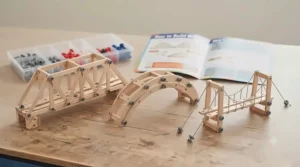
Bridge Construction Toy Sets vs Traditional Construction Toys
It’s a fair question: why buy a dedicated bridge kit at all when you probably already own a tub of generic building bricks? The honest answer is that bridge construction toy sets and traditional building-brick systems are solving genuinely different problems, and the table below lays out where each one actually earns its keep.
| Factor | Bridge Construction Toy Sets | Traditional Building Bricks |
|---|---|---|
| Learning focus | Named structural principles (trusses, arches, tension) | Open-ended creativity, no fixed physics goal |
| Failure built in | Yes — under-built models genuinely collapse | Rarely — most brick builds stay standing regardless |
| Vocabulary taught | Real engineering terms transferable to school science | Generic construction language |
| Best For | Children specifically curious about how structures hold weight | Children who want unrestricted creative building |
The analysis here isn’t that one category beats the other outright — a child benefits from both types of play for different reasons. But if the specific goal is genuine structural understanding rather than open creativity, bridge construction toy sets are simply built for that job in a way generic bricks aren’t, because collapse and load-bearing failure are baked into the design rather than avoided. Where budget only stretches to one purchase, and the stated goal is “teach my child how bridges actually work,” a dedicated kit from this list will always outperform a general brick set on that specific brief.
Understanding Load-Bearing Structures: The Science Behind Every Build
Every single kit on this list, however different their materials or price points, is ultimately teaching the same core lesson: how load-bearing structures distribute force without failing. It’s worth unpacking, briefly, why this matters so much in the real world — because it’s not an abstract classroom concept.
A bridge spanning a river has to carry its own weight (what engineers call the dead load) plus everything crossing it — vehicles, pedestrians, weather — which is the live load. The genius of good bridge design isn’t brute strength; it’s clever geometry that redirects force along the path of least resistance. A truss bridge’s triangular lattice works because triangles are the only shape that can’t be deformed without changing the length of at least one side — which is precisely why K’NEX’s truss models and Thames & Kosmos’s truss lessons both lean so heavily on triangulation. An arch bridge, meanwhile, pushes almost all of its load outward and down into compression at its abutments, which is why Pathfinders’ glue-free Da Vinci design works at all — it’s compression holding the whole structure together, not adhesive.
What most buyers overlook about load-bearing structures is that the failure point is rarely the material itself — it’s almost always a joint, a connection, or a poorly distributed load concentrated in one weak spot. That’s exactly why the testing trucks and weighted-load challenges built into several of these kits matter so much: they teach a child to find and fix the weak point, rather than simply admiring a finished model.
Practical Usage Guide: Getting the Most from Your Kit in the First 30 Days
Buying the right kit is only half the job — how it’s used in the first month determines whether it becomes a genuinely loved toy or an abandoned box under the bed.
Start with the simplest model in the instruction set, even if your child wants to leap straight to the most ambitious build. Every kit on this list is sequenced deliberately, and skipping ahead usually means missing a foundational technique — like how to secure a joint properly — that the later, harder builds assume you already know. In the first week, resist the urge to correct every wobble; let a structure fail once before stepping in, because that failure is the actual lesson, not an inconvenience to be avoided. For wooden kits especially, keep spare elastic bands, PVA glue and a small sanding block on hand — minor manufacturing variances (like the dowel-spacing issue noted in real Pathfinders reviews) are usually a five-minute fix rather than a reason to abandon the model. By week two or three, introduce genuine load-testing beyond whatever the kit provides: stacking coins, using kitchen scales, or timing how long a structure holds a small weight before flexing. This turns a one-off build into a repeatable experiment, which is where the actual engineering thinking develops. Finally, photograph each finished (and failed) build — a simple before/after record becomes genuinely useful later if the child ever wants to enter a science fair project or simply wants to see their own progress.
STEM Bridge Building Challenges to Try at Home
Once the box-provided models are exhausted, the real fun of a bridge building STEM kit for kids often starts — because the pieces themselves are reusable, and a good set of STEM bridge building challenges can extend a single kit’s life by months.
Try a “maximum span, minimum material” challenge: set a fixed piece budget — say, 30 pieces — and see how far a child can span two chairs without the structure sagging more than a few centimetres. This directly mirrors real bridge-design economics, where every extra tonne of material costs money and adds dead load. A “load-off” challenge works well with siblings or friends: each child builds independently using an identical piece count, then structures compete to hold the most weight — coins, marbles, or small toys — before failing. It’s genuinely competitive, genuinely educational, and rarely takes more than twenty minutes. For older children, a “disaster-proofing” challenge adds a twist: build a bridge, then simulate an earthquake by gently shaking the table it sits on, and see which design survives — arch and truss structures typically outperform simple beams here, which is a brilliant hands-on way to demonstrate why real-world engineers so rarely rely on flat beams alone for long spans.
✨ Don’t Miss These Exclusive Deals!
🔍 Take your child’s engineering skills to the next level with these carefully selected kits. Click on any highlighted product to check current pricing and availability — these tools help build genuine, lasting curiosity your whole family will enjoy.
Real-World Scenarios: Matching the Right Kit to Your Child
Specs and tables only go so far — here’s how three fairly typical households might actually choose, based on real circumstances rather than abstract buyer personas.
If your child is five or six and has never built anything more complex than wooden blocks, the goal isn’t complexity — it’s confidence. Learning Resources STEM Explorers Bridge Builders is built precisely for this stage: 72 pieces is genuinely manageable for small hands, and the included testing truck turns “did it work?” into an instant, visible answer rather than a guessing game. If you’re the parent of an 8 to 11-year-old who devours facts and loves being told the “proper” name for things, the K’NEX Education Intro to Structures: Bridges Set or Thames & Kosmos Structural Engineering: Bridges & Skyscrapers will satisfy that appetite far better than a simpler kit — both kits’ emphasis on real bridge categories and documented engineering principles rewards exactly that kind of curiosity. And if budget is genuinely tight this month but a birthday or wet weekend activity is needed regardless, the Pathfinders Da Vinci Bridge Wooden Kit at under £15 delivers a surprisingly complete engineering lesson without demanding a big spend — it’s proof that “cheap” and “educationally shallow” aren’t the same thing in this category.
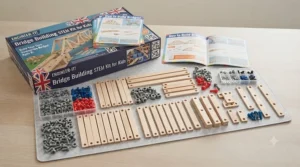
Engineering Challenge Kits for Every Age and Skill Level
Not every child engages with engineering challenge kits the same way, and matching format to temperament matters as much as matching age rating to age.
For the methodical child who likes clear instructions and a defined end point, app-guided or manual-driven kits — Engino Discovering STEM: Structures – Buildings & Bridges and Thames & Kosmos Structural Engineering: Bridges & Skyscrapers — offer exactly that structure, with a right answer to work towards each time. For the tinkerer who gets more excited by taking something apart and rebuilding it differently than by following steps, the reusable rod-and-connector systems in K’NEX Education Intro to Structures: Bridges Set genuinely reward experimentation beyond the printed instructions, since the pieces are just as happy forming an unofficial fourteenth model as one of the official thirteen. For a child who needs to see and touch a mechanism actually working to stay engaged, Pathfinders STEM Kit – Wooden Lift Bridge‘s genuine moving parts beat any static model, however elaborate. And for a family whose child is already deep into another hobby ecosystem — GraviTrax, in this case — extending that existing enthusiasm via the Ravensburger GraviTrax Bridges Expansion Set often gets more genuine engagement than introducing an entirely separate, unrelated toy line.
Science Fair Projects: Turning Your Kit into a Winning Entry
A bridge building STEM kit for kids is, almost by design, one of the strongest starting points for science fair projects — the physical model does half the presentation work for you, and the underlying physics is genuinely testable rather than just descriptive.
The strongest entries don’t simply show a finished bridge; they show a documented process of design, test, failure and redesign, which is exactly what the UK’s own design and technology curriculum expects children to demonstrate — the official key stage 1 and 2 programme of study explicitly asks pupils to evaluate and improve their own designs against criteria, not just produce a finished object. Practically, that means keeping a simple log: how many pieces were used, what load the first attempt held before failing, what changed in the redesign, and what load the improved version held. A comparison chart — even a hand-drawn bar chart showing “Attempt 1: held 200g, Attempt 2: held 550g” — turns a static model into a genuine experiment with a measurable result, which is precisely what judges are looking for over a merely decorative build. For a common problem many parents hit — a child who wants to enter a project but has run out of ideas — the maximum-span and disaster-proofing challenges outlined earlier in this guide both translate directly into a testable science fair hypothesis with almost no extra preparation required.
Common Mistakes When Buying a Bridge Building STEM Kit
A handful of buying mistakes show up repeatedly across real customer feedback for this category, and most of them are entirely avoidable with a little forethought.
The single most common error is buying for the age you wish your child were, rather than the age they actually are — an 8+ rated kit handed to a five-year-old usually ends in frustration rather than triumph, regardless of how bright that child is. A close second is missing the standalone-versus-expansion distinction entirely, which is precisely what trips buyers up with GraviTrax bridge add-ons — reading the small print about a required Starter Set before purchase saves a genuinely disappointing unboxing moment. Buyers also frequently underestimate how much adult involvement a first build needs; even a kit rated for independent play at 8+ usually benefits from a parent sitting alongside for the first model, purely to model the habit of reading instructions carefully rather than skipping ahead. Finally, many buyers assume more pieces automatically means better value, when in fact a focused 72-piece set with genuine load-testing can teach more than a sprawling 300-piece kit that never gets fully explored.
What to Expect: Real-World Performance and Durability
Specs on a box rarely tell you what daily use actually feels like, so here’s an honest translation of what the research suggests for each material category.
Snap-fit plastic systems — K’NEX, Engino, Thames & Kosmos — are, based on aggregated review evidence, remarkably tolerant of enthusiastic, repeated rebuilding; connectors are engineered specifically to survive hundreds of assembly cycles without loosening, which matters enormously for a toy that’s meant to live in active rotation rather than be built once and shelved. Wooden kits, by contrast, trade that endurance for authenticity and tactile satisfaction — they look and feel genuinely more like real engineering materials, but as the sourced Pathfinders review noted, manufacturing tolerances on laser or die-cut wood can vary slightly between units, occasionally resulting in a joint that needs a little extra sanding or persuasion to seat properly. Neither trade-off is a dealbreaker; it’s simply worth setting expectations correctly before the box is opened, particularly for a child who gets easily discouraged by a piece that doesn’t fit first time.
Long-Term Value and Cost Per Use
Sticker price alone is a poor guide to genuine value in this category — what actually matters is how many hours of engaged play a kit delivers relative to what it costs, and that varies enormously across these seven products.
| Kit | Price Range | Models / Builds | Approx. Value Per Build |
|---|---|---|---|
| Thames & Kosmos Structural Engineering: Bridges & Skyscrapers | £35-£50 | 20 models | Around £2 per model |
| K’NEX Education Intro to Structures: Bridges Set | Around £25 | 13 bridges | Around £2 per bridge |
| Learning Resources STEM Explorers Bridge Builders | £20-£25 | 9 challenges | Around £2.50 per challenge |
| Pathfinders Da Vinci Bridge Wooden Kit | Under £15 | 1 model | Highest per-model cost, lowest entry cost |
Read purely on cost-per-model, the Thames & Kosmos Structural Engineering: Bridges & Skyscrapers and K’NEX Education Intro to Structures: Bridges Set both land at a similar, genuinely reasonable rate of roughly £2 per finished structure — strong value if your child is likely to work through most or all of the included builds. The Pathfinders Da Vinci Bridge Wooden Kit looks weaker by this narrow metric, but that comparison misses the point slightly: its real value proposition is the lowest possible entry cost for a family testing whether this hobby sticks at all, not maximum builds-per-pound. Total cost of ownership should also factor in reusability — snap-fit systems retain resale or hand-down value far better than a single-use wooden model, since the pieces themselves remain useful long after the original instruction booklet has been outgrown.
Safety Considerations and UK Toy Standards
Every product recommended in this guide is intended for sale in the UK and, as such, should carry UKCA or CE marking confirming compliance with UK and EU toy safety regulations covering choking hazards, material safety and mechanical risk — always check current packaging for this marking before purchase, as compliance labelling can occasionally change between production runs. Small pieces are a genuine consideration across nearly every kit on this list; several manufacturers explicitly flag choking hazard warnings for children under 3, and even kits rated from age 5 or 7 generally recommend adult supervision for the first few builds, not because the product is unsafe when used correctly, but because small connector pieces are, unavoidably, small. Wooden kits carry an additional consideration worth a sentence: freshly cut edges on die-cut wood pieces can occasionally be slightly rough, and a light sand before handing a piece to a younger child is a sensible five-second precaution. None of this should discourage purchase — every kit here is a mainstream, widely sold product — but reading the age guidance as a genuine safety indicator, not just a marketing suggestion, matters more with bridge-style kits than with softer, larger-piece toys.
FAQ
❓ What age is best to start a bridge building STEM kit for kids?
❓ Do bridge building STEM kits actually teach real engineering?
❓ What's the difference between a standalone kit and an expansion set?
❓ Are wooden or plastic bridge building kits better for kids?
❓ Can a bridge building STEM kit be used for a science fair project?
Conclusion
Choosing between seven genuinely different kits ultimately comes down to three honest questions: what’s the actual age and attention span you’re buying for, do you want breadth of models or depth in one working mechanism, and how much are you comfortable spending for that experience. There’s no single “best” answer here — the £41-ish Thames & Kosmos Structural Engineering: Bridges & Skyscrapers earns its price through sheer curriculum depth, while the under-£15 Pathfinders Da Vinci Bridge Wooden Kit proves a tight budget doesn’t mean a shallow lesson. What every genuinely good bridge building STEM kit for kids shares, regardless of price point, is the same core mechanism: letting a child build something, test it honestly, watch it occasionally fail, and understand exactly why — which is, in the end, the entire discipline of engineering in miniature. Pick the kit that matches your child’s actual age and temperament today, not the one they might grow into eventually, and the learning tends to take care of itself..
Recommended for You
- Wind Power Kit For Kids: 7 Brilliant STEM Picks (2026)
- Solar Power Building Kit: 7 Best STEM Picks for UK Kids (2026)
- Pneumatic Building Kit for Kids: 7 Top UK Picks (2026)
Disclaimer: This article contains affiliate links. As an Amazon Associate, I earn from qualifying purchases. If you purchase products through these links, we may earn a small commission at no additional cost to you.
✨ Found this helpful? Share it with your friends! 💬🤗
