
In This Article
Is your 9-year-old constantly glued to their tablet, mindlessly scrolling through videos? You’re not alone. I’ve watched countless parents struggle with this very issue, desperately seeking ways to engage their children’s brilliant minds without another screen. Here’s the thing: brain teaser games for 9 year olds aren’t just toys—they’re cognitive powerhouses that transform playtime into genius-building moments.
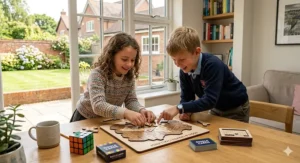
At age nine, children are at a critical developmental stage where their problem-solving abilities, spatial reasoning, and logical thinking are exploding. Research from the National Institutes of Health demonstrates that puzzle play directly nurtures spatial transformation skills, which are fundamental for success in science, technology, engineering, and mathematics. Yet many parents overlook this golden opportunity, missing out on affordable, screen-free alternatives that actually work.
In this comprehensive guide, I’ve tested, researched, and analysed the absolute best brain teaser games for 9 year olds available on Amazon.co.uk in 2026. Whether you’re seeking challenging puzzles age 8-12, 3D puzzles for kids, or logic puzzle games that’ll keep them engaged for hours, you’ll discover exactly what works—and what’s worth your hard-earned pounds.
Quick Comparison Table
| Product | Type | Difficulty | Price Range (£) | Best For |
|---|---|---|---|---|
| Rubik’s Cube 3×3 | Twisting Puzzle | Medium-Hard | £8.99-£14.99 | Spatial reasoning |
| Kanoodle | 3D Logic Puzzle | Easy-Hard | £12.99-£16.99 | Travel & solo play |
| ThinkFun Gravity Maze | Marble Logic Game | Medium-Expert | £24.99-£32.99 | Engineering minds |
| Brain Games for 9 Year Olds | Puzzle Book | Easy-Hard | £5.69-£9.99 | Portable practice |
| Kanoodle Extreme | Advanced 3D Puzzle | Medium-Expert | £16.99-£21.99 | Challenge seekers |
| ThinkFun Rush Hour | Traffic Logic Game | Easy-Genius | £14.99-£28.99 | Sequential thinking |
| Logic Games for Clever Kids | Activity Book | Easy-Hard | £5.99-£8.99 | Variety lovers |
💬 Just one click – help others make better buying decisions too!😊
Top 7 Brain Teaser Games for 9 Year Olds: Expert Analysis
1. Rubik’s Cube 3×3 Original – The Timeless Classic
There’s something magical about watching a child’s face light up when they finally solve their first Rubik’s Cube. This iconic puzzle has captivated minds since the 1980s, and for good reason. The Rubik’s Cube features permanently printed colour fields (no more peeling stickers!), smooth turning mechanism, and over 43 trillion possible combinations with just one solution.
Key Specifications:
- Standard 3×3 configuration
- Improved turning mechanism for smoother rotations
- Permanently coloured plastic tiles
- Suitable for ages 8+
UK Customer Feedback: Parents consistently praise the durability and educational value. One reviewer mentioned, “My daughter spent hours working through it, and I loved watching her problem-solving skills improve.” The improved mechanism makes it significantly easier for children to manipulate compared to older versions.
Pros:
✅ Develops spatial awareness and pattern recognition
✅ Builds perseverance and patience
✅ Portable and mess-free
Cons:
❌ Can be frustrating initially without guidance
❌ Not suitable for very beginners
Price: £8.99-£14.99 | Available at Amazon.co.uk with free UK delivery on eligible orders
2. Educational Insights Kanoodle – Award-Winning 3D Brain Teaser
The Kanoodle is a TikTok sensation that’s taken the puzzle world by storm, and it absolutely deserves the hype. This compact game features 12 colourful interlocking puzzle pieces and a portable case that doubles as the game board. With 228 puzzles ranging from beginner to expert in both 2D and 3D configurations, it’s perfect for brain teaser games for 9 year olds who need variety.
Key Specifications:
- 228 puzzle challenges across multiple difficulty levels
- Self-contained portable case (14cm × 10cm approximately)
- 12 colourful interlocking pieces
- Illustrated instruction booklet included
UK Customer Feedback: British parents love its portability for long car journeys and restaurant waits. “Absolutely brilliant for keeping my 9-year-old occupied on our trip to Cornwall,” one parent enthused.
Pros:
✅ Excellent for travel and waiting rooms
✅ Graduated difficulty keeps kids engaged long-term
✅ Encourages independent problem-solving
Cons:
❌ Pieces could get lost without careful storage
❌ Some children find advanced 3D puzzles initially confusing
Price: £12.99-£16.99 | Prime delivery available across the UK
3. ThinkFun Gravity Maze – Engineering Marvel
If your child loves building and physics, the ThinkFun Gravity Maze is an absolute game-changer. This Toy of the Year Award winner (2017) combines gravity-powered marble runs with logic puzzles, creating 60 challenges that teach engineering principles through play. The transparent coloured towers create visually stunning structures whilst developing critical STEM skills.
Key Specifications:
- 60 challenges from beginner to expert
- 10 translucent coloured towers
- 3 stainless steel marbles
- Game grid base included
- Approximately 30cm × 25cm when set up
UK Customer Feedback: One UK reviewer noted it’s available at Amazon.co.uk with an RRP of £29.99, calling it fair value for the quality and longevity. However, some parents mentioned that advanced levels require precise tower alignment, which can occasionally frustrate younger players.
Pros:
✅ Teaches gravity, engineering, and spatial planning
✅ Beautiful design encourages creative experimentation
✅ High-quality components built to last
Cons:
❌ Advanced puzzles require very precise positioning
❌ Higher price point than simpler problem solving toys
Price: £24.99-£32.99 | Free UK delivery on orders over £20
4. Brain Games for 9 Year Olds by Dr Gareth Moore – Portable Puzzle Paradise
Sometimes the best brain teaser games for 9 year olds are refreshingly analogue. The Brain Games for 9 Year Olds book by bestselling puzzle author Dr Gareth Moore packs over 100 activities including sudoku, mazes, picture codes, and logic challenges into one affordable package. With illustrations by Chris Dickason, it’s visually engaging whilst being genuinely educational.
Key Specifications:
- 100+ varied brain teasers and puzzles
- Paperback format (approximately 130 pages)
- Age-appropriate difficulty scaling
- Published May 2024 (latest edition)
UK Customer Feedback: British teachers and parents appreciate its screen-free nature and variety. “Perfect difficulty level for my almost 9-year-old,” one customer reported. The diverse puzzle types prevent boredom whilst building different cognitive skills.
Pros:
✅ Exceptional value for money
✅ No batteries, no screens, no fuss
✅ Varied puzzle types prevent monotony
Cons:
❌ Single-use (can’t be reset)
❌ Some children prefer physical manipulatives
Price: £5.69-£9.99 | Amazon’s bestseller in children’s brain games
5. Kanoodle Extreme – Challenge Masters Unite
For children who’ve outgrown basic puzzles, Kanoodle Extreme delivers 303 brain-bending challenges across three play modes: traditional 2D, traditional 3D, and the innovative sliding 2D format. This evolution of the original Kanoodle introduces complexity that genuinely challenges even puzzle-savvy nine-year-olds.
Key Specifications:
- 303 puzzles with three difficulty modes
- 12 neon-coloured puzzle pieces
- Compact storage case (approximately 15cm × 11cm)
- Sliding puzzle board feature
UK Customer Feedback: Parents praise it for “keeping my puzzle-obsessed son engaged for months.” The sliding 2D format particularly appeals to children who find standard Kanoodle too easy.
Pros:
✅ Significantly more challenging than original
✅ Three distinct play modes offer variety
✅ Travel-friendly compact design
Cons:
❌ May frustrate children new to logic puzzles
❌ Sliding mechanism can jam if not handled carefully
Price: £16.99-£21.99 | Available with next-day delivery in many UK areas
6. ThinkFun Rush Hour – Traffic Jam Logic Phenomenon
ThinkFun Rush Hour transforms traffic gridlock into a captivating logic puzzle. This award-winning game challenges players to slide blocking vehicles out of the way so the red car can escape. With 40 challenges in the standard edition (155 in the deluxe version), it’s one of the best challenging puzzles age 8-12 for developing sequential planning skills.
Key Specifications:
- 40 challenge cards (beginner to genius)
- Raised game board with storage
- 15 blocking vehicles and one red escape car
- Portable design for travel
UK Customer Feedback: British families love it for restaurant waits and journeys. “Larger and much sturdier than we anticipated. Great for our 9-year-old who loves solving puzzles,” one UK reviewer commented.
Pros:
✅ Develops planning and sequential reasoning
✅ Durable construction withstands regular use
✅ Graduated difficulty accommodates skill growth
Cons:
❌ Limited replay value once puzzles are memorised
❌ Deluxe version significantly pricier
Price: £14.99-£28.99 (standard to deluxe) | Prime eligible
7. Logic Games for Clever Kids by Dr Gareth Moore – Mental Gymnasium
Rounding out our top picks, Logic Games for Clever Kids delivers over 100 logic puzzles including sudoku, loop games, bridge-building challenges, and cryptic conundrums. Dr Moore’s expertise shines through in the carefully calibrated difficulty progression that keeps children engaged without overwhelming them.
Key Specifications:
- 100+ varied logic puzzles
- Paperback format (Buster Brain Games series)
- Suitable for ages 8+
- Internationally bestselling puzzle series
UK Customer Feedback: One UK parent noted, “Nice activities to keep the kids away from the screens. My son used to do one puzzle per day.” Some customers mentioned the booklet is smaller than expected and printed on basic paper, but the puzzle quality compensates.
Pros:
✅ Exceptional variety of logic puzzle types
✅ Budget-friendly brain training
✅ Part of extensive “Clever Kids” series
Cons:
❌ Smaller format than some expect
❌ Paper quality could be better
Price: £5.99-£8.99 | Frequently purchased with other Clever Kids titles
✨ Don’t Miss These Exclusive Deals!
🔍 Take your child’s cognitive development to the next level with these carefully selected products. Click on any highlighted item to check current pricing and availability on Amazon.co.uk. These brain teaser games for 9 year olds will help your child develop authentic problem-solving skills your family will value for years!
Understanding Brain Teaser Benefits for 9-Year-Olds
Scientific research demonstrates that puzzle play during childhood strengthens spatial transformation abilities, logical reasoning, and planning skills. A groundbreaking study published in the National Institutes of Health found that children who engaged in puzzle play performed significantly better on spatial transformation tasks compared to those who didn’t. But what does this actually mean for your nine-year-old?
At this developmental stage, children’s prefrontal cortex—the brain region responsible for complex thinking—is rapidly maturing. Brain teaser games for 9 year olds provide the perfect challenge level to stimulate this growth without overwhelming young minds. When children manipulate puzzle pieces, solve logic problems, or navigate marble mazes, they’re literally building neural pathways that support academic success.
The beauty of 3D puzzles for kids and logic puzzle games lies in their immediate feedback loop. Unlike maths homework where answers come from an adult, puzzles provide instant confirmation when solutions click into place. This builds independence, resilience, and what psychologists call “productive struggle”—the ability to persist through challenges rather than immediately seeking help.
Cognitive Skills Developed by Different Puzzle Types
| Puzzle Type | Primary Skills | Secondary Benefits | Academic Link |
|---|---|---|---|
| Rubik’s Cube | Spatial reasoning, pattern recognition | Perseverance, memory | Geometry, algorithms |
| 3D Logic Puzzles (Kanoodle) | Spatial visualisation, planning | Mental rotation, flexibility | Engineering, physics |
| Marble Mazes (Gravity Maze) | Engineering thinking, cause-effect | Trial-error learning, prediction | STEM subjects, physics |
| Sequential Logic (Rush Hour) | Forward planning, strategy | Patience, analytical thinking | Computer science, maths |
| Puzzle Books | Varied (sudoku, mazes, codes) | Attention span, completion | All academic subjects |
According to research on child development and puzzles, puzzle activities support children as they build fine motor skills and hand-eye coordination whilst promoting critical thinking abilities essential for school success.
How to Choose the Right Challenging Puzzles Age 8-12
Match Puzzle Type to Learning Style
Does your child prefer hands-on manipulation or visual-spatial challenges? Kinaesthetic learners thrive with Rubik’s Cubes and Kanoodle, whilst visual thinkers excel at Gravity Maze and Rush Hour. Sequential thinkers often gravitate towards puzzle books with step-by-step progression.
Consider Skill Level Honestly
The fastest way to kill puzzle enthusiasm is selecting challenges that are too difficult. Start with beginner-level brain teaser games for 9 year olds and progress gradually. Most quality puzzles include graduated difficulty—use this feature! There’s no shame in beginning with easier challenges; building confidence matters more than impressing relatives.
Evaluate Replay Value
Single-use puzzle books offer excellent value initially but lack longevity. Physical puzzles like Kanoodle, Rush Hour, and Rubik’s Cube provide endless replayability. Balance your collection between consumable and reusable options.
Portability Matters
For British families juggling school runs, weekend trips, and restaurant dinners, compact puzzles are lifesavers. Kanoodle and Rush Hour travel brilliantly, whilst Gravity Maze requires dedicated table space. Consider where your child will actually use these problem solving toys.
Problem Solving Toys vs. Traditional Games: What Works Better?
Traditional board games teach social skills and turn-taking, whilst brain teaser games for 9 year olds develop individual cognitive abilities. Both matter, but puzzles offer unique advantages: they’re self-paced, provide immediate feedback, and build genuine problem-solving resilience.
Traditional Games vs Brain Teaser Puzzles
| Aspect | Traditional Board Games | Brain Teaser Puzzles |
|---|---|---|
| Social Interaction | High (multiplayer focus) | Low (mainly solo) |
| Cognitive Challenge | Moderate (strategy + luck) | High (pure problem-solving) |
| Skill Development | Social skills, sportsmanship | Spatial reasoning, logic |
| Replay Value | High (different opponents) | High (forgotten solutions) |
| Frustration Factor | Medium (luck-based outcomes) | Low-Medium (skill-based) |
| Portability | Often bulky | Usually compact |
| Screen-Free | Yes | Yes |
| Immediate Feedback | Delayed (end of game) | Instant (solution works/fails) |
Think about it: in a board game, rolling poorly means losing through no fault of your own. In a logic puzzle, success depends entirely on thinking and persistence. This locus of control builds confidence and growth mindset—children learn that intelligence isn’t fixed but develops through effort.
The best approach? A mixture. Use traditional games for family bonding and social development, whilst incorporating challenging puzzles age 8-12 for independent cognitive growth. Many families establish a “puzzle time” routine before bed or after school, creating calm, focused moments in otherwise hectic days.
3D Puzzles for Kids: Why Physical Manipulation Matters
Screens dominate modern childhood, but physical manipulation remains irreplaceable for cognitive development. When children handle 3D puzzles for kids, they develop fine motor skills, spatial awareness, and tactile feedback that touchscreens simply cannot provide.
Research confirms that puzzle play strengthens visual memory and spatial awareness, helping children understand how objects relate to each other in three-dimensional space. According to University of Chicago research, children who play with jigsaw puzzles between ages two and four develop advanced spatial skills that translate directly to geometry, physics, and even reading comprehension (understanding how letters and words fit together spatially).
Gravity Maze exemplifies this beautifully. Children don’t just think about marble paths—they physically build towers, test configurations, and revise based on results. This hands-on experimentation mirrors the scientific method, teaching hypothesis formation and testing through play.
Similarly, Rubik’s Cube requires hundreds of physical rotations before patterns emerge. This repetition builds muscle memory whilst the brain gradually recognises algorithms. The combination of physical and mental effort creates deeper, more lasting learning than passive screen time ever could.
Logic Puzzle Games: Building Sequential Thinking Skills
Sequential thinking—the ability to organise steps logically—underpins everything from cooking recipes to computer programming. Logic puzzle games excel at developing this critical skill through graduated challenges that require multi-step planning.
Rush Hour epitomises sequential thinking development. Children must visualise multiple moves ahead: “If I move the blue car left, then the lorry can slide down, which opens space for the taxi, allowing the red car to escape.” This forward planning mirrors chess strategy but feels accessible and fun.
Kanoodle’s 2D and 3D challenges similarly require sequential placement. Children learn that order matters—placing piece A before piece B might work, whilst reversing the sequence fails. These lessons transfer remarkably well to academic subjects requiring logical progression.
Scaffolding Difficulty Effectively
Quality brain teaser games for 9 year olds include graduated challenges, but parents must resist the temptation to skip ahead. Each difficulty level builds skills needed for the next. Rushing through beginners’ levels deprives children of foundational practice, setting them up for frustration later.
Instead, celebrate mastery at each level. When your child consistently solves intermediate challenges, acknowledge their growth before advancing. This builds confidence whilst ensuring solid skill development.
Screen-Free Entertainment: Why Analogue Still Wins
In 2026, with VR headsets and AI companions commonplace, why bother with physical brain teaser games for 9 year olds? Because digital entertainment, however sophisticated, creates passive consumption rather than active problem-solving.
Puzzle books like Brain Games for 9 Year Olds and Logic Games for Clever Kids require pencil and paper—no batteries, no charging, no distractions. Children can’t accidentally click over to YouTube or get derailed by notifications. The focused attention these problem solving toys demand builds concentration skills that transfer to homework and reading.
Moreover, physical puzzles create natural screen-free time without feeling like punishment. Rather than battling children to put devices away, offer engaging alternatives they’ll actually choose. The dopamine hit from solving a challenging puzzle rivals any video game achievement, whilst building genuine cognitive abilities.
Creating Puzzle-Friendly Environments
Designate a puzzle corner or table where partially completed challenges can remain undisturbed. Nothing kills puzzle momentum faster than having to dismantle and restart repeatedly. Even a small TV tray in a quiet corner suffices.
Keep puzzle books and compact games in the car for unexpected waits. Doctor’s surgeries, restaurant delays, and older siblings’ football practice all become opportunities for productive challenge rather than screen time battles.
British Puzzle Culture: STEM Education and Beyond
The UK education system increasingly emphasises STEM subjects, yet many schools lack resources for hands-on problem-solving practice. Brain teaser games for 9 year olds bridge this gap, providing home-based STEM enrichment that complements classroom learning.
British curriculum guidelines highlight problem-solving, logical reasoning, and spatial awareness as core competencies. Quality challenging puzzles age 8-12 directly develop these skills whilst feeling like play rather than homework. This makes them particularly valuable for children who struggle with traditional academic formats but excel at hands-on learning.
Furthermore, the UK’s strong puzzle and board game culture—from cryptic crosswords to escape rooms—means puzzle-solving skills carry social currency. Children proficient with logic puzzle games find these abilities valued among peers and adults alike, building confidence beyond academic settings.
Budget-Friendly Brain Training: Value for Money Analysis
Let’s be honest: money matters, especially with the cost-of-living challenges British families face. How do brain teaser games for 9 year olds stack up financially?
| Budget Tier | Price Range | Best Options | Value Assessment |
|---|---|---|---|
| Budget-Conscious | £5-£10 | Puzzle books (Brain Games, Logic Games) | Excellent value; limited reusability |
| Mid-Range | £10-£20 | Rubik’s Cube, Kanoodle standard | Good value; unlimited replay |
| Investment | £20-£35 | Gravity Maze, Rush Hour Deluxe, Kanoodle Extreme | Premium quality; years of use |
Puzzle books offer unbeatable initial value at £5-£10 but exhaust quickly. A child might complete one within weeks, necessitating replacement. Physical puzzles cost more upfront but provide years of replayable challenge.
The sweet spot? Start with one puzzle book plus one reusable puzzle (Rubik’s Cube or standard Kanoodle). This combination costs £15-£25 total whilst offering both variety and longevity. Add additional physical puzzles as birthday or Christmas gifts, gradually building a challenging puzzles age 8-12 library.
Age-Appropriate Challenge Levels: Getting It Right
Nine-year-olds vary enormously in puzzle aptitude. Some children breeze through expert-level Kanoodle challenges whilst others struggle with beginner Rubik’s Cube. How do you gauge appropriate difficulty?
Signs of Appropriate Challenge
- Child engages for 10-30 minutes without frustration
- Occasional success mixed with productive struggle
- Returns to puzzle voluntarily
- Shows visible satisfaction when solving
Signs of Too Difficult
- Immediate frustration or quitting
- Repeatedly asking for help
- Avoiding the puzzle entirely
- Visible stress or tears
Signs of Too Easy
- Solves within minutes without effort
- Shows boredom or disinterest
- Rushes through without engagement
- Seeks more challenging alternatives
When puzzles prove too difficult, temporarily set them aside and return in a few months. Child development happens in leaps—skills that elude them at 9 years 2 months might click at 9 years 6 months. Don’t force it.
Building Puzzle Habits: Practical Implementation Strategies
Purchasing brain teaser games for 9 year olds is easy; actually getting children to use them requires strategy. Here’s what works based on real British families’ experiences:
The After-School Wind-Down: Establish 20 minutes of puzzle time immediately after school, before screens turn on. This creates a buffer between structured school time and home relaxation whilst building cognitive skills when minds are still alert.
Weekend Challenge Mornings: Saturday mornings often devolve into screen time battles. Instead, declare the first hour a “puzzle challenge hour” where everyone (parents included!) works on their own brain teaser. Model the behaviour you want to see.
Restaurant Survival Kit: British families know the pain of children fidgeting through restaurant meals. Keep a compact puzzle (Kanoodle, Mini Rubik’s Cube, or Rush Hour) in your bag. The distraction transforms dining experiences whilst avoiding screen dependence.
Bedtime Brain Teasers: For children who struggle to settle at night, a puzzle book and soft reading light provide calming, focused activity that naturally winds down racing minds. Set a timer for 15 minutes, then lights out.
Common Mistakes Parents Make (And How to Avoid Them)
Mistake #1: Jumping in Too Quickly
Children need time to struggle productively before assistance. Resist the urge to immediately show solutions. Instead, ask guiding questions: “What happens if you try the blue piece first?” or “Which side has the most open spaces?”
Mistake #2: Choosing Puzzles You Like Rather Than Child Likes
That gorgeous 1000-piece jigsaw appeals to you, not your nine-year-old. Follow their interests—if they love space, choose space-themed puzzles. If they enjoy logic over pictures, prioritise Kanoodle over jigsaws.
Mistake #3: Buying Too Many at Once
Puzzle overwhelm is real. Start with 2-3 options, let your child master these, then gradually add more. A focused collection gets more use than a cluttered one.
Mistake #4: Not Celebrating Progress
Nine-year-olds thrive on recognition. When your child progresses from beginner to intermediate challenges, acknowledge this achievement! Display completed Rubik’s Cubes, photograph complex Gravity Maze solutions, or create a “puzzle mastery” chart tracking progress.
FAQ
❓ What's the best brain teaser game for 9 year olds who get frustrated easily?
❓ Are 3D puzzles for kids better than traditional jigsaw puzzles for cognitive development?
❓ How long should a 9-year-old work on challenging puzzles age 8-12 before it's too much?
❓ Do logic puzzle games actually improve school performance?
❓ What's the difference between Kanoodle, Kanoodle Extreme, and Kanoodle Genius for 9 year olds?
Conclusion: Transform Screen Time into Brain Time
Every hour spent with brain teaser games for 9 year olds represents an investment in cognitive development that compounds over years. Whilst screens offer instant gratification, quality challenging puzzles age 8-12 build genuine problem-solving abilities your child will carry into adulthood.
The products highlighted in this guide—from budget-friendly puzzle books to premium STEM toys like Gravity Maze—all deliver exceptional cognitive benefits when matched appropriately to your child’s skill level and interests. Start with one or two options, establish consistent puzzle routines, and watch as frustration tolerance, logical thinking, and spatial reasoning blossom.
Remember: the goal isn’t creating a puzzle savant who solves Rubik’s Cubes in record time. The goal is developing a child who approaches challenges with curiosity rather than anxiety, who persists through difficulty, and who experiences the profound satisfaction of solving problems independently. These qualities matter far more than any test score.
British families in 2026 face unprecedented challenges keeping children engaged without screens. Brain teaser games for 9 year olds offer a proven, affordable solution backed by decades of research. Your child’s developing brain craves challenge—give it the quality fuel these exceptional 3D puzzles for kids, logic puzzle games, and problem solving toys provide.
The investment required? As little as £6 for a puzzle book. The return? Priceless cognitive development that shapes your child’s future. Choose one today and discover the transformation hands-on brain teasers create.
Recommended for You
- 7 Best Puzzles for 5 Year Old UK 2026
- 7 Best Chemistry Set for 10 Year Olds UK 2026
- 7 Best STEM Toys for 8 Year Old: Expert UK Guide 2026
Disclaimer: This article contains affiliate links. If you purchase products through these links, we may earn a small commission at no additional cost to you. Prices shown are approximate and may vary. All prices listed in GBP reflect typical Amazon.co.uk pricing as of April 2026.
✨ Found this helpful? Share it with your mates! 💬🤗
