
In This Article
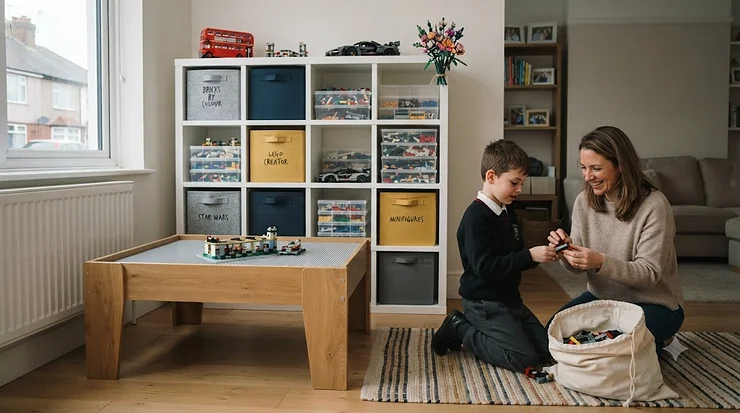
There is a very specific sound every parent in Britain knows: the crunch. Bare foot, unlit hallway, one stray brick, and suddenly you’re hopping around the landing at 11pm muttering things you’ll need to apologise for in the morning. If you’ve searched for lego storage solutions before, you already know the problem isn’t the bricks themselves — it’s that nobody designs a system that a genuinely excited, slightly chaotic child will actually use. The bricks always seem to migrate: under the sofa, behind the radiator, somewhere near the dog’s bed, everywhere except the box you bought for £30 with such confidence.
LEGO itself is built on Ole Kirk Christiansen’s interlocking brick system, a design so enduringly clever that pieces from 1958 still click into sets made this year — which is precisely why collections balloon so fast and why a proper storage strategy matters more than it does for almost any other toy category. This guide walks through seven genuine products available on amazon.co.uk, spanning budget bins to furniture-grade systems, plus the playroom organisation thinking that makes any of them actually work long-term. We’ll cover toy building blocks storage box options for sorting loose pieces, stackable toy storage bins kids can manage themselves, and the broader kids toy storage furniture question, so that by the end you’ll know exactly which route suits your home, your budget, and your particular flavour of chaos.
Quick Comparison Table: LEGO Storage Solutions At A Glance
| Category | Product | Price Range | Best For |
|---|---|---|---|
| Best Overall | IKEA TROFAST Storage Combination | £65–£90 | Families wanting a permanent playroom system |
| Best Budget | Wham Crystal 5 x 45L Stackable Storage Boxes | Under £50 | Bulk brick storage on a tight budget |
| Best for Small Pieces | Really Useful Box 0.55 Litre (Pack of 10) | £25–£35 | Sorting minifigures, wheels, and 1×1 studs |
| Best Portable | Room Copenhagen LEGO Sorting Case To Go | £10–£20 | Travel, grandparents’ houses, car journeys |
| Best Official Pick | LEGO Sort and Store Box V2 | £15–£25 | Quick sorting by colour or theme |
Looking at the spread above, the clearest pattern is that no single product wins outright — the IKEA TROFAST Storage Combination dominates for permanent playroom setups precisely because it’s furniture rather than a box, while the Wham Crystal 5 x 45L Stackable Storage Boxes win on raw litres-per-pound for families with an avalanche of loose bricks. If your main headache is losing minifigure accessories down the side of the sofa, the Really Useful Box 0.55 Litre (Pack of 10) solves a completely different problem to either of them, which is exactly why most well-organised households end up running two or three of these systems in parallel rather than hunting for one perfect box.
💬 Just one click — help others make better buying decisions too!😊
Top 7 LEGO Storage Solutions: Expert Analysis
1. IKEA TROFAST Storage Combination — modular frame kids can reach on their own
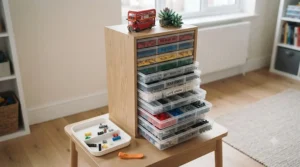
The IKEA TROFAST Storage Combination is technically furniture rather than a box, and that distinction is what makes it worth the extra spend. The pine frame holds a mix of plastic and mesh boxes on sliding rails, so you can rearrange the layout as your child’s collection — and their height — changes over the years. Specs-wise, the largest frame measures 99x44x94cm and can also function as a room divider, with the smallest tabletop-height option starting at roughly £41 and running to around £85.50 for room-divider sizes with a full set of boxes.
Based on the spec comparison against loose plastic tubs, the low, open-fronted design is what actually gets used by toddlers and young children: nothing to unclip, no lid to wrestle off, just pull the drawer and dig in. That’s who this is really for — households with kids aged roughly 2 to 8 who need to self-serve, rather than teenage AFOLs sorting by part number. IKEA positions the whole TROFAST range specifically around helping families organise even large toy collections, offering it in a wide spread of colours and sizes, and reviewers on IKEA’s own site consistently rate the range 4 to 4.5 stars, with recurring praise for how easily it survives years of daily hauling in and out.
Pros:
- ✅ Kids can access and tidy it independently from a young age
- ✅ Expands with the family — add more boxes as the collection grows
- ✅ Doubles as a room divider or desk in some configurations
Cons:
- ❌ Flat-pack assembly required, and it’s a proper afternoon job
- ❌ Boxes aren’t as airtight as dedicated plastic storage, so dust gets in
At around £65–£90 for a mid-sized combination, this sits in the mid-range bracket, but the cost-per-year over a decade of use makes it genuinely good value for a permanent playroom fixture.
2. Really Useful Box 0.55 Litre Clear (Pack of 10) — bomb-proof lids for the tiniest pieces
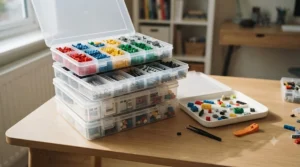
Anyone who has ever hunted for a single 1×1 round stud across an entire carpet will understand why the Really Useful Box 0.55 Litre Clear (Pack of 10) earns its spot here. These are small, transparent, clip-lock boxes manufactured largely in Britain, and the ten-pack retails in the £25–£35 range depending on current stock — a genuinely useful price-per-box for anyone trying to colour-sort or theme-sort a serious collection.
The clip-lock handles are the whole point: unlike snap-fit lids that pop open the second a box gets knocked off a shelf, these stay sealed even when a toddler decides the box makes an excellent stepping stone. What most buyers overlook about this range is that the boxes stack without their lids too, so once emptied they nest flat for storage — a small detail that matters enormously if you’re working with limited shelf space. Reviewers consistently note the same thing across the Really Useful range: the plastic doesn’t yellow or crack the way cheaper alternatives do after a year or two of handling, which for a family running through hundreds of open-close cycles a month is not a trivial claim.
Pros:
- ✅ Clip-lock lids survive drops and toddler stepping-stone incidents
- ✅ Fully transparent, so contents are visible without opening
- ✅ Stack flat when empty, saving shelf space
Cons:
- ❌ Small capacity means you need many boxes for a big collection
- ❌ No built-in dividers, so sub-sorting within a box isn’t possible
For pure loose-piece sorting by colour or part type, this is hard to beat, and it’s the toy building blocks storage box most serious brick sorters reach for first.
3. LEGO Sort and Store Box V2 — official four-compartment carry case
The LEGO Sort and Store Box V2 is the officially branded option, and it takes a genuinely different approach to the problem: rather than one big tub, it’s four separate compartments joined by a central carry handle, so you can grab one quarter of your collection and take it to another room without hauling the whole lot. Pricing typically lands in the £15–£25 range, putting it squarely in the mid-range bracket alongside the Really Useful boxes.
Here’s what to weigh with this one: the four-compartment split is genuinely clever for colour-sorting (reds in one, blues in another) but it caps your organisation at four categories unless you buy a second unit, which the brand clearly intends. What most buyers overlook about this model is that the individual compartments detach fully from the carry frame, so a child can take just one section to their bedroom desk while the rest stays put in the playroom — a nice compromise between centralised and distributed storage. Aggregated review sentiment on this line is generally positive for durability, though a recurring theme in feedback is that the plastic carry handle can feel slightly flimsy under a fully loaded set of four compartments.
Pros:
- ✅ Four detachable compartments for genuine colour or theme sorting
- ✅ Official LEGO branding and design language that kids recognise
- ✅ Central handle makes moving a full section between rooms easy
Cons:
- ❌ Carry handle feels less sturdy once all four sections are full
- ❌ Capped at four categories per unit, so serious collections need multiples
At its price point, it’s best suited to buyers who want an official product and value portability over sheer sorting granularity.
4. Room Copenhagen LEGO Sorting Case To Go — pocket-sized brick case for days out
Not every trip needs the whole collection. The Room Copenhagen LEGO Sorting Case To Go is a genuinely pocket-sized briefcase-shaped box, roughly the size of an adult hand, with a semi-transparent lid embossed with brick studs and two secure clips to keep it shut during transit. It typically sells in the £10–£20 bracket, making it one of the more accessible entry points on this list.
Based on the spec comparison with larger boxes, the size here is the entire selling point and also its biggest limitation — this is not a solution for a serious collection, it’s a travel companion for a handful of favourite minifigures or a small themed set heading to a car journey, a waiting room, or a grandparent’s house. The semi-transparent lid means kids can see roughly what’s inside without opening it, which cuts down on unnecessary fiddling in the car. Aggregated customer feedback flags this clearly: several reviewers note they expected briefcase-sized storage based on the name and were disappointed to find it’s genuinely compact, so it’s worth setting that expectation before buying.
Pros:
- ✅ Genuinely pocket-sized — fits in a school bag or car door pocket
- ✅ Secure double-clip closure prevents spills during travel
- ✅ Semi-transparent lid lets kids preview contents at a glance
Cons:
- ❌ Too small for anything beyond a handful of pieces or minifigures
- ❌ Not a realistic option for sorting a full collection
If your searches keep circling back to “small, portable, take it in the car,” this is the specific answer.
5. Play & Go Drawstring Play Mat Storage Bag — playmat that swallows the mess in one pull
The Play & Go Drawstring Play Mat Storage Bag takes an entirely different design philosophy: it’s a flat, circular play mat that converts into a drawstring sack with one pull of the cord, gathering every brick on the floor into a single bundle in seconds. The 140cm size retails typically in the £25–£40 range and comes in a range of prints, including a whale design aimed at younger children.
What the spec sheet won’t tell you, but the design implies clearly, is that this solves the “getting kids to actually tidy up” problem better than almost anything else on this list — because tidying becomes a single satisfying physical action rather than a tedious sort-and-place chore. That matters enormously for younger children who find traditional box-sorting overwhelming. The waterproof, washable material also means it doubles as an outdoor play surface for picnics or garden play, adding genuine multi-use value beyond pure storage. Real-world feedback on this style of bag does flag one consistent limitation: because the bag doesn’t fully cinch shut, an underfilled bag with only a few toys inside won’t seal completely — the more weight inside, the better it closes, so it suits medium-to-large collections better than sparse ones.
Pros:
- ✅ Converts tidy-up into one single drag-and-pull motion
- ✅ Doubles as a waterproof outdoor play mat for picnics or garden use
- ✅ Genuinely motivates younger children to self-tidy
Cons:
- ❌ Doesn’t fully close when lightly filled — works best when well-loaded
- ❌ Offers zero sorting or sub-categorisation of contents
For chaos-reduction rather than meticulous organisation, this is one of the most genuinely clever entries on the list.
6. LEGO Iconic 4-Piece Organizer Tote and Playmat — official tote-and-playmat combo
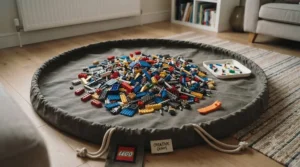
The LEGO Iconic 4-Piece Organizer Tote and Playmat is the official brand’s answer to the same problem the Play & Go bag solves, but with a structured twist: it’s a soft-sided tote bag that unfolds into a flat playmat, then cinches shut with drawstrings once play is over. Pricing typically sits in the £20–£35 bracket depending on the specific design and retailer stock at the time of research.
Honest analysis here has to acknowledge the trade-off directly: the LEGO branding and official design language carry real appeal for brand-loyal kids, and reviewers frequently note the sturdier stitching compared with generic drawstring alternatives, but you are paying a premium for that badge versus a comparable third-party bag. Who this suits: households who already invest heavily in LEGO sets and want the accessory range to match, plus families who want a slightly more premium feel and stronger seams for daily use rather than occasional travel. The four-piece framing typically bundles the tote-playmat with smaller organiser pouches, giving a basic first layer of sorting alongside the scoop-and-tidy function.
Pros:
- ✅ Official LEGO design and typically stronger stitching than generic bags
- ✅ Bundle includes smaller organiser pouches for basic sorting
- ✅ Doubles as a floor playmat, reducing furniture footprint
Cons:
- ❌ Price premium over generic drawstring alternatives for similar function
- ❌ Bulkier to store flat than a single simple bag
If brand consistency and slightly sturdier build quality matter to your household, this earns its higher price tag.
7. Wham Crystal 5 x 45L Stackable Storage Boxes — cheapest way to store an avalanche of bricks
When the real problem is sheer volume — years of birthday and Christmas sets merged into one seething mass of bricks — the Wham Crystal 5 x 45L Stackable Storage Boxes solve it with brute-force capacity. Five boxes at 45 litres each gives you 225 litres of clear, stackable storage, manufactured in the UK, typically priced under £50 for the full set of five.
Based on the spec comparison against smaller dedicated sorting boxes, this product isn’t trying to be clever about categorisation — it’s answering a different question entirely: where do I physically put an enormous volume of loose bricks without spending a fortune. The clear polypropylene construction means you can see roughly what’s in each box without opening it, and the stackable lids mean five boxes take up the same footprint as one, provided your shelving or cupboard has the vertical clearance. This is genuinely the toy building blocks storage box option for parents who have given up trying to sort by colour and just need everything contained, visible, and off the floor. Aggregated feedback on the Wham Crystal range consistently highlights the value-for-litre ratio compared with named competitors, alongside praise for lid durability under repeated stacking and restacking.
Pros:
- ✅ Exceptional capacity-to-price ratio for bulk brick storage
- ✅ Made in the UK with sturdy, repeatedly-stackable lids
- ✅ Clear sides give a rough visual inventory without opening
Cons:
- ❌ No internal dividers or sorting structure whatsoever
- ❌ Bulky footprint needs genuine cupboard or shelving clearance
For value-per-litre alone, this is the pick to check current price on if budget is the binding constraint.
Practical Usage Guide: Setting Up A System That Survives Contact With Children
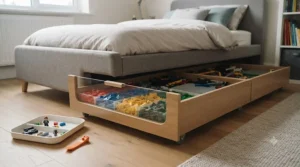
Buying the right box solves half the problem; the other half is setting it up so it actually gets used after week one. Start by resisting the urge to sort by exact part number — that’s a hobbyist’s approach, not a family one. Colour-based sorting into two or three large categories (bricks, wheels-and-specials, minifigures) is achievable for a five-year-old and realistic to maintain long-term, whereas sorting by 200 individual part types collapses within days in most households.
Position matters more than most guides admit. A Really Useful Box stack on a high shelf might look tidy in a showroom photo, but if a six-year-old can’t reach it without a chair, it won’t get used for tidying — only for the initial, parent-led setup. Low, open access — which is exactly why the IKEA TROFAST Storage Combination performs so well in real homes — beats a beautiful but inaccessible system every time.
For the first 30 days, expect resistance. Most families report the novelty wearing off around day four, at which point the temptation is to abandon ship and let bricks pile back onto the floor. The fix that actually works, according to consistent parenting-blog and playroom-organisation consensus, is a two-minute “reset” habit before bed rather than a single big weekend clean — little and often beats occasional deep cleans for maintaining any storage system, LEGO included.
Real-World Scenarios: Matching Storage To Your Household
The toddler household (ages 2–4): Sorting by category is unrealistic at this age, and safety is the priority rather than organisation. A Play & Go Drawstring Play Mat Storage Bag works brilliantly here because the entire “tidy-up” action is a single satisfying pull, with no fiddly lids or small compartments a toddler could open and choke on. Pair it with occasional supervised brick-checking to remove any oversized DUPLO-to-LEGO transition pieces that no longer suit the youngest child in the house.
The primary-school builder (ages 5–10): This is peak collection-growth territory, and it’s where a permanent system pays off. An IKEA TROFAST Storage Combination paired with a few Really Useful Box 0.55 Litre units for minifigures and small accessories covers both bulk and detail sorting, and crucially, both are low enough for a child this age to manage independently.
The serious builder or family with a large legacy collection (ages 10+ or multi-generational): Volume becomes the dominant problem, often running into thousands of loose pieces accumulated across years. The Wham Crystal 5 x 45L Stackable Storage Boxes provide the raw capacity needed, while a LEGO Sort and Store Box V2 handles the “current project” pieces that are in active rotation, keeping the bulk collection separate from what’s actually being built with this week.
The frequent traveller or grandparent’s-house family: If LEGO regularly needs to leave the house — for car journeys, sleepovers, or holidays — the Room Copenhagen LEGO Sorting Case To Go is purpose-built for exactly that scenario, holding a curated selection without the risk of losing pieces from the main collection at home.
Problem → Solution: Fixing The Five Most Common LEGO Storage Headaches
Problem: Pieces constantly end up on the floor. The realistic solution isn’t more storage — it’s lower, more accessible storage. Swap any high-shelf box for something at knee height, such as the lower tiers of an IKEA TROFAST Storage Combination, and floor-scatter typically drops sharply within weeks.
Problem: Minifigure accessories (hats, tools, weapons) go missing constantly. These small pieces need their own dedicated small-parts container rather than living loose in a big bin. A Really Useful Box 0.55 Litre set aside specifically for accessories, kept near wherever building happens, solves this more reliably than any sorting system applied to a single large tub.
Problem: Sorting takes so long nobody bothers. Simplify the categories. Two or three colour-based groups, not twenty. Reviewers across nearly every storage range consistently note that over-engineered sorting systems get abandoned within a month, while simple ones stick.
Problem: The playroom looks cluttered even with boxes in place. This is usually a furniture problem, not a box problem — mismatched, visible clutter of different box shapes and colours reads as chaos even when technically organised. Standardising on one system, like matching Wham Crystal boxes throughout, visually calms a room instantly.
Problem: LEGO needs to travel but keeps spilling in the car. Don’t take the whole collection. A dedicated, sealed portable option like the Room Copenhagen LEGO Sorting Case To Go avoids the spillage entirely by design, since it’s built for movement rather than static storage.
How To Choose A Toy Building Blocks Storage Box
- Match capacity to your actual collection size, not your aspirations. Weigh or roughly estimate your current volume before buying — most people underestimate by half.
- Prioritise child-reachability over adult convenience. A box that looks tidy on a high shelf but is never used for tidying defeats its own purpose.
- Check lid mechanism durability, not just price. Clip-lock designs like the Really Useful range survive years of daily use better than simple snap-fit lids.
- Decide sorting granularity in advance. Two or three broad categories are realistically maintainable; twenty specific ones rarely survive contact with a real household.
- Factor in portability needs separately from home storage. A travel case and a home system solve different problems — don’t expect one box to do both well.
- Consider material transparency. Clear boxes let children self-locate pieces without adult help, reducing the “where’s my blue brick” interruptions during build sessions.
- Budget for growth. Collections grow faster than most parents expect, particularly around birthdays and Christmas, so leaving room to add more boxes or shelving beats buying a single “final” solution.
Stackable Toy Storage Bins For Kids Vs Kids Toy Storage Furniture
| Factor | Stackable Bins (e.g. Really Useful, Wham) | Toy Storage Furniture (e.g. TROFAST) |
|---|---|---|
| Upfront cost | Lower, typically £25–£50 per set | Higher, typically £65–£90+ |
| Child accessibility | Good if positioned low | Excellent — designed for low, open access |
| Sorting granularity | High, if multiple small boxes used | Moderate, limited by number of drawers |
| Room aesthetics | Can look cluttered if mismatched | Neater, integrated appearance |
| Best For | Flexible, growing collections | Permanent playroom setups |
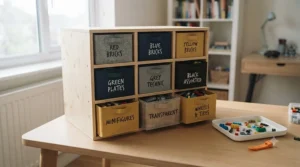
Interpreting the table, stackable toy storage bins kids can manage themselves win on flexibility and upfront cost, letting you scale up gradually as the collection grows without committing to a large piece of furniture. Kids toy storage furniture systems, by contrast, win decisively on long-term usability and room aesthetics, because a single integrated unit reads as “organised” in a way that six mismatched tubs never quite manages, even when the tubs are technically tidier inside. Most households running a genuinely clutter-free playroom long-term end up combining both: furniture for the bulk of the collection, bins for the fine sorting within it.
What To Expect: Real-World Performance
On paper, most storage boxes look similar — plastic, a lid, a price tag. In daily use, the differences show up fast. Clip-lock lids like the Really Useful range genuinely do resist the “kicked across the floor and pops open” scenario that snap-fit lids fail on repeatedly. Furniture systems like TROFAST show their value not on day one but around month three, once the novelty of a new box has worn off and the real test — does a tired child at bedtime actually put things away — begins.
Expect drawstring bags and playmat-style solutions to age faster than rigid boxes, since fabric takes more visible wear than moulded plastic, but also expect them to get used more consistently by younger children precisely because the tidy-up action is so simple. The honest trade-off across this whole category is durability versus ease-of-use, and very few products manage to lead on both simultaneously.
Playroom Organisation Ideas Beyond The Brick Bin
LEGO rarely lives in isolation — it shares floor space with everything else a child owns, so playroom organisation ideas that only address bricks tend to fail within a season. Zoning the room into distinct activity areas (a building zone, a reading corner, a craft table) gives each storage system a clear “home,” which meaningfully reduces the drift of pieces migrating across the room.
Labelling helps more than most parents expect, particularly picture-based labels for children who aren’t yet reading fluently — a small photo of a minifigure taped to a Really Useful Box does more to encourage independent tidying than any verbal instruction ever will. Rotating stock is another underused tactic: keeping half a large collection in less-accessible storage (a garage shelf, a loft box) and swapping it in every few months keeps the active playroom volume manageable while making “old” sets feel new again when they resurface.
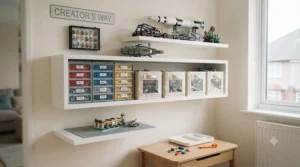
Vertical space is consistently under-used in UK homes, where floor area tends to be tighter than in many other markets. Wall-mounted shelving above a TROFAST unit, or stacking Wham Crystal boxes higher rather than spreading them across the floor, reclaims usable play space without shrinking storage capacity — a genuinely practical playroom organisation idea for anyone working with a boxroom-sized playroom rather than a purpose-built one.
Kids Toy Storage Furniture: Long-Term Cost & Maintenance
Furniture-grade kids toy storage furniture costs more upfront but tends to win on total cost of ownership over a five-to-ten-year horizon, since a well-built frame like the IKEA TROFAST Storage Combination typically outlasts multiple generations of loose plastic bins, which crack, discolour, or lose their lids well before a wooden frame shows comparable wear. Maintenance is minimal — a wipe-down with a damp cloth handles most spills, and individual boxes within the system can be replaced piecemeal rather than requiring a full system replacement.
Compare that with budget bins: a set of Wham Crystal boxes at under £50 is cheaper per litre today, but lids do eventually wear at the hinge points under years of daily flexing, and replacing a full five-box set periodically adds up over a decade in a way that a one-time furniture purchase doesn’t. The genuine ROI calculation depends heavily on household size and collection longevity — a family with one child who’ll eventually outgrow LEGO in five years gets less lifetime value from furniture than a family with three children spanning a decade of shared use.
Common Mistakes When Buying LEGO Storage Solutions
The most frequent mistake is buying based on Instagram-perfect photos of colour-coded, minutely-sorted collections rather than realistic household capacity — most families abandon granular sorting within weeks, so buying dozens of tiny labelled boxes for a system nobody will maintain wastes money that would be better spent on fewer, larger, more forgiving containers.
A close second is ignoring reach height entirely, buying attractive furniture and placing it exactly where an adult finds it visually pleasing rather than where a child can actually use it. Third, many buyers underestimate collection growth, purchasing a “final” solution that’s full within eighteen months, particularly around birthday and Christmas seasons when LEGO sets are among the most commonly gifted toys in UK households. Finally, mixing incompatible box systems — different brands, different stacking dimensions — creates a shelf full of oddly-shaped gaps that undermines the tidiness the whole exercise was meant to achieve; standardising early avoids this entirely.
Safety, Regulations And Choking-Hazard Guidance
Storage strategy and toy safety are more connected than most guides acknowledge. RoSPA’s toy safety guidance advises checking for the CE or UKCA mark on toys as a basic indicator that a manufacturer has met the relevant safety requirements, and this matters directly for storage decisions: households with children under three should keep smaller LEGO pieces — and any older sibling’s sets containing them — in genuinely separated, harder-to-access storage rather than a single shared bin. For businesses or resellers rather than end buyers, it’s worth knowing that current UK guidance allows CE marking to continue being recognised alongside or in place of UKCA marking for the Great Britain market, so both marks can currently appear on legitimately sold toy products — you can read the official GOV.UK guidance on UKCA and CE marking for the full detail.
Practically, this means storage systems that physically separate age-appropriate pieces matter as much as tidiness. A Play & Go Drawstring Play Mat Storage Bag dedicated to a toddler’s larger DUPLO-style pieces, kept entirely apart from an older sibling’s small-part LEGO Technic collection stored in a Really Useful Box on a higher shelf, is a genuine safety strategy dressed up as an organisation tip — and it’s one of the more overlooked reasons a mixed-age household benefits from running more than one storage system rather than a single shared bin for everything.
Your Decision Framework For A Clutter-Free Playroom
If you’re short on time, use this simple priority checklist to land on the right combination:
- If your child is under 5 → choose the Play & Go Drawstring Play Mat Storage Bag for ease of use over sorting complexity.
- If you have a mixed-age household with a large existing collection → combine the IKEA TROFAST Storage Combination for bulk with Really Useful Box 0.55 Litre units for small-parts safety separation.
- If budget is the binding constraint → start with the Wham Crystal 5 x 45L Stackable Storage Boxes and add sorting boxes later as funds allow.
- If LEGO regularly travels with your family → add a Room Copenhagen LEGO Sorting Case To Go alongside whatever home system you choose.
- If you want official branding and a moderate sorting structure → the LEGO Sort and Store Box V2 or LEGO Iconic 4-Piece Organizer Tote and Playmat both deliver that at a mid-range price.
Genuinely well-organised, clutter-free playroom outcomes tend to come from layering two complementary systems rather than searching for one perfect product — and that layered approach also supports the kind of open-ended, self-directed play that the NHS notes helps toddlers develop language, cognitive growth, and fine and gross motor skills, since a child who can actually find and access their pieces independently builds more, and builds more confidently, than one wrestling with an overcomplicated system. For more general guidance on play and development, NHS Best Start in Life is a genuinely useful resource for UK parents.
✨ Don’t Miss These Exclusive Deals!
🔍 Take your playroom organisation to the next level with the picks above. Click through to check current pricing and availability on any that fit your household — a few well-chosen boxes today save a lot of stepped-on bricks tomorrow!
FAQ
❓ What is the best way to store LEGO long-term?
❓ How do you organise LEGO by colour easily?
❓ What size storage box is best for LEGO?
❓ Is LEGO storage furniture worth the extra cost?
❓ How do you get kids to actually tidy up LEGO?
Conclusion
There’s no single perfect answer to lego storage solutions, and honestly, that’s good news — it means you get to build a system around how your specific household actually behaves rather than chasing a one-size-fits-all product. A toddler-heavy home benefits from the pure simplicity of a Play & Go Drawstring Play Mat Storage Bag, while a decade-deep family collection needs the raw capacity of Wham Crystal 5 x 45L Stackable Storage Boxes paired with the fine sorting of a Really Useful Box set. Furniture systems like the IKEA TROFAST Storage Combination earn their higher price tag through years of low-maintenance, child-accessible use, and portable options like the Room Copenhagen LEGO Sorting Case To Go solve a genuinely different problem that a home-based system never will.
Whichever combination you land on, the underlying principle holds across every product on this list: storage that a tired child can actually use beats storage that merely looks organised in a photo. Start with one system that matches your child’s current age and your collection’s current size, and layer in a second as needs change — that’s a far more sustainable path to a clutter-free playroom than searching for the mythical perfect box.
Recommended for You
- 7 Best Travel Size Lego Alternative Sets for 2026 (UK)
- Travel Building Blocks Set: 7 Best Picks for 2026
- Jumbo Cardboard Building Blocks: 7 Best Sets Compared (2026)
Disclaimer: This article contains affiliate links. As an Amazon Associate, I earn from qualifying purchases. If you purchase products through these links, we may earn a small commission at no additional cost to you.
✨ Found this helpful? Share it with your friends! 💬🤗
