

In This Article
Somewhere in every parent’s life there’s a moment of quiet panic in the toy aisle, staring at two boxes that promise roughly the same thing in wildly different ways. LEGO Technic vs Meccano for teenagers isn’t really a fight between two toy brands — it’s a fight between two entirely different philosophies of how a teenager should learn to think mechanically. One hands your teen a bag of precision-moulded plastic and a picture-perfect instruction booklet. The other hands them actual metal nuts, actual bolts, and a spanner that could, in theory, tighten something on a real bicycle.

Both approaches work. Both have made grown engineers misty-eyed about their childhoods. But they don’t work the same way, and for a 13-year-old who’s outgrown Duplo but isn’t quite ready for a lathe, the difference matters more than most gift-buyers realise. LEGO Technic is a system of gears, axles, pins, and — increasingly — smartphone-controlled motors that snap together with satisfying LEGO precision, first launched back in 1977 and still one of the brand’s best-selling themes. Meccano, invented in Britain in 1898 as “Mechanics Made Easy,” is the original build-it-with-real-tools construction toy, and its current range still leans on that heritage: metal or reinforced plastic strips, actual screwdrivers, and models that genuinely resemble small-scale engineering rather than display pieces.
This guide compares both systems head-to-head using seven real, currently available sets — LEGO Technic and Meccano alike — spanning budget, mid-range, and premium price points. You’ll get honest commentary grounded in real specifications and aggregated review sentiment, not marketing copy dressed up as advice. Prices shown are indicative ranges only, since Amazon pricing shifts constantly — always check the current price before buying. By the end, you should know exactly which system (or which specific set) suits your teenager’s patience level, mechanical curiosity, and, frankly, your wallet.
Quick Comparison Table
Before diving into all seven products, here’s the headline verdict for anyone in a hurry.
| Factor | LEGO Technic | Meccano |
|---|---|---|
| Material | Injection-moulded ABS plastic | Metal strips/plates (standard range), reinforced plastic (Junior) |
| Typical price band | Budget to premium (wide range) | Budget to mid-range, generally cheaper on average |
| Motorisation | LEGO Control+ app, Powered Up motors on selected sets | 6V electric motor on selected sets, pull-back mechanisms |
| Best for | Realistic vehicle replicas, display-worthy builds | Open-ended engineering, real tool use, multi-model kits |
| Rebuild flexibility | Largely single-model per set (some alternate builds) | Multiple models per box (often 5, 10, or 25-in-1) |
LEGO Technic and Meccano solve the same problem — teaching real mechanical principles through play — from opposite directions. Based on the spec comparison, LEGO Technic wins on polish, realism, and app-driven motorised features, while Meccano wins on open-ended engineering practice and the sheer number of models you can wring out of one box. Neither is objectively “better”; it depends entirely on whether your teenager wants to build one gorgeous supercar or twenty-five different contraptions with the same box of parts.
💬 Just one click — help others make better buying decisions too!😊
Top 7 LEGO Technic and Meccano Sets for Teenagers: Expert Analysis
We’ve deliberately mixed budget, mid-range, and premium options from both brands so there’s a genuine head-to-head at every price point, not just a LEGO showcase with Meccano as an afterthought.
1. LEGO Technic Chevrolet Corvette Stingray (42205) — best entry point for a 13 year old
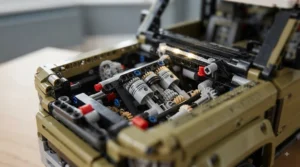
The LEGO Technic Chevrolet Corvette Stingray is the set most reviewers point to as the natural starting line for a young teen moving up from beginner LEGO Technic kits. It’s built around a detailed V8 engine block with moving pistons, opening doors, and a hood that lifts to reveal the engine — none of which are gimmicks, since each mechanism teaches a distinct principle of linkage and gearing.
Key specs worth knowing: the model uses a piston-driven engine display (turn the rear wheels and the pistons visibly move), functional steering via the front wheel linkage, and roughly 1,300+ pieces aimed at builders aged 9 and up, though the complexity comfortably suits early teens too. What this means in practice is a three-to-five-hour build that rewards patience without demanding an engineering degree — a genuinely good on-ramp rather than a watered-down toy.
Reviewers consistently note that the finished model looks proportionally accurate next to the real Corvette, and that the opening doors and engine detail hold up well under repeated handling, which matters if your teenager plans to actually play with it rather than shelve it. A recurring theme in aggregated feedback is that first-time Technic builders find the instructions clearer than expected for a model this detailed.
Pros:
- ✅ Genuinely realistic opening doors and moving V8 pistons
- ✅ Approachable build difficulty for a first “grown-up” Technic set
- ✅ Sturdy enough to survive regular handling and display moves
Cons:
- ❌ No motorisation — everything is manually operated
- ❌ Static once built, with limited alternate-model options
Expect a budget-to-mid-range price, generally under £60 at typical UK retail — check current price, as it fluctuates. For a first serious Technic set aimed at a young teenager, this is hard to beat on value.

2. LEGO Technic Fast & Furious Toyota Supra MK4 (42204) — best licensed build for film fans
The LEGO Technic Fast & Furious Toyota Supra MK4 leans hard into pop culture, and for a teenager who’s just discovered the film franchise, that’s precisely the point — it’s a gateway build that happens to teach real mechanics along the way.
The set delivers a 6-cylinder engine display, functional steering, an opening bonnet, and a removable Targa roof, all built to roughly 1:8 proportions. What that means practically is that the steering mechanism isn’t decorative — turning the steering wheel genuinely pivots the front wheels via a rack-and-pinion linkage, the same principle used in real cars, just scaled down into LEGO pins and gears.
Aggregated review sentiment highlights the two NOS bottles tucked into the boot as a nice nod to the source film, and builders frequently mention that the Targa top’s removable design is more satisfying to fit than it looks in product photos. On the flip side, some reviewers note the model’s proportions favour screen accuracy over strict scale realism, which purists occasionally flag.
Pros:
- ✅ Working rack-and-pinion steering you can actually feel
- ✅ Film-accurate details reward fans specifically
- ✅ Removable Targa roof adds a satisfying extra mechanism
Cons:
- ❌ Licensed theming may date faster than a generic supercar build
- ❌ No motor or app connectivity included
Pricing typically sits in the low-to-mid range, often in the £50-£60 range — always confirm the current price before ordering. It’s a strong mid-tier pick if your teenager’s interest is sparked by film culture as much as engineering.
3. LEGO Technic Koenigsegg Jesko Absolut (42173) — best pull-back mechanism for dramatic play
The LEGO Technic Koenigsegg Jesko Absolut trades a static display piece for genuine kinetic drama: pull it back and let go, and the model launches forward under its own stored energy — a mechanism that’s far more mechanically interesting than it sounds.
Specs-wise, the set features an 8-speed sequential gearbox you shift manually, working suspension on all four corners, and a detailed aerodynamic body shell replicating the real hypercar’s silhouette. In real-world terms, shifting through that 8-speed gearbox and watching the wheel speed visibly change is one of the better hands-on demonstrations of gear ratios you’ll find in any teenage-appropriate toy, full stop.
Reviewers consistently rate the pull-back mechanism’s punchiness as a highlight, though some flag that the plastic gearbox internals feel less robust than the exterior bodywork after months of enthusiastic play. Based on the spec comparison against the pricier RC version of the same car (42174), the pull-back Jesko is the far better value entry unless remote control is a genuine must-have.
Pros:
- ✅ Working 8-speed sequential gearbox demonstrates real gear ratios
- ✅ Satisfying pull-back launch mechanism for dynamic play
- ✅ Detailed suspension teaches four-corner mechanics
Cons:
- ❌ Gearbox internals reportedly wear faster than the bodywork
- ❌ No app or remote control on this specific variant
Expect a premium price point, commonly in the £130-£170 range depending on retailer promotions — check current price, as premium Technic sets fluctuate more than budget ones. This is the set for a teenager who wants their build to actually do something dramatic once finished.
4. LEGO Technic Ferrari SF-24 F1 Car (42207) — best for motorsport-obsessed older teens
Aimed explicitly at ages 18 and up on the box but genuinely appropriate for a mechanically confident 15-to-17-year-old with patience, the LEGO Technic Ferrari SF-24 F1 Car is less a toy and more a scale-model engineering exercise wearing Formula 1 branding.
The build replicates the real SF-24’s aerodynamic package, halo safety structure, and front/rear wing assemblies at a scale that prioritises visual accuracy over playability — this is a shelf piece, not a push-around car. What that distinction means practically: builders should expect a longer, more meticulous build session (often spread across multiple evenings) rather than an afternoon project, and the reward is a genuinely impressive static display model.
Aggregated customer sentiment is polarised in an instructive way — motorsport fans rate it extremely highly for detail accuracy, while buyers expecting a play-first vehicle sometimes find it underwhelming since it isn’t designed to be raced around a living room. That’s worth flagging honestly rather than glossing over, since it directly affects whether this is the right seventh birthday-to-legal-adulthood gift for your particular teenager.
Pros:
- ✅ Exceptional aerodynamic and structural detail accuracy
- ✅ Genuinely challenging build that rewards patience
- ✅ Outstanding as a permanent display piece
Cons:
- ❌ Not designed for active, rough play
- ❌ Higher skill and patience threshold than other Technic sets
Pricing sits in the mid-to-premium band, often the £60-£90 range depending on stock and promotions — verify current pricing before buying, as F1-licensed sets see periodic price adjustments. This is the pick for the teenager who watches every Grand Prix rather than the one who just likes fast cars in general.
5. Meccano 10-in-1 Racing Vehicles Construction Set (25206) — best budget Meccano entry point
Here’s where the comparison gets genuinely interesting, because the Meccano 10-in-1 Racing Vehicles Construction Set approaches the exact same “teenager who likes cars” brief from a completely different angle — real metal parts, real tools, and ten separate models from one 225-piece box rather than one polished vehicle. Independent reviewers covering the current Meccano range consistently rate its motorised and multi-model sets among the standout picks for older, more confident builders.
The set includes genuine nuts, bolts, and metal (or reinforced) construction strips, two real tools (a spanner and screwdriver), and instructions to build ten distinct high-speed vehicles — cars, planes, and boats among them — one at a time, disassembling each to build the next. In practice this means a teenager isn’t just following a single linear build; they’re repeatedly practising fastening, alignment, and structural logic across ten different mechanical puzzles, which builds transferable skill faster than a single-model LEGO set.
Reviewers consistently praise the genuine metal-parts feel as more “real engineering” than plastic pin-and-axle systems, and several note that the ten-model format keeps teenagers engaged well past the initial build, since there’s always another model to try. A recurring complaint in aggregated feedback is that the smaller nuts and bolts can be fiddly to handle and are easy to lose, so a tidy workspace matters more here than with LEGO’s snap-fit pieces.
Pros:
- ✅ Ten distinct models teach ten different mechanical layouts
- ✅ Real tools and fasteners build genuine hands-on skill
- ✅ Strong value across such a wide model range
Cons:
- ❌ Small parts are genuinely easy to misplace
- ❌ Rebuilding between models takes real time and patience
Expect a genuinely budget-friendly price, frequently under £30 — check current price, as Meccano’s budget range often sees seasonal discounting. For a teenager who likes taking things apart as much as building them, this is arguably the strongest value set in this entire comparison.

6. Meccano Engineering & Robotics Race Car Building Kit (Level 2, model 18207) — best working mechanism showcase
The Meccano Engineering & Robotics Race Car Building Kit sits a rung up in complexity from the entry-level Meccano sets, and its headline feature — a working jack mechanism — is exactly the kind of practical, slightly show-off-able build a 13-year-old wants to demonstrate to visiting relatives.
Specs include genuine metal construction parts, real tools included in the box, and a “Level 2” difficulty rating that Meccano uses to signal it’s aimed at builders with at least one previous set under their belt. What that difficulty rating means in practice is a build that introduces compound mechanisms — the jack doesn’t just move, it lifts under mechanical leverage the same way a real automotive jack does, which is a genuinely satisfying “aha” moment when a teenager first gets it working correctly.
Reviewers consistently flag the working jack as the standout feature, with several noting it holds up to repeated demonstration better than expected for a construction toy at this price point. On the downside, aggregated feedback suggests the instruction booklet assumes slightly more prior Meccano familiarity than a total beginner might have, so pairing this with an easier first Meccano set is a sensible sequencing choice.
Pros:
- ✅ Working jack mechanism demonstrates real leverage principles
- ✅ Genuine metal parts with real tools included
- ✅ Solid step up in complexity from entry-level sets
Cons:
- ❌ Assumes some prior Meccano building experience
- ❌ Smaller model range than the 10-in-1 or 25-in-1 sets
Pricing typically lands in the low-to-mid range, often £30-£40 — check current price given periodic retailer promotions. This is a smart “second Meccano set” for a teenager who’s already built the 10-in-1 and wants a genuine mechanical challenge.
7. Meccano 25-in-1 Motorised Super Construction Set — best premium Meccano for serious builders
At the top of the Meccano range for this comparison sits the Meccano 25-in-1 Motorised Super Construction Set, a genuinely substantial kit that can, one model at a time, become twenty-five different motorised machines — from a working crane with a real winch to a helicopter with spinning rotors.
The headline spec is a 6V electric motor with adjustable speed control, paired with roughly 638 pieces and two real tools. Worth flagging honestly: full step-by-step instructions are included for 11 of the 25 possible models, with the remaining 14 supported by reference images rather than exhaustive instructions — a genuine trade-off between breadth and hand-holding that buyers should know before purchase, not discover afterwards.
Aggregated review sentiment is strongly positive on the motor’s usefulness — reviewers note that having an actual adjustable-speed 6V motor, rather than a pull-back mechanism, makes the finished models feel meaningfully more like real machines than toys. A recurring theme in feedback is that the 14 image-only models genuinely do require a confident, patient builder — this isn’t a set to hand to a first-time Meccano user expecting full hand-holding throughout.
Pros:
- ✅ Real 6V motor with adjustable speed on every motorised build
- ✅ Twenty-five possible models from one box
- ✅ Teaches genuine mechanical and electrical basics together
Cons:
- ❌ Only 11 of 25 models have full step-by-step instructions
- ❌ Requires more building confidence than entry Meccano sets
Expect a premium price for the Meccano range, commonly in the £70-£90 range — check current price, as this flagship set sees notable seasonal price movement. For a mechanically confident teenager who wants the widest possible range of builds from one purchase, this is the standout Meccano pick.
Getting Started: A Practical Usage Guide for New Builders
Buying the set is the easy part. Getting a teenager from “box on the floor” to “finished, working model” without a meltdown involves a few tricks neither Amazon listing nor instruction booklet will tell you outright.
First, sort before you build. Whether it’s LEGO Technic bags or a Meccano parts tray, tip everything into small containers or a muffin tin before starting — the single biggest cause of abandoned builds is hunting for one specific 6mm axle pin in a carpet for twenty minutes. Second, build somewhere with good light and a flat, stable surface; Meccano’s metal fasteners in particular roll and vanish on soft carpet in a way LEGO pieces never do. Third, resist the urge to “help” by taking over — mechanical confidence comes from struggling through a tricky linkage alone, not from watching a parent do it.
For maintenance, LEGO Technic gearboxes benefit from an occasional gentle wipe to remove dust, since grit accelerates wear on moving gear teeth. Meccano’s metal parts should be kept dry and, if they ever squeak, a tiny amount of general-purpose lubricant on the axle points solves it instantly — never oil the plastic gearboxes on Technic sets, though, since it can degrade the plastic over time. In the first 30 days, the most common mistake is over-tightening Meccano’s nuts and bolts, which strips the threads; snug is sufficient, and a real mechanic never cranks a fastener to breaking point either.

Real-World Scenarios: Which Set Fits Which Teenager
Abstract advice is only so useful, so here are three genuinely common buyer profiles matched to specific recommendations, with reasoning attached rather than a guess.
If you’re buying for a car-obsessed 13-year-old with a modest £50 budget who mainly wants something impressive to show friends, the LEGO Technic Chevrolet Corvette Stingray or the Meccano 10-in-1 Racing Vehicles Construction Set both fit comfortably, and the choice really comes down to whether they’d rather have one polished vehicle or ten different ones from the same box.
If you’re buying for a 15-year-old who’s already built two or three LEGO sets and is getting bored of following instructions exactly, either the Meccano Engineering & Robotics Race Car Building Kit or the LEGO Technic Koenigsegg Jesko Absolut introduces a genuine mechanical challenge — the jack mechanism and the 8-speed gearbox respectively both demand more spatial reasoning than a beginner build.
If you’re buying for a motorsport-mad 16-to-17-year-old with weekend free time and real patience, the LEGO Technic Ferrari SF-24 F1 Car rewards that patience with unmatched detail accuracy, while a teenager who prefers tinkering with electronics and motors over static display pieces will get more mileage from the Meccano 25-in-1 Motorised Super Construction Set‘s adjustable-speed motor.
Problem → Solution: Fixing the Most Common Building Set Complaints
Even good sets generate predictable frustrations. Here’s how to solve the five most common ones without returning the box.
Lost small parts are the number-one complaint across both brands — the fix is a labelled parts tray from day one, not after the first bag goes missing. Confusing instructions, particularly on Meccano’s image-only models, are solved by starting with the fully-instructed builds first to build pattern recognition before attempting the reference-image-only ones. Gearboxes that feel “gritty” on LEGO Technic sets usually just need dust removed with a soft brush, not replacement parts. Stripped Meccano threads happen from over-tightening — the solution is simply teaching “snug, then quarter-turn more,” never full-strength tightening. Finally, a teenager who abandons a build halfway through almost always needs the model broken into smaller milestones rather than “finish the whole thing today” — celebrate the chassis, then the drivetrain, then the bodywork as separate wins.
How to Choose Between LEGO Technic and Meccano for Teenagers
- Consider their patience threshold first. Teenagers who enjoy multi-hour, single-focus tasks suit LEGO Technic’s longer premium builds; those with shorter attention spans do better with Meccano’s shorter, swappable models.
- Weigh realism against variety. LEGO Technic sets are usually one highly realistic model per box; Meccano sets typically offer several models from one set of parts, which suits teenagers who get bored quickly.
- Check for genuine tool use appeal. If your teenager likes the idea of using a real spanner and screwdriver rather than snap-fit pieces, Meccano’s tactile experience wins decisively.
- Factor in motorisation interest. LEGO’s Control+ app-controlled sets appeal to teenagers who like smartphone integration; Meccano’s 6V motor appeals to those who prefer a tangible, physical control dial.
- Budget realistically across the full range. Both brands span roughly the same overall price bracket, but Meccano’s average set tends to sit lower, making it a sensible choice for repeat gifting throughout the year.
- Think about display versus play. Premium LEGO Technic builds like the Ferrari SF-24 are built to be displayed; Meccano’s multi-model sets are built to be disassembled and rebuilt repeatedly.
- Match complexity to prior experience. A total beginner should start with an entry-level set from either brand rather than jumping straight to a flagship motorised kit.
LEGO Technic vs Meccano: The Full Mechanical Building Sets Comparison
| Aspect | LEGO Technic | Meccano | Best For |
|---|---|---|---|
| Realism of finished model | Very high, screen/scale accurate | Functional but less visually polished | LEGO Technic Ferrari SF-24 for display |
| Number of models per box | Usually 1 (occasionally 2) | Often 5, 10, or 25 | Meccano 10-in-1 for variety |
| Tactile “real tool” experience | Minimal — snap-fit pieces | Genuine spanner and screwdriver use | Meccano Engineering & Robotics Kit |
| Motorisation and tech | LEGO Control+ app, Powered Up motors | 6V motor, adjustable speed | Meccano 25-in-1 for hands-on motor control |
| Typical rebuild durability | High, plastic resists corrosion | High, though threads can strip if over-tightened | Roughly tied |
Reading across that table, the honest takeaway is that LEGO Technic consistently wins on polish and realism, which explains why it dominates the premium end of the market, while Meccano consistently wins on raw building repetitions per pound spent, which is exactly why engineering-minded parents often gravitate back to it despite LEGO’s marketing dominance. Neither system teaches “more” mechanical thinking in absolute terms — they teach it through different repetitions, and a genuinely mechanically curious teenager benefits from owning at least one set from each.
✨ Don’t Miss These Exclusive Deals!
🔍 Take your building set collection to the next level with these carefully selected picks. Click through to check current pricing and availability before it changes. These sets make genuinely engaging gifts your teenager will actually use, not just unwrap.

Common Mistakes When Buying a Building Set for a 13 Year Old
The single biggest mistake is buying strictly by age recommendation on the box without checking actual build complexity — a “9+” LEGO Technic set and an “9+” Meccano set can differ enormously in real difficulty, so read the piece count and mechanism descriptions rather than trusting the age label alone. A close second is buying the flagship, most expensive set as a first purchase; a teenager who’s never handled Technic pins or Meccano bolts before will get more genuine enjoyment (and less frustration) from an entry-level set that they can actually finish in one sitting.
Parents also frequently underestimate how much workspace and storage a multi-model Meccano set requires — ten or twenty-five models’ worth of loose parts need somewhere to live between builds, and a shoebox with dividers solves this cheaply. Another common misstep is assuming motorisation automatically means “better” — a non-motorised set that’s well-matched to a teenager’s actual skill level will get played with far more than an expensive motorised set that’s genuinely too advanced. Finally, don’t ignore aggregated review sentiment about durability; a set with consistent complaints about specific parts snapping or threads stripping is worth avoiding regardless of how impressive the marketing photography looks.
What to Expect: Functional Models in Real-World Use
Marketing photography makes every functional model look flawless, so here’s what actually happens once real hands are involved. LEGO Technic’s moving parts — steering racks, piston engines, opening panels — genuinely work as advertised, but they’re built to a tolerance that favours smooth motion over heavy-duty durability, meaning aggressive play (repeatedly slamming doors, forcing steering past its range) will eventually loosen connections faster than gentle demonstration use.
Meccano’s metal mechanisms, by contrast, tend to tolerate rougher handling better structurally, but the trade-off is that loose nuts and bolts genuinely do work themselves loose over repeated use and need periodic re-tightening — which is, ironically, itself a small mechanical lesson in why real machines need maintenance schedules. Reviewers across both brands consistently note that functional models photograph beautifully but need realistic expectation-setting: a pull-back Technic car launches impressively but not at toy-car-track speeds, and a Meccano crane’s “working winch” lifts small loads smoothly rather than heavy ones. Setting that expectation before the box is opened prevents a surprisingly common source of disappointment.
Motorised Builds: LEGO Control+ vs the Meccano Motor
LEGO’s Control+ system uses Bluetooth-connected motors paired with a free smartphone app, turning selected Technic vehicles into genuinely remote-controllable machines with programmable functions — steering, driving, and specific vehicle actions can all be triggered from a phone screen. What that means practically is a more “modern,” screen-integrated experience that appeals directly to teenagers already comfortable with app-based interfaces.
Meccano’s approach, by contrast, is deliberately analogue: a physical 6V motor with a manual speed dial, wired directly into the model rather than controlled wirelessly. Based on the spec comparison, this is arguably the more instructive option for teaching actual electrical-mechanical cause and effect, since the teenager sees the direct relationship between the dial position and the motor’s behaviour, without an app layer abstracting that connection away. Neither approach is definitively superior — a teenager drawn to coding and apps will prefer Control+, while one drawn to hands-on electrics will prefer Meccano’s tangible motor control.
LEGO Technic Sets for Teens: Age-by-Age Breakdown
Not every LEGO Technic set aimed at “teens” is genuinely appropriate for the full 13-to-17 range, so it’s worth breaking down by rough age band. For 12-to-13-year-olds newer to the theme, sets like the LEGO Technic Chevrolet Corvette Stingray hit the sweet spot of genuine mechanical features without an overwhelming piece count. For 14-to-15-year-olds with a set or two of prior experience, the LEGO Technic Fast & Furious Toyota Supra MK4 and the pull-back LEGO Technic Koenigsegg Jesko Absolut introduce more advanced gearing concepts while remaining achievable in a weekend. For 16-to-17-year-olds seeking a genuine engineering challenge, the LEGO Technic Ferrari SF-24 F1 Car — officially rated 18+ but manageable for a patient, confident older teen — delivers a build experience that rewards sustained concentration rather than a quick afternoon win.
STEM Gifting: Why These Sets Make Smarter Presents Than Screens
STEM gifting has become something of a buzzword, but the underlying logic holds up under scrutiny: physical construction toys give teenagers hands-on experience with gear ratios, leverage, torque, and structural load in a way that passive screen time simply cannot replicate. The Technic theme was designed from the outset as a tool for teaching basic mechanical engineering principles through working vehicles and machines, rather than the simpler brick-building of standard LEGO ranges — which is precisely the pitch that makes it such a compelling STEM gift rather than just another toy.
Both LEGO Technic and Meccano sets translate directly into transferable skills — spatial reasoning, sequential problem-solving, fine motor control, and, in Meccano’s case specifically, genuine tool literacy that carries over into real-world DIY confidence later in life. For a gift-giver choosing between a games console and a mechanical building set for a birthday, the honest case for the latter is that it produces an actual finished object the teenager made themselves, which tends to generate a different, more durable kind of satisfaction than completing a level.
Long-Term Cost & Maintenance
Total cost of ownership looks different across the two brands once you factor in repeat purchases. A single premium LEGO Technic set represents a one-time cost with essentially zero ongoing spend, since the finished model typically becomes a static or occasional-play display piece. Meccano’s multi-model sets, by contrast, offer better cost-per-build-session — a Meccano 25-in-1 Motorised Super Construction Set effectively delivers 25 separate build projects from one purchase, which meaningfully lowers the cost-per-hour of engagement even before accounting for its typically lower up-front price relative to flagship LEGO Technic sets.
Maintenance costs for both brands are close to negligible — LEGO Technic gearboxes rarely need anything beyond occasional dust removal, and Meccano’s occasional squeaky joint is solved with a drop of general household lubricant. The main long-term cost consideration is replacement parts: LEGO’s bricks-and-pieces ordering service makes replacing a single lost Technic pin straightforward and cheap, while Meccano’s standard nuts and bolts are common enough hardware that many are replaceable from a standard hardware shop in a pinch, which is a genuinely underrated practical advantage of the metal-parts system.
Safety, Regulations and Compliance for UK Buyers
For UK buyers, both LEGO Technic and Meccano sets sold through legitimate retailers must comply with the Toys (Safety) Regulations 2011, which governs mechanical, chemical, and flammability safety standards for toys sold in Great Britain, with either UKCA or CE marking currently accepted on packaging. In practical terms, this means genuine retail sets carry age gradings and small-parts warnings that are worth reading properly rather than skimming past — a set rated “9+” is rated that way partly for build complexity and partly for genuine choking-hazard risk with younger siblings in the house.
Meccano’s metal parts, including small nuts, bolts, and washers, warrant particular attention in households with younger children who might wander into a teenager’s build session, since loose metal fasteners are an obvious hazard for anyone under the set’s stated minimum age. LEGO Technic’s motorised sets using Powered Up components run on low-voltage battery systems that fall comfortably within standard toy electrical safety limits, and Meccano’s 6V motor sets are similarly designed to stay well under the voltage thresholds that would require additional certification. Buying from established UK retailers rather than unbranded marketplace listings remains the simplest way to ensure genuine compliance, since counterfeit or grey-market sets have periodically failed independent safety testing in ways the genuine branded products have not.
Frequently Asked Questions
❓ Is LEGO Technic or Meccano better for a 13 year old just starting out?
❓ Can Meccano and LEGO Technic pieces be combined in the same build?
❓ Are LEGO Technic motorised sets worth the extra cost over standard sets?
❓ How long does a typical LEGO Technic or Meccano build take a teenager?
❓ Do Meccano sets still use real metal parts in 2026?
Conclusion
There isn’t a single correct winner in the LEGO Technic vs Meccano debate, and honestly, treating it as a winner-takes-all contest misses the point of both toys. LEGO Technic delivers polish, realism, and increasingly clever app-driven motorisation that suits a teenager who wants one genuinely impressive finished model to show off. Meccano delivers repetition, real tool literacy, and a distinctly British engineering heritage that suits a teenager who’d rather build twenty-five imperfect machines than one perfect one.
If your budget and your teenager’s patience allow for it, the strongest recommendation coming out of this comparison isn’t to pick a side — it’s to consider one set from each system. Starting with an accessible entry point like the LEGO Technic Chevrolet Corvette Stingray or the Meccano 10-in-1 Racing Vehicles Construction Set gives a genuine, low-risk introduction to both philosophies before committing to a premium purchase like the LEGO Technic Ferrari SF-24 F1 Car or the Meccano 25-in-1 Motorised Super Construction Set. Whichever you choose, always check the current price before buying, since both ranges see regular promotional movement throughout the year — particularly around Christmas and birthdays, when demand for genuinely engaging STEM gifts for teenagers tends to spike.
Recommended for You
- LEGO Harry Potter Sets for Adult Fans: 7 Best Builds 2026
- 7 Best LEGO Marvel Set for Kids Picks in 2026: Budget to Epic
- 7 Best LEGO City Set Picks for 2026: Budget to Premium
Disclaimer: This article contains affiliate links. As an Amazon Associate, I earn from qualifying purchases. If you purchase products through these links, we may earn a small commission at no additional cost to you.
✨ Found this helpful? Share it with your friends! 💬🤗
