
In This Article
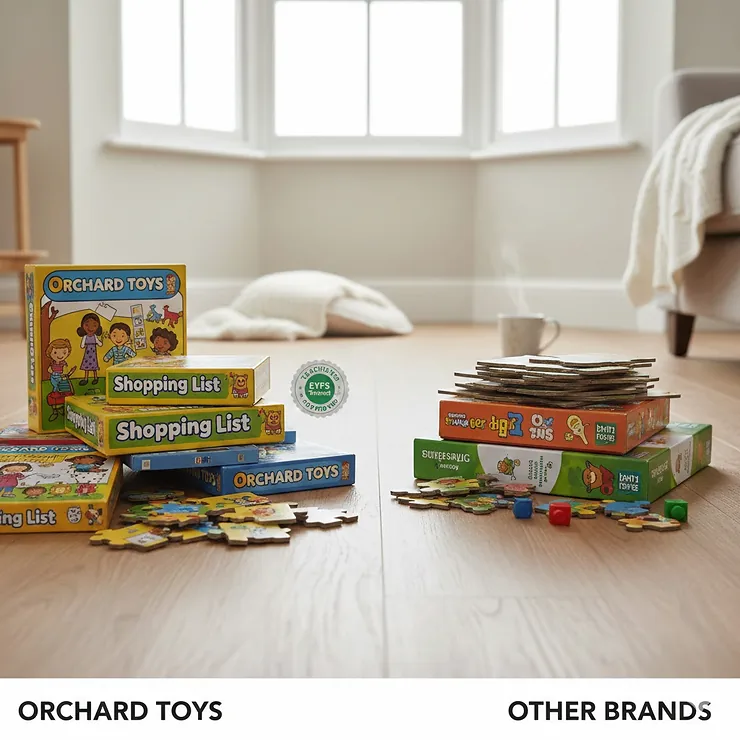
You’ve probably stood in the toy aisle, overwhelmed by the sheer number of educational games promising to turn your little one into the next Einstein. I’ve been there myself, clutching my shopping list whilst my four-year-old tugged at my sleeve, begging for yet another game we’d “absolutely need.” Here’s the thing: not all educational toys are created equal, especially when it comes to orchard toys vs other brands available in the UK market.
British parents are becoming increasingly savvy about the toys they bring home. We’re not just looking for something to keep the kids quiet on rainy afternoons—we want games that genuinely support learning through play, align with the Early Years Foundation Stage, and won’t fall apart after three uses. According to research from the Education Endowment Foundation, play-based learning approaches can improve learning outcomes by approximately four additional months when implemented effectively. That’s not insignificant when you’re preparing your child for reception class.
But with established British brands like Orchard Toys competing against international giants such as Melissa & Doug, Ravensburger, and fellow UK stalwart Galt Toys, how do you make an informed decision? In this comprehensive guide, I’ll compare orchard toys vs other brands across seven top-rated products, examining everything from educational value and durability to price points and customer satisfaction. Whether you’re searching for the best educational games age 4 or phonics learning toys reception children actually enjoy using, this article will help you invest wisely.
Quick Comparison Table
| Feature | Orchard Toys | Melissa & Doug | Ravensburger | Galt Toys |
|---|---|---|---|---|
| Origin | 🇬🇧 UK (Since 1971) | 🇺🇸 USA | 🇩🇪 Germany (Since 1883) | 🇬🇧 UK (Since 1836) |
| Price Range | £6.99-£15.99 | £4.99-£35.99 | £5.66-£49.99 | £4.99-£19.99 |
| Age Focus | 18 months – 8 years | 0 – 12+ years | 3 – 14+ years | 0 – 10 years |
| Materials | Recycled board, FSC certified | Primarily wood | High-quality card/plastic | Mixed materials |
| EYFS Alignment | ✅ Excellent | ✅ Good | ✅ Good | ✅ Excellent |
| UK Availability | Excellent | Excellent | Excellent | Excellent |
| Durability | ⭐⭐⭐⭐⭐ | ⭐⭐⭐⭐⭐ | ⭐⭐⭐⭐ | ⭐⭐⭐⭐ |
| Educational Focus | School readiness, literacy, numeracy | Open-ended play, creativity | Puzzles, memory, logic | Science, creativity, basics |
💬 Just one click – help others make better buying decisions too! 😊
Top 7 Educational Games: Expert Analysis
When comparing orchard toys vs other brands, I’ve selected seven standout products that represent the best each manufacturer offers for UK families. These aren’t random choices—they’re based on customer reviews, educational value, and alignment with school readiness games children need before starting reception.
1. Orchard Toys Shopping List Memory Game vs Ravensburger My First Memory Game
Price: £7.99-£10.99 | Ages: 3-7 years | Players: 2-4 (expandable to 8)
The Shopping List game has been Orchard Toys’ bestseller for over 25 years, and for good reason. This clever memory and matching game asks children to collect items from their shopping list—ranging from tomatoes to washing powder—by turning over cards and remembering their positions. What makes it brilliant for counting games for preschoolers is the natural progression: younger children play with cards face-up as a simple matching exercise, whilst older ones use strategic memory to locate items faster.
UK parents consistently praise its sturdy, wipe-clean cards made from recycled board. One reviewer noted: “My six-year-old boy enjoyed it. Easy to play. My two-year-old also enjoyed it. It’s helped with learning the names of objects.” The game cleverly includes both traditional paper lists and a modern tablet shopping list, which resonates with today’s digitally-aware children.
Shopping List integrates seamlessly into daily life—you can extend learning by asking children to spot items from their game cards during actual supermarket trips, reinforcing vocabulary and observation skills.
✅ Pros:
- Exceptional durability with FSC-certified recycled materials
- Expandable gameplay with Clothes and Fruit & Veg extras packs
- Supports both cooperative and competitive play styles
❌ Cons:
- Limited variety with base set (32 items)
- Younger siblings may find standard rules challenging
Ravensburger Alternative: Their My First Memory Game (around £5.66) offers similar memory mechanics with larger, chunkier cards featuring simple images. However, it lacks the shopping theme’s real-world connection and has fewer expansion options.
2. Orchard Toys Match and Spell vs Melissa & Doug See & Spell Learning Toy
Price: £9.75-£12.99 | Ages: 4+ years | Players: 1-4
For parents seeking phonics learning toys reception teachers actually recommend, Match and Spell is extraordinary. This award-winning literacy game teaches letter recognition, phonetic word building, and sight word matching through two distinct play modes. Beginners match letter cards to pre-printed boards, gradually learning letter shapes and sounds. Advanced players flip boards to the blank side, independently constructing words from pictures—a genuine cognitive leap.
The game progresses from simple three-letter words like “cat” and “dog” to more complex four-letter words such as “slug” and “frog.” What UK parents particularly appreciate is its alignment with synthetic phonics teaching used in British primary schools. Children learn to blend sounds naturally, which directly supports their literacy development in reception and Year 1.
British buyers report that it holds children’s attention remarkably well. A teacher shared: “Good game, I use it quite a lot for lessons. Great fun.” The quality of Orchard Toys’ card stock means the game survives enthusiastic handling by multiple children over several years.
✅ Pros:
- Two difficulty levels provide extended value as children progress
- Aligns perfectly with UK phonics curriculum (Letters and Sounds)
- Colourful, engaging illustrations maintain interest
❌ Cons:
- Focuses primarily on three- and four-letter words
- May feel repetitive for advanced readers
Melissa & Doug Alternative: Their wooden See & Spell board (£12.99-£18.99) offers tactile, three-dimensional letter tiles that some children find more engaging. However, it’s designed for American English spelling patterns and doesn’t align as closely with UK phonics teaching methods. The wooden construction is beautiful but heavier and less portable than Match and Spell.
3. Galt Toys First Phonics vs Orchard Toys Alphabet Lotto
Price: £8.99-£11.99 | Ages: 4-7 years | Players: 2-4
Galt Toys, Britain’s oldest toy manufacturer (established 1836), brings serious heritage to british educational toy brands. Their First Phonics game uses a unique approach: children match colourful picture cards to initial letter sounds on their playing boards. What distinguishes Galt from orchard toys vs other brands is their focus on multi-sensory learning. Many Galt products incorporate tactile elements or scientific concepts alongside traditional literacy and numeracy.
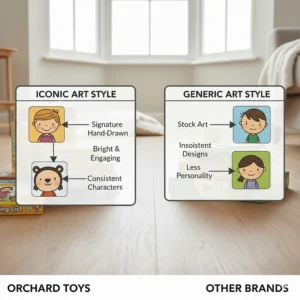
First Phonics features sturdy cards and clear, uncluttered imagery that helps children focus on letter-sound relationships without distraction. However, some parents find the artwork slightly less engaging than Orchard Toys’ characterful illustrations. UK customers report good durability, though not quite matching Orchard Toys’ legendary robustness.
Orchard Toys Alphabet Lotto (£9.99-£12.49) offers a similar premise but with Orchard’s signature vibrant design. It includes 28 double-sided picture/letter boards, providing exceptional variety. Children match colourful pictures to letters, learning alphabetical order whilst developing observation skills.
✅ Pros (Galt):
- Excellent value for money
- Clear focus on phonemic awareness
- Good for visual learners
❌ Cons (Galt):
- Less visually engaging than some competitors
- Fewer gameplay variations
The verdict? For learning through play toys that prioritise clear educational outcomes, Galt delivers solid value. For entertainment value that keeps children returning to the game voluntarily, Orchard Toys edges ahead.
4. Ravensburger ABC Educational Game vs Orchard Toys Buzz Words
Price: £5.66-£8.99 (Ravensburger) | £11.99-£14.99 (Orchard Toys) | Ages: 3-5 years
Ravensburger’s ABC game is remarkably affordable, making it an attractive entry point for school readiness games. The big, bold puzzle pieces help develop observation and communication skills through picture-letter association. With 28 double-sided pairs, children learn the alphabet by matching pictures to letters, then progressing to sounding out letters independently.
What makes Ravensburger products special is their German engineering heritage—even card-based games feel substantial and precisely manufactured. However, the downside is limited replay value. Once children master the alphabet, the game loses its challenge. British parents note it’s excellent value for reception-age children but outgrown relatively quickly.
Orchard Toys Buzz Words takes a different approach entirely. This hilarious spelling bee game for ages 5+ has children spelling increasingly difficult words under gentle time pressure. It’s more sophisticated, making it perfect for Year 1 and Year 2 pupils who’ve mastered basic phonics and are ready for sight words and irregular spellings. The bee theme is engaging (children collect bee counters), and the competitive element adds excitement.
✅ Pros (Ravensburger ABC):
- Exceptional value at under £6
- Large pieces perfect for developing motor skills
- Proven track record (130+ years of toy manufacturing)
❌ Cons (Ravensburger ABC):
- Limited progression opportunities
- Less interactive than board games
UK parents shopping for best educational games age 4 often start with Ravensburger’s budget-friendly options before investing in more complex Orchard Toys games as children progress.
5. Melissa & Doug Wooden Magnetic Numbers vs Orchard Toys Counting Mountain
Price: £7.99-£12.99 (M&D) | £10.99-£13.49 (Orchard Toys) | Ages: 3+ years
Melissa & Doug built their reputation on beautifully crafted wooden toys that feel heirloom-quality. Their Wooden Magnetic Numbers set includes 37 colourful wooden numbers stored in a sturdy wooden case. Children can stick them to magnetic boards or fridges, practising number recognition and simple arithmetic in an open-ended format.
The advantage? Pure tactile satisfaction. There’s something deeply satisfying about the weight and feel of wooden toys that plastic or card alternatives can’t match. However, they lack structured gameplay, meaning parents need to actively guide learning rather than letting children play independently.
Orchard Toys Counting Mountain (£10.99-£13.49) transforms counting practice into an adventure. Players help mountaineers climb a 3D mountain by solving addition and subtraction problems from 1-10. The game board is cleverly designed with multiple paths, and children use strategy alongside maths skills. It’s one of the best counting games for preschoolers because it contextualises numbers within an engaging narrative.
British parents particularly value games that children will actually choose to play repeatedly. Counting Mountain achieves this by blending education with genuine fun. One parent shared: “Brilliant for teaching basic maths without it feeling like work. My five-year-old asks to play this daily!”
✅ Pros (Counting Mountain):
- Combines counting, addition, and subtraction naturally
- 3D mountain element adds excitement
- Multiple difficulty levels for different abilities
❌ Cons (Counting Mountain):
- More expensive than basic number toys
- Requires more storage space
For learning through play toys focused on numeracy, board games like Counting Mountain provide structured progression that magnetic numbers can’t match. However, Melissa & Doug’s wooden sets excel for free-play and creative exploration.
6. Orchard Toys Bus Stop Game vs Galt Toys Mini Marble Run
Price: £11.99-£14.49 (Bus Stop) | £6.99-£9.99 (Marble Run) | Ages: 4-8 years
Here’s where we see real differentiation between british educational toy brands. Orchard Toys Bus Stop is specifically designed to teach addition and subtraction through a charming bus journey narrative. Children move buses along routes, picking up and dropping off passengers, whilst practising number bonds and basic calculations. Teachers frequently use Bus Stop in classroom settings because it makes abstract maths concepts concrete and relatable.
UK parents report that Bus Stop has remarkable longevity. Unlike some educational games that children outgrow within months, this remains engaging from ages 4 through 8 by offering multiple difficulty levels. It’s particularly effective for school readiness games because it mirrors real-world scenarios—something children observe daily if they use public transport.
Galt Toys Mini Marble Run takes an entirely different approach to STEM learning. Rather than structured gameplay, it’s a construction toy encouraging spatial reasoning, problem-solving, and physics understanding. Children design marble runs, test them, troubleshoot issues, and rebuild. This open-ended play style aligns brilliantly with learning through play principles advocated by early years educators.
✅ Pros (Bus Stop):
- Exceptional educational value for maths development
- Teacher-tested and classroom-approved
- Wipe-clean board for durability
❌ Cons (Bus Stop):
- Requires reading ability for full enjoyment
- Less appealing to children who prefer construction toys
Pros (Marble Run):
- Develops engineering thinking
- Unlimited creative possibilities
- Compact and travel-friendly
Cons (Marble Run):
- Less structured learning
- Small pieces pose choking hazard for under-3s
When comparing orchard toys vs other brands for maths education, Orchard wins decisively. For STEM exploration and creative problem-solving, Galt’s construction-focused products shine.
7. Melissa & Doug Suspend Family Game vs Orchard Toys What’s the Time, Mr Wolf?
Price: £14.99-£19.99 (Suspend) | £11.99-£14.49 (Mr Wolf) | Ages: 5+ years
As children approach Key Stage 1, they need games that teach practical life skills. Orchard Toys What’s the Time, Mr Wolf? is genius in its simplicity. The game includes a moveable clock face, and children must set the time correctly to progress around the board. It teaches both digital and analogue time-telling—essential skills many children struggle with.
British parents particularly value this because telling the time is a specific curriculum requirement by Year 2. Rather than drilling time facts through worksheets, Mr Wolf embeds learning in an enjoyable chase game where players avoid being caught by the wolf. The clock manipulation gives children hands-on practice that pure digital displays can’t provide.
Melissa & Doug Suspend is a completely different beast: a beautiful balancing game where players carefully hang notched rods on an increasingly precarious structure. It’s not overtly educational but develops fine motor skills, spatial awareness, strategic thinking, and most importantly, frustration tolerance and turn-taking.
UK customers rate Suspend (11,559 reviews, 4.6 stars) extremely highly as a family game that adults genuinely enjoy playing alongside children. That’s crucial—when parents find games engaging, they’re more likely to facilitate regular play sessions.
✅ Pros (Mr Wolf):
- Directly addresses curriculum requirement
- Multiple ways to play (two difficulty levels)
- Includes quality clock with moving hands
❌ Cons (Mr Wolf):
- Specifically focused on one skill
- Some children find wolf-chase theme scary
Pros (Suspend):
- Outstanding build quality
- Engaging for all ages (5 to adult)
- Develops patience and focus
Cons (Suspend):
- Less obviously educational
- Higher price point
For targeted school readiness games addressing specific curriculum needs, Orchard Toys excels. For family bonding with incidental learning, Melissa & Doug’s beautifully designed games win hearts.
✨ Don’t Miss These Exclusive Deals!
🔍 Take your child’s early learning to the next level with these carefully selected products. Click on any highlighted item to check current pricing and availability on Amazon.co.uk. These games will help you create authentic learning moments your family will love!
What Makes Orchard Toys vs Other Brands Stand Out?
British Heritage and EYFS Alignment
Both Orchard Toys and Galt Toys are quintessentially British companies with deep understanding of UK educational requirements. Founded in 1971, Orchard Toys has spent five decades collaborating with teachers, nursery professionals, and children to ensure products perfectly balance educational value with play appeal. This isn’t accidental—it’s embedded in their design process.
Every Orchard Toys product aligns explicitly with Early Years Foundation Stage (EYFS) framework objectives. The Birth To 5 Matters guidance emphasises that play “makes a powerful contribution to children’s wellbeing, development and learning.” Orchard Toys’ games operationalise this principle superbly, offering structured play that develops specific competencies without feeling like formal teaching.
International brands like Melissa & Doug and Ravensburger design brilliant toys, but they’re created for global markets. Subtle differences matter: British phonics teaching differs from American approaches; our number formation follows distinct patterns; even our cultural references vary. When children play with Shopping List, they’re seeing familiar British grocery items and packaging styles, making connections stronger.
Sustainability and Environmental Responsibility
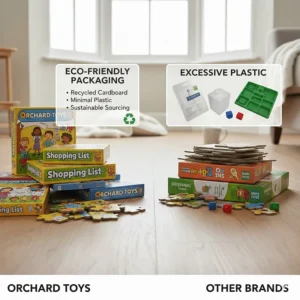
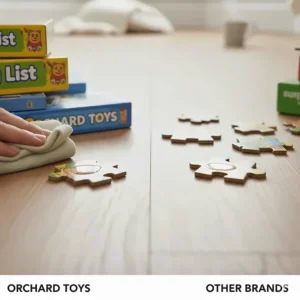
UK parents increasingly prioritise eco-friendly products, and this is where orchard toys vs other brands shows significant variation. Orchard Toys manufactures games in Britain from recycled board and paper sourced from sustainable forests. Their products carry FSC (Forest Stewardship Council) certification, meaning materials come from responsibly managed forests.
According to their specifications, Orchard Toys’ packaging uses minimal plastic, and their wipe-clean boards mean games last for years—often being passed down through siblings or donated to schools. This durability isn’t just economical; it’s environmentally responsible. As the National Literacy Trust research indicates, play is crucial for developing children’s communication and language skills, making long-lasting, reusable educational toys a sound investment.
Melissa & Doug also champions sustainability through their wooden toys, which biodegrade naturally unlike plastic alternatives. However, shipping wooden products from overseas facilities increases carbon footprint compared to locally manufactured card games. Ravensburger has made significant sustainability commitments, manufacturing 86% of products in-house at their German facilities with robust environmental controls.
Galt Toys similarly emphasises quality and durability, ensuring products withstand the rigours of both home and nursery use. Their heritage means they understand the value of toys that last generations, not just months.
Price Points and Value for Money
When evaluating orchard toys vs other brands on price, several factors deserve consideration beyond the initial purchase cost:
Budget Range (£4-£10):
- Ravensburger offers exceptional entry-level games
- Galt Toys mini games provide excellent value
- Orchard Toys mini games (£4.99-£6.99)
Mid-Range (£10-£15):
- Orchard Toys’ core range sits here
- Melissa & Doug simpler wooden toys
- Galt Toys standard games
Premium (£15+):
- Melissa & Doug elaborate wooden sets
- Ravensburger advanced systems (like GraviTrax)
- Orchard Toys deluxe games with 3D components
Here’s the clever bit: Orchard Toys’ mid-range pricing (£7.99-£14.99 for most games) hits a sweet spot. Products cost more than basic budget options but significantly less than premium wooden toys, whilst offering comparable or superior educational outcomes. The durable materials mean cost-per-play is exceptionally low when games survive 2-3 children over several years.
British parents on Mumsnet forums consistently cite Orchard Toys as “investment purchases” that prove their worth through repeated use. As one parent noted: “We bought Shopping List when my eldest was 3. She’s now 8, her brother is 6, and the youngest at 3 is just starting to play. It looks nearly new despite hundreds of games. That’s proper value.”
Age Appropriateness and Skill Progression
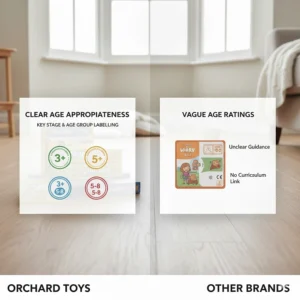
One subtle advantage when examining orchard toys vs other brands is Orchard’s clear age progression pathway. Their range is specifically designed for 18 months through 8 years, with games building incrementally in complexity:
18 months – 3 years:
- Simple matching games (Farmyard Heads and Tails)
- Large chunky cards for little hands
- Basic turn-taking introduction
3-5 years (Nursery/Reception):
- Memory games (Shopping List, Little Bug Bingo)
- Basic phonics (Alphabet Lotto, First Sounds)
- Early counting (Dotty Dinosaurs)
5-7 years (Reception/Year 1/Year 2):
- Advanced literacy (Match and Spell, Buzz Words)
- Maths operations (Bus Stop, Counting Mountain)
- Time-telling (What’s the Time, Mr Wolf?)
7-8+ years:
- Multiplication (Times Tables Heroes)
- Advanced maths (Mammoth Maths with magic viewer)
- Strategic thinking games
This structured progression means parents can confidently purchase Orchard Toys products knowing they align with their child’s developmental stage and school curriculum. Melissa & Doug’s age range is broader (0-12+), offering fantastic products but requiring more research to identify appropriate options. Ravensburger’s strength lies in puzzles and older children’s games, with less emphasis on structured early years education.
Quality, Durability and Safety Standards
All brands discussed meet rigorous UK and EU safety standards, but construction quality varies significantly. Orchard Toys’ recycled board is remarkably resilient—their wipe-clean coating withstands sticky fingers, spilled juice, and enthusiastic handling. Cards rarely tear or separate, even in busy nursery environments.
Melissa & Doug’s wooden toys are heirloom-quality, often lasting decades when properly cared for. However, wooden components can chip or crack if dropped, and younger children sometimes find pieces heavy to manipulate. The premium price partly reflects this superior construction, but for families on budgets, card-based alternatives offer excellent value without sacrificing educational quality.
Ravensburger’s card and box quality is exceptional, reflecting their 140+ years manufacturing experience. However, some UK parents note that Ravensburger games can feel slightly less robust than Orchard Toys equivalents, with boxes occasionally showing wear faster. Galt Toys occupies a middle ground—good quality that withstands normal use but perhaps not quite matching Orchard’s legendary durability.
For busy families with multiple children, childminders, or nurseries, Orchard Toys’ toughness represents real value. Products routinely survive hundreds of play sessions looking fresh enough to donate or resell, extending their useful life and reducing waste.
Real-World Educational Impact
The crucial question: do these games actually support learning through play, or are they expensive distractions? Research from the Education Endowment Foundation demonstrates that guided play—where adults set up learning environments and provide resources whilst children lead activities—generates the strongest educational outcomes.
Orchard Toys excels here because games provide structure (rules, objectives, progression) whilst allowing children considerable autonomy in how they engage. Shopping List can be played as pure matching, strategic memory challenge, or extended into imaginative shop role-play. Match and Spell adapts from simple letter recognition to independent phonetic spelling. This flexibility means games grow with children rather than being quickly outgrown.
Teachers consistently report that Orchard Toys games work brilliantly in Reception and Key Stage 1 classrooms. The visual appeal, clear learning objectives, and robust construction make them ideal for small-group work. Many schools invest in Orchard Toys resources precisely because they align with best educational practices whilst maintaining children’s engagement—the holy grail of early years education.
International brands offer different strengths: Melissa & Doug excels at open-ended creative play supporting imagination and problem-solving; Ravensburger provides outstanding cognitive challenges through puzzles and memory games; Galt Toys introduces scientific thinking and hands-on exploration. When comparing orchard toys vs other brands, there’s genuinely no single “winner”—it depends on your child’s interests, developmental needs, and learning style.
What Makes Educational Play Effective?
Understanding the psychology behind best educational games age 4 helps parents make informed choices. According to research compiled by Save the Children UK, children’s brains develop at remarkable rates during early years, with 80% of brain development completed by age three and 90% by age five.
Effective educational play shares several characteristics:
Active Engagement: Children learn best when physically and mentally involved. Games requiring card manipulation, dice rolling, piece moving, and decision-making activate multiple brain regions simultaneously.
Meaningful Content: Learning sticks when connected to children’s lives and interests. Shopping themes, animals, dinosaurs, and everyday scenarios help children relate abstract concepts to familiar contexts.
Social Interaction: Playing with others develops communication, negotiation, turn-taking, and emotional regulation—crucial life skills alongside academic learning. Research published by My College UK confirms that play-based learning particularly strengthens social-emotional development.
Progressive Challenge: The best counting games for preschoolers or phonics learning toys reception children use grow with learners. Games should feel achievable but not boringly easy, stretching children’s capabilities within their “zone of proximal development”—the sweet spot between what they can do independently and what’s completely beyond them.
Intrinsic Motivation: When games are genuinely fun, children play voluntarily and repeatedly. This repetition—without feeling like drill practice—solidifies learning more effectively than forced study.
Orchard Toys’ enduring popularity stems from nailing these principles. Their games look appealing, feel satisfying to play, teach genuine skills, and remain engaging across multiple sessions. That’s remarkably difficult to achieve, which explains why Shopping List remains a bestseller after 25+ years.
How to Choose Between Orchard Toys vs Other Brands
Your decision should balance multiple factors:
1. Your Child’s Current Developmental Stage
- Toddlers (18 months – 3 years): Chunky matching games from Orchard Toys or Galt
- Preschool (3-5 years): Memory and early literacy games from any brand
- Reception/Year 1 (4-6 years): Targeted phonics and numeracy from Orchard Toys
- Key Stage 1 (5-7 years): More complex strategy games, multiplication games
2. Specific Learning Objectives
- Literacy focus: Orchard Toys (UK phonics alignment)
- Open-ended creativity: Melissa & Doug
- STEM exploration: Galt Toys, Ravensburger GraviTrax
- Memory and cognitive skills: Ravensburger
- Maths skills: Orchard Toys excels here
3. Budget Constraints
- Start with Ravensburger or Galt budget options
- Invest in mid-range Orchard Toys for longevity
- Splurge on Melissa & Doug for special occasions or gifts
4. Space and Storage
- Card games: Minimal storage (Orchard Toys, Ravensburger)
- Wooden toys: Require more space (Melissa & Doug)
- Construction sets: Varying storage needs (Galt, Ravensburger)
5. Values and Priorities
- Sustainability: Orchard Toys (British-made, recycled materials)
- Tactile quality: Melissa & Doug (wooden heirloom pieces)
- Educational rigour: Orchard Toys (EYFS-aligned)
- Value for money: Galt and Ravensburger budget ranges
Building Your Educational Toy Collection
Rather than viewing this as orchard toys vs other brands competition where one must “win,” consider building a balanced collection:
Core Literacy Games (Age 3-7):
- Orchard Toys Match and Spell (phonics foundation)
- Orchard Toys Shopping List (vocabulary, memory)
- Galt First Phonics or Ravensburger ABC (letter recognition)
Core Numeracy Games (Age 3-7):
- Orchard Toys Bus Stop or Counting Mountain (operations)
- Melissa & Doug Wooden Numbers (number recognition)
- Orchard Toys First Times Tables (once ready for multiplication)
Memory and Cognitive Development:
- Orchard Toys Shopping List (structured memory practice)
- Ravensburger My First Memory (classic concentration)
- Any snap or pairs game from preferred brand
Open-Ended Creativity:
- Melissa & Doug wooden construction sets
- Galt Toys Marble Run or craft kits
- Ravensburger GraviTrax (older children)
Social Skills and Cooperation:
- Orchard Toys Unicorn Fun (collaborative play)
- Any multiplayer board game encouraging turn-taking
This balanced approach provides targeted educational support through structured games whilst preserving space for creative, child-led exploration that Birth To 5 Matters identifies as equally crucial for holistic development.
Common Mistakes When Choosing Educational Toys
After reviewing hundreds of UK parent experiences, several patterns emerge:
❌ Over-purchasing toys that duplicate skills: Three different phonics games aren’t better than one excellent one played repeatedly.
❌ Choosing by packaging rather than content: Flashy marketing doesn’t guarantee educational value or engagement.
❌ Ignoring age recommendations: Toys slightly beyond children’s current ability discourage rather than challenge; too-easy toys bore quickly.
❌ Forgetting durability: Cheap alternatives falling apart after weeks create false economy and frustrate children.
❌ Neglecting personal interests: A dinosaur-mad child will learn more from Orchard Toys Dinosaur Dig than a generic counting game, even if the counting game is “more educational.”
✅ Smart strategies include:
- Researching products thoroughly (hence this guide!)
- Reading UK-specific reviews from parents with similarly-aged children
- Starting with one highly-rated product per skill area
- Rotating toys to maintain novelty and interest
- Involving children in selection when age-appropriate
FAQ: Orchard Toys vs Other Brands
❓ Are Orchard Toys games worth the higher price compared to supermarket alternatives?
❓ Which brand is best for children with special educational needs or developmental delays?
❓ Do Ravensburger and Melissa & Doug products work with UK school curriculum?
❓ How often should I rotate educational games to maintain interest?
❓ Can educational board games replace screen time for learning?
Conclusion: Making the Right Choice for Your Family
After examining orchard toys vs other brands across educational value, durability, pricing, and UK market suitability, here’s my honest assessment: Orchard Toys deserves its reputation as Britain’s leading educational games manufacturer. Their products brilliantly balance fun and learning, align impeccably with UK curriculum requirements, and demonstrate exceptional longevity. For school readiness games specifically targeting literacy, numeracy, and cognitive skills needed for British primary schools, they’re unmatched.
However, that doesn’t make other brands irrelevant. Melissa & Doug offers beautiful wooden alternatives perfect for open-ended creative play. Ravensburger provides outstanding cognitive challenges and puzzle variety. Galt Toys brings 185 years of British toy-making heritage plus excellent value options. The smartest approach involves selecting appropriate products from different brands based on your child’s specific needs, interests, and developmental stage.
When comparing orchard toys vs other brands, consider these key factors: Are you addressing specific curriculum gaps (Orchard Toys excels)? Building creative thinking (Melissa & Doug shines)? Working with tight budgets (Ravensburger and Galt offer excellent affordable options)? Supporting multiple children across age ranges (Orchard’s progression pathway helps)?
Remember that the best educational games age 4 or any age are the ones children actually want to play. Pay attention to their interests—a dinosaur-obsessed child will learn more from Dinosaur Dig than a generic game teaching identical skills with less engaging themes. Learning through play toys work precisely because they don’t feel like work; they feel like play that happens to teach valuable skills.
Your investment in quality educational toys during these crucial early years pays lifelong dividends. As research consistently demonstrates, the foundation children build before Key Stage 1 significantly influences their entire educational journey. Choosing thoughtfully between orchard toys vs other brands means selecting tools that make this foundational learning joyful, effective, and lasting.
Start with one or two highly-rated games addressing your child’s current learning priorities. Observe how they engage, what captures their attention, and what skills need support. Then build your collection deliberately, balancing structured educational games with open-ended creative toys. Your child’s growing mind will thank you—and their future teachers probably will too.
Recommended for You
- 7 Best Art Set for 4 Year Old UK – Creative Play Guide 2026
- Best Balance Bike for 3 Year Old 2026
- 7Best Lego Duplo vs Lego Classic Transition Sets UK 2026
Disclaimer: This article contains affiliate links. If you purchase products through these links, we may earn a small commission at no additional cost to you. Prices shown were accurate at time of writing but may vary. All product recommendations are based on genuine research and UK parent reviews.
✨ Found this helpful? Share it with your mates! 💬🤗
