
In This Article
There’s a specific kind of quiet that falls over a room when a finished starship model sits on the shelf, catching the light just right. That’s the whole point of a LEGO Star Wars set for collectors: it isn’t really a toy anymore, it’s a small monument you built with your own hands. In the simplest terms, this kind of set usually means a large-scale, highly detailed building kit — most often from LEGO’s Ultimate Collector Series — engineered for display rather than play, pitched squarely at builders aged 18 and over, and obsessed with capturing one ship, vehicle or character as faithfully as physically possible.

The theme itself has been running since 1999, evolving from simple playsets into the dedicated Lego Star Wars product line it is today, and the Ultimate Collector Series sits right at its top end. This isn’t a “here’s what’s on Amazon” listicle dressed up in Star Wars branding. What follows is a genuinely researched breakdown of seven real, currently trackable sets, why each one earns its spot, and how they stack up against each other on price, piece count and long-term collectability. We’ll dig into what LEGO Star Wars UCS sets actually deliver for the money, where the value genuinely sits, and where marketing hype quietly overpromises. Whether you’re eyeing your first LEGO Star Wars display models purchase or you’ve already got shelf space reserved for the next one, you’ll leave with a shortlist and the reasoning behind it, not just a wall of specs copied from a product page.
We’ll also get properly practical: how to protect a finished build, how to choose LEGO display shelving that won’t sag under 9,000 bricks, and which mistakes quietly ruin resale value. Let’s get into it.
Quick Comparison Table
| Set | Pieces | Price Range | Best For |
|---|---|---|---|
| Millennium Falcon | 7,541 | £700–£800 | Maximalist display centrepieces |
| Death Star | 9,023 | £850–£950 | The single biggest showpiece in the range |
| AT-AT | 6,785 | £700–£800 | Minifigure-scale walker fans |
| Mandalorian’s N-1 Starfighter | 1,809 | £220–£240 | Newest UCS release, modern shelf space |
| X-Wing Starfighter | 1,949 | £200–£220 | Best all-round mid-range starship |
| TIE Interceptor | 1,931 | £190–£210 | Villain-side counterpart, tighter footprint |
| Darth Vader Helmet | 834 | £55–£70 | Best entry point for new collectors |
Looking at the spread above, there’s a clear budget-to-premium ladder rather than a single “best” set — the Darth Vader Helmet gets a foot in the door for under £70, while the Death Star sits at the very top as the largest and most expensive LEGO Star Wars set ever released. What’s genuinely interesting is the middle tier: the X-Wing Starfighter, TIE Interceptor and Mandalorian’s N-1 Starfighter all land within about £50 of each other, so the deciding factor there is really which ship speaks to you, not which one is “better value” on paper.
💬 Just one click — help others make better buying decisions too!😊
Top 7 LEGO Star Wars Sets for Collectors: Expert Analysis
Coverage below spans budget, mid-range and premium tiers, plus a genuine mix of vehicle types — freighters, walkers, starfighters and a display bust — so there’s a sensible entry point whatever your shelf and wallet can handle right now.
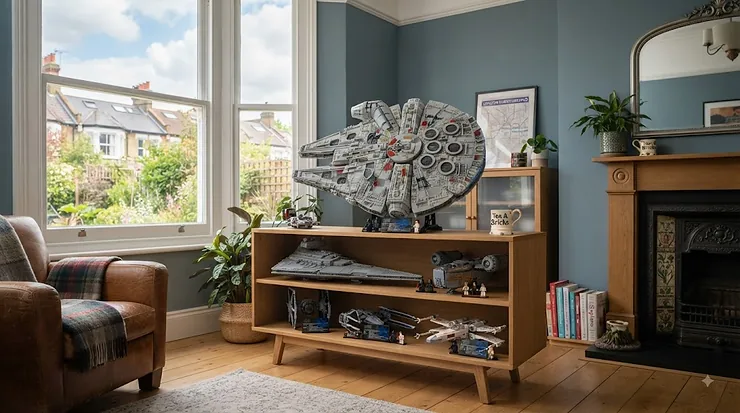
1. Millennium Falcon — the biggest minifigure-scale UCS ship ever built
Right off the bat, the standout feature here is scale: this is a minifigure-accurate recreation, not a shrunken interpretation, and that decision alone defines everything else about the build. With 7,541 pieces, it’s still one of the largest LEGO sets ever produced in any theme, and that piece count translates into a genuinely removable hull — panels lift away to reveal the main hold, gunnery station and rear compartment, which is a level of playable detail you simply don’t get on smaller UCS ships. Based on the spec comparison with newer UCS releases, the Millennium Falcon still wins on sheer engineering ambition even years after launch; LEGO hasn’t matched its combination of size and interior detail since.
This is the pick for collectors who want one genuinely show-stopping centrepiece rather than several smaller models — it rewards people with the wall space and the patience for a multi-weekend build. Reviewers consistently note that the swap-out sensor dish and crew loadout let you display either the classic trilogy or sequel-trilogy version of the ship, which is a clever bit of longevity built into the design itself.
Pros:
- ✅ Removable panels reveal a fully detailed interior
- ✅ Two display configurations from one set
- ✅ Genuinely minifigure-accurate scale, unlike most UCS ships
Cons:
- ❌ Requires significant shelf depth and floor-level support
- ❌ Among the longest builds in the entire range
Expect to pay somewhere in the £700–£800 range depending on retailer stock, and given its continued demand nearly a decade after release, it remains one of the strongest value-holds in the whole LEGO Star Wars UCS sets lineup.
2. Death Star — the largest and most minifigure-packed LEGO Star Wars set ever
The headline feature is scale of an entirely different kind: 38 minifigures packed into a single set, more than any other LEGO product has ever included. That figure count alone tells you this isn’t a single-ship model — it’s a cross-section diorama, slicing through iconic scenes like the trash compactor, Leia’s holding cell and the Emperor’s throne room in one continuous build. At 9,023 pieces, the practical upshot is a build that spans multiple sittings and a compact-but-tall footprint that displays well on a smaller surface than its piece count might suggest.
What most buyers overlook about this model is that it isn’t a spherical Death Star replica — it’s a slice, which disappointed some early reviewers expecting a globe. Once you reframe it as a diorama rather than a ship model, the design decisions make far more sense, and the density of scene recreation genuinely justifies the premium price tag for scene-focused collectors.
Pros:
- ✅ Highest minifigure count of any LEGO set ever made
- ✅ Recreates multiple iconic film scenes in one build
- ✅ Compact footprint relative to its piece count
Cons:
- ❌ Highest price point in the entire UCS range
- ❌ Cross-section design divides opinion versus a full sphere
Price sits around £850–£950, making this a considered, once-in-a-collection purchase rather than an impulse buy — but for anyone chasing the single biggest LEGO Star Wars set for collectors currently available, there’s simply nothing bigger.
3. AT-AT — the first properly minifigure-scaled walker in the range
The standout here is proportion: earlier LEGO attempts at the AT-AT always felt slightly compressed, but this version is built genuinely to minifigure scale, meaning the cockpit, guns and interior all read correctly next to the included figures. With 6,785 pieces, the body comfortably houses up to 40 minifigures (nine included) plus speeder bikes, and the head and legs are fully posable rather than fixed in one battle stance.
Here’s what to weigh before buying: this set has moved through its retail lifecycle and increasingly turns up via resellers rather than direct restock, so availability and pricing can swing more than on currently active sets. Reviewers who owned it from launch consistently praised the stability of the leg joints — a real engineering achievement given how top-heavy a walker design naturally is — while noting that the sheer footprint demands a dedicated shelf or cabinet.
Pros:
- ✅ True minifigure scale, unlike earlier AT-AT attempts
- ✅ Fully posable head and legs for dynamic display
- ✅ Interior fits up to 40 minifigures for scene-building
Cons:
- ❌ Increasingly scarce as an actively restocked set
- ❌ Very large footprint even by UCS standards
Prices have historically sat around £700–£800 at RRP, though as availability tightens, expect more variation — check current price and stock carefully before committing.
4. Mandalorian’s N-1 Starfighter — the newest UCS release, built around metallic detailing
The standout feature on this one is material, not just shape: LEGO introduced drum-lacquered silver elements specifically for this model to recreate the ship’s reflective, stripped-back hull, a finish not used on earlier Naboo-style starfighters. At 1,809 pieces, it’s a mid-scale build that includes three visible engines (rather than the usual two), with the third mounted underneath in a genuinely new building technique for the range.
What the spec sheet won’t tell you, but reviewer commentary suggests, is that the higher price-per-piece ratio here reflects those specialist silver parts rather than padding — this is a smaller piece count than some rivals but a noticeably more premium finish. It’s aimed squarely at fans of the more recent Star Wars television era, pairing a Din Djarin minifigure with a Grogu figure on a display stand that pivots between side-on and forward-facing presentation.
Pros:
- ✅ New drum-lacquered silver parts, unique to this set
- ✅ Dual display orientation on the included stand
- ✅ Includes both Din Djarin and Grogu figures
Cons:
- ❌ Higher price-per-piece than comparable mid-range UCS ships
- ❌ Build is repetitive in sections due to symmetrical panelling
Priced around £220–£240, this is the set to watch if you want the newest addition to your LEGO Star Wars display models collection rather than a legacy classic.
5. X-Wing Starfighter — the strongest all-rounder in the mid-range tier
The headline advantage is balance: at 1,949 pieces, this is the third UCS interpretation of the X-Wing, and LEGO used the extra design generations to fix long-standing proportion complaints from earlier versions — printed cockpit glass, a genuine information plaque and barely any stickers. Wings adjust between flight mode and attack mode at the flick of a switch, which is a small mechanical touch that adds a surprising amount of display personality.
Based on the spec comparison with its immediate predecessor from a decade earlier, this version is priced almost identically once you adjust for inflation, which quietly makes it better value in real terms. Reviewers have flagged some panel looseness around the wings under handling, but as a display-first model rather than a play set, that’s a manageable trade-off rather than a dealbreaker.
Pros:
- ✅ Adjustable wings between flight and attack configurations
- ✅ Printed cockpit glass and plaque, minimal stickers
- ✅ Includes Luke Skywalker and R2-D2 minifigures
Cons:
- ❌ Hull panels can loosen with repeated handling
- ❌ Engine proportions run slightly oversized versus the film ship
At around £200–£220, and already flagged by collector-tracking sites as approaching retirement, this is a strong pick for anyone who wants classic trilogy nostalgia without premium-tier pricing — but it’s worth checking current price and availability sooner rather than later.
6. TIE Interceptor — the Imperial counterpart with the tightest footprint
The standout feature is heritage: this model directly revisits the very first wave of UCS sets from 2000, redesigned a quarter-century later with a genuinely detailed cockpit interior that the original never attempted. With 1,931 pieces, the build measures a comparatively compact 32cm high by 40cm wide, making it one of the more shelf-friendly premium starfighters in the entire lineup.
The spec sheet won’t tell you this, but reviewer commentary suggests the four-to-five-hour build time makes it one of the more approachable weekend projects in the UCS range, rather than the multi-week commitments some flagship ships demand. It includes a buildable mouse droid alongside the TIE Pilot minifigure, a nice bit of scene-building detail that smaller UCS sets often skip entirely.
Pros:
- ✅ Detailed cockpit interior absent from the 2000 original
- ✅ Compact footprint compared with rival mid-range starfighters
- ✅ Includes a buildable mouse droid alongside the pilot figure
Cons:
- ❌ Angular wing panels are more fragile than curved alternatives
- ❌ Single minifigure feels light next to two-figure rival sets
Pricing generally runs £190–£210, and it’s a genuinely strong companion piece if you’re already displaying an X-Wing Starfighter and want the villain-side counterpart on the opposite end of the shelf.
7. Darth Vader Helmet — the best entry point into collector-grade LEGO Star Wars
The standout advantage here is accessibility: at 834 pieces, this is the largest of LEGO’s Star Wars helmet busts, but it’s still a fraction of the size and price of a full UCS starship, making it the natural first purchase for anyone testing the waters. The building techniques used to sculpt Vader’s distinctive dome and jaw are genuinely inventive, relying on angled plate stacking rather than large moulded panels, which keeps the finished piece looking sculpted rather than blocky.
What most buyers overlook about this model is that it includes zero minifigures — deliberately, since the finished bust is designed to be the sole focal point of the display, and adding a minifigure alongside it would only compete for attention. Reviewers have consistently rated it among the best value builds in the adult LEGO Star Wars sets for adults category, largely because the price-per-piece ratio undercuts almost every full-scale UCS starship.
Pros:
- ✅ Compact footprint suits a bookshelf rather than a cabinet
- ✅ Inventive sculpting technique using angled plates
- ✅ Strong price-per-piece value versus full UCS starships
Cons:
- ❌ No minifigures included, which some buyers find sparse
- ❌ Display stand takes up more depth than the helmet itself
At roughly £55–£70, this remains one of the smartest low-risk entries into serious LEGO collecting, and a genuinely sensible gift for someone who hasn’t built a UCS-grade set before.
Practical Usage Guide: Building, Displaying and Protecting Your Sets
Getting a set home is the easy part — keeping it looking sharp for years is where most collectors quietly go wrong. Start by sorting pieces by numbered bag before you open the instructions properly; UCS sets routinely ship with 15+ numbered bags precisely so you build in stages without hunting through thousands of loose bricks. Work on a large, flat, well-lit surface, ideally with a shallow tray to stop small silver or chrome elements — genuinely easy to lose against a light carpet — from rolling away.
Once built, LEGO display shelving matters more than most first-time collectors expect. Reinforced shelving rated for real weight (a Death Star alone weighs around 16kg boxed) beats decorative floating shelves every time, and keeping models out of direct sunlight prevents the yellowing that quietly devalues resale-grade pieces over a few years. Dusting with a soft brush rather than cloth avoids snagging delicate greebled surfaces, and if you’re stacking several starship models on one unit, leave enough depth that wingspans and landing gear aren’t under constant lateral pressure.
A common first-30-days mistake is over-handling a freshly built display piece while showing it off — repeated lifting is genuinely the leading cause of loosened panels on models like the X-Wing Starfighter. Once it’s positioned, treat it as a display object, not a handling object, and it’ll hold its shape for years rather than months.
✨ Don’t Miss These Exclusive Deals!
🔍 Take your LEGO Star Wars collection to the next level with these carefully selected sets. Click on any highlighted item to check current pricing and availability. These builds will help you create an authentic Star Wars display shelf your friends and family will love!
Real-World Scenarios: Which Collector Are You?
If you’re a first-time adult builder with a spare corner of a bookshelf and roughly £60 to spend, the Darth Vader Helmet is the obvious starting point — it delivers a genuine UCS-style building experience without demanding a dedicated display cabinet or a four-figure budget commitment.
If you’re a mid-budget collector with around £200–£250 to invest and a preference for classic trilogy nostalgia, either the X-Wing Starfighter or TIE Interceptor makes sense, and buying both eventually gives you a hero-versus-villain pairing that displays beautifully side by side. Someone building out a Mandalorian-era shelf, meanwhile, is better served by the Mandalorian’s N-1 Starfighter, since it’s the only set here tied to the newer television storylines rather than the original saga.
If you’re further along — an established collector with dedicated shelving, insurance-aware storage habits, and a genuine “one big piece a year” budget — the Millennium Falcon, AT-AT or Death Star are the sets worth saving for. Each represents a multi-week build and a serious financial commitment, but each also anchors a collection in a way smaller sets simply can’t.
How to Choose a LEGO Star Wars Set for Collectors
- Set a realistic shelf budget first. Measure your available display space before falling in love with a set online — the Death Star alone needs roughly 70cm of vertical clearance, which rules it out for many bookshelves.
- Decide between scale accuracy and scene detail. Minifigure-scale ships like the Millennium Falcon and AT-AT prioritise proportion; diorama-style sets like the Death Star prioritise storytelling density instead.
- Check current piece-count-to-price ratio. A higher price doesn’t automatically mean better value — the Darth Vader Helmet consistently outperforms full starships on price-per-piece.
- Factor in retirement status. Sets flagged as approaching retirement, like the X-Wing Starfighter, tend to become harder to find at standard pricing, so buy sooner if you’ve decided it’s the one.
- Match the set to your building patience. Larger UCS ships genuinely take multiple sittings; if you want a satisfying weekend project rather than a month-long commitment, the mid-range 1,800–1,950 piece sets are the sweet spot.
- Think about companion pairings. Hero-and-villain pairs, like the X-Wing Starfighter alongside the TIE Interceptor, display more compellingly together than either does alone.
- Verify authenticity and condition if buying secondhand. Missing pieces are common on resold UCS sets given their size — a partial parts inventory check before purchase saves real disappointment later.
For a full rundown of every set the Ultimate Collector Series has released since 2000, the complete UCS history from Brick Fanatics is a genuinely useful reference if you want to see how today’s picks fit into the wider range.

LEGO Star Wars UCS Sets vs Standard Playsets: What’s the Real Difference
It’s tempting to assume a bigger box just means more of the same experience, but LEGO Star Wars UCS sets and standard playsets are built around fundamentally different goals. Standard Star Wars sets — the kind aimed at younger builders — prioritise playability: opening cockpits, spring-loaded shooters, simplified minifigure-scale proportions that sacrifice accuracy for durability during actual handling. Ultimate Collector Series sets flip that priority entirely, trading play features for structural fidelity, premium finishes like the drum-lacquered silver on the Mandalorian’s N-1 Starfighter, and information plaques that read more like museum labels than toy packaging.
| Feature | Standard Playset | UCS Collector Set |
|---|---|---|
| Target age | Typically 7–14 | 16/18+ |
| Design priority | Play durability | Display accuracy |
| Piece count | Usually under 800 | 800–9,000+ |
| Minifigure inclusion | Common, play-focused | Sometimes none, or scene-specific |
| Typical price range | £30–£150 | £190–£950 |
The practical upshot: if you’re buying for a child who’ll actually fly the ship around the living room, a standard playset genuinely serves that purpose better and will survive the handling. But for a LEGO Star Wars set for collectors that’s staying on a shelf indefinitely, the UCS line’s obsession with accuracy and premium materials is exactly what justifies the price gap — you’re paying for restraint and detail, not extra play functionality you’ll never use.
Benefits vs Traditional Star Wars Memorabilia
| Factor | LEGO UCS Sets | Traditional Memorabilia (statues, cels, replicas) |
|---|---|---|
| Build engagement | High — active hours of assembly | None — purchased pre-made |
| Typical entry price | £55–£950 | £100–£2,000+ |
| Display footprint | Moderate to large | Highly variable |
| Long-term value trend | Generally stable to rising on retired sets | Highly dependent on rarity and provenance |
| Repairability | High — bricks are individually replaceable | Often low or impossible |
Comparing the two categories side by side, the biggest practical edge LEGO holds over traditional Star Wars memorabilia is repairability: a broken statue is usually a write-off, while a damaged LEGO panel can simply be rebuilt or replaced piece by piece. That resilience, combined with LEGO’s habit of retiring UCS sets after a fixed window, is a large part of why the secondary market for these models has held up so consistently over the years, according to independent collectible-tracking analysis.
LEGO Star Wars Sets for Adults: What to Expect from a UCS Build
The 18+ branding on these boxes isn’t just a marketing flourish — it genuinely signals a different building experience from anything aimed at younger audiences. Expect dense, repetitive sections (the silver panelling on the Mandalorian’s N-1 Starfighter is a good example) that reward patience rather than speed, alongside genuinely advanced techniques like the AT-AT’s posable leg joints or the Millennium Falcon’s removable hull sections. None of this is intuitive on first attempt; instructions lean on you recognising sub-assembly patterns rather than following simple numbered steps.
What most first-time adult builders don’t expect is the emotional payoff at completion — there’s a reason “display piece” rather than “toy” is the accurate description. The finished models are engineered to be photographed, shown off and lived with, not packed away. If you’re new to this category, starting with a smaller set like the Darth Vader Helmet before attempting a 6,000-plus-piece walker is genuinely the sensible on-ramp; jumping straight to the deep end tends to lead to abandoned builds rather than confident ones.
Long-Term Cost, Value and Maintenance of Your Collection
Buying the set is only the first financial decision — storage, display and eventual resale all factor into the real cost of ownership. On the value side, independent market analysis has repeatedly shown that retired LEGO sets, particularly Star Wars UCS models, have appreciated meaningfully faster than many people assume — reporting on LEGO’s fastest-growing collectible themes puts some annual growth rates well ahead of traditional stock market returns — though returns vary enormously by individual set and condition, and past performance is never a guarantee of future value. What consistently drives that appreciation is retirement combined with genuine scarcity, not simply age — a set still in active production, however old, won’t command the same premium as one LEGO has stopped making.
Maintenance costs are mostly time rather than money: occasional dusting, keeping models out of direct sunlight to prevent plastic yellowing, and avoiding stacking anything on top of a finished build. If you do plan to treat a set as a long-term hold rather than a display piece, keeping the original box and instructions intact is one of the single biggest factors in resale value — sealed, boxed sets consistently command a significant premium over built, displayed examples on the secondary market.
| Price Tier | Example Set | Typical RRP Range | Value Trend Since Launch |
|---|---|---|---|
| Budget | Darth Vader Helmet | £55–£70 | Stable |
| Mid-range | TIE Interceptor / X-Wing Starfighter | £190–£220 | Rising as retirement approaches |
| Premium | AT-AT / Millennium Falcon | £700–£800 | Strong appreciation post-retirement |
| Flagship | Death Star | £850–£950 | Too new to assess long-term trend |
Reading across this table, the clearest pattern is that mid-range sets nearing retirement — like the X-Wing Starfighter right now — often represent the sweet spot for value-conscious collectors, since they combine a manageable entry price with the strongest near-term appreciation potential.
Common Mistakes When Buying LEGO Star Wars Display Models
Even experienced collectors trip up on a handful of recurring pitfalls. First, buying purely on piece count: a higher number doesn’t automatically mean a better set, and the Darth Vader Helmet‘s reputation proves smaller can still be excellent value. Second, ignoring shelf depth and weight limits before ordering — more than one collector has learned the hard way that a standard floating shelf simply isn’t rated for a 9,000-piece Death Star.
Third, buying a soon-to-retire set without checking current availability first, which risks paying inflated resale prices within months of missing the standard retail window. Fourth, assuming every UCS set includes minifigures — several, like the Darth Vader Helmet, deliberately don’t, so check the box contents rather than assuming. Finally, over-handling a finished display piece for photos or guests; it’s the single most common cause of loosened panels and sagging wings on models like the X-Wing Starfighter.

Frequently Asked Questions
❓ What is the best LEGO Star Wars set for collectors on a budget?
❓ Are LEGO Star Wars UCS sets a good investment?
❓ How many pieces do LEGO Star Wars display models usually have?
❓ Do LEGO Star Wars UCS sets include minifigures?
❓ What's the difference between LEGO Star Wars sets for adults and standard sets?
Conclusion
There’s no single “best” LEGO Star Wars set for collectors — only the right one for your shelf, your budget and the era of the saga you love most. What ties all seven of these sets together is genuine engineering ambition: LEGO isn’t just scaling up a playset when it builds a UCS model, it’s rethinking proportion, materials and display mechanics from the ground up. Whether that means starting small with the Darth Vader Helmet or committing to the sheer scale of the Death Star, the sets covered here represent honest, currently trackable options rather than a rehashed spec sheet.
Take the comparison tables above, weigh your available shelf space against your budget, and don’t feel pressured to jump straight to a flagship set — some of the most satisfying LEGO Star Wars UCS sets in this list are also the most accessible. Build one, display it properly, and there’s a good chance it won’t be your last.
✨ Ready to Start Your Collection?
🔍 Browse the full range of LEGO Star Wars display models today and check current pricing before stock shifts. A great collection starts with one confident first build.
Recommended for You
- LEGO Creator 3-in-1 Sets 2026: 7 Best Versatile Builds Ranked
- LEGO Technic vs Meccano for Teenagers: 7 Best Sets Ranked
- LEGO Harry Potter Sets for Adult Fans: 7 Best Builds 2026
Disclaimer: This article contains affiliate links. As an Amazon Associate, I earn from qualifying purchases. If you purchase products through these links, we may earn a small commission at no additional cost to you.
✨ Found this helpful? Share it with your friends! 💬🤗
