
In This Article
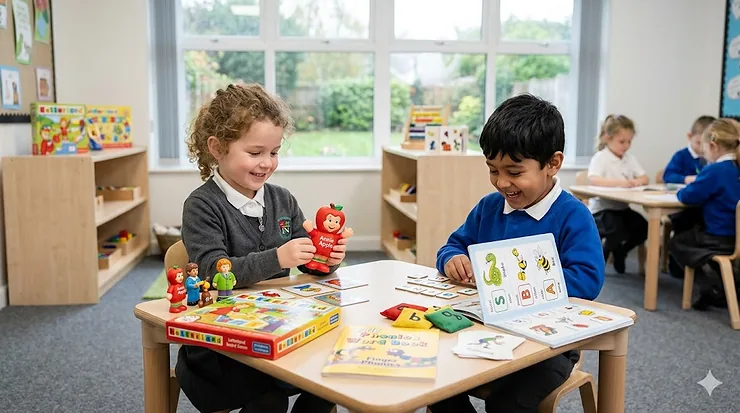
Let’s be honest. Standing in a school corridor, overhearing two Reception teachers debate the merits of Letterland versus Jolly Phonics, is the kind of low-key thrilling drama most British parents never expected to find themselves invested in. And yet, here we are — because the phonics system your child learns with genuinely matters, and choosing the right supplementary toys and resources at home can make the difference between a child who confidently blends sounds by Christmas and one who still finds “cat” mildly baffling by Easter.
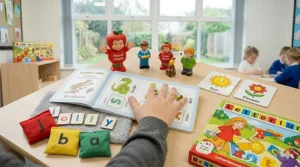
So what exactly are Letterland vs Jolly Phonics toys? In short: both are systematic synthetic phonics programmes — validated by the Department for Education — that teach children the 42+ sounds of the English language through characters, actions, and stories. The toys, games, and resources that accompany each programme bring those classroom methods home, giving parents a structured, child-friendly way to reinforce learning. Letterland leans on charming narrative characters (Annie Apple, Bouncy Ben, Clever Cat) to make letter shapes and sounds memorable. Jolly Phonics takes a more kinetic approach, pairing each sound with a physical action and a short story — the kind of multi-sensory method that suits wiggly four-year-olds rather well.
Both programmes appear on the gov.uk validated SSP (Systematic Synthetic Phonics) programmes list, which means they’ve been assessed against the DfE’s criteria for high-quality phonics teaching. That’s your first quality assurance. What this guide does is go further — cutting through the marketing speak to help you pick the right resources for your child’s learning style, your budget in GBP, and the realities of fitting phonics practice into a busy British household.
Quick Comparison: Letterland vs Jolly Phonics Toys at a Glance
| Feature | Letterland | Jolly Phonics |
|---|---|---|
| Core Approach | Character-based phonics learning | Synthetic phonics with actions |
| No. of Sounds Covered | 44 sounds | 42 letter sounds |
| Age Range | 3–7 years | 3–6 years (Reception focus) |
| DfE Validated? | ✅ Yes | ✅ Yes |
| Best For | Visual/narrative learners | Kinetic/multi-sensory learners |
| Resource Range | Books, flashcards, magnetic letters, software | Workbooks, finger phonics books, cards, puppets |
| Price Range (Amazon.co.uk) | Under £10 to £370+ (full packs) | Under £8 to £85+ (workbook sets) |
| School Adoption Rate | Lower (more nursery/home use) | Higher (dominant in UK Reception classes) |
The table above tells an interesting story. Jolly Phonics has become the dominant choice in UK primary schools — largely because its action-based, systematic approach aligns closely with how Reception teachers are trained to deliver the phonics screening check. Letterland, meanwhile, has found its niche as the gentler, more visually-led introduction that nurseries and parents use before formal schooling begins. This isn’t a verdict — it’s context. And context, as any good teacher will tell you, is everything.
💬 Just one click — help others make better buying decisions too! 😊
✨ Don’t Miss These Exclusive Deals!
🔍 Take your child’s phonics learning to the next level with these carefully selected products. Click on any highlighted item to check current pricing and availability on Amazon.co.uk. These picks will help you find exactly what you need!
Top 7 Letterland vs Jolly Phonics Toys: Expert Analysis
1. Jolly Phonics Workbooks 1–7 (Precursive Letters, British English Edition) by Sara Wernham & Sue Lloyd
The backbone of almost every UK Reception classroom, and for good reason. This complete set of seven write-in workbooks takes children through all 42 letter sounds in the precisely sequenced order that Jolly Phonics is famous for — starting with s, a, t, i, p, n and building systematically from there. Each sound gets its own story, action, letter formation guide, and writing practice section.
What makes this stand out from a home-use perspective is the pace — it’s gentle enough that a child can work through a page during a quiet twenty minutes after school without it feeling like homework. The precursive (joined-ready) letterforms align with what most English state schools now teach, which means you’re not inadvertently creating handwriting habits the teacher will spend three months trying to undo. UK reviewers consistently highlight how quickly children progress from hesitant blending to reading simple sentences. One parent noted their son was confidently reading before starting Reception — with no parental pressure, just consistent use of these books.
✅ Systematic, sequential sound introduction
✅ Precursive letterforms match UK school standards
✅ Comprehensive — seven books cover a full year’s phonics journey
❌ Write-in format means they’re single-use (buy one set per child)
❌ No colour or tactile element — purely paper-based
Price range: under £20 for the full set — genuinely excellent value for a year’s worth of structured phonics practice.
2. Letterland ABC Phonics Book (55th Anniversary Edition) by Lisa Holt & Lyn Wendon
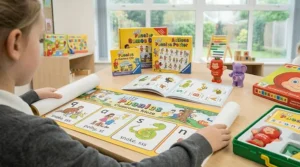
This is where thousands of British children’s reading journeys have begun, and the 2024 updated edition — celebrating Letterland’s 55th anniversary — is the most visually refined version yet. Each letter of the alphabet is brought to life through a memorable character: Clever Cat, Dippy Duck, Eddy Elephant. The logic is elegant: the character’s name starts with the letter sound, so “just start to say Annie Apple’s name” becomes an automatic mnemonic for the short /a/ sound.
For parents with children who are narrative learners — who remember stories better than rules — this is quietly brilliant. The combination of alliterative character names and vivid illustration makes letter-sound correspondence click in a way that abstract phonics instruction simply cannot. It’s particularly useful in the six to twelve months before Reception starts, when you want to build phonics readiness without drilling. UK parents of 3–5 year-olds will find this especially valuable — it’s the gentle on-ramp that makes the steeper Jolly Phonics motorway much easier to navigate later.
✅ 55 years of proven effectiveness — a British institution
✅ Narrative approach ideal for imaginative young learners
✅ Beautiful illustrations keep children engaged without screen time
❌ Not as systematically sequenced as Jolly Phonics for sound-blending progression
❌ Characters can become a distraction for some learners
Price range: under £10 on Amazon.co.uk — an easy first purchase for any phonics-curious parent.
3. Jolly Phonics Activity Books 1–7 (Sticker-Based, Precursive Edition)
If the workbooks above are the serious older sibling, these activity books are the fun one. Packed with colouring pages, mazes, puzzles, crafts, and — critically — over 50 stickers per book, they make phonics feel considerably less like education and considerably more like a Saturday morning project. Each of the seven books follows the Jolly Phonics sound sequence, so they complement the workbooks perfectly or work equally well as a standalone resource.
The sticker element is not mere gimmick. For children aged 3–5, the reward of placing a sticker after completing an activity creates a genuine feedback loop — a small but psychologically effective mechanism for reinforcing effort. What most parents overlook is that these books are particularly useful for children who find the workbooks’ writing demands frustrating. A child who struggles with pencil control can still build phonological awareness beautifully through the picture-matching and listening activities here. Available on Amazon.co.uk with Prime next-day delivery, which is handy when you’ve realised at 9pm that your child’s phonics session tomorrow needs something fresh.
✅ 50+ stickers per book make sessions feel rewarding
✅ Wide activity variety suits different learning styles
✅ Full colour throughout — visually engaging
❌ Sticker-based activities are one-use only
❌ Less writing practice than the standard workbooks
Price range: under £10 per book, or around £50–£60 for the complete set — worth buying the full set from the start.
4. Letterland First Reading Flashcards (65-Card Set)
Sixty-five double-sided flashcards featuring the full a–z and A–Z Letterland characters on one side and the plain letter on the reverse. The production quality is noticeably sturdy — these aren’t the flimsy supermarket cards that curl at the edges after a fortnight. Children begin with the illustrated character side (building sound-symbol association through the Letterland story logic) and gradually transition to the plain letter side as confidence grows. The pack includes game ideas and pronunciation guidance, which is genuinely useful for parents who weren’t taught phonics themselves and are quietly terrified of mispronouncing /th/.
The dual-sided design is smart instructional engineering. It creates a natural progression within a single product — start with the scaffolded character image, move to the bare letter when ready. This mirrors exactly how good phonics teaching works: gradual removal of support as the child internalises the knowledge. These cards also work brilliantly for the classic “sound hunt” game where you find objects around the flat that start with each sound — particularly effective on a rainy Sunday in November, which is to say, most of November.
✅ Dual-sided design supports progressive learning
✅ 65 cards cover the full alphabet comprehensively
✅ Includes game ideas — not just flashcards
❌ Letterland-specific characters won’t mean much to children using Jolly Phonics at school
❌ Game ideas included are basic — experienced parents may want more variety
Price range: under £10 — an affordable entry point to the Letterland system.
5. Jolly Phonics Finger Phonics Big Books 1–7
This is where Jolly Phonics reveals its multi-sensory credentials most dramatically. The Finger Phonics Big Books are large-format, tactile books where each letter features a raised texture that children physically trace with their finger as they learn the sound and its action. Touch, sight, sound, movement — all simultaneously engaged. For children who are kinaesthetic learners (which, if you’ve watched a four-year-old try to sit still for more than forty seconds, may well be most of them), this is the resource that makes everything else click.
The big-book format is designed for group use, but works perfectly at home too — it’s large enough to be visually commanding without being unwieldy. The raised letter textures are robust enough for repeated use, which matters when you’re the third child to trace Inky Mouse’s /s/ in eighteen months. UK practitioners note that the combination of physical tracing and sound actions dramatically improves letter formation habits from the outset, meaning less remediation work later. Available on Amazon.co.uk, though check availability — stock can vary on individual titles versus the full set.
✅ Tactile raised letters engage kinaesthetic learners powerfully
✅ Simultaneous multi-sensory input (touch, sight, sound, movement)
✅ Durable for repeated use across multiple children
❌ Large format less suited to small flats with limited storage space
❌ More expensive than workbook alternatives
Price range: around £80–£90 for the full set of 7 — an investment, but unmatched for multi-sensory phonics engagement.
6. Learning Resources Hot Dots Jolly Phonics Letter Sounds Practice Cards
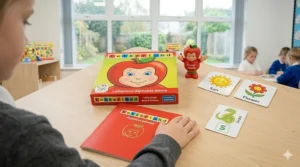
Thirty-six wipe-clean double-sided cards, 72 multiple-choice activities, and a rather clever self-correcting pen mechanism — press the Hot Dots Teaching Pen on the correct answer and it responds with positive feedback; press the wrong one and you’ll know about it. The cards cover all 42 letter sounds from the Jolly Phonics framework, focusing on beginning, medial, and final sounds. Crucially, children can use these independently, without an adult hovering over their shoulder marking answers.
That independence is the real selling point here. Most phonics resources require parental involvement, which is wonderful in principle and occasionally impractical when dinner needs making. These cards let a child aged 4+ work through phonics practice autonomously, building the kind of self-checking metacognitive habit that teachers actively encourage. Note: the Teaching Pen is sold separately (typically under £10 on Amazon.co.uk) — a detail that catches buyers out, so factor that into your budget. UK reviews are mixed on this point, with some parents understandably annoyed by what feels like an incomplete product listing. Buy the pen at the same time and save yourself the frustration.
✅ Wipe-clean — reusable indefinitely
✅ Self-correcting mechanism enables independent practice
✅ Covers all 42 Jolly Phonics sounds comprehensively
❌ Pen sold separately — remember to add to basket
❌ Multiple-choice format doesn’t require active recall — less demanding than blending practice
Price range: cards under £15 on Amazon.co.uk; add under £10 for the pen — total investment well under £25.
7. Letterland Phonics Touch & Trace Flashcards (62-Card Set)
The premium tactile option in the Letterland range. Each of the 62 textured cards features the Letterland pictogram in full colour on one side and the plain letter on the reverse — identical concept to the First Reading Flashcards, but elevated by the textured surface that allows children to physically feel the letter shape as they learn it. The cards include guidance for correct pronunciation, tracing instructions for proper letter formation, and ideas for building simple three-letter words.
For children who responded brilliantly to the Letterland ABC book but need a more hands-on reinforcement tool, these flashcards are the natural progression. The texture element is particularly valuable for children who are developing fine motor skills alongside phonics — feeling a letter shape helps the muscle memory form at the same time as the sound-symbol connection. They’ve won the Primary Teacher Awards, which isn’t marketing fluff — it’s an industry signal that practitioners have found them genuinely useful in classroom and home settings. Compact enough to store in a kitchen drawer and pull out for a five-minute practice session while waiting for pasta to boil.
✅ Textured surface supports tactile learning and letter formation
✅ Primary Teacher Award winner — practitioner-endorsed
✅ Compact and easy to store in a small home
❌ Letterland-specific — less useful if school uses a different phonics programme
❌ No auditory element; parents need to model the sounds themselves
Price range: under £10 — excellent value for a tactile reinforcement tool.
How to Use Letterland and Jolly Phonics Resources Together
Here’s something most comparison articles won’t tell you: you don’t have to choose. In fact, many experienced UK Reception teachers use both systems at different stages — Letterland for the early narrative introduction to letter shapes and sounds, Jolly Phonics for the more systematic, action-based blending and segmenting work that follows. The two approaches are more complementary than competitive.
A practical framework for home use:
Stage 1 — Pre-school (ages 3–4): Start with Letterland. The Letterland ABC Book and First Reading Flashcards introduce the alphabet in a story-led, character-based way that young children find engaging and low-pressure. There’s no expectation of blending yet — just building the foundation that letters represent sounds.
Stage 2 — Reception entry (ages 4–5): Introduce Jolly Phonics. The Activity Books or Workbooks 1–7 will reinforce whatever the school is teaching, in the same systematic sequence. The Finger Phonics Big Books are particularly useful during this stage if your child responds to tactile learning.
Stage 3 — Year 1 (ages 5–6): Use both as supplementary resources alongside school. The Hot Dots Practice Cards are excellent for independent reinforcement, while the Letterland Touch & Trace Flashcards continue to support letter formation and spelling pattern recognition.
The key insight here: neither programme expects children to be passive recipients of instruction. Research from University College London consistently shows that active, multi-sensory engagement with phonics dramatically improves both reading accuracy and reading speed. These resources — used consistently, in short daily bursts of ten to fifteen minutes — deliver exactly that.
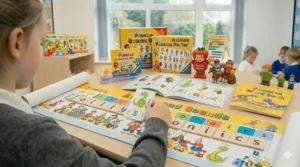
How to Choose Phonics Resources for Your Child in the UK: A Practical Guide
Buying phonics toys and resources is one of those decisions that feels more complicated than it needs to be. Here’s how to cut through the noise:
1. Find out what programme your child’s school uses. Ring the office or ask the class teacher. If it’s Jolly Phonics (highly likely in most English state schools), prioritise JP resources at home. If it’s Letterland (more common in some independent schools and nurseries), match accordingly. Misalignment between home and school phonics methods causes confusion — specifically around letter names versus letter sounds.
2. Consider your child’s learning style. Visual-narrative learners thrive with Letterland’s character-based approach. Active, physical learners tend to respond more strongly to Jolly Phonics’ action sequences. Of course, most children are a mixture — which is why the Finger Phonics Big Books and Letterland Touch & Trace Flashcards both have strong credentials.
3. Start small. Buy one book or one card set rather than an entire pack. See how your child responds. Then scale up. The full Letterland Early Years Pack (around £280) and the Jolly Phonics Finger Phonics set (around £80–90) are genuinely worthwhile — but only if you’ll actually use them.
4. Prioritise DfE-validated resources. Both Letterland and Jolly Phonics appear on the government’s validated SSP programmes list — your assurance that the pedagogy has been rigorously assessed.
5. Keep sessions short. Ten to fifteen minutes daily is more effective than an hour on Saturdays. The reading and phonics research is unambiguous on this point — distributed practice consistently outperforms massed practice for young children.
6. Don’t panic about the phonics screening check. It’s a diagnostic tool, not a verdict. If your Year 1 child needs extra support, the resources above — used consistently — are your most powerful allies.
Letterland vs Jolly Phonics: Which Is Better for Different UK Learners?
This is the question that doesn’t have a single clean answer, which is why most articles dodge it. Let’s not.
If your child is a natural storyteller who asks “why” about everything — Letterland. The narrative logic (Clever Cat doesn’t like noise, that’s why she says “c, c, c” quietly) gives imaginative children a satisfying explanation to hang sound-symbol knowledge on.
If your child loves movement and hates sitting still — Jolly Phonics. The actions are non-negotiable: there’s a physical gesture for every single sound, and children who need to move to learn will find this deeply satisfying in a way that a book simply cannot replicate.
If your child’s school uses Jolly Phonics — supplement with JP resources at home. Consistency between school and home environments is the single biggest factor in phonics progress.
If your child is ahead of peers and needs extension — both programmes offer resources well beyond basic alphabet recognition. Letterland’s Beyond ABC and Far Beyond ABC books push into digraphs and advanced spelling patterns. Jolly Phonics’ decodable reader series (colour-graded from Orange to Purple level) provides the independent reading practice that consolidates phonics knowledge.
If budget is a genuine constraint — Jolly Phonics workbooks represent exceptional value. Under £20 for a complete seven-book set covering a full year’s phonic instruction is, frankly, remarkable.
Common Mistakes British Parents Make When Buying Phonics Resources
A few pitfalls worth knowing before you spend a penny.
Buying the “wrong” letterform. Both programmes offer print and precursive (joined-ready) letter versions. Most UK state schools now teach precursive letters from Reception — buying print-letter resources when your school uses precursive creates confusion. Check with the school first. The Jolly Phonics Workbooks and Activity Books come in both versions; the precursive British English editions are what most English state school children need.
Ignoring the sound-learning sequence. The Jolly Phonics sound order (s, a, t, i, p, n first) is deliberately chosen so children can build real words immediately. Disrupting this sequence by jumping to flashcards for random letters undermines the system’s architecture. Work in sequence.
Confusing letter names with letter sounds. This is probably the most common home phonics mistake in the UK. The letter “b” is called “bee” but makes the sound /b/. Letterland navigates this elegantly (Bouncy Ben starts with the /b/ sound). Jolly Phonics avoids letter names altogether in early stages. If you’re unsure how to pronounce the pure phonemes, the BBC Bitesize phonics pronunciation guide is an excellent free resource.
Over-investing in resources before knowing your child’s style. Start with one inexpensive entry point — the ABC Phonics Book (under £10) or Workbook 1 (under £5) — and only scale up when you know what’s working.
Real-World Scenarios: Which Resources Suit Which UK Families
Scenario 1 — The London nursery parent whose child starts Reception in September. Your child’s nursery uses Letterland. Their new school uses Jolly Phonics. This is more common than you’d think, and it’s not a catastrophe. Spend the summer reinforcing Letterland basics with the ABC Phonics Book and First Reading Flashcards, then introduce the Jolly Phonics Activity Book 1 in September to give them a head start in the school system. The Letterland characters will still be helpful for letter shape memory — the systems aren’t mutually exclusive.
Scenario 2 — The Manchester suburb family with a struggling Year 1 reader. Your child is finding the phonics screening check stressful and confidence is flagging. Avoid adding pressure. The Hot Dots Practice Cards offer autonomous, game-like phonics reinforcement that doesn’t feel like remedial work. Pair with the Finger Phonics Big Books for tactile engagement. Keep sessions to ten minutes maximum. The goal is rebuilding confidence as much as building skills.
Scenario 3 — The rural Scottish family home-educating a 4-year-old. With no school phonics programme to align with, you have genuine flexibility. Start with Letterland for the narrative foundation, introduce Jolly Phonics actions alongside it, and let your child’s response guide which system you lean into. The Education Scotland guidance on early literacy is worth reading alongside whatever resources you choose.
Price Range & Value Comparison
| Resource | System | Price Range | Best Value For |
|---|---|---|---|
| Jolly Phonics Workbooks 1–7 | Jolly Phonics | Under £20 (set) | Best overall value |
| Letterland ABC Book | Letterland | Under £10 | Narrative introduction |
| JP Activity Books 1–7 | Jolly Phonics | £50–£60 (set) | Multi-activity variety |
| Letterland First Reading Flashcards | Letterland | Under £10 | Visual/card learners |
| JP Finger Phonics Big Books 1–7 | Jolly Phonics | Around £80–£90 (set) | Tactile kinaesthetic learners |
| Hot Dots JP Practice Cards | Jolly Phonics | Under £15 (+ pen ~£10) | Independent practice |
| Letterland Touch & Trace Flashcards | Letterland | Under £10 | Tactile letter formation |
The clearest value story here is the Jolly Phonics Workbooks set: a full year of structured, sequenced phonics instruction for well under £20 is exceptional. The Finger Phonics Big Books are the premium investment — justifiable if you have multiple children who’ll use them, or if your child is a strong tactile learner for whom the standard workbooks simply aren’t engaging enough. All prices should be verified on Amazon.co.uk at time of purchase, as they fluctuate regularly.
FAQ
❓ Are Letterland and Jolly Phonics both approved by the UK Government?
❓ Which phonics system do most UK schools use — Letterland or Jolly Phonics?
❓ Can I use Letterland and Jolly Phonics resources together at home?
❓ What's the best age to start using phonics toys and resources at home in the UK?
❓ Are Letterland and Jolly Phonics toys available with free delivery on Amazon.co.uk?
Conclusion: The Verdict on Letterland vs Jolly Phonics Toys
Here’s the honest truth: neither programme is objectively better. What matters — what has always mattered in early literacy — is consistency, engagement, and fit. Jolly Phonics wins on systematic rigour and UK school alignment. Letterland wins on narrative charm and gentle visual introduction. The best phonics journey for most British children probably uses both, at different stages, in ways that match how their particular brain is making sense of the remarkable, maddening, wonderfully illogical English language.
The resources highlighted above are among the best available on Amazon.co.uk right now — genuinely useful, educationally sound, and priced accessibly for most family budgets. Start with one. See what your child responds to. Build from there. Ten minutes a day of engaged, consistent phonics practice will outperform an expensive, unused resource box every single time.
✨ Ready to Boost Your Child’s Reading?
🔍 Browse the highlighted products above and click through to Amazon.co.uk for current pricing and availability. Whether you’re team Letterland, team Jolly Phonics, or — wisely — a bit of both, these carefully chosen resources are the starting point your child deserves.
Recommended for You
- LeapFrog vs VTech Alphabet Toys: 7 Best Picks UK 2026
- Best Alphabet Toys for 3 Year Olds UK 2026: Top 7 Picks
- Arduino Starter Kit vs Elegoo: 7 Best Kits for UK Buyers in 2026
Disclaimer: This article contains affiliate links. As an Amazon Associate, I earn from qualifying purchases. If you purchase products through these links, we may earn a small commission at no additional cost to you.
✨ Found this helpful? Share it with your mates! 💬🤗
