
In This Article
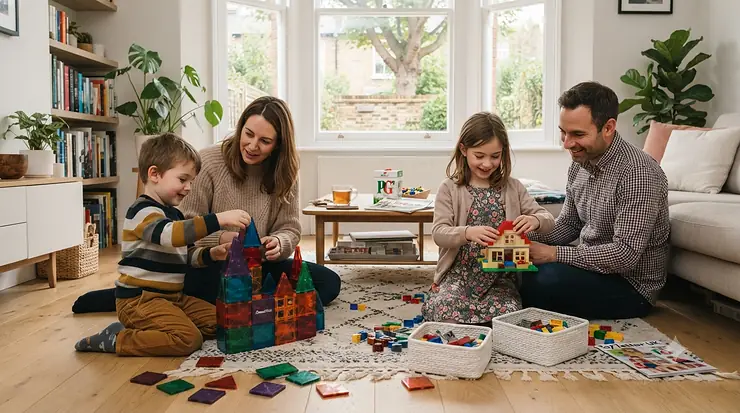
Stand in any toy aisle in 2026 and you’ll spot the same stand-off happening on repeat: a glowing tower of translucent magnetic tiles on one shelf, a mountain of colourful brick boxes on the other, and a parent standing between them looking faintly haunted. The magnetic tiles vs LEGO for creative play debate isn’t really about which toy is “better” in some abstract sense — it’s about which one fits the actual child you’re buying for, the actual budget you’ve got, and the actual chaos of your actual living room floor.
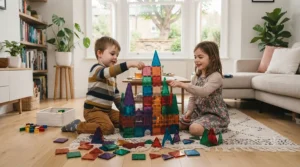
Both toys have earned their cult followings for good reason. Magnetic tiles click together in seconds and reward big, dramatic, three-dimensional building with almost no fine-motor frustration. LEGO bricks demand a bit more patience and precision but pay it back with staggering versatility — from wobbly first towers to genuinely engineering-grade builds a decade later. Neither one is a gimmick; both are backed by decades of research into how construction play shapes young minds.
This guide walks through magnetic tiles versus building bricks as an open-ended construction toy category, with seven real, currently available products spanning budget, mid-range and premium price points. You’ll get honest analysis grounded in real specifications and aggregated review sentiment, a proper head-to-head comparison, and practical guidance for matching the right set to the right child — whether you’re chasing STEAM learning outcomes, screen-free play, or simply five minutes of peace while dinner’s on. As the NHS notes, play is one of the main ways young children learn about the world around them, and the toy you choose genuinely does shape what that learning looks like.
What Is Magnetic Tiles vs LEGO for Creative Play?
Magnetic tiles vs LEGO for creative play refers to the comparison between two open-ended construction toy systems: geometric magnetic panels that snap together edge-to-edge to build 3D shapes instantly, and interlocking plastic bricks that connect via a stud-and-tube system requiring more precise hand movements. Both support unstructured, child-led building, but they develop different skills at different paces.
Quick Comparison Table
| Factor | Magnetic Tiles | LEGO Building Bricks |
|---|---|---|
| Entry age | Around 3+ | Around 4+ (LEGO DUPLO covers younger) |
| Assembly effort | Low — tiles self-align via magnets | Moderate — requires precise pressure and grip |
| Build style | Large, 3D, architectural, translucent | Detailed, structured, model-based |
| Fine motor demand | Light | Higher |
| Long-term collection value | Strong (cross-brand compatible) | Very strong (huge secondary ecosystem) |
| Best For | Younger builders, sensory play, big fast structures | Older builders, detail-focused, long-term hobbyists |
Reading across this table, the real story is timing rather than superiority. Magnetic tiles tend to win the early years because there’s almost no barrier between having an idea and seeing it stand up in front of you, which matters enormously for a three-year-old’s attention span. LEGO bricks ask more of small hands early on, but that same friction is what builds the fine motor control and patience that make LEGO the toy families still reach for at age nine, ten, and beyond.
💬 Just one click — help others make better buying decisions too!😊
Top 7 Magnetic Tiles and LEGO Sets: Expert Analysis
Below are seven genuinely available sets spanning budget, mid-range and premium tiers across both toy categories, researched for real specifications, honest aggregated review sentiment, and practical buying context — not lifted from any listing description.
1. Connetix Tiles 62-Piece Creative Pack — strongest magnets for ambitious builds
The standout here is magnet strength, and it’s not marketing fluff — Connetix pieces are consistently reported as the heaviest and most magnetically robust tiles on the market, which translates directly into taller, sturdier structures that don’t collapse mid-build. The 62-piece pack includes squares, triangles and rectangles in a translucent colourway, made from ABS plastic with rivet-secured magnets rather than glued seams, which matters because glued magnets are the leading cause of tiles falling apart within a year.
Based on the spec comparison across the category, this is the set for families who want to invest once and build a large collection over time, since Connetix pieces are designed to be fully compatible with the brand’s expansion sets and, largely, with rival tile brands too. It suits a child who already loves construction play and is ready to build bigger, rather than a total beginner testing the waters. Reviewers consistently note the tiles’ clarity and colour vibrancy holding up well over years of use, with occasional comments that the premium price makes topping up a full collection a slow, deliberate process rather than an impulse buy.
Pros:
- ✅ Noticeably stronger magnetic hold than most rival brands
- ✅ Rivet construction resists the magnets popping loose over time
- ✅ Compatible with most other major magnetic tile ranges
Cons:
- ❌ Among the pricier options per tile in the category
- ❌ 62 pieces alone limits large-scale builds without add-ons
Prices for the Connetix Tiles 62-piece pack typically sit in the £70-£90 range at the time of research, so check current pricing before buying. Given the durability reports, it’s a strong long-term value pick even if the upfront cost stings a little.

2. Magna-Tiles Classic 100-Piece Solid Colors Set — the original, best all-round starter collection
The standout feature is sheer scale for the price point — 100 pieces is genuinely enough to build a proper structure straight out of the box, which fewer starter sets manage. As the brand that essentially invented the category, Magna-Tiles has decades of manufacturing refinement behind the encapsulated, ultrasonically welded magnets, a detail that matters because it’s specifically designed to stop magnets breaking free during rough toddler play.
What most buyers overlook about this set is that solid, opaque colours (rather than translucent) actually help younger children with colour recognition and sorting games alongside free building, making it slightly more versatile for the 3-5 age bracket than clear tile sets. Aggregated review sentiment is overwhelmingly positive on durability and magnet strength, though a recurring theme across UK and US reviews alike is that 100 pieces, while generous, still tends to leave ambitious builders wanting more within a few months. Families report the set is compatible with the cheaper Playmags range, widening its long-term flexibility.
Pros:
- ✅ Generous 100-piece count for the price bracket
- ✅ Encapsulated magnets built to resist breakage
- ✅ Compatible with several other tile brands for expansion
Cons:
- ❌ Opaque colours lack the visual “wow” of translucent sets
- ❌ Serious builders often outgrow 100 pieces within months
The Magna-Tiles Classic 100-Piece Solid Colors Set generally falls in the £85-£100 range, positioning it as a mid-to-premium buy — but as the benchmark the whole category is measured against, it earns that price with genuinely excellent build quality.
3. PicassoTiles 60-Piece Magnetic Building Set — best budget entry point
The standout feature is price-per-tile: PicassoTiles routinely undercuts the premium brands by a wide margin while still using rivet-secured magnets rather than the glued construction found in the very cheapest knock-offs. That distinction matters enormously for safety, since glued magnets are exactly the type flagged in UK product recall notices for coming loose during play.
Here’s what to weigh with a budget-tier set like this: the plastic is noticeably lighter than Connetix or Magna-Tiles, and the magnets, while functional, are reported as measurably weaker in side-by-side tests — fine for flat patterns and small structures, less reliable for tall towers that get knocked about. This makes it an ideal low-risk way to test whether a child actually takes to magnetic building before committing to a premium collection. Aggregated review sentiment on Amazon is strongly positive for the price point, with tens of thousands of ratings clustering around 4.5 stars, though a consistent minority complaint is that pieces occasionally arrive with slightly uneven edges affecting how flush they sit together.
Pros:
- ✅ Significantly cheaper per tile than premium brands
- ✅ Rivet-secured magnets, safer than glued alternatives
- ✅ Huge review volume gives confidence in typical experience
Cons:
- ❌ Weaker magnets than Connetix or Magna-Tiles in tall builds
- ❌ Occasional manufacturing inconsistency in edge alignment
Typically priced under £30 at the time of research, the PicassoTiles 60-Piece Magnetic Building Set is the sensible low-commitment starting point, especially for gifting or testing interest before a bigger spend.
4. Playmags 100-Piece Magnetic Tile Set — best mid-range pick with genuine extras
The standout feature is the included click-in accessory tiles — this set ships with printable ABC learning tiles that snap onto the standard pieces, giving it a literacy angle most competitors skip entirely. In terms of raw magnet strength, Playmags sits right alongside Connetix at the top of the category, a genuinely surprising result for a mid-priced brand.
On paper this means Playmags offers premium-tier build stability without the premium-tier price tag, which is precisely why families who’ve owned several brands frequently name it as their sleeper favourite. Reviewers consistently report the tiles as visually distinct thanks to a slightly more matte, less glossy finish than Connetix, a preference that comes down to taste rather than function. The trade-off worth flagging honestly: Playmags has a smaller expansion catalogue than the two bigger brand names, so scaling up your collection several years down the line may mean mixing brands rather than staying within one ecosystem.
Pros:
- ✅ Magnet strength that rivals the premium brands
- ✅ Bundled ABC click-in tiles add early literacy value
- ✅ Strong price-to-quality ratio in the mid-range bracket
Cons:
- ❌ Smaller range of official expansion sets
- ❌ Not as widely stocked in UK stores as bigger names
Expect the Playmags 100-Piece Magnetic Tile Set to sit in roughly the £45-£65 range, making it arguably the best value-for-performance pick across the whole magnetic tile line-up.
5. LEGO Classic Large Creative Brick Box 10698 — best premium brick set for sheer range
The standout feature is volume and variety in one box: 790 pieces across 33 colours, plus genuinely useful special pieces like green baseplates, wheels and eyes that unlock entire categories of build (vehicles, creatures, mini-scenes) a plain brick pile can’t. It ships in a purpose-built storage container shaped like an oversized brick, which sounds gimmicky until you’re the one tidying up at 6pm.
What most buyers overlook about a set this size is that it isn’t really a “starter” purchase — it’s a foundation collection designed to combine with themed LEGO sets a child already owns or will receive later, meaningfully extending the play value of everything else in the house. Reviewers consistently highlight the baseplates as a standout addition, since they give young builders a stable “ground” to construct on rather than a loose pile of bricks sliding around a table. The recurring critique in aggregated feedback is the classic LEGO complaint: stepping on a stray piece barefoot is a genuine household hazard, and sorting 790 mixed pieces by colour or shape takes real time if a child (or parent) is that way inclined.
Pros:
- ✅ Enormous piece count and colour variety for one box
- ✅ Special pieces (wheels, eyes, baseplates) unlock varied builds
- ✅ Combines seamlessly with other LEGO sets already owned
Cons:
- ❌ Genuinely painful to step on if pieces escape the box
- ❌ Sorting and storage takes real effort at this volume
Prices for the LEGO Classic Large Creative Brick Box 10698 typically sit in the £65-£80 range, and given how it functions as an anchor for an entire LEGO collection rather than a single toy, most reviewers consider it worth the outlay.

6. LEGO Classic Creative Suitcase 10713 — best portable, self-storing option
The standout feature is the built-in sorting suitcase — this set solves the single biggest practical headache of brick ownership (loose pieces everywhere) by shipping bricks in a carry case with dividers, so packing up and travelling with it is actually realistic. It’s a smaller collection than the Large Creative Brick Box, but the organisation more than earns its keep for families who take toys in the car or on holiday.
Based on the spec comparison, this set trades raw piece count for portability and tidiness, which makes it the better fit for a child who builds in short, frequent bursts (car journeys, waiting rooms, grandparents’ houses) rather than long, immersive sessions at home. Aggregated review sentiment praises the case build quality and the clever compartment layout, while a fair number of reviewers note that serious builders will still want to supplement it with a bigger brick box fairly quickly, since the piece variety is noticeably slimmer than the flagship sets.
Pros:
- ✅ Genuinely useful built-in storage and carry case
- ✅ Ideal size and weight for travel or car journeys
- ✅ Encourages independent tidying-up habits early
Cons:
- ❌ Smaller piece variety than the larger brick boxes
- ❌ Likely to need supplementing for ambitious builders
The LEGO Classic Creative Suitcase 10713 generally sits in the £25-£35 range, making it an easy, practical add-on gift rather than a sole first purchase.
7. LEGO Classic Bricks and Houses 11008 — best budget-friendly LEGO starter
The standout feature is structured guidance built into an open-ended set — with 270 pieces and simple house-building suggestions included, it bridges the gap between totally free-form play and the step-by-step instructions of themed LEGO kits, which is exactly what nervous first-time builders need. It’s priced as an entry point rather than a flagship, and it earns that positioning honestly.
Here’s what to weigh: at 270 pieces, this set won’t build anything particularly elaborate on its own, and reviewers consistently frame it as “the one that gets you hooked” rather than “the one you keep forever.” That’s a fair trade for families unsure whether their child will actually take to brick building, since the cost of finding out is low. Aggregated feedback highlights the house-shaped guide models as genuinely confidence-building for younger or less experienced builders, with the main criticism being that experienced LEGO kids blow through the included ideas within a single afternoon.
Pros:
- ✅ Low-risk price point for testing interest in LEGO
- ✅ Simple house-build guides boost early confidence
- ✅ Compatible with every other LEGO Classic set
Cons:
- ❌ Limited piece count restricts ambitious builds
- ❌ Experienced builders may find it too basic, too fast
At around £20-£30 at the time of research, the LEGO Classic Bricks and Houses 11008 is the obvious low-commitment starting point for a first LEGO purchase, particularly as a gift alongside another toy.
Top 7 Products: Specs & Value Comparison
| # | Product | Piece Count | Best For | Price Range |
|---|---|---|---|---|
| 1 | Connetix Tiles 62-Piece Creative Pack | 62 | Ambitious tall builds | £70-£90 |
| 2 | Magna-Tiles Classic 100-Piece Solid Colors Set | 100 | All-round starter collection | £85-£100 |
| 3 | PicassoTiles 60-Piece Magnetic Building Set | 60 | Testing interest on a budget | Under £30 |
| 4 | Playmags 100-Piece Magnetic Tile Set | 100 | Best value-to-performance | £45-£65 |
| 5 | LEGO Classic Large Creative Brick Box 10698 | 790 | Long-term brick foundation | £65-£80 |
| 6 | LEGO Classic Creative Suitcase 10713 | Approx. 300 | Portable, self-storing play | £25-£35 |
| 7 | LEGO Classic Bricks and Houses 11008 | 270 | First-ever LEGO purchase | £20-£30 |
Looking at the table as a whole, the clearest pattern is that magnetic tiles front-load their value — even the budget PicassoTiles 60-Piece Magnetic Building Set builds something impressive within minutes — while LEGO sets front-load their long-term ecosystem value, since every brick from the £20 LEGO Classic Bricks and Houses 11008 onward stays compatible with every other LEGO set a child ever receives. If your household is deciding between magnetic tiles versus building bricks purely on cost-per-hour-of-entertainment over five years, LEGO tends to edge ahead, but only once you’ve bought enough sets to matter.
✨ Don’t Miss These Exclusive Deals!
🔍 Take your creative play collection to the next level with these carefully selected sets. Click through on any set above to check current pricing and availability, and help build the kind of screen-free, hands-on afternoons your family will actually remember.
How to Choose Between Magnetic Tiles and Building Bricks
- Start with age and hand strength. Under-4s generally get more out of magnetic tiles because the connection requires almost no pressure or precision — a real advantage for developing fine motor skills.
- Consider attention span honestly. If your child abandons tasks quickly, magnetic tiles reward that impatience with instant visual results; LEGO rewards sustained focus with more detailed outcomes.
- Think about noise and floor damage. Both toys involve stepping on stray pieces, but LEGO’s smaller, harder bricks are notoriously worse underfoot than flat magnetic tiles.
- Weigh long-term collection cost. LEGO’s ecosystem is vast and endlessly expandable across decades; magnetic tiles plateau once a child ages into more detailed building.
- Factor in siblings and group play. Magnetic tiles are easier for mixed-age groups to build together simultaneously, since there’s no “wrong” way to attach two pieces.
- Check storage realities in your home. LEGO needs sorting systems to stay manageable; magnetic tiles stack flat and store more compactly.
- Don’t assume it’s exclusive. Many of the families in our research owned both, using magnetic tiles for younger children or fast sensory play and LEGO for slower, detail-oriented sessions with older siblings.
Magnetic Tiles vs LEGO: The Detailed Comparison
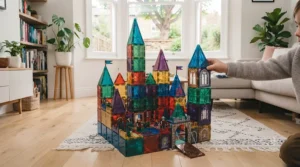
The magnetic tiles vs LEGO for creative play question ultimately comes down to what kind of creativity you’re trying to cultivate. Magnetic tiles are spatial and architectural — children think in planes, angles and light, building houses, tunnels and geometric shapes that let them see straight through the walls. LEGO is compositional and mechanical — children think in individual units, assembling and rebuilding with far more granular control over exactly what a structure looks like.
| Benefit | Magnetic Tiles | LEGO Bricks |
|---|---|---|
| Speed to first build | Seconds | Minutes |
| Skill ceiling | Moderate | Very high |
| Sensory/visual appeal | High (light, colour, transparency) | Moderate |
| Mixed-age group play | Excellent | Requires more supervision |
| Long-term hobby potential | Limited | Extensive (adult LEGO builders exist) |
This table makes the generational difference clear: magnetic tiles are brilliant at the “instant gratification, big and bold” end of construction play, while LEGO’s skill ceiling stretches all the way from toddler towers to genuinely complex adult modelling, which explains why the brand retains builders well into their teens and beyond. If your household has a wide age range of children, the practical answer is often both — magnetic tiles for the youngest, LEGO for the ones ready to sit still for twenty minutes at a stretch.
What to Expect: Real-World Performance
Specs on a box rarely capture what building actually feels like day to day. With magnetic tiles, expect structures that lean, wobble and occasionally collapse in slow motion — the magnets hold shape but not rigid weight, so towers above a certain height genuinely do sway. This isn’t a flaw so much as a physics lesson in disguise, and it’s part of why researchers link block-style construction play to stronger spatial reasoning skills measured in later childhood.
With LEGO, expect the opposite failure mode: structures hold their shape stubbornly once assembled, but getting there involves real trial and error, misaligned studs, and the occasional small meltdown when a piece won’t separate cleanly. Reviewers across both categories consistently note that parental involvement changes the experience dramatically — a five-minute demonstration of a new technique (interlocking tiles into a dome, or using a brick separator tool) tends to unlock a noticeable jump in what a child attempts next.
STEAM Learning: Features That Actually Matter (And Those That Don’t)
Marketing copy loves to slap “STEAM learning” onto any toy with a right angle, so it’s worth separating genuine developmental value from noise. What actually matters: open-endedness (no single correct outcome), physical cause-and-effect feedback (does it stand up or fall down?), and repeatability (can the child rebuild it differently tomorrow?). Both magnetic tiles and LEGO score well on all three.
What matters far less than the packaging suggests: exact piece counts beyond a reasonable threshold, licensed characters printed onto bricks, and app-connected “smart” building sets, which several independent reviews note actually reduce open-ended thinking by nudging children toward a single prescribed outcome. A 2024 study on spatial thinking in early years design activities found that children engage in richer, more varied spatial reasoning during genuinely open-ended construction tasks than in tasks with a single correct solution, which is a fairly strong evidence-based argument for choosing simplicity over gimmicks in either category.
Spatial Reasoning: The Skill Both Toys Build Differently
Spatial reasoning — the ability to mentally rotate, manipulate and understand three-dimensional relationships — is consistently identified in developmental research as a strong predictor of later maths and science achievement. Magnetic tiles build this skill through volume and geometry: children physically see how flat shapes fold into 3D forms, which is a fairly rare and valuable kind of visual-spatial learning. LEGO builds spatial reasoning through a different mechanism entirely — precise stud alignment, layering, and the mental rotation required to picture how a hidden connector fits underneath a visible layer.
Neither approach is superior; they’re complementary. Families chasing STEAM learning outcomes specifically are often best served by rotating between both toys rather than betting everything on one system, since the cognitive demands genuinely differ.
Screen-Free Play: Why This Matters More in 2026
Screen-free play has shifted from a “nice to have” to an active priority for a lot of UK parents navigating device-heavy households in 2026. Both magnetic tiles and LEGO deliver hours of genuinely absorbed, self-directed play without a battery or app in sight — a meaningfully different kind of engagement to passive screen time. What tips the balance for many families is duration: LEGO’s higher skill ceiling tends to extend independent play sessions further as children age, while magnetic tiles are unmatched for getting a reluctant three-year-old off a tablet in the first place, thanks to that near-instant building payoff.
Practical Usage Guide: Setup, Storage and First 30 Days
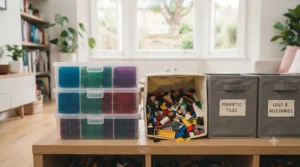
Getting the most from either toy is mostly about avoiding early frustration. For magnetic tiles, start with flat shapes on a hard floor rather than carpet, since carpet fibres reduce the magnetic grip and cause more collapses than the toy deserves credit for. Introduce 3D shapes (cubes, pyramids) only once flat patterns feel easy — jumping straight to towers is the single most common cause of early disappointment. Store tiles upright in a shallow bin rather than a deep toy box, which prevents the weight of a full collection crushing pieces at the bottom.
For LEGO, the first 30 days go far more smoothly with a simple sorting system in place from day one — even just separating by colour into a few trays saves enormous frustration later. Teach the “wiggle and lift” separation technique early to avoid tears over stuck bricks, and resist the urge to buy the biggest set first; a smaller starter set like the LEGO Classic Bricks and Houses 11008 lets a child build genuine competence before tackling 790 pieces at once. A brick separator tool, sold cheaply on its own, is a five-minute fix worth having in the house from week one.
Real-World Scenarios: Which Toy Fits Your Family?
The toddler household (ages 2-4): Fast-moving attention spans and developing fine motor skills point strongly toward magnetic tiles like the PicassoTiles 60-Piece Magnetic Building Set or Magna-Tiles Classic 100-Piece Solid Colors Set — instant results keep engagement high without the frustration of misaligned studs.
The mixed-age sibling household (ages 3-9): A hybrid approach works best here — magnetic tiles for parallel play where a toddler and a school-age child can build side by side without one “ruining” the other’s precise work, paired with a LEGO set like the LEGO Classic Large Creative Brick Box 10698 for when the older child wants detail-focused solo time.
The frequent traveller or small-space household: Portability and tidiness matter more than raw piece count here, making the LEGO Classic Creative Suitcase 10713 or a compact tile set like the Connetix Tiles 62-Piece Creative Pack the more sensible picks over bulkier boxed sets.
Common Mistakes When Buying Magnetic Tiles or Building Bricks
Buying too small a starter set is the single most common regret across aggregated reviews — 30-40 piece “trial” sets in either category rarely build anything satisfying, which can wrongly convince a parent their child “isn’t interested” in construction play. Buying unbranded, ultra-cheap magnetic tiles from unfamiliar sellers is a genuine safety risk rather than just a quality one, since several UK product recalls have specifically targeted magnetic toys with poorly secured magnets. On the LEGO side, the common mistake is buying themed sets exclusively and skipping Classic-range sets entirely, which limits genuinely open-ended building in favour of following instructions to a single fixed outcome.
Long-Term Cost & Maintenance
Neither toy requires maintenance in the traditional sense, but total cost of ownership diverges sharply over time. A starter magnetic tile collection plateaus fairly quickly — most families report topping up once or twice before reaching a “complete enough” set that satisfies years of play. LEGO’s total cost of ownership is genuinely open-ended, since the ecosystem of themed sets, replacement pieces and expansions has no natural ceiling, though the flip side is that every pound spent adds to a collection that never becomes obsolete or incompatible.
| Cost Factor | Magnetic Tiles | LEGO Bricks |
|---|---|---|
| Typical starter spend | £30-£90 | £20-£80 |
| Typical “satisfied” collection size | 100-200 pieces | Open-ended |
| Resale value | Moderate | Strong (especially rare sets) |
| Cross-generation durability | High | Very high |
The resale market tells its own story here — secondhand LEGO holds value remarkably well due to steady collector demand, while magnetic tiles, though durable, have a thinner secondhand market simply because the category is newer. For budget-conscious families, that makes LEGO the marginally safer long-term financial bet, even if magnetic tiles win on immediate cost-per-smile with younger children.
Safety, Regulations and Compliance Guide
Safety is where magnetic tiles genuinely need more careful shopping than LEGO. Small, high-powered magnets pose a serious ingestion risk if they detach from a toy, which is why UK law specifically addresses this: The Magnetic Toys (Safety) Regulations 2008 require warnings on any toy where magnets could become accessible to children under normal or reasonably foreseeable use. This is precisely why choosing rivet-secured or ultrasonically welded tiles from established brands (rather than the cheapest unbranded listings) genuinely matters, not just for durability but for safety.
LEGO bricks carry a more familiar small-parts choking risk for children under 3, clearly labelled on every box under UK Toys (Safety) Regulations 2011 and the EN71 standard both categories must meet for UKCA marking. Practically speaking, that means checking age labelling matters more than brand loyalty when younger siblings are in the house, and periodically inspecting magnetic tiles for any cracked casing that could expose a magnet.
Buyer’s Decision Framework
If your child is under 4 and easily frustrated by fiddly tasks, choose magnetic tiles because the low-effort connection keeps engagement high. If your child is 5 or older and enjoys detailed, structured challenges, choose LEGO because the skill ceiling extends play value for years rather than months. If you’re buying for a mixed-age household, choose one starter set from each category rather than doubling down on one, because the two toys solve different problems rather than competing for the same one. If budget is the primary constraint, start with a mid-tier set in either category — the Playmags 100-Piece Magnetic Tile Set or LEGO Classic Bricks and Houses 11008 — rather than the cheapest possible option, since both durability and magnet safety noticeably improve once you’re past rock-bottom pricing.

FAQ
❓ Are magnetic tiles or LEGO better for toddlers?
❓ Can magnetic tiles and LEGO be used together?
❓ Are magnetic tiles safe for young children?
❓ Do magnetic tiles support STEAM learning as well as LEGO?
❓ How many magnetic tiles do you actually need to start?
Conclusion
There’s no universal winner in the magnetic tiles vs LEGO for creative play debate, and honestly, that’s good news — it means you can make the decision based on your actual child rather than chasing a mythical “best” toy. Magnetic tiles deliver near-instant, sensory-rich building that suits younger children and mixed-age group play beautifully, while LEGO offers a skill ceiling and long-term ecosystem that very few toys can match once a child is ready for more detailed, patient construction.
If you’re weighing this as a creative building toys comparison for a single gift, let age and temperament guide you more than price or piece count. If you’re building out a long-term play collection, there’s a strong case for owning at least a starter set of each — a Magna-Tiles Classic 100-Piece Solid Colors Set for fast, architectural building and a LEGO Classic Large Creative Brick Box 10698 for detail-focused sessions as your child grows into it. Whichever you choose, you’re opting into genuinely valuable, screen-free, open-ended construction toy play — and that’s a decision that’s hard to get wrong.
Recommended for You
- Magnetic Tiles for Toddlers: 7 Safest Picks for 2026
- Magnetic Tiles Under £30: 7 Brilliant Budget Picks for 2026
- LEGO Classic Set for Toddlers: 7 Safe Picks; Age Guide (2026)
Disclaimer: This article contains affiliate links. As an Amazon Associate, I earn from qualifying purchases. If you purchase products through these links, we may earn a small commission at no additional cost to you.
✨ Found this helpful? Share it with your friends! 💬🤗
