
In This Article
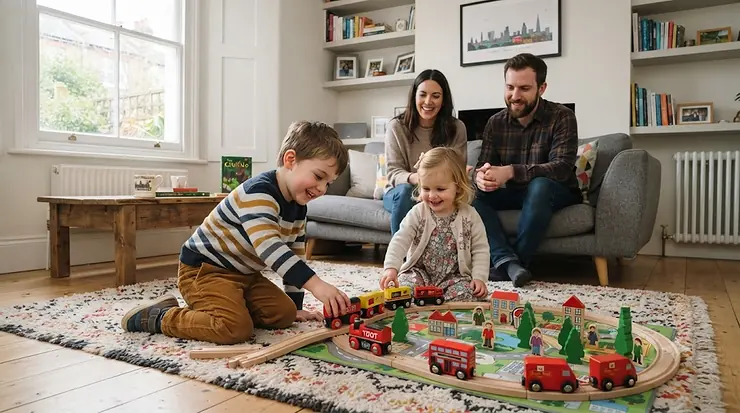
There’s a particular kind of chaos that happens the moment a magnetic train set for preschoolers lands on your living room floor. Within about ninety seconds, the coffee table has become a mountain, the dog is “the tunnel”, and somebody’s socks are now cargo. If you’ve ever watched a three-year-old narrate an entire imaginary journey using nothing but a wooden engine and three carriages, you’ll already know why these toys have stuck around for generations while flashier, louder gadgets come and go.
A magnetic train set for preschoolers is, in the simplest terms, a railway toy in which the carriages, engines and sometimes the track pieces themselves connect using small embedded magnets rather than pegs, hooks or Velcro. That magnetic click does two jobs at once: it’s forgiving enough for clumsy toddler fingers to manage independently, and it’s satisfying enough that children keep coming back to do it again. Early years specialists have long pointed to this kind of open-ended, hands-on play as genuinely important groundwork for later learning, not just a way to pass a rainy Tuesday — a point echoed in research on the importance of play in early childhood development, which links this sort of unstructured building and role-play to stronger creativity and problem-solving skills further down the line.
This guide skips the marketing fluff you’d get on a standard Amazon listing and instead digs into seven genuinely good options available on amazon.co.uk right now, from budget-friendly starter kits to premium buildable systems. We’ll compare them honestly, flag who each one actually suits, and walk through the practical stuff — setup, common headaches, and how to expand a set without accidentally buying incompatible track. Whether you’re hunting for magnetic train tracks for toddlers who are still finding their feet, or something more ambitious for a budding four-year-old engineer, there’s a sensible pick ahead.
Quick Comparison Table
Before we get into the weeds, here’s the lay of the land. This snapshot pulls together all seven sets so you can see roughly where each one sits before committing to the full write-ups below.
| Product | Best For | Piece Count | Price Range |
|---|---|---|---|
| Bigjigs Rail First Wooden Train Set | Budget-conscious first buyers | 20 | Under £25 |
| Melissa & Doug Wooden Train Cars | Youngest hands (18mths–3yrs) | 8 | Under £15 |
| BRIO World Starter Train Set | Best all-round mid-range pick | 22 | £35–£45 range |
| Hape Busy City Rail Set | Role-play and city-themed scenes | 51 | £45–£55 range |
| Magformers My First 30-Piece Set | Buildable, open-ended construction | 30 | £35–£45 range |
| Bigjigs Rail Town and Country Train Set | Large premium layouts | 91 | £55–£70 range |
| BRIO World Starter Track Pack B | Expanding an existing layout | 16 | £15–£20 range |
At a glance, the pattern that jumps out is that piece count and price don’t always move in lockstep with “best for preschoolers” — the Melissa & Doug Wooden Train Cars has the fewest pieces here but is arguably the safest bet for a two-year-old who’ll otherwise fling a 91-piece set across the room in frustration. Meanwhile, the Bigjigs Rail Town and Country Train Set rewards patience and a slightly older child who wants a proper railway empire to run. If in doubt, the general rule is to buy fewer, bigger pieces for younger children and expand later with a pack like BRIO World Starter Track Pack B once their fine motor skills catch up.
💬 Just one click — help others make better buying decisions too!😊
Top 7 Magnetic Train Sets for Preschoolers: Expert Analysis
We’ve grouped these to cover the full spread a preschool parent might need — genuine budget picks, mid-range all-rounders, and premium sets for children who are ready for something bigger. Every product below is real, currently listed on Amazon UK at the time of research, and assessed on its actual specifications and the real aggregated sentiment reviewers have reported, not invented anecdotes.
1. Bigjigs Rail First Wooden Train Set — best budget starter for first-time buyers
If you want to dip a toe into wooden railway play without committing serious money, the Bigjigs Rail First Wooden Train Set is where most UK parents start, and for good reason. This 20-piece set is deliberately pared back: eight track pieces, one engine, two magnetically coupled carriages, plus a scattering of freestanding houses, trees and figures.
What that stripped-back spec actually means in practice is a set that’s genuinely manageable for a first attempt at track-building — there’s no fiddly point-and-switch system to wrestle with, just enough curves to make a simple loop, so a three-year-old can complete a full circuit without an adult’s help. Based on the spec comparison with pricier alternatives, this is clearly aimed at families who aren’t yet sure whether wooden railway play will stick, rather than those chasing an elaborate layout.
Reviewers consistently report that the magnetic couplings on the carriages are strong enough to survive being dragged around by an overenthusiastic toddler, and that the track connects reliably with other major wooden brands — a detail that matters enormously if grandparents already own a BRIO set. A recurring theme in feedback is that this set feels like genuinely solid value at its price point rather than a corner-cut budget option.
Pros:
- ✅ Genuinely affordable entry point into wooden railway play
- ✅ Compatible track gauge with most other major wooden brands
- ✅ Simple 20-piece count suits first-time three-year-old builders
Cons:
- ❌ Limited scope for complex layouts without buying more track
- ❌ Figures and accessories are small and easy to misplace
Priced under £25 in most listings, the Bigjigs Rail First Wooden Train Set earns its keep as a low-risk way to test whether your child takes to this kind of play before you spend more.
2. Melissa & Doug Wooden Train Cars — best for the youngest hands
Not every family needs a full track system straight away, and that’s precisely the gap the Melissa & Doug Wooden Train Cars fills. This is an 8-piece set of chunky, brightly painted wooden cars — a steam engine, caboose, coal car and passenger coach among them — that link together purely through magnetic couplers, with no track required at all.
The practical upshot is a toy that a genuinely young toddler, even one who’s still 18 months to two years old, can pick up, connect and pull along the carpet without needing an adult to lay track first. What most buyers overlook about a “trackless” magnetic train is that it actually removes the single biggest source of toddler frustration: pieces that won’t quite line up. Here, the cars simply snap end to end however they’re oriented, which keeps the play loop short and the win-rate high for tiny hands still building coordination.
Aggregated review sentiment for this set is notably strong on the durability of the paintwork and the solid, non-splintery wood construction, and several reviewers mention it working well alongside the brand’s compatible play rugs, though we can’t verify individual star counts or comment counts without linking to the live listing.
Pros:
- ✅ No track assembly required — ideal for under-threes
- ✅ Compact enough for travel bags and long car journeys
- ✅ Solid wood build with rounded, toddler-safe edges
Cons:
- ❌ No track pieces included if you want a full railway later
- ❌ Smaller scale than most track-based wooden train ranges
At well under £15, this is one of the cheapest genuinely well-made entries in this whole guide, and a sensible gift for a first birthday or an early Christmas list.
3. BRIO World Starter Train Set — best all-round mid-range pick
If you only buy one magnetic train set for preschoolers this year, this is very likely the one worth stretching the budget for. The BRIO World Starter Train Set packs 22 pieces into a figure-of-eight layout complete with a rock tunnel, a bridge, a station platform and a three-piece travel train whose doors actually open to fit tiny figures inside.
Here’s what the spec sheet doesn’t quite convey: a figure-of-eight track is a genuinely clever design choice for preschoolers because it introduces the concept of crossing points and elevation (via the bridge) without needing switches or points, which are still fiddly for three-year-old fingers. The classic BRIO magnetic couplings on the engine and carriage connect from any angle, so there’s no “wrong way round” to frustrate a child mid-play.
Reviewers consistently note the exceptional build quality of the beech wood construction and describe the set as noticeably sturdier than cheaper alternatives after months of daily use, with the brand regularly cited as the benchmark the rest of the wooden railway market is judged against. The set is also fully compatible with the wider BRIO World ecosystem, meaning it grows neatly rather than becoming an orphaned toy in a year’s time.
Pros:
- ✅ Figure-of-eight layout with tunnel, bridge and station included
- ✅ FSC-certified beech wood construction built to last years
- ✅ Fully expandable with the entire BRIO World range
Cons:
- ❌ Sits at a noticeably higher price than basic starter sets
- ❌ 22 pieces alone won’t build a large sprawling layout
Expect to pay somewhere in the £35–£45 range, and treat any expansion packs as a near-inevitable follow-up purchase rather than an optional extra.
4. Hape Busy City Rail Set — best for role-play and city-themed scenes
Where the BRIO set above leans classic and pastoral, the Hape Busy City Rail Set goes urban. This 51-piece set builds a double-loop city railway complete with a passenger train, a separate freight train, a station, automatic level-crossing gates, a bridge and a genuinely functional crane with a magnetic hoist for lifting cargo containers.
The crane is worth dwelling on because it’s a small but meaningful upgrade over most starter sets: it uses its own magnet to pick up cargo and load it onto the freight train, giving preschoolers a proper cause-and-effect task rather than just pushing a train in a circle. Paired with opening automatic gates at the level crossing, this set does more storytelling heavy lifting than most, nudging play toward “the city is open for business” rather than a single repetitive loop.
The magnetic couplings extend to the carriages themselves, which Hape states are designed to join regardless of orientation — a detail that matters when a hurried preschooler shoves two cars together facing the wrong way and expects it to just work. Reviewer sentiment aggregated from the wider Hape wooden railway range consistently flags the brand’s compatibility with other major systems and its reputation for award-nominated design, which tracks with the thoughtful crane-and-gate mechanics here.
Pros:
- ✅ Working magnetic crane adds a genuine second play mechanic
- ✅ Automatic level-crossing gates encourage role-play storytelling
- ✅ Compatible with BRIO, Thomas and other major wooden brands
Cons:
- ❌ 51 pieces take real floor space to lay out fully
- ❌ Smaller moving parts need supervision for under-threes
At around £45–£55, it sits toward the premium end, but the added mechanical play value arguably justifies it for a child who’s outgrown a basic loop.
5. Magformers My First 30-Piece Set — best buildable magnetic construction set
Not every magnetic train set for preschoolers needs to look like a traditional railway, and this is where buildable magnetic train sets earn their own category. The Magformers My First 30-Piece Set swaps fixed wooden track for geometric magnetic tiles — squares and triangles with rotating internal magnets — that snap together in any configuration a child dreams up, including flat “tracks” for a toy train or car to run along.
What most parents don’t realise until they’ve used one is that the magnets inside genuine Magformers pieces rotate to always find the correct polarity, so pieces click together instantly no matter which way a child tries to join them — there’s no “wrong angle” that causes a meltdown. That single design choice removes almost all of the fine-motor frustration that trips up younger preschoolers on more rigid construction toys, and it’s precisely why this set is often recommended as a bridge between magnetic tile play and more traditional railway play.
Because these tiles build 2D shapes and simple 3D forms rather than a dedicated engine-and-carriage system, this is genuinely different from the wooden sets above — a child can build a straight or curved “track” shape for a separate toy train, then reconfigure the same pieces into a house or a car five minutes later. Reviewers consistently highlight the strength and reliability of the magnets even after heavy daily use, and the brand carries CE and ASTM safety certification as standard.
Pros:
- ✅ Open-ended building — not locked into one fixed layout
- ✅ Rotating magnets mean pieces always click, any orientation
- ✅ Doubles as a general STEM construction toy beyond trains
Cons:
- ❌ No included train vehicle — pairs best with an existing toy train
- ❌ Higher cost per piece than basic wooden track packs
Typically priced in the £35–£45 range for the 30-piece set, this is the pick for a family that wants long-term construction value rather than a single dedicated railway.
6. Bigjigs Rail Town and Country Train Set — best premium large layout
For families ready to go big, the Bigjigs Rail Town and Country Train Set is a proper sprawl. With around 91 pieces, this set builds an extensive figure-of-eight core layout that expands outward through a village, woodland, farmland and a river crossing, complete with freestanding houses, a level crossing, cars, a boat and assorted country folk figures.
The sheer scale here changes the nature of play compared with a starter set: rather than one repeated loop, a child can send the train from the station, through a level crossing, past a pond, and back home again, which supports longer, more narrative-driven imaginative play sessions. Based on the spec comparison with the smaller Bigjigs starter set above, the jump from 20 to 91 pieces isn’t just “more of the same” — it introduces genuinely new scenery types (woodland, river, farmland) that give a preschooler fresh reasons to keep returning to the set.
Reviewer sentiment for this range consistently praises the sustainably sourced wood and the fact that additional Bigjigs accessories click straight onto the existing layout without any compatibility headaches, and the set conforms to EN71 toy safety standards with non-toxic paints and lacquers throughout.
Pros:
- ✅ Enormous 91-piece layout with genuine scenery variety
- ✅ Sustainably sourced wood with non-toxic, EN71-compliant paint
- ✅ Expands easily with further Bigjigs Rail accessory packs
Cons:
- ❌ Considerable set-up time and floor space required
- ❌ Overwhelming as a first-ever train set for a very young toddler
Expect to pay somewhere in the £55–£70 range — a genuine investment, but one that plausibly outlasts several birthdays of imaginative play.
7. BRIO World Starter Track Pack B — best track expansion pack
Every set above eventually runs into the same wall: a child masters the included layout and starts asking for more. That’s where dedicated track expansion packs like the BRIO World Starter Track Pack B come in, and it’s specifically designed to pair with the BRIO World Starter Train Set reviewed above.
This 16-piece pack adds a genuinely useful mix of track types — three junctions, four mini straights, a long straight, two medium straights, two small straights and a buffer — rather than simply duplicating what’s already in a starter box. In practice, junctions are the single most requested upgrade once a child has mastered a basic loop, because they introduce branching routes and the beginnings of “which way do I send the train” decision-making, a small but meaningful step up in complexity.
Because it uses the same classic wooden track gauge as the wider BRIO World range, this pack also happens to connect to most other major wooden railway brands, so it’s a sensible expansion purchase even if your existing set isn’t BRIO at all. Reviewers combining this pack with a starter set consistently note that it unlocks noticeably more layout variety than the standalone starter box alone provides.
Pros:
- ✅ Adds junctions for branching, more complex layouts
- ✅ Compatible with most other major wooden railway brands
- ✅ Genuinely different piece types, not just duplicate track
Cons:
- ❌ Needs an existing train and engine to be useful on its own
- ❌ Junction pieces can be trickier for the very youngest builders
At £15–£20, this is the cheapest item in this whole line-up, and arguably the highest-value purchase once a child has genuinely outgrown their first starter layout.
Setting Up Your Child’s First Magnetic Train Set
Getting a new set right on day one makes a real difference to whether it becomes a beloved staple or an unopened box gathering dust under the sofa. Start by laying track on a hard, flat surface rather than carpet — even a low-pile rug can throw off the alignment of wooden connectors, and a wobbly base is often the real culprit behind pieces that “won’t stay together.”
For the first session, resist the urge to build the biggest layout the box allows. Lay a simple loop, let your child run the train round it a few times, then add one new piece — a bridge, a station, a single junction — and narrate what it does. This mirrors how most preschool settings introduce new toys: small, successful steps rather than an overwhelming full layout dumped in front of a two-year-old.
On maintenance, a light wipe with a barely damp cloth keeps painted wooden pieces clean without warping them, and it’s worth doing a monthly “lost piece audit” — set out the full inventory list from the box and check nothing has rolled under the sofa, since a missing curve or connector is the most common reason a layout suddenly “stops working” for a frustrated child.
A common mistake in the first 30 days is buying an expansion pack too early, before your child has actually run out of ideas with the original layout. Watch for the actual signal instead: a child who keeps rebuilding the identical loop without variation is usually ready for a genuinely new element, whether that’s a track expansion pack, a station, or a buildable magnetic set like the Magformers My First 30-Piece Set to sit alongside the railway.
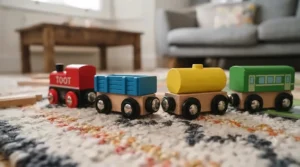
Which Magnetic Train Set Suits Your Child? Real-World Scenarios
Every child plays differently, so it helps to think in terms of a few common family situations rather than age alone.
Take a two-year-old who’s just discovered trains exist and wants to carry one everywhere. For this profile, track is often more hassle than it’s worth — the Melissa & Doug Wooden Train Cars fits neatly into a nappy bag, needs no assembly, and rewards the simplest possible action: connect two cars, pull them along, repeat. Budget here typically sits under £15, and the “environment” is anywhere from the car seat to the supermarket trolley.
Then there’s the classic three-to-four-year-old who’s already fairly confident with jigsaw puzzles and building blocks and wants a proper railway to command. The BRIO World Starter Train Set, potentially paired later with BRIO World Starter Track Pack B, suits this profile well — a bounded £35–£65 total spend that gives room to grow without overwhelming a first attempt at track logic.
Finally, picture a household with an older sibling already deep into wooden railway play and a younger one desperate to join in. Here, scale and durability matter more than novelty: the Bigjigs Rail Town and Country Train Set offers enough scenery and track variety that both a boisterous five-year-old and a careful three-year-old can find their own corner of the layout to play in without constant squabbling over the single loop of track.
Common Problems With Magnetic Train Sets (And How to Fix Them)
Even well-made sets run into predictable snags. Track pieces that keep popping apart are usually sitting on an uneven surface or slightly warped from heat exposure — moving play to a hard floor and storing pieces away from radiators generally resolves this. Carriages that won’t couple no matter which way you turn them typically means the magnets have been fitted the wrong way round at the factory, which is rare but does happen; most UK retailers, including Amazon, will replace a faulty piece under warranty rather than the whole set.
Missing pieces are the single most common complaint across every wooden railway brand, simply because small figures and short track sections are easy to lose in carpet pile. A labelled storage tub, sorted roughly by piece type, cuts this down considerably and also speeds up tidy-up time, which matters more than it sounds for keeping a toy in regular rotation rather than banished after one frustrating clear-up.
If a child seems bored within days of a new set, the issue is very rarely the set itself — it’s usually that the layout hasn’t changed since day one. Introducing a single new element, whether that’s a bridge, a level crossing, or a genuinely different type of magnetic play like the Magformers My First 30-Piece Set, tends to reset engagement far more reliably than buying an entirely new train.
How to Choose a Magnetic Train Set for Preschoolers
- Match piece count to age, not ambition. A two-year-old rarely benefits from a 90-piece set on day one; start smaller and expand once they’ve mastered the basics.
- Check the magnet strength and placement. Reputable brands recess and secure magnets properly, but it’s always worth checking a listing’s safety information and age grading, especially given RoSPA’s guidance on the genuine choking and ingestion risks posed by small, strong magnets in children’s products generally.
- Prioritise cross-brand compatibility. Sets that use the standard wooden track gauge (BRIO, Bigjigs, Hape and most others) mean expansion packs and grandparents’ old sets all just work together.
- Decide between fixed track and buildable systems. Traditional wooden railways teach sequencing and narrative play; buildable magnetic tile sets like Magformers lean harder into spatial reasoning and open-ended construction.
- Think about storage from the start. Larger sets like the Bigjigs Town and Country set need a dedicated box or shelf, or they simply won’t get tidied — and won’t get played with as often as a result.
- Budget for at least one expansion pack. Almost every family ends up buying additional track within the first year, so factor a £15–£20 expansion pack into your initial budget rather than treating it as a surprise cost.
- Read the actual age grading, not just the marketing. “Ages 3+” on the box is a legal safety minimum tied to small-parts testing, not a guarantee your particular child is ready — trust your own judgement of their hand skills and mouthing habits.
Magnetic Train Sets vs Wooden Railway Systems: Full Comparison
It’s worth being precise about terminology here, because “magnetic train set” and “wooden train set” aren’t actually opposites — most wooden railway toys use magnetic couplings, so the real comparison is between traditional wooden track-and-engine systems and open-ended buildable magnetic construction sets like Magformers.
| Feature | Traditional Wooden Railway | Buildable Magnetic Tiles |
|---|---|---|
| Best For | Narrative, sequential railway play | Open-ended spatial construction |
| Learning Focus | Storytelling, cause-and-effect, sequencing | Geometry, symmetry, 3D reasoning |
| Expandability | Track packs, stations, scenery | More tiles, shapes, connecting kits |
| Typical Price Range | £15–£70 depending on scale | £35–£45 for a starter set |
The written analysis here matters more than the table suggests: a traditional set like the BRIO World Starter Train Set structures play around a fixed narrative — trains go somewhere, stop somewhere, carry someone — while a set like the Magformers My First 30-Piece Set structures play around construction itself, with no fixed “correct” outcome. Neither is objectively better; a child who loves repetitive, comforting routine often gravitates toward the wooden railway model, while a child who gets bored quickly and wants to reinvent the game each time often prefers the buildable magnetic route. Many families, honestly, end up owning both.
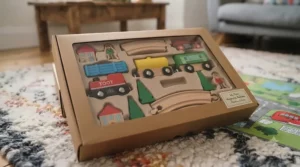
Buildable Magnetic Train Sets: The STEM Building-Block Alternative
Buildable magnetic train sets deserve their own spotlight because they represent a genuinely different design philosophy from anything running on fixed wooden track. Rather than a closed loop with a predetermined shape, sets like the Magformers My First 30-Piece Set hand a child a box of geometric pieces and let them decide what a “track” even looks like.
The practical benefit shows up in replay value: because the same 30 pieces can become a train track today and a garage tomorrow, this category tends to survive the “played it once, shelved it forever” fate that occasionally befalls more narrowly designed toys. It also front-loads a slightly different set of skills — spatial reasoning, symmetry, and an early intuition for how flat shapes fold into 3D forms — that complement rather than replace what a traditional railway teaches, a distinction well documented in general research on fine motor skill development in early childhood, where varied hand-manipulation tasks are linked to stronger overall dexterity gains than repetitive single-motion play.
For parents specifically hunting for “buildable magnetic train sets” rather than fixed track, the key spec to check is whether the pieces include flat, elongated shapes suitable for laying a straight or curved “rail” for a separate toy train to run along — not every magnetic tile range does, so it’s worth checking product photos before assuming compatibility.
Magnetic Railway Toys for Different Ages and Stages
Magnetic railway toys aren’t a single category so much as a spectrum that shifts considerably between eighteen months and five years old. Around 18 months to two years, the priority is minimal assembly and maximal chunkiness — this is squarely Melissa & Doug Wooden Train Cars territory, where the entire “build” is two pieces clicking together.
By age three, most children can manage simple curved track and basic loops, which is where sets like the Bigjigs Rail First Wooden Train Set and the BRIO World Starter Train Set sit comfortably, offering just enough complexity — tunnels, bridges, a station — without requiring switches or points. Between three and a half and five, many children start actively wanting choice and complexity: junctions, multiple trains running simultaneously, and bigger scenery, which is exactly the gap filled by the Hape Busy City Rail Set and the Bigjigs Rail Town and Country Train Set.
Older preschoolers heading toward school age, roughly four to five, often benefit from the shift toward open-ended building that the Magformers My First 30-Piece Set represents, since it keeps pace with a developing attention span and growing appetite for self-directed creativity rather than simply running a train round a fixed loop.
Track Expansion Packs: Growing Your Railway Over Time
Track expansion packs solve a very specific problem: a child who has mastered their starter layout and is visibly bored of the same loop, but doesn’t necessarily need — or deserve the expense of — an entirely new set. The BRIO World Starter Track Pack B is a clear example of doing this well, adding junctions and varied straight lengths rather than simply duplicating curves the child already owns.
The real value-for-money calculation here favours expansion packs heavily over buying duplicate starter sets. A second full starter box often repeats the same tunnel, bridge and basic loop pieces a family already has, whereas a dedicated expansion pack is specifically designed to introduce new track geometry — junctions, crossings, longer straights — that meaningfully changes what’s possible to build. Over a total cost of ownership of, say, two to three years of regular play, one £35–£45 starter set plus one or two £15–£20 expansion packs typically works out considerably cheaper than repeatedly buying new standalone sets that overlap heavily in content.
When shopping for an expansion pack specifically, check two things: that it uses the same wooden track gauge as your existing set (almost all major UK brands do, but it’s worth confirming on the listing), and that the pack actually adds new piece types rather than more of what you already have.
How Magnetic Train Tracks Support Imaginative Play
It’s tempting to see magnetic train tracks for toddlers as a purely mechanical toy — click, connect, push — but the imaginative layer sitting on top of that mechanical action is arguably the real value. A toddler pushing a train “to Grandma’s house” through a cardboard tunnel is doing far more cognitive work than the simple physical action suggests: sequencing an event, assigning a destination, and narrating a small story out loud, often before they can do the same thing with words alone in other contexts.
This lines up with what’s been observed more broadly in early years research: sustained, self-directed imaginative play in toddlers has been associated with better emotional regulation and fewer behavioural difficulties later in childhood, suggesting this kind of “just playing” carries genuine developmental weight rather than being purely recreational filler. Magnetic couplings specifically remove a layer of friction from this process — because connecting two carriages rarely fails, a young child can stay immersed in the story of the play rather than getting stuck troubleshooting a peg that won’t quite fit, which matters enormously for attention spans that are still measured in single-digit minutes.
Practically, parents can lean into this by resisting the urge to correct “wrong” play — a train that becomes a boat, or a station that’s suddenly a castle, is exactly the kind of flexible reimagining that’s worth encouraging rather than steering back toward the box’s suggested layout.
Common Mistakes When Buying Magnetic Train Sets
The most frequent mistake is buying based on piece count alone, treating “more pieces” as automatically “better value.” In practice, a 91-piece set handed to a two-year-old with no prior track experience often causes more frustration than delight, while a 20-piece starter set given to a confident four-year-old can feel underwhelming within a week.
A second common error is ignoring brand compatibility, particularly for families likely to receive hand-me-down pieces from grandparents or older cousins. Most major UK brands share a standard wooden gauge, but a small number of budget or off-brand sets use slightly different dimensions that won’t reliably connect, so it’s worth checking listing details rather than assuming universal compatibility.
Parents also frequently overlook storage requirements at the point of purchase, only to find a 51- or 91-piece set has nowhere sensible to live between play sessions, which shortens its useful lifespan considerably. Finally, buying an expansion pack before the original set has been fully explored is a subtler but common misstep — it dilutes the sense of achievement a child gets from mastering what they already have.
Safety, Regulations and Magnet Compliance in the UK
All toys sold legitimately in Great Britain, magnetic train sets included, must comply with the Toys (Safety) Regulations 2011, which set requirements around small parts, choking hazards and — specifically relevant here — magnet strength and containment. Manufacturers placing toys on the UK market are required to carry out a safety assessment and issue a declaration of conformity, full detail on which is laid out in the Office for Product Safety and Standards’ official guidance for toy manufacturers.
Both the CE mark and the UK’s own UKCA mark are currently accepted as valid indicators of compliance on toys sold in Great Britain, so seeing either on packaging is a reasonable baseline check, alongside the age grading printed on the box. For magnetic toys specifically, it’s worth checking that magnets are securely embedded within the wood or plastic housing rather than loose or exposed, since detached small magnets carry genuine ingestion risk if swallowed in pairs.
As a general household rule, magnetic train sets rated 3+ should be supervised for children at the younger end of that range, and any set explicitly marked with a higher minimum age due to small parts should be taken seriously rather than treated as an overcautious suggestion.
Frequently Asked Questions
❓ What age is a magnetic train set suitable for?
❓ Are magnetic train sets safe for toddlers?
❓ Do all magnetic train brands connect to each other?
❓ What's the difference between a magnetic train set and a buildable magnetic set?
❓ Do I need to buy a track expansion pack straight away?
Conclusion
There’s no single “best” magnetic train set for preschoolers, and honestly, that’s the whole point of this guide — a two-year-old exploring their first magnetic click, a confident three-year-old ready for a figure-of-eight layout, and a five-year-old craving open-ended construction all need genuinely different things. The Melissa & Doug Wooden Train Cars and Bigjigs Rail First Wooden Train Set cover the earliest, gentlest end of that journey, the BRIO World Starter Train Set and Hape Busy City Rail Set carry things through the classic preschool sweet spot, and the Magformers My First 30-Piece Set and Bigjigs Rail Town and Country Train Set stretch things further for children who want more scale or more creative freedom.
Whichever you choose, remember that the magnets doing the clever engineering underneath aren’t really the point — they’re just there to get out of the way of the story your child is about to tell. A pile of wooden carriages and a bit of open floor space has been quietly teaching sequencing, patience and imagination for decades, long before “STEM toy” was ever printed on a box, and it’ll likely keep doing exactly that for a good while yet.
If you’re still torn between two options, lean toward whichever set better matches your child’s current attention span rather than their theoretical potential — you can always add a BRIO World Starter Track Pack B or a second Magformers box later, but a set that’s too advanced on day one risks gathering dust before it gets a fair chance.
Recommended for You
- 7 Best Magnetic Building Vehicles for Kids UK 2026 (Tested Picks)
- 3D Magnetic Puzzle Sets: 7 Best Brain Teasers to Buy in 2026
- Magnetic Balls and Rods Set: 7 Best Picks for 2026 (Tested Specs)
Disclaimer: This article contains affiliate links. As an Amazon Associate, I earn from qualifying purchases. If you purchase products through these links, we may earn a small commission at no additional cost to you.
✨ Found this helpful? Share it with your friends! 💬🤗
