
In This Article
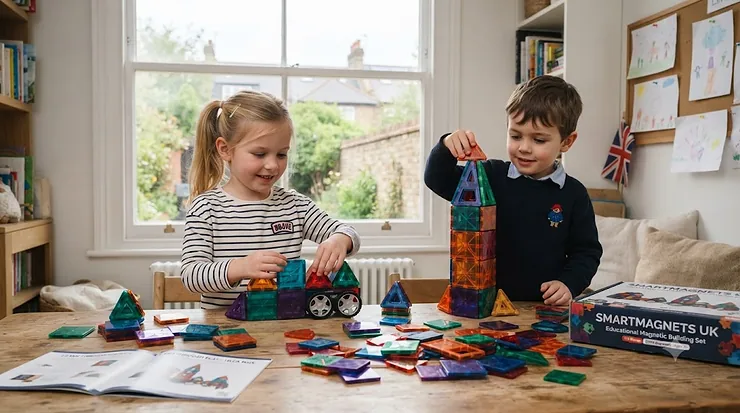
An educational magnetic building set is a collection of shaped, magnetised pieces — usually flat tiles or 3D panels — that click together edge to edge, letting children construct anything from a simple square to a full geometric dome, all while quietly absorbing lessons in shape, symmetry, spatial reasoning and basic engineering along the way.
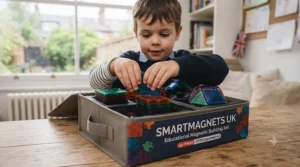
If you’ve ever watched a four-year-old lose an entire afternoon building and rebuilding the same wobbly tower, you already know these things have a strange kind of magic to them. There’s something about the click of a magnetic edge locking into place that keeps children coming back long after the novelty of most toys has worn off. According to the statutory framework for the early years foundation stage, it’s important that the curriculum includes rich opportunities for children to develop their spatial reasoning skills across all areas of mathematics, including shape, space and measures, and magnetic building sets happen to be one of the most naturally engaging ways to deliver exactly that.
A good educational magnetic building set won’t turn a reluctant learner into a maths prodigy overnight, but it does something genuinely useful: it makes abstract concepts like symmetry, angles and 3D structure something a child can physically hold, turn over, and rebuild when it inevitably collapses. Below, we’ve dug into seven real sets sold in the UK, weighed up their specs against what parents and teachers actually report, and worked out which one suits which child, classroom, or budget. No fluff, no invented five-star testimonials — just an honest look at what’s out there.
Quick Comparison Table
| Set | Piece Count | Price Range | Best For |
|---|---|---|---|
| MAGNA-TILES Classic | 100 pieces | £55-£65 range | Reliable, brand-original quality |
| CONNETIX Rainbow Creative Pack | 102 pieces | £90-£100 range | Strongest magnets and durability |
| PicassoTiles 100 Piece Set | 100 pieces | £30-£40 range | Clear, Montessori-style tiles |
| Coodoo Magnetic Tiles | 100 pieces | £25-£35 range | Budget-friendly first set |
| Science Kidz Magnetic Tiles | 100 pieces + figures | £22-£30 range | Imaginative play alongside building |
| Polydron Sphera Starter Set | 36 pieces | £30-£40 range | Dedicated maths and geometry teaching |
| Polydron Magnetic Class Set | 96 pieces | £150-£180 range | Classroom and group settings |
Looking at the spread above, the MAGNA-TILES Classic and CONNETIX Rainbow Creative Pack occupy similar territory in terms of piece count, but the price gap tells you something real is different — magnet strength and build tolerance, not just branding. Meanwhile the Polydron Sphera Starter Set sits apart from every other entry here because it isn’t chasing open-ended creative play at all; it’s built specifically to teach 3D shape names and properties, which matters enormously if your priority is curriculum-aligned maths rather than free construction.
💬 Just one click — help others make better buying decisions too!😊
Top 7 Educational Magnetic Building Sets: Expert Analysis
Coverage below spans budget, mid-range and premium options, plus classroom-scale sets and shape-specific variants, because “educational magnetic building set” covers a genuinely wide range of needs — a single child building at the kitchen table has very different requirements from a reception classroom sharing one box between six children.
1. MAGNA-TILES Classic 100-Piece Set — the original brand, still setting the benchmark
The MAGNA-TILES Classic set is where the whole magnetic tile category effectively started, and that pedigree still counts for something. Key specs worth interpreting properly: the 100-piece set includes squares, triangles and larger shapes in translucent jewel-tone colours, designed so light passes through when built against a window, which turns ordinary construction play into something closer to stained-glass art.
Based on the spec comparison, what most buyers overlook about the original brand is manufacturing consistency — the tolerances on the magnets and the plastic edges are tight enough that pieces from a set bought years ago still click cleanly with a brand-new box, which matters enormously for households and schools building a collection gradually over several birthdays or terms rather than buying everything at once.
Reviewers consistently note that the magnets, while strong, are noticeably gentler than the newer premium competitors, which some parents of very young children actually prefer, since pieces separate more easily during rough toddler play rather than pinching small fingers.
Pros:
- ✅ Original brand with decades of manufacturing consistency
- ✅ Translucent colours ideal for light-table and window play
- ✅ Compatible across older and newer sets in the range
Cons:
- ❌ Magnets are gentler than the strongest competitors
- ❌ Premium pricing for what is now a fairly basic shape range
At around £55-£65, the MAGNA-TILES Classic is the safe, well-established choice if you want a brand with a genuine track record rather than a newer challenger.

2. CONNETIX Rainbow Creative Pack — strongest magnets on this list
The CONNETIX Rainbow Creative Pack has developed a reputation in UK parenting circles as the set to beat on raw build quality. It’s genuinely compatible with other leading magnetic tile brands, but its magnets are stronger than most, meaning taller, more ambitious structures hold together where cheaper competitors would collapse mid-build.
What most buyers overlook about this set is the bevelled edge design — a small manufacturing detail that makes tiles sit flush against each other with less visible gap than square-edged competitors, producing noticeably neater finished structures. Aggregated feedback from parent communities consistently describes it as the most-played-with toy in the house, with several reviewers noting it holds children’s attention daily rather than becoming a forgotten Christmas present by February.
Here’s what to weigh up: the 102-piece Creative Pack is genuinely comparable in size to the MAGNA-TILES Classic, but sits at a noticeably higher price point, and the wider Connetix range of themed expansion packs, while excellent, adds up quickly if a child gets hooked and wants every add-on.
Pros:
- ✅ Strongest magnets in this comparison for taller builds
- ✅ Bevelled edges for a neater, more polished finish
- ✅ Compatible with most other major magnetic tile brands
Cons:
- ❌ Priciest single set on this list
- ❌ Expansion packs can add up quickly for enthusiastic builders
Priced around £90-£100, the CONNETIX Rainbow Creative Pack earns its premium tag through genuine build quality, not just branding — worth the spend if durability across years of use matters more than upfront cost.
3. PicassoTiles 100 Piece Set — best clear, Montessori-style tiles
The PicassoTiles 100 Piece Set takes a different aesthetic approach, favouring fully clear, jewel-like tiles over the block colours of most competitors. This isn’t just a style choice — the transparency means children can genuinely see the geometric structure of what they’ve built rather than the shapes being obscured by opaque colour, which several Montessori-aligned settings specifically favour for that reason.
Key specs worth interpreting properly: the set includes smooth, safe edges designed for small hands, and the pieces are explicitly marketed toward preschool classroom gifting alongside home use, suggesting reasonably robust construction for group and multi-child handling. Based on the spec comparison, this is a genuinely solid mid-tier option that undercuts the premium brands by a meaningful margin while still offering a comparable piece count.
Reviewers consistently note strong satisfaction across a very large review base, with the clear design specifically praised for sensory learning and easy small-hand grip, though a handful mention the clear tiles show fingerprints and scuffs more visibly than coloured alternatives over time.
Pros:
- ✅ Fully clear tiles show structure and light effects clearly
- ✅ Smooth edges designed for small hands
- ✅ Strong value at the mid-range price point
Cons:
- ❌ Clear plastic shows fingerprints and scuffs more visibly
- ❌ Magnet strength trails the premium competitors
At around £30-£40, the PicassoTiles 100 Piece Set is a sensible middle-ground pick for anyone who wants near-premium visual appeal without the premium price tag.
4. Coodoo Magnetic Tiles 100-Piece Set — best budget-friendly first set
If you’re not yet sure whether magnetic tiles will genuinely hold a particular child’s attention, the Coodoo Magnetic Tiles 100-Piece Set is a sensible way to find out without committing to premium pricing. It includes two toy cars alongside the standard tile shapes, adding a small-world play element that pure geometric sets don’t offer.
Based on the spec comparison, this sits meaningfully below the premium brands on magnet strength, but the trade-off is proportionate to the price — for toddlers and younger preschoolers who aren’t yet building particularly tall or ambitious structures, the difference is far less noticeable than it would be for an older child attempting elaborate constructions.
Reviewers consistently note strong satisfaction across a genuinely large purchase volume, with the bundled car bases specifically praised for extending play value beyond flat building into pretend-play scenarios, a detail that matters for households wanting one toy to cover multiple play styles rather than several separate purchases.
Pros:
- ✅ Lowest price point among the 100-piece sets on this list
- ✅ Includes car bases for extended small-world play
- ✅ Popular, well-reviewed starter option for testing interest
Cons:
- ❌ Magnet strength noticeably weaker than premium brands
- ❌ Less consistent piece-to-piece manufacturing tolerance
At around £25-£35, the Coodoo Magnetic Tiles 100-Piece Set is the lowest-risk way to work out whether magnetic building genuinely suits your child before spending more.
5. Science Kidz Magnetic Tiles 100-Piece Set — best for combining building with imaginative play
The Science Kidz Magnetic Tiles 100-Piece Set bundles four play figures and a storage bag alongside the standard tile shapes, explicitly targeting the crossover between construction play and imaginative, story-driven play — a combination several competitors on this list treat as an afterthought rather than a core feature.
What most buyers overlook about this UK-focused brand is the storage solution — a proper bag rather than a flimsy box, which genuinely matters for households where “tidy-up time” determines whether a toy gets played with again or ends up permanently scattered across the carpet. Based on the spec comparison, the piece variety and included figures make this a strong pick for children who enjoy building a scene — a zoo enclosure, a doll’s house room — rather than pure abstract geometric construction.
Aggregated review sentiment is strongly positive, with the included figures and storage bag specifically flagged as thoughtful additions that competitors charge extra for as separate accessory packs.
Pros:
- ✅ Includes four play figures for imaginative building
- ✅ Proper storage bag included, not just loose packaging
- ✅ Strong value combining construction and pretend play
Cons:
- ❌ Figures and extras mean fewer pure tile pieces for the price
- ❌ Magnet strength sits at the budget end of the range
Priced around £22-£30, the Science Kidz Magnetic Tiles 100-Piece Set is the pick for children whose play style leans toward storytelling and scenes rather than pure structural building.

6. Polydron Sphera Starter Set — best for dedicated maths and geometry teaching
Unlike every other entry on this list, the Polydron Sphera Starter Set isn’t chasing open-ended creative building at all — it’s a purpose-built maths teaching tool. The 36-piece set includes sphere, cylinder, cone, circle and triangle pieces specifically designed to help children understand curved 3D shapes, which flat-tile sets genuinely cannot replicate.
Key specs worth interpreting properly: this set is aimed at children aged five and up, reflecting the more abstract shape concepts involved compared with the simpler square-and-triangle building of toddler-focused sets. Based on the spec comparison, this is the only product in this comparison that directly targets curved solids — spheres and cones — rather than flat-faced polygons, filling a genuine gap that even premium tile brands like Connetix and Magna-Tiles don’t cover.
Reviewers consistently note that this set works best used alongside adult guidance or structured lesson activities rather than fully independent free play, since the shape concepts it teaches genuinely benefit from an adult naming and explaining what’s being built.
Pros:
- ✅ Only set here covering curved 3D solids like spheres and cones
- ✅ Explicitly designed around maths and geometry curriculum concepts
- ✅ Compact size suits small-group or one-to-one teaching
Cons:
- ❌ Smaller piece count limits large-scale free building
- ❌ Best used with adult guidance rather than fully independent play
At around £30-£40, the Polydron Sphera Starter Set is genuinely worth the spend if curriculum-aligned geometry teaching, not just creative play, is your priority.
7. Polydron Magnetic Class Set — best for classroom and group settings
Every other set here is scaled for one or two children playing at home; the Polydron Magnetic Class Set is built for a genuinely different use case — a full classroom of children building simultaneously. At 96 pieces including squares, right-angle and equilateral triangles, it’s specifically marketed as a classroom essential rather than a home toy.
What most buyers overlook here is the durability specification — school-grade construction toys need to survive daily handling by dozens of different children across a full academic year, not just occasional weekend play at home, and Polydron’s decades-long presence in UK primary schools reflects genuine confidence in that durability from institutional buyers who’ve tested the alternative and found it wanting.
Reviewers consistently note the set holds up remarkably well to sustained classroom use, though the price reflects that institutional positioning rather than a typical home-toy budget.
Pros:
- ✅ Purpose-built for classroom and group teaching settings
- ✅ Decades of proven durability in UK school use
- ✅ Piece variety supports structured geometry lessons
Cons:
- ❌ Significantly pricier than any home-focused set on this list
- ❌ Overkill for a single child building alone at home
At around £150-£180, the Polydron Magnetic Class Set is squarely aimed at schools, nurseries and childminding settings needing enough pieces for genuine group building rather than individual home use.
STEM Magnetic Building Toys: What Makes Them Genuinely Educational
Not every toy labelled “STEM” earns the term, and it’s worth understanding what actually separates a genuine learning tool from clever marketing. STEM magnetic building toys deliver real educational value through a specific mechanism: they let children physically manipulate abstract concepts — angles, symmetry, structural stability — rather than simply memorising facts about them.
What most buyers overlook is that the “S-T-E-M” label applies most convincingly when a child is actively problem-solving, not just stacking pieces at random. A structure that keeps collapsing teaches genuine engineering feedback — cause, effect, and iteration — in a way that a completed, static toy simply cannot. Based on the spec comparison across the sets above, the ones with genuinely strong magnets, like Connetix and MAGNA-TILES, allow children to build tall enough and complex enough structures that this trial-and-error engineering process kicks in properly, rather than pieces falling apart before any real problem-solving happens.
How to Choose an Educational Magnetic Building Set
Working through this decision doesn’t need to be complicated. Here’s the order that actually matters:
- Match piece count to ambition. Under 60 pieces suits toddlers building small, simple shapes; 100 pieces or more supports the taller, more complex structures older children attempt.
- Check magnet strength against the child’s age. Very young children benefit from gentler magnets that separate easily during rough play; older children building ambitious structures need the stronger hold that premium brands offer.
- Decide between open-ended and curriculum-specific. Standard tile sets suit free creative building; sets like the Polydron Sphera Starter Set suit targeted geometry teaching.
- Consider compatibility if you already own tiles. Several brands, including Connetix, are genuinely cross-compatible, letting you expand an existing collection rather than starting over.
- Factor in group versus solo use. A single child needs far fewer pieces than a classroom or playgroup building simultaneously — the Polydron Magnetic Class Set exists specifically for that scenario.
- Set a realistic budget band. Prices here span roughly £25 to £180, and the jump in quality above the mid-range is real but incremental, not proportional to the price jump.
- Read aggregated reviews for your specific use case, not just star ratings — a set rated highly for toddler play may still underperform for an older child’s more ambitious building.
Magnetic Sets for Maths and Geometry: Why Shape Toys Matter for Numeracy
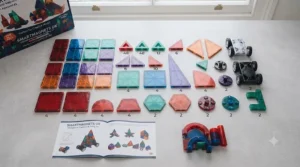
It’s tempting to think of magnetic tiles purely as a creative toy, but the maths link is genuinely substantial, not marketing spin. Researchers at the Education Endowment Foundation’s guidance on early maths teaching identify building blocks as especially important for developing children’s spatial awareness and knowledge of shapes, recommending that children have experiences with a wide variety of shapes rather than a narrow, repetitive set.
Magnetic sets for maths and geometry specifically earn their place in a child’s toy collection because they make abstract vocabulary — vertex, symmetry, face, edge — something physically graspable rather than purely verbal. The Polydron Sphera Starter Set covered above goes furthest in this direction, directly targeting curved solids that flat tiles can’t represent, but even standard tile sets like PicassoTiles and Coodoo build the foundational shape vocabulary that later, more formal geometry lessons build upon.
Educational Construction Toys: Building Skills Beyond the Box
Treating a magnetic tile set as a single, static purchase misses much of its value. Genuine educational construction toys reward ongoing, varied use across months and years, not just the first excited week after unboxing.
First-session setup: Introduce the set on a flat, stable surface — carpet works better than a slippery table for younger children, since toppled towers on carpet feel less discouraging than the same collapse on hard flooring. Demonstrate one or two simple builds first rather than leaving a completely open brief, which can overwhelm very young children unfamiliar with construction toys.
Ongoing engagement ideas: Rotate between free building and guided challenges — “build something taller than your hand,” “make a shape with exactly four sides” — to keep engagement fresh across repeated play sessions. Combining sets with everyday objects, torches for light-table effects, or simple printed shape cards extends genuine educational value well beyond the pieces themselves.
Common early mistakes: Buying too few pieces for the ambition of the child using them leads to frustration rather than creativity — a 30-piece set rarely satisfies a determined seven-year-old wanting to build a proper castle. Equally, expecting a child to build unaided from day one without any modelling or guided example undersells how much scaffolded early support improves long-term independent play.
Classroom Learning Aids: Choosing Sets for Group Settings
Buying for a nursery, reception class or childminding setting introduces considerations that home buyers rarely face. Classroom learning aids need to withstand daily handling by multiple children, survive being dropped, stepped on, and occasionally chewed by the very youngest users, and still function reliably a full academic year later.
The shift worker or childminder managing mixed ages: A set spanning a wide age range, like the standard 100-piece tile sets, works better than narrowly age-targeted options, since group settings rarely have the luxury of separate toys for each individual child’s exact developmental stage.
The reception classroom running structured maths lessons: Purpose-built teaching sets like the Polydron Magnetic Class Set or Polydron Sphera Starter Set justify their higher price through curriculum alignment and proven institutional durability that generic tile sets, however good for home use, weren’t specifically engineered for.
The small playgroup on a tight budget: Starting with a budget-friendly option like Coodoo or Science Kidz, then expanding gradually as funding allows, spreads cost sensibly without sacrificing the core learning value in the meantime.
✨ Don’t Miss These Exclusive Deals!
🔍 Take your classroom or playroom set-up to the next level with these carefully selected sets. Click on any highlighted item above to check current pricing and availability. The right building set could genuinely transform how children learn shape and structure.
Real-World Scenarios: Matching the Set to the Child
The toddler taking their first steps into construction play: Very young children benefit from gentler magnets and simpler shapes rather than premium strength they don’t yet need. The Coodoo Magnetic Tiles 100-Piece Set, with its included cars and forgiving magnet strength, suits this stage well without overspending on features a toddler won’t yet use.
The older child obsessed with elaborate builds: Ambitious structures need magnets strong enough to hold taller, more complex shapes without collapsing mid-build. The CONNETIX Rainbow Creative Pack genuinely earns its premium price here, where a weaker budget set would frustrate a determined seven- or eight-year-old builder.
The parent specifically targeting maths confidence: If shape recognition and geometry vocabulary are the priority rather than open-ended play, the Polydron Sphera Starter Set delivers curriculum-relevant learning that generic tile sets, however fun, weren’t specifically designed to teach.
Common Mistakes When Buying an Educational Magnetic Building Set
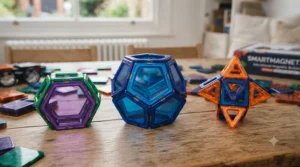
Even sensible shoppers trip up here, usually in predictable ways. The most common mistake is buying too small a set for the child’s actual ambition — a 30 or 40-piece starter pack satisfies a two-year-old but frustrates a determined six-year-old within days, leading to an unnecessary second purchase soon after.
The second mistake is ignoring magnet strength entirely and buying on piece count or price alone — a large but weakly-magnetised set collapses constantly during ambitious building, teaching frustration rather than the persistence and problem-solving these toys are meant to encourage. Third, several buyers skip checking cross-brand compatibility before purchase, then discover their new set won’t reliably click with an existing collection from a different brand. Finally, treating classroom-scale sets like the Polydron Magnetic Class Set as suitable for home use, or vice versa, wastes money in both directions — match the scale of the set to the actual number of children using it.
Magnetic Building Sets vs Traditional Construction Toys
Traditional construction toys — wooden blocks, interlocking plastic bricks — remain genuinely valuable and shouldn’t be entirely replaced by magnetic sets. Wooden blocks in particular teach gravity, balance and weight distribution in ways that lightweight magnetic tiles, which stay upright through magnetic attraction rather than physical stacking, simply don’t replicate.
That said, magnetic sets offer something traditional blocks can’t: near-instant, forgiving assembly that lets younger children experience the satisfaction of building tall, complex structures well before their fine motor skills could manage the precision that stacking or interlocking bricks demand. The honest verdict is that magnetic sets and traditional blocks work best as complementary tools rather than direct competitors — a well-rounded toy collection benefits from both the gravity-based problem-solving of wooden blocks and the geometry-focused, forgiving construction of magnetic tiles.
What to Expect: Real-World Play and Learning Outcomes
Specs and marketing copy only tell half the story of how these sets actually get used day to day. In practice, most children move through a fairly predictable progression: an early phase of simple, flat building — squares and triangles laid out on the floor — before gradually attempting taller, more three-dimensional structures as confidence and fine motor control develop.
During that early phase, even budget sets like Coodoo or Science Kidz perform perfectly well, since the structures being attempted are simple enough that magnet strength differences barely matter. As ambition grows toward towers, domes, and multi-room structures, the gap between budget and premium sets becomes far more noticeable — this is precisely where Connetix and MAGNA-TILES‘s stronger magnets earn their higher price tags, holding together builds that weaker-magnet sets simply can’t sustain.
STEM Curriculum Toys: Linking Play to the National Curriculum
Parents and teachers buying STEM curriculum toys often want reassurance that play time genuinely connects to what’s being taught in the classroom, not just marketing language borrowed from education circles. The early years foundation stage statutory framework is explicit that children should develop a deep understanding of numbers, alongside rich opportunities to develop spatial reasoning skills across all areas of mathematics, including shape, space and measures.
Magnetic building sets map directly onto this framework in a way few other toy categories manage so naturally. Building a cube, for instance, gives a child hands-on experience of faces, edges and vertices well before those words appear in a formal maths lesson — and sets like the Polydron Sphera Starter Set extend that connection into curved solids that later geometry units cover in more depth. This genuine curriculum alignment is precisely why schools invest in sets like the Polydron Magnetic Class Set rather than treating construction toys as purely a break-time activity.
Shape Recognition: How Magnetic Tiles Build Early Geometry Skills
Shape recognition sounds like a simple, almost trivial skill, but it’s genuinely foundational to later mathematical confidence. The Royal Society’s expert panel perspective on spatial reasoning notes that teaching children to think and work spatially results in substantially improved mathematics performance with lifelong benefits, extending well beyond geometry into number, algebra and statistics.
What most buyers overlook is that repetitive, varied exposure matters more than any single “perfect” set — a child who only ever handles squares and triangles develops a narrower shape vocabulary than one who’s also encountered pentagons, hexagons and curved solids. This is precisely where mixing a standard tile set, such as PicassoTiles or MAGNA-TILES, with a shape-specific set like the Polydron Sphera Starter Set produces a more rounded shape recognition foundation than either alone.
Safety, Age Ranges & Buying Considerations
Magnetic toys carry a genuine safety consideration that’s worth taking seriously rather than glossing over. The Child Accident Prevention Trust has worked alongside UK researchers to raise awareness of the dangers of strong magnets, following a Southampton study that found hundreds of children hospitalised each year in the UK after ingesting small magnets, with some requiring surgery.
The critical distinction here is piece size and set design: every set covered in this guide is built from large, tile-sized magnetic pieces genuinely unsuitable for swallowing, unlike the small loose “fidget ball” style magnets the safety warnings above primarily target. Even so, always respect the stated age recommendations — sets marked 3+ have been assessed against that risk specifically, and younger siblings in the household should be supervised around any set with detachable small components. Buying from established, reputable brands rather than unbranded budget listings also matters, since safety testing consistency varies considerably outside the well-known names covered in this guide.
Long-Term Cost & Value
Working out genuine value here means looking past the upfront price tag to years of realistic use. A £30 set used daily through toddlerhood and into early primary years, gradually supplemented rather than replaced, often works out better value than repeatedly buying and discarding cheaper, weaker sets that frustrate ambitious builders and get abandoned within months.
The premium CONNETIX Rainbow Creative Pack, at £90-£100, justifies its cost partly through cross-compatibility with the brand’s wider expansion range, meaning a single core investment can grow steadily over several birthdays rather than needing full replacement. Budget options like Coodoo and Science Kidz remain excellent value specifically for younger children or households testing genuine interest before committing further, while classroom-scale sets like the Polydron Magnetic Class Set spread their higher cost across dozens of children over multiple years, making the per-child cost considerably lower than the headline price suggests.
Frequently Asked Questions
❓ What age is best for an educational magnetic building set?
❓ Are magnetic building sets actually educational, or just a creative toy?
❓ Can different magnetic tile brands be mixed together?
❓ How many pieces does a child actually need?
❓ Are magnetic building sets safe for young children?
Conclusion
There’s no single “best” educational magnetic building set here, because the right pick genuinely depends on the child’s age, ambition, and whether you’re buying for home or a group setting. If you want the most reliable, well-established option, the MAGNA-TILES Classic delivers proven consistency. If durability for ambitious, elaborate builds matters most, the CONNETIX Rainbow Creative Pack justifies its premium price. Budget-conscious first-timers are well served by the Coodoo Magnetic Tiles 100-Piece Set or Science Kidz Magnetic Tiles 100-Piece Set, and anyone specifically targeting maths and geometry learning should look closely at the Polydron Sphera Starter Set. Classrooms and group settings, meanwhile, are the one scenario where the Polydron Magnetic Class Set genuinely earns its considerably higher price.
Whichever you choose, remember that the educational value comes from sustained, varied use, not the purchase itself — rotating between free building and guided shape challenges, mixing sets where possible, and letting structures collapse and get rebuilt again and again is where the genuine learning happens. A magnetic building set, chosen properly for the child in front of you rather than simply the highest-rated option online, can quietly do more for early shape and spatial confidence than almost any other toy on the shelf.
Recommended for You
- Magnetic Train Set for Preschoolers: 7 Brilliant 2026 Picks
- 7 Best Magnetic Building Vehicles for Kids UK 2026 (Tested Picks)
- 3D Magnetic Puzzle Sets: 7 Best Brain Teasers to Buy in 2026
Disclaimer: This article contains affiliate links. As an Amazon Associate, I earn from qualifying purchases. If you purchase products through these links, we may earn a small commission at no additional cost to you.
✨ Found this helpful? Share it with your friends! 💬🤗
