
In This Article
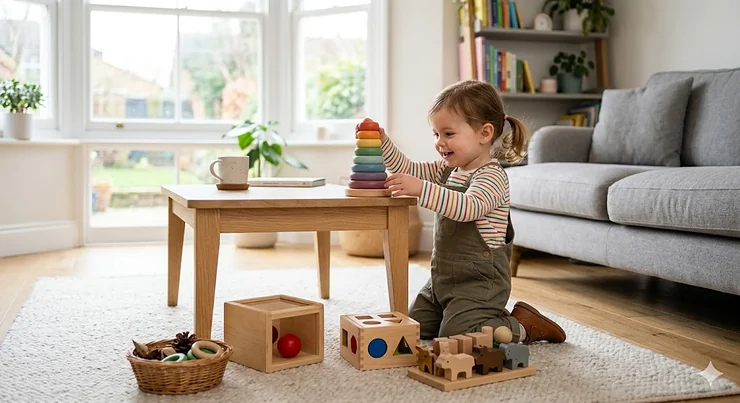
Your two-year-old is at a fascinating crossroads. One moment they’re attempting to dress themselves with mittens on both hands, the next they’re proudly stacking blocks into something vaguely resembling the Shard. This is precisely when Montessori toys for 2 year olds become rather invaluable.
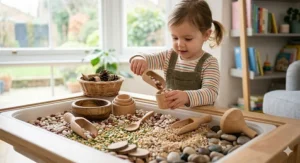
Developed by Italian physician Maria Montessori in the early 1900s, the Montessori method centres on child-led learning through hands-on exploration. According to Wrexham University’s research on Maria Montessori, the UK now hosts over 600 Montessori schools, with 88% of OFSTED-inspected institutions graded “outstanding” or “good”. The philosophy has clearly struck a chord with British families seeking alternatives to screen time and battery-operated distractions.
What makes these toys different from the plastic cacophony cluttering most playrooms? Montessori toys for 2 year olds emphasise natural materials, purposeful design, and activities that mirror real life. Rather than flashing lights announcing “well done!” every three seconds, these toys allow children to discover cause and effect on their own terms. A wooden shape sorter doesn’t congratulate your toddler for finding the square hole—but the satisfying thunk when that block slides into place? That’s reward enough.
For British parents navigating compact flats, unpredictable weather, and the relentless pace of toddler development, wooden practical life toys reviews consistently highlight durability and storage efficiency. In this guide, I’ll walk you through seven outstanding options available on Amazon.co.uk, practical implementation strategies, and how to match toys to your child’s emerging independence skills.
Quick Comparison Table: Top Montessori Toys for 2 Year Olds
| Product | Best For | Key Feature | Price Range (£) | Amazon Prime |
|---|---|---|---|---|
| Jaques of London Montessori Puzzle Set | Cognitive development | Hand-painted British design | £15-£25 | ✅ |
| Melissa & Doug Rainbow Stacker | Fine motor skills | Eight graduated rings | £10-£18 | ✅ |
| Joyreal Wooden Busy Board | Practical life skills | 15+ sensory activities | £18-£28 | ✅ |
| TOWO Wooden Shape Sorter | Problem-solving | Geometric complexity | £12-£20 | ✅ |
| Montessori Dressing Frame Set | Independence training | Buttons, zips, buckles | £20-£35 | ✅ |
| HABA Rainbow Whirls | Colour recognition | German engineering | £22-£32 | ✅ |
| Wooden Threading Beads Set | Hand-eye coordination | Chunky toddler-safe pieces | £8-£15 | ✅ |
From the comparison above, the Jaques of London puzzle set offers exceptional value in the £15-£25 range, particularly for families prioritising British-made quality and supporting a company with 230 years of toy-making heritage. If you’re working with a tighter budget, the threading beads provide remarkable developmental bang for under £15, though they lack the visual appeal of pricier options. Budget-conscious parents should note that TOWO’s shape sorter sacrifices some aesthetic charm for functionality—a fair trade-off when you’re more concerned with skill-building than Instagram-worthy play corners.
💬 Just one click — help others make better buying decisions too! 😊
Top 7 Montessori Toys for 2 Year Olds: Expert Analysis
1. Jaques of London Montessori Wooden Puzzle Set
The Jaques of London Montessori Puzzle Set represents British toy-making at its finest—chunky wooden pieces painted in cheerful colours, designed to withstand the enthusiastic handling of a determined two-year-old. This four-puzzle collection features animals, vehicles, and everyday objects, each with raised pegs perfectly sized for little fingers still mastering their pincer grip.
What the product listing won’t tell you: the 6-8mm thickness of these puzzles means they won’t warp in our damp British climate, unlike thinner alternatives that start curling after a few months in an unheated playroom. The hand-painted finish uses water-based, non-toxic paints that comply with UK safety standards, and I’ve yet to encounter a child who didn’t instinctively want to touch and explore these tactile pieces. UK reviewers consistently praise the company’s responsive customer service—rather important when a puzzle piece inevitably goes missing during a particularly enthusiastic game of “throw everything behind the radiator.”
For Montessori philosophy implementation, these puzzles excel at encouraging independent problem-solving without frustration. The simple designs prevent cognitive overload whilst still providing enough challenge to maintain engagement. Perfect for rainy Manchester afternoons when you need 20 minutes of focused quiet time.
Pros:
✅ British heritage brand with robust customer support
✅ Chunky pieces resist damage from toddler enthusiasm
✅ Natural wood construction survives UK humidity
Cons:
❌ Limited piece count means children may outgrow quickly
❌ Higher price point than imports
Price range: £15-£25. A solid mid-range investment that should last through multiple children, assuming the first one doesn’t post pieces through heating vents.
2. Melissa & Doug Rainbow Stacker
The Melissa & Doug Rainbow Stacker is the sort of deceptively simple toy that reveals its genius over time. Eight smooth wooden rings graduate from large to small, stacking on a rocking base that adds an element of gentle challenge. What initially appears to be merely a colourful tower quickly becomes a lesson in size relationships, colour sequencing, and spatial reasoning.
Here’s what separates this from cheaper stackers: the rings are sanded to perfection, with no rough edges to snag tiny fingers. The rocking base introduces instability—which sounds counterintuitive for a stacking toy, but actually teaches toddlers to steady objects whilst manipulating them. It’s a skill that translates directly to pouring juice without flooding the kitchen table. The FSC-certified wood means you’re supporting sustainable forestry practices, though cynics might note that sustainable wood still requires proper finishing to survive British weather if stored in a garage or garden shed.
British parents appreciate that this toy doesn’t take up half the living room floor when assembled. In a typical terraced house or flat, every centimetre of storage matters. The entire set fits in a standard toy basket, and unlike battery-operated monstrosities, you won’t be tripping over it in the dark at 3am during a toddler crisis.
Pros:
✅ Compact footprint suits smaller British homes
✅ Rocking base adds developmental challenge
✅ Sustainably sourced materials
Cons:
❌ Limited play variations after initial mastery
❌ Rocking feature may frustrate some children initially
Price range: £10-£18. Excellent value for a toy that’ll see daily use for 12-18 months before graduating to the donation pile.
3. Joyreal Wooden Busy Board
The Joyreal Wooden Busy Board is essentially a portable Montessori classroom disguised as a wooden panel. Fifteen different activities—latches, switches, buckles, zippers, and gears—provide the hands-on experience toddlers crave whilst developing practical life skills they’ll actually use. Unlike felt busy boards that fray after a few months, this solid wood construction should survive the journey from toddlerhood through to younger siblings.
What makes this particularly suited to British living: it’s genuinely portable enough for long car journeys, train trips to visit grandparents, and those interminable waits at the GP surgery. The handles are reinforced, not decorative, and the entire board measures roughly 30cm × 40cm—large enough to be engaging without becoming unwieldy on the cramped tray table of a Virgin Trains service. Several UK reviewers mention successfully using this on flights to Spain and Portugal, where it apparently kept small humans occupied long enough for parents to enjoy a tepid airline coffee in peace.
The switches and latches are properly secured, not glued-on afterthoughts, which matters when your two-year-old applies the full force of their determination to “making it work.” The gears actually turn smoothly, the latch genuinely latches, and the buckle requires real dexterity to fasten. These aren’t dumbed-down versions—they’re scaled appropriately for toddler independence skills toys.
Pros:
✅ Genuinely portable for British travel scenarios
✅ Durable wood construction outlasts felt alternatives
✅ Activities mirror real-world fasteners
Cons:
❌ Some activities may initially frustrate younger two-year-olds
❌ Heavier than felt boards (around 1.2kg)
Price range: £18-£28. Worth every penny if you value your sanity during travel, though perhaps excessive if your toddler rarely leaves the neighbourhood.
4. TOWO Wooden Shape Sorter Puzzle
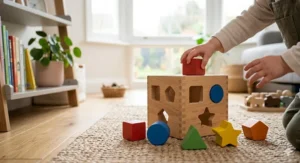
The TOWO Wooden Shape Sorter takes the traditional concept and adds geometric complexity that challenges spatial reasoning without causing toddler meltdowns. Rather than simple circles and squares, this sorter includes octagons, rectangles, and triangles that must be threaded onto colour-coded pegs in the correct orientation. It’s problem-solving with training wheels—structured enough to prevent frustration, open-ended enough to encourage experimentation.
What UK parents particularly appreciate: this toy doesn’t require batteries, updates, or wi-fi to function. In an age where even toddler toys increasingly demand connectivity, there’s something rather refreshing about a chunk of wood and some colourful shapes. The base measures approximately 35cm × 8cm × 7cm, fitting neatly on a shelf or in a toy box without requiring dedicated storage furniture.
The quality control can be inconsistent—some UK buyers report plastic pegs rather than the advertised wooden ones, and occasionally a shape arrives with rough edges requiring light sanding. That said, most reviewers praise the robust construction and note that their children engaged with this toy far longer than expected. The colour coding provides a scaffold for younger toddlers whilst the shape complexity challenges older ones, meaning you’ll get 12-18 months of use before they master it completely.
Pros:
✅ Graduated difficulty grows with child’s skills
✅ Compact footprint for British homes
✅ No batteries or electronic components to fail
Cons:
❌ Inconsistent quality control on materials
❌ May require minor sanding upon arrival
Price range: £12-£20. Solid value if you receive a good-quality unit, though the quality lottery makes this slightly risky.
5. Montessori Dressing Frame Set
The Montessori Dressing Frame Set transforms the daily battle of getting dressed into intentional practice. This set typically includes four wooden frames featuring buttons, zippers, buckles, and snaps—the essential fasteners your two-year-old encounters on British weather-appropriate clothing. Rather than wrestling a squirming toddler into a raincoat whilst balanced on one foot in a doorway, these frames allow unhurried practice at the child’s own pace.
Here’s the practical magic: when your toddler practices buttoning on a frame secured to a table, they’re not simultaneously arching their back and demanding biscuits. The frames isolate the fine motor skills without the pressure of an impatient parent or the time constraints of actually needing to leave the house. Several UK parents report that children who practiced with dressing frames became genuinely independent with buttons and zips weeks ahead of peers—a development that’s worth its weight in gold on rushed nursery mornings.
The frames work particularly well in British homes because they stack flat for storage, taking up minimal space in already-crowded cupboards. The wooden construction withstands damp better than fabric alternatives, and the fasteners themselves are standard British sizing—not oversized “training” versions that don’t translate to real clothing. The buckles are proper metal, the zippers have standard teeth, and the buttons are sewn on properly rather than glued.
Pros:
✅ Directly translates to real-world dressing skills
✅ Flat storage suits compact British homes
✅ Standard UK fastener sizing
Cons:
❌ Limited appeal once skills are mastered
❌ Fabric panels may eventually need washing
Price range: £20-£35. A purposeful investment in toddler independence skills toys that pays dividends in reduced morning chaos.
6. HABA Rainbow Whirls
The HABA Rainbow Whirls brings German engineering precision to colour sorting and stacking. Six wooden rings in rainbow colours thread onto three posts, but the rings are cut at angles that create visual interest and challenge fine motor control. It’s the sort of toy that looks simple on the surface but reveals complexity through extended play—classic Montessori philosophy implementation.
HABA’s German manufacturing shows in the details: the paint is genuinely lead-free (not just claiming compliance), the wood is sourced from sustainable European forests, and the pieces are precisely cut so they stack smoothly without wobbling frustratingly. The toy arrives in proper packaging rather than shrink-wrap, and UK parents consistently report that HABA products survive multiple children without visible wear. In practical terms, this means you could reasonably pass it to cousins or donate it in sellable condition rather than binning a broken wreck.
The toy measures roughly 20cm × 15cm × 15cm, sitting comfortably on a small play table or shelf. British reviewers particularly praise its aesthetic appeal—it’s handsome enough to leave out rather than cramming into a toy box after each play session. The graduated difficulty (colour matching first, then stacking in rainbow order, then creating patterns) means children return to this toy repeatedly over 12-18 months.
Pros:
✅ German engineering ensures lasting quality
✅ Aesthetically pleasing for display
✅ Multiple skill levels extend usability
Cons:
❌ Premium pricing reflects European manufacturing
❌ Limited activity variations
Price range: £22-£32. The upper end of the budget spectrum, justified by exceptional build quality and longevity.
7. Wooden Threading Beads Set
The Wooden Threading Beads Set is deceptively educational—children think they’re making jewellery, whilst parents know they’re developing hand-eye coordination, concentration, and early maths skills through pattern-making. This particular set includes 30-40 chunky wooden beads in various shapes and colours, plus two thick laces with wooden tips that won’t fray or become soggy messes.
What distinguishes quality threading sets from cheaper alternatives: the holes are properly drilled at consistent sizes, the laces are genuinely thick enough for toddler fingers to manipulate, and the wooden tips stay attached after repeated use. Several budget options on Amazon.co.uk feature holes barely larger than the lace itself, creating unnecessary frustration. This set gets the proportions right—holes large enough for success, but not so cavernous that beads slide around uncontrollably.
British parents particularly value this toy during the dark winter months when outdoor play becomes limited. Threading beads provides quiet, focused activity that doesn’t require adult intervention beyond initial demonstration. It’s also brilliantly portable—the entire set fits in a sandwich bag for restaurant waits or trips to the in-laws. The wooden construction means pieces won’t shatter if dropped, though inevitably a few beads will end up under sofas and behind radiators.
Pros:
✅ Exceptional value under £15
✅ Highly portable for British travel needs
✅ Years of use through increasing complexity
Cons:
❌ Small pieces require vigilant supervision
❌ Beads will scatter and disappear over time
Price range: £8-£15. Remarkable value for a toy providing 2-3 years of developmental benefit across multiple skill areas.
Real-World Application: Montessori Principles in British Homes
Implementing Montessori philosophy doesn’t require converting your lounge into a minimalist showroom—good news for those of us living in terraced houses stuffed with generations of accumulated belongings. The core principle is creating an environment where your two-year-old can access, use, and return materials independently.
Start with a low shelf dedicated to your toddler’s current interests. In practical terms, this means installing a simple bookshelf at roughly 60cm height—low enough for small arms to reach, high enough that crawling infants won’t demolish it. Rotate 4-6 toys weekly, keeping the rest in storage. This isn’t just aesthetic minimalism; it’s cognitive management. A two-year-old faced with 40 toy options experiences decision paralysis, whilst 5-6 thoughtfully chosen items encourage focused engagement.
British weather complicates outdoor access, a key Montessori component. On days when Edinburgh drizzle or Manchester rain makes garden time impractical, bring natural elements indoors: a basket of pinecones for sorting by size, shells from last summer’s Cornwall trip, smooth pebbles for counting. These materials cost nothing and provide the sensory variety Montessori champions. Store them in wicker baskets on that low shelf, making them independently accessible.
Practical life activities adapt brilliantly to British routines. Set up a child-height coat rack near your entrance (around 90cm high) where your toddler can hang their own jacket. Provide a step stool by the bathroom sink so teeth-brushing becomes self-initiated rather than parent-directed. These adjustments require minimal investment but cultivate genuine independence—the sort that translates to calmer mornings and fewer power struggles. According to the Montessori Foundation, children in Montessori environments develop stronger intrinsic motivation, becoming “independent and competent beings in the world” rather than dependent on external rewards.
Practical Life Skills: The Foundation of Toddler Development
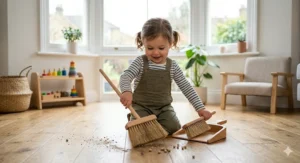
Practical life skills form the cornerstone of Montessori education for toddlers. These aren’t academic exercises—they’re the everyday activities that transform dependent babies into capable humans. Self-care activity materials for two-year-olds focus on dressing, washing, and feeding skills that directly reduce parental workload whilst building toddler confidence.
Consider meal preparation: a child-safe knife (widely available on Amazon.co.uk for £8-£12) allows your two-year-old to slice soft bananas whilst you tackle the actual cooking. It’s slower than doing it yourself, naturally, but the concentration on your child’s face as they carefully position that knife makes the extra five minutes worthwhile. Several British Montessori practitioners recommend setting up a toddler snack station—a low drawer with whole fruit, breadsticks, and similar non-perishable options. Your child learns to recognize hunger signals, choose appropriate food, and clean up afterwards. Revolutionary concept for British parents accustomed to mediating every snack request.
Washing hands independently requires a sturdy step stool (not those rickety folding ones that collapse at inopportune moments) and a pump soap dispenser your toddler can actually operate. The standard screw-top soap dispensers in most British homes require adult hand strength to open. Switch to a pump style, and suddenly your two-year-old is washing hands without assistance—rather handy during cold and flu season.
Dressing frames, mentioned earlier, directly support self-care development. But don’t stop there: organize your child’s wardrobe at their height with 3-4 outfit options maximum. Choice is empowering; 40 options are overwhelming. On rushed mornings, you can reasonably say “choose trousers and a jumper” rather than orchestrating every clothing decision. Will they choose clashing patterns? Absolutely. Will you care when you’re rushing to nursery? Probably not.
Toddler Independence Skills Toys: Beyond the Basics
Developing toddler independence skills toys extends beyond manual dexterity into emotional regulation and decision-making. Two-year-olds are navigating the complicated territory between “I want to do it myself!” and actually possessing the skills to succeed. Thoughtfully chosen toys bridge this gap without frustration.
Puzzles with 4-8 pieces provide achievable challenges. The key is selecting puzzles where piece shapes clearly indicate placement—animal outlines, for example, where the giraffe’s long neck obviously fits in that tall space. Avoid puzzles where identical rectangular pieces could theoretically fit multiple locations, requiring trial and error beyond a two-year-old’s patience threshold. The Jaques of London sets excel here, with raised pegs and clear silhouettes guiding placement.
Practical skill development extends to household participation. Provide a small dustpan and brush set (around £6 on Amazon.co.uk) so your toddler can sweep up spilled snacks rather than watching helplessly whilst you clean. It won’t be thorough—you’ll re-sweep later—but the act of participating in household maintenance builds competence. Similarly, a spray bottle filled with water and a cloth transforms window-cleaning into toddler entertainment. Your windows won’t be streak-free, but your child learns that contributing to household tasks is normal and expected.
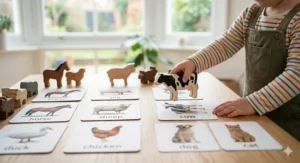
The sorting and matching activities inherent in Montessori materials directly support cognitive development. The TOWO shape sorter, for example, requires recognizing geometric forms, matching colours, and problem-solving spatial orientation. These aren’t abstract academic exercises—they’re the mental processes required for eventually sorting laundry, organizing toys, and finding matching socks. Practical life activities disguised as play, essentially.
Common Mistakes When Choosing Montessori Toys for 2 Year Olds
The first mistake British parents make is assuming more expensive automatically means more educational. That £60 imported German wooden toy might be exquisitely crafted, but if it’s too advanced for your child’s current skills, it’ll gather dust on the shelf. Conversely, that £8 threading beads set could provide months of engaged play. Price indicates quality and durability, not educational value.
Overcomplicated toys are another pitfall. Montessori principles emphasize isolating skills—teaching one thing at a time rather than bombarding children with simultaneous stimuli. Those elaborate activity cubes with 15 different functions seem appealing, but they scatter attention rather than building focused engagement. Your two-year-old benefits more from 5 separate toys targeting specific skills than one overwhelm-inducing mega-toy.
British parents often underestimate the importance of natural materials in damp climates. Cheap wooden toys may warp after a few months in an unheated playroom, whilst quality construction withstands UK humidity. Check reviews specifically mentioning durability—wooden toys that survive British weather patterns are worth the premium. Similarly, metal components should be rust-resistant; those adorable vintage-style toys with standard metal hinges will corrode within a year.
Buying toys that don’t scale with development wastes money. A simple stacking ring set might entertain for 3 months, whilst threading beads evolves from basic stringing to pattern-making to counting exercises, providing 2-3 years of appropriate challenge. Consider whether a toy offers multiple difficulty levels or if it’s a one-trick pony your child will master and abandon.
Ignoring UK safety certifications is dangerously shortsighted. Toys sold on Amazon.co.uk should display UKCA marking (which replaced CE marking post-Brexit). According to GOV.UK guidance on toy safety regulations, this confirms compliance with British safety standards regarding choking hazards, toxic materials, and structural integrity. Imported toys lacking proper certification might save £5 initially, but they pose genuine risks to your child.
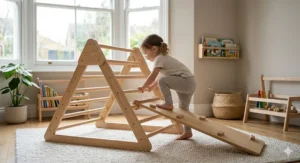
The final mistake is forgetting that storage matters in British homes. That lovely Montessori climbing frame might be developmentally perfect, but if it dominates your lounge because you lack a garden or playroom, it’ll become a source of resentment rather than joy. Consider your actual living space before purchasing large items, regardless of their educational pedigree.

How to Choose Montessori Toys for 2 Year Olds in the UK
Start by observing your child’s current interests and emerging skills. Is your two-year-old fascinated by opening and closing doors? A busy board with latches addresses that interest productively. Obsessed with stacking household items into precarious towers? Channel that energy into proper stacking toys that won’t result in broken crockery.
Assess your child’s fine motor development honestly. The threading beads requiring precise hand-eye coordination might frustrate a younger two-year-old whilst perfectly challenging an older one. Similarly, dressing frames work best when your child is already attempting to dress independently—they refine emerging skills rather than teaching from scratch.
Consider your British living situation realistically. Flat dwellers need compact, easily stored toys. Those blessed with dedicated playrooms can accommodate larger items. Garden access influences choices—families with outdoor space can prioritize indoor fine motor activities, whilst flat-bound families might need more active play options for energy burning on rainy days.
Budget appropriately across skill areas. Rather than spending £100 on one premium toy, distribute funds across fine motor development (£15-£25), practical life skills (£20-£35), cognitive development (£10-£20), and creative play (£10-£15). This ensures comprehensive skill development without breaking the bank.
Research seller reputation on Amazon.co.uk, prioritizing Prime-eligible items from established brands. Check UK-specific reviews rather than international ones—British reviewers discuss durability in damp conditions, space constraints, and compatibility with UK safety standards. Look for reviews mentioning multiple months of use, indicating lasting engagement rather than initial novelty.
Verify UK compatibility explicitly. Some imported toys designed for American or European markets may not meet current British safety standards or might be intended for different voltage plugs (though this matters less for wooden toys than electronic ones). The UKCA marking confirms UK compliance.
Finally, resist the urge to fill every available shelf. Montessori principles emphasize curated selection over abundance. Six well-chosen toys providing focused skill development serve your child better than 40 random playthings creating visual chaos and decision paralysis. Rotate toys every 2-3 weeks, keeping some in storage to maintain novelty and interest.
Montessori Materials vs. Traditional Toys: What British Parents Need to Know
Traditional toys often prioritize entertainment over education, featuring bright lights, loud sounds, and instant gratification. Montessori materials, by contrast, emphasize purposeful activity, natural consequences, and sustained engagement. The difference isn’t merely philosophical—it manifests in how children interact with objects.
Consider a battery-operated shape sorter versus the TOWO wooden version. The electronic one announces “Well done!” and plays a jingle when shapes are inserted correctly. The wooden version offers silence and the natural feedback of a shape sliding satisfyingly into place—or not fitting at all. The electronic toy provides external reward; the wooden one cultivates internal satisfaction from problem-solving success.
Traditional toys frequently combine multiple functions—shape sorting with music, lights, and counting. This seems efficient but actually scatters attention. Montessori education emphasizes materials that “isolate” specific concepts, allowing children to focus on mastering one skill at a time without distraction. The HABA Rainbow Whirls teaches colour sorting and stacking without competing stimuli demanding attention.
Durability differs markedly. Traditional plastic toys often crack or break within months, particularly under the enthusiastic handling of determined two-year-olds. Quality Montessori materials built from solid wood typically survive years of use, multiple children, and eventual donation in working condition. For British families on budgets, this long-term value justifies higher initial costs.
Aesthetic considerations matter more than parents initially realize. Bright plastic toys cluttering every surface create visual chaos that subtly stresses both children and adults. Natural wood toys with muted colours blend into home environments, reducing visual overwhelm. Several British interior design blogs now specifically recommend Montessori toys for families wanting Instagram-worthy play areas—a rather superficial benefit, admittedly, but one that encourages leaving toys accessible rather than hiding everything in cupboards.
The environmental impact increasingly concerns British families. Traditional toys manufactured from petroleum-based plastics in distant factories, shipped globally, then discarded after brief use contribute significantly to environmental degradation. Montessori materials made from sustainably sourced European wood, built to last multiple generations, align better with UK sustainability values.
Age-Appropriate Montessori Philosophy Implementation for Two-Year-Olds
Two-year-olds occupy a unique developmental window Montessori identified as the “sensitive period” for order, movement, and language. They’re transitioning from sensory exploration to purposeful activity, making this ideal for introducing structured Montessori materials whilst respecting their need for movement and autonomy.
The sensitive period for order explains why two-year-olds become distressed when routines change or objects aren’t returned to their “proper” places. Channel this tendency productively by establishing consistent locations for toys on that low shelf. Your toddler learns that threading beads live in the blue basket on the left, whilst puzzles stack on the right. This predictability provides security whilst teaching organizational skills.
Practical life activities align perfectly with two-year-olds’ desire to participate in adult activities. They’re not interested in dumbed-down “pretend” versions—they want real involvement. Provide actual tasks rather than toy versions: real vegetable scrubbing (cucumbers, courgettes), genuine sweeping with a properly sized child’s broom, actual pouring practice with water and small jugs. The mess is considerable initially, naturally, but the skill development justifies the cleanup.
The Montessori “work cycle” typically spans 1-2 hours for two-year-olds—select activity, engage with it, complete it, return it to its place. In reality, British two-year-olds might maintain focus for 10-20 minutes before needing movement or change. That’s perfectly normal. Provide 4-6 options so your child can transition between activities whilst still practicing the cycle.
Independence in toileting becomes relevant for British two-year-olds, particularly those approaching nursery age where nappy-free attendance might be expected. Montessori-aligned potty training emphasizes accessible facilities, appropriate clothing (elasticated trousers rather than complicated dungarees), and allowing natural consequences rather than rewards charts. The goal is internalized bladder awareness rather than performing for stickers.
Frequently Asked Questions
❓ Are Montessori toys worth the extra cost for British families on a budget?
❓ Do Montessori toys work for children with additional needs or developmental delays?
❓ Can I use Montessori toys in small British flats without dedicated playrooms?
❓ How often should I rotate Montessori toys to maintain interest?
❓ Are wooden Montessori toys safe for two-year-olds who still mouth objects?
Conclusion: Building Independence Through Thoughtful Toy Selection
Choosing Montessori toys for 2 year olds isn’t about achieving Pinterest-perfect minimalism or adhering to rigid educational dogma. It’s about providing your child with tools for developing genuine independence, confidence, and problem-solving skills whilst respecting British realities of compact homes, unpredictable weather, and busy family schedules.
The seven toys reviewed above represent diverse skill development opportunities available through Amazon.co.uk with reliable delivery, reasonable pricing, and quality construction suited to British conditions. From the heritage craftsmanship of Jaques of London to the German engineering of HABA, these options balance educational value with practical usability.
Remember that Montessori philosophy adapts to your family rather than demanding rigid compliance. Start with one or two toys addressing your child’s current interests, observe how they engage, and expand gradually. The threading beads might captivate your child for hours whilst the dressing frames sit unused—and that’s perfectly fine. Child-led learning means following their developmental path, not imposing a prescribed sequence.
For British families navigating the transition from baby to toddler, Montessori materials offer structure without rigidity, challenge without frustration, and independence without chaos. Your two-year-old might not thank you now—they’re rather busy perfecting their tantrum technique—but the skills they’re building will serve them for years to come.
✨ Don’t Miss These Exclusive Deals!
🔍 Take your toddler’s development to the next level with these carefully selected Montessori toys for 2 year olds. Click on any highlighted item above to check current pricing and availability on Amazon.co.uk. These picks will help your child build independence, coordination, and confidence through purposeful play. Whether you’re seeking wooden practical life toys reviews or comprehensive toddler independence skills toys, this curated selection offers quality options suited to British homes and families!
Recommended for You
- littleBits vs Snap Circuits Comparison: 7 Best UK Kits 2026
- Snap Circuits Review: 7 Best UK Kits for Kids (2026 Guide)
- Celestron vs National Geographic Telescopes: 7 Best UK 2026
Disclaimer: This article contains affiliate links. As an Amazon Associate, I earn from qualifying purchases. If you purchase products through these links, we may earn a small commission at no additional cost to you.
✨ Found this helpful? Share it with your mates! 💬🤗
