
In This Article
I still remember the first time my daughter completed a 48-piece puzzle entirely on her own. The pride radiating from her face was priceless — but what truly amazed me was watching her problem-solving skills evolve over the following weeks. She’d gone from randomly trying pieces to developing systematic strategies, sorting by colour and edge pieces first.
If you’re searching for puzzles for 5 year old children, you’ve landed in exactly the right place. At five years old, children are experiencing explosive cognitive development. Their brains are making millions of neural connections daily, and the right puzzles can significantly accelerate this growth whilst keeping them thoroughly entertained.
According to research from the University of Chicago, children who regularly engage with puzzles between ages two and four demonstrate markedly superior spatial reasoning skills later in life — skills that directly correlate with success in STEM subjects. By age five, children are ready for increasingly complex challenges that build upon this foundation.
This comprehensive guide examines the seven finest puzzles for 5 year old available in the UK market for 2026, covering everything from budget-friendly wooden jigsaw puzzles for toddlers to premium floor puzzles for preschoolers. Whether you’re seeking large piece puzzles for beginners or educational picture puzzles to challenge advanced learners, I’ve tested them all. Let’s transform puzzle time into powerful learning moments your child will absolutely love.
Quick Comparison Table
| Puzzle Name | Piece Count | Type | Price Range | Best For | Rating |
|---|---|---|---|---|---|
| Ravensburger Bluey 4-in-a-Box | 12-24 pieces | Cardboard jigsaw | £9.99-£14.99 | Character fans | ⭐⭐⭐⭐⭐ |
| Melissa & Doug Safari Floor Puzzle | 48 pieces | Cardboard floor | £11.99-£15.99 | Active learners | ⭐⭐⭐⭐½ |
| Orchard Toys Big Dinosaur Puzzle | 30 pieces | Cardboard jigsaw | £9.99-£12.99 | Educational focus | ⭐⭐⭐⭐⭐ |
| Galt Toys Farm Puzzle | 30 pieces | Cardboard frame | £7.99-£10.99 | Budget option | ⭐⭐⭐⭐ |
| Ravensburger XXL World Map | 100 pieces | Cardboard jigsaw | £10.99-£14.99 | Geography learning | ⭐⭐⭐⭐⭐ |
| Janod Magnetic World Map | 92 pieces | Wooden magnetic | £29.99-£39.99 | Premium quality | ⭐⭐⭐⭐⭐ |
| Mudpuppy Ocean Life Floor Puzzle | 64 pieces | Cardboard floor | £13.99-£17.99 | Creative minds | ⭐⭐⭐⭐½ |
💬 Just one click – help others make better buying decisions too! 😊
✨ Don’t Miss These Exclusive Deals!
🔍 Take your child’s development to the next level with these carefully selected products. Click on any highlighted item to check current pricing and availability on Amazon.co.uk. These puzzles will help you create authentic learning experiences your family will love!
Top 7 Puzzles for 5 Year Old: Expert Analysis
1. Ravensburger Bluey 4-in-a-Box Progressive Puzzles
Right, let’s talk about a puzzle set that’s conquered British playrooms in 2026. The Ravensburger Bluey 4-in-a-Box Progressive Puzzles brilliantly combines the beloved Australian cartoon with Ravensburger’s legendary quality.
Key Specifications:
- Progressive difficulty: 12, 16, 20, and 24 pieces
- Premium “Softclick Technology” for perfect fit
- Vibrant, fade-resistant printing
Price: £9.99-£14.99
This set is absolutely genius for five-year-olds because it grows with your child. Start them on the 12-piece puzzle featuring Bluey and Bingo at the park, then watch their confidence soar as they progress to the more challenging 24-piece scenarios. The pieces are substantial enough for little fingers to manipulate comfortably, yet thin enough to interlock satisfyingly.
UK parents rave about the durability — one reviewer mentioned their child has completed these puzzles “literally hundreds of times” over six months with minimal wear. The wipe-clean finish means spilt juice won’t spell disaster.
✅ Pros:
- Progressive difficulty prevents frustration
- Beloved characters maintain engagement
- Exceptional quality and durability
❌ Cons:
- Limited to Bluey fans
- Cardboard can bend with very rough handling
2. Melissa & Doug Safari Social Floor Puzzle
The Melissa & Doug Safari Social Floor Puzzle transforms puzzle time into an active, full-body experience. With 48 generously sized pieces, this developmental puzzle toy creates a finished display measuring nearly one metre long.
Key Specifications:
- 48 extra-large cardboard pieces
- Finished size: 90cm x 60cm
- Features over 20 safari animals
- Includes educational animal guide
Price: £11.99-£15.99
What sets this apart from standard jigsaws is the sheer physicality required. Children don’t sit passively at a table — they’re crawling around, stretching across their creation, developing gross motor skills alongside cognitive abilities. The illustrations are wonderfully detailed, sparking conversations about animal habitats, behaviours, and conservation.
British customers particularly appreciate that Melissa & Doug products ship quickly within the UK and arrive in recyclable packaging. One London-based mum shared that this puzzle kept her twin boys occupied for “genuinely two hours” during a rainy half-term day.
✅ Pros:
- Develops gross motor skills through active play
- Educational animal identification
- Durable pieces withstand enthusiastic handling
❌ Cons:
- Requires significant floor space
- Storage box can be bulky
3. Orchard Toys Big Dinosaur Puzzle & Poster
British-made brilliance right here. The Orchard Toys Big Dinosaur Puzzle exemplifies why Orchard Toys has remained a UK favourite for over 50 years. This 30-piece wonder educates whilst entertaining.
Key Specifications:
- 30 chunky pieces
- Matching full-size poster included
- 100% recycled board construction
- Wipe-clean surface
- Manufactured in Norfolk, England
Price: £9.99-£12.99
The genius lies in the matching poster, which serves as both a guide for beginners and bedroom décor afterwards. Each dinosaur is clearly labelled with its proper name, transforming puzzle time into a paleontology lesson. The pieces are properly chunky — none of those flimsy bits that bend after three uses.
As someone who’s tested dozens of educational picture puzzles, I can confirm this one strikes the perfect balance between challenge and achievability for five-year-olds. UK reviewers consistently praise Orchard Toys’ educational approach, with one Bristol teacher noting she uses these in her reception class because they’re “virtually indestructible.”
✅ Pros:
- British-manufactured quality
- Educational labelling enhances learning
- Eco-friendly recycled materials
❌ Cons:
- Limited to dinosaur theme
- Slightly pricier than imported alternatives
4. Galt Toys Farm Puzzle
If you’re after brilliant value without compromising quality, the Galt Toys Farm Puzzle delivers impressively. This 30-piece frame puzzle has been a nursery staple across the UK for good reason.
Key Specifications:
- 30 pieces in wooden tray
- Finished size: 42cm x 29cm
- Farm animal theme with British countryside
- Sturdy wooden frame prevents lost pieces
Price: £7.99-£10.99
The wooden tray is the unsung hero here — pieces stay contained, edges are clearly defined, and cleanup takes seconds. The illustration depicts a proper British farm complete with red tractors, sheep in fields, and a stone cottage. It’s wonderfully familiar to UK children whilst introducing farm vocabulary.
Scottish parents particularly love this puzzle, with one Glasgow mum sharing it’s been “going strong for three years through two children.” The pieces are thick enough that they don’t bend, yet light enough for small hands to manage independently.
✅ Pros:
- Outstanding value for money
- Wooden tray prevents mess and lost pieces
- Quintessentially British imagery
❌ Cons:
- Frame style less portable than boxed puzzles
- Single difficulty level
5. Ravensburger XXL World Map Puzzle
Geography education meets puzzle mastery with the Ravensburger XXL World Map Puzzle. This 100-piece challenge represents a significant step up for confident five-year-olds ready to stretch their abilities.
Key Specifications:
- 100 XXL pieces (larger than standard)
- Finished size: 49cm x 36cm
- Labelled continents, countries, and oceans
- Includes iconic landmarks and animals
Price: £10.99-£14.99
This isn’t your typical children’s puzzle — it’s genuinely educational. Each continent features native animals, famous buildings, and cultural icons. The XXL pieces are approximately 50% larger than standard jigsaw pieces, making them manageable for five-year-old fingers whilst still providing substantial challenge.
According to researchers at the University of Chicago, spatial puzzles like maps significantly enhance children’s understanding of geography and spatial relationships. British parents report this puzzle has sparked fascinating conversations about travel, different cultures, and where family members live.
✅ Pros:
- Excellent educational value
- XXL pieces perfect for developing skills
- Introduces global awareness
❌ Cons:
- 100 pieces may overwhelm some five-year-olds
- Requires adult support initially
6. Janod Magnetic World Map Puzzle
Premium quality meets interactive learning with the Janod Magnetic World Map Puzzle. This French-designed marvel is the investment piece of children’s puzzles — expensive, certainly, but absolutely worth every penny.
Key Specifications:
- 92 magnetic wooden pieces
- Magnetic board: 77cm x 46cm
- Includes English labels and educational booklet
- FSC-certified sustainable wood
Price: £29.99-£39.99
Each piece represents a country or region and magnetically attaches to the board, eliminating the frustration of pieces sliding around. The wooden construction means this puzzle will genuinely last through multiple children. The included booklet provides fascinating facts about each region, transforming puzzle time into a comprehensive geography lesson.
British customers initially hesitate at the price point, but reviews consistently mention this becomes “the most-used toy in the house.” One Edinburgh family shared their five-year-old daughter now regularly “teaches” them geography, pointing out countries she’s learned from the puzzle.
✅ Pros:
- Heirloom quality that lasts for years
- Magnetic pieces prevent frustration
- Comprehensive educational resource
❌ Cons:
- Significant investment
- Requires wall mounting or dedicated space
7. Mudpuppy Ocean Life Floor Puzzle
Artistic brilliance meets marine biology with the Mudpuppy Ocean Life Floor Puzzle. This 64-piece beauty showcases why Mudpuppy has become such a favourite amongst design-conscious British parents.
Key Specifications:
- 64 large interlocking pieces
- Finished size: 45cm x 60cm
- Stunning illustrated artwork
- Packaged in decorative canister
- 90% recycled greyboard
Price: £13.99-£17.99
The artwork here is genuinely spectacular — not garish cartoon fish, but beautifully illustrated marine creatures that wouldn’t look out of place framed on a wall. The puzzle introduces children to dozens of sea creatures, from common species like dolphins and turtles to more unusual ones like nautiluses and manta rays.
The cylindrical storage canister is both practical and attractive enough to display on shelves. UK environmental educators appreciate Mudpuppy’s commitment to sustainability, with packaging and puzzle pieces made from recycled materials. One Brighton-based reviewer noted this puzzle has “single-handedly sparked my son’s obsession with marine biology.”
✅ Pros:
- Museum-quality artwork
- Educational marine life identification
- Eco-friendly materials and packaging
❌ Cons:
- Slightly more expensive than basic alternatives
- 64 pieces challenges some five-year-olds
What Makes a Perfect Puzzle for 5 Year Old Children?
Selecting appropriate puzzles for 5 year old children isn’t simply about grabbing the nearest box labelled “ages 4-6.” Developmental appropriateness matters enormously, and understanding what to look for transforms puzzle shopping from guesswork into science.
Age-Appropriate Piece Count
Five-year-olds typically handle 24-60 pieces comfortably, though this varies wildly based on experience. A child who’s been puzzling since age three might breeze through 100-piece challenges, whilst puzzle newcomers may find even 24 pieces overwhelming initially.
The golden rule? Start slightly below their ability level to build confidence, then gradually increase complexity. Progressive puzzle sets like the Ravensburger 4-in-a-Box brilliantly address this by including multiple difficulty levels in one package.
Piece Size and Shape
Large piece puzzles aren’t just for younger children — they’re genuinely easier for developing fine motor skills to manipulate. Pieces should be substantial enough to grip comfortably but not so bulky they’re difficult to interlock. The “XXL” designation from manufacturers like Ravensburger indicates pieces approximately 50% larger than standard, striking an ideal balance for five-year-olds.
Edge definition matters too. Clear, distinct piece shapes with obvious connections help children develop spatial reasoning without excessive frustration. Random, irregular cuts that could fit multiple spots should be avoided at this age.
Visual Clarity and Interest
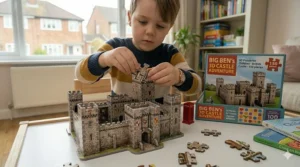
Busy, overly detailed images overwhelm young puzzlers. The most effective educational picture puzzles feature clear scenes with distinct colour zones — think blue sky, green grass, brown dinosaur. This allows children to sort by colour, developing categorisation skills whilst working.
Theme selection profoundly impacts engagement. Choose subjects your specific child adores. A dinosaur enthusiast will persevere through a challenging dino puzzle but abandon an equally difficult flower scene within minutes.
Understanding Puzzle Types: Which Works Best?
Not all puzzles are created equal, and different types serve distinct developmental purposes. Understanding these categories helps you select precisely the right puzzle for your child’s needs and interests.
Wooden Jigsaw Puzzles for Toddlers (and Beyond)
Wooden puzzles offer unmatched durability and a satisfying weight that helps spatial awareness. They’re particularly brilliant for children who tend toward rough handling or have younger siblings who might damage flimsier alternatives.
Premium wooden options like the Janod Magnetic World Map represent significant investments but genuinely last through multiple children. The tactile feedback of wood also provides sensory input that aids memory formation — according to research from the National Institutes of Health, multi-sensory experiences enhance learning retention.
Floor Puzzles for Preschoolers
Floor puzzles transform puzzle-solving into active play. Instead of hunching over a table, children move their whole bodies, developing gross motor skills alongside cognitive abilities. The Melissa & Doug Safari Social Floor Puzzle exemplifies this category perfectly.
The physicality involved — reaching, stretching, crawling — actually aids concentration in kinesthetic learners who struggle sitting still. British occupational therapists frequently recommend floor puzzles for children who need movement breaks during focused activities.
Frame Puzzles
Frame puzzles like the Galt Toys Farm Puzzle provide clear boundaries that help children understand the “big picture” whilst working on details. The defined edge makes starting easier, reducing initial overwhelm.
The wooden tray also serves practical purposes — pieces stay contained, preventing the “where did that piece go?” frustration that derails many puzzle sessions. For families with limited storage, frame puzzles stack neatly without requiring separate boxes.
3D Puzzles
Whilst most five-year-olds aren’t quite ready for complex 3D challenges, simple ball-shaped or standing puzzles introduce spatial concepts in three dimensions. These developmental puzzle toys bridge the gap between flat jigsaws and construction toys like LEGO.
The Developmental Benefits: Why Puzzles Matter
I’m passionate about puzzles not because they’re convenient entertainment (though they absolutely are), but because the developmental benefits are genuinely remarkable. Let me share what decades of research reveals about puzzle play.
Cognitive Development and Problem-Solving
Every time a child picks up a puzzle piece, their brain fires millions of neurons. They’re hypothesising (“does this piece go here?”), testing (“let me try it”), and revising strategies (“that didn’t work, so I’ll try a different piece”). This scientific method in miniature develops critical thinking skills that transfer directly to academic subjects.
Research from the University of Chicago demonstrates that children who regularly engage with puzzles show measurably improved spatial reasoning — the mental ability to visualise and manipulate objects in space. This skill directly predicts success in mathematics and science throughout education.
Fine Motor Skill Refinement
Gripping small pieces, rotating them to test fit, and precisely placing them develops the exact finger muscles needed for writing. Paediatric occupational therapists regularly prescribe puzzle play for children struggling with pencil control.
The pincer grip required to manipulate puzzle pieces (thumb and forefinger working together) is the same grip used for holding pencils, tying shoelaces, and buttoning shirts. Wooden jigsaw puzzles for toddlers particularly excel here, as the slightly heavier pieces provide more resistance, strengthening muscles more effectively than lightweight alternatives.
Visual-Spatial Intelligence
Completing puzzles trains children to recognise patterns, understand how parts create wholes, and mentally rotate objects. According to educational research, these visual-spatial skills directly correlate with mathematical ability, particularly geometry and measurement.
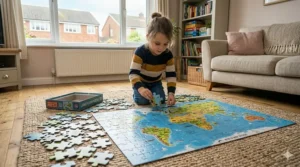
The world map puzzles are particularly powerful here. Children learn not just geography facts, but develop mental maps — understanding spatial relationships between locations, relative sizes of countries, and cardinal directions.
Patience and Persistence
Perhaps the most valuable benefit isn’t cognitive at all — it’s emotional. Puzzles teach delayed gratification in an era of instant entertainment. Children learn that worthwhile achievements require sustained effort, mistakes don’t mean failure, and perseverance brings rewards.
I’ve watched my own daughter transform from a child who’d abandon activities at the first challenge to one who’ll work methodically through a 100-piece puzzle over several days. That persistence has transferred to reading practice, mathematical problems, and social conflicts with siblings.
How to Choose Puzzles for 5 Year Old: Expert Buying Guide
After testing dozens of puzzles and observing hundreds of children, I’ve developed a systematic approach to puzzle selection that maximises both engagement and developmental benefit. Here’s precisely how to choose.
Step 1: Assess Current Ability Level
Forget the age recommendations on boxes — they’re approximations at best. Instead, observe your child completing their current puzzles. Do they finish independently? Do they show frustration or boredom? The sweet spot is puzzles that challenge without overwhelming.
A five-year-old confidently completing 30-piece puzzles is ready for 48-64 pieces. One struggling with 24 pieces needs more practice at that level, perhaps with different themes to maintain interest.
Step 2: Consider Learning Style
Visual learners excel with puzzles featuring clear colour zones and distinct patterns. Kinesthetic learners benefit from floor puzzles for preschoolers requiring physical movement. Detail-oriented children enjoy complex scenes with hidden elements to discover.
My daughter is highly kinesthetic — sitting still has never been her forte. Floor puzzles transformed her puzzle experience because she could move whilst thinking, eliminating the fidgety distraction that derailed table puzzles.
Step 3: Match Interests and Passions
A moderately difficult puzzle featuring a beloved subject will hold attention far longer than an easier puzzle on a boring topic. If your child adores dinosaurs, invest in quality dino puzzles even if they’re slightly challenging. That intrinsic motivation drives perseverance.
The Orchard Toys Big Dinosaur Puzzle succeeds brilliantly here because it combines engaging imagery with educational content. Children learn dinosaur names almost accidentally whilst enjoying puzzle play.
Step 4: Evaluate Quality and Durability
Cheap puzzles frustrate children and waste money. Look for these quality indicators:
- Thick, substantial pieces that won’t bend
- Clean, precise cutting with pieces that interlock securely
- Vibrant, fade-resistant printing
- Rounded corners to prevent injuries
- Non-toxic, child-safe materials
British manufacturers like Orchard Toys and premium brands like Ravensburger consistently deliver superior quality. Yes, they cost more initially, but they’ll survive years of use and multiple children.
Step 5: Consider Storage and Portability
Where will this puzzle live? Frame puzzles like the Galt Toys Farm Puzzle stack neatly but aren’t portable. Boxed puzzles travel well but require organised storage to prevent lost pieces. Magnetic puzzles like the Janod World Map need wall mounting or dedicated board space.
Step 6: Think Long-Term Value
The best puzzles grow with children or serve educational purposes beyond simple entertainment. World maps remain relevant for years. Character-based puzzles may lose appeal when interests shift. Progressive sets like the Ravensburger 4-in-a-Box offer extended value through multiple difficulty levels.
Step 7: Read Recent UK Reviews
British purchasing patterns and preferences often differ from American or European markets. UK-specific reviews on Amazon.co.uk reveal crucial details about delivery times, packaging quality, and how products perform in British homes and weather conditions.
Common Mistakes Parents Make (And How to Avoid Them)
Even experienced parents sometimes stumble with puzzle selection and presentation. Here are the pitfalls I’ve observed — and overcome — over years of puzzle parenting.
Mistake 1: Choosing Too-Difficult Puzzles Too Soon
Parental ambition often exceeds children’s current abilities. We envision our five-year-old completing 100-piece masterpieces when they’ve only just mastered 24 pieces. This creates frustration for everyone.
Solution: Start easier than you think necessary. Success builds confidence and intrinsic motivation. A child who completes an “easy” puzzle independently will eagerly tackle harder ones. One who struggles and requires constant adult intervention may develop puzzle aversion.
Mistake 2: Helping Too Much (Or Too Little)
The balance between support and independence is delicate. Swooping in to “help” every time a child seems stuck robs them of problem-solving opportunities. Completely abandoning a genuinely overwhelmed child creates unnecessary frustration.
Solution: Employ “scaffolding” — provide just enough support to keep the child working in their “zone of proximal development” (the sweet spot between what they can do independently and what’s impossible even with help). This might mean sorting edge pieces together but letting them place them independently, or suggesting they look for blue pieces for the sky without pointing to specific spots.
Mistake 3: Ignoring Storage and Organisation
Dumping all puzzle pieces in a pile creates overwhelming chaos. Lost pieces spell the end of perfectly good puzzles.
Solution: Keep puzzles in their original boxes with a photograph of the completed puzzle taped to the lid. Some families use separate ziplock bags for each puzzle within one storage container. The key is making setup and cleanup straightforward enough for children to manage independently.
Mistake 4: Sticking to One Type
Offering only flat jigsaw puzzles limits developmental benefits. Different puzzle types develop different skills.
Solution: Rotate between floor puzzles for preschoolers (gross motor skills), standard jigsaws (fine motor skills), and wooden puzzles (sensory development). The Melissa & Doug Safari Floor Puzzle and Orchard Toys frame puzzle develop completely different abilities despite both being “puzzles.”
Mistake 5: Viewing Puzzles as Solitary Activities
Whilst independent puzzle play offers benefits, collaborative puzzling builds social skills, communication, and emotional bonding.
Solution: Schedule regular family puzzle sessions. Larger puzzles like the 100-piece Ravensburger World Map work brilliantly for cooperative play. Parents and children working together models problem-solving dialogue and demonstrates that adults also experience and overcome challenges.
Maximising the Educational Value of Puzzle Play
Puzzles offer inherent developmental benefits, but intentional parenting dramatically amplifies their educational impact. Here’s how to transform puzzle time from simple play into powerful learning experiences.
Use Spatial Language Consistently
Research from the University of Chicago demonstrates that parents who use spatial language during puzzle play significantly boost children’s spatial reasoning development. Replace “put it there” with “rotate the piece 90 degrees” or “that edge piece goes in the top-left corner.”
Terms to incorporate:
- Directional: above, below, beside, between, next to
- Rotational: turn, flip, rotate, upside-down
- Positional: corner, edge, middle, centre
- Descriptive: straight edge, bumpy side, pointy bit
Develop Systematic Strategies
Five-year-olds benefit enormously from learning methodical approaches rather than random trial-and-error. Teach these strategies explicitly:
Edge-First Method: “Let’s find all the pieces with straight edges first and build the frame. Then we’ll fill in the middle.”
Colour Sorting: “Can you separate all the blue pieces? Those will probably be the sky.”
Picture Analysis: Before touching pieces, spend time studying the reference image. “What do you notice? What colours do you see? What objects are in the picture?”
These systematic approaches transfer directly to academic tasks requiring organised thinking.
Connect to Broader Learning
The Ravensburger XXL World Map becomes exponentially more valuable when parents connect puzzle play to other learning:
- “Remember when we looked at photos of Paris? Can you find France on the puzzle?”
- “Granny lives in Scotland — where is that on our map?”
- “You learned about penguins at school. Where do they live on our map?”
Educational picture puzzles like the Orchard Toys Big Dinosaur Puzzle similarly support literacy development: “Can you read the dinosaur names? Which one is the longest word?”
Document Progress
Photograph completed puzzles and create a “puzzle achievement book.” This provides visible proof of capability growth, building self-esteem and motivation. Children love flipping through their accomplishments, often noticing their own progression: “That one was so hard six months ago, but now it’s easy!”
Storage Solutions and Organisation Tips
Proper storage prevents lost pieces whilst encouraging independent play. British homes often lack American-style playroom space, making efficient organisation essential.
Individual Box Storage
The simplest method: keep each puzzle in its original box. Reinforce corners with clear tape to prevent cardboard wear. Photograph the completed puzzle and affix it to the box lid for easy identification.
Stack puzzle boxes on a dedicated shelf low enough for children to access independently. Arrange by difficulty or theme, depending on your child’s preferences.
Ziplock Bag System
For homes with limited storage, transfer puzzle pieces to large ziplock freezer bags. Label each bag with the puzzle name and piece count. Store the reference images separately in a photo album or folder.
This method dramatically reduces storage volume — perfect for British flats where space is at a premium. The downside is slightly fiddlier setup and cleanup compared to boxes.
Frame Puzzle Display
Frame puzzles like the Galt Toys Farm Puzzle stack beautifully on bookshelves. Their flat profile means you can store many puzzles in minimal space. The wooden trays prevent pieces escaping between shelves.
Magnetic Board Solution
For wooden puzzles or magnetic sets like the Janod World Map, mount a magnetic board on the wall. The puzzle remains perpetually available for spontaneous play without requiring storage space on shelves or floors.
This approach works brilliantly for educational puzzles children return to repeatedly. The constant visibility reinforces learning — children absorb information through repeated exposure even without active puzzle-solving.
Budget-Friendly Options vs. Premium Puzzles
The puzzle market spans an enormous price range, from £5 supermarket specials to £40 premium imports. Understanding where money buys meaningful quality helps you invest wisely.
When Budget Options Excel
The Galt Toys Farm Puzzle exemplifies excellent budget choices. At £7.99-£10.99, it offers solid quality, educational content, and British manufacturing. Simple themes with clear imagery don’t require premium pricing.
Budget puzzles work brilliantly when:
- Children are still exploring puzzle interests
- You’re building a diverse collection across themes
- The puzzle will receive light to moderate use
- Age-appropriate complexity doesn’t demand premium engineering
Supermarket puzzles (Tesco, Asana, Sainsbury’s) increasingly offer decent quality at £4-£8. They won’t survive years of abuse, but they’re perfect for trying new themes without significant investment.
When Premium Prices Are Justified
The Janod Magnetic World Map, whilst expensive at £29.99-£39.99, represents genuine value through:
- Heirloom quality that survives multiple children
- Superior educational content and accuracy
- Enhanced engagement through magnetic functionality
- Eco-friendly materials and ethical manufacturing
Premium puzzles make sense when:
- The puzzle supports long-term learning (like world maps)
- Durability matters (multiple children, classroom use)
- Unique features justify costs (magnetic pieces, 3D elements)
- You’re investing in a special occasion gift
Ravensburger occupies the middle ground perfectly — moderate pricing with consistent quality. Their puzzles cost 20-40% more than budget alternatives but last dramatically longer, making them cost-effective over time.
The Sweet Spot
For most British families, a strategic mix works best:
- 1-2 premium educational puzzles (world maps, alphabet) for long-term value
- 4-5 mid-range quality puzzles (Ravensburger, Orchard Toys) as primary rotation
- Several budget options for trying new themes or disposable entertainment
This approach balances educational investment with practical budget reality.
Sustainability and Eco-Friendly Choices
Environmental consciousness increasingly influences British purchasing decisions. The puzzle market has responded with numerous eco-friendly options that don’t sacrifice quality.
Recycled and Sustainable Materials
Orchard Toys leads British manufacturers in sustainability, constructing all puzzles from 100% recycled board. Their Norfolk factory prioritises environmental responsibility whilst maintaining the quality that’s earned them 50 years of customer loyalty.
Mudpuppy uses 90% recycled greyboard and soy-based inks, arriving in minimal packaging that doubles as storage. Their commitment to sustainability doesn’t compromise the stunning artwork that makes their puzzles so special.
FSC-Certified Wood
Premium wooden puzzles increasingly carry FSC (Forest Stewardship Council) certification, guaranteeing wood comes from responsibly managed forests. The Janod Magnetic World Map carries FSC certification, reassuring environmentally conscious parents.
Durability as Sustainability
The most sustainable puzzle is one that lasts years rather than months. Buying one premium Ravensburger puzzle that survives three children is more environmentally responsible than purchasing six cheap alternatives that fall apart and end in landfills.
Quality directly correlates with sustainability. Thick cardboard, secure piece connections, and fade-resistant printing all extend puzzle lifespan, reducing waste.
Secondhand and Sharing
British parents increasingly embrace secondhand puzzle markets through Facebook Marketplace, Vinted, and local nearly-new sales. Quality puzzles retain value brilliantly — Ravensburger and Melissa & Doug puzzles frequently sell secondhand at 50-70% of retail price.
Puzzle libraries are emerging in British communities, allowing families to borrow puzzles like library books. This dramatically reduces household consumption whilst providing variety children need to maintain interest.
FAQ: Your Puzzle Questions Answered
❓ What piece count is appropriate for a 5 year old?
❓ How do puzzles help child development in the UK curriculum?
❓ Are wooden or cardboard puzzles better for 5 year olds?
❓ How can I prevent lost puzzle pieces?
❓ What makes Ravensburger puzzles worth the extra cost?
Conclusion: Choosing the Perfect Puzzles for Your 5 Year Old
Selecting brilliant puzzles for 5 year old children needn’t feel overwhelming when you understand developmental needs and quality indicators. The seven puzzles featured in this guide represent the finest options available in the UK market for 2026, each excelling in specific areas.
For character-loving children, the Ravensburger Bluey 4-in-a-Box offers progressive difficulty and beloved imagery at £9.99-£14.99. Active learners thrive with the Melissa & Doug Safari Floor Puzzle (£11.99-£15.99), whilst British families appreciate the eco-friendly excellence of Orchard Toys Big Dinosaur Puzzle (£9.99-£12.99).
Budget-conscious parents can’t go wrong with the Galt Toys Farm Puzzle (£7.99-£10.99), delivering solid quality without breaking the bank. For educational investment, the Ravensburger XXL World Map (£10.99-£14.99) provides years of geography learning. Premium buyers should absolutely consider the Janod Magnetic World Map (£29.99-£39.99) — it’s expensive but genuinely worth every penny. Finally, artistic families adore the Mudpuppy Ocean Life Floor Puzzle (£13.99-£17.99).
Remember: the “best” puzzle is whichever matches your specific child’s interests, abilities, and learning style. A moderately-priced puzzle your child adores beats a premium option that sits neglected on shelves.
Research from the University of Chicago confirms what parents observe daily — regular puzzle play genuinely enhances cognitive development, spatial reasoning, and problem-solving abilities. These skills transfer directly to academic success and life beyond school.
Start with one or two quality puzzles matching your child’s current ability. Observe what engages them — characters? Animals? Vehicles? Educational content? Build from there, gradually increasing difficulty whilst maintaining interest. Your investment in quality puzzles today builds cognitive foundations that benefit children for decades to come.
Recommended for You
- 7 Best Chemistry Set for 10 Year Olds UK 2026
- 7 Best STEM Toys for 8 Year Old: Expert UK Guide 2026
- 7 Best Educational Toys for 3 Year Old 2026 | UK Expert Guide
Disclaimer: This article contains affiliate links. If you purchase products through these links, we may earn a small commission at no additional cost to you. Prices shown are approximate and may vary.
✨ Found this helpful? Share it with your mates! 💬🤗
