
In This Article
If you’ve ever stood in the toy aisle — or more likely, scrolled blearily through Amazon.co.uk at eleven o’clock on a Wednesday night — wondering whether Melissa & Doug vs Hape Montessori is a question worth losing sleep over, you’re in good company. The short answer is yes, it genuinely is.
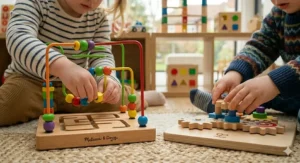
Both brands dominate the wooden educational toy market, and both carry real Montessori credentials. But they differ in philosophy, price, sustainability approach, and the kind of British living room they’re best suited to. Melissa & Doug is an American brand (now owned by Canadian company Spin Master) with over 35 years in the business and a vast catalogue of vibrant, boldly designed wooden toys. Hape is a German brand, manufactured in its own Chinese factories, with a reputation for quieter, more restrained aesthetics and arguably stronger eco credentials. Understanding where they overlap — and where they sharply diverge — is the difference between a toy that gathers dust under the sofa and one your child reaches for every single morning.
Montessori-aligned wooden toys aren’t a passing trend either. Research from the Centre for Early Childhood Education in Connecticut suggests wooden toys have a positive impact on children’s thinking, peer interaction, and creative expression. And according to Jaques of London, a British toy expert with deep Montessori experience, research shows that child-led, hands-on play with self-correcting materials produces strong outcomes for executive function and self-regulation. Both Melissa & Doug and Hape tap directly into these benefits — but through quite different doors.
In this guide, I’ll give you a genuinely useful breakdown: which brand wins in specific categories, which products are worth your money on Amazon.co.uk in 2026, and — crucially — which toys will survive a British household’s combination of enthusiastic toddlers, a damp garage, and a living room that definitely doesn’t have spare storage space.
Quick Comparison: Melissa & Doug vs Hape Montessori at a Glance
| Feature | Melissa & Doug | Hape |
|---|---|---|
| Brand Origin | USA (now Spin Master, Canada) | Germany (manufactured in own Chinese factories) |
| Montessori Alignment | Partial (selective range) | Strong (most core range) |
| Sustainability | FSC-certified wood, 10M tree pledge | FSC wood, water-based paints, bamboo range |
| UK Price Range | Around £10–£60 depending on product | Around £8–£45 |
| Amazon.co.uk Availability | ✅ Wide range available | ✅ Good range available |
| Aesthetic | Bold, bright, colourful | Calmer, natural tones |
| Best For | Value, variety, pretend play | Pure Montessori, eco-focus, music toys |
| UK Safety Standards | EN71 compliant | EN71 compliant, exceeds UK standards |
Both brands use FSC-certified (Forest Stewardship Council) wood and non-toxic, water-based paints — a genuinely important consideration for parents. What the table above doesn’t tell you is why these differences matter: Melissa & Doug’s bolder colours are developmentally appropriate and highly engaging for under-threes, whilst Hape’s more muted palette tends to suit the calmer Montessori aesthetic that many UK parents are deliberately cultivating at home. If your living space is on the compact side — a Victorian terrace in Leeds or a purpose-built flat in Edinburgh — Hape’s tidier visual language might be the more sensible choice. If your child is the sort who needs maximum stimulation to stay engaged, Melissa & Doug often wins.
💬 Just one click — help others make better buying decisions too!😊
Top 7 Melissa & Doug vs Hape Montessori Wooden Toys: Expert Analysis
1. Melissa & Doug Wooden Shape Sorting Cube
The Shape Sorting Cube is arguably Melissa & Doug’s most enduringly popular Montessori-aligned product, and it’s easy to see why. It features 12 different shape blocks that post through corresponding holes on all six sides of a sturdy wooden cube — and unlike cheaper alternatives, the lid opens for easy retrieval, which matters more than you’d think when your toddler insists on doing it themselves.
The construction is reassuringly solid. The wood has genuine heft, and the painted finishes have held up admirably in UK conditions based on feedback from British reviewers, who consistently mention it surviving both toddler enthusiasm and the occasional damp-storage period. The bold, primary-coloured shapes help develop colour recognition alongside shape-matching, making it genuinely multi-functional for the 12–36 month age range.
What most buyers overlook is how well this toy self-corrects without adult intervention — the block either fits or it doesn’t, and that immediate feedback is precisely what Maria Montessori described as essential for independent learning. It’s a proper Montessori material in shape-sorter clothing.
UK parents’ reviews note it packs away neatly and has a footprint small enough for a typical British sitting room. Prime-eligible on Amazon.co.uk.
✅ Sturdy, long-lasting construction
✅ Self-correcting design supports independent play
✅ Easy-clean painted surfaces
❌ Some parents find the shape holes slightly stiff initially
❌ Bold colour palette may not suit all Montessori aesthetics
Price range: Around £15–£22 | A reliable, excellent-value first shape sorter.
2. Hape Shape Sorter Xylophone (E0334)
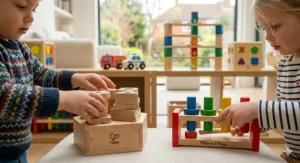
This is where Hape genuinely outclasses the competition for sheer multi-functional cleverness. The Shape Sorter Xylophone combines three toys in one: a shape sorter, a piano, and a xylophone — all in a single compact unit. Five wooden puzzle blocks drop through matching holes, each producing a distinct musical note (Do, Re, Mi, Fa, So) as they pass through, making the sorting process auditory as well as tactile.
For a British flat or smaller semi-detached, this is a particularly sensible choice — you get the developmental benefit of three separate toys in the space of one. That matters when storage is at a premium. The xylophone function uses a small wooden baton, which is easily lost (worth noting), but the piano function remains accessible at all times.
Hape’s water-based, non-toxic finishes are confirmed to exceed UK safety standards. The natural wood-and-primary-colour combination strikes a balance between Hape’s usual calm palette and Melissa & Doug’s more exuberant approach. UK reviewers specifically praise the quality of the musical notes — genuinely tuneful rather than the tinny rattle some competitors produce.
✅ Three developmental functions in one compact toy
✅ High-quality musical tones
✅ Suits small UK living spaces
❌ Small baton easily misplaced
❌ Shape holes require some adult setup initially
Price range: Around £18–£28 | Exceptional value for a genuinely 3-in-1 toy.
3. Melissa & Doug Pattern Blocks and Boards
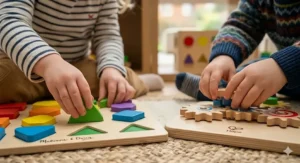
One of the brand’s standout products for the 3–6 age range, this set includes 120 wooden shape tiles in six shapes and colours, plus five double-sided puzzle boards. Children replicate the pattern shown on the board using the loose tiles — a task that quietly develops spatial reasoning, early geometry, and sustained concentration.
The spec sheet doesn’t tell you this, but the portable wooden storage case is genuinely excellent. It’s solid enough to withstand being dragged off a coffee table repeatedly, and everything packs away cleanly inside, making it one of the tidier large-piece wooden toy sets on Amazon.co.uk. For UK households, where toy storage in shared living spaces is a constant negotiation, this matters enormously.
This is one of the toys where Melissa & Doug’s Montessori alignment is strongest: it isolates a clear concept (spatial pattern matching), is self-correcting (the pattern either matches or it doesn’t), and requires zero adult input once explained. UK parents of children aged three-plus consistently give it high marks for longevity of engagement.
✅ 120 pieces offer years of progressive challenge
✅ Solid carry case — excellent storage solution
✅ Strong Montessori spatial reasoning credentials
❌ Small parts — not suitable under age 3 (clearly labelled)
❌ Some boards’ patterns are similar; advanced children may find early levels too simple
Price range: Around £20–£30 | One of the best-value extended-play Montessori sets available on Amazon.co.uk.
4. Hape Wooden Wonder Shape Sorter (E0516)
Hape’s newer shape sorter offering brings a thoughtful twist: the six wooden blocks aren’t just different shapes, they’re different functions. One triangle block makes a sound when shaken; another features a small mirror surface; the remaining four each have a different coloured plexiglass insert that casts coloured light. For a toy that looks deceptively simple, it offers a genuinely rich sensory experience.
Research from Leeds Community Healthcare, highlighted by UK educational toy specialists, confirms that sensory and exploratory play — particularly with varied textures and materials — helps children develop crucial movement and coordination skills. The Wooden Wonder Shape Sorter delivers on this more explicitly than most.
The aesthetic is distinctly more restrained than Melissa & Doug — natural wood tones with small colour accents rather than bold primaries — which makes it a comfortable fit with a Montessori home environment. It’s Prime-eligible on Amazon.co.uk and confirmed to meet UK safety standards.
✅ Multi-sensory blocks offer more than basic shape sorting
✅ Mirror and coloured light elements add visual discovery
✅ Compact footprint for UK living spaces
❌ Fewer blocks than some competitors
❌ Premium price point for the size
Price range: Around £22–£35 | Worth the extra spend for sensory depth.
5. Melissa & Doug Wooden Building Blocks (100-Piece Set)
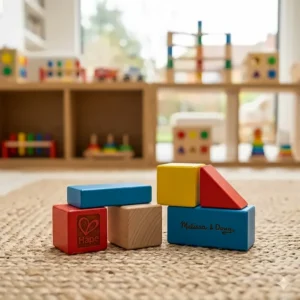
Arguably the most traditional Montessori material in this list, and deliberately so. One hundred FSC-certified wooden blocks in four colours and nine classic shapes — cylinders, arches, triangles, rectangles, and so on. No gimmicks, no electronics, no instructions. Just blocks.
What most parents underestimate about this set is the sheer developmental range it covers. For an 18-month-old, it’s about grasping, stacking, and knocking down. For a four-year-old, it’s about architectural planning, symmetry, and learning that a poorly balanced tower will fall regardless of how much you want it not to. That honest feedback loop — the tower either stands or it doesn’t — is pure Montessori methodology.
The blocks are lightweight enough for small hands but solid enough to feel satisfying. They store neatly in the included cardboard box with carry handle, which isn’t as durable as a wooden case but does the job adequately for most households. UK parent reviews are uniformly positive on build quality and durability.
As noted by TTS Group, a UK educational supplier, wooden toys associated with natural materials can have a calming, positive effect on children’s mental wellbeing — and a set of plain unit blocks on an open shelf is perhaps the purest expression of this principle.
✅ 100 pieces provide enormous play value
✅ FSC-certified, non-toxic finishes
✅ Suits age 2 through early primary school
❌ Cardboard storage box less durable than wooden alternatives
❌ Plain aesthetic won’t appeal to children who need more visual stimulation
Price range: Around £20–£30 | Exceptional value per piece; a genuine long-term investment.
6. Hape Pound & Tap Bench with Slide Out Xylophone
A beloved classic in Hape’s range and one of the brand’s best-selling products on Amazon.co.uk. Children use a wooden hammer to pound five balls through holes in a bench; the balls roll down and can then be played as a xylophone at the other end. Two distinct fine motor activities in one toy, with the satisfying bonus of music.
The developmental layering here is intelligent: pounding develops gross motor skills and hand-eye coordination; picking up the balls and placing them back requires the pincer grip that supports later writing readiness; playing the xylophone introduces basic cause-and-effect musical exploration. It’s the kind of toy that earns its Amazon.co.uk shelf space by delivering more than it initially promises.
The construction is typically solid Hape — beech wood, smooth-sanded edges, non-toxic paint. UK parents note it’s one of the more robust options in this price range, surviving repeated drops and the kind of enthusiastic use that British toddlers tend to apply to everything they love. Prime-eligible with next-day delivery for Prime members.
✅ Two complementary fine motor activities in one toy
✅ Musical element sustains engagement
✅ Robust construction suitable for vigorous British toddlers
❌ Hammer is occasionally lost (sold separately as replacement)
❌ Xylophone notes, whilst pleasant, are limited in range
Price range: Around £18–£28 | A well-rounded, durable buy.
7. Melissa & Doug Wooden Cleaning Set
This one earns its place through a different kind of Montessori alignment: practical life education. Melissa & Doug’s wooden cleaning set includes a broom, mop, brush, and dustpan — all scaled to toddler height, with solid wooden handles. The Montessori philosophy places enormous emphasis on practical life activities — real tasks performed with real (or realistic) tools — as a route to independence, concentration, and self-esteem.
What most buyers overlook is that this isn’t just a toy; it’s a gateway to genuinely useful behaviour. Children who use it regularly tend to develop a genuine interest in helping around the home, which UK parents tend to regard as rather a good outcome. The handles are appropriately sized for children aged 3–6, and the construction is sturdy enough for actual light sweeping, not just pretend.
The practical life credentials here are arguably stronger than many toys that more explicitly market themselves as Montessori. It’s also one of the more compact storage options in this list — the tools lean neatly in a corner or hang on a hook, which suits smaller British homes well.
✅ Strong Montessori practical life philosophy
✅ Encourages genuine independence and household participation
✅ Compact storage — lean against a wall or in a cupboard
❌ Broom bristles can lose shape over time with heavy use
❌ Younger children (under 3) may use it purely as a percussion instrument
Price range: Around £20–£35 | Distinctly underrated Montessori value.
Buyer’s Decision Framework: How to Choose Between the Two Brands
Choosing between Melissa & Doug and Hape isn’t about which brand is objectively better — it’s about matching the brand’s approach to your child, your home, and your values. Here’s a practical framework:
If you prioritise sustainability above all else, lean towards Hape. Their bamboo range, water-based finishes, and German-engineered quality control are slightly ahead of Melissa & Doug’s commendable but less comprehensive eco approach. Hape’s UK website confirms all products exceed UK and EU safety standards.
If you want the widest range of pretend play and life-skills toys, Melissa & Doug wins comfortably. Their practical life range — kitchens, cleaning sets, food sets, doctor kits — is unmatched in depth and value at the price points available on Amazon.co.uk.
If you’re working with limited space (a flat, a terraced house, a shared children’s room), Hape’s multi-function toys like the Shape Sorter Xylophone give you more developmental value per square metre of floor space.
If you’re on a tighter budget, Melissa & Doug generally offers a slightly lower entry price for comparable quality — particularly on building blocks and puzzles in the £15–£25 range.
If your child is 12–24 months, both brands offer excellent options; Hape’s sensory-focused range is arguably slightly better calibrated for this stage. For 2–5 years, either brand works beautifully, with selection depending on the specific toy category.
✨ Don’t Miss These Exclusive Deals!
🔍 Check current pricing and availability on Amazon.co.uk for all the toys featured above — click any highlighted product name to go directly to the listing!
Practical Guide: Getting the Most from Wooden Montessori Toys in a British Home
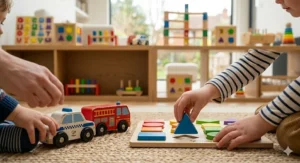
Buying the right toy is only half the job. Getting lasting developmental value from it — in a British home, with British weather, and the storage constraints that entails — requires a bit more thought.
Rotation is your friend. The Playroom Collective’s 2026 Montessori guide cites research showing that children with access to fewer toys at a time show longer engagement periods and more creative play. Six to eight toys accessible at once, rotated every two to three weeks, is the sweet spot. This approach also solves the British storage problem rather neatly — most of the set stays in a cupboard or under the bed whilst the active rotation sits on an accessible shelf.
Damp storage matters. British garages and garden sheds are genuinely not suitable long-term storage for wooden toys — the damp will eventually cause warping and splitting, regardless of how well finished the wood is. Indoors, at room temperature, is where both Hape and Melissa & Doug toys will last longest. A simple lidded box in a hallway cupboard is preferable to a garden shed in November.
Cleaning wooden toys: both brands use water-based, non-toxic finishes. Wipe with a barely-damp cloth; never submerge in water or use alcohol-based cleaners. The surface paint can lift with prolonged moisture exposure. A brief wipe-down is all that’s needed — which is fortunate, because toddlers aren’t particularly gentle with their biscuits.
Open shelving at child height — even a simple low shelf or repurposed bookcase — transforms how children engage with wooden toys. Rather than diving into a toy box and extracting the most colourful thing available, children can make genuine choices about what to play with, which is a core Montessori principle. Both brands’ toys are designed with this kind of display in mind.
Winter considerations: shorter British winter days and less outdoor time mean children spend more time with their toys from October to March. This is worth factoring into which toys you rotate into active use during autumn — open-ended construction sets (building blocks) and multi-activity toys (the Hape Shape Sorter Xylophone) tend to sustain engagement across long indoor afternoons particularly well.
Real-World Scenarios: Which Toys for Which Families?
The London flat family: space is the constraint
A young couple in a two-bedroom flat in Islington, with a 20-month-old and a second-floor living room roughly the size of a reasonable boot sale. Storage is limited; noise is a genuine neighbour consideration.
Best picks: The Hape Shape Sorter Xylophone (three functions, one toy, manageable sound level), the Melissa & Doug Shape Sorting Cube (compact, self-contained), and the Hape Wooden Wonder Shape Sorter (small footprint, rich sensory experience). Avoid the 100-piece building block set until the child is old enough to manage pieces independently — the cleanup overhead in a small space is real.
The suburban family: more space, more budget flexibility
A family in a semi-detached in Sheffield, with a four-year-old and a seven-year-old. Garden, garage (damp, as noted), and a playroom that doubles as the home office on weekday mornings.
Best picks: The Melissa & Doug Pattern Blocks and Boards (excellent for sustained independent play during video calls), the Melissa & Doug Wooden Building Blocks 100-piece set (both children, different levels of play), and the Melissa & Doug Wooden Cleaning Set for the younger child to feel involved in the household.
The eco-conscious first-time parents: sustainability is the priority
A couple in Bristol, expecting their first child, committed to natural materials and minimal plastic. Budget is considered but not constrained.
Best picks: Build a core Hape collection. Start with the Pound & Tap Bench for 12 months onwards, add the Hape Wooden Wonder Shape Sorter at 18 months, and introduce the Hape Shape Sorter Xylophone around two years. All FSC-certified, all water-based paints, all manufactured in Hape’s own quality-controlled factory.
Melissa & Doug vs Hape Montessori: A Closer Look at the Brands
Sustainability credentials compared
Both brands are genuinely committed to responsible sourcing, but there are meaningful differences worth knowing. Melissa & Doug uses FSC-certified wood and has pledged to plant 10 million trees by 2030. Their paints are non-toxic and water-based. Following the Spin Master acquisition in 2023, they have maintained their core product philosophy, which is reassuring.
Hape goes a step further in several areas. The brand operates its own factories in China (rather than outsourcing production), which gives it greater control over quality and environmental standards. Their bamboo range takes advantage of one of the most rapidly renewable natural materials available. All Hape products are confirmed to exceed EN71 — the European toy safety standard that also applies in the UK market — and the brand’s UK distributor confirms they meet UKCA requirements for the post-Brexit British market.
Neither brand is perfect, and “eco-friendly” claims in the toy industry deserve healthy scepticism. But both are meaningfully better than the plastic-heavy mainstream toy market, which still accounts for the vast majority of toys sold globally.
Value for money in GBP
On a per-toy basis, Melissa & Doug tends to offer marginally better value in the budget-to-mid-range tier — their shape sorters, building blocks, and puzzle sets are frequently available in the £15–£25 range on Amazon.co.uk, which represents excellent value for FSC-certified wooden toys.
Hape’s multi-function toys (like the Shape Sorter Xylophone and the Pound & Tap Bench) justify a slightly higher price point through the breadth of developmental function per pound spent. Think of it as cost-per-skill rather than cost-per-toy.
Post-Brexit pricing context: both brands are available from UK-based Amazon warehouses, so there are no additional import duties for British buyers, and both are covered by UK consumer protections under the Consumer Rights Act 2015, including the 14-day cooling-off period for online purchases. UK prices include 20% VAT in the Amazon.co.uk listings.
A note on the Montessori alignment debate
It’s worth being clear: neither Melissa & Doug nor Hape is a “Montessori brand” in the strict sense. As the Montessori Family blog explains, Melissa & Doug’s catalogue is enormous and uneven — their wooden puzzles, stackers, and practical life toys align well with Montessori principles; their branded character toys and anything electronic do not. Hape’s core range aligns more consistently, but even there, selection matters.
The practical rule: look for toys that isolate one or two skills, are self-correcting (the child knows immediately whether they’ve succeeded), require no adult operation, and are made from natural materials. By that standard, both brands have excellent options — and several duds. This guide has done the filtering for you.
FAQ
❓ Are Melissa & Doug and Hape toys available on Amazon.co.uk with fast delivery?
❓ Which brand is better for babies under 12 months?
❓ Do Hape and Melissa & Doug toys meet UK safety standards?
❓ Is Hape more eco-friendly than Melissa & Doug?
❓ How many wooden Montessori toys does my child actually need?
Conclusion: Which Should You Buy in 2026?
The Melissa & Doug vs Hape Montessori debate doesn’t have a single winner — it has the right answer for your child, your home, and your priorities.
Choose Melissa & Doug if you want excellent value across a broad range of pretend play and practical life toys, particularly for children aged 2–6. Their building blocks, pattern boards, and cleaning sets represent some of the best per-pound Montessori value on Amazon.co.uk.
Choose Hape if eco-credentials and sensory richness are your priorities, particularly for children under 2, or if you want multi-function toys that justify their space in a compact British home. Their Shape Sorter Xylophone and Pound & Tap Bench are genuinely outstanding products.
If budget allows, the honest recommendation is to use both: let Melissa & Doug fill the pretend play and construction gaps, and let Hape anchor the sensory and musical play categories. Together, they cover the developmental spectrum from birth to primary school age rather brilliantly — which, given they’re both made of wood and designed to last a generation, is rather good value in the long run.
Recommended for You 📚
- 7 Best Hundred Board Montessori for UK Kids 2026
- Best Montessori Number Rods UK: Top 7 Picks Transform Learning 2026
- Best Colour Tablets Montessori UK: 7 Top Picks 2026
Disclaimer: This article contains affiliate links. As an Amazon Associate, I earn from qualifying purchases. If you purchase products through these links, we may earn a small commission at no additional cost to you.
✨ Found this helpful? Share it with your mates! 💬🤗
