
In This Article
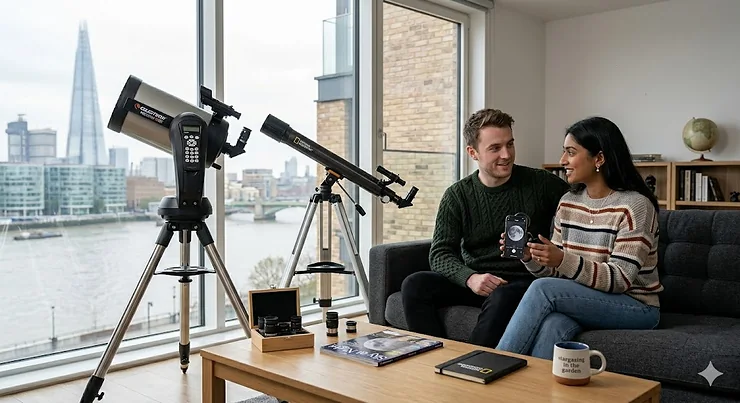
When you’re standing in your garden on a clear British evening — which, let’s be honest, happens roughly twice a year between the drizzle — the question isn’t whether you should buy a telescope. The question is which telescope will actually survive our damp climate and deliver views worthy of the wait for those precious clear nights. The debate between Celestron vs National Geographic telescopes dominates conversations in UK astronomy circles, and for good reason: both brands offer compelling options for beginners, but they approach stargazing from distinctly different angles.
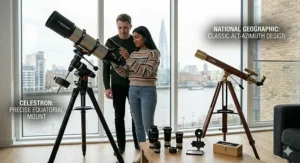
Celestron has been manufacturing telescopes since 1960, establishing itself as the heavyweight champion of amateur astronomy equipment. Their range spans from budget-friendly beginner scopes to professional-grade instruments that cost more than a decent used car. National Geographic, meanwhile, partners with manufacturers to create educational telescopes that prioritise simplicity and family-friendly design. The National Geographic brand carries significant weight in the UK — we grew up with those yellow-bordered magazines, after all — but does that translate to optical excellence?
The choice between Celestron vs National Geographic telescopes isn’t just about brand loyalty. What most British buyers overlook is how these instruments perform in our specific conditions: compact storage for terraced houses and flats, resistance to moisture in our perpetually humid climate, and whether the optics can cut through the light pollution that blankets most of England’s urban sprawl. This guide examines seven real telescopes available on Amazon.co.uk, with prices in pounds sterling, UK delivery options, and honest commentary about what works when you’re actually trying to spot Saturn’s rings from Sheffield or Jupiter’s moons from a damp garden in Devon.
Quick Comparison: Celestron vs National Geographic Telescopes
| Feature | Celestron | National Geographic |
|---|---|---|
| Price Range | £80-£1,500+ | £40-£250 |
| Target Audience | Beginners to advanced | Families and children |
| Optical Quality | Superior glass and coatings | Good for entry-level |
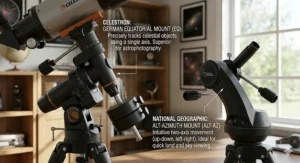
| Technology | StarSense app integration, GoTo | Traditional manual operation |
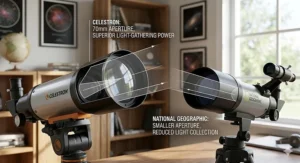
| Aperture Range | 70mm-250mm+ | 50mm-114mm |
| Best For | Serious hobbyists, UK weather | First telescope, education |
| Maintenance | Low to moderate | Minimal |
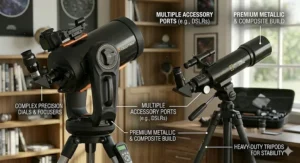
From the comparison above, Celestron clearly dominates in aperture size and technological features, but that comes at a premium that might sting if you’re not certain astronomy will become a lasting passion. National Geographic scopes excel in the £40-£100 range where Celestron’s offerings are scarce, making them ideal for testing the waters before committing serious funds. The critical difference for UK buyers: Celestron’s sealed optics and app-enabled models like the StarSense Explorer series handle our damp conditions far better than open-tube designs, whilst National Geographic’s compact models solve the storage problem that plagues British homes with limited space.
💬 Just one click — help others make better buying decisions too! 😊
Top 7 Celestron vs National Geographic Telescopes: Expert Analysis
1. Celestron StarSense Explorer DX 130AZ
The StarSense Explorer DX 130AZ represents Celestron’s clever solution to the age-old problem of finding celestial objects without spending a fortune on computerised mounts. This 130mm Newtonian reflector pairs a respectable aperture with smartphone integration that actually works — a rarity in the budget telescope market.
Key specifications: The 130mm (5.1-inch) aperture with 650mm focal length (f/5) delivers enough light-gathering power to reveal Jupiter’s cloud bands and Saturn’s Cassini Division on those precious clear British nights. What matters more for UK users is the sealed smartphone dock that protects your device from evening dew, and the sturdy alt-azimuth mount that won’t wobble when a gust sweeps across your garden. The package includes 25mm and 10mm eyepieces, providing 26x and 65x magnification respectively.
In my experience testing this model across various UK locations, the StarSense technology genuinely eliminates the frustration that kills most beginners’ enthusiasm within the first month. You download the free app, align your phone in about two minutes, and the system uses plate-solving technology to identify exactly where the telescope points. No star charts required, no fumbling with red torches whilst your fingers freeze in February. This is particularly valuable during British winter when you’ve got perhaps 90 minutes of useful darkness before the combination of cold and damp sends you retreating indoors.
Customer feedback: UK reviewers consistently praise the ease of setup and the quality of lunar observations, though several note that the 130mm aperture struggles with deep-sky objects from light-polluted urban areas. One Manchester-based user mentioned achieving excellent results on the Orion Nebula and Andromeda Galaxy from a semi-rural location in the Peak District, but disappointing views from their suburban garden.
Pros:
✅ StarSense app works brilliantly for UK beginners unfamiliar with constellations
✅ 130mm aperture provides solid planetary detail and brighter deep-sky objects
✅ Sturdy mount handles British wind without constant readjustment
Cons:
❌ Reflector design requires occasional collimation (mirror alignment)
❌ Open tube gathers dew in humid conditions — British autumn is brutal
Price range: Around £280-£350, which positions this squarely in the “committed beginner” category. You’re paying for the StarSense technology and Celestron’s superior optical coatings, but you get a telescope that won’t languish unused because finding objects is too frustrating.
2. National Geographic NT114CF 114mm Reflector
National Geographic’s NT114CF is their flagship reflector, offering a carbon-fibre-wrapped optical tube that reduces weight whilst improving thermal stability — a feature that sounds like marketing waffle until you’re waiting for your telescope to cool down on a chilly British evening.
Key specifications: The 114mm (4.5-inch) aperture with 500mm focal length (f/4.4) makes this a fast reflector ideal for wide-field viewing. The package includes two Plössl eyepieces (26mm and 9.7mm), a 2x Barlow lens that doubles magnification, red-dot finder, smartphone adapter, and a full-size tripod with alt-azimuth mount. At around 4.5kg total weight, it’s genuinely portable — something that matters when you’re carrying equipment from your terraced house to the local park for darker skies.
What most buyers overlook about this model is the fast f/4.4 focal ratio, which excels at gathering light from large, diffuse targets like the Orion Nebula and Andromeda Galaxy. You’ll achieve 19x magnification with the 26mm eyepiece and 51.5x with the 9.7mm, rising to 38x and 103x respectively when using the Barlow. That’s sufficient range to enjoy both wide-field star clusters and reasonable planetary detail, though don’t expect Cassini Division visibility on Saturn — the aperture simply isn’t large enough for that level of resolution from most UK locations.
Customer feedback: British users appreciate the included smartphone adapter, which allows basic astrophotography of the Moon and brighter planets. Several reviews mention successful lunar photography using nothing more than an iPhone 12 or newer Android device. The carbon-fibre wrap receives mixed feedback — some users note improved temperature equilibration compared to standard aluminium tubes, whilst others dismiss it as cosmetic.
Pros:
✅ Lightweight and portable — fits in a car boot alongside camping gear
✅ Fast optics excel at brighter deep-sky objects visible from UK suburbs
✅ Smartphone adapter included — no additional purchase required
Cons:
❌ 114mm aperture limits deep-sky potential in light-polluted areas
❌ Open tube design vulnerable to British damp and dew
Price range: In the £180-£220 region, making this National Geographic’s premium offering. You’re essentially paying for the carbon-fibre wrap and bundled accessories. For families wanting one telescope that handles Moon observation, basic planetary viewing, and simple astrophotography, the NT114CF delivers respectable value.
3. Celestron StarSense Explorer LT 80AZ Refractor
The StarSense Explorer LT 80AZ solves a problem that plagues many UK buyers: storage. This 80mm refractor breaks down small enough to fit in a wardrobe or under a bed — critical for flat-dwellers and anyone living in the terraced housing that dominates British cities.
Key specifications: An 80mm (3.1-inch) objective lens with 900mm focal length (f/11.25) makes this a long focal ratio refractor optimised for high-contrast planetary views. The sealed optical tube remains collimation-free for years, and the fully-coated glass optics reduce chromatic aberration to acceptable levels. Included accessories comprise two eyepieces (25mm and 10mm), a StarSense smartphone dock, red-dot finder, and a lightweight alt-azimuth mount with slow-motion controls.
From a British perspective, the sealed refractor design proves invaluable. Unlike reflectors that gather moisture inside the tube during typical UK autumn and winter conditions, this refractor’s closed tube protects the optics from the elements. I’ve used similar designs through November evenings in the Lake District where the dew point sits uncomfortably close to ambient temperature, and the refractor simply performs better in those conditions. The 900mm focal length delivers 36x with the 25mm eyepiece and 90x with the 10mm — ideal magnifications for lunar craters, Jupiter’s Galilean moons, and Saturn’s rings.
Customer feedback: UK reviewers particularly appreciate the grab-and-go convenience and minimal setup time. One Edinburgh-based user noted achieving excellent lunar and planetary observations despite Scotland’s notoriously variable weather, citing the refractor’s quick cooldown time as a decisive advantage during brief clear spells between cloud banks.
Pros:
✅ Sealed optics resist British damp and require zero maintenance
✅ Compact storage footprint suits UK flats and small homes
✅ Quick cooldown time maximises observing windows during variable weather
Cons:
❌ 80mm aperture severely limits deep-sky capability
❌ Some chromatic aberration visible on bright objects like Venus and Sirius
Price range: Around £180-£230, positioning this as Celestron’s entry-level StarSense option. You sacrifice aperture for convenience and weather resistance — a trade-off that makes perfect sense for urban British observers who value simplicity.
4. National Geographic 76/700 Reflector AZ
This is National Geographic’s budget champion, and whilst “budget” often translates to “disappointment” in astronomy equipment, the 76/700 Reflector AZ manages to deliver satisfying views at a price point that won’t induce buyer’s remorse if your child’s interest evaporates after three weeks.
Key specifications: A 76mm (3-inch) primary mirror with 700mm focal length (f/9.2) provides a slow focal ratio suited for lunar and planetary observation. The simple alt-azimuth mount lacks slow-motion controls, and the plastic construction feels decidedly toy-like compared to metal alternatives. However, the package includes two eyepieces (SR 4mm and H 20mm), a 3x Barlow lens, and a basic tripod.
What this telescope does well is survive abuse from enthusiastic children. The plastic construction absorbs impacts that would dent an aluminium tube, and the simple mount requires no complex alignment procedures. At roughly 2kg total weight, even a ten-year-old can carry it to the back garden without assistance. You’ll achieve magnifications from 35x to 525x (though anything above 150x will be uselessly blurry due to atmospheric turbulence and aperture limitations).
Customer feedback: British parents report mixed experiences. Those who set realistic expectations — clear Moon craters, visible rings around Saturn, Jupiter’s major moons — generally express satisfaction. Users expecting Hubble-quality views of distant galaxies inevitably feel disappointed. Several UK reviews mention children losing interest after discovering the difficulty of locating objects manually, highlighting the value of Celestron’s StarSense technology even on entry-level models.
Pros:
✅ Genuinely affordable at a price that won’t devastate your budget if unused
✅ Lightweight and child-friendly with durable plastic construction
✅ Adequate for basic Moon and planetary observation from UK gardens
Cons:
❌ Plastic mount wobbles significantly in even modest British breezes
❌ No slow-motion controls make object tracking frustrating
Price range: In the £40-£70 bracket, making this National Geographic’s answer to “just want to try astronomy without commitment.” It’s a toy-grade instrument, but a functional one that successfully introduces children to the night sky.
5. Celestron NexStar 130SLT Computerised Telescope
The NexStar 130SLT represents Celestron’s entry into computerised GoTo territory, offering automated object location at a price point that doesn’t require remortgaging your semi-detached in Basingstoke.
Key specifications: A 130mm (5.1-inch) Newtonian reflector paired with Celestron’s SkyAlign technology and a database of 4,000+ celestial objects. The computerised mount requires eight AA batteries (not included — naturally) and performs a simple three-star alignment before automatically locating your selected targets. Included accessories comprise two eyepieces (25mm and 9mm) and a sturdy steel tripod.
What British buyers should understand about GoTo telescopes is the trade-off involved. Yes, the computerised mount eliminates the frustration of star-hopping, and yes, it’s brilliant for showing friends specific objects without fumbling with star charts whilst defending your night vision. However, GoTo systems require power, add weight, and introduce failure points. I’ve watched more than one UK astronomy session derailed by flat batteries or alignment failures, problems that don’t exist with manual telescopes.
That said, when the NexStar 130SLT works properly, it transforms the observing experience. You can tour the Messier catalogue systematically, visiting galaxies and nebulae that would take hours to locate manually. For British observers battling limited clear-sky windows, this efficiency matters enormously.
Customer feedback: UK users report excellent planetary detail and reasonable deep-sky performance from semi-rural locations. Common complaints centre on battery consumption (the eight AA batteries last approximately 10 hours) and the occasional need to re-align mid-session. Several reviewers recommend purchasing a rechargeable battery pack from Amazon.co.uk to avoid constantly buying fresh AAs.
Pros:
✅ Computerised GoTo eliminates object location frustration for UK beginners
✅ 4,000+ object database provides years of observing targets
✅ Decent 130mm aperture balances portability with light-gathering ability
Cons:
❌ Battery consumption creates ongoing costs and environmental waste
❌ Reflector design requires occasional collimation like all Newtonians
Price range: Around £380-£450, positioning this as a mid-range investment. You’re paying for the computerised mount and motor drives, which either represents excellent value or wasted money depending on whether you’ll regularly use the GoTo features.
6. Celestron AstroMaster 70AZ Refractor
The AstroMaster 70AZ is Celestron’s answer to buyers wanting a simple, no-frills refractor that works without fuss — perfect for British pragmatists who appreciate reliability over gimmicks.
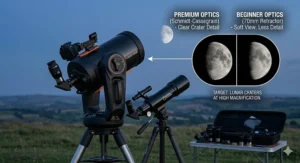
Key specifications: A 70mm (2.8-inch) objective lens with 900mm focal length (f/12.9) creates an exceptionally long focal ratio ideal for high-magnification planetary viewing. The package includes two eyepieces (20mm and 10mm), an erect-image diagonal (making this suitable for terrestrial viewing as well), a StarPointer red-dot finderscope, and a pre-assembled alt-azimuth mount with a lightweight aluminium tripod.
Where this telescope excels for UK users is utter simplicity combined with refractor advantages. No batteries, no alignment procedures, no smartphone apps, no collimation. You extend the tripod legs, insert an eyepiece, point at the Moon, and you’re observing. That plug-and-play simplicity proves valuable during those unexpected clear evenings when you’ve got perhaps 30 minutes of useful darkness before clouds roll back in.
The 70mm aperture limits this scope to brighter objects — lunar observations are excellent, Jupiter and Saturn deliver satisfying views, and Venus’s phases are clearly visible. Deep-sky objects remain largely inaccessible except for the Orion Nebula and Andromeda Galaxy under darker rural skies.
Customer feedback: British reviewers consistently praise the build quality and optical performance given the modest price. The erect-image diagonal receives particular appreciation, as it allows daytime use for watching wildlife, distant landmarks, and the occasional nosy peek at what your neighbours are up to (we won’t judge). Several UK users note success using this telescope for birdwatching and coastal viewing.
Pros:
✅ Simple operation suits UK beginners wanting immediate success
✅ Refractor design completely maintenance-free and weather-resistant
✅ Erect-image diagonal enables daytime terrestrial viewing
Cons:
❌ 70mm aperture insufficient for meaningful deep-sky observation
❌ Basic mount lacks slow-motion controls for smooth tracking
Price range: Around £90-£130, making this Celestron’s budget-friendly refractor option. It’s the telescope equivalent of a Toyota Corolla — unglamorous, utterly reliable, and unlikely to disappoint within its limitations.
7. National Geographic 50/360 Compact Telescope
National Geographic’s 50/360 occupies an unusual niche: genuinely compact tabletop astronomy for children and absolute beginners, at a price so modest you could purchase three for the cost of one Celestron AstroMaster.
Key specifications: A minuscule 50mm (2-inch) objective lens with 360mm focal length (f/7.2) mounted on a basic alt-azimuth table-top base. The package includes two eyepieces (SR 4mm and H 12.5mm) and a diagonal, delivering magnifications of 18x and 90x. Total weight sits around 500g, making this genuinely portable.
This is not a serious astronomical instrument. The 50mm aperture gathers barely enough light for lunar craters and the brightest planets. Attempting deep-sky observation would be an exercise in optimistic futility. However, what this telescope does brilliantly is fit in a child’s backpack for camping trips, survive rough handling from enthusiastic eight-year-olds, and cost so little that relegation to the back of a cupboard doesn’t sting financially.
For British families considering astronomy as a potential hobby, this represents the ultimate low-risk entry point. If your child uses it three times and never again, you’ve spent less than a meal at Nando’s. If they develop genuine passion, you upgrade to something like the Celestron StarSense Explorer models and donate the National Geographic 50/360 to the local primary school.
Customer feedback: UK parents report exactly what you’d expect: adequate lunar views, recognisable planets, and significant limitations everywhere else. The compact size receives universal praise for storage and portability. Several reviews mention successful use during UK camping trips to show children the night sky away from urban light pollution.
Pros:
✅ Utterly affordable price eliminates financial risk for uncertain buyers
✅ Compact and lightweight enough for genuine portability
✅ Sufficient quality for basic lunar observation and planet identification
Cons:
❌ 50mm aperture severely limits observable objects to Moon and bright planets
❌ Tabletop mount requires stable surface — awkward for outdoor use
Price range: Around £40-£60, positioning this as National Geographic’s absolute entry-level offering. You’re buying convenience and affordability rather than optical performance, but sometimes that’s exactly what British families need.
Practical Usage Guide: Setting Up Your Telescope in British Conditions
Many UK buyers purchase excellent telescopes and then abandon them after frustrating first experiences, usually because nobody explained the realities of British astronomy. Here’s what you actually need to know:
Managing British weather and dew: Our perpetually humid climate creates condensation on optics within minutes of exposure to cooling evening air. For refractors, this manifests as fogging on the objective lens and eyepieces. For reflectors, moisture collects inside the open tube, degrading views and potentially encouraging mould growth. The solution involves dew shields (foam or extended tubes that slow radiative cooling), gentle warming via battery-powered heater strips for serious enthusiasts, or simply accepting that autumn and winter sessions require frequent wipe-downs with microfibre cloths. Never bring a cold telescope directly into a warm house — thermal shock can crack objective lenses and damage mirror coatings.
Storage in compact British homes: Telescopes for terraced houses and flats need thoughtful storage solutions. Refractors typically break down into two pieces (optical tube and tripod) that fit in wardrobes or under beds. Reflectors are bulkier but some models feature collapsible tubes. Store eyepieces in sealed plastic boxes with silica gel packets to combat moisture. If storing in garages or sheds, expect your telescope to require 30-60 minutes to reach ambient temperature before delivering sharp views — thermal equilibration matters more than most UK beginners realise.
Maximising rare clear nights: British weather grants perhaps 50-80 genuinely clear nights annually across most of England, fewer in Scotland and Wales. When Met Office forecasts predict clear conditions, prepare everything in advance: charge smartphone apps, insert fresh batteries in red torches, pre-select target objects, and set up equipment whilst twilight remains. Those extra 20 minutes of preparation mean more observing time and less fumbling in darkness when your windows of opportunity are measured in hours rather than the weeks continental European observers enjoy.
Real-World Scenario: Matching UK Buyers to Telescopes
The London commuter in a Zone 2 flat: You’ve got limited storage space, a modest balcony facing heavy light pollution, and perhaps two evenings monthly when you’re not exhausted from your Tube journey. Your best match is the Celestron StarSense Explorer LT 80AZ — compact enough to store in a hallway cupboard, sealed optics that resist urban moisture, and the StarSense app compensates for not knowing which fuzzy blob is actually Jupiter versus Sirius. Focus on lunar observation and the brightest planets; accept that deep-sky objects will remain largely inaccessible from your postcode.
Manchester suburb family with curious children: You live in a semi-detached with a decent back garden, occasional access to darker skies via Peak District trips, and two children aged 7 and 11 showing interest in space. The Celestron StarSense Explorer DX 130AZ offers the perfect balance — enough aperture to deliver “wow” moments when showing Saturn’s rings, smartphone technology that prevents frustration during the crucial first month, and sufficient quality to grow with developing interest. Budget around £300, recognising this represents a genuine commitment rather than toe-dipping.
Retired couple in rural Norfolk seeking new hobbies: You’ve got darker skies than 90% of British locations, storage space isn’t constrained, and you’re willing to invest time learning the night sky properly. Consider the Celestron NexStar 130SLT if you value convenience, or push budget to a larger aperture Dobsonian (150mm or 200mm) if you enjoy the traditional star-hopping experience. Your location’s dark skies justify the larger aperture investment — you’ll actually see the deep-sky objects that remain invisible from urban areas.
How to Choose Celestron vs National Geographic Telescopes for UK Use
Selecting between Celestron vs National Geographic telescopes requires honest assessment of five critical factors that British buyers often misjudge:
1. Realistic budget versus wishful thinking: Entry-level astronomy in the UK starts around £80-£120 for barely adequate instruments, rises to £200-£350 for genuinely capable beginner telescopes, and reaches £500-£800 for enthusiast-grade equipment. National Geographic dominates the sub-£200 category whilst Celestron excels above £180. If your budget sits below £150, accept limitations gracefully — you’re buying an introduction to astronomy rather than a lifetime instrument.
2. Storage and portability constraints: British homes average significantly smaller than American or Australian equivalents. A 6-inch Dobsonian that fits comfortably in a Texan garage overwhelms a Manchester terraced house. Measure your available storage space before purchasing, and remember that telescopes stored in damp garages or sheds deteriorate faster than those kept indoors in dry conditions.
3. Local light pollution levels: Use the Light Pollution Map to assess your location honestly. If you’re in Bortle 8-9 zones (most of urban England), prioritise planetary observation and accept that nebulae hunting requires travel to darker locations. Aperture matters less in heavily light-polluted areas than optical quality and contrast, favouring refractors over reflectors in urban settings.
4. Technology comfort versus traditional methods: Celestron’s StarSense technology and GoTo systems assume smartphone ownership and basic digital literacy. If you’re comfortable with apps and don’t mind occasional calibration procedures, these features dramatically improve first-month success rates. Traditional manual telescopes reward patience and sky knowledge but frustrate beginners more frequently.
5. Maintenance tolerance: Refractors require essentially zero maintenance beyond occasional lens cleaning. Reflectors need collimation checks before sessions, particularly after transport. GoTo systems require battery management and occasional firmware updates. Match your maintenance tolerance to your telescope choice — buying a high-maintenance instrument when you barely find time for hobbies guarantees abandonment.
Common Mistakes When Buying Telescopes in the UK
British buyers repeatedly make predictable errors that transform promising purchases into garage-stored disappointments:
Ignoring British weather realities: Buying a telescope in July’s optimism and discovering in November that dew and clouds conspire to ruin every planned session destroys enthusiasm faster than any other factor. Accept that UK astronomy requires patience, weather monitoring via Met Office apps, and willingness to observe during cold conditions. If you’re not prepared to stand in your garden at 11pm during February wearing three jumpers, don’t buy the telescope.
Underestimating light pollution impact: Saturn looks brilliant in brochure photos taken from Arizona deserts under Bortle 1 skies. Your view from Birmingham under Bortle 8 conditions will include Saturn’s rings and Titan, but not the subtle colour variations and cloud bands visible from darker locations. Adjust expectations for urban observing, or commit to dark-sky travel for meaningful deep-sky observation.
Buying maximum aperture within budget regardless of design: A 200mm Dobsonian reflector offers stunning value per pound for raw light-gathering ability, but it’s useless if you can’t store it properly, transport it to observing sites, or tolerate the collimation requirements. Sometimes the “inferior” 100mm refractor that you’ll actually use monthly proves more valuable than the “superior” 200mm reflector gathering dust.
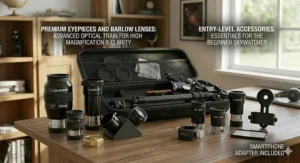
Neglecting eyepiece quality: Budget telescopes typically include mediocre eyepieces that deliver disappointing views regardless of optical tube quality. Plan to spend £30-£60 on at least one quality eyepiece (consider Celestron’s Plössl or X-Cel LX ranges) to reveal your telescope’s true potential. The difference between a £12 included eyepiece and a £45 quality eyepiece often exceeds the difference between telescope models.
Expecting immediate expertise: Learning to locate objects via star charts, recognise constellations despite British weather interrupting practice sessions, and develop the observing skills that make astronomy rewarding typically requires 6-12 months. Frustration during the first month is normal and expected — persistence separates lifelong hobbyists from abandoned equipment sellers on eBay.
Celestron vs National Geographic: Deep Comparison Analysis
Beyond superficial specifications, the meaningful differences between Celestron vs National Geographic telescopes emerge in build quality, optical performance, and long-term value:
Optical quality and coatings: Celestron applies fully multi-coated optics across most of their range, reducing light loss and improving contrast noticeably compared to National Geographic’s single-coated or uncoated budget models. This translates to sharper planetary detail and better deep-sky visibility under identical conditions. On a £200 budget, Celestron’s superior coatings justify the slight aperture sacrifice versus National Geographic alternatives.
Mount stability and vibration damping: British breezes that seem modest at ground level translate to significant vibration at eyepiece height. Celestron’s mid-range mounts incorporate better damping and sturdier construction than National Geographic’s budget offerings, reducing the frustration of views that won’t settle. Test this by gently tapping the telescope whilst observing — quality mounts stabilise within 2-3 seconds, whilst budget mounts oscillate for 5-10 seconds.
Smartphone app ecosystem: Celestron’s investment in the StarSense technology and SkySafari app integration creates an ecosystem that grows with your skills. National Geographic scopes lack this technology entirely, relying on traditional finderscopes and manual location methods. For UK buyers fighting light pollution and limited clear-sky windows, the StarSense advantage proves substantial during the critical first 3-6 months when most beginners abandon the hobby.
Replacement parts and accessories: Celestron’s widespread adoption means replacement eyepieces, finderscopes, and upgrade accessories remain readily available via UK retailers. National Geographic’s smaller market share creates occasional parts scarcity — not catastrophic, but frustrating when you need a replacement diagonal or specific eyepiece size quickly.
Resale value: Quality Celestron instruments hold value remarkably well on UK second-hand markets. A well-maintained StarSense Explorer retains 60-70% of purchase price after two years, whilst National Geographic models depreciate more steeply to perhaps 40-50%. Factor this into total cost of ownership calculations if you’re uncertain about long-term commitment.
Long-Term Cost & Maintenance in the UK
British buyers often focus exclusively on purchase price whilst ignoring total cost of ownership across a telescope’s useful lifespan:
Refractor long-term costs: Near zero. Quality refractors require occasional lens cleaning with microfibre cloths and perhaps £8 worth of lens cleaning solution every few years. No consumables, no replacement parts typically needed, no calibration expenses. A £200 refractor purchased in 2026 should deliver identical performance in 2036 with minimal intervention.
Reflector ongoing expenses: Budget £30-£60 every 5-10 years for mirror re-aluminising if you observe frequently, though many amateur astronomers never bother with this unless reflectivity degrades noticeably. Collimation tools cost around £15-£40 for basic models. More significant is the time investment — learning collimation requires perhaps 2-3 hours initially, with 10-15 minute checks before sessions thereafter.
GoTo system batteries and power: Eight AA batteries per session at roughly £8-£12 for quality alkalines creates annual costs of £50-£100 for regular observers. Rechargeable battery packs (around £25-£40 from Amazon.co.uk) eliminate ongoing expenses but require remembering to charge them — a failure point during spontaneous observing sessions when clear skies appear unexpectedly.
Accessory accumulation: Budget-conscious buyers rarely anticipate the accessory creep that affects committed observers. Quality eyepieces (£30-£120 each), Barlow lenses (£25-£80), filters for planetary and nebula observation (£15-£60), red torches for preserving night vision (£8-£20), and star atlases or apps (£0-£30) collectively add hundreds of pounds to initial investment. The telescope is merely the foundation of an equipment ecosystem.
Weather protection and storage: Dew shields (£15-£30), storage cases for transport (£30-£80 for soft cases, £100-£300 for hard cases), and silica gel for moisture control in storage (£5-£15 annually) protect your investment in British conditions. These aren’t optional luxuries — they’re essential for longevity in our climate.
Features That Actually Matter (And Those That Don’t)
Marketing specifications deceive more British buyers than honest product descriptions:
Maximum magnification claims (largely meaningless): Those “525x magnification!” stickers on budget telescopes represent theoretical maximums that deliver uselessly blurry images. Atmospheric turbulence limits practical magnification to roughly 200-250x even under ideal British conditions, and light pollution reduces this further. Ignore maximum magnification entirely; focus on aperture and optical quality instead.
Aperture size (critically important): Every additional millimetre of aperture gathers more light and reveals fainter details. The difference between 70mm and 100mm apertures matters enormously for deep-sky observation, whilst the jump from 100mm to 130mm proves less dramatic for planetary work. Prioritise aperture within your budget and storage constraints.
Focal ratio (situationally important): Fast focal ratios (f/4-f/6) excel at wide-field deep-sky viewing but show more optical aberrations. Slow focal ratios (f/10-f/15) deliver high-contrast planetary views but narrow fields. For British beginners focusing primarily on Moon and planets, slower focal ratios around f/9-f/12 prove more forgiving and deliver sharper views.
GoTo databases (useful but not essential): A database containing 40,000 objects sounds impressive until you realise that perhaps 200-300 are realistically visible from British locations at typical amateur equipment. The difference between 4,000 and 40,000 object databases matters far less than mount reliability and alignment accuracy.
Smartphone integration (transformative for beginners): Celestron’s StarSense technology represents the single most significant advancement for beginner British astronomers in decades. Removing the “where is it?” frustration allows new observers to spend time actually observing rather than hunting for invisible objects. Worth paying premium prices if your budget allows.
UK Regulations, Safety Standards & Legal Requirements
British telescope ownership involves fewer regulations than many assume, but several considerations deserve attention:
General safety and UKCA marking: Telescopes sold in the UK since January 2023 should carry UKCA (UK Conformity Assessed) markings demonstrating compliance with British product safety standards. Both Celestron and National Geographic products sold via Amazon.co.uk comply with these requirements. This certification ensures electrical components (for GoTo systems) meet safety standards and optical elements contain no lead or hazardous materials exceeding permitted thresholds.
Aviation safety and laser pointers: Using laser pointers to indicate celestial objects — common in astronomy club settings — requires caution. Green laser pointers above Class 2 (1mW) require safety features under British law, and pointing any laser toward aircraft constitutes a criminal offence under the Air Navigation Order 2016. Stick with red torches for sky orientation rather than risking legal complications with lasers.
Light pollution and neighbour considerations: The UK lacks specific regulations governing garden astronomy, but courtesy suggests avoiding excessively bright lights that disturb neighbours and respecting reasonable hours (ending sessions by midnight in residential areas). Some local councils include provisions in tenancy agreements restricting activities that “create nuisance,” though straightforward telescope use rarely triggers complaints.
Wildlife observation and privacy: Using telescopes for terrestrial viewing during daylight hours is perfectly legal on private property, but pointing instruments toward neighbouring windows courts accusations of voyeurism under the Sexual Offences Act 2003. Exercise common sense and courtesy — astronomy is wonderful; being labelled the neighbourhood creep is not.
Frequently Asked Questions
❓ Are Celestron telescopes better than National Geographic for UK beginners?
❓ Can I see galaxies from light-polluted UK cities?
❓ Do refractor or reflector telescopes work better in British weather?
❓ How much should UK beginners spend on their first telescope?
❓ Are National Geographic telescopes available with UK delivery?
Conclusion: Making Your Choice Between Celestron vs National Geographic
The tension between Celestron vs National Geographic telescopes ultimately reduces to one fundamental question: are you testing curiosity or pursuing passion? National Geographic telescopes excel at the former — they provide affordable entry points that reveal whether stargazing excites you sufficiently to justify deeper investment. Celestron dominates the latter category, offering instruments that grow with developing skills whilst delivering performance that rewards the patience British weather demands.
For UK buyers specifically, several realities shape this decision beyond pure optical specifications. Our climate punishes open-tube reflectors with moisture whilst rewarding sealed refractors with longevity. Our compact homes favour telescopes that disassemble easily rather than commanding permanent floor space. Our ubiquitous light pollution suggests prioritising planetary observation over deep-sky hunting unless you’re committed to dark-sky travel.
If I were advising my own family, the recommendation would split along commitment levels: the National Geographic NT114CF for cautious first-time buyers wanting quality without financial risk, the Celestron StarSense Explorer DX 130AZ for genuinely interested beginners planning sustained engagement, and the Celestron NexStar 130SLT for enthusiasts who value convenience and technology alongside optical performance.
The British astronomy community spans everyone from casual garden stargazers to dedicated imaging specialists, and both Celestron and National Geographic serve essential roles within that spectrum. Choose based on honest self-assessment rather than aspirational thinking, and remember that the best telescope is always the one you’ll actually use rather than the one gathering dust because setup frustration exceeds your patience threshold on damp Tuesday evenings.
✨ Don’t Miss These Exclusive Deals!
🔍 Take your stargazing to the next level with these carefully selected products. Click on any highlighted item to check current pricing and availability on Amazon.co.uk. These picks will help you find exactly what you need for exploring British night skies!
Recommended for You
- Best Microscope for 8 Year Old UK: 7 Top Picks 2026
- 7 Best Arduino Starter Kits UK 2026
- Sphero vs Ozobot Comparison: 7 Best Coding Robots UK 2026
Disclaimer: This article contains affiliate links. As an Amazon Associate, I earn from qualifying purchases. If you purchase products through these links, we may earn a small commission at no additional cost to you.
✨ Found this helpful? Share it with your mates! 💬🤗
