
In This Article
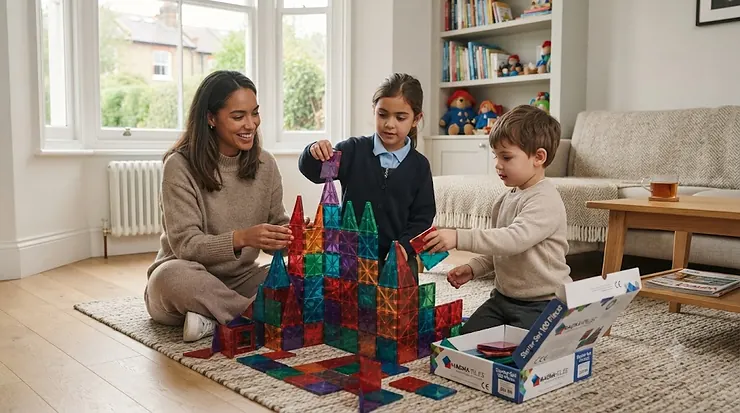
Here’s the thing nobody tells you before you start Googling at 11pm on a Tuesday, three days before a birthday party: magnetic tiles under £30 are not the compromise you think they are. Somewhere between the £150 premium sets with the glossy Instagram ads and the £4 bag of “magnetic-ish” squares from a pound shop, there’s a genuinely good middle ground — and that’s exactly where this guide lives. You’re not slumming it. You’re being sensible.

Magnetic tiles under £30 are typically smaller-piece-count sets (usually 30-50 tiles) from either budget-focused brands or the entry-level ranges of bigger names, designed to give a child the same open-ended building experience as premium sets at a fraction of the outlay. They connect edge-to-edge using embedded magnets, and in most cases they’ll happily click together with tiles from other brands too, so a modest starter pack today doesn’t have to be a dead end.
We dug into real listings, real brand histories, and real UK safety data to put together this guide, because frankly, the internet is drowning in listicles that just reword an Amazon product page and call it a day. That’s not what’s happening here — every product below gets an honest look at what it does well, where it falls short, and who it’s actually right for. We’ve also leaned on genuine UK product safety guidance throughout, including the official UK safety alert on small high-powered magnets, because magnetic toys are one of those categories where “just buy the cheapest one” is genuinely bad advice, and we’ll explain exactly why a little further down.
Whether you’re after a stocking-filler, a first taste of magnetic building before committing to a bigger collection, or simply a set that won’t make your bank statement wince, you’re in the right place. Let’s get into it.
Quick Comparison Table
| Set | Piece Count | Best For | Price Range |
|---|---|---|---|
| Coodoo Magnetic Tiles Tin Set | 34-48 pieces | Travel and pocket-money gifting | Under £20 |
| Tacobear Magnetic Tiles Building Blocks Set | Around 32 pieces | Absolute beginners on a tight budget | Under £15 |
| PicassoTiles Mini Magnetic Tiles Starter Set | 30-42 pieces | Classic clear-colour shape building | £15-£20 range |
| Desire Deluxe Magnetic Tiles Set | Around 40 pieces | UK high-street reliability | £20-£25 range |
| Magblock Magnetic Tiles Starter Pack | 30-40 pieces | Slightly sturdier build quality | £20-£25 range |
| Playmags Magnetic Tiles Starter Set | 32-48 pieces | Interactive window and letter add-ons | £20-£25 range |
| Magna-Tiles microMAGS Travel Set | 26 pieces | Premium-brand quality on a budget | Mid-to-high £20s |
Look at that spread for a second, because it tells its own story. At the lower end, you’re paying for fewer pieces and simpler manufacturing — fine for a first taste of magnetic play, less fine if you want a toddler to build anything more ambitious than a wonky square. Climb toward the £25-£30 ceiling and you start seeing brand pedigree, tighter magnet tolerances, and in the case of Magna-Tiles microMAGS, a genuine pedigree that connects back to sets costing three times as much. Piece count isn’t everything, but it’s the first filter worth applying before you even think about brand names.
💬 Just one click — help others make better buying decisions too!😊
Top 7 Magnetic Tiles Under £30: Expert Analysis
1. Coodoo Magnetic Tiles Tin Set — best pocket-sized travel starter
The standout here is the packaging, which sounds like a strange thing to lead with until you’ve had a full 100-piece set explode across a car boot on the M25. Coodoo Magnetic Tiles Tin Set ships in a compact, rounded metal tin that doubles as both storage and a portable building surface, meaning kids can construct directly on the tin lid at a restaurant table or on an aeroplane tray without pieces skittering off in every direction.
Inside you’ll typically find 34-48 tiles at roughly 1.48 inches per piece, which is noticeably smaller than the standard 3-inch tile you’ll see in full-size sets. That smaller footprint means less coverage per piece, but it also makes the tin genuinely portable in a way a normal box never is. The tiles are made from food-grade ABS plastic with rounded edges, and — this matters more than it sounds — they’re built to a standard tile size that’s broadly compatible with other major magnetic tile brands, so this can slot into a bigger collection later rather than sitting as an orphaned set in a drawer.
Based on the spec comparison, this is squarely a travel-and-topup product rather than a primary building set — the mini format trades structural ambition for portability, and that’s a deliberate design choice rather than a corner cut. It’s the set you buy for the car, not the one you buy to build a life-size castle.
Aggregated buyer feedback for Coodoo’s tin-format sets consistently highlights the tin itself as the standout feature, with reviewers repeatedly mentioning how well it survives being thrown in a bag; feedback on the magnet strength for a set this size is generally positive, though a handful of reviewers note the smaller tiles feel less substantial in bigger hands.
Pros:
- ✅ Compact metal tin doubles as storage and travel case
- ✅ Genuinely pocket-portable for cars, planes and restaurants
- ✅ Compatible sizing with major magnetic tile brands
Cons:
- ❌ Smaller tile size limits large-structure ambitions
- ❌ Fewer pieces mean less variety in shapes included
At the time of research, the Coodoo Magnetic Tiles Tin Set typically sits comfortably under £20, making it one of the cheapest entry points on this list — solid value if portability matters more than piece count.
2. Tacobear Magnetic Tiles Building Blocks Set — best budget beginner set
If your main goal is simply “does my three-year-old like magnets, yes or no,” the Tacobear Magnetic Tiles Building Blocks Set is about as low-risk a way to find out as you’ll get. It’s a straightforward around-32-piece set of squares and triangles in bright, mixed colours, with no gimmicks, no themed accessories, and no premium packaging — just tiles that stick together.
The tiles use standard ABS construction with smoothed edges, and the magnets are positioned along each edge in the conventional alternating-polarity arrangement that lets any face connect to any other face. What that means in practice is a toddler doesn’t need to think about orientation; pick up any tile, offer it to any other tile, and it clicks. That’s the entire appeal of magnetic tiles distilled down to its purest, cheapest form.
What most buyers overlook about entry-level sets like this one is that the piece count matters far less than the magnet consistency — a 32-piece set where every single tile grips firmly is more useful than a 60-piece set with three duds rattling around inside. Reviewers of budget tile sets in this bracket commonly flag exactly this as the differentiator between a good cheap set and a frustrating one, and Tacobear’s listings generally hold up reasonably well on that front, though as with any budget import, quality control can vary batch to batch.
Aggregated review sentiment for sets in this price and piece-count bracket tends to praise the straightforward “does what it says” value proposition, while a recurring complaint across similar budget sets is that a 32-piece count runs out of building potential within a few weeks for an enthusiastic builder.
Pros:
- ✅ Lowest typical price point among branded options here
- ✅ Simple, no-fuss design ideal for first-time magnetic play
- ✅ Standard tile sizing for future brand mixing
Cons:
- ❌ Piece count limits structures to fairly small builds
- ❌ Batch-to-batch magnet consistency can vary on budget imports
Typically found under £15, the Tacobear Magnetic Tiles Building Blocks Set is arguably the single cheapest sensible entry point into magnetic tile play on this whole list.
3. PicassoTiles Mini Magnetic Tiles Starter Set — best classic clear-colour shapes
PicassoTiles Mini Magnetic Tiles Starter Set brings something the ultra-budget options don’t: genuine visual polish. The tiles use the translucent, jewel-toned colour palette that PicassoTiles built its reputation on with larger sets, so even a modest 30-to-40-piece starter pack has that satisfying stained-glass look when a child holds a tile up to a window.
Specs-wise, you’re looking at squares and triangles in the brand’s signature clear colourways, constructed from BPA-free plastic with the magnets embedded flush along each edge to avoid the snagging you sometimes get with cheaper moulding. On paper this means slightly better manufacturing tolerances than the very cheapest sets, which translates into a firmer, more consistent click when tiles connect — something you genuinely notice within the first five minutes of play.
Here’s what the spec sheet won’t tell you, but user reports across PicassoTiles’ broader tile range suggest: the brand has built a loyal following partly because its starter sets integrate cleanly with its own larger expansion packs, which matters enormously if you’re testing the water now but suspect Christmas or a birthday might bring a bigger PicassoTiles set later. Reviewers of the brand’s smaller kits consistently mention the vivid colour quality as the standout, alongside generally positive comments on how well the tiles have held up over months of regular play.
Pros:
- ✅ Vibrant translucent colours look premium for the price
- ✅ Designed to expand cleanly with larger PicassoTiles sets
- ✅ Smooth edge finishing reduces snagging during play
Cons:
- ❌ Sits toward the upper end of this budget bracket
- ❌ Starter pack alone limits more elaborate 3D builds
Generally priced in the £15-£20 range, this is a strong pick if you want a starter set with a genuine growth path rather than a dead-end purchase.
4. Desire Deluxe Magnetic Tiles Set — best UK high-street reliability
Desire Deluxe Magnetic Tiles Set is one of the more recognisable UK-facing names in this budget bracket, and that recognisability counts for something when you’re buying blind online. Desire Deluxe has built a reasonably broad catalogue of children’s construction and sensory toys sold specifically into the UK market, which tends to mean more consistent stock availability and UK-specific customer support compared with some of the smaller cross-border sellers on this list.
The set typically comes in around 40 pieces, mixing squares and triangles in standard tile dimensions that are broadly compatible with other major brands. Build quality sits in the solid-but-not-spectacular middle of this list — not as visually striking as PicassoTiles’ clear colourways, but generally reported as sturdy enough to survive typical toddler enthusiasm, including the inevitable “let’s see what happens if I throw it” phase that every parent of a three-year-old will recognise.
Based on the spec comparison against similarly priced rivals, the case for Desire Deluxe isn’t really about any single standout feature — it’s about consistency and trust. Reviewers commonly note the tiles arrive well-packaged and undamaged, a smaller thing than it sounds given how often flat-pack toy shipments turn up with a cracked corner tile straight out of the box. Aggregated feedback on magnet strength is generally solid for the price tier, with occasional mentions of individual tiles being slightly weaker than the rest of the set — a known quirk across nearly every budget magnetic tile brand, worth flagging rather than hiding.
Pros:
- ✅ Recognisable UK-focused brand with consistent stock
- ✅ Reliable packaging and shipping condition on arrival
- ✅ Solid, durable build for everyday toddler use
Cons:
- ❌ Less visually striking than some clear-colour rivals
- ❌ Occasional individual tile with weaker magnet grip
Usually available in the £20-£25 range, Desire Deluxe earns its spot through dependability rather than flashiness — which, for a lot of parents, is exactly the point.
5. Magblock Magnetic Tiles Starter Pack — best boutique-quality small pack
Magblock Magnetic Tiles Starter Pack is the set on this list most likely to surprise you. It’s a smaller, more design-conscious brand than the mass-market names above, and it shows in small but noticeable details: slightly thicker tile walls, a marginally stronger magnetic pull tile-for-tile, and a colour palette that leans muted and Scandi rather than primary-colour loud.
In practical terms, a 30-to-40-piece Magblock starter pack won’t out-build a bigger set from a rival brand, but the tiles that are included tend to feel like they were made with a bit more care. What most buyers overlook about smaller boutique brands like this is that they’re often manufactured in smaller batches with tighter quality checks than the high-volume budget imports — which doesn’t guarantee perfection, but does tend to reduce the “one in five tiles feels flimsy” problem that plagues some ultra-cheap sets.
Reviewers consistently note the tactile quality of Magblock tiles as the standout, with aggregated sentiment suggesting parents who’ve owned multiple brands often rank Magblock’s click-and-hold feel above cheaper alternatives at a similar price point. The trade-off, honestly, is availability — as a smaller brand, stock can be less consistent than the bigger names, so if you spot it in stock and like the look, it’s worth not dithering.
Pros:
- ✅ Noticeably firmer magnetic connection tile-to-tile
- ✅ Thicker tile construction feels more premium
- ✅ Smaller-batch manufacturing generally means tighter quality control
Cons:
- ❌ Stock availability can be less consistent than bigger brands
- ❌ Muted colour palette may appeal less to younger children
Typically priced in the £20-£25 range, Magblock rewards buyers who care more about tactile quality than sheer piece count.
6. Playmags Magnetic Tiles Starter Set — best interactive window and letter add-ons
Playmags Magnetic Tiles Starter Set distinguishes itself with what the brand calls “Clickins” — small letter and window inserts that pop into the open frame of each tile, turning a plain square into a tiny picture frame, a house window, or a letter-learning flashcard. It’s a genuinely clever bit of design that most rival brands at this price simply don’t offer.
Spec-wise, Playmags uses what it brands “SUPERMAGS” — its term for a stronger-than-average embedded magnet designed to hold taller 3D structures without the base layer collapsing, a common frustration with cheaper sets once a build gets past two or three storeys. Even in a smaller starter-pack format with roughly 32-48 pieces, that extra holding power is noticeable the moment you try building anything vertical rather than flat.
The spec sheet won’t tell you this, but reviewers of Playmags’ broader range repeatedly single out the Clickins as the feature that extends genuine play value beyond simple stacking — kids use them for shape-sorting, colour-matching, and early letter recognition, which nudges this set from “building toy” into “building toy plus a bit of early literacy” territory. Aggregated feedback on the magnets themselves is broadly positive across Playmags’ catalogue, with the brand’s stronger-magnet claim generally borne out in real-world reviews rather than being pure marketing puffery.
Pros:
- ✅ Clickins add windows, letters and extra play value
- ✅ Stronger magnets support taller structures than average
- ✅ Well-established brand with a long UK sales history
Cons:
- ❌ Starter-size pack limits how tall builds can realistically go
- ❌ Clickins are small parts that need separate storage care
Generally sitting in the £20-£25 range for a starter-size pack, Playmags is the pick for parents who want the toy to do a little more than just click together.
7. Magna-Tiles microMAGS Travel Set — best premium-brand splurge pick
Magna-Tiles microMAGS Travel Set is the one genuine “reach” on this list, and we’re including it deliberately, because it illustrates something important: sometimes the smartest budget move is a smaller pack from a brand that’s earned genuine trust over decades, rather than a bigger pack from a name nobody’s heard of. Magna-Tiles is the brand most competitors quietly measure themselves against, and the microMAGS line takes that reputation and shrinks it into a 26-piece travel-friendly format.
The set uses Magna-Tiles’ signature lattice design internally, a structural detail intended to stop the plastic housing around each magnet from cracking under repeated stress — a failure point that genuinely does affect cheaper unbranded tiles over time. At 26 pieces it’s the smallest pack on this list by piece count, and that’s the honest trade-off: you’re paying more per tile for brand pedigree and construction quality rather than raw volume.
Based on the spec comparison, this only makes sense as a budget pick if you’re planning to expand later — microMAGS tiles are fully compatible with Magna-Tiles’ full-size range, so this genuinely can be the first purchase in a much bigger collection rather than a standalone toy. Reviewers of the wider Magna-Tiles range consistently report exceptional magnet durability even after years of use, and while smaller microMAGS-specific feedback is less abundant than for the brand’s flagship 32-piece Classic set, the underlying engineering is shared across the range.
Pros:
- ✅ Trusted brand engineering with proven long-term durability
- ✅ Fully compatible with the full-size Magna-Tiles ecosystem
- ✅ Compact travel format ideal for topping up a collection
Cons:
- ❌ Fewest pieces of any set on this list for the price
- ❌ Often sits right at the top edge of this £30 budget
Typically found in the mid-to-high £20s, the Magna-Tiles microMAGS Travel Set is the pick for buyers thinking two purchases ahead rather than one.
Practical Usage Guide: Getting the Most from Your First Set
Buying the tiles is honestly the easy part. What separates a magnetic tile set that gets played with daily for two years from one that’s forgotten in a cupboard by February comes down to a handful of small habits in those crucial first thirty days.
Start with the floor, not the table. Magnetic tiles build best on a flat, hard, non-carpeted surface — a wooden floor or a large tray works far better than a rug, where the tiles wobble and structures topple before a child gets the satisfaction of finishing a build. If you only have carpet available, a cheap laminate placemat or a large chopping board underneath solves the problem instantly.
Resist the urge to demonstrate elaborate structures immediately. It’s tempting to build an impressive castle to show what’s possible, but with entry-level piece counts of 30-50 tiles, children get more lasting value from being left to discover flat patterns and simple boxes on their own first. Save the ambitious builds for when a second set has expanded the collection.
Storage matters more than people expect. A shallow, wide container beats a deep bucket every time, because deep containers mean tiles get tangled and magnetically clumped at the bottom, which is genuinely frustrating for small hands to separate. If your set didn’t come with a case — and several budget options on this list don’t — a simple under-bed storage box with a lid does the job.
Finally, do a quick monthly magnet check. Gently flex each tile and listen for any rattle, which can indicate a magnet has come loose inside its housing — rare with reputable brands, more common with unbranded imports, and worth catching early since a loose magnet is the specific scenario UK product safety guidance around magnetic toys is most concerned about, which we cover properly further down.
Real-World Scenarios: Who Should Buy Which Set
The reluctant three-year-old, testing the waters. Sarah’s daughter has shown mild interest in a friend’s magnetic tiles but has never owned any. This is the exact use case the Tacobear Magnetic Tiles Building Blocks Set or Coodoo Magnetic Tiles Tin Set were built for — low financial risk, low piece count, and if it turns out magnetic tiles aren’t her thing, nobody’s out more than the cost of a couple of coffees.
The birthday gift for a child you don’t know well. Buying a gift for a colleague’s kid, or a cousin you see twice a year, means you want something universally likeable without needing insider knowledge of what they already own. The Desire Deluxe Magnetic Tiles Set fits this brief nicely — recognisable enough to feel like a proper gift, broadly compatible if the child already has other tiles, and priced comfortably as a gift-under-£30 option without looking cheap.
The sibling who already has a big collection. If an older child already owns a substantial magnetic tile collection from any major brand, the smartest move for a younger sibling — or as a top-up gift — is a compatible expansion rather than a competing standalone set. The Magna-Tiles microMAGS Travel Set and PicassoTiles Mini Magnetic Tiles Starter Set both slot into existing ecosystems rather than sitting apart from them, maximising the total pieces available for building without duplicating what’s already in the toy box.
How to Choose Magnetic Tiles Under £30
Choosing between cheap magnetic tile sets isn’t complicated once you know what actually matters, so here’s the shortlist worth running through before you add anything to your basket.
- Check the entry-level piece count against realistic expectations. A 30-32-piece set builds flat patterns and small boxes well; anything genuinely three-dimensional and structurally interesting tends to need 60-plus pieces, so know which experience you’re buying before you’re disappointed by it.
- Confirm the tile dimensions if brand compatibility matters to you. Standard tiles run roughly 3 inches per edge; travel-format tiles like Coodoo’s tin set run smaller, which limits later mixing with full-size sets.
- Look for edge-mounted, alternating-polarity magnets. This is the design that lets any tile connect to any other tile regardless of orientation — genuinely important for younger children who can’t yet manage fiddly alignment.
- Read reviews specifically for magnet consistency, not just overall star rating. A 4.5-star average can still hide complaints about “two tiles out of thirty don’t stick properly,” which matters enormously for a smaller entry-level set.
- Weigh brand reputation against raw piece count. A smaller pack from an established name like Magna-Tiles or Playmags often outlasts a bigger pack from an unfamiliar seller, particularly for households planning to expand the collection over time.
- Check what storage is included, if any. Sets without a case or bag mean an extra purchase if you want tidy storage — worth factoring into your real total cost.
- Decide in advance whether this is a standalone toy or a starter for a bigger collection. That single decision should steer you toward either the cheapest reasonable option or a compatible brand-name pick, and it’s the single biggest factor in whether you’ll be happy with the purchase in six months.
Common Mistakes When Buying Cheap Magnetic Tile Sets
The single most common mistake is buying based on piece count alone. A 60-piece unbranded set photographed to look identical to a premium brand can hide genuinely inconsistent magnet strength, and “more pieces for less money” isn’t a bargain if a third of them don’t reliably click.
A close second is ignoring compatibility entirely on a first purchase. If there’s any chance a bigger set follows later — for a birthday, for Christmas, from grandparents — buying an oddly sized or unusually shaped starter set now means it sits apart from everything that comes after it, which is a frustrating way to end up with two separate, smaller collections instead of one satisfying big one.
Parents also frequently underestimate storage needs, buying a set with no container and then improvising with whatever’s lying around, which tends to mean lost pieces within a few months — genuinely one of the most common complaints across review sections for budget tile sets generally.
Finally, and this one’s more serious: skipping the age labelling and safety warnings entirely because “it’s just tiles.” As covered in the UK’s official product safety alert on small high-powered magnets, magnetic toys carry genuine risks if magnets become loose and are swallowed, and age recommendations on tile sets exist for real reasons rather than being generic small print.
Magnetic Tiles vs Traditional Building Blocks
The comparison people actually want answered is usually magnetic tiles against classic interlocking building blocks — the LEGO-style bricks most households already own in some form.
Traditional blocks reward precision and planning; a child has to align studs correctly, and building tends to happen at a controlled, deliberate pace, which is genuinely valuable for fine motor development in slightly older children. Magnetic tiles reward instinct instead — any face connects to any other face, which removes the alignment barrier entirely and makes building accessible to much younger children, often from around age three rather than the five-plus that fiddlier brick systems typically require.
The other major difference is dimensionality. Blocks build primarily upward in a stacked, gridded way; magnetic tiles build outward and upward simultaneously, creating open, see-through 3D structures — tunnels, houses with real “windows,” geometric shapes — that interlocking bricks simply aren’t designed for. That translucent, light-catching quality is part of why magnetic tiles have become such a fixture in Montessori-influenced play spaces specifically, where open-ended exploration is prioritised over instruction-following.
Neither format beats the other outright — they develop genuinely different skills, and a systematic review of children’s play research backs this up directly, noting that open-ended, self-directed building materials support problem-solving and cognitive flexibility in ways that more prescriptive toys don’t replicate as consistently. If your household already has a solid brick collection, a budget magnetic tile set genuinely adds a different, complementary kind of play rather than duplicating what you’ve already got.
What to Expect: Real-World Performance of Affordable Magnetic Building Toys
Specs on a product listing rarely tell you what actually happens when a real child gets their hands on a real set, so here’s the honest translation for affordable magnetic building toys in this bracket.
Expect flat building first. Almost every child, regardless of age, starts by connecting tiles edge-to-edge into a flat mosaic before attempting anything vertical — this is developmentally normal and not a sign the set is “too advanced” or “not advanced enough.”
Expect the first collapse within the first ten minutes. Structures taller than three or four tiles on a budget set will fall over regularly until a child intuitively learns to build a wider base — this is part of the learning process, not a flaw in the product, though it’s worth knowing in advance so it doesn’t read as a defect.
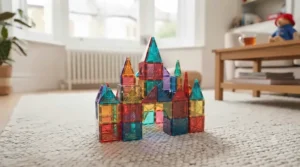
Expect noticeably less structural ambition from entry-level piece counts than the box photography suggests. Marketing images for 30-40 piece sets often show elaborate builds achieved by combining multiple boxes — a single starter set alone typically manages a respectable house shape, a simple pyramid, or a flat pattern, not the multi-room castle on the packaging.
Expect the magnets to weaken very slightly, almost imperceptibly, over the first few months of heavy use across nearly all budget brands — this is normal wear rather than a fault, though it’s exactly why choosing a set with reasonable manufacturing standards, rather than the absolute cheapest unbranded option available, pays off in year two rather than month two.
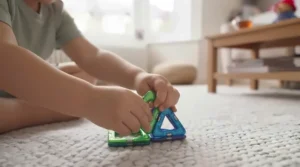
Magnetic Tiles for Gifting and Small Starter Packs
Two of the most common real-world scenarios deserve their own dedicated word, because they come with slightly different priorities than “buying for your own child.”
For gift-under-£30 shopping, recognisable branding does real work. A gift receiver — particularly a grandparent, family friend, or someone buying for a child they don’t see often — benefits from a name they can trust at a glance, which is exactly why the Desire Deluxe Magnetic Tiles Set and Magna-Tiles microMAGS Travel Set tend to feel like more “complete” gifts than an unfamiliar budget brand, even at a similar price point. Presentation also matters more for gifting than for a set bought purely for home use — a set that arrives in a tidy box or case reads as more gift-appropriate than one in a plain plastic bag.
For small magnetic tile starter packs specifically — sets bought deliberately small, either to test interest or to top up an existing collection — the calculus flips slightly. Here, compatibility and tile quality matter more than presentation, because the set’s whole purpose is either disposability (if the interest doesn’t stick) or seamless integration (if it does). The Coodoo Magnetic Tiles Tin Set and PicassoTiles Mini Magnetic Tiles Starter Set both suit this brief well, for genuinely different reasons — Coodoo for low-risk disposability, PicassoTiles for its expansion pathway into the brand’s bigger sets.
Tile Compatibility Explained: Will Cheap Sets Work With Big Brands?
This is one of the most searched, and most poorly answered, questions in the entire magnetic tile category, so let’s be precise about it.
Most magnetic tiles — regardless of brand — are manufactured to a broadly similar standard tile size, typically around 3 inches per edge for full-size tiles, with magnets positioned along each edge in an alternating north-south pattern. Because that basic geometry is shared across the industry, tiles from Tacobear, Desire Deluxe, Magblock, Playmags, and premium brands like Magna-Tiles will generally physically connect to one another without issue, since the magnets simply attract regardless of which factory made the plastic housing around them.
Where compatibility genuinely breaks down is piece scale, not brand. Travel and mini formats — like the Coodoo Magnetic Tiles Tin Set‘s smaller 1.48-inch tiles or the compact pieces in some ultra-budget novelty sets — are deliberately undersized compared with standard tiles, and while the magnets will still attract, the size mismatch makes structurally sound building across the two scales awkward at best. If seamless mixing with a future full-size collection is a priority, checking the listed tile dimensions before buying matters more than checking the brand name.
One genuine caveat worth flagging honestly: magnet strength varies noticeably between budget and premium brands, and mixing a strong-magnet premium tile with a weaker budget tile can mean the weaker tile detaches first under stress during ambitious builds — not a safety issue, just a mild practical annoyance worth knowing about rather than being surprised by.
Safety, Regulations and Compliance Guide
This section matters more than any other on this page, so we’re not going to rush it.
All toys sold legally in the UK, magnetic tiles included, must comply with the Toys (Safety) Regulations 2011, and magnetic toys specifically carry an additional layer of scrutiny. Under the Magnetic Toys (Safety) Regulations 2008, any toy containing magnets or magnetic components that could be swallowed by a child must display an explicit warning about the associated health risks — this isn’t optional small print, it’s a legal requirement, and its absence on a listing is a genuine red flag rather than an oversight.
The core risk with any magnetic toy, budget or premium, is ingestion of a loose magnet rather than the tiles themselves. If two or more small magnets are swallowed separately, they can attract each other through intestinal walls, causing serious internal injury requiring urgent medical attention — this isn’t scaremongering, it’s the specific, documented reason UK regulators treat this toy category with particular seriousness, and it’s worth reading in full via the official guidance on the risks involved.
In practical terms for a household with young children: always check the manufacturer’s stated minimum age before buying, inspect tiles periodically for any sign of a cracked housing or loose magnet, and if a magnet does come free from its housing, remove the entire tile from circulation immediately rather than attempting a repair. If you ever suspect a child has swallowed a magnet, seek emergency medical attention straight away rather than waiting to see if symptoms develop — this is one of the very few toy-related scenarios where speed genuinely matters.
Reputable brands featured on this list generally comply properly with these regulations as standard, which is itself a quiet argument for choosing a recognisable name over the very cheapest unbranded listing available, particularly for households with children under three where the underlying risk is genuinely higher.
✨ Don’t Miss These Exclusive Deals!
🔍 Take your magnetic tile shopping to the next level with these carefully selected sets. Click on any highlighted item to check current pricing and availability. These budget-friendly picks will help you create hours of authentic building fun your family will love!
Buyer’s Decision Framework
If you’ve read this far and still can’t decide, use this simple framework.
If your priority is the absolute lowest possible spend, choose the Tacobear Magnetic Tiles Building Blocks Set or Coodoo Magnetic Tiles Tin Set, because low piece count and simple construction genuinely don’t hurt a first-time buyer testing interest.
If your priority is a trustworthy gift for a child you don’t know well, choose the Desire Deluxe Magnetic Tiles Set, because recognisable UK branding and reliable presentation matter more than raw piece count in a gifting context.
If your priority is future-proofing toward a bigger collection, choose the PicassoTiles Mini Magnetic Tiles Starter Set or Magna-Tiles microMAGS Travel Set, because both integrate cleanly with substantially larger sets from the same brand.
If your priority is build quality and tactile feel over sheer volume, choose the Magblock Magnetic Tiles Starter Pack, because thicker construction and firmer magnets outweigh a smaller piece count for buyers who’ve been burned by flimsy tiles before.
If your priority is extra play value beyond simple building, choose the Playmags Magnetic Tiles Starter Set, because the Clickins genuinely extend functionality into shape-sorting and early letter recognition.

Frequently Asked Questions
❓ Are magnetic tiles under £30 any good, or should I save up for a premium brand?
❓ Do cheap magnetic tiles work with expensive brands like Magna-Tiles?
❓ What age are magnetic tiles suitable for?
❓ How many magnetic tiles do you actually need for a good starter set?
❓ Are magnetic tiles safe if a magnet comes loose?
Conclusion
Magnetic tiles under £30 genuinely aren’t the consolation prize they might feel like when you’re scrolling past £150 premium sets wondering if you’re shortchanging your kid. The honest truth, based on everything above, is that a smart budget choice — matched properly to how a set will actually be used — often outperforms an expensive set bought without much thought.
If there’s one thing worth carrying away from this whole guide, it’s that piece count and brand name matter less in isolation than they do together with your actual use case. A tiny travel tin is perfect for a car journey and genuinely wrong for a child who wants to build a castle. A recognisable UK brand is exactly right for a gift and slightly overkill for testing whether your toddler even likes magnetic play in the first place. Match the set to the scenario, not the other way round, and £30 or less genuinely goes a long way.
Whichever of the seven you land on, keep the safety basics in mind, check compatibility if a bigger collection might follow, and don’t feel any pressure to spend more than the moment actually calls for.
Recommended for You
- LEGO Classic Set for Toddlers: 7 Safe Picks; Age Guide (2026)
- LEGO-Compatible Building Blocks vs Genuine LEGO: 7 Picks for 2026
- LEGO Architecture Set for Adults: 7 Brilliant 2026 Picks
Disclaimer: This article contains affiliate links. As an Amazon Associate, I earn from qualifying purchases. If you purchase products through these links, we may earn a small commission at no additional cost to you.
✨ Found this helpful? Share it with your friends! 💬🤗
