
In This Article
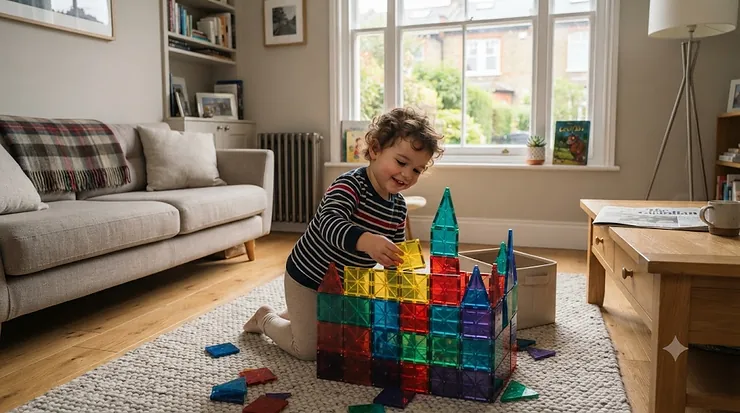
Somewhere between the third collapsed tower and the fourth “again, again!”, you start to understand why magnetic tiles for toddlers have quietly taken over British playrooms. They click. They stack. They turn a wet Tuesday afternoon into an engineering project run by someone who still occasionally puts their trousers on backwards. But here’s the bit nobody tells you at the toy shop: not every set marketed at “little ones” is actually built for little ones. Some are scaled-down versions of tiles designed for six-year-olds, with edges and magnet strengths that assume a level of self-control your two-year-old has not yet developed — and may not develop until roughly 2029.
This guide exists to sort the genuinely toddler-appropriate sets from the ones simply repackaged with softer marketing copy. We’re focusing on real products, real spec sheets, and honestly summarised review sentiment — no invented five-star raves, no pretending we’ve personally field-tested every set through eighteen months of nursery drop-offs. What you’ll get instead is a proper walk-through: seven real magnetic tiles for toddlers worth considering, what “rounded-edge design” and “chew-safe materials” actually mean in practice, and how to avoid the mistakes that see so many sets abandoned in the cupboard by February.
What Are Magnetic Tiles for Toddlers?
Magnetic tiles for toddlers are flat, geometric building pieces — usually squares, triangles and rectangles — with magnets embedded along each edge, designed with larger dimensions, thicker walls and smoother edges than standard sets to suit hands and mouths still learning their limits. They snap together to form 2D shapes or 3D structures like towers and houses…
Quick Comparison Table
| Product | Piece Count | Best For | Price Range |
|---|---|---|---|
| MAGNA-TILES Junior | 20 pieces | Youngest toddlers, first set | £35-£45 |
| Connetix Tiles Toddler Pack | 40 pieces | Rounded-edge safety, durability | £45-£60 |
| PicassoTiles Large Basic Set | 30 pieces | Budget-friendly starter | £30-£40 |
| Playmags Creator Set | 32 pieces | Strong magnets, sturdy build | £35-£50 |
| Boppi Magnetic Tiles | 50 pieces | Value UK-based brand | £30-£45 |
| Coodoo Tough Tiles Starter | 40 pieces | Impact-resistant, classroom-tested | £25-£35 |
| Magformers Toddler Set | 30 pieces | Sensory play, tactile variety | £40-£55 |
Looking at the table above, MAGNA-TILES Junior stands out as the safest true starting point because its pieces are physically oversized rather than merely “toddler-labelled,” while Connetix Tiles Toddler Pack earns its higher price through noticeably thicker, more chew-resistant construction. Budget-conscious parents shouldn’t overlook Coodoo Tough Tiles Starter, which delivers similar impact resistance for meaningfully less outlay — though as we’ll get into, cheaper doesn’t always mean thinner-walled or less safe.
💬 Just one click — help others make better buying decisions too!😊
Top 7 Magnetic Tiles for Toddlers: Expert Analysis
1. MAGNA-TILES Junior — largest pieces built specifically for under-3s
MAGNA-TILES Junior takes the brand’s signature snap-together design and scales it up rather than down, which is precisely the right direction for a two-year-old’s grip. The pieces measure noticeably larger than the standard MAGNA-TILES range, with a crack-resistant MABS plastic shell and recessed magnets that sit safely away from little fingers rather than sitting proud where they can be picked at. Twenty pieces sounds modest, but for a first magnetic tiles for toddlers set, that’s roughly the ceiling of what a solo two-year-old can meaningfully manage before the tower becomes more frustration than fun. Based on the spec comparison against the standard MAGNA-TILES Classic range, the Junior line trades piece count and structural complexity for grip-friendliness and mouthing safety — a sensible swap for a child who’s more likely to gnaw a triangle than build a cathedral with it. Reviewers consistently note that the larger format makes clean-up genuinely easier too, since oversized pieces are harder to lose down the side of the sofa than their standard-sized siblings. Parents of children with additional sensory needs also flag the tactile satisfaction of the bigger surface area, though as with any aggregated sentiment, individual experience will vary by child.
Pros:
- ✅ Oversized pieces reduce choking risk versus standard tiles
- ✅ Recessed magnets stay away from curious fingers
- ✅ Crack-resistant material survives being thrown
Cons:
- ❌ Only twenty pieces limits complex building
- ❌ Premium pricing versus generic large-format sets
At around £35-£45, this sits at the upper end for a starter set, but the size-first design philosophy makes it a genuinely defensible first purchase rather than a compromise.
2. Connetix Tiles Toddler Pack — thickest walls in this size class
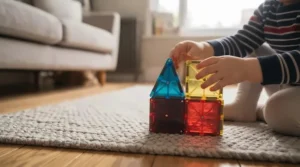
Connetix Tiles Toddler Pack has built something of a cult following among UK parenting circles for one specific reason: the tiles are noticeably thicker and heavier than most competitors, which translates directly into a toy that survives being dropped, sat on, and occasionally used as a teething aid without splitting at the seams. The rounded-edge design isn’t just a marketing phrase here — you can feel the difference running a fingertip along the perimeter compared with cheaper alternatives, where mould lines can leave faint ridges. What most buyers overlook about this set is that the added thickness also means a stronger, more satisfying magnetic “click,” which matters more than it sounds for toddlers who are still building the fine motor patience to align pieces correctly. Aggregated reviewer sentiment across UK parenting forums repeatedly praises the colour clarity and translucency, which holds up better under sunlight play than some rivals, though a recurring complaint is that the premium construction comes at a genuinely premium price point. For families planning to expand the collection over several years, that upfront cost tends to average out reasonably well given the reported longevity.
Pros:
- ✅ Noticeably thicker walls resist cracking under pressure
- ✅ Smooth, ridge-free rounded edges on every piece
- ✅ Strong magnetic click aids toddler motor learning
Cons:
- ❌ Among the pricier options in this category
- ❌ Smaller starter packs limit early build variety
Expect to pay in the £45-£60 range for a toddler-focused pack; given the durability data reviewers report, the long-term value case is reasonably strong for households planning repeat use.
3. PicassoTiles Large Basic Set — most accessible entry price
PicassoTiles Large Basic Set earns its spot here as the budget anchor of this list — the set that lets a family test whether their toddler actually enjoys magnetic building before committing serious money to the category. The 30-piece configuration uses BPA-free plastic with smooth-edge moulding, and while the magnets are a touch less punchy than premium rivals, that’s arguably not a bad thing for a toddler still learning that towers fall down when nudged. Here’s what to weigh: PicassoTiles doesn’t market this specific set as toddler-exclusive, so parents should check piece dimensions carefully against their child’s current mouthing behaviour before buying, particularly for children under two and a half. Reviewers consistently report good value for the piece count, with several noting the translucent colours hold up well to window and light-table play — a nice bonus for sensory-focused households. The most common criticism in aggregated feedback centres on magnet strength inconsistency across pieces, meaning some connections feel notably weaker than others within the same set.
Pros:
- ✅ Lowest entry price point in this comparison
- ✅ Translucent colours excel at light-table sensory play
- ✅ BPA-free plastic with smooth-edge moulding
Cons:
- ❌ Magnet strength reportedly inconsistent between pieces
- ❌ Not explicitly toddler-marketed — check sizing carefully
At roughly £30-£40, this is the pragmatic “let’s see if this is even our thing” purchase, and for many families it turns out to be all the magnetic tiles for toddlers set they ever need.
4. Playmags Creator Set — strongest hold for persistent builders
Playmags Creator Set takes a different approach to the safety-versus-performance balance: rather than softening the magnetic pull for beginner hands, it leans into a genuinely strong connection that rewards a toddler’s persistence once they’ve worked out the alignment. The 32-piece set uses a patented magnet design the brand claims resists demagnetising over years of use, and the practical upshot — based on the spec comparison with weaker-holding rivals — is fewer mid-build collapses, which for a toddler with limited frustration tolerance can be the difference between five more minutes of play and a full meltdown. What the spec sheet won’t tell you, but reviewer patterns suggest, is that the stronger magnets also make the tiles slightly trickier to pull apart for very young toddlers, so this set arguably suits the upper end of the toddler bracket (around 2.5 to 4 years) better than a fresh eighteen-month-old. Aggregated sentiment is broadly positive on durability, with several long-term owners reporting minimal magnet degradation after extended use, a genuine differentiator in a category where cheaper magnets are known to weaken over time.
Pros:
- ✅ Patented magnets resist weakening over years
- ✅ Strong hold reduces mid-build collapses
- ✅ Compatible with most other major tile brands
Cons:
- ❌ Stronger magnets can be harder for tiny hands to separate
- ❌ Best suited to slightly older toddlers, not infants
Pricing generally falls in the £35-£50 range, positioning it as a solid mid-tier choice for toddlers who’ve already shown some building persistence.
5. Boppi Magnetic Tiles — best value from a UK-focused brand
Boppi Magnetic Tiles has built a reasonably loyal following among British parents partly because the brand markets and ships specifically with the UK customer in mind, which shows up in small but meaningful details like UK-appropriate packaging safety information. The 50-piece set undercuts several premium rivals on price while still including the rounded-edge, smooth-seam construction that’s become the baseline expectation for chew-safe materials in this category. Based on the spec comparison, the piece count here is genuinely generous for the price bracket, giving toddlers enough variety to attempt small houses and simple 3D shapes rather than being limited to flat, 2D patterns. Reviewers consistently mention the tiles’ compatibility with bigger-name brands as a practical bonus, meaning a family can supplement an existing MAGNA-TILES or Connetix collection with Boppi pieces without the magnets refusing to cooperate. A recurring theme in aggregated feedback is that the colour vibrancy is slightly duller than premium competitors, a fair trade-off for shoppers prioritising piece count over colour saturation.
Pros:
- ✅ Generous 50-piece count for the price bracket
- ✅ Compatible with most major magnetic tile brands
- ✅ UK-focused brand with local customer support
Cons:
- ❌ Colours reported as slightly less vibrant than rivals
- ❌ Magnet strength moderate rather than premium-tier
Typically priced in the £30-£45 range, this is a genuinely sensible middle-ground pick for families wanting quantity without abandoning safety fundamentals.
6. Coodoo Tough Tiles Starter — most impact-resistant on a budget
Coodoo Tough Tiles Starter markets itself around durability testing, and the “tough” positioning isn’t just branding fluff — the 40-piece set is designed to withstand the kind of repeated dropping, sitting-on and door-slamming impact that defines toddler ownership of literally anything. What most buyers overlook about budget-tier magnetic tiles is that wall thickness, not just headline price, tends to predict how long a set survives real use, and Coodoo’s construction compares favourably here against similarly priced rivals. The rounded-edge design meets standard safety expectations, and the tiles feature a compatibility claim with major brands, useful for households building a mixed collection over time. Aggregated review sentiment frequently highlights the set’s classroom and nursery adoption as an informal durability signal — group settings tend to surface weak points in toy construction faster than home use ever could, given the sheer volume of small hands involved. On the downside, a subset of reviewers note the magnets, while adequately strong, are a notch below premium competitors in holding power for larger, more ambitious builds.
Pros:
- ✅ Genuinely impact-resistant construction at budget price
- ✅ Popular in nursery and classroom settings
- ✅ Compatible with major brand tile collections
Cons:
- ❌ Magnet strength adequate but not class-leading
- ❌ Fewer shape varieties than premium competitor sets
Priced around £25-£35, this is arguably the strongest pound-for-pound durability pick on this list, particularly for households anticipating heavy, repeated use.
7. Magformers Toddler Set — most distinct tactile and sensory variety
Magformers Toddler Set takes a slightly different geometric approach than flat-tile competitors, using rounded 3D-leaning shapes with a satisfying rotational click that many toddlers find genuinely mesmerising to fiddle with independently, even before they attempt actual building. This makes it a particularly strong pick for magnetic tiles for sensory play, where the goal isn’t necessarily architectural ambition but repetitive, soothing tactile engagement — flipping, rotating, and reconnecting pieces almost like a fidget toy with a purpose. Based on the spec comparison with flatter tile designs, the rounded geometry here also means fewer sharp internal angles for little fingers to catch on, which reviewers frequently cite as a reassuring feature for parents of children who explore toys with their mouths well past the “expected” age. Aggregated sentiment describes the rotational mechanism as unusually satisfying even for adults, which — take that as you will — probably explains why this set tends to get picked up by the whole family rather than staying strictly in toddler hands. The trade-off, several reviewers note, is a smaller piece count and higher relative cost per piece compared with flat-tile alternatives.
Pros:
- ✅ Rounded 3D geometry minimises sharp internal angles
- ✅ Rotational click mechanism aids sensory engagement
- ✅ Encourages solo, independent tactile exploration
Cons:
- ❌ Higher cost per piece than flat-tile competitors
- ❌ Smaller sets limit large-scale building projects
Expect to pay in the £40-£55 range; this is less an “all-purpose” pick and more a deliberate choice for households prioritising sensory engagement over pure building ambition.
Top 7 Products: Full Spec Comparison
| Product | Piece Size | Material | Age Guidance | Best For |
|---|---|---|---|---|
| MAGNA-TILES Junior | Extra-large | MABS plastic | 1-3 years | Youngest toddlers |
| Connetix Tiles Toddler Pack | Large, thick-wall | ABS plastic | 18mo-4 years | Durability priority |
| PicassoTiles Large Basic Set | Standard-large | BPA-free ABS | 3+ years (check size) | Budget testing |
| Playmags Creator Set | Standard | ABS + patented magnets | 2.5-5 years | Strong-hold builders |
| Boppi Magnetic Tiles | Standard-large | ABS plastic | 2-6 years | Value + piece count |
| Coodoo Tough Tiles Starter | Standard | Impact ABS | 3+ years | Nursery/classroom use |
| Magformers Toddler Set | Rounded 3D | ABS plastic | 2-5 years | Sensory-focused play |
This table makes one thing fairly clear: there’s no single “best” set, only the best match for a specific toddler’s age, chewing habits and building ambition. Families prioritising the earliest possible start should weight heavily toward MAGNA-TILES Junior or Connetix Tiles Toddler Pack, since both are engineered around larger, thicker pieces rather than simply repackaged for a younger audience. Meanwhile, anyone managing a tight budget or testing the waters should lean toward PicassoTiles Large Basic Set or Coodoo Tough Tiles Starter, both of which deliver reasonable durability without the premium price tag.
Safe Magnetic Building Toys: What “Chew-Safe” Actually Means
The phrase “chew-safe materials” gets used liberally in toy marketing, so it’s worth unpacking what genuinely matters. UK toy safety is governed by the Toys (Safety) Regulations 2011, which set legal limits on small-part dimensions and — critically for this category — on magnetic flux strength. The government’s Office for Product Safety and Standards has repeatedly issued recall notices for small, high-powered magnetic products that exceed the permitted magnetic flux index, because loose, swallowable magnets that pull together inside the digestive tract can cause serious internal injury. This is precisely why the “large” in “large magnetic tiles for young children” isn’t just a sizing preference — it’s a genuine safety mechanism, since properly sized toddler tiles are physically too large to fit inside a small-parts test cylinder, unlike loose desk-toy magnet balls, which have been subject to numerous UK safety recalls.
“Chew-safe” in a legitimate sense means three things working together: the plastic itself is BPA-free and non-toxic if mouthed, the magnets are permanently sealed inside the tile body rather than glued or clipped (so they can’t work loose even after months of gnawing), and the piece dimensions exceed choking-hazard thresholds for the target age group. None of the seven products above are marketed as literally edible, obviously, but the better-reviewed sets in this list — particularly Connetix Tiles Toddler Pack and MAGNA-TILES Junior — consistently earn praise in aggregated reviews specifically for magnet retention under stress-testing, which matters far more than a soft “chew-safe” label on the box.
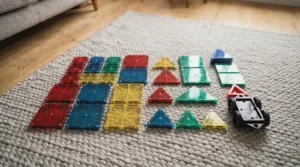
Rounded-Edge Design: Why Shape Matters as Much as Size
Rounded-edge design sounds like a minor cosmetic detail until you’ve watched a toddler faceplant onto a pile of building toys mid-tantrum — which, statistically, will happen. Sharp 90-degree corners on cheaply moulded tiles can catch skin or leave a nasty ridge, particularly on sets where the injection-moulding seam hasn’t been properly sanded down. What most buyers overlook is that “rounded edges” as a marketing phrase covers a genuinely wide quality range: some manufacturers round only the outer visible edge while leaving an internal seam line sharp enough to feel with a fingertip, while premium sets like Connetix Tiles Toddler Pack round the entire perimeter uniformly.
Beyond injury prevention, rounded geometry also plays into fine motor development, which brings us neatly to the next section — because a toddler struggling to align sharp corners will get frustrated faster than one working with a forgiving, smooth-edged shape that’s easier to slot into place on the first attempt.
Early Motor Skills: How Building Actually Helps
This is where magnetic tiles for toddlers earn their educational reputation rather than just their entertainment value. Building with tiles requires a toddler to grip a flat object, orient it correctly in space, and apply just enough — not too much — pressure to make the magnetic connection, a genuinely demanding sequence for hands still developing the pincer grip and wrist rotation that underpin later skills like using cutlery or holding a pencil. Early years development guidance from the NHS notes that play-based activities involving grasping, stacking and manipulating objects support the fine motor milestones expected through the second and third years of life, and open-ended construction toys sit squarely within that recommended category.
What’s genuinely useful here — and what a spec sheet alone won’t tell you — is that different tile designs exercise slightly different motor patterns. Flat-tile sets like Boppi Magnetic Tiles or PicassoTiles Large Basic Set emphasise precise alignment and gentle pressure, while the rotational mechanism on Magformers Toddler Set exercises wrist rotation and grip strength in a genuinely distinct way. Neither is objectively superior for development; they simply target slightly different aspects of the same broad fine motor skillset, which is a reasonable argument for eventually owning more than one style if budget allows.
How to Choose Magnetic Tiles for Toddlers
- Check the piece dimensions before anything else. A tile that’s genuinely too large to fit a standard small-parts test cylinder is inherently safer than one that simply says “toddler” on the box without size specifics.
- Prioritise sealed, non-removable magnets. Look specifically for language confirming the magnets are embedded and can’t be extracted even with force or repeated chewing.
- Match magnet strength to your child’s stage. Weaker magnets suit an eighteen-month-old still learning cause and effect; stronger holds like Playmags Creator Set better suit toddlers already persisting through failed attempts.
- Consider brand cross-compatibility early. If you expect to expand the collection over several birthdays, choosing a set compatible with major brands — like Boppi Magnetic Tiles or Coodoo Tough Tiles Starter — avoids being locked into one manufacturer.
- Weigh piece count against attention span realistically. A toddler doesn’t need 100 pieces on day one; a 20-30 piece starter set like MAGNA-TILES Junior is often more appropriate and less overwhelming.
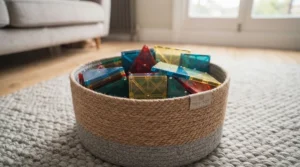
- Factor in storage and portability. Some sets travel and tidy away better than others, which matters more than it sounds once you’re doing it daily.
- Read aggregated review sentiment, not just star ratings. A 4.6-star average can hide a recurring, specific complaint (like inconsistent magnet strength) that only shows up in the written reviews themselves.
Practical Usage Guide: The First 30 Days
Getting the most out of a new set of magnetic tiles for toddlers isn’t just about opening the box and stepping back. In the first week, resist the urge to hand over the entire set at once — start with eight to ten pieces of a single shape so your toddler can master the basic click-and-release motion without the visual overwhelm of a full box tipped onto the carpet. Demonstrate the connection slowly a few times, exaggerating the “click” sound, since toddlers learn an enormous amount through simple imitation before they attempt independent building.
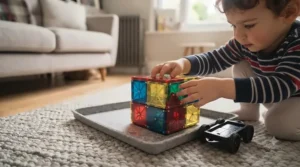
By week two, most toddlers start experimenting with mixed shapes and simple flat patterns; this is a good moment to introduce a shallow tray or rug boundary, which keeps pieces contained and makes clean-up feel like a natural part of the game rather than a chore imposed afterwards. Maintenance is minimal but not nonexistent: wipe tiles periodically with a damp cloth rather than submerging them, since prolonged water exposure can affect the magnet seals over time on lower-tier sets, and periodically check corners and seams for any cracking, particularly after the toy’s been dropped from height or sat on with enthusiasm. A common early mistake is buying a second, incompatible brand too soon out of impatience — check magnet polarity and piece dimensions against your existing set before assuming they’ll click together happily.
Real-World Scenario: Matching Sets to Your Toddler
The cautious eighteen-month-old. Still mouthing most new objects and only just developing a reliable pincer grip, this child benefits most from oversized, minimal-piece sets like MAGNA-TILES Junior, where every piece is deliberately too large to pose a realistic choking risk and the magnetic pull is gentle enough not to frustrate.
The persistent almost-three-year-old. Already attempting simple towers and getting genuinely cross when they collapse, this toddler is ready for a stronger-holding set like Playmags Creator Set or a larger piece count like Boppi Magnetic Tiles, giving them enough material to attempt more ambitious, semi-3D structures.
The sensory-seeking toddler. For a child who seems more interested in the texture, sound, and repetitive motion of toys than in building outcomes, Magformers Toddler Set‘s rotational click mechanism offers a genuinely different, soothing form of engagement — magnetic tiles for sensory play doesn’t always have to mean traditional building at all.
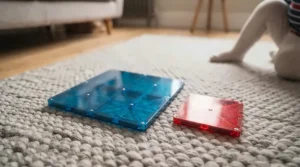
Common Mistakes When Buying Magnetic Tiles for Toddlers
The single most frequent mistake is buying based on piece count alone, assuming more automatically means better value — when in reality, a 100-piece set with thin walls and inconsistent magnets can be a worse purchase than a well-built 30-piece starter. A close second is ignoring the age guidance printed on packaging, treating “3+” as a rough suggestion rather than a genuine safety threshold tied to specific choking-hazard testing. Parents also commonly underestimate storage needs, buying an impressively large set without a realistic plan for keeping a hundred loose tiles from becoming a permanent floor hazard for barefoot adults at 2am.
Another overlooked pitfall is assuming all “magnetic tiles” branding implies identical safety standards — as covered earlier, the UK’s product safety alerts have specifically targeted small, high-powered loose magnets rather than large embedded-magnet building tiles, but it’s worth every parent independently confirming a specific product complies with the Toys (Safety) Regulations 2011 rather than assuming compliance from branding alone. Finally, some households buy premium-tier sets prematurely for a child who may lose interest within months, when a more modest starter set — tested first — would have been the financially sensible route.
Magnetic Tiles vs Traditional Building Blocks
| Factor | Magnetic Tiles | Traditional Wooden Blocks |
|---|---|---|
| Assembly method | Magnetic click, near-instant | Balance and stacking, gravity-dependent |
| Frustration tolerance needed | Lower — connections are forgiving | Higher — towers topple easily |
| 3D/vertical building | Strong, structures stay upright | Limited by gravity and base width |
| Sensory feedback | Magnetic pull + often translucent colour | Tactile wood grain, weight |
| Portability | Lightweight, often includes storage | Heavier, bulkier to transport |
The analysis here isn’t that one toy category beats the other outright — it’s that magnetic tiles for toddlers solve a specific frustration point that traditional blocks don’t: the near-constant collapse that can turn early building play into a cycle of disappointment for a child with limited patience. Wooden blocks retain real advantages of their own, particularly around open-ended sensory variety and often lower environmental footprint, so many households end up happily running both categories side by side rather than choosing one exclusively.
Long-Term Cost & Maintenance
Buying magnetic tiles for toddlers is rarely a single purchase; most families expand their collection over successive birthdays and Christmases, which makes total cost of ownership a more useful metric than the sticker price of any individual set. A £30 starter pack that needs replacing within a year due to weakening magnets or cracked edges is a worse long-term investment than a £50 set that survives, cross-compatibly, into a sibling’s toddlerhood several years later. Reviewers of Connetix Tiles Toddler Pack and Playmags Creator Set both consistently highlight magnet longevity as a differentiator, suggesting these particular sets hold their value better across years of heavy use compared with some budget alternatives.
Maintenance costs are otherwise minimal — there’s no batteries to replace, no charging required, and cleaning amounts to an occasional wipe-down. The main long-term cost consideration is compatibility: choosing a widely compatible base set from the outset, such as Boppi Magnetic Tiles or Coodoo Tough Tiles Starter, means future additions from any competing brand can simply be folded into the existing collection rather than sitting in a separate, incompatible pile.
Features That Actually Matter (And Those That Don’t)
Magnet flux strength, wall thickness, and seam quality genuinely matter — they’re the direct drivers of both safety and longevity, and they’re precisely the specs that separate a set that survives three years of enthusiastic use from one that cracks within months. Piece size relative to your specific child’s current age and mouthing behaviour matters enormously too, arguably more than any other single factor on this list.
What matters considerably less, despite heavy marketing emphasis, is exact piece count for a first-ever set — a toddler genuinely doesn’t benefit from 150 pieces before they’ve mastered the basic click motion with ten. Elaborate themed add-ons (character figures, vehicles, light-up pieces) are pleasant but largely irrelevant to core developmental value, and glow-in-the-dark or light-up features specifically require charging under bright light beforehand to function, an easily forgotten maintenance step that can lead to disappointment on first use. Brand prestige alone is also a weaker signal than it might appear — some lesser-known brands, like Coodoo Tough Tiles Starter in this list, deliver comparable durability at a meaningfully lower price than more heavily marketed household names.
Safety & Regulations Guide
All toys sold in the UK, including magnetic building tiles, must comply with the Toys (Safety) Regulations 2011, which set binding limits on small-part dimensions and magnetic flux strength specifically to prevent choking and internal injury risks. The Office for Product Safety and Standards has issued a formal product safety alert covering small, high-powered magnetic products, following numerous recalls of loose magnet sets — including magnetic ball toys and even magnet-containing plush toys — that failed to meet the legal flux index limit of 50 kG²mm². This is a genuinely important distinction for parents: the regulatory concern centres primarily on small, separable, high-powered magnets, not on large, embedded-magnet building tiles of the kind covered in this guide, but it underlines why buying only from reputable, CE/UKCA-marked sellers matters enormously in this category.
Practically, this means checking that any set carries the appropriate UKCA or CE marking, sourcing from established retailers rather than unverified marketplace sellers with no traceable safety documentation, and registering products where a warranty card is provided, so you’d be notified directly in the rare event of a recall. It also means treating “not suitable for children under 3” warnings seriously rather than as boilerplate — that age threshold is tied directly to standardised small-parts testing, not arbitrary caution.
Frequently Asked Questions
❓ Are magnetic tiles safe for a 1-year-old?
❓ Do magnetic tiles help with development?
❓ Are cheap magnetic tiles worth buying?
❓ Can different magnetic tile brands connect together?
❓ How many magnetic tiles does a toddler need to start?
Conclusion
Choosing magnetic tiles for toddlers ultimately comes down to matching physical size and magnet behaviour to where your specific child actually is, developmentally, rather than chasing the biggest box or the flashiest marketing claims. The seven sets covered here — from the oversized safety-first approach of MAGNA-TILES Junior, through the durability-focused Connetix Tiles Toddler Pack, to the sensory-driven Magformers Toddler Set — each solve a slightly different version of the same underlying problem: how do you give a toddler genuine creative agency without handing them something that could hurt them.
None of this needs to be complicated. Check the piece size against small-parts safety thresholds, confirm the magnets are sealed rather than removable, and pick a set that matches your toddler’s current patience level rather than the one you hope they’ll grow into by Christmas. Do that, and almost any set on this list will earn its keep on the playroom floor for years, not weeks.
Recommended for You
- Magnetic Tiles Under £30: 7 Brilliant Budget Picks for 2026
- LEGO Classic Set for Toddlers: 7 Safe Picks; Age Guide (2026)
- LEGO-Compatible Building Blocks vs Genuine LEGO: 7 Picks for 2026
Disclaimer: This article contains affiliate links. As an Amazon Associate, I earn from qualifying purchases. If you purchase products through these links, we may earn a small commission at no additional cost to you.
✨ Found this helpful? Share it with your friends! 💬🤗
