

In This Article
Walk into any well-equipped early years room on a wet Tuesday afternoon and you’ll usually find the same scene: four or five children hunched over a spreading pile of coloured tiles, arguing amicably about whether the tower needs a roof or a drawbridge. A large magnetic tile set for classrooms earns its keep precisely because it survives that scene — repeated daily, by different groups of children, for years, without pieces snapping, magnets weakening, or the set shrinking down to an unusable handful of odd shapes. Unlike a home toy box, a classroom or nursery setting needs volume, durability and a design that lets six children build at once rather than one child building alone.

This guide is written for UK early years practitioners, teaching assistants, SENCOs and nursery managers who are comparing bulk magnetic tile sets rather than a single small gift-boxed pack. We’ve researched seven genuinely available sets — from an entry-level 125-piece starter pack to a 212-piece mega pack built for a whole classroom — and assessed them on piece count, tile size, magnet strength, storage and real aggregated review sentiment rather than marketing claims. Independent research on constructive play, published via the National Library of Medicine, notes that hands-on building play is closely linked to problem solving, cognitive flexibility and language development in young children — which is exactly the kind of outcome a classroom investment like this is meant to support.
Quick Comparison Table
For readers short on time, here’s the shape of the market before we go deep. Prices shown are indicative ranges only, correct at the time of research — always check the current price before ordering, particularly for bulk classroom purchases where budgets are tightly planned.
| Model | Price Range | Piece Count | Storage Included | Best For |
|---|---|---|---|---|
| SUNNY AUNTIE Magnetic Tiles 125 PCS XL Set | £30-£40 range | 129 pieces | Zippered carry case | Tightest nursery budgets |
| PicassoTiles 100 Piece Set | £30-£45 range | 100 pieces | No | Budget-conscious top-up sets |
| Magna-Tiles Translucent Colors 100-Piece | £65-£80 range | 100 pieces | No | Reliable, well-known classroom staple |
| Magna-Tiles Classic 100-Piece | £90-£100 range | 100 pieces | No | Trusted original brand for daily use |
| Magna-Tiles City Center 110-Piece | £105-£120 range | 110 pieces | No | Themed small-world and storytelling play |
| Connetix Pastel Creative Pack | £110-£120 range | 120 pieces | No | Bevelled edges, brand compatibility |
| Connetix Rainbow/Pastel Mega Pack | £190-£200 range | 202-212 pieces | No | Whole-classroom bulk group play |
Looking at this spread, the clearest pattern is that piece count and brand reputation move together: the two most-established classroom names, Magna-Tiles and Connetix, sit in the upper half of the price range, while budget entrants win on sheer affordability but ask more of the classroom’s own storage and durability standards over time. For a single key worker group of four to six children, a 100-piece set is usually sufficient; for a whole-room resource shared across a rolling rota of children, the 200+ piece mega packs genuinely earn their higher price.
💬 Just one click — help others make better buying decisions too!😊
Top 7 Large Magnetic Tile Sets for Classrooms: Expert Analysis
1. SUNNY AUNTIE Magnetic Tiles 125 PCS XL Set — cheapest genuine bulk entry point
The SUNNY AUNTIE Magnetic Tiles 125 PCS XL Set is the set to consider when a nursery budget genuinely can’t stretch to a premium brand but still needs enough pieces for proper group play. At 129 pieces including two toy cars, it comfortably covers a small group build without constant piece-sharing arguments, and the included zippered carrying case doubles as tidy-up storage.
Based on the spec comparison with premium rivals, the plastic used here is lighter-gauge than Magna-Tiles or Connetix, which shows up in aggregated review sentiment as a common theme: parents and practitioners consistently describe the set as excellent value for occasional or home use, with more mixed feedback on how the pieces cope with the kind of daily, multi-child handling a busy classroom delivers. The manufacturer backs the set with a five-year warranty, which is a genuinely useful signal of confidence at this price point and worth registering for a school or nursery’s asset records.
What most buyers overlook about this model is that the storage bag, while a nice inclusion, isn’t designed for repeated heavy use the way a dedicated classroom storage tub is — for daily rotation between key worker groups, transferring the pieces into a stackable tray tends to extend the set’s working life considerably.
Pros:
- ✅ Genuinely large 129-piece count at a low price
- ✅ Includes carry case and two play vehicles
- ✅ Five-year manufacturer warranty included
Cons:
- ❌ Lighter plastic than premium classroom brands
- ❌ Carry case wears faster under daily group use
Priced in the £30-£40 range, this is a sensible way to trial magnetic tile play in a setting before committing to a bigger classroom budget.

2. PicassoTiles 100 Piece Set — best clear, budget-friendly staple
The PicassoTiles 100 Piece Set has built a loyal following among UK parents and early years settings as a straightforward, no-frills option: 100 clear tiles in classic square and triangle shapes, BPA-free ABS plastic, and a price that regularly undercuts the two big classroom brand names.
Here’s what to weigh: clear tiles genuinely change how children use the set, since light passes through completed structures on a window ledge or light table, adding a sensory dimension that opaque tiles simply can’t offer. Reviewers consistently note strong magnetic connection for a budget set, with the more common criticism being that edges can feel slightly less refined to the touch than Connetix’s bevelled design, a detail that matters more in daily classroom handling than in occasional home play.
What most buyers overlook about this model is its genuine compatibility with other major magnetic tile brands — a classroom that already owns some Magna-Tiles or Connetix pieces can top up numbers with PicassoTiles without creating two separate, incompatible collections, which is exactly the kind of practical cost-saving a school budget holder will appreciate.
Pros:
- ✅ Clear tiles add a light-table sensory dimension
- ✅ Compatible with other major magnetic tile brands
- ✅ Consistently competitive pricing among UK retailers
Cons:
- ❌ Edges less refined than premium bevelled brands
- ❌ 100 pieces limits simultaneous group builds
Typically priced in the £30-£45 range depending on promotions, it’s a genuinely sensible way to expand an existing classroom collection.
3. Magna-Tiles Translucent Colors 100-Piece — best-known classroom staple
As the brand widely credited with popularising magnetic tile construction toys in the first place, Magna-Tiles Translucent Colors 100-Piece remains a default recommendation across UK early years settings, and the reputation is largely earned rather than inherited.
The set’s 2-large and 14-small square design, alongside a spread of equilateral, right and isosceles triangles, gives children genuine geometric variety rather than a single repeated shape, which matters for the mathematical development side of construction play. Aggregated review sentiment consistently highlights the strength and reliability of the internal magnets even after years of use, a detail practitioners in long-running settings mention specifically because it’s the single most common failure point in cheaper alternatives — magnets that weaken or shift out of alignment after heavy handling.
What most buyers overlook about this model is that “the original brand” isn’t just marketing language; because so many nurseries and reception classes already own Magna-Tiles sets, buying more of the same brand avoids the awkward compatibility gaps that can appear when mixing tile brands with slightly different tolerances.
Pros:
- ✅ Established reliability across years of heavy use
- ✅ Genuine shape variety supports maths learning
- ✅ Widely already owned by UK settings, easy to top up
Cons:
- ❌ Premium pricing relative to newer competitors
- ❌ 100 pieces is modest for larger group sizes
At £65-£80 in most UK listings, this remains the safe, well-tested default for settings that want proven longevity above all else.
4. Magna-Tiles Classic 100-Piece — best for daily nursery durability
Sitting alongside the Translucent set in the Magna-Tiles range, the Magna-Tiles Classic 100-Piece set trades the see-through aesthetic for bold, opaque rainbow colours, which many practitioners find easier for younger children to sort, name and categorise during structured colour-recognition activities.
On paper this means a set that does double duty: free-flow construction play during choosing time, and a genuinely useful resource during adult-led maths or colour-sorting sessions. Reviewers commonly note that the bold colour palette holds up visually over time without fading, a small but real consideration in a resource that may sit under classroom lighting for years. Based on the spec comparison with the Translucent version, the underlying build quality, magnet strength and piece dimensions are identical — the choice between the two really comes down to whether transparency or colour-sorting utility matters more for your specific curriculum activities.
What most buyers overlook about this model is that its long track record means replacement pieces and compatible expansion packs, such as the microMAGS range, are readily available, letting a setting grow a single 100-piece starter into a much larger collection over successive budget cycles rather than needing to buy a whole new set outright.
Pros:
- ✅ Bold opaque colours ideal for sorting activities
- ✅ Wide range of compatible expansion packs available
- ✅ Proven durability record across UK early years settings
Cons:
- ❌ No transparency for light-table sensory play
- ❌ Among the pricier 100-piece options on this list
Priced around £90-£100, it’s the classroom-tested choice for settings prioritising long-term reliability over novelty.
5. Magna-Tiles City Center 110-Piece — best for themed storytelling play
Where the Classic and Translucent sets are purely abstract building tools, Magna-Tiles City Center 110-Piece adds road pieces, spiral and classic staircases, balconies and a wheeled chassis with axles, turning open-ended construction into a platform for genuine small-world storytelling.
This matters more in a classroom context than it might sound: practitioners consistently use themed construction sets to support specific EYFS areas of learning, particularly Understanding the World and Communication and Language, since children narrate their city-building as they play in a way that flatter geometric sets don’t always prompt as naturally. Aggregated review sentiment is strongly positive on the added play value of the road and vehicle pieces, with the main recurring comment being that, because several piece types are unique to this set, it works best as a genuine addition to an existing Magna-Tiles collection rather than a first purchase on its own.
What most buyers overlook about this model is that the microMAGS detail pieces included are noticeably smaller than the standard tiles, which is a genuine consideration for settings with very young children or particular sensory or choking-hazard policies in place — always check the manufacturer’s age guidance against your setting’s own risk assessment before introducing smaller pieces into a mixed-age room.
Pros:
- ✅ Road, stair and vehicle pieces support storytelling play
- ✅ Strong fit with Understanding the World EYFS activities
- ✅ Compatible with existing Magna-Tiles collections
Cons:
- ❌ Includes smaller detail pieces needing careful supervision
- ❌ Best used as an addition rather than a first set
At £105-£120, it’s a strong second-purchase pick for settings looking to add narrative depth to an existing tile collection.
6. Connetix Pastel Creative Pack, 120 Pieces — best refined build quality
The Connetix Pastel Creative Pack, 120 Pieces has become the go-to challenger brand in UK early years settings, built around a distinctive bevelled tile edge that Connetix says improves both structural strength and light refraction compared with flat-edged rivals.
In practice, this shows up as genuinely satisfying rainbow refractions when structures catch the light, alongside a tactile edge that reviewers consistently describe as smoother in small hands than several competing brands. The set’s ultrasonically sealed and riveted construction is specifically engineered for durability, and aggregated review sentiment from parents and practitioners alike consistently praises the strength of the ceramic ferrite ring magnets used inside each tile, which Connetix positions as more resistant to demagnetising over years of use than some cheaper alternatives.
What most buyers overlook about this model is that Connetix tiles are explicitly designed to be compatible with Magna-Tiles and other leading magnetic tile brands, meaning a setting can mix Connetix’s pastel palette into an existing rainbow Magna-Tiles collection to extend variety without needing two entirely separate storage systems.
Pros:
- ✅ Distinctive bevelled edges aid strength and light refraction
- ✅ Compatible with Magna-Tiles and other major brands
- ✅ Consistently strong reviewer sentiment on magnet durability
Cons:
- ❌ Among the pricier per-piece options on this list
- ❌ Pastel palette may suit some settings less than bold colours
Priced in the £110-£120 range, it’s the pick for settings wanting the newest refinements in tile design at a genuinely premium finish.
7. Connetix Rainbow/Pastel Mega Pack, 202-212 Pieces — best for whole-classroom bulk group play
For settings buying specifically to equip an entire classroom or a busy construction corner used by rotating groups all day, the Connetix Rainbow/Pastel Mega Pack, 202-212 Pieces is the largest genuinely available option on this list, and it’s built with exactly that scale of use in mind.
With every standard Connetix shape included across a full colour range, plus motion car bases in the Pastel version, this is less a “starter set” than a small classroom resource in its own right — Connetix specifically markets it as the ultimate option for shared, collaborative building where several children need enough pieces to work on ambitious structures simultaneously without running out of a particular shape halfway through. Reviewers commonly highlight that the sheer piece count changes the type of play possible: rather than one modest structure, children can build multiple connected structures across a shared floor space, which is precisely the scenario a busy nursery construction area needs to support several children at once without conflict over limited pieces.
What most buyers overlook about this model is the cost-per-piece calculation: at roughly £0.94-£0.99 per tile, it’s actually one of the more efficient ways to buy Connetix in volume compared with piecing together several smaller packs, even though the upfront total looks significant on a single purchase order.
Pros:
- ✅ Largest genuinely available bulk piece count on this list
- ✅ Every shape and colour included for full group play
- ✅ Most cost-efficient per-piece price within the Connetix range
Cons:
- ❌ Highest upfront cost of any set reviewed here
- ❌ Genuinely needs substantial classroom storage space
At around £190-£200, this is the considered, budget-cycle purchase for a setting equipping a shared construction area rather than a single small group.
Practical Usage Guide: Setting Up Magnetic Tiles for Classroom Use
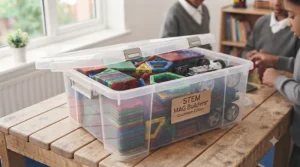
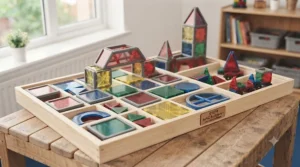
Getting real value from a large magnetic tile set for classrooms starts before a single tile touches the carpet. Sort pieces by shape into shallow, labelled trays rather than one large mixed tub — young children can independently find the piece they want far more quickly, and it builds early sorting and categorisation skills as a side effect of simple tidy-up routines. A dedicated floor space, ideally with a defined boundary like a rug or floor tape, helps larger structures survive being accidentally kicked over by children moving through the room, which is one of the most common causes of frustration and damaged pieces in busy settings.
Common first-term mistakes are worth flagging early. Storing tiles in a deep toy box invites piece damage, since larger structures collapse under the weight of children rummaging for a specific shape at the bottom. Introducing the full set to a very large group on day one, rather than a smaller key worker group first, tends to produce a scrum around popular pieces rather than genuine collaborative building — a staged introduction across a fortnight lets children develop shared-use habits before the whole set goes into general provision. Finally, skipping a simple daily piece-count check in the early weeks makes it far harder to notice when pieces are quietly disappearing into pockets or other classroom areas, an issue every setting eventually deals with at some point.
Real-World Scenarios: Matching the Set to Your Setting
Picture three different UK settings, each with a genuinely different requirement from a large magnetic tile set for classrooms. First, the small childminder or single key worker room with four to six children and a tight budget — here, the SUNNY AUNTIE Magnetic Tiles 125 PCS XL Set or PicassoTiles 100 Piece Set genuinely covers the need without overspending on capacity that will rarely be used simultaneously.
Second, the reception class or larger nursery room running a busy, rotating construction corner across a full school day, where different groups of children access the resource at different points. This is the classic case for choosing based on durability and expandability rather than price alone — Magna-Tiles Classic 100-Piece or Magna-Tiles Translucent Colors 100-Piece, ideally topped up over successive terms, tend to suit this pattern of heavy, varied daily use.
Third, the larger setting or school specifically equipping a dedicated construction area intended for group and shared play resources across an entire year group or key stage. Here, piece count stops being a nice-to-have and becomes the entire point — this is exactly the scenario the Connetix Rainbow/Pastel Mega Pack and Magna-Tiles City Center 110-Piece are built for, whether purchased together or the Mega Pack alone as the anchor resource for the whole area.
Buyer’s Decision Framework: Choosing by Situation
Rather than working through every spec individually, use this simple priority checklist. If your priority is trialling magnetic tiles on a tight budget before committing further, choose the SUNNY AUNTIE Magnetic Tiles 125 PCS XL Set, because its low entry price and included storage let a setting test genuine demand before a larger spend. If your priority is proven, long-term classroom durability, choose Magna-Tiles Classic 100-Piece or Magna-Tiles Translucent Colors 100-Piece, because both have the longest track record of daily nursery use across UK settings.
If your priority is adding storytelling and small-world depth to an existing collection, choose Magna-Tiles City Center 110-Piece, because its themed road and building pieces directly support narrative and Understanding the World activities. If your priority is refined build quality and brand compatibility, choose Connetix Pastel Creative Pack, because its bevelled edges and cross-brand compatibility let it slot into an existing collection cleanly. And if your priority is equipping a whole classroom or shared construction area for genuine group play, choose the Connetix Rainbow/Pastel Mega Pack, because its piece count is specifically built for several children building simultaneously without running short of any one shape.
How to Choose a Large Magnetic Tile Set for Classrooms
What is a large magnetic tile set for classrooms? In short, it’s a bulk pack of flat, magnet-edged geometric pieces — typically 100 pieces or more — designed so several children can build simultaneously, sized and reinforced for repeated daily handling in a nursery or school setting rather than occasional home play. Here’s how to choose the right one for your setting:
- Prioritise piece count over novelty shapes. A plain 150-piece set supports more simultaneous group play than a themed 60-piece set with unique but limited pieces.
- Check magnet type and placement. Ceramic ferrite ring magnets set into a bevelled or reinforced edge tend to hold their strength longer under heavy classroom handling than budget alternatives.
- Consider brand compatibility. Choosing a brand compatible with tiles you already own, such as Connetix or PicassoTiles alongside Magna-Tiles, protects future budget spend.
- Match tile size to your age group. Larger, chunkier tiles suit younger or additional-needs groups; standard sizing suits reception-age fine motor development.
- Plan storage before you buy. Shallow, shape-sorted trays extend a set’s working life far more than a single mixed toy box.
- Check UKCA or CE marking and age guidance. Any toy sold for use by under-14s in the UK must meet the Toys (Safety) Regulations 2011, and age labelling matters for mixed-age settings.
- Read aggregated review themes on durability, not just star ratings. Look specifically for comments about performance after months or years of daily use, since that’s the real test for a classroom resource.
Common Mistakes When Buying for Group and Classroom Settings
The single most common mistake settings make is buying based on the price-per-set rather than the price-per-piece for genuine group use. A cheap 60-piece set that leaves three of six children waiting for a turn isn’t actually good value, however low its sticker price looks against a larger, pricier alternative. The second common mistake is underestimating storage needs before the purchase arrives — a 200-piece mega pack needs genuine shelf or floor cupboard space, and settings that haven’t planned for this often end up storing tiles in a way that shortens their working life considerably.
Third, many settings buy a single brand without checking compatibility with tiles they may already own, unnecessarily duplicating shapes rather than genuinely expanding variety. Finally, it’s easy to overlook age-appropriateness for smaller detail pieces, such as the microMAGS included in themed sets — always cross-check manufacturer age guidance against your own setting’s risk assessment, particularly in mixed-age rooms where younger siblings or visiting children may access the resource unsupervised. RoSPA’s toy safety advice is a useful independent checklist here, recommending toys be checked periodically for wear and discarded or repaired once edges or fixings become damaged — a habit worth building into a set’s ongoing classroom life, not just its initial purchase.
Large Bulk Sets vs Small Individual Tile Packs
It’s worth being honest about when a genuinely large bulk set earns its higher cost against simply buying several smaller individual packs. Smaller packs, typically 20-50 pieces, are cheaper individually and easier to introduce gradually, but they rarely allow more than one or two children to build a meaningful structure at once, which limits their usefulness as shared play resources in a classroom setting.
| Factor | Large Bulk Set (100+ pieces) | Several Small Packs |
|---|---|---|
| Simultaneous builders | Comfortably supports 4-6+ children | Usually limits to 1-2 children per pack |
| Shape variety | Full range from a single coherent set | Can be patchy depending on which packs bought |
| Storage | One larger, well-organised system | Multiple smaller containers, easier to lose track of |
| Best For | Dedicated construction areas, whole-room resources | Small key worker groups, home corners, travel use |
A large bulk set like the Connetix Rainbow/Pastel Mega Pack or Magna-Tiles Classic 100-Piece wins decisively for genuine shared, collaborative construction, precisely because it removes the piece-scarcity that turns group play into competition. That said, for a small childminder setting or a home corner used by one or two children at a time, several smaller packs like the PicassoTiles 100 Piece Set can be a perfectly sensible, lower-cost alternative.
What to Expect: Real-World Performance in Group Play
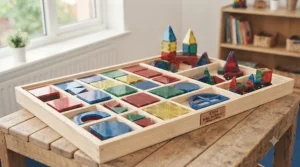
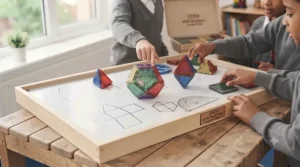
Specification sheets talk about piece counts and magnet strength, but what actually happens when six children share one tile set? With a genuinely large set, structures tend to grow collaboratively — one child starts a base, another adds walls, a third adds a roof — because there are simply enough pieces for everyone to contribute without waiting. With a smaller set, aggregated observation from practitioners consistently describes a different pattern: children building separately, in parallel, then dismantling their own work to free up pieces for someone else, which is a meaningfully different, more individualistic play experience.
Durability under group use follows a predictable pattern too. Magnets in premium sets like Magna-Tiles and Connetix maintain their strength through years of daily handling according to consistently positive aggregated reviewer sentiment, while budget sets more commonly show early signs of weakening magnetic connection after sustained heavy use, particularly in tiles that get dropped or stepped on regularly, which is an unavoidable reality of a busy classroom floor.
Long-Term Cost & Maintenance for Shared Classroom Resources
The purchase price is only part of the real cost of a shared classroom resource. Replacement and expansion packs are widely available for both Magna-Tiles and Connetix, meaning a setting can top up numbers or replace the occasional broken piece without buying an entirely new set, which meaningfully changes the total cost of ownership over several years compared with a budget brand where matching replacement pieces may be harder to source.
Looking at total cost of ownership rather than sticker price alone, a £95 Magna-Tiles Classic 100-Piece set that remains fully functional after five years of daily nursery use works out considerably cheaper per year of service than a £35 budget set needing replacement every twelve to eighteen months due to weakened magnets or cracked pieces. For most UK settings, budgeting for a premium 100-piece starter set in year one, then expanding with compatible add-on packs across subsequent budget cycles, tends to offer the most sensible balance between upfront spend and multi-year classroom value.
Storage and Durability: Protecting Your Investment
Storage and durability are genuinely the two factors that determine whether a large magnetic tile set for classrooms lasts five years or fifteen months. Stackable, shape-sorted trays or a low-level shelving unit at child height both protect pieces from being crushed under a mixed toy box and support the kind of independent tidy-up routines that free up staff time. Labelling trays with shape outlines, a classic Montessori-inspired approach, helps even very young children return pieces to the right place without adult prompting, which meaningfully extends the working life of a set that might otherwise end up as a jumbled, hard-to-use pile.
On durability specifically, the tiles that hold up best under years of classroom use share consistent features across this list: ultrasonically sealed edges rather than glued seams, ceramic rather than cheaper alnico magnets, and a bevelled or reinforced edge design that resists cracking when dropped onto a hard nursery floor. It’s a genuinely worthwhile trade-off to spend more upfront on a set built this way, since the alternative is quietly replacing a cheaper set every year or two as pieces fail one by one.
✨ Don’t Miss These Exclusive Deals!
🔍 Take your classroom’s construction area to the next level with these carefully selected sets. Click on any highlighted item to check current pricing and availability. These resources will help you build genuinely shared, lasting play experiences your whole class will love!
Safety, Regulations & Compliance for Nursery and Classroom Equipment
Any large magnetic tile set for classrooms sold in the UK must comply with the Toys (Safety) Regulations 2011, which set the essential safety requirements toys must meet before being placed on the market, including physical properties, choking hazard assessments for small parts, and UKCA or CE marking. Before introducing any set into a mixed-age room, check the manufacturer’s stated minimum age against your own setting’s risk assessment, particularly where themed sets include smaller detail pieces such as microMAGS.
Beyond product-specific regulation, settings registered with Ofsted also operate under the wider Early Years Foundation Stage statutory framework, which sets out the safeguarding and welfare requirements covering the safety and suitability of premises, environment and equipment more broadly. Keeping a simple record of when equipment was purchased, inspected for damage, and any pieces removed from circulation is good practice for demonstrating compliance during an inspection, and it’s a habit worth building into a term-by-term maintenance routine rather than leaving until an inspection is announced.
Frequently Asked Questions
❓ How many pieces should a classroom magnetic tile set have?
❓ Are magnetic tiles safe for nursery and preschool settings?
❓ Which magnetic tile brands are compatible with each other?
❓ How do you store magnetic tiles in a busy classroom?
❓ Do bigger magnetic tile sets last longer than smaller ones?
Conclusion
Choosing the right large magnetic tile set for classrooms really comes down to matching the size and build quality of the set to how many children will genuinely be building at once, not to whichever set happens to have the most striking box. Budget-conscious settings get a fair, honest option in the SUNNY AUNTIE Magnetic Tiles 125 PCS XL Set or PicassoTiles 100 Piece Set; most nurseries and reception classes will find their long-term sweet spot with Magna-Tiles Classic 100-Piece or Magna-Tiles Translucent Colors 100-Piece; and settings equipping a genuinely shared construction area have two credible premium routes in Connetix Pastel Creative Pack and the substantial Connetix Rainbow/Pastel Mega Pack.
Whichever set you choose, remember that storage habits and staged introduction matter almost as much as the tiles themselves — a modest set stored and rotated thoughtfully will often deliver more genuine collaborative play than an expensive set left in a jumbled box. As the wider research on constructive play makes clear, the value here isn’t really about the tiles at all; it’s about the shared problem-solving, negotiation and creativity that happen the moment several children start building something together.
Recommended for You
- Best Educational Magnetic Building Set 2026: 7 UK Picks
- Magnetic Train Set for Preschoolers: 7 Brilliant 2026 Picks
- 7 Best Magnetic Building Vehicles for Kids UK 2026 (Tested Picks)
Disclaimer: This article contains affiliate links. As an Amazon Associate, I earn from qualifying purchases. If you purchase products through these links, we may earn a small commission at no additional cost to you.
✨ Found this helpful? Share it with your friends! 💬🤗
