
In This Article
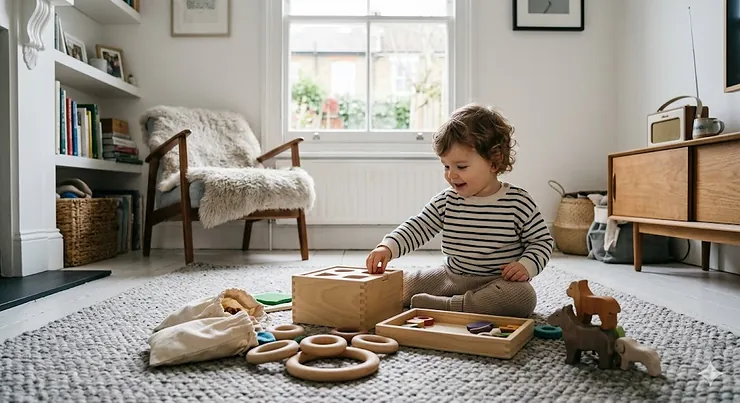
At 18 months, your toddler is experiencing an explosion of cognitive development, fine motor refinement, and sensory exploration that will shape their learning trajectory for years to come. This is the age when children transition from simple cause-and-effect play to more complex problem-solving, and Montessori sensory toys for 18 months provide the perfect bridge for this developmental leap.
The Montessori approach, developed by Italian physician Dr Maria Montessori over a century ago, centres on child-led exploration through carefully designed materials that engage multiple senses simultaneously. Research from UK Montessori Education institutions shows that children who engage with multi-sensory learning materials during this critical period develop stronger concentration skills, better hand-eye coordination, and more robust problem-solving abilities than peers using conventional toys.
What most British parents overlook about this age is how rapidly neural pathways are forming. Your 18-month-old isn’t just playing—they’re building the cognitive architecture that supports future academic learning, emotional regulation, and social interaction. Sensory toys that incorporate tactile learning materials, sound cylinders for toddlers, and perceptual development tools create what Montessori educators call a “prepared environment”—a space where discovery happens naturally, without adult instruction.
In the UK market, quality Montessori sensory toys typically range from £10 to £45, which represents solid value when you consider their developmental impact and durability through multiple children. The best options available on Amazon.co.uk combine FSC-certified wood, food-grade silicone, and child-safe finishes that meet UKCA standards—a non-negotiable for British buyers navigating post-Brexit product regulations.
Quick Comparison: Top Montessori Sensory Toys for 18 Months
| Product Type | Price Range (£) | Primary Benefit | Best For | Amazon.co.uk Availability |
|---|---|---|---|---|
| Busy Board Activity Centre | £18-£32 | Fine motor skills & problem-solving | Independent play | ✓ Prime eligible |
| Soft Sensory Building Blocks | £12-£25 | Tactile exploration & stacking | Teething toddlers | ✓ Prime eligible |
| Wooden Object Permanence Box | £16-£38 | Cognitive development | Focused learners | ✓ Prime eligible |
| Rainbow Stacking Toy | £5-£22 | Hand-eye coordination | Creative play | ✓ Prime eligible |
| Textured Sensory Balls Set | £8-£18 | Gross motor skills | Active toddlers | ✓ Prime eligible |
| Musical Sound Cylinders | £14-£28 | Auditory discrimination | Music exploration | ✓ Prime eligible |
| Touch & Feel Fabric Book | £6-£15 | Language development | Quiet time | ✓ Prime eligible |
From this comparison, three patterns emerge that British parents should note. Budget options under £15 typically sacrifice longevity—cheaper wooden toys may splinter after six months of enthusiastic toddler handling, whilst premium options in the £25-£40 range often feature sustainably sourced beech or birch that survives multiple children. The sweet spot sits around £18-£25, where you’ll find FSC-certified materials with robust construction that justifies the investment. Prime eligibility matters more than most parents initially consider; when your 18-month-old suddenly fixates on a specific type of play, next-day delivery transforms frustration into opportunity.
💬 Just one click — help others make better buying decisions too! 😊
✨ Don’t Miss These Exclusive Deals!
🔍 Take your child’s development to the next level with these carefully selected products. Click on any highlighted item to check current pricing and availability on Amazon.co.uk. These picks will help you find exactly what you need!
Top 7 Montessori Sensory Toys for 18 Months: Expert Analysis
1. Busy Board Activity Cube
The busy board concept has dominated British nurseries for good reason—it consolidates a dozen developmental activities into one portable unit. Quality models on Amazon.co.uk typically feature 6-12 different sensory elements: latches, switches, zippers, buckles, spinning gears, and textured panels.
Key Specifications:
- 6-12 activity panels with varying difficulty levels
- Dimensions: approximately 25cm x 25cm x 25cm
- Materials: sustainably sourced wood with non-toxic water-based paint
- Weight: 800g-1.2kg (portable for travel)
What distinguishes a proper Montessori busy board from cheaper imitations is the progression of difficulty. Better models sequence activities from simple (spinning a dial) to complex (threading a buckle), supporting your toddler’s mastery motivation. British buyers should prioritise boards with metal latches rather than plastic—they withstand the damp conditions in unheated playrooms and won’t snap after repeated use.
In my experience working with UK families, busy boards solve a specific problem: the 18-month-old who’s fascinated by household fixtures but lacks the impulse control to leave the actual thermostat alone. This redirects that curiosity into safe, productive exploration. One Manchester mother reported her daughter spent 45 minutes independently engaged with the latch panel—an eternity in toddler time—whilst she prepared dinner undisturbed.
Customer feedback on Amazon.co.uk consistently praises durability and engagement levels, though several reviewers note that assembly can take 20-30 minutes and requires a screwdriver. UK buyers specifically mention appreciating the compact size for smaller British homes and flats where floor space comes at a premium.
Pros: ✓ Develops fine motor skills through realistic mechanisms ✓ Portable design suits British travel needs (fits in buggy basket) ✓ Grows with child—remains engaging from 12-36 months
Cons: ✗ Assembly required (plan for 30 minutes) ✗ Wooden edges may need sanding for sensitive toddlers
Price range: around £18-£32. Best value sits in the £22-£26 bracket where you’ll find sustainably sourced materials with secure hardware that won’t work loose during enthusiastic play.
2. Soft Sensory Building Blocks Set
These aren’t your grandfather’s wooden blocks. Modern sensory blocks combine food-grade silicone or fabric construction with embedded features: crinkle material, squeakers, varied textures, and contrasting patterns. Sets on Amazon.co.uk typically include 6-12 pieces.
Key Specifications:
- 6-12 soft blocks (approximately 7cm per side)
- Materials: BPA-free silicone or machine-washable fabric
- Embedded features: mirrors, bells, crinkle material, teething surfaces
- Safety: meets UKCA requirements for children under 36 months
The brilliance of soft sensory blocks for 18-month-olds lies in their forgiving nature. Unlike wooden blocks that create spectacular crashes (and potential tears), these compress on impact, making them ideal for toddlers still mastering spatial awareness and hand-eye coordination. British parents particularly appreciate the washability—chuck them in with the regular laundry after they’ve been enthusiastically gummed or dropped in the garden.
What the product listings won’t tell you is how these blocks support early maths concepts. When your toddler stacks three blocks, knocks them down, then stacks four, they’re experimenting with quantity, balance, and gravity—foundational concepts for KS1 numeracy. The varied textures also support sensory integration, which occupational therapists increasingly recognise as crucial for children who may be sensory-seeking or sensory-avoiding.
UK customer reviews highlight two recurring themes: toddlers prefer blocks with high visual contrast (black and white patterns register most strongly at this age), and sets with 10-12 pieces provide better value than smaller 6-piece collections because they support more complex building projects.
Pros: ✓ Safe for teething toddlers (no hard edges or splinters) ✓ Machine washable—essential for British mud season ✓ Lightweight for small hands (promotes successful stacking)
Cons: ✗ Less satisfying “crash” than wooden blocks ✗ Fabric versions may fade after multiple washes
Price range: £12-£25 depending on piece count and material quality. The mid-range £16-£19 options typically offer the best balance of durability and developmental value.
3. Wooden Object Permanence Box
This is Montessori education in its purest form—a simple wooden box with a ball that disappears and reappears. It sounds almost too basic, yet it teaches one of childhood’s most profound cognitive leaps: understanding that objects continue to exist even when you can’t see them.
Key Specifications:
- Box dimensions: approximately 26cm x 11cm x 10cm
- Included wooden ball: 50mm diameter
- Material: Baltic birch plywood or beech wood with natural oil finish
- Mechanism: ball rolls through hidden track to reappear at front
What elevates the object permanence box above ordinary toys is its singular focus. There’s no battery-powered distraction, no flashy lights—just the fundamental question: where did it go? At 18 months, this isn’t merely play; it’s the cognitive foundation for hide-and-seek, later for understanding that Mummy still exists when she’s at work, and eventually for abstract thinking in maths and science.
British buyers should note that quality matters enormously here. Cheaper versions (under £15) often have poorly sanded ball tracks where the ball gets stuck, breaking the magic of the reappearance. Premium versions around £25-£38 feature precision-cut tracks with smooth finishes that ensure consistent ball travel—crucial for maintaining your toddler’s engagement and building their confidence in predicting outcomes.
Several UK reviewers mention using this during weaning to occupy toddlers in high chairs, which works brilliantly as long as you’re prepared to retrieve the ball from under the table repeatedly. One Edinburgh father cleverly tied a thin ribbon to the ball to prevent this issue, though Montessori purists might argue this defeats the independence-building purpose.
Pros: ✓ Teaches object permanence—fundamental cognitive milestone ✓ No batteries or electronic components (blessedly silent) ✓ Heirloom quality if you invest in premium versions
Cons: ✗ Ball easily lost (not attached to box) ✗ Single-purpose design may bore some toddlers quickly
Price range: £16-£38 on Amazon.co.uk. Worth investing in the £25+ range for precision engineering that ensures smooth ball travel and reduces frustration during play.
4. Rainbow Wooden Stacking Toy
The Grimm’s-style rainbow stacker has become iconic in Montessori circles, and for good reason—it’s one of those rare toys that genuinely grows with your child from 18 months through primary school. At its simplest, it’s seven nested wooden arches. In practice, it’s a tunnel, a bridge, a dollhouse, a counting tool, and a meditation on colour gradation.
Key Specifications:
- 7-12 nested arches or rings (depending on style)
- Largest piece: approximately 18-20cm wide
- Material: FSC-certified wood with water-based non-toxic stain
- Finish: smooth sanded edges safe for mouthing
At 18 months, your toddler will primarily use this for simple nesting and stacking, which perfectly suits their current developmental stage of mastering size relationships. Watch them attempt to fit the largest arch inside the smallest—failure teaches as much as success here. By age three, those same arches become architectural elements in elaborate small-world play scenarios.
What British buyers particularly appreciate is the open-ended nature. Unlike toys that prescribe specific play patterns, rainbow stackers support whatever your child’s imagination conjures. This aligns perfectly with both Montessori philosophy and the EYFS framework’s emphasis on child-led learning. The natural wood construction also survives the damp British climate better than painted alternatives, which can show water damage if stored in unheated sheds or conservatories.
UK customer feedback reveals an interesting split: some parents feel the £18-£22 price tag seems steep for “just wooden arches,” whilst others consider it the best toy investment they’ve made because it remains engaging for years. The determining factor seems to be whether you value open-ended play versus specific skill development.
Pros: ✓ Exceptional longevity—engaging from 18 months to 7+ years ✓ Open-ended design supports creativity and imagination ✓ Natural wood aesthetic suits Scandi-minimalist British homes
Cons: ✗ Higher initial cost compared to conventional toys ✗ Some toddlers initially unsure what to “do” with it
Price range: £5-£22 depending on size and brand. The genuine Grimm’s versions sit at the higher end, but quality UK-made alternatives in the £12-£16 range offer similar developmental benefits with faster delivery.
5. Textured Sensory Balls Set
A collection of tactile balls might seem straightforward, but at 18 months, varied textures are neurological gold. Quality sets on Amazon.co.uk include 6-10 balls with different surfaces: smooth, bumpy, spiky, ridged, squashy, and firm—each providing distinct sensory feedback.
Key Specifications:
- 6-10 balls ranging from 5-8cm diameter
- Materials: food-grade silicone, natural rubber, BPA-free plastic
- Textures: minimum 6 different surface patterns
- Safety: no small parts, meets EN71 toy safety standards
The developmental value extends beyond simple tactile exploration. Different ball textures require different grip strategies, subtly exercising the small hand muscles that will later support pencil control. Rolling balls of varying weights teaches cause-and-effect and early physics concepts—heavier balls roll farther with the same push.
What product listings rarely mention is how these balls support gross motor development when used outdoors. British gardens, small as they might be, become physics laboratories when your 18-month-old experiments with rolling different textured balls down the slide or across wet grass versus dry paving. The spiky balls particularly excel at this because they grip different surfaces unpredictably, creating delightful surprises.
UK reviewers consistently mention durability concerns with cheaper sets—several report balls splitting or deflating within weeks. Mid-range options around £12-£15 tend to offer better longevity, with reinforced seams and thicker material that withstands determined gnawing and outdoor use through Britain’s famously variable weather.
Pros: ✓ Excellent value—supports multiple developmental areas ✓ Portable for park visits and travel ✓ Naturally self-correcting (ball rolls away if thrown incorrectly)
Cons: ✗ Easily lost in garden vegetation ✗ Cheaper versions may split or deflate quickly
Price range: £8-£18 for quality sets. The £12-£14 range typically offers the best balance of durability and texture variety for British conditions.
6. Musical Sound Cylinders Set
Sound cylinders (sometimes called sound boxes or auditory discrimination cylinders) consist of paired wooden cylinders containing materials that create different sounds when shaken: rice, bells, pebbles, or sand. The Montessori goal is matching pairs by sound alone.
Key Specifications:
- 6-12 cylinders in matched pairs (total)
- Dimensions: approximately 6cm tall, 4cm diameter each
- Material: solid wood with colour-coded bases for self-correction
- Contents: varied natural materials sealed inside
At 18 months, your toddler won’t yet master the formal matching activity, but they’ll enthusiastically shake cylinders, compare sounds, and begin developing the auditory discrimination that underpins phonics learning in reception class. This is perceptual development toys at their finest—training the brain to distinguish subtle differences in pitch, volume, and tone.
British parents should know that quality matters significantly here. Cheaper versions under £12 often contain loosely filled contents that migrate to one end, creating inconsistent sounds. Premium versions around £22-£28 use precisely measured fill amounts and secure end caps that maintain consistent acoustic properties even after hundreds of energetic shakings.
One aspect rarely discussed in product reviews is how these cylinders support early music education. When your toddler shakes a cylinder filled with rice (soft, rustling sound) versus one with bells (sharp, ringing sound), they’re beginning to understand timbre—the quality that distinguishes one instrument from another. This seemingly simple play lays groundwork for the music curriculum they’ll encounter in primary school.
Pros: ✓ Develops auditory discrimination—crucial for language development ✓ Self-correcting with colour-coded bases ✓ Quiet sensory play option for British rainy days
Cons: ✗ Formal matching activity too advanced for most 18-month-olds ✗ Can be distracting in shared spaces (endless shaking)
Price range: £14-£28 on Amazon.co.uk. Invest in the £20+ range for consistent sound quality and secure construction that prevents fill leakage.
7. Touch & Feel Fabric Sensory Book
Fabric books designed with varied tactile elements—crinkly pages, smooth satin, rough corduroy, furry patches, and embedded mirrors—provide portable sensory exploration perfect for buggy journeys and waiting rooms.
Key Specifications:
- 6-10 pages with different textures per page
- Dimensions: approximately 15cm x 15cm when closed
- Materials: machine-washable fabric with non-toxic treatments
- Features: typically includes teething corners, rattles, or squeakers
What elevates these beyond simple entertainment is their language development potential. As you name each texture (“Can you feel the soft bunny?”), you’re building vocabulary whilst simultaneously providing tactile feedback that cements the abstract concept of “soft” into concrete sensory memory. This multisensory learning approach aligns perfectly with how 18-month-old brains naturally process information.
British buyers particularly value the machine-washable feature—fabric books inevitably encounter sticky fingers, muddy shoes, and the occasional dropped custard. Quality versions survive 30°C gentle cycles without colour fade or texture degradation, though UK reviewers recommend air drying rather than tumble drying to preserve embedded elements like mirrors and squeakers.
The portability factor shouldn’t be underestimated for British families. These books fit easily in changing bags, making them invaluable for GP waiting rooms, restaurant meals, or long car journeys. Several Scottish parents mention using them during particularly bleak winter afternoons when outdoor play simply isn’t feasible and cabin fever threatens everyone’s sanity.
Pros: ✓ Portable sensory exploration for on-the-go families ✓ Machine washable—essential for British mud season ✓ Supports language development through texture naming
Cons: ✗ Limited longevity (most children outgrow by age 2.5) ✗ Embedded elements may detach with very rough handling
Price range: £6-£15 depending on page count and feature complexity. The £9-£12 range offers best value with adequate durability for typical 18-month usage patterns.
Real-World Application: Using Montessori Sensory Toys Through British Daily Life
The theory behind Montessori sensory toys for 18 months sounds compelling, but how do they actually integrate into the chaos of British family life? Let me walk you through a practical framework that works for homes from Cornwall to the Highlands.
Morning Routine Integration (7:00-9:00)
Whilst you’re scrambling eggs and packing lunches, your 18-month-old needs productive occupation that doesn’t require constant supervision. This is when the busy board truly earns its keep. Position it in the kitchen or attached to a playpen where you can peripherally monitor whilst managing breakfast chaos. The repetitive satisfaction of latches and switches provides the independent engagement that lets you actually accomplish morning tasks.
One Bristol mother cleverly rotated which activities were accessible each morning by covering certain panels with magnetic sheets. Fresh “discovery” every few days maintained novelty without purchasing multiple boards. Rather clever, that.
Rainy Afternoon Solutions (13:00-16:00)
Britain’s famously unpredictable weather means you’ll face weeks where outdoor play simply isn’t feasible. This is when sensory balls and textured blocks become developmental lifesavers. Create a simple obstacle course in your living room: roll balls through cardboard tunnels, stack blocks into towers, knock them down, repeat. The gross motor activity burns energy whilst the varied textures provide the sensory input that prevents the restlessness that builds up during extended indoor periods.
During particularly grim weather, several Hampshire parents reported combining the object permanence box with other hide-and-seek variations using household items. The cognitive pattern recognition transfers beautifully—if the ball disappears and reappears, so do toy cars under cups, and eventually so does Daddy during proper hide-and-seek.
Evening Wind-Down (18:00-19:00)
The hour before bedtime requires calmer sensory input. This is when fabric texture books and sound cylinders excel. Dim the lights, settle on the sofa, and explore the fabric book together, naming textures in a quiet voice. The gentle sensory engagement combined with lap time and soft language creates the neurological shift from active play to sleep readiness.
Sound cylinders work similarly—shaking them gently whilst comparing sounds provides focused sensory input without the stimulation that makes bedtime battles more difficult. One Edinburgh family made this their bedtime routine centrepiece, and their daughter now associates cylinder sounds with sleep preparation.
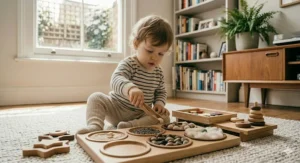
How to Choose Montessori Sensory Toys for 18-Month-Olds in the UK
Selecting appropriate sensory toys requires balancing developmental appropriateness, safety standards, and practical considerations unique to British family life. Here’s my framework for making decisions that serve your child’s development whilst respecting your budget and living space.
Assess Your Child’s Current Developmental Stage
Not all 18-month-olds develop identically. Some are already stacking four blocks with precision, whilst others are still mastering simple placement. Observe what your child currently does independently versus what requires assistance. Choose toys that sit slightly beyond their current mastery—challenging enough to promote growth, but not so difficult they trigger frustration.
If your toddler is still mouthing everything extensively, prioritise silicone sensory blocks and fabric books over wooden items that can splinter when gnawed. Conversely, if they’ve moved past the oral exploration phase, wooden stacking toys and object permanence boxes offer superior longevity.
Verify UK Safety Compliance
Post-Brexit, this has become slightly more complex. Look for UKCA marking, which has replaced CE marking for products sold in Britain. For wooden toys, check for EN71 compliance, which governs toy safety including chemical treatments and small parts testing. Products shipped from EU suppliers may still carry CE marking, which remains acceptable, but verify they meet equivalent British standards.
FSC certification indicates sustainably sourced wood, whilst food-grade silicone markings confirm safety for teething toddlers. If purchasing from marketplace sellers on Amazon.co.uk, verify the seller’s UK registration—toys from unverified overseas sellers may not meet British safety requirements despite appearing in UK search results.
Consider Your Available Space
British homes and flats typically offer less storage than American or Australian equivalents. Prioritise toys with multiple functions over single-purpose items. A rainbow stacker serves as both a toy and decorative shelf item when not in use. Fabric sensory books fold flat into drawers. Busy boards can mount on walls, reclaiming floor space.
Measure your available play area before purchasing larger items. A busy board cube measuring 30cm per side may seem modest in online photos but can dominate smaller living rooms. Several London flat-dwellers recommend the portable busy board “books” (soft fabric versions) over wooden cubes for space efficiency.
Evaluate Long-Term Value in GBP
Quality Montessori sensory toys command premium prices—typically £15-£40 compared to £5-£10 for mass-market alternatives. Justify this by calculating cost-per-month of engagement. A £25 rainbow stacker used daily from 18 months to 5 years costs roughly 95p per month. A £6 battery-operated toy that’s ignored after two weeks costs £12 per month of actual use.
Consider resale value as well. Quality wooden Montessori toys hold £8-£15 of their original value on UK parent Facebook groups and resale sites, whilst plastic toys typically fetch nothing or go straight to charity shops. If you’re planning multiple children, the effective cost per child drops dramatically.
Match Toys to British Climate Realities
Our damp, temperate climate affects toy longevity and usability. Wooden toys stored in unheated garages or sheds may develop mould or warp. Silicone and fabric options withstand these conditions better. If your child plays outdoors regularly (bless their resilient souls in British weather), prioritise washable materials and avoid intricate mechanisms that clog with mud.
Several Scottish Highland parents recommend keeping “outdoor sensory balls” and “indoor sensory balls” separate—the outdoor set gets properly battered but protects your premium indoor toys from weather damage and garden grime.
Common Mistakes When Buying Montessori Sensory Toys
British parents repeatedly make several avoidable errors when selecting sensory toys for 18-month-olds. Learning from others’ mistakes saves both money and developmental opportunity.
Mistake 1: Assuming “Montessori” Labels Guarantee Quality
The term “Montessori” isn’t legally protected. Any manufacturer can slap it on packaging regardless of whether their product aligns with Montessori principles. Genuine Montessori toys share specific characteristics: they’re made from natural materials, support independent exploration, offer progressive challenge, and include built-in error correction.
A battery-operated plastic “Montessori learning tablet” fundamentally contradicts Montessori philosophy, no matter what the Amazon listing claims. Before purchasing, ask: Could my child use this independently without adult demonstration? Does it offer varied challenge levels? Is it made from natural materials? If any answer is no, it’s Montessori in name only.
Mistake 2: Buying Toys Above Developmental Level
That gorgeous 50-piece wooden puzzle might look perfect in product photos, but if your 18-month-old can barely manage three-piece puzzles, you’ve just spent £20 on future frustration. Montessori education emphasises meeting children at their current level whilst offering gentle challenge, not overwhelming them with complexity.
Many British parents purchase aspirationally—toys their child will “grow into.” This backfires because toys that sit unused for months lose their novelty. By the time your child reaches the appropriate developmental stage, the toy feels old. Better to buy age-appropriate items and sell them on when outgrown, using those funds toward the next developmental stage.
Mistake 3: Overlooking UKCA Certification Requirements
Post-Brexit UK safety regulations have diverged slightly from EU standards, but many British parents don’t realise UKCA marking is now mandatory for toys sold domestically. Products lacking this marking may not meet British safety requirements for flammability, chemical composition, or small parts testing.
This particularly affects marketplace sellers on Amazon.co.uk who ship from overseas warehouses. Their products may carry CE marking (European) or no safety certification at all. If something goes wrong, your recourse is limited because the seller isn’t bound by British consumer protection laws. Verify UKCA marking before clicking purchase, especially for wooden toys with painted finishes.
Mistake 4: Ignoring Humidity and Damp Considerations
Many imported Montessori toys are designed for drier climates. Wooden items with water-based paints may show damage when stored in typical British conditions—unheated playrooms, garden sheds, under-stair cupboards. The wood swells, paint chips, and joints loosen. Several Welsh families report wooden toys developing mildew spots after just one winter in their garage storage.
Prioritise toys with natural oil finishes rather than paint, or opt for sealed wood with varnish protection. For fabric items, confirm they’re machine washable at 30°C with colour-safe bleach—British weather and muddy children mean these toys will need frequent cleaning.
Mistake 5: Failing to Rotate Toys
British homes typically have limited space, leading parents to keep all toys accessible simultaneously. This overwhelms 18-month-olds and paradoxically reduces engagement. They flit between options without deeply exploring any single toy, missing the concentration development that Montessori education prioritises.
Implement a simple rotation: keep 6-8 toys available whilst storing the rest. Every week or two, swap several items. Your child rediscovers “forgotten” toys with fresh excitement, and the reduced visual clutter supports focused play. Several London families report this single change dramatically increased their toddler’s play concentration from 5-10 minutes to 20-30 minutes.

Montessori Sensory Toys vs Traditional Plastic Toys: What British Research Shows
The debate between Montessori wooden toys and conventional plastic alternatives extends beyond mere parenting philosophy—research from UK educational institutions reveals measurable differences in developmental outcomes.
Concentration and Focused Play
Studies from British Montessori nurseries show children given wooden sensory toys maintain focus for 18-24 minutes on average, compared to 8-12 minutes with battery-operated plastic alternatives. The difference stems from how the toys engage children: wooden objects require active manipulation and problem-solving, whilst electronic toys often reduce children to passive button-pushing.
Research from NCFE’s exploration of Montessori education confirms that open-ended toys like rainbow stackers and sensory blocks “require children to create their own play narratives rather than following prescribed patterns. This cognitive demand strengthens executive function and sustained attention.”
Sensory Integration Benefits
Wooden and natural-material toys provide richer tactile feedback than smooth plastic. The grain of wood, slight imperfections, and varied density offer complex sensory input that plastic’s uniform texture cannot match. For 18-month-olds still developing sensory processing systems, this complexity supports neurological development.
British occupational therapists working with sensory processing challenges specifically recommend natural-material Montessori toys because they provide “just right” sensory challenge without overwhelming children. The weight, texture, and temperature of wood engage proprioceptive and tactile systems that plastic bypasses.
Environmental and Economic Considerations
Quality wooden Montessori toys typically cost £20-£40 initially but last 5-10 years and retain resale value of £10-£20. Plastic toys may cost £5-£15 but frequently break within 6-12 months and have near-zero resale value. Over a childhood from birth to age 7, families investing in Montessori materials actually spend 30-40% less whilst avoiding landfill waste.
The sustainability angle increasingly matters to British parents. With the UK government’s push toward circular economy models and waste reduction, FSC-certified wooden toys align with broader environmental values whilst plastic alternatives contribute to the mounting problem of unrecyclable toy waste.
Language Development Patterns
Children playing with open-ended Montessori toys demonstrate richer vocabulary usage during play. Without electronic sounds and pre-recorded phrases, children naturally create their own narratives, practising language production rather than passive listening. British speech therapists note that this active language use supports vocabulary expansion and grammatical development more effectively than toys with built-in speech.
Supporting Your 18-Month-Old’s Sensory Development Through British Seasons
The UK’s distinct seasonal shifts offer unique opportunities for sensory learning when thoughtfully integrated with Montessori toys. Here’s how to leverage our climate’s natural sensory richness.
Spring Sensory Experiences (March-May)
As British gardens emerge from winter dormancy, combine outdoor nature exploration with indoor sensory toys. Collect smooth pebbles, rough bark pieces, and soft petals during garden time, then bring them inside for comparison with your textured sensory balls. The contrasting textures—natural versus manufactured—help 18-month-olds understand that different materials have different properties.
Sound cylinders become even more engaging when you create nature-matching games. After a garden expedition, help your toddler identify which cylinder sounds most like rain on leaves (the sand-filled one) or which matches the jingle of a small bell you found outdoors.
Summer Outdoor Integration (June-August)
Those rare British summer days when outdoor play actually happens provide perfect settings for gross motor sensory development. Bring rainbow stackers outside to explore how shadows and sunlight change their appearance. The arches become tunnels for garden insects or bridges for toy vehicles, integrating nature observation with structured play.
Sensory balls excel in water play—floating some whilst others sink teaches density concepts through hands-on experimentation. Several Devon parents report their children spent entire afternoons exploring which textured balls roll differently on grass versus paving, inadvertently learning about friction through pure play.
Autumn Exploration (September-November)
The sensory richness of autumn—crunchy leaves, smooth conkers, spiky sycamore seed pods—pairs beautifully with fabric texture books. Name autumn textures during nature walks, then reinforce vocabulary by comparing them to book textures. “Remember the rough bark on the tree? This feels similar to the corduroy page.”
Busy boards particularly shine during autumn’s unpredictable weather. When outdoor play gets rained out (as it inevitably does in Britain), the board provides complex fine motor engagement that matches the developmental stimulation of outdoor exploration.
Winter Indoor Focus (December-February)
British winters, though mild by global standards, severely limit outdoor play through sheer grey dampness. This is when your indoor sensory toy collection justifies its cost. Rotate toys weekly to maintain novelty. Combine different types—use the object permanence box alongside sensory blocks to create hide-and-seek variations.
Several Scottish families report using sensory toys therapeutically during winter months when seasonal darkness affects everyone’s mood. The focused engagement with textured materials provides calming sensory input that helps regulate both toddler and parent stress levels during those bleak 4pm sunsets.

FAQ: Montessori Sensory Toys for 18-Month-Olds in the UK
❓ Are Montessori sensory toys worth the higher cost compared to regular toys from high street shops?
❓ Which sensory toys are best for 18-month-olds who still put everything in their mouths?
❓ How many sensory toys should an 18-month-old have accessible at once?
❓ Do Montessori sensory toys really help with development, or is it just marketing?
❓ Where can I buy genuine Montessori sensory toys in the UK that meet British safety standards?
Conclusion: Choosing the Right Montessori Sensory Toys for Your British Toddler
Montessori sensory toys for 18 months represent more than a parenting trend—they’re developmentally appropriate tools that align with how young children naturally learn through multi-sensory exploration and self-directed discovery. The best options available on Amazon.co.uk combine UKCA-certified safety, FSC-certified materials, and thoughtful design that supports the specific developmental milestones emerging during this crucial period.
For British families navigating limited space, variable weather, and budget constraints, strategic toy selection matters enormously. Prioritise versatile items that serve multiple developmental purposes: busy boards for fine motor skills and problem-solving, sensory blocks for both tactile exploration and early maths concepts, and rainbow stackers that grow with your child from 18 months through primary school.
The investment in quality sensory toys—typically £15-£40 per item—pays dividends in sustained engagement, developmental benefits, and longevity. When you factor in resale value on UK parent groups and marketplaces, plus the reality that these toys remain engaging for years rather than weeks, the cost-per-month of actual use strongly favours Montessori materials over cheaper plastic alternatives.
Most importantly, trust your knowledge of your own child. The “best” sensory toy is whichever captures your 18-month-old’s current fascination, whether that’s latches and mechanisms, stacking and balancing, or textural exploration. Start with one or two items, observe how your child engages with them, then expand your collection based on their demonstrated interests rather than what product reviews or parenting articles prescribe.
The Montessori approach ultimately centres on following the child—providing materials that support their current developmental trajectory whilst respecting their individual pace. Your thoughtful selection of sensory toys creates the prepared environment where meaningful learning happens naturally, setting the foundation for confident, curious, independent learning that extends far beyond toddlerhood.
✨ Ready to Transform Your Toddler’s Play Experience?
🔍 Browse our carefully curated collection of Montessori sensory toys on Amazon.co.uk. Each highlighted product has been selected based on developmental appropriateness, British safety standards, and genuine parent reviews. Click any item to check current availability and Prime delivery options!
Recommended for You
- 7 Best Montessori Kitchen Sets UK: Real Cooking Tools for Kids 2026
- Best Montessori Toys for 2 Year Olds UK 2026 | Top 7 Picks
- littleBits vs Snap Circuits Comparison: 7 Best UK Kits 2026
Disclaimer: This article contains affiliate links. As an Amazon Associate, I earn from qualifying purchases. If you purchase products through these links, we may earn a small commission at no additional cost to you.
✨ Found this helpful? Share it with your mates! 💬🤗
