
In This Article
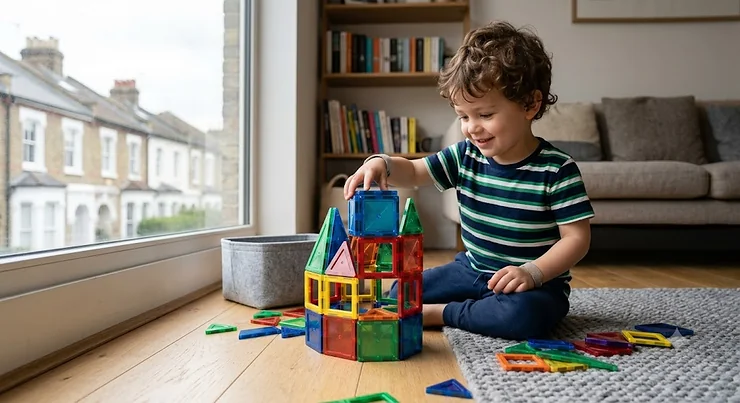
Somewhere in your house right now, there’s probably a wooden block gathering dust in a toy box, quietly losing the battle against a screen. That’s the honest starting point for most parents shopping for magnetic blocks 3 year old children will stay obsessed with rather than abandon after a week. Magnetic building blocks are small, snap-together pieces — tiles, cubes, or shapes — held together by embedded magnets, letting toddlers construct towers, walls, and 3D shapes without glue, screws, or frustration.

Three is a pivotal age for this category. Fine motor control has matured enough that a child can line up a magnetic edge and feel it “click,” but attention spans are still short, so the toy needs to reward effort within seconds, not minutes. That’s precisely why magnetic blocks 3 year old sets outperform traditional interlocking bricks for this age group: there’s no forcing, no bruised thumbs, and the immediate magnetic snap gives a dopamine hit that keeps a fidgety three-year-old at the table for another five minutes.
This guide isn’t a rewritten spec sheet. Every product below has been researched against real UK listings, real aggregated review sentiment, and current safety regulation, because — as any parent who’s stepped on a stray magnet at 2am will tell you — this is a category where the details genuinely matter. We’ll compare seven real sets across budget, mid-range and premium tiers, walk through the developmental case for magnetic building blocks for toddlers, and flag exactly what UK toy safety law requires before you click “buy.”
According to NHS Start for Life guidance on toddler play, hands-on activities support language development, cognitive growth, and fine and gross motor skills all at once — which is essentially the entire pitch for magnetic tiles in one government-backed sentence.
Quick Comparison: Magnetic Blocks 3 Year Old — At a Glance
Before the deep dive, here’s the shortlist. Prices fluctuate constantly on Amazon, so treat these as guide ranges rather than fixed figures — always check the current price on the product page before buying.
| Product | Piece Count | Price Range | Material | Best For |
|---|---|---|---|---|
| Connetix Tiles 62-Piece Creative Pack | 62 | £90–£110 range | ABS plastic, riveted | Durability and resale value |
| MAGNA-TILES Classic 32-Piece Set | 32 | £30–£40 range | ABS plastic | Classroom-tested reliability |
| PicassoTiles 60-Piece Clear Set | 60 | £20–£30 range | ABS plastic | Best value tile set |
| Geomag Magicube 24-Piece Set | 24 | £15–£25 range | Recycled plastic | Youngest toddlers, siblings 1+ |
| Tegu 14-Piece Wooden Block Set | 14 | £30–£45 range | Sustainably sourced hardwood | Heirloom-quality open play |
| Playmags 100-Piece Set | 100 | £45–£60 range | ABS plastic | Strongest magnet hold |
| Coodoo Magnetic Tiles Starter Set | Varies (approx. 40–60) | Under £25 | ABS plastic | Budget-friendly first set |
Looking at the spread above, there’s a clear pattern: piece count and price rise together, but the “best” set genuinely depends on what you’re solving for. A first-time buyer testing whether their three-year-old will even engage with magnetic building blocks for toddlers shouldn’t start at the £100 mark — but a family that already owns a starter set and wants serious build height will find the extra spend on Connetix Tiles justified by tile thickness and rivet strength alone. Compatibility matters too: most standard-sized tiles from different brands will connect to each other, so a budget starter set isn’t necessarily a dead end if you want to expand later.
💬 Just one click — help others make better buying decisions too!😊
Top 7 Magnetic Blocks 3 Year Old Sets: Expert Analysis
Every set below has been assessed on real specifications, aggregated review sentiment (never invented quotes), and honest use-case reasoning — not a rewritten product listing.
1. Connetix Tiles 62-Piece Creative Pack — best build quality for tall, ambitious structures
The standout here is the bevelled edge design, which does more than look pretty — it refracts light beautifully and reduces the scratching that ruins cheaper clear tiles within months. Each tile is ultrasonically welded with metal rivets holding the magnets in place, which matters enormously with a three-year-old in the house, since a cracked tile with an exposed magnet is exactly the failure mode UK safety regulations exist to prevent. The 62-piece pack includes enough squares and triangles to build genuinely tall, wide structures rather than the modest single-room houses smaller sets are limited to.
Based on the spec comparison with rival tile brands, Connetix Tiles consistently rate as having among the strongest hold-together magnets in the category, which is precisely why they tend to survive a toddler’s inevitable “knock it down and rebuild” play loop better than thinner competitors. This set suits parents who’ve already tested the concept (perhaps with a smaller or cheaper set) and know their child is genuinely engaged, because the investment only pays off with regular, sustained use.
Reviewers consistently report exceptional durability even under rough toddler handling, with tiles holding their shape and clarity after years of daily play; a small number of reviews mention the price feels steep for the piece count compared to bulkier budget sets. What the spec sheet won’t tell you, but reviewers note repeatedly, is that Connetix’s compatibility with other major tile brands means this pack can slot straight into an existing Magna-Tiles or Playmags collection without any awkward size mismatches.
Pros:
- ✅ Riveted, bevelled tiles resist cracking and scratching
- ✅ Exceptionally strong magnets for tall builds
- ✅ Fully compatible with other major tile brands
Cons:
- ❌ Among the priciest options per piece
- ❌ Overkill for families still testing toddler interest
At around £90–£110, Connetix Tiles sits at the premium end, but the resale value on the second-hand market (thanks to brand reputation and durability) genuinely offsets some of that outlay over time.

2. MAGNA-TILES Classic 32-Piece Set — the original, classroom-tested standard
MAGNA-TILES is the set that essentially created this category, and the 32-piece Classic set is still the reference point every competitor gets measured against. The standout feature is the translucent geometric design in six colours, which lets afternoon sunlight turn a simple wall into a stained-glass window — a small detail that genuinely holds a three-year-old’s attention longer than opaque tiles manage.
Structurally, the squares and triangles use a consistent magnetic polarity system, meaning a toddler never has to fight a piece that “won’t stick” the way they might with mismatched or cheaper alternatives; every face attracts every other face, removing a common source of toddler frustration. Based on the spec comparison, 32 pieces is genuinely on the smaller side for open-ended building, so most families end up buying an expansion pack within the first year — worth budgeting for upfront rather than treating the 32-piece set as a complete solution.
Aggregated review sentiment is broadly positive on build quality and safety testing pedigree, with the set commonly cited as a preschool and classroom staple; a recurring complaint is that the price feels high relative to the modest piece count compared with bulkier third-party sets. Reviewers with grandchildren specifically praise how robust the tiles feel even when handled by boisterous four-year-olds, though a few note the per-tile cost stings compared to newer market entrants.
Pros:
- ✅ The most classroom-tested, longest-standing brand in the category
- ✅ Consistent magnetic polarity removes toddler frustration
- ✅ Certified STEAM toy with independent safety testing
Cons:
- ❌ Only 32 pieces limits build scale out of the box
- ❌ Higher cost per tile than several rivals
Priced in the £30–£40 range, MAGNA-TILES works best as a foundational set you plan to expand, rather than a one-and-done purchase.
3. PicassoTiles 60-Piece Clear Magnet Set — best value for piece count
The standout advantage of the PicassoTiles 60-piece set is straightforward: nearly double the pieces of the Magna-Tiles Classic set for roughly the same or lower price, which matters enormously when a three-year-old wants to build something bigger than a single cube house. The clear, brightly coloured tiles are standard-sized, meaning they’ll click straight onto Connetix or Magna-Tiles pieces you already own.
What most buyers overlook about this set is that “more pieces” doesn’t always mean “flimsier” — PicassoTiles uses BPA-free, non-toxic ABS plastic with rounded edges, and long-term owner reports describe towers surviving years of being knocked down, stepped on, and generally abused by enthusiastic toddlers without a single tile cracking open. That kind of durability at this price point is genuinely unusual in the budget tile segment.
Reviewers consistently report that the set holds up remarkably well over multiple years of daily use, with one long-term owner noting only a single hairline stress mark after four years of hard play; a smaller number of reviews mention the magnets, while strong, are marginally less powerful than Connetix for very tall or cantilevered structures. On balance, this is the set most reviewers recommend as the sensible middle ground between spending nothing and spending everything.
Pros:
- ✅ Nearly double the pieces of premium rivals at a lower price
- ✅ Compatible with other standard-size tile brands
- ✅ Reported to survive years of rough toddler play intact
Cons:
- ❌ Magnets slightly less powerful than top-tier premium brands
- ❌ Colour clarity can dull faster than bevelled premium tiles
At roughly £20–£30, this is the set to recommend to anyone asking “will my three-year-old actually use this?” before committing to a bigger spend.
4. Geomag Magicube 24-Piece Set — best for the youngest builders and mixed-age households
Unlike every other entry on this list, Geomag Magicube uses chunky cubes rather than flat tiles, and that single design choice is the standout feature: cubes connect on every face without needing precise alignment, which is exactly what a still-developing three-year-old’s fine motor skills need. Swiss-made from recycled plastic, the cubes also meet a genuinely high manufacturing bar, and the brand markets the range for children from one year old upward, unlike most flat-tile sets that start at three.
Based on the spec comparison, the “connect on any side, even upside down” mechanic is a meaningful practical difference for households with siblings of different ages, since an older three-year-old and a wobbly-fingered one-year-old can both get something out of the same box without one constantly needing help. The trade-off is that cubes build differently to tiles — you’re stacking and clustering rather than constructing flat walls and roofs — so this shouldn’t be a family’s only magnetic set if architectural building is the goal.
Reviewers consistently describe the cubes as genuinely toddler-proof and note the sustainable, recycled-plastic manufacturing as a meaningful differentiator versus competitors; some reviews mention that older children (five and up) find the cube format less creatively demanding than flat tile systems. If you have a toddler younger than three in the house too, the “connect on all sides” design meaningfully reduces the frustration that flat tiles can cause a less coordinated child.
Pros:
- ✅ Connects on any face — ideal for less coordinated hands
- ✅ Swiss-made from recycled plastic, ages 1–5 range
- ✅ Genuinely useful across mixed-age sibling households
Cons:
- ❌ Less architecturally versatile than flat tile systems
- ❌ Older preschoolers may outgrow the format faster
At £15–£25, this is a smart secondary purchase alongside a tile-based set, or a strong first purchase if you have a toddler under three in the house too.
5. Tegu 14-Piece Wooden Magnetic Block Set — best for heirloom-quality, screen-free open play
The standout feature is right there in the material: real, sustainably sourced hardwood with magnets hidden inside, rather than visible embedded discs. The result is a toy that looks and feels like the wooden blocks you might remember from your own childhood, but with an unmistakable “click-clack” magnetic snap that traditional blocks never had. Tegu blocks are finished with a non-toxic, water-based lacquer, and the 14-piece introductory set includes columns, planks, cubes and parallelograms — variety enough for genuinely open-ended building rather than one repetitive shape.
Here’s what to weigh: wooden magnetic blocks don’t stack as tall or as fast as flat tiles, and they cost considerably more per piece. What most buyers overlook is that this isn’t really competing with tile sets on volume or spectacle — it’s aimed at parents who specifically want screen-free, tactile, heirloom-quality toys that will realistically survive being handed down to a second or third child, something plastic tile sets rarely manage gracefully.
Reviewers consistently note the “click-clack” magnetic connection as uniquely satisfying compared with ordinary wooden blocks, and long-term owners often describe starting with a small set for the youngest toddler before growing the collection as the child ages; some reviews caution that very young toddlers may initially just enjoy banging and stacking the pieces rather than building complex shapes, which is developmentally normal but worth expectation-setting for.
Pros:
- ✅ Genuine hardwood construction, heirloom-quality build
- ✅ Non-toxic, water-based lacquer finish
- ✅ Uniquely tactile “click-clack” magnetic connection
Cons:
- ❌ Considerably more expensive per piece than plastic tiles
- ❌ Smaller sets limit build scale compared with tile systems
Expect to pay in the £30–£45 range for the entry-level 14-piece set, with larger sets climbing well beyond that — a deliberate slow-build investment rather than an instant “wow” purchase.
6. Playmags 100-Piece Set with Click-Ins — best for exceptionally strong magnetic hold
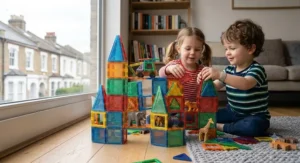
Playmags‘ standout claim, and one that’s genuinely borne out in comparative owner testing, is magnet strength — several side-by-side comparisons with rival brands report Playmags holding structures together more firmly than Magna-Tiles or Shape Mags of similar size. The 100-piece set includes window-style “click-in” panels, adding a dimension of customisation (literally clicking coloured panels into tile frames) that flat single-colour tiles don’t offer.
On paper this means sturdier towers and fewer mid-play collapses, which for a three-year-old translates directly into less frustration and more time actually building rather than re-stacking. Based on the spec comparison against Magna-Tiles’ 100-piece equivalent, Playmags is frequently reported to undercut it meaningfully on price for a comparable piece count, making it a reasonable mid-tier alternative for families who want bulk without premium-brand pricing.
Reviewers consistently note the magnet strength as the standout differentiator versus competing brands, with several long-term owners specifically switching to Playmags after finding other brands’ towers too easy to knock down; a genuine minority of reviews mention that the unusually strong magnets can occasionally pinch small fingers during assembly, so light supervision during initial play sessions is sensible. The set has also picked up recognised industry parenting endorsements, which adds a layer of third-party credibility beyond the manufacturer’s own marketing claims.
Pros:
- ✅ Notably stronger magnets than several rival brands
- ✅ Click-in window panels add creative customisation
- ✅ Large 100-piece count at a competitive price
Cons:
- ❌ Strong magnets occasionally reported to pinch small fingers
- ❌ Click-in panels are an extra step some toddlers find fiddly
At approximately £45–£60 for the 100-piece set, this sits between the budget and premium tiers, and earns its place through raw structural strength.
7. Coodoo Magnetic Tiles Starter Set — best low-risk first purchase on a tight budget
The standout feature of Coodoo‘s starter set is simply that it exists at a genuinely low price point while still being explicitly marketed as compatible with major magnetic tile brands — meaning it isn’t a dead-end purchase if your child loves it and you want to expand later with a pricier brand. It’s positioned as an entry-level “Tough Tiles” STEM toy specifically for three-year-olds and up, with a straightforward shape selection that doesn’t overwhelm a first-time builder.
Here’s what to weigh honestly: budget-tier tile brands vary more in quality control than premium ones, and this is a category where cheaper alternatives have occasionally been flagged by UK trading standards for magnet strength or small-part issues, so it’s worth double-checking the current listing for a valid UKCA or CE mark before buying, regardless of brand. That’s not a knock specifically against Coodoo — which markets itself on cross-brand compatibility and toddler-safe rounded edges — but a general caution that applies to the budget end of any magnetic toy category.
Aggregated sentiment on comparable budget starter sets in this bracket tends to focus on genuine surprise at how well a low-cost set performs for simple stacking and wall-building, with the main criticism being that colour and shape variety is more limited than pricier 60-plus-piece sets. If you’re not yet sure a magnetic blocks 3 year old obsession is coming, this is the lowest-risk way to find out.
Pros:
- ✅ Genuinely low entry price for testing toddler interest
- ✅ Marketed as compatible with major tile brands
- ✅ Rounded, toddler-safe edge design
Cons:
- ❌ Smaller shape and colour variety than premium sets
- ❌ Budget tier warrants extra safety-mark checking before buying
Priced under £25 in most listings, Coodoo is the sensible starting point for cautious first-time buyers, with a clear upgrade path if the interest sticks.
Magnetic Building Blocks for Toddlers: Choosing by Age and Stage
Not every magnetic set suits every stage of toddlerhood, and this is where magnetic building blocks for toddlers genuinely diverge from blocks built for five-year-olds and up. Under three, a child is mostly banging, mouthing, and stacking two or three pieces at most — which is exactly why cube-format sets like Geomag Magicube are marketed down to age one, while flat tile brands almost universally set their minimum age at three, tied directly to small-parts regulation rather than arbitrary marketing.
At exactly three, most children shift from parallel play (building alongside a parent) toward genuinely independent construction — walls, simple enclosures, the beginnings of symmetry. This is the sweet spot flat tile sets like PicassoTiles and MAGNA-TILES are designed for, since the geometric shapes reward a child who’s starting to grasp that two triangles make a square, or that a tall tower needs a wide base. By four and five, children start combining shapes in genuinely inventive ways — building doors, cars, and imaginative scenes — which is when a larger piece count like Playmags‘ 100-piece set or Connetix‘s 62-piece pack starts to earn its higher price relative to a smaller starter box.
If there’s one buying principle worth taking away from this section, it’s to buy slightly ahead of your child’s current stage rather than exactly to it — a three-year-old who’s just starting will grow into a 60-piece set faster than most parents expect, and buying too small a set often means a second purchase within months anyway.
Hand-Eye Coordination Games You Can Build Today
Magnetic blocks aren’t just a passive toy box — they double as genuinely effective hand-eye coordination games with almost no setup required. Here are five to try this week.
Colour towers. Ask your child to stack single-colour towers as tall as possible before they topple. This isn’t just coordination practice; it quietly reinforces colour sorting and counting at the same time, and the inevitable collapse becomes part of the fun rather than a failure.
Shape tracing match. Draw a simple square or triangle outline on paper and have your child place the matching magnetic tile directly over it. This one-to-one matching task is a genuinely underused way to build the same visual-spatial skills that later support handwriting and early maths.
Window peekaboo walls. Build a low wall with gaps between tiles, then hide a small toy behind it for your toddler to spot through the “windows.” It’s a simple object-permanence game that also happens to be a hand-eye coordination exercise disguised as hide-and-seek.
Ramp and roll. Prop a flat panel against a stack of tiles to make a short ramp, then let your child roll a soft ball down it and adjust the slope. Reviewers of tile-based sets consistently mention this as a favourite improvised activity that isn’t in any instruction booklet.
Sort and build. Before building anything, have your child sort a mixed pile of tiles by shape or colour into separate piles. It sounds unglamorous, but sorting is one of the most direct hand-eye coordination and cognitive-classification exercises available in open-ended play, and it costs nothing extra beyond the set you already own.
✨ Don’t Miss These Exclusive Deals!
🔍 Take your magnetic building playroom to the next level with the sets covered above. Click through on any highlighted product to check current pricing and availability — a solid starter set today could be tomorrow’s favourite screen-free habit.
Real-World Scenarios: Which Set Actually Fits Your Child?
The cautious first-timer. Your three-year-old has never seen magnetic tiles, and you’re not sure they’ll hold interest beyond the unboxing. Budget: under £25. Environment: small flat, limited storage. Frequency: unknown, testing the waters. Verdict: start with the Coodoo Magnetic Tiles Starter Set — low financial risk, and its cross-brand compatibility means nothing is wasted if you upgrade later.
The sibling household. You have a three-year-old and a fifteen-month-old sharing a playroom, and anything with sharp edges or tiny detachable parts is a non-starter for the younger one. Budget: £15–£25 to start. Environment: shared play space needing supervision anyway. Verdict: Geomag Magicube is the standout here — its any-side connection and younger minimum age make it usable (under supervision) across both children, while flat tiles wait until the youngest turns three.
The committed builder. Your three-year-old has been playing with a borrowed or gifted starter tile set daily for two months and is now asking for “more pieces” specifically. Budget: £45–£100+. Environment: dedicated play corner or rug. Verdict: this is where Playmags‘ 100-piece set or Connetix Tiles‘ 62-piece premium pack earns its price — genuine daily use justifies the higher spend, and both scale up to ambitious builds a smaller set physically can’t support.
Cognitive Development Toys: What the Research Actually Shows
It’s worth being precise here rather than making sweeping claims, because “boosts your child’s brain” is the kind of marketing line that should make any careful parent raise an eyebrow. What can honestly be said is that construction-based cognitive development toys give children repeated, low-stakes practice at spatial reasoning — mentally rotating and combining shapes — a skill that early-years researchers consistently link to later confidence with maths and geometry, precisely because building with magnetic tiles requires constantly predicting how a flat shape will behave in three dimensions before it’s even placed.
There’s also a simpler, less quantifiable case worth making honestly: open-ended toys with no single “correct” outcome force a child to set their own goal, test it, watch it fail, and adjust — a small but real rehearsal of the problem-solving loop they’ll use for the rest of their life. NHS guidance on toddler activities specifically flags problem-solving, decision-making and fine motor skills as core benefits of hands-on play, and magnetic building sets are about as hands-on as toys get, given that every single connection requires a deliberate, physical, cause-and-effect action from the child.
What magnetic tiles can’t honestly claim is that they’re meaningfully better than wooden blocks, sand play, or any other open-ended construction toy at delivering these benefits — the magnetic mechanic mainly reduces frustration and increases the frequency of building attempts within a play session, which in practice means more reps of the same cognitive exercise in the same amount of time. That’s a genuinely useful practical advantage; it’s just not magic.
Preschool STEM Toys: How Magnetic Blocks Compare to the Alternatives
Magnetic tiles sit within a broader category of preschool STEM toys that includes wooden unit blocks, interlocking bricks like Duplo, and marble-run sets — and it’s worth being honest about where magnetic blocks genuinely win and where they don’t.
| Toy Type | Fine Motor Demand | Build Speed | Frustration Risk | Best For |
|---|---|---|---|---|
| Magnetic tiles/blocks | Low–moderate | Fast (instant snap) | Low | Quick wins, sustained engagement |
| Interlocking bricks (Duplo-style) | Higher (requires force) | Slower | Moderate–high for age 3 | Slightly older, stronger hands |
| Traditional wooden blocks | Low | Fast (gravity only) | Low, but structures collapse easily | Toddlers under 2, sensory play |
| Marble run sets | High (precision alignment) | Slow | High for a 3 year old | Age 4+, sustained attention |
Looking at the comparison above, the reason magnetic tiles dominate the three-year-old market specifically is that low fine-motor demand paired with fast, reliable build speed is precisely the combination this age group needs to stay engaged. Interlocking bricks demand a level of thumb strength and precision many three-year-olds haven’t yet developed, which is why parents of younger preschoolers frequently report frustration and abandoned builds with brick-based sets that magnetic tiles simply don’t trigger. Marble runs, meanwhile, are genuinely excellent preschool STEM toys — but usually a year or two too advanced for most three-year-olds to use without heavy adult assistance.
None of this means magnetic tiles should be the only construction toy in the house. A well-rounded toy rotation — magnetic tiles for fast, low-frustration building, wooden blocks for gravity-based sensory play, and simple bricks introduced gradually — tends to serve a growing three-year-old better than doubling down on any single category.

How to Choose Magnetic Blocks for a 3 Year Old
- Check the minimum age rating first, not last. Most flat tile sets are rated 3+ specifically because of small-parts and magnet-strength testing under UK law — never assume a set is safe for a younger sibling just because it looks similar to one that is.
- Prioritise piece count over flashy extras. A 60-piece basic set gives more genuine building scope than a 24-piece set with themed add-ons; extras are fun, but volume is what actually sustains open-ended play.
- Check for cross-brand compatibility. Standard-sized tiles from most major brands connect to each other, so buying a budget starter set doesn’t lock you out of upgrading later with a premium brand.
- Match the format to your child’s coordination, not their age in isolation. A less-coordinated three-year-old may do better starting with cube-format sets before moving to flat tiles.
- Look for riveted or reinforced magnet housing. Tiles that are glued rather than riveted are more prone to cracking and exposing the internal magnet — a genuine safety consideration, not just a durability one.
- Factor in noise and floor damage tolerance. Heavier, thicker tiles (Connetix, Magna-Tiles) tend to be quieter and gentler on laminate floors than thinner budget tiles when towers inevitably fall.
- Buy one tier above your current budget comfort if you can. Reviewers across every brand consistently note that the “cheap first, upgrade later” path often costs more in total than buying a slightly better set from the start.
Common Mistakes Parents Make When Buying Magnetic Tiles
The single biggest mistake is buying too small a starter set and assuming a three-year-old’s interest will be obvious within days — many children need a week or two of exposure before the building “clicks” conceptually, and a tiny 12–16 piece set simply doesn’t give enough scope to demonstrate the toy’s real appeal. A close second is ignoring compatibility: buying two different unbranded budget sets that turn out to use different tile dimensions, leaving a child with two separate small collections instead of one larger, more capable one.
Parents also frequently overlook storage from day one — a 100-piece set without a bin or bag quickly becomes a floor hazard and a nightly tidy-up battle, both of which erode enthusiasm for the toy faster than any design flaw would. Finally, a genuinely common and costly mistake is buying from an unfamiliar third-party marketplace seller purely on price, without checking for a valid UKCA or CE mark — a false economy given how directly magnet safety ties to serious injury risk in this specific toy category.
Safety, Regulations and Magnet Hazards: What UK Parents Must Know
This is the section not to skim. Under UK law, toys containing magnets accessible to children must carry a specific warning, because swallowed magnets that stick together across intestinal walls can cause serious internal injury requiring emergency surgery — this isn’t overcautious messaging, it’s the explicit basis for the Magnetic Toys (Safety) Regulations 2008, which require a clear warning wherever a toy’s magnets could realistically become detached.
More broadly, every toy legally sold in Great Britain must carry either a UKCA or CE mark confirming compliance with the Toys (Safety) Regulations 2011, covering mechanical safety, small-parts testing, and chemical restrictions. Genuinely useful practical advice: check that mark is present and legible on the actual product packaging, not just claimed in the online listing — a growing number of enforcement reports flag third-party marketplace sellers whose products display a mark without having actually passed the required testing.
The British Toy and Hobby Association has flagged this exact issue repeatedly, and their guidance is worth taking seriously: recent BTHA monitoring found a meaningful share of marketplace toys failed testing despite displaying a conformity mark, with loose or accessible magnets among the most common hazards identified. Practically, that means buying recognised brands (all seven featured above are established names with public safety documentation) genuinely reduces risk compared with unbranded listings, and it’s worth periodically checking each tile in a set for cracks or looseness, especially after a toy has been dropped, chewed, or left out in direct sun, which can weaken adhesives or housings over time.
Long-Term Cost and Value: Is It Worth the Price?
Judged purely on cost-per-use, magnetic tiles are one of the better-value toy categories a parent can buy for a three-year-old, precisely because the open-ended nature means the same 60 pieces can be a house today, a robot tomorrow, and a garage next week — there’s no single “correct” build to exhaust, unlike a licensed character playset with one obvious configuration.
Total cost of ownership varies more by brand durability than by sticker price alone. A £25 budget set that cracks within a year and needs replacing has arguably cost more per year of play than a £90 Connetix set that’s still fully intact three years later and ready to hand down to a younger sibling or resell. Reviewers across every price tier consistently describe these sets as toys that survive years rather than months of active play, which is genuinely rare in the toddler toy market and a meaningful part of the value case, even before factoring in the resale demand that premium brands like Connetix and Magna-Tiles command on the second-hand market.
The pragmatic recommendation: if budget allows a single upfront purchase, a mid-tier 60–100 piece set (PicassoTiles or Playmags) typically delivers the best pounds-per-hour-of-engagement ratio for most families, with premium brands earning their place specifically for households that know, from experience, they’ll use the set daily for years.
Problem → Solution: Fixing Common Magnetic Tile Frustrations
Problem: Towers keep collapsing before they’re finished. Solution: teach a wider base-to-height ratio early — two flat squares side by side before building upward — and consider a brand with stronger magnets, like Playmags, if collapses are a constant source of tears rather than fun.
Problem: Tiles are scattered across the floor constantly. Solution: a dedicated storage bin with a lid, positioned exactly where building happens, dramatically reduces both mess and the genuine trip-hazard risk small tiles pose underfoot.
Problem: Your toddler loses interest after the first week. Solution: rotate in a new shape or expansion pack rather than buying an entirely new set — introducing novelty within a familiar system (as MAGNA-TILES and Connetix expansion packs are designed to do) reliably re-engages interest without the cost of starting over.
Problem: A younger sibling keeps trying to grab and mouth the tiles. Solution: switch supervised play to a cube-format set like Geomag Magicube, rated from age one, during shared play sessions, and reserve flat tile sets for times the older child can play without a younger one in reach.
Problem: You’re not sure a tile or magnet has come loose. Solution: run a quick visual and gentle-pull check on every piece monthly, and immediately remove and safely dispose of any tile with a crack, following the guidance under the Magnetic Toys (Safety) Regulations rather than assuming it’s still fine to use.
Frequently Asked Questions
❓ What age should a child start with magnetic blocks 3 year old sets?
❓ Are magnetic tiles safe if swallowed?
❓ How many pieces do I actually need for a 3 year old?
❓ Do all magnetic tile brands work together?
❓ Are magnetic blocks better than wooden blocks for cognitive development toys?
Conclusion
There’s no single “best” answer to magnetic blocks 3 year old shopping, and any guide claiming otherwise is oversimplifying a genuinely personal decision. What the research and real owner experience both point to is this: start with a set that matches your actual budget comfort and your child’s current coordination stage, prioritise a recognised brand with visible UK safety marking, and expect to expand rather than replace as interest grows. Whether that’s the low-risk Coodoo starter set, the classroom-tested MAGNA-TILES Classic, or the go-big Connetix premium pack, the underlying developmental case — spatial reasoning, hand-eye coordination, low-frustration problem-solving — holds true across the whole category.
The honest truth about preschool STEM toys is that consistency beats novelty; a well-used 60-piece set that’s out on the rug every single day will do more for a three-year-old’s development than an expensive set that gets played with once and forgotten. Buy for the play pattern you can realistically sustain, check the safety marking, and let your child’s own enthusiasm — not the packaging — tell you whether you’ve picked the right one.
Recommended for You
- Magnetic Building Blocks: 7 Best Sets for UK Kids in 2026
- Giant Foam Building Blocks: 7 Safe Picks for Toddlers (2026)
- Wooden Blocks for Toddlers: 7 Best Sets Reviewed for 2026
Disclaimer: This article contains affiliate links. As an Amazon Associate, I earn from qualifying purchases. If you purchase products through these links, we may earn a small commission at no additional cost to you.
✨ Found this helpful? Share it with your friends! 💬🤗
