
In This Article
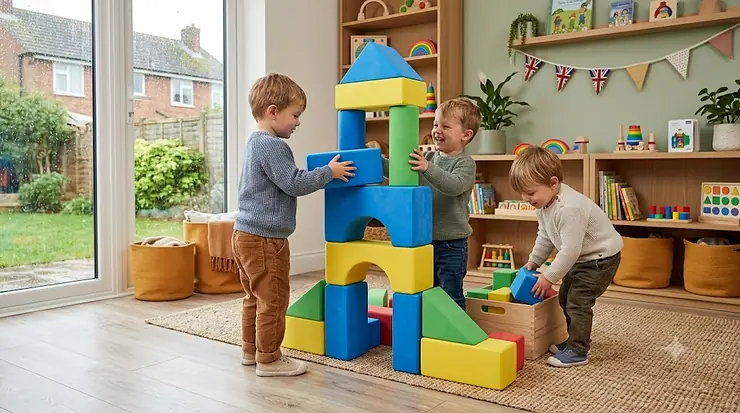
Somewhere between the third stubbed toe on a wooden brick and the fifth Lego piece hoovered up by accident, most parents start Googling something softer. That’s usually how the search for giant foam building blocks begins — not as a Pinterest-inspired nursery upgrade, but as a genuinely practical response to a toddler who wants to build, stack, throw and occasionally headbutt their toys with total abandon.
The appeal is straightforward once you’ve handled a set: these are oversized, lightweight foam shapes that behave nothing like traditional blocks. A tower can topple onto a sibling, a sofa, or a shin without anyone crying, and a two-year-old can lift a “giant” piece that would be far too heavy in wood or hard plastic at the same scale. That combination of scale and softness is precisely why this category has become a staple of soft play areas, nurseries and increasingly, front rooms.
This guide covers seven genuine, currently available foam block sets sold to UK shoppers, from budget bestsellers to properly engineered early-years brands. We’ll compare materials, washability, sizing and price honestly, and answer the questions parents actually search for — how safe are they really, what does “washable” mean in practice, and which set will still get used in a year rather than deflating quietly under the sofa. Active, hands-on play like block-building also supports the kind of daily physical activity the NHS recommends for under-fives, so it’s worth choosing a set that actually gets picked up rather than one that just looks good in a product photo.
By the end, you’ll know exactly which of these seven sets suits your child’s age, your floor space, and your tolerance for glitter-adjacent mess.
Quick Comparison Table
| Foam Block Set | Pieces | Material / Cover | Washable | Best For |
|---|---|---|---|---|
| National Geographic Kids Jumbo Foam Blocks | 30 | Dense foam, wipeable surface | Yes | Branded pick with activity cards |
| Edushape Giant Foam Blocks Pack 32 | 32 | Lightweight foam, 10-38cm sizes | Yes | Babies and toddlers, nursery-grade |
| ECR4Kids SoftZone Big Foam Building Blocks | 7 | Foam core, fabric-covered | Spot clean | Oversized structural building |
| Casafield Large Toddler Foam Building Blocks | 7 | Foam core, PU leather cover | Spot clean | Water-resistant, mixed shapes |
| TRENDBOX Toddler Foam Blocks with Detachable Cover | 12 | Foam core, removable fabric cover | Machine washable cover | Genuinely washable option |
| Number 1 in Gadgets Giant Foam Building Blocks | 50 | Waterproof foam | Yes | Budget-friendly variety |
| LOLO TOYS Large Building Foam Blocks | 30 | EVA foam, floatable | Yes | Budget bath-and-floor crossover |
Even from this snapshot, the category splits into two genuinely different design approaches: solid washable foam (wipe or hose it down directly) versus foam-core-with-fabric-cover (the cover comes off and washes, the core stays dry). That distinction matters more for day-to-day cleaning than piece count or price, so it’s worth deciding which you’d rather deal with before comparing anything else.
💬 Just one click — help others make better buying decisions too!😊
Top 7 Giant Foam Building Blocks: Expert Analysis
These seven were chosen to cover the realistic spread UK parents are actually choosing between: budget multi-piece sets, nursery-grade early-years brands, and the washable-cover designs built specifically to survive daily toddler abuse.
1. National Geographic Kids Jumbo Foam Blocks — best branded pick with built-in learning cards
There’s a reason licensed, brand-backed toy lines tend to command a premium, and it isn’t just the logo — it’s usually a more consistent quality-control process behind the product. This 30-piece set follows that pattern: large, lightweight foam pieces in varied shapes and sizes, paired with a storage bag and four “Play & Learn” activity cards that give structure to open-ended play without forcing it.
What most buyers overlook about activity cards bundled with blocks is that they’re genuinely useful for parents who want block time to feel purposeful rather than just a way to buy fifteen quiet minutes — the cards nudge toward specific building challenges, colour naming, and counting, which extends how the same set gets used as a toddler grows into preschool age. The washable design means spills and the inevitable snack residue wipe off without soaking into the foam core, a detail that matters more after month three than it does on unboxing day.
Reviewers of licensed jumbo foam sets in this category consistently highlight the bright, varied shapes as a strength for open-ended building, while noting that — as with most foam-core sets — pieces compress slightly during shipping and need a day or two to fully regain their shape.
Pros:
- ✅ Includes activity cards that add structure to free play
- ✅ Washable surface handles everyday spills easily
- ✅ Storage bag keeps the full set tidy between sessions
Cons:
- ❌ Costs more than generic unbranded equivalents
- ❌ Pieces need time to decompress fully after delivery
Expect this set in the mid-price bracket for a 30-piece collection; always check current price, as licensed toy lines see regular seasonal promotions around birthdays and Christmas.
2. Edushape Giant Foam Blocks Pack 32 — best for babies through toddlers, nursery-grade build
Edushape is a name that turns up repeatedly in early-years settings rather than just toy shop shelves, and that’s a genuine signal of durability rather than marketing. This 32-piece pack is explicitly rated suitable from birth, with individual block sizes ranging from 10cm up to a genuinely giant 38cm — a size range wide enough to serve a six-month-old exploring textures and a four-year-old building a proper structure.
Based on the spec comparison with toddler-only sets, the from-birth rating is the standout detail here: it means the smallest, softest pieces are genuinely safe for supervised infant handling, not just marketed loosely as “all ages.” That matters for households with a wide age gap between siblings, where a single set needs to work for the baby on a playmat and the older child building a tower nearby.
What the spec sheet won’t tell you, but the nursery and early-years procurement pattern for this brand suggests, is that Edushape’s reputation in professional settings tends to reflect genuinely tougher foam density than budget consumer-only brands — useful context if daily, heavy use is the plan rather than occasional weekend building.
Pros:
- ✅ Rated suitable from birth through toddlerhood
- ✅ Wide size range from 10cm up to 38cm giant pieces
- ✅ Established early-years brand with nursery-grade reputation
Cons:
- ❌ Fewer bold licensed characters than mainstream branded sets
- ❌ Larger 38cm pieces need meaningful storage space
At the time of research, this sits in the mid-to-upper price bracket reflecting its early-years specification; check current price against pack size, as smaller Edushape sets are available at a lower entry point.
3. ECR4Kids SoftZone Big Foam Building Blocks (7-Piece) — best for oversized structural building
Sometimes fewer, bigger pieces beat dozens of small ones, and that’s the entire proposition of ECR4Kids’ SoftZone range. With just seven pieces, this set is built around size rather than volume — proper large-format shapes designed to let a toddler build something structurally satisfying (a tunnel, a low wall, a wobbly castle) rather than assembling dozens of small units into something fiddly.
The foam-core-with-fabric-cover construction is a genuinely different approach from solid wipeable foam, and it comes with a real trade-off worth understanding before buying: the covered design gives a softer, more cushioned feel that’s arguably safer for a toddler who tends to fall onto their blocks rather than just stack them, but it also means spot-cleaning rather than full washing is the realistic maintenance routine.
ECR4Kids is a brand with a strong footprint in daycare and nursery equipment, which is generally a reliable signal that a product has survived sustained group use rather than just a single household’s gentler treatment — worth weighing if the set is heading into a busy, multi-child home rather than a single-child playroom.
Pros:
- ✅ Large-format pieces enable proper structural building
- ✅ Softer covered construction cushions toddler falls well
- ✅ Established daycare/nursery brand built for heavy use
Cons:
- ❌ Only 7 pieces limits variety compared to larger sets
- ❌ Spot-clean only, not fully washable or hosable
Pricing for this set typically sits in the mid-range bracket for a small piece count, reflecting the larger individual block size; check the current listing for exact dimensions before assuming compatibility with your play space.
4. Casafield Large Toddler Foam Building Blocks (7-Piece) — best for a water-resistant, mixed-shape set
Casafield’s approach splits the difference between solid foam and fully fabric-covered design: each block uses a soft foam core wrapped in a smooth, water-resistant PU leather-style covering, giving a wipeable surface without the fully saturated-foam feel of solid wipeable blocks. The seven-piece set includes three genuinely different shapes and sizes, from a substantial 12″x12″x6″ piece down to smaller 6″ cubes.
Here’s what most buyers overlook about mixed-shape sets like this one: variety in shape, not just colour, is what actually extends imaginative building beyond simple towers — a rectangular piece becomes a bridge, a small cube becomes a chimney, and that shape diversity is doing more developmental work than sheer piece count. CPSIA certification on this set also gives a documented safety baseline worth checking for on any set you’re comparing it against.
The manufacturer is explicit that this design is spot-clean rather than machine washable, and not intended for prolonged outdoor or wet-weather use — an honest limitation worth factoring in if your household’s play happens partly in the garden.
Pros:
- ✅ Three distinct shapes and sizes support varied building
- ✅ Water-resistant PU cover wipes clean easily
- ✅ CPSIA certified against documented safety standards
Cons:
- ❌ Spot-clean only, not machine washable
- ❌ Not designed for extended outdoor or wet use
Expect a mid-range price for the 7-piece set; a smaller 12-piece cube-only version is also generally available at a lower price point if size variety matters less than sheer piece count.
5. TRENDBOX Toddler Foam Blocks with Detachable Washable Cover (12-Piece) — best for genuinely machine-washable cleaning
If “washable foam blocks for toddlers” is the exact thing you searched for, this is the set built specifically around that promise rather than using the word loosely. Each 5.5-inch cube has a cover that fully detaches from the foam core and goes into the washing machine, which is a meaningfully different (and more thorough) cleaning method than wiping a sealed surface.
What most buyers overlook about detachable-cover designs is the actual mechanism matters as much as the washability claim — a cover that’s genuinely easy to remove and refit gets washed regularly; one that’s fiddly gets left dirty regardless of what the packaging promises. TRENDBOX’s cube design keeps the foam core protected during the wash cycle, addressing the practical worry parents have with “washable” foam claims: that the foam itself, not just a fabric skin, might degrade or absorb water over repeated washes.
For households managing reflux, food-throwing toddlers, or a child who insists on eating snacks mid-build, the ability to actually machine wash rather than just wipe is a genuinely different tier of practical hygiene, not just a marketing distinction.
Pros:
- ✅ Covers fully detach for genuine machine washing
- ✅ Foam core stays protected and dry during washing
- ✅ Cube shape suits both stacking and simple sorting play
Cons:
- ❌ Uniform cube shapes offer less structural variety
- ❌ Refitting covers after washing takes a little patience
This set typically sits in the low-to-mid price bracket for 12 pieces; check the current listing’s colour options, as availability tends to rotate between colour combinations.
6. Number 1 in Gadgets Giant Foam Building Blocks (50-Piece) — best budget pick for variety
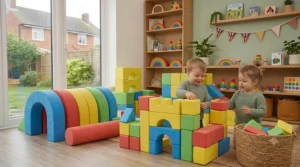
Fifty pieces at a genuinely accessible price point makes this the set to consider if quantity and variety matter more than premium branding. The blocks measure a substantial 21.3″ x 9.6″ as a full set footprint, come in six colours, and span multiple shapes — enough raw material for a toddler to attempt genuinely ambitious builds rather than being limited by running out of pieces halfway through.
Based on the spec comparison with smaller premium sets, the trade-off here is fairly predictable: budget multi-piece sets like this generally use a slightly less dense foam than nursery-grade brands, meaning individual pieces feel a touch lighter and less structurally rigid. In practice, that’s rarely a problem for typical home play — it becomes more relevant if the set is heading into a high-traffic nursery or childminding setting with heavy daily rotation.
The waterproof, non-toxic construction covers the essentials parents check for first, and the sheer piece count means a genuinely good first set for a family testing whether foam blocks will actually get used before investing in a premium alternative.
Pros:
- ✅ 50 pieces gives genuinely ambitious building potential
- ✅ Waterproof construction wipes and rinses easily
- ✅ Strong value for money at this piece count
Cons:
- ❌ Foam density feels lighter than premium nursery brands
- ❌ Less structurally rigid for tall, stable towers
At the time of research, this remains one of the more budget-friendly 50-piece sets available; check current price and stock, as bestselling budget toy listings can fluctuate in availability.
7. LOLO TOYS Large Building Foam Blocks (30-Piece) — best budget bath-and-floor crossover
Foam that floats changes what a block set can actually do, and that’s the specific niche this set fills. Built from high-density EVA foam, it’s genuinely washable, waterproof and floatable, which means the same 30-piece set can move between the playroom floor and bath time without needing two separate toy budgets.
What most buyers overlook about bath-compatible foam blocks is that the crossover isn’t just a bonus feature — it solves a real scheduling problem for parents, since a toddler who’s finished building on the floor can carry the same excitement straight into bath time, extending the toy’s usable hours per day without buying anything extra. The clear zippered storage bag also earns its place here, since loose 30-piece sets are notoriously easy to lose pieces from without dedicated storage.
Aggregated sentiment for budget EVA foam sets in this category tends to flag easy cleaning and genuine floatability as the strongest points, with the honest trade-off being a smooth, simpler finish than the more textured, structurally complex shapes found in premium nursery-grade brands.
Pros:
- ✅ Genuinely floats, doubling as a bath-time toy
- ✅ High-density EVA foam wipes and rinses easily
- ✅ Zippered storage bag keeps all 30 pieces together
Cons:
- ❌ Simpler shapes than premium structural building sets
- ❌ Less rigid than denser nursery-grade foam blocks
Expect a genuinely budget price point for 30 pieces; this is one of the more accessible entries on this list and a sensible starting point for families new to foam block play.
Top 7 at a Glance: Specs & Value
| Foam Block Set | Age Guidance | Cleaning Method | Price Bracket | Best For |
|---|---|---|---|---|
| National Geographic Kids Jumbo Foam Blocks | Preschool+ | Wipe/washable | Mid | Structured, card-guided play |
| Edushape Giant Foam Blocks Pack 32 | From birth+ | Wipeable | Mid-upper | Wide sibling age range |
| ECR4Kids SoftZone Big Foam Building Blocks | Toddler+ | Spot clean | Mid | Large structural builds |
| Casafield Large Toddler Foam Building Blocks | Toddler+ | Spot clean | Mid | Mixed shapes, water-resistant |
| TRENDBOX Toddler Foam Blocks with Detachable Cover | Toddler+ | Machine washable cover | Budget-mid | Genuinely washable priority |
| Number 1 in Gadgets Giant Foam Building Blocks | Toddler+ | Wipe/rinse | Budget | Variety and volume |
| LOLO TOYS Large Building Foam Blocks | Toddler+ | Washable, floats | Budget | Bath-and-floor crossover |
Reading across this table, the real decision point isn’t age suitability — every set here works for the standard toddler-to-preschool window — it’s cleaning method. If a genuinely machine-washable cover matters most, the TRENDBOX Toddler Foam Blocks with Detachable Cover is the clearest match; if wide age range and nursery-grade durability matter more, the Edushape Giant Foam Blocks Pack 32 justifies its higher bracket.
Setting Up a Safe Play Space for Foam Blocks
Getting the most from a new foam block set in the first month is mostly about space and expectations rather than the blocks themselves. Clear a genuinely open floor area before first use — foam blocks are designed to be built tall and knocked down, and a cramped corner surrounded by furniture edges undermines both the fun and the safety of the toppling part, which is often the favourite bit for toddlers under three.
Let pieces air out and decompress for a day or two after unboxing if they arrive vacuum-packed; most foam blocks regain their full shape within 24-48 hours, and forcing play with still-compressed pieces can make early builds feel unstable in a way that’s about packaging, not product quality.
The most common early mistake is skipping a first wash or wipe-down before use, particularly with sets that travelled a long shipping route — a quick wipe with mild soap and water settles any manufacturing residue and gets ahead of the cleaning routine rather than starting behind it. Finally, establish a simple end-of-session habit early: a designated storage bag or box, ideally within your toddler’s own reach, turns tidy-up into part of the play routine rather than a battle you have every single time.
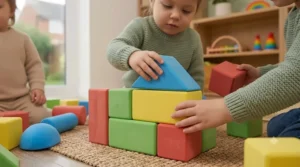
Which Foam Block Set Suits Your Child? Three Real-World Scenarios
A six-month-old exploring textures alongside an older sibling: age-range flexibility matters most here. The Edushape Giant Foam Blocks Pack 32‘s from-birth rating and wide size range let a baby handle the smaller, softer pieces under supervision while an older child builds with the larger 38cm blocks nearby, using one set rather than two.
A boisterous two-year-old who topples every tower on purpose: durability and softness both matter, favouring the ECR4Kids SoftZone Big Foam Building Blocks‘ large-format, cushioned covered design, which handles both enthusiastic knock-downs and the inevitable toddler collision without complaint. Open-ended, physically engaged building play like this fits squarely within what UK early years research on block play’s developmental benefits associates with stronger problem-solving and spatial reasoning skills as children progress through the EYFS age range.
A household managing food mess or reflux near play time: genuine washability trumps everything else here, making the TRENDBOX Toddler Foam Blocks with Detachable Cover the clearer fit over spot-clean-only alternatives, since a full machine wash handles the kind of mess a wipe-down simply can’t.
Building a Mini Soft Play Corner at Home
Soft play toys at home don’t need to replicate an entire commercial soft play centre to deliver real value — a single dedicated corner with foam blocks, a soft mat, and clear boundaries does most of the work. Start by choosing a spot away from hard furniture edges and glass, ideally on carpet or a padded play mat, so toppled towers and enthusiastic diving don’t introduce hazards the blocks themselves were meant to remove.
Rotate which blocks are out rather than dumping the entire set on the floor permanently; a smaller, curated selection is easier for a toddler to actually engage with meaningfully, and swapping in “new” pieces from storage every week or two renews interest without any additional spending. Pairing a large structural set like the ECR4Kids SoftZone Big Foam Building Blocks with a smaller, varied set like the National Geographic Kids Jumbo Foam Blocks gives both big-build and fine-detail play within the same corner.
✨ Don’t Miss These Exclusive Deals!
🔍 Take your home soft play corner to the next level with the seven foam block sets covered above. Click through on any highlighted set to check current pricing and availability, and give your toddler a safer, screen-free way to build, stack and (happily) knock everything down! 🧱🌈
What Are Giant Foam Building Blocks?
Giant foam building blocks are oversized, lightweight construction toys made from soft foam — either solid wipeable foam or a foam core with a removable fabric or leather-style cover — designed for toddlers and preschoolers to stack, build and safely knock down. Unlike wooden or hard plastic blocks, their size and softness make them low-risk for falls, throws and collisions during active play.
How to Choose Giant Foam Building Blocks
- Decide between solid wipeable foam and covered foam-core designs first, since this determines your realistic cleaning routine more than any other spec.
- Check the stated age range against your child’s actual size and stage, not just the box label, particularly for babies who may mouth or chew pieces.
- Count pieces relative to ambition, not just price — a toddler building serious structures benefits from more pieces than a baby exploring texture and shape.
- Confirm safety certification (CPSIA, CE or UKCA marking) is stated on the listing, especially for sets from lesser-known sellers.
- Consider shape variety over uniform cubes if imaginative, varied building matters more than simple stacking and sorting.
- Check storage provisions, since a set without a bag or box is more likely to end up scattered and gradually lost.
- Compare current price against typical range for the piece count, as this category runs frequent seasonal promotions worth timing a purchase around.
Giant Foam Blocks vs Hard Plastic or Wooden Blocks: What Changes
The honest comparison isn’t “foam is simply safer” — it’s more nuanced than that. Wooden and hard plastic blocks offer better structural precision for detailed building and typically last longer physically, which is why they remain popular for slightly older, more coordinated builders. Foam blocks trade some of that precision for dramatically reduced injury risk during exactly the kind of enthusiastic, uncoordinated play that defines the toddler years.
| Factor | Giant Foam Blocks | Wooden/Hard Plastic Blocks |
|---|---|---|
| Fall/collision risk | Low — soft, lightweight material | Higher — hard edges and weight |
| Structural precision | Lower, better for big simple builds | Higher, suits detailed construction |
| Noise level | Near-silent when dropped or knocked | Noticeably louder on hard floors |
| Typical lifespan | 2-4 years with regular use | Often 5+ years, more durable |
Looking at this comparison, the practical takeaway is that foam and hard blocks serve genuinely different stages rather than competing directly — foam suits the toddler window where falls and throws are frequent and coordination is still developing, while hard blocks come into their own once a child’s building ambitions outpace what soft foam can structurally support. Many families end up owning both rather than choosing one over the other permanently.
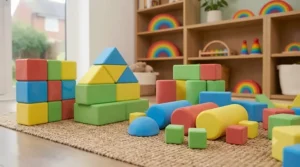
Soft Foam Blocks for Toddlers: What Age Can They Start?
Soft foam blocks for toddlers are generally suitable from around six months for supervised handling, with independent stacking and building play typically beginning around 12-18 months as gross motor coordination develops. Sets explicitly rated “from birth,” such as the Edushape Giant Foam Blocks Pack 32, are formulated and sized with that younger end of the range specifically in mind rather than simply being a toddler set with a generous label.
What matters more than the calendar age is developmental stage: a child who can sit unsupported and grip objects deliberately is generally ready for supervised block exploration, while independent building without constant adult involvement tends to emerge closer to 18 months to two years. Always supervise younger toddlers closely regardless of the stated minimum age, since mouthing behaviour persists well beyond the age most packaging assumes it has stopped.
Washable Foam Blocks for Toddlers: What “Washable” Actually Means
“Washable” is used loosely across this category, and the practical difference between claims matters more than it first appears. Solid foam sets, like the Number 1 in Gadgets Giant Foam Building Blocks and LOLO TOYS Large Building Foam Blocks, are typically wiped down or rinsed directly, since the foam itself forms the outer surface.
Covered designs split further into two types: spot-clean-only covers, as used on the Casafield Large Toddler Foam Building Blocks and ECR4Kids SoftZone Big Foam Building Blocks, which shouldn’t be fully submerged or machine washed; and genuinely detachable, machine-washable covers, as used on the TRENDBOX Toddler Foam Blocks with Detachable Cover, where the fabric skin comes off entirely for a proper wash cycle. Reading the specific cleaning instructions on a listing, rather than assuming “washable” means “machine washable,” avoids a genuinely common source of buyer disappointment in this category.
Safe Indoor Building Toys: Common Mistakes When Buying
The most common mistake is assuming all foam blocks are automatically choke-hazard-free simply because they’re soft — smaller accessory pieces, detachable covers, and any decorative elements should still be checked against stated minimum ages, particularly in households with a baby or younger sibling who might access an older child’s toys.
A second frequent error is buying purely on piece count without checking individual block size — fifty small pieces and thirty giant pieces occupy very different amounts of floor and storage space, and “more pieces” doesn’t automatically mean “more play value” if the set ends up too fiddly for your toddler’s current coordination level.
Parents also commonly overlook checking for CPSIA, CE, or UKCA safety marking before buying from lesser-known third-party sellers, treating bright colours and positive-sounding descriptions as a substitute for documented compliance — a shortcut worth avoiding given how directly it affects genuine child safety.
Finally, underestimating storage needs is a recurring regret; a giant foam block set without a bag, box, or dedicated shelf space tends to end up scattered and gradually incomplete within a few months, undermining the value of a larger, more expensive set.
Easy-Clean Playroom Toys: Hygiene & Maintenance Tips
Easy-clean playroom toys stay in rotation far longer than ones that become a genuine chore to maintain, and a few simple habits make the biggest difference. For wipeable solid foam sets, a mild soap and warm water solution on a cloth handles the vast majority of everyday mess without needing anything specialist; avoid harsh solvents or bleach, which can degrade foam density over repeated use.
For covered sets, check and follow the specific manufacturer washing guidance rather than assuming standard laundry settings are safe — a cold, gentle cycle for detachable covers, air-dried rather than tumble-dried, generally preserves both the cover’s fit and the block’s overall shape longest. Building a simple weekly habit — a quick wipe-down or cover swap as part of the general tidy-up — keeps a set genuinely hygienic without turning cleaning into a separate, dreaded task on its own.
Long-Term Value & Cost per Play Session
Foam blocks don’t carry the ongoing costs of battery-powered or consumable toys, but comparing budget and premium sets over their realistic lifespan still reveals a meaningful value picture worth understanding before buying.
| Cost Factor | Budget Foam Sets | Premium/Nursery-Grade Sets |
|---|---|---|
| Typical purchase price | Lower entry cost | Higher upfront cost |
| Expected foam density/rigidity | Lighter, softer over time | Denser, holds shape longer |
| Realistic lifespan | 1-3 years with regular use | 3-5+ years, often hand-me-down ready |
Looking at this table, the value case shifts depending on how the set will actually be used. A budget set like the LOLO TOYS Large Building Foam Blocks makes strong financial sense for a household testing whether foam blocks will genuinely get used, or for occasional rather than daily play. A nursery-grade set like the Edushape Giant Foam Blocks Pack 32 costs more upfront but spreads that cost across a longer lifespan and, often, a second child — worth factoring in rather than comparing purchase price alone.
FAQ
❓ Are giant foam building blocks safe for a one-year-old?
❓ Can foam building blocks be machine washed?
❓ How many pieces do toddlers actually need to build with?
❓ Do foam blocks work for bath time as well as the playroom?
❓ How long do giant foam building blocks typically last?
Conclusion
Choosing between seven genuinely different foam block sets comes down to matching material, cleaning method and size to how your specific household actually plays. If genuine machine washability is the priority, the TRENDBOX Toddler Foam Blocks with Detachable Cover earns its place clearly. If you need a set that works from early infancy through preschool, the Edushape Giant Foam Blocks Pack 32 justifies its higher price through a wider, better-documented age range than most competitors.
For big, structural building, the ECR4Kids SoftZone Big Foam Building Blocks offer large-format pieces that reward ambitious toddlers, while budget-conscious families will find genuine value in the Number 1 in Gadgets Giant Foam Building Blocks and LOLO TOYS Large Building Foam Blocks, both offering strong piece counts without premium pricing. For a polished, activity-guided experience, the National Geographic Kids Jumbo Foam Blocks and its bundled learning cards round out a well-covered field.
Whichever set you choose, the underlying advice holds: check the specific cleaning method rather than trusting the word “washable” alone, confirm safety certification, and match piece size to your child’s current coordination rather than the age printed on the box. Do that, and a set of giant foam building blocks should deliver genuinely active, screen-free building fun for years rather than months.
✨ Don’t Miss These Exclusive Deals!
🔍 Ready to build your toddler’s own soft play corner? Click through on any of the seven giant foam building block sets above to check current pricing and availability, and bring home safe, easy-clean building fun today! 🧱✨
Recommended for You
- Wooden Blocks for Toddlers: 7 Best Sets Reviewed for 2026
- Wooden Building Blocks: 7 Best Sets for UK Families in 2026
- Solar System Posters for Children: 7 Best Picks for 2026
Disclaimer: This article contains affiliate links. As an Amazon Associate, I earn from qualifying purchases. If you purchase products through these links, we may earn a small commission at no additional cost to you.
✨ Found this helpful? Share it with your friends! 💬🤗
