
In This Article
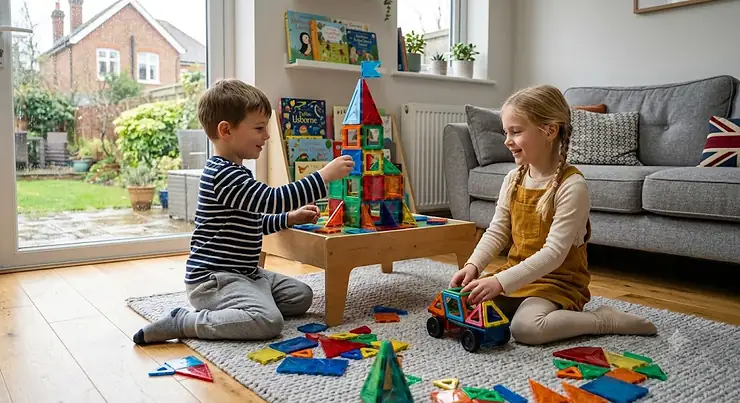
Walk into almost any UK household with a child between two and eight, and you’ll trip over a small drift of translucent, brightly coloured tiles before you reach the sofa. Magnetic building blocks have quietly become the toy parents actually recommend to other parents — not because of clever marketing, but because the things genuinely earn their keep on the playroom floor, day after day, long after the latest character-branded gadget has been abandoned in a drawer.
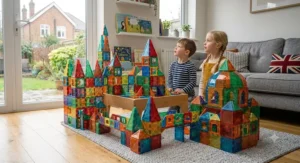
Magnetic building blocks are flat, shaped tiles or interlocking pieces with magnets sealed inside their edges, allowing children to snap them together into towers, houses, cars, and increasingly ambitious architectural nonsense. Because every edge connects to every other edge, there’s no “wrong” way to build, which is precisely what makes them such a strong example of open-ended play — the kind that scales with a child rather than being outgrown by them. They also sit squarely within STEM (science, technology, engineering, and mathematics) learning, since every build quietly teaches geometry, balance, and cause-and-effect long before a child could define any of those words.
This guide skips the vague “top picks” approach and instead digs into real specifications, genuine UK pricing patterns, and honestly aggregated parent and reviewer sentiment across seven real sets sold on amazon.co.uk — from budget-friendly bulk packs to the premium brand every toy blogger seems to own personally. Whether you’re after the cheapest way in, the biggest possible set, or a genuinely STEM-focused alternative to flat tiles, there’s a real option below.
Quick Comparison Table
| Set | Type | Standout Feature | Best For |
|---|---|---|---|
| Connetix Tiles | Flat tiles | Strongest magnets, beveled premium finish | Families wanting the best build quality |
| Magna-Tiles | Flat tiles | The original, most trusted classic brand | Buyers who prioritise brand pedigree |
| Playmags | Flat tiles + cars | Strong value on larger piece counts | Bigger families needing more tiles |
| PicassoTiles | Flat tiles | Budget-friendly Magna-Tiles alternative | Cost-conscious first-time buyers |
| Cossy Magnetic Tiles | Flat tiles + cars | Vivid colour, large piece counts cheaply | Budget kids toys shoppers wanting volume |
| Geomag | Rods and spheres | Genuinely different STEM building system | Older kids wanting an engineering challenge |
| SUNNY AUNTIE XL Set | Flat tiles | Big piece count at a low per-tile cost | Affordable magnetic building blocks large sets |
At a glance, the spread here runs from budget bulk sets that prioritise sheer piece count, through mid-range value options that add extras like click-in cars, up to the premium finish of Connetix Tiles and the brand heritage of Magna-Tiles. If your child already has a shelf of flat tiles and needs a genuinely different challenge, Geomag‘s rods-and-spheres system is the one true outlier on this list — everything else here is a variation on the same tile format, which also means most of them click together regardless of brand.
💬 Just one click — help others make better buying decisions too!😊
Top 7 Magnetic Building Blocks: Expert Analysis
There’s no single “best” magnetic building block set — piece count, magnet strength, budget, and your child’s age all pull the decision in different directions. Here’s an honest, spec-and-sentiment-based look at seven real sets, running roughly from premium to budget, with one genuine STEM specialist thrown in.
1. Connetix Tiles — strongest magnets and most premium finish
Connetix Tiles has become the set that toy reviewers and parent bloggers reach for personally, not just professionally, and the reason comes down to two things: magnet strength and finish. The beveled edge design gives the tiles a more angular, glass-like appearance than flat-edged rivals, and independently weighed comparisons have found Connetix tiles among the heaviest — and therefore strongest-magnet — square tiles on the market, edging out even Magna-Tiles in head-to-head pull tests.
Based on the spec comparison with rivals in this guide, that extra magnet strength translates directly into sturdier builds: taller towers, wider bridges, and structures that survive an overenthusiastic sibling a little better than lighter-magnet alternatives. Reviewers consistently note the beautiful, saturated colour palette — particularly the pastel ranges — as a standout, alongside metal-riveted corners that keep the magnets securely sealed rather than relying on glue alone. What most buyers overlook about a beveled design like this is that it’s also more scratch-resistant over years of play than flat-surfaced tiles, which matters if you’re investing at this price point and want the set to last through more than one child.
Pros:
- ✅ Strongest magnets of the major tile brands in independent testing
- ✅ Beveled, scratch-resistant design with vivid, glass-like colours
- ✅ Metal-riveted corners for secure, long-lasting construction
Cons:
- ❌ Among the priciest tile brands on the UK market
- ❌ Larger builds require noticeably firmer effort to pull apart
Expect roughly £45-£120 depending on set size, with larger starter packs running higher — but resale value stays strong, which meaningfully softens the premium price over a few years of use.

2. Magna-Tiles — the original, most trusted classic brand
Magna-Tiles invented this entire toy category, and that pioneering history still counts for something: it’s the brand most likely to be recommended by name by a grandparent, a nursery, or a paediatric occupational therapist. The tiles use a criss-cross lattice reinforcement inside the plastic, which independent testers describe as exceptionally resistant to cracking even when dropped or stepped on — a genuinely reassuring trait for a toy that inevitably ends up underfoot.
Here’s what the spec sheet won’t tell you, but user reports suggest: Magna-Tiles‘ magnets are on the smaller side compared with newer rivals like Connetix, so very large or ambitious structures can occasionally feel less rock-solid — but for the vast majority of everyday play, from toddler stacking to primary-school castle-building, the difference is barely noticeable. The brand’s genuine strength lies in its enormous range of themed expansion sets — dinosaurs, farm animals, vehicles — which means a family that starts with the classic set has years of natural, compatible additions to grow into. Aggregated reviewer sentiment consistently praises the tiles’ durability over many years of daily play, with some families reporting sets still in daily use after four or five years.
Pros:
- ✅ Reinforced lattice design resists cracking under drops
- ✅ Huge range of compatible themed expansion sets
- ✅ Long track record of durability across years of use
Cons:
- ❌ Smaller magnets than some newer premium rivals
- ❌ Among the more expensive options per tile
Pricing typically sits around £50-£130 for core sets, and while that’s a genuine investment, the brand’s resale value and expansion ecosystem make it one of the more future-proof choices in this guide.
3. Playmags — strong value on larger piece counts
Playmags carved out its niche by offering genuinely large sets — 100 to 150 pieces — at a price that undercuts the premium brands, while still including the click-in car bases and accessory pieces that turn flat tiles into functioning vehicles. Reviewers who own multiple brands side by side consistently rate Playmags’ magnet strength as comparable to Connetix and noticeably stronger than the smaller Magna-Tiles magnets, which is a striking result for a mid-range price point.
What most buyers overlook about Playmags is that the brand’s bundled extras — click-in wheelbases, ABC learning tiles on some sets — add genuine play variety beyond pure geometric building, which matters for younger children who need a bit more structured direction before they’re ready for fully open-ended construction. On the downside, the colour palette and overall polish read as slightly less premium than Connetix’s glass-like finish, and the plastic has a marginally more utilitarian feel in hand. For a family prioritising piece count and play variety over showroom looks, that trade-off is easy to accept.
Pros:
- ✅ Large piece counts (100-150) at a mid-range price
- ✅ Magnet strength comparable to premium rivals
- ✅ Click-in car bases add extra play variety
Cons:
- ❌ Less premium finish and colour saturation than Connetix
- ❌ Fewer themed expansion sets than Magna-Tiles
At around £55-£90 for a 100-150 piece set, Playmags is arguably the strongest pure value pick among the premium-adjacent brands in this guide.
4. PicassoTiles — budget-friendly Magna-Tiles alternative
PicassoTiles exists explicitly to answer one question: what if magnetic tiles cost roughly a third of the premium brands without sacrificing the core play experience? Side-by-side comparisons consistently find the two brands fully compatible and structurally similar, with PicassoTiles’ 100-piece sets typically including a higher proportion of large square tiles — genuinely useful for younger children whose hands aren’t yet dextrous enough to fiddle with lots of small triangles.
Based on real testing accounts, magnet strength on PicassoTiles is comparable to, and in some direct pull tests even marginally stronger than, Magna-Tiles’ own magnets, which is a notable result given the price gap. The trade-off is construction method: PicassoTiles typically uses glued seams rather than the metal rivets found on Connetix and Magna-Tiles, meaning the tiles are more likely to crack open under serious force — a relevant safety consideration given the small magnets inside, covered further in our safety section below. For everyday play rather than being dropped from height repeatedly, reviewers describe the tiles as holding up well over years of regular use.
Pros:
- ✅ Roughly a third of the price of premium tile brands
- ✅ Fully compatible with Magna-Tiles and most rival brands
- ✅ Comparable or stronger magnets than the market leader
Cons:
- ❌ Glued rather than riveted seams are less crack-resistant
- ❌ Slightly less refined plastic clarity than premium brands
At roughly £25-£45 for a 60-100 piece set, PicassoTiles is a genuinely sensible entry point for families testing whether magnetic building blocks will actually get used before committing to a premium brand.
5. Cossy Magnetic Tiles — vivid colour and large piece counts on a budget
Cossy Magnetic Tiles leans hard into value through volume: 120-piece sets that undercut most rivals on a per-tile basis, paired with an unusually vibrant, highly transparent colour palette that reviewers repeatedly single out as brighter and more saturated than competing budget brands. The current generation uses rivet reinforcement rather than the glued seams of some earlier budget sets, addressing one of the classic budget-tile weak points directly.
What most buyers overlook about a large, low-cost set like this is that sheer piece count changes what a young child can actually build — 120 pieces supports genuinely ambitious multi-room houses and long bridges in a way that a 30-piece starter set simply can’t, regardless of magnet quality. Reviewers consistently describe the magnets as “strong but not overly powerful,” which several parents specifically welcome as a middle ground: sturdy enough for stable builds, gentle enough to reduce pinched-finger complaints from younger children. Aggregated sentiment across owner reviews is strongly positive on durability, with many reporting the tiles surviving years of enthusiastic, unsupervised play without cracking.
Pros:
- ✅ Large 120-piece sets at a genuinely low per-tile cost
- ✅ Unusually vibrant, highly transparent colour palette
- ✅ Rivet-reinforced current generation improves durability
Cons:
- ❌ Shape variety is narrower than premium brand ranges
- ❌ Fewer themed expansion or accessory sets available
Typically priced around £30-£45 for a 120-piece set, Cossy Magnetic Tiles is one of the strongest affordable magnetic building blocks options in this guide for families who want maximum pieces for minimum spend.

6. Geomag — a genuinely different STEM building system
Every other set in this guide is a variation on the flat magnetic tile; Geomag is the outlier, and deliberately so. Instead of tiles, the Swiss-made system uses magnetic rods and non-magnetic steel spheres that click together to form 3D geometric shapes, wireframe structures, and — with the panel expansion sets — solid-surfaced models. It’s a fundamentally different building logic, closer to structural engineering than architecture, and it rewards a slightly older child who’s ready for genuine spatial problem-solving.
Reviewers consistently note that Geomag’s magnet strength is excellent — structures don’t collapse under their own weight the way looser rod-and-ball systems can — though tidying away does take longer, since misaligned polarity causes pieces to repel rather than nest neatly back into their storage tray. Based on the spec comparison with flat-tile systems, Geomag’s smaller sets (32-52 pieces) are genuinely limited in scope, which makes it better suited as a second or third construction toy rather than a family’s only set; the manufacturer’s own guide leaflets openly acknowledge this by recommending combining boxes for more ambitious builds. Swiss manufacturing and 100% recycled plastic in the current Supercolour range are also repeatedly praised, appealing to eco-conscious parents specifically.
Pros:
- ✅ Genuinely different rod-and-sphere STEM building logic
- ✅ Strong magnets that hold complex 3D structures securely
- ✅ Made in Switzerland from 100% recycled plastic
Cons:
- ❌ Smaller sets are limited without additional expansion boxes
- ❌ Steel spheres present a stricter minimum age (5+) than tiles
Prices range roughly £20-£65 depending on set size, making Geomag a smart, genuinely educational STEM building sets addition for a child who’s already mastered flat tiles and wants a new kind of challenge.
7. SUNNY AUNTIE XL Set — big piece count at a low per-tile cost
For families chasing the single lowest cost-per-piece on a genuinely large set, the SUNNY AUNTIE XL Set — commonly sold in 125 to 240-piece bundles with a storage bag included — consistently comes up in budget comparisons as one of the better-value bulk options available on amazon.co.uk. The core appeal is straightforward: more raw building material for siblings, playdates, or classroom use, without the premium-brand price tag.
Based on the spec comparison with other budget bulk sets, the trade-off for that piece count is largely aesthetic and structural refinement rather than safety — reviewers describe the tiles as functionally similar to other mid-tier budget brands, with adequate but not exceptional magnet strength, and a plastic finish that’s a step behind Connetix or Magna-Tiles in clarity and colour depth. For open-ended play with a large group of children — a classroom, a big family Christmas, a nursery setting — that trade-off is entirely reasonable, since the priority shifts from individual tile quality to simply having enough pieces for everyone to build something at once. The included storage bag is a small but genuinely practical touch that budget bulk sets frequently skip.
Pros:
- ✅ Large 125-240 piece bundles at a low cost-per-tile
- ✅ Included storage bag keeps pieces contained between uses
- ✅ Enough volume for siblings or group play simultaneously
Cons:
- ❌ Less refined finish and colour clarity than premium brands
- ❌ Magnet strength is adequate rather than exceptional
Typically priced around £30-£55 depending on piece count, the SUNNY AUNTIE XL Set is the clearest answer in this guide to anyone specifically searching for magnetic building blocks large enough to satisfy more than one child at once.
Practical Usage Guide: Getting Started, Storage & Care
Getting genuine long-term value from magnetic building blocks starts with how you introduce them, not just which set you buy. For toddlers under three, start with simple stacking and colour-sorting rather than expecting structured building — pulling tiles apart and reconnecting them is itself valuable sensory and fine-motor practice, and pushing straight into “build a house” instructions too early often leads to frustration rather than engagement. As children approach four and five, introduce simple picture-guided builds before moving to fully open-ended construction, since a little scaffolding early on helps them discover the toy’s creative potential rather than defaulting to flat, two-dimensional patterns.
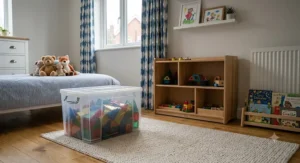
Storage matters more than most parents expect in the first 30 days. A shallow, wide storage bin or the manufacturer’s own storage bag (included with sets like the SUNNY AUNTIE XL Set) works far better than a deep toy box, since children can actually see and sort pieces by shape rather than digging blind. Sorting by shape or colour before putting tiles away isn’t just tidiness — it’s a genuinely valuable classification exercise that reinforces the same STEM thinking the toy encourages during building.
Maintenance is minimal but worth doing properly: wipe tiles down with a damp cloth rather than submerging them, since soaking can degrade the seal around the magnets over time on any brand. Periodically check tiles — particularly on budget, glued-seam sets like early PicassoTiles generations — for any cracks or separation at the edges, since a cracked tile with an exposed magnet is the single biggest safety issue with this toy category and should be removed from play immediately and disposed of safely.

Real-World Scenarios: Which Magnetic Building Blocks Suit Your Child?
Picture Amara, a first-time parent of an 18-month-old in a small flat, buying magnetic tiles for the first time and unsure whether her toddler is even ready for them. For Amara, a smaller, budget-friendly starter set like PicassoTiles or a compact Cossy set makes far more sense than a large premium investment — toddlers this age are exploring cause and effect and colour rather than building elaborate structures, so a lower-cost entry point lets the family confirm the toy actually gets used before scaling up.
Then there’s the Osei family, with three children spanning ages three to nine sharing one big open-plan living space and frequent friends over after school. Volume matters enormously here, which points toward the SUNNY AUNTIE XL Set or a large Playmags bundle — enough pieces that three children (plus visitors) can build simultaneously without constant squabbling over the last triangle. Durability across years of heavier, multi-child use also nudges the decision toward rivet-reinforced options over glued-seam budget brands.
Finally, consider Priya, a parent of a curious seven-year-old who has outgrown flat tiles from a previous Christmas and wants something more genuinely challenging as a birthday gift. Geomag is the standout here — the rod-and-sphere system introduces real spatial and structural problem-solving that flat tiles don’t, giving an older child who’s mastered basic building a fresh, age-appropriate STEM challenge rather than just more of the same shape.
Problem → Solution: Common Magnetic Building Block Issues
Problem: a tile has cracked and the magnet is visible or loose. This is the single most important issue to act on immediately, given the serious ingestion risk covered in our safety section below. Solution: remove the tile from play straight away, do not attempt to glue or repair it yourself, and dispose of it securely — most manufacturers, including premium brands, will replace a cracked tile under warranty if you contact them with a description and photo.
Problem: tiles from different brands don’t sit quite flush together. Most major brands — Connetix, Magna-Tiles, Playmags, and PicassoTiles among them — are broadly compatible, but very slight size or magnet-strength differences between brands can occasionally cause a mixed-brand build to feel less rock-solid than a single-brand set. Solution: for a child’s primary “everyday” set, stick to one brand where possible, and treat mixed-brand pieces as fine for casual play but not for tall, ambitious structures.
Problem: younger siblings keep destroying older children’s builds. This is a near-universal complaint rather than a toy fault. Solution: a large enough piece count — from sets like Playmags or the SUNNY AUNTIE XL Set — genuinely helps, since it lets each child build their own separate structure rather than competing over a limited shared pile; a designated “no-touch” building board or tray for ongoing projects also reduces conflict significantly.
Problem: pieces go missing and sets slowly become unusable. Magnetic building blocks are notorious for migrating under sofas and into other toy boxes. Solution: a dedicated, visible storage bin used consistently from day one — rather than a general toy box — combined with a quick five-minute “tile count” habit after big building sessions, keeps sets complete for years rather than months.
How to Choose Magnetic Building Blocks
- Match set size to your child’s age and ambitions. A toddler needs 30-60 pieces to explore; a primary-school-aged builder genuinely benefits from 100+ pieces to attempt ambitious structures without running out mid-build.
- Decide how much magnet strength actually matters to you. Heavier-magnet premium sets like Connetix hold taller, more complex builds; lighter-magnet budget sets are entirely adequate for younger children building smaller, flatter structures.
- Check the construction method — riveted or glued. Metal-riveted seams, found on Connetix and Magna-Tiles, are generally more crack-resistant over years of heavy use than glued seams on some budget sets.
- Think about brand compatibility if you already own a set. Most major tile brands connect with each other, so expanding an existing collection with a cheaper brand like PicassoTiles or Cossy is a genuinely sensible way to grow piece count affordably.
- Consider whether your child needs variety beyond flat tiles. For an older child who’s mastered basic building, a genuinely different system like Geomag offers a fresh STEM challenge rather than simply more of the same shapes.
- Prioritise sets with proper storage solutions. A set with an included bag or bin, like the SUNNY AUNTIE XL Set, stays complete and usable for years longer than one that gets tipped straight into a general toy box.
- Always check UK safety compliance and age recommendations before buying, particularly around magnet strength and choking-hazard warnings, which we cover in detail in the safety section below.
Common Mistakes When Buying Magnetic Building Blocks
The most common mistake is buying too small a starter set and assuming a child simply “isn’t that interested” in magnetic building blocks, when in fact 30 pieces genuinely aren’t enough to build anything satisfying for a child past toddlerhood. It’s worth genuinely considering starting with 100 pieces rather than 30-60 if your budget allows, since a frustratingly small set is one of the most common reasons this toy category gets written off prematurely by parents who never see its real potential.
The second frequent error is over-indexing on brand name alone rather than checking construction method and reviewer sentiment for the specific set in question. Not every product from a well-known brand is automatically the strongest option, and conversely, some genuinely excellent budget kids toys — PicassoTiles and Cossy among them — regularly outperform their price point in independent magnet-strength testing. Spend five minutes checking recent reviews for the specific set and piece count you’re considering, rather than assuming brand reputation alone guarantees quality.
Finally, many buyers underestimate how much storage and care affects long-term value. A brilliant, expensive set tipped into a general toy box with no sorting system will lose pieces and develop cracked tiles faster than a modest budget set that’s properly stored and cared for — the toy’s longevity depends as much on how it’s looked after as on what it cost.
Magnetic Building Blocks vs Standard Building Blocks: Comparing Construction Toys
Parents shopping for magnetic construction toys often land here after comparing them against more traditional options — wooden blocks and interlocking brick systems like LEGO — and it’s worth being honest about where each genuinely excels. Magnetic tiles offer the lowest barrier to entry of the three: a toddler can successfully connect two tiles on their very first attempt, where wooden blocks require balance and precision, and interlocking bricks require enough hand strength and dexterity to push pieces firmly together.
| Toy Type | Ease of Use (Young Children) | Structural Complexity Ceiling | Best For |
|---|---|---|---|
| Magnetic tiles (this guide) | Very high | Moderate-high | Open-ended play, all ages 2+ |
| Wooden building blocks | High | Low-moderate | Balance, gravity, early motor skills |
| Interlocking bricks (e.g. LEGO-style) | Moderate | Very high | Fine motor skills, precise building |
The honest takeaway is that magnetic building blocks and interlocking bricks aren’t really competing for the same moment in a child’s development — tiles tend to dominate the two-to-seven age range for open-ended, low-frustration building, while interlocking bricks become more compelling once fine motor skills catch up and a child wants to follow precise, complex instructions. Most families who own both report using magnetic tiles more frequently day-to-day specifically because the barrier to starting a build is so low; there’s no hunting for the exact right brick, no risk of a wonky wall from imprecise pressure.
What to Expect: Real-World Play with Magnetic Building Blocks
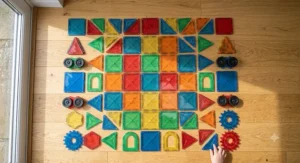
Specs are one thing; how a set actually gets used on a Tuesday afternoon is another matter entirely. Expect a genuinely wide age range of engagement from most sets — reviewers consistently describe children playing meaningfully with the same magnetic tiles from around 18 months right through to seven or eight, with the type of play evolving from simple stacking and pulling apart, through colour sorting, to increasingly elaborate architectural builds, marble-run-style engineering, and imaginative city-building.
On the heavier-magnet premium sets — Connetix and Playmags in particular — expect noticeably taller and more ambitious structures to stay standing, which matters more than it sounds once a child starts attempting multi-storey builds or wide bridges. On lighter-magnet budget sets, structures are perfectly stable for typical play but do topple more easily under an enthusiastic sibling’s touch, which some parents specifically prefer as a gentler, lower-frustration experience for very young children still developing patience. Across virtually every brand in this guide, reviewers note that the toy holds attention far longer than character-branded alternatives, precisely because there’s no single “correct” way to play — a pattern repeated so consistently across independent reviews that it’s genuinely one of the strongest arguments for the category as a whole.
Affordable Magnetic Building Blocks: Getting Great Value Without Overspending
Not every family needs, or can justify, a premium £100+ tile set, and there’s genuinely no shame in that — some of the best-reviewed budget kids toys in this entire category punch well above their price point. PicassoTiles and Cossy Magnetic Tiles both consistently score comparable magnet strength to premium rivals in independent testing, at roughly a third to a half of the price, which makes either a genuinely sensible way to test whether a specific child will actually engage with the toy before committing to a bigger spend.
The most cost-effective strategy for a genuinely affordable magnetic building blocks purchase is usually to start with a single mid-sized budget set — around 60-100 pieces — and expand later with a second, similarly priced set rather than one large premium purchase upfront. Since most brands are broadly compatible with each other, this staged approach spreads cost over time, lets you gauge genuine interest before a bigger spend, and still results in a large combined collection eventually. Watch for seasonal Amazon promotions too, since bulk piece-count sets in this category are frequently discounted around Christmas and back-to-school periods — check current price and availability before buying, as promotional pricing shifts constantly.
Choosing Magnetic Building Blocks Large Sets and STEM Building Sets for Growing Families
Families with multiple children, or a single child with genuinely ambitious building goals, quickly discover that piece count matters more than almost any other factor. A 30-piece starter set that felt generous for a solo toddler becomes frustratingly limiting the moment a sibling wants to join in or a child wants to build something the size of an actual piece of furniture. For magnetic building blocks large enough to satisfy that ambition, the SUNNY AUNTIE XL Set and larger Playmags bundles are the strongest picks in this guide, both offering 125+ pieces without premium-brand pricing.
For families specifically prioritising the educational angle, dedicated STEM building sets like Geomag deserve serious consideration alongside — rather than instead of — a large flat-tile set. The two toy types teach genuinely different spatial and engineering concepts, and owning both gives a child a broader construction “vocabulary” than either alone. A sensible approach for a family building out a proper collection is to combine one large flat-tile set as the daily workhorse with a smaller Geomag set as an occasional, more structured challenge activity.
Long-Term Cost & Value of Magnetic Construction Toys
The purchase price is only part of the real cost story with magnetic construction toys, and it’s worth thinking in years rather than months. Premium brands like Connetix and Magna-Tiles carry a genuinely higher upfront cost, but both hold resale value unusually well — a well-cared-for set can be sold on second-hand marketplaces for a meaningful proportion of its original price years later, which meaningfully softens the real cost of ownership over time. Budget brands like PicassoTiles, Cossy, and the SUNNY AUNTIE XL Set cost far less upfront but hold resale value less strongly, and glued-seam construction on some budget sets means a slightly shorter realistic lifespan before tiles need replacing.
| Cost Factor | Budget Sets (PicassoTiles, Cossy, SUNNY AUNTIE) | Premium Sets (Connetix, Magna-Tiles) |
|---|---|---|
| Typical Purchase Price | £25-£55 | £45-£130+ |
| Typical Resale Value After 2-3 Years | Low | Moderate-High |
| Expected Realistic Lifespan | 2-4 years of heavy use | 4+ years, often passed to younger siblings |
| Best For | Testing interest, tight budgets | Long-term family investment |
Run the numbers over several years and a family with more than one child — where a set gets handed down rather than retired — often finds the premium brands work out comparably priced per year of actual use, even with the higher upfront cost. For a family with a single child, or genuine budget constraints, a well-reviewed budget set represents entirely sound value and shouldn’t be treated as a compromise.
Safety, Regulations & Compliance Guide
Magnet safety deserves serious, specific attention in this category, not just a passing mention. RoSPA’s official guidance on magnet safety explains that if two or more magnets are swallowed, they can attract each other through the walls of the intestines, trapping tissue and causing serious internal injury — a risk that applies specifically to loose or exposed magnets rather than to intact, properly sealed tiles, but one that makes checking a set’s construction quality genuinely important, not just a nice-to-have.
Under UK law, toys sold in Great Britain must comply with the Toy Safety Regulations, and the government’s official product safety alert on high-powered magnetic products sets out the acceptable magnetic flux index defined in the EN71 toy safety standard, along with a requirement for clear ingestion-risk warnings on any product containing magnets. In practice, this means checking that any set you buy — particularly from lesser-known third-party Amazon sellers — carries proper CE or UKCA marking and an age recommendation, and taking that age guidance seriously rather than assuming a bright, fun-looking toy is automatically fine for a younger sibling in the room.
Beyond the legal minimum, sensible household practice matters just as much: periodically check tiles for cracks or looseness at the seams, particularly on glued-construction budget sets, and remove any damaged piece from play immediately. Riveted-seam brands like Connetix and Magna-Tiles are generally more resistant to this failure mode than glued alternatives, which is a genuine safety consideration worth weighing alongside price when younger children or persistent chewers are in the house. If you ever suspect a child has swallowed a magnet, seek medical advice immediately rather than waiting to see if symptoms appear, since internal damage from multiple swallowed magnets can progress quickly.
Frequently Asked Questions
❓ What age are magnetic building blocks suitable for?
❓ Are magnetic building blocks safe for toddlers?
❓ Which magnetic building blocks are the strongest?
❓ How many magnetic building blocks should I buy to start?
❓ Are cheaper magnetic building blocks worth buying?
Conclusion
There’s no single correct answer to “which magnetic building blocks should I buy,” and honestly, the right choice depends far more on your child’s age, your household size, and your budget than on any one brand’s marketing claims. A family wanting the strongest possible magnets and the most premium finish should look hard at Connetix Tiles; anyone drawn to brand heritage and a huge expansion ecosystem will find Magna-Tiles hard to beat. For genuinely affordable magnetic building blocks that still perform well in independent testing, PicassoTiles and Cossy Magnetic Tiles are honest, strong-value choices, while the SUNNY AUNTIE XL Set and larger Playmags bundles answer the specific need for magnetic building blocks large enough for siblings or group play. If your child has already mastered flat tiles, Geomag‘s rod-and-sphere system is a genuinely different STEM building sets option worth adding to the mix.
Whichever set you choose, prioritise proper storage, keep an eye on tile condition over time, and take UK safety guidance around magnets seriously rather than as small print. Do that, and there’s a good chance whatever you pick becomes the toy that’s still out on the living room floor years from now — the true mark of a genuinely good investment.
✨ Don’t Miss These Exclusive Deals!
🔍 Take your child’s playroom to the next level with the carefully researched magnetic building block sets above. Click on any highlighted set to check current pricing and availability on amazon.co.uk. The right set could be the difference between a toy that’s forgotten by February and one that’s still being built with years from now!
Recommended for You
- Giant Foam Building Blocks: 7 Safe Picks for Toddlers (2026)
- Wooden Blocks for Toddlers: 7 Best Sets Reviewed for 2026
- Wooden Building Blocks: 7 Best Sets for UK Families in 2026
Disclaimer: This article contains affiliate links. As an Amazon Associate, I earn from qualifying purchases. If you purchase products through these links, we may earn a small commission at no additional cost to you.
✨ Found this helpful? Share it with your friends! 💬🤗
