

In This Article
Standing in the toy aisle trying to decide between flat, translucent squares and chunky wooden pieces that both claim to be the ultimate magnetic construction toy is a genuinely confusing moment for most parents. The magnetic tiles vs magnetic blocks question comes up constantly precisely because the two categories look similar in marketing photos but behave quite differently once they’re actually being pulled apart, stacked, and occasionally launched across the living room by an enthusiastic four-year-old.

Here’s the short version: magnetic tiles are flat, geometric shapes — usually squares and triangles — with magnets embedded along every edge, designed to snap together into flat patterns or tall 3D structures like walls and roofs. Magnetic blocks are typically solid, three-dimensional pieces — cubes, planks, columns — with magnets embedded inside, built more for stacking, balancing and vehicle-style play than for the window-and-wall builds tiles specialise in. Both fall under the broader magnetic building set STEM category, and both genuinely earn a place in that category, but they teach and encourage different things. According to RoSPA’s guidance on toy safety, the most common problems with any construction toy come down to age-appropriateness and supervision rather than the toy type itself, which is worth keeping in mind before assuming one category is automatically “safer” than the other. This guide compares seven real, currently available sets across both tiles and blocks, so you can work out which genuinely suits your child’s play style rather than just following whichever one is trending this month.
Quick Comparison Table
| Set | Type | Piece Style | Best For |
|---|---|---|---|
| Connetix Magnetic Tiles | Tiles | Flat, translucent geometric shapes | Colour and light-play, premium builds |
| Magna-Tiles Clear Colors | Tiles | Flat, translucent squares and triangles | The established benchmark, classroom use |
| PicassoTiles Classic Starter Set | Tiles | Flat squares and triangles, cross-brand compatible | Budget entry into magnetic tiles |
| Magna-Tiles Cars / Dashers | Tiles with wheels | Wheeled chassis for tile-built vehicles | Magnetic blocks with wheels, motion play |
| Magformers Amazing Transform Wheel Set | Tiles with wheels | Rotating-magnet shapes with adjustable wheels | 3D magnetic construction toys, vehicles |
| Tegu Magnetic Wooden Blocks | Blocks | Solid wooden cubes, planks and columns | Genuine magnetic blocks, tactile play |
| Geomag Classic / Panels Set | Rods and balls | Magnetic rods with steel spheres | Spatial reasoning toys, engineering play sets |
Looking at the spread above, the genuine dividing line in this category isn’t really tiles versus blocks as a binary choice — it’s flat-panel building versus solid-piece building versus rod-and-sphere construction, three distinct play styles that all fall under the “magnetic construction toy” umbrella. The Tegu Magnetic Wooden Blocks stand out as the only genuinely wooden, non-tile option here, while Magna-Tiles Cars and the Magformers Amazing Transform Wheel Set both bridge the gap between flat-tile building and rolling vehicle play. For anyone specifically hunting for engineering play sets that emphasise structural thinking over flat patterns, the Geomag Classic Panels Set takes a genuinely different mechanical approach from every other entry on this list.
💬 Just one click — help others make better buying decisions too!😊
Top 7 Magnetic Tiles and Magnetic Blocks Sets: Expert Analysis
Coverage below spans flat magnetic tiles, solid magnetic blocks, and rod-and-sphere construction sets, plus budget, mid-range and premium options, so there’s a genuine fit whichever side of the magnetic tiles vs magnetic blocks debate your child leans toward.
1. Connetix Magnetic Tiles — clearest colour and light refraction in the tile category
Connetix’s standout feature is a bevelled tile edge that Connetix states enhances durability while creating a genuinely noticeable light-refraction effect when built structures are held up to a window or light table — a visual detail that matters more than it sounds for younger children who engage with colour and light as much as with structure. Made from non-toxic ABS plastic that’s BPA, lead and phthalate-free, the tiles use ultrasonic welding and metal rivets to keep magnets sealed inside, and Connetix states the magnets are exceptionally strong to support tall, large-scale builds without the wobble that weaker tile brands can suffer from at height. Based on the spec comparison, what most buyers overlook is that Connetix tiles are explicitly designed to be cross-compatible with other major tile brands, including Magna-Tiles, which matters considerably if a family already owns a starter set and is expanding rather than starting from scratch. UK Amazon reviews for Connetix sets consistently sit around 4.6-4.7 out of 5 across sets ranging from smaller expansion packs to larger starter kits, with buyers repeatedly highlighting the colour vibrancy and magnet strength as standout features compared with cheaper alternatives, while the recurring criticism is straightforwardly the price point relative to unbranded competitors.
Pros:
- ✅ Bevelled edges create a distinctive light-refraction effect
- ✅ Cross-compatible with Magna-Tiles and other major brands
- ✅ Consistently strong buyer ratings across the range
Cons:
- ❌ Premium pricing compared with unbranded tile sets
- ❌ Larger sets represent a significant upfront investment
Typical pricing runs from around £30-£35 for smaller expansion packs up to £95-£115 for larger starter sets; check current price and set size before buying, since Connetix’s range spans considerably in scope. For families wanting the strongest magnets and clearest colour in the flat-tile category specifically, this is one of the more consistently well-reviewed premium picks.

2. Magna-Tiles Clear Colors — the original, no-recall benchmark for magnetic tiles
Magna-Tiles holds a genuinely unusual position in this category: it’s the original translucent tile brand, and according to Good Housekeeping Institute’s Chief Technologist Rachel Rothman, the company has never issued a recall in over 25 years of production, a track record few construction toy brands can match. The Clear Colors sets — available in 32, 37 and 100-piece configurations — include a mix of small and large squares alongside equilateral, right and isosceles triangles, all made from food-grade MABS plastic free from BPA, phthalates and latex. Based on the spec comparison, what genuinely sets Magna-Tiles apart from newer tile brands isn’t flashier features but a track record of durability that’s been independently tested rather than simply claimed, meeting US and international testing guidelines including EN71, ASTM and CPSIA. The translucent design works particularly well on light tables, a detail favoured heavily in early years classrooms, and every piece remains compatible with the brand’s growing range of vehicle chassis and themed expansion sets. Reviewers across multiple retailers consistently praise the durability of pieces that have survived a decade or more of regular play without cracking, with the most common criticism being that Magna-Tiles’ pricing sits at a genuine premium relative to compatible third-party alternatives offering similar piece counts.
Pros:
- ✅ Longest independently-verified durability track record in the category
- ✅ Meets EN71, ASTM and CPSIA safety testing standards
- ✅ Compatible with the brand’s full vehicle and themed expansion range
Cons:
- ❌ Among the more expensive options per piece
- ❌ Smaller starter sets limit build scale until expanded
Expect pricing in the £30-£45 range for smaller starter sets, rising to £90-£130 for the 100-piece Clear Colors set. As the benchmark the rest of the magnetic tiles category is generally measured against, this remains a strong, if premium, choice.
3. PicassoTiles Classic Starter Set — the budget-friendly way into magnetic tiles
PicassoTiles takes a straightforwardly different approach from the premium brands above: a 100-piece Classic Starter Set including large and small squares alongside small, medium and tall triangular pieces, priced to make magnetic tile play accessible without a significant upfront commitment. The tiles are described by PicassoTiles as sized appropriately for small hands to grasp and position easily, and the brand states its standard sizing ensures compatibility with other popular tile brands, allowing a family to blend a PicassoTiles starter set with pricier Connetix or Magna-Tiles expansion packs later without needing to replace anything. Based on the spec comparison, what most budget buyers overlook is that magnetic strength and edge-seal quality genuinely do vary between tile brands even when dimensions match, so a PicassoTiles set functions as a genuinely solid starting point rather than a permanent ceiling, particularly for families wanting to trial whether magnetic tile play suits their child before investing in the premium end of the category. Reviewers commonly note the set’s smooth, rounded edges as a thoughtful safety detail for younger builders, and the sheer piece count at this price point is repeatedly flagged as strong value, with the main criticism being that magnet strength feels noticeably weaker than Connetix or Magna-Tiles once structures get tall.
Pros:
- ✅ Cross-brand compatible with pricier tile ranges
- ✅ Strong piece count for the price point
- ✅ Smooth, rounded edges suited to younger builders
Cons:
- ❌ Magnets feel weaker than premium brands at height
- ❌ Colour translucency is less vivid than Connetix or Magna-Tiles
Pricing typically sits in the £30-£45 range for the 100-piece set, making it one of the most accessible entry points into magnetic tiles on this entire list. For a first set to test genuine interest before committing to premium pricing, this is a sensible starting choice.
4. Magna-Tiles Cars / Dashers — turns flat tiles into rolling vehicles
Where the tile sets above build walls and towers, this expansion range solves a genuinely different problem: giving children a way to build cars, trucks and trains using their existing tile collection. The Cars 2-Piece Set includes wheeled magnetic chassis with 12 magnets around the frame, letting children attach standard tiles to build a custom vehicle body, while the newer Dashers range takes a more kid-powered approach, with wheels designed to ride along tile-built ramps and roads and a small brake regulating speed for frustration-free play. Based on the spec comparison, what genuinely sets this apart from other magnetic blocks with wheels solutions is that it doesn’t require an entirely separate toy system — it plugs directly into an existing Magna-Tiles or compatible tile collection, meaning the investment already made in flat tiles gets a second life as vehicle-building material rather than sitting unused once the novelty of flat structures wears off. The reusable packaging doubles as a small ramp, a nice touch for immediate play value straight out of the box. Reviewers, including teachers using the range in classroom settings, consistently highlight how naturally the cars integrate with existing tile play, describing genuine excitement from children discovering they can drive their own tile-built creations, with the main limitation being that the wheeled chassis pieces themselves are sold in small quantities relative to their price.
Pros:
- ✅ Works directly with existing tile collections
- ✅ Encourages cause-and-effect and motion-based play
- ✅ Reusable packaging doubles as a ramp
Cons:
- ❌ Small piece count relative to price
- ❌ Requires an existing tile collection to get full value
Pricing generally runs £15-£25 for a small 2-piece car set, up to £30-£40 for larger Dashers packs. For families who already own tiles and want to add motion-based play without starting a new collection, this is a genuinely well-targeted expansion.
5. Magformers Amazing Transform Wheel Set — rotating magnets and adjustable wheels in one 3D set
Magformers takes a mechanically different approach from every tile brand on this list: rather than flat magnets embedded along tile edges, each piece uses a Rotating Magnets System with spinning barrel magnets sealed inside, meaning pieces always attach correctly regardless of which way they’re rotated when a child brings them together. The Transform Wheel Set specifically includes 15 magnetic shapes — 8 triangles, 6 squares and 1 double-square rectangle — alongside adjustable in-line wheels that can be repositioned to suit a buggy, low-profile racer or monster truck build, or folded flat to build robot arms instead. Based on the spec comparison, what genuinely distinguishes this as one of the stronger 3D magnetic construction toys on this list is the adjustable wheel geometry itself, which teaches a more advanced spatial concept than static wheeled chassis — children learn that changing wheel position and height changes how a vehicle behaves, a genuinely early engineering concept dressed up as play. Independent reviewers at The Good Play Guide noted that younger testers needed brief adult help positioning pieces initially but were building independently within a short time, and praised the included playsheet guides for teaching genuine 2D and 3D geometry alongside free construction. The main limitation flagged consistently is that the Rotating Magnets System, while more forgiving than flat tile magnets, comes at a higher price per piece than comparable flat-tile sets.
Pros:
- ✅ Rotating Magnets System means pieces always attach correctly
- ✅ Adjustable wheel geometry teaches genuine engineering concepts
- ✅ Playsheet guides support structured 2D and 3D geometry learning
Cons:
- ❌ Higher price per piece than flat tile equivalents
- ❌ Younger children may need initial adult assistance
Pricing typically sits in the £25-£40 range for the Transform Wheel Set. For families specifically prioritising 3D magnetic construction toys with genuine engineering variety over flat tile stacking, this is one of the strongest picks on this list.

6. Tegu Magnetic Wooden Blocks — the genuine magnetic blocks alternative to tiles
Tegu takes the category in a genuinely different material direction entirely: solid, sustainably-sourced hardwood blocks — cubes, planks, columns and parallelograms — with magnets embedded inside rather than along a flat tile edge, finished with non-toxic, water-based lacquers rather than moulded plastic. The 24-Piece Set includes medium columns, mega planks, long and short planks, cubes and parallelograms, all fully compatible with every other Tegu set, including the 42-piece range that adds click-on magnetic wheels for mobile creations. Based on the spec comparison, this is arguably the clearest real-world example of what “magnetic blocks” actually means as distinct from tiles — the pieces are solid and three-dimensional in their own right rather than flat panels that only become 3D when connected at angles, which produces a noticeably different building style favouring stacking, balancing and weight distribution over wall-and-window construction. Tegu is manufactured in Tegucigalpa, Honduras, with the company stating a commitment to fair wages and working conditions for local craftspeople, a detail some parents specifically value alongside the product itself. Reviewers consistently describe Tegu blocks as heirloom-quality, citing the tactile, natural wood feel as a genuine point of difference from plastic tile brands, with the main criticism being that the smaller starter sets feel limited in scope compared with the vast piece counts available from PicassoTiles or Magna-Tiles at a similar price.
Pros:
- ✅ Genuine solid wooden blocks, distinct from flat tiles
- ✅ Sustainably sourced hardwood with non-toxic lacquer finish
- ✅ Fully compatible across the entire Tegu range, including wheeled sets
Cons:
- ❌ Smaller sets offer fewer pieces than equivalent tile starter sets
- ❌ Wood construction costs more per piece than plastic tiles
Expect pricing in the £35-£50 range for the 24-piece set, rising for larger configurations. For anyone specifically wanting the “blocks” side of the magnetic tiles vs magnetic blocks comparison rather than another flat-tile brand, this is the clearest genuine alternative on this list.
7. Geomag Classic / Panels Set — the purest spatial reasoning toy on this list
Geomag takes a third, entirely distinct mechanical approach: magnetic rods, each roughly 6cm long with a neodymium magnet at both ends, connected via non-magnetic steel spheres to form three-dimensional geometric structures rather than flat panels or solid blocks. Invented in Switzerland in 1998 and credited as the first magnetic construction toy of its kind, Geomag predates the current wave of flat tile brands by roughly two decades, and the Panels range adds coloured triangle, square and pentagon panels that clip between the rods to create enclosed 3D shapes rather than open frameworks. Based on the spec comparison, what genuinely sets this apart as a spatial reasoning toy is the construction method itself — building a stable 3D shape from rods and spheres requires understanding angles, tension and structural geometry in a way that flat tiles, which simply snap flush at 90-degree angles, don’t demand in the same way. Independent reviewer The Brick Castle noted that younger children found the precise angle alignment required for panels to click into place genuinely challenging, describing it as “a challenge for older ones” rather than instantly intuitive, which is worth knowing if you’re buying for a younger sibling used to more forgiving tile-based play. Reviewers consistently praise the structural rigidity of finished builds even when several rods are chained together to bear weight, and Geomag’s more recent ranges use up to 100% recycled plastic, a detail increasingly relevant to environmentally-conscious buyers.
Pros:
- ✅ Genuinely distinct 3D construction method, not a tile variant
- ✅ Strong structural rigidity even in complex builds
- ✅ Recycled plastic used across newer Geomag ranges
Cons:
- ❌ Steeper learning curve than flat tiles for younger children
- ❌ Loose steel spheres present a swallowing risk requiring close supervision
Pricing generally runs £25-£45 for smaller sets, rising toward £60-£80 for larger Panels configurations. For engineering play sets specifically targeting spatial reasoning over flat pattern-building, this remains one of the most genuinely distinct options in the entire magnetic construction category.
Top 7 Sets: Full Specification Comparison
| Set | Construction Type | Material | Price Range | Best For |
|---|---|---|---|---|
| Connetix Magnetic Tiles | Flat tiles | ABS plastic | £30-£115 | Colour, light-play, premium builds |
| Magna-Tiles Clear Colors | Flat tiles | MABS plastic | £30-£130 | Durability benchmark, classrooms |
| PicassoTiles Starter Set | Flat tiles | ABS plastic | £30-£45 | Budget entry point |
| Magna-Tiles Cars/Dashers | Wheeled tile expansion | ABS plastic | £15-£40 | Motion and vehicle play |
| Magformers Transform Wheel | Rotating-magnet tiles + wheels | Toughened ABS | £25-£40 | 3D construction, adjustable geometry |
| Tegu Wooden Blocks | Solid blocks | Sustainable hardwood | £35-£50+ | Genuine “blocks” tactile play |
| Geomag Classic/Panels | Rods and spheres | Plastic-coated rods, steel spheres | £25-£80 | Spatial reasoning, engineering |
The construction-type column above is genuinely the most important one to read before buying, since it determines play style far more than piece count or price does. Flat tile sets from Connetix, Magna-Tiles and PicassoTiles dominate wall-and-window style building and are broadly interchangeable across brands, while the Tegu Wooden Blocks and Geomag Classic/Panels Set represent genuinely different mechanical approaches that don’t combine with tile collections at all. For families wanting maximum flexibility from a single purchase, a tile-based starter set with a wheeled expansion like Magna-Tiles Cars offers the broadest single-brand play range on this list.
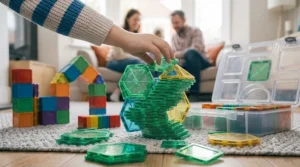
Practical Usage Guide: Getting Started with Magnetic Building Sets
Starting a magnetic building set collection benefits from a genuinely simple rule: buy fewer, better pieces before buying more, cheaper ones. A 30-40 piece starter set from a reputable tile brand gives most three and four-year-olds enough variety to build genuinely satisfying structures, and expanding later once a specific interest emerges — vehicles, larger architectural builds, or a switch toward blocks or rods — tends to produce better long-term value than an enormous initial purchase that goes untouched. A common mistake in the first thirty days is storing pieces loose in a large toy box, where tiles and blocks get buried under unrelated toys and lose the visual appeal that makes magnetic construction genuinely engaging; a shallow, open storage tray keeps pieces visible and accessible in a way that encourages spontaneous building.
For families mixing brands within the flat tile category, always test compatibility with a single piece before buying a full cross-brand expansion, since magnet strength differences between brands like Connetix and PicassoTiles can create a noticeably weaker join at connection points, even when the physical dimensions match. Cleaning magnetic tiles and blocks is straightforward for most plastic sets — a damp cloth handles the vast majority of everyday grime — but wooden sets like Tegu should never be fully submerged in water, since this can damage both the wood finish and the embedded magnets over time. Finally, periodically checking pieces for any sign of cracking or a loosened magnet is worth building into a household routine, since a magnet working its way free from its housing is the single most common safety issue across every set on this list, regardless of brand or price point.
Real-World Scenarios: Which Magnetic Set Suits Your Child?
Picture three different children approaching a construction toy shelf. First, a three-year-old just starting to show interest in building, whose fine motor skills are still developing and whose attention span for anything requiring precision is genuinely limited — for this profile, the PicassoTiles Classic Starter Set or a small Magna-Tiles Clear Colors pack makes the most sense, since flat tiles snap together at forgiving right angles that don’t demand the precise geometry Geomag’s rods require. Second, a six-year-old deep into a vehicles-and-motion phase, more interested in how things move than in static structures — here, Magna-Tiles Cars or the Magformers Amazing Transform Wheel Set pulls ahead decisively, since both let a child build something that then actually does something, which tends to hold attention considerably longer than a static tower once the novelty of stacking wears off. Third, an eight or nine-year-old who has largely outgrown basic tile stacking and is ready for a genuine engineering challenge involving angles, tension and structural stability — for this profile, the Geomag Classic/Panels Set offers meaningfully more challenge than any tile brand on this list, precisely because its rod-and-sphere mechanism doesn’t snap together as forgivingly as flat magnetic edges do.
A fourth profile worth naming directly: a family specifically drawn to natural materials and tactile play over bright plastic, perhaps already gravitating toward wooden toys elsewhere in the home. For this scenario, Tegu Magnetic Wooden Blocks deliver a genuinely different sensory experience from every plastic tile or rod set on this list, and the solid, weighted feel of hardwood blocks tends to suit stacking and balancing play in a way flat tiles, which are lightweight by design, simply can’t replicate.
Buyer’s Decision Framework
If your child is under four and just beginning construction play, choose flat magnetic tiles over blocks or rods, because the forgiving right-angle connections and immediate visual feedback of colour and light suit developing fine motor skills better than the more demanding geometry of rods and spheres. If your child is drawn to vehicles and motion over static structures, prioritise Magna-Tiles Cars or the Magformers Amazing Transform Wheel Set over a plain tile starter pack, since both channel building energy toward something that moves rather than something that simply stands. If you’re building a first collection on a limited budget, start with PicassoTiles rather than a premium brand, and only upgrade to Connetix or Magna-Tiles once genuine sustained interest is confirmed. If your priority is maximum spatial and structural challenge for an older child, Geomag offers meaningfully more engineering complexity than any tile-based set on this list. And if tactile, natural materials matter more to your family than maximum piece count or vivid colour, Tegu Magnetic Wooden Blocks remain the clearest genuine “blocks” alternative to the flat tile category entirely.
Magnetic Tiles vs Magnetic Blocks: The Real Differences
The core magnetic tiles vs magnetic blocks question comes down to geometry and physical form rather than brand preference. Magnetic tiles are flat panels — squares, triangles, rectangles — with magnets running along every edge, meaning any two edges of matching length will connect at a clean 90 or 60-degree angle. This makes tiles exceptionally good at flat pattern-building and enclosed 3D structures like walls, roofs and windows, but genuinely limited when it comes to freeform, non-geometric shapes. Magnetic blocks, by contrast — represented on this list by Tegu’s solid wooden pieces — are three-dimensional in their own right before they’re ever connected to anything else, with magnets embedded inside rather than along an exposed edge, favouring stacking, balancing and weight-bearing constructions over flat wall-building. Neither category is objectively superior; they teach genuinely different pre-engineering concepts. Tiles excel at teaching 2D shape recognition, symmetry and enclosed 3D geometry, while blocks lean toward gravity, balance and load-bearing structural thinking, closer to traditional wooden block play with the added benefit of magnetic connection rather than pure stacking. For most families, the practical answer isn’t choosing exclusively between the two but recognising that a child’s interest often shifts between them as fine motor skills and spatial reasoning develop, which is precisely why many households end up owning both a tile set and a block or rod-based set over time rather than committing permanently to one category.
✨ Don’t Miss These Exclusive Deals!
🔍 Take your child’s building play to the next level with these carefully selected magnetic tiles and blocks sets. Click on any highlighted item to check current pricing and availability. These picks genuinely support STEM learning long after the birthday wrapping paper is gone!
How to Choose a Magnetic Building Set STEM Toy
- Match the construction type to your child’s age and current skill level. Flat tiles suit younger builders best; rod-and-sphere sets like Geomag genuinely reward older children with more developed fine motor control.
- Decide whether flat building or 3D stacking better fits your child’s interests. A child who loves drawing and pattern-making often gravitates toward tiles, while one who loves stacking blocks and knocking them down may prefer solid magnetic blocks instead.
- Check cross-brand compatibility before mixing collections. Most flat tile brands are broadly compatible, but blocks, rods and rotating-magnet systems like Magformers generally are not interchangeable with tile-based sets.
- Consider whether vehicle or motion-based play matters to your child. If so, prioritise a magnetic building set STEM toy with a wheeled expansion, like Magna-Tiles Cars or the Magformers Transform Wheel Set, over a purely static tile pack.
- Weigh piece count against genuine build ambition. A 30-piece starter set satisfies most younger children; older children building elaborate structures benefit from 100-plus piece collections.
- Factor in material preference. Plastic tiles are lightweight and vividly colourful; wooden blocks like Tegu offer a different tactile experience that some families specifically value.
- Always check age recommendations and supervision needs around small magnets. This matters across every set on this list, regardless of construction type or price point.
Common Mistakes When Buying Magnetic Construction Toys
The most frequent mistake is assuming all magnetic tile brands are interchangeable purely because pieces look similar in photos, only to discover a budget brand’s magnets are noticeably weaker once a structure gets more than a few layers tall. A second common error is buying a rod-and-sphere set like Geomag for a child still in the early stages of construction play, then finding the precision required to align rods and spheres correctly leads to frustration rather than engagement — this category genuinely suits older, more dexterous builders better than tile-based alternatives. Parents also frequently underestimate storage needs; a large piece collection dumped into a generic toy box loses much of its visual appeal and encourages abandonment rather than continued building, whereas open, shallow storage keeps pieces genuinely inviting. Finally, a critical and genuinely underrated mistake is failing to account for loose magnet risk as pieces age; OPSS, the UK’s product safety regulator, has issued repeated safety alerts about the serious injury risk posed by small, high-powered magnets if swallowed, and any construction toy with embedded magnets — tiles, blocks or rod-and-sphere sets alike — should be checked periodically for damage that could expose or loosen the magnets inside.
Magnetic Blocks with Wheels and 3D Construction: Features That Actually Matter
Marketing copy for magnetic blocks with wheels and 3D magnetic construction toys tends to emphasise novelty over genuine engineering value, but a handful of features separate the sets that hold up to real play from ones that feel gimmicky within a week. Wheel mounting mechanism matters more than most buyers initially realise: Magna-Tiles’ wheeled chassis pieces plug directly into an existing tile collection, while Magformers’ adjustable in-line wheels can be repositioned to change a vehicle’s handling characteristics entirely, teaching a genuinely more advanced concept than a fixed chassis ever could. Axle rigidity is a second underrated factor — cheaper wheeled expansions can wobble or detach under the weight of a taller tile-built vehicle body, while better-engineered options like the Magna-Tiles Dashers range include a small brake mechanism specifically to regulate speed and prevent frustration during play. For genuine 3D construction beyond flat wall-building, the connection angle flexibility of a set matters considerably: Geomag’s rod-and-sphere system allows for genuinely freeform angles that flat tiles, locked into fixed 90 and 60-degree connections, simply can’t replicate, which is precisely why rod-based sets tend to produce more structurally ambitious builds among older, more experienced builders. Compatibility between wheeled expansions and a family’s existing tile collection is worth checking carefully before buying, since a wheeled chassis from one brand won’t reliably connect to a different brand’s tiles even when both are nominally “magnetic tile compatible.”
Do Magnetic Tiles Really Build Spatial Reasoning? What the Research Suggests
The claim that magnetic tiles and blocks develop spatial reasoning skills is one of the most heavily marketed benefits in this entire category, and it’s worth understanding what that actually means in practice rather than taking it purely on faith. Spatial reasoning, broadly, covers a child’s ability to visualise, manipulate and understand the relationships between shapes and objects in space — precisely the skill required to work out which tile shape will complete a wall, or how many rods are needed to close a triangular frame. Construction toys that require a child to plan ahead, test a hypothesis about whether a piece will fit, and adjust when it doesn’t, genuinely engage this kind of reasoning in a way that passive toys don’t. What the marketing copy tends to gloss over is that different construction mechanisms exercise this skill differently: flat tiles, with their forgiving fixed-angle connections, build early spatial confidence quickly but plateau in complexity once a child masters the basic shape vocabulary, while rod-and-sphere sets like Geomag continue to challenge spatial reasoning at a genuinely higher level as children get older, precisely because the connections aren’t fixed at convenient right angles. In practice, this means a single toy rarely delivers spatial reasoning development across an entire childhood — a family that starts with tiles at age three and introduces a rod-based or block-based set by age seven or eight is likely to see more sustained developmental benefit than sticking with one category throughout.
Safety and Regulations for Magnetic Toys
Every set on this list, whether flat tile, solid block or rod-and-sphere, relies on embedded magnets, which places it under the UK’s Toys (Safety) Regulations 2011, covering physical construction, small parts, and mandatory CE or UKCA marking. Magnets specifically receive additional regulatory attention beyond standard toy safety rules, because small, high-powered magnets pose a genuinely serious health risk if swallowed — if more than one magnet is ingested, they can attract each other through intestinal walls, causing internal injuries that require emergency surgery. This isn’t a hypothetical concern: OPSS’s safety alert on small high-powered magnets was issued specifically in response to rising injury reports, particularly among children and young people, and the guidance is unambiguous that any product containing loose or accessible magnets should be kept away from young children and checked regularly for damage. For the sets covered in this guide, reputable brands like Connetix, Magna-Tiles, PicassoTiles, Magformers, Tegu and Geomag all seal their magnets inside the plastic or wooden housing using welding, rivets or lacquer specifically to prevent this risk under normal use — but “normal use” assumes intact, undamaged pieces, which is exactly why periodic inspection matters more with magnetic construction toys than with almost any other toy category. If a piece ever shows a crack, a rattle, or any sign a magnet has come loose inside, remove it from circulation immediately rather than continuing to let a child play with it, and if a child is ever suspected of swallowing a magnet, seek emergency medical attention straight away rather than waiting to see if symptoms develop.
Price Range & Value Analysis
| Budget Tier | Price Range | What You Get | Best For |
|---|---|---|---|
| Entry | £30-£45 | Small tile starter set or basic block pack | Testing genuine interest before expanding |
| Mid-range | £45-£80 | Larger tile sets, wheeled expansions, or Geomag Panels | Established interest, more build variety |
| Premium | £80-£130+ | Large Connetix or Magna-Tiles sets, full Tegu collections | Long-term collections, classroom or multi-child use |
Looking at the value breakdown, the entry tier is genuinely sufficient to establish whether a child engages with magnetic construction play at all, and jumping straight to a premium-tier purchase before confirming that interest is one of the more common regrets parents report in this category. The mid-range tier tends to represent the strongest overall value for most families, offering enough pieces for genuinely ambitious builds without the cost of a full premium collection, while the premium tier makes most sense for households with multiple children sharing a set, or families specifically building toward long-term, large-scale construction play over several years.

FAQ
❓ Are magnetic tiles or magnetic blocks better for toddlers?
❓ Can different brands of magnetic tiles be mixed together?
❓ Are magnetic building sets safe for young children?
❓ What age are magnetic tiles and blocks suitable for?
❓ Do magnetic tiles or magnetic blocks better support STEM learning?
Conclusion
There’s no single winner in the magnetic tiles vs magnetic blocks debate, and treating it as a binary choice misses the genuine point of the category: tiles, blocks and rod-and-sphere sets each teach a meaningfully different kind of spatial and structural thinking, and most children benefit from encountering more than one over the course of their construction-play years. The Connetix, Magna-Tiles and PicassoTiles picks on this list cover the flat-tile category from premium to budget, Magna-Tiles Cars and the Magformers Amazing Transform Wheel Set bring genuine motion and vehicle play into the mix, Tegu Magnetic Wooden Blocks offers the clearest true “blocks” alternative for tactile, natural-material play, and the Geomag Classic/Panels Set remains the most genuinely challenging engineering play set on this entire list for older, more experienced builders. Whichever category you start with, the underlying advice holds: buy a modest starter set first, watch which kind of building genuinely captures your child’s attention, and expand from there rather than guessing upfront which side of the tiles-versus-blocks divide will win.
Recommended for You
- Giant Foam Building Blocks: 7 Safe Picks for Toddlers (2026)
- Wooden Blocks for Toddlers: 7 Best Sets Reviewed for 2026
- Wooden Building Blocks: 7 Best Sets for UK Families in 2026
Disclaimer: This article contains affiliate links. As an Amazon Associate, I earn from qualifying purchases. If you purchase products through these links, we may earn a small commission at no additional cost to you.
✨ Found this helpful? Share it with your friends! 💬🤗
