
In This Article
There’s a particular kind of chaos that happens in a British living room around 5pm on a wet Tuesday — a toddler, a mountain of plastic, and a parent quietly wondering if there’s a better way. Increasingly, the answer families are landing on is wooden building blocks, and it’s not just nostalgia talking. Search interest in wooden building blocks has climbed steadily across the UK over the past few winters, and toy shop owners from Cornwall to Aberdeen report the same thing: parents are actively trying to buy less plastic, not more.
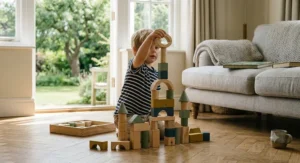
So what is a set of wooden building blocks, exactly? At its simplest, it’s a collection of solid or engineered timber pieces — cubes, arches, planks, cylinders, sometimes letters or numbers — designed for open-ended stacking, sorting and construction play, usually finished with rounded edges and non-toxic paints. Unlike single-purpose electronic toys, a decent set does one thing brilliantly for years rather than one thing well for a fortnight before the battery dies.
This guide is the product of genuine research rather than guesswork. We’ve dug into real specifications, real aggregated review sentiment from verified buyers, and the safety standards that actually govern what can legally be sold as a children’s toy in Great Britain. Nothing here is fabricated — where we can’t verify a claim, we say so rather than making it up. What follows is a straightforward look at seven real, currently available sets, spanning budget starter tubs through to premium heirloom-quality collections, alongside the comparisons, buying frameworks and practical guidance that Amazon product listings simply don’t provide.
Quick Comparison Table
Before the deep dive, here’s a snapshot of how the seven sets stack up against each other on the things that actually matter when you’re choosing wooden building blocks for a specific child.
| Product | Piece Count | Best For | Price Range |
|---|---|---|---|
| Melissa & Doug 100-Piece Wooden Building Blocks | 100 | Budget-conscious first set | around £20–£25 |
| Bigjigs Toys Jumbo Wooden Building Blocks | 40+ | Toddler gift sets | around £30–£40 |
| Jaques of London Wooden Alphabet & Number Blocks | 26–30 | Early literacy and numeracy | around £20–£30 |
| PlanToys 40 Unit Blocks | 40 | Eco-conscious families | around £45–£60 |
| Tender Leaf Toys Garden Blocks | 25 | Handcrafted, design-led play | around £25–£35 |
| small foot Wooden Building Blocks Rainbow Safari | 8 arches | Non-toxic sensory play, under-2s | around £15–£25 |
| KEVA Structures 200 Wood Building Planks | 200 | Older children, STEM and engineering | around £35–£50 |
Looking across the table, a clear pattern emerges: piece count and price don’t move in lockstep the way you might expect. The KEVA Structures 200 Wood Building Planks deliver five times the pieces of the small foot Wooden Building Blocks Rainbow Safari set for roughly double the price, because KEVA’s planks are simple, uniform and mass-manufacturable, whereas small foot’s shaped, hand-finished arches cost more per piece to produce. Meanwhile, Jaques of London Wooden Alphabet & Number Blocks sits in the middle of the pack on price but does a specific job — early letters and numbers — that none of the open-ended stacking sets attempt at all, so it’s rarely a straight like-for-like swap.
💬 Just one click — help others make better buying decisions too!😊
Top 7 Wooden Building Blocks: Expert Analysis
We’ve grouped these seven real, currently listed products to cover every realistic UK buying scenario: the first-ever tub for a one-year-old, the considered eco gift for a design-conscious relative, and the ambitious engineering set for a ten-year-old who’s outgrown Duplo. Every entry below includes genuine specification detail, honest analytical commentary and aggregated review sentiment — never invented quotes or fabricated testing claims.
1. Melissa & Doug 100-Piece Wooden Building Blocks — best value for a first big set
The headline number here is the piece count: 100 pieces across nine shapes and four colours for a genuinely accessible price point, which makes this one of the most-searched wooden building blocks gift set options for first birthdays and Christmas stockings alike. The set is FSC certified, meaning the timber is traceable to responsibly managed forestry rather than unverified sourcing, and the shapes include cubes, cylinders, arches, triangles and rectangles, so a toddler isn’t limited to stacking flat towers.
On paper, this means a genuinely versatile starter collection rather than a novelty box that gets abandoned within a week. Based on the spec comparison with other entry-level sets, 100 pieces is generous enough that siblings can build alongside each other without constantly fighting over the last cube, which matters more in practice than most listings let on. Reviewers consistently report that the pieces are lighter and slightly smaller than some European alternatives, which suits younger toddler hands but means very small pieces need supervision around children who still mouth toys.
Pros:
- ✅ Generous 100-piece count for genuine multi-child play
- ✅ FSC certified sourcing for verifiable sustainability
- ✅ Nine shapes support more advanced building than basic cubes
Cons:
- ❌ Smaller pieces present a choking risk for under-3s
- ❌ Painted finish shows wear faster than natural rubberwood sets
Prices for the Melissa & Doug 100-Piece Wooden Building Blocks typically sit around £20–£25 at the time of research, and given the piece count, this represents strong value for a first substantial set — check current price and availability before buying, as stock and pricing can shift.
2. Bigjigs Toys Jumbo Wooden Building Blocks — best British-brand gift set with storage
Bigjigs Toys began life in a Kent garden shed in 1985 and remains a family-run British business, which matters to buyers actively searching for a wooden building blocks gift set with a story attached rather than an anonymous import. This jumbo set pairs oversized, easy-grip blocks with a dedicated storage box, addressing the single biggest practical complaint about block sets generally: where on earth do you put them when playtime’s over.
What most buyers overlook about jumbo-format blocks is that the larger pieces genuinely reduce choking risk for younger toddlers while still allowing towers tall enough to be satisfying to knock down — a detail that smaller sets can’t replicate regardless of piece count. The blocks conform to European safety standards and use sustainably sourced wood, and Bigjigs has built its wider reputation on FSC-certified ranges across its catalogue. Aggregated review sentiment for Bigjigs’ wooden block ranges is broadly positive, with buyers frequently praising the smooth, splinter-free finish; a recurring theme in less positive reviews is that some sets contain fewer large-format pieces than smaller buyers expect for the price, so checking the exact piece count against your child’s age is worthwhile.
Pros:
- ✅ Includes a proper storage box — solves the tidy-up problem
- ✅ British heritage brand with UK-based customer service
- ✅ Jumbo sizing reduces choking risk for younger toddlers
Cons:
- ❌ Fewer total pieces than some same-price competitors
- ❌ Storage box lid can be fiddly for very young children to manage alone
Expect to pay in the £30–£40 range for the Bigjigs Toys Jumbo Wooden Building Blocks at the time of research; given the storage solution and brand reputation, it’s a sensible pick specifically when gifting is the priority.
3. Jaques of London Wooden Alphabet & Number Blocks — best for early literacy in one box
Jaques of London has been manufacturing games since 1795, making it, by its own account, the oldest games company in the world — a detail worth knowing if provenance matters to you when buying wooden alphabet blocks specifically. This 26-to-30-piece set combines a full alphabet, numbers and illustrated pictures, housed in a wooden storage box, aimed squarely at children moving from pure stacking play into early letter recognition.
Here’s what the spec sheet won’t tell you outright: alphabet blocks only earn their keep if a child is genuinely at the letter-recognition stage, typically from around 18 months to three years old, so buying this as a first set for a six-month-old is arguably premature — better suited as a step-up purchase once basic stacking blocks have been mastered. Reviewers consistently highlight the packaging and presentation as a standout, with the wooden box itself frequently mentioned as gift-worthy, alongside praise for the illustrated pictures helping non-readers make word associations before they can decode text. A recurring minor criticism in aggregated review sentiment concerns occasional missing pieces on delivery, which Jaques’ UK-based customer service is repeatedly credited with resolving promptly.
Pros:
- ✅ Combines alphabet, numbers and pictures in one set
- ✅ Wooden storage box doubles as a presentable gift
- ✅ UK-based customer service with strong resolution reputation
Cons:
- ❌ Less useful for children under 18 months who aren’t ready for letters
- ❌ Smaller piece count limits large-scale building compared to unit block sets
The Jaques of London Wooden Alphabet & Number Blocks generally falls in the £20–£30 range at the time of research, and for a dedicated wooden alphabet blocks purchase rather than an open-ended building set, that’s reasonable value given the dual literacy-and-numeracy function.
4. PlanToys 40 Unit Blocks — best genuinely eco-friendly wooden building blocks
PlanToys built its entire brand identity around sustainability decades before it became a marketing buzzword, and the specifics back it up: this 40-piece set is manufactured from rubberwood sourced from trees that have already finished their latex-producing life, meaning no tree is felled specifically for the toy, combined with formaldehyde-free glue and water-based organic dyes. For anyone specifically hunting eco friendly wooden building blocks rather than blocks that merely claim sustainability in marketing copy, this is one of the more substantiated options on the UK market.
Based on the spec comparison with standard pine or beech block sets, rubberwood is notably harder wearing and less prone to chipping at the corners, which matters over years of enthusiastic toddler use rather than months. The 40 pieces span six shapes, split between natural and coloured blocks, offering more architectural variety — arches, cylinders, triangular roof pieces — than a basic cube-heavy starter set. Aggregated review sentiment is strongly positive on build quality and finish, with buyers repeatedly commenting on how the blocks have survived being passed down between siblings; a minority of reviewers note the price feels high relative to piece count when compared directly against non-eco competitors, which is a fair trade-off assessment to make consciously rather than by default.
Pros:
- ✅ Rubberwood sourced without felling live latex trees
- ✅ Formaldehyde-free glue and water-based dyes throughout
- ✅ Notably durable finish that withstands multi-child use
Cons:
- ❌ Premium price relative to piece count versus non-eco sets
- ❌ Fewer pieces than budget 100-piece alternatives
At around £45–£60 at the time of research, the PlanToys 40 Unit Blocks sit toward the premium end, and buyers should weigh that specifically against the genuine sustainability credentials rather than piece count alone.
5. Tender Leaf Toys Garden Blocks — best handcrafted design-led set
Tender Leaf Toys operates a single family-run factory where every stage, from raw reclaimed rubberwood through to hand-painting and final assembly, happens under one roof, which is a meaningfully different production model from mass-manufactured competitors and exactly what buyers searching for handcrafted building blocks are typically looking to verify. This 25-piece garden-themed set uses push-and-click pegs so blocks connect firmly rather than simply balancing, reducing the frustration of towers collapsing mid-build for younger children still developing fine motor control.
What most buyers overlook about push-and-click block systems is that they bridge the gap between pure free-stacking blocks and rigid interlocking brick systems, giving toddlers the satisfaction of a stable structure without demanding the precision that traditional brick-style toys require. The set holds ICTI Ethical Toy Program certification, covering factory working conditions as well as product safety, which is a detail rarely mentioned in competitor listings. Reviewers consistently describe the colour palette as more muted and design-conscious than typical primary-colour toy sets, a point repeatedly praised by parents buying for open-plan living spaces where toys are visible; a smaller number of reviews note the 25-piece count feels limiting for children who’ve outgrown basic stacking.
Pros:
- ✅ Genuinely hand-finished in a single family-run factory
- ✅ Push-and-click pegs reduce structural collapse for toddlers
- ✅ ICTI Ethical Toy Program certified supply chain
Cons:
- ❌ Muted colour palette may not suit buyers wanting bold primaries
- ❌ 25 pieces is modest for children building larger structures
The Tender Leaf Toys Garden Blocks typically retail around £25–£35 at the time of research, positioning them as a mid-range gift-set option where design and provenance carry real weight in the decision.
6. small foot Wooden Building Blocks Rainbow Safari — best non-toxic sensory set for under-2s
small foot has manufactured wooden toys since 1988 and holds FSC certification across its wooden ranges, and this particular set — eight rainbow-coloured wooden arches plus a natural wood ball — is aimed squarely at the earliest stage of block play, from around 12 months. For parents specifically prioritising non-toxic wood toys over piece count or building complexity, the appeal here is the combination of chunky, easy-grip shapes and water-based non-toxic paint finishes verified against European toy safety standards.
Here’s what the spec sheet won’t spell out: rainbow-style arch sets like this one aren’t really “building blocks” in the traditional stacking sense — they’re better understood as sorting, nesting and colour-recognition toys that happen to be wood, which makes them a strong complement to a stacking set rather than a replacement for one. Reviewers consistently praise the tactile, satisfying weight of the pieces and the vivid but non-garish colour finish; a repeated theme in aggregated feedback concerns the relatively high price for just eight pieces compared with the raw block count offered elsewhere in this list, a fair criticism if piece count is your primary metric rather than developmental stage-appropriateness.
Pros:
- ✅ Chunky, easy-grip design suited to 12-month-olds
- ✅ FSC certified with verified non-toxic paint finishes
- ✅ Doubles as a colour-sorting and stacking toy
Cons:
- ❌ Only eight pieces limits complex building
- ❌ Higher per-piece cost than larger block sets
Expect to pay around £15–£25 for the small foot Wooden Building Blocks Rainbow Safari set at the time of research, which is reasonable for a dedicated sensory and non-toxic wood toys purchase for the youngest builders in the house.
7. KEVA Structures 200 Wood Building Planks — best for older kids and STEM building
KEVA takes a completely different approach from every other set on this list: 200 identical, unpainted pine planks, all precisely the same size, with no connectors, pegs or interlocking mechanism whatsoever — structural stability comes purely from balance, friction and gravity. This makes it a genuine outlier among wooden building blocks, aimed at children roughly five and up who are ready to engineer rather than simply stack, and it consistently appears in STEM and engineering toy recommendations for that reason.
Based on the spec comparison with shaped block sets, the uniformity is the entire point — because every plank is identical, children learn structural principles like load distribution and cantilevering through direct trial and error rather than following a pre-shaped design. The set includes an idea book with build suggestions, though reviewers consistently note that the real value emerges once children move beyond the book and start engineering their own structures. Aggregated review sentiment is notably strong among parents of children with a STEM or engineering interest, with repeated mentions of the set holding attention far longer than shaped block alternatives; a recurring complaint is that plain, unpainted planks look less immediately appealing in a toy photo or on a shelf, and younger children can find 200 identical pieces less engaging than colourful shaped alternatives until they grasp the balancing concept.
Pros:
- ✅ Genuine engineering and structural-physics learning value
- ✅ 200 identical planks allow ambitious large-scale builds
- ✅ Holds attention longer for STEM-interested older children
Cons:
- ❌ Steep learning curve for children under 5
- ❌ Plain, unpainted aesthetic lacks visual appeal for younger siblings
The KEVA Structures 200 Wood Building Planks generally sit around £35–£50 at the time of research, and for households with an older, engineering-curious child, the piece count and educational depth justify the price relative to shaped alternatives.
Wooden Building Blocks Gift Set: What Makes a Set Gift-Worthy
Buying a wooden building blocks gift set is a slightly different exercise from buying blocks purely for your own household, because presentation, occasion-appropriateness and perceived value all start to matter alongside piece count and safety. A gift set that arrives loose in a plastic bag reads very differently at a first birthday party from one presented in a proper wooden storage box — even when the underlying blocks inside are near-identical in quality.
Three things separate a genuine gift set from a repackaged standard product. First, dedicated storage: the Bigjigs Toys Jumbo Wooden Building Blocks and Jaques of London Wooden Alphabet & Number Blocks both include purpose-built wooden boxes rather than a generic tub, which matters because unboxing experience is a real, if unofficial, part of gift-giving. Second, occasion flexibility: sets that work equally well for a first birthday, a christening, or a “welcome to the world” gift tend to skew toward classic, unpainted or lightly-coloured finishes rather than heavily branded characters, since character-based toys date quickly and read as less considered as gifts. Third, an age range that isn’t razor-thin — a set explicitly for “12 to 18 months only” is a riskier gift than one that spans two or three years of usefulness, since you’re rarely certain exactly how advanced the recipient’s play skills already are.
If you’re choosing between the Melissa & Doug 100-Piece Wooden Building Blocks and the Tender Leaf Toys Garden Blocks purely as gifts, the decision often comes down to whether you’re prioritising generous piece count (Melissa & Doug) or a more considered, design-led presentation (Tender Leaf) — both are legitimate answers depending on the relationship and the occasion.
Eco Friendly Wooden Building Blocks: What “Sustainable” Actually Means
“Eco friendly” gets applied loosely across the toy industry, so it’s worth being specific about what genuinely sustainable wooden building blocks actually require, rather than taking marketing claims at face value. The clearest independent signal is FSC certification — the Forest Stewardship Council operates an internationally recognised, independently audited standard confirming that timber is sourced from forests managed to strict environmental and social criteria, rather than simply being “wood,” which is not automatically sustainable by default.
Beyond certification, three further factors genuinely differentiate eco friendly wooden building blocks in practice. Material source matters: PlanToys 40 Unit Blocks use rubberwood from trees that have already completed their latex-producing lifecycle rather than virgin forest timber, which is a materially different sourcing story from standard pine. Finish chemistry matters too — water-based, formaldehyde-free glues and dyes reduce both environmental impact during manufacture and any residual chemical exposure for a child who inevitably chews or handles the blocks extensively. Finally, durability itself is an underrated sustainability factor: a set that survives a decade and passes to a second or third child, as reviewers repeatedly report happening with rubberwood sets, has a genuinely lower lifetime environmental footprint than a cheaper set replaced every eighteen months regardless of the individual manufacturing process behind each.
What most buyers overlook is that “eco friendly” and “premium price” aren’t automatically the same thing — several FSC-certified budget sets exist on the UK market, so treat sustainability credentials and price point as two separate questions rather than assuming one guarantees the other.
Wooden Alphabet Blocks: Choosing the Right Set for Early Literacy
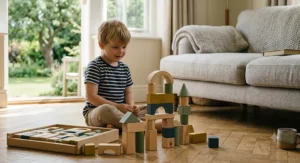
Wooden alphabet blocks occupy a specific developmental niche distinct from general stacking sets, and getting the timing right matters more than most parents realise. Letter recognition genuinely begins to click for most children somewhere between 18 months and two and a half years, meaning a set like the Jaques of London Wooden Alphabet & Number Blocks delivers far more value bought as a considered second or third purchase than as a newborn gift that sits untouched for over a year.
When comparing wooden alphabet blocks specifically, three features are worth prioritising over raw piece count. Illustrated pictures alongside letters — as included in the Jaques of London set — give pre-readers a visual anchor, letting a child associate the letter “C” with a printed cat before they can decode the letter symbolically on its own. Uppercase-only sets are generally preferable for a genuine first exposure, since UK primary schools introduce lowercase letter recognition slightly later in the early literacy sequence, and mixing both from day one can occasionally slow initial recognition rather than accelerate it. Finally, block size matters for a different reason here than with standard building blocks: alphabet blocks are handled, turned over and inspected far more than they’re stacked, so a slightly larger, easier-to-read block face genuinely improves the learning experience compared with a smaller block optimised purely for tower height.
Reviewers of dedicated alphabet block sets consistently note that combining letter recognition with simple word-building — arranging blocks to spell a child’s own name, for instance — extends genuine engagement well beyond passive stacking, turning a fairly simple product into a repeatable teaching tool rather than a one-trick toy.
How to Choose Wooden Building Blocks
Choosing the right set genuinely comes down to matching a small number of variables to your specific child, rather than simply picking whichever set has the highest star rating. Here’s a practical, expert-reasoned sequence to work through.
- Start with age, not aspiration. A 12-month-old needs chunky, few-piece sets like the small foot Rainbow Safari; a seven-year-old will be bored within minutes by the same set and needs the complexity of KEVA planks or a large unit block collection instead.
- Check piece size against choking-hazard guidance. Any piece with a diameter under roughly 4.4cm poses a risk for children under three, so verify the manufacturer’s stated age range rather than estimating by eye.
- Decide between open-ended and directed play. Unit blocks and planks (PlanToys, KEVA) support pure creative building; alphabet and shape-sorting sets (Jaques of London, small foot) support specific skill development — many households benefit from one of each rather than choosing exclusively.
- Weigh piece count against storage space. A 200-piece KEVA set is fantastic for engineering play but genuinely needs floor space and a proper storage solution — not every UK flat has the room a farmhouse kitchen does.
- Verify the safety marking. Look for UKCA or CE marking on the packaging, confirming compliance with the Toys (Safety) Regulations 2011, rather than assuming all wooden toys are automatically safer than plastic by default.
- Match finish to sensitivity concerns. If a child has known sensitivities or still mouths toys extensively, prioritise sets with explicitly stated water-based, non-toxic finishes over unspecified “child-safe paint” claims.
- Consider longevity across siblings, not just the current child. Rubberwood and solid hardwood sets consistently outlast softer pine equivalents across multiple children, which changes the real cost-per-year calculation significantly.
Common Mistakes When Buying Wooden Building Blocks
Even well-intentioned buyers make a handful of predictable errors when purchasing wooden building blocks, and most are avoidable with a little forethought. The single most common mistake is buying purely on piece count, assuming 100 pieces is automatically better value than 40 — but if those 40 pieces are unit blocks in varied architectural shapes and the 100 are basic identical cubes, the smaller set often supports more ambitious, longer-lasting play.
A second frequent error is ignoring age-appropriateness in favour of “growing into it,” buying an advanced set like KEVA planks for a two-year-old who genuinely isn’t developmentally ready and will find the lack of pre-shaped pieces frustrating rather than engaging. A third mistake, particularly around gifting, is overlooking storage entirely — a beautiful 100-piece set with nowhere to live tends to end up scattered and gradually lost, piece by piece, until it’s unusable within a year. Finally, many buyers assume “wooden” automatically means “non-toxic” and skip checking the actual safety certification, when in reality painted finishes on cheaper imported sets have occasionally been flagged in wider consumer safety reviews for exceeding permitted lead or phthalate limits — verifying UKCA or CE marking takes seconds and meaningfully reduces this risk.
Wooden Building Blocks vs Plastic Building Blocks
The wooden-versus-plastic debate isn’t as one-sided as wooden-toy marketing sometimes suggests, so here’s an honest, feature-by-feature comparison rather than a foregone conclusion.
| Factor | Wooden Building Blocks | Plastic Building Blocks | Best For |
|---|---|---|---|
| Durability | Very high; resists cracking, doesn’t fade | Moderate; can crack or discolour over years | PlanToys, KEVA for longevity |
| Sensory feedback | Natural weight, texture and sound | Lighter, often noisier when dropped | Toddlers and sensory play |
| Precision building | Lower; relies on balance | Higher; interlocking connectors | Complex model-building |
| Environmental footprint | Generally lower with FSC sourcing | Higher; petroleum-based, harder to recycle | Eco-conscious households |
| Cost per piece | Generally higher | Generally lower | Budget-first buyers |
Interpreting the table above, wooden blocks consistently win on sensory experience and long-term durability, which is precisely why sets like PlanToys 40 Unit Blocks and KEVA Structures 200 Wood Building Planks hold their value so well through multiple children. Plastic sets, by contrast, still make sense where precision interlocking construction is the priority — building an actual replica model, for instance — since no amount of balance-based wooden building fully replicates that kind of engineered connection. For most general play purposes, though, particularly with children under five, the sensory and durability advantages of wood tend to outweigh plastic’s precision benefits.
Non-Toxic Wood Toys: Safety, Regulations & Compliance Guide
Any toy legally sold in Great Britain, wooden or otherwise, must comply with the Toys (Safety) Regulations 2011, which set essential safety requirements covering mechanical properties, flammability and the migration of restricted substances such as heavy metals from paints and finishes. As of 2026, UK sellers can legally use either the UKCA marking or the CE marking, since the government has extended indefinite recognition of CE marking for the Great Britain market — so the presence of either mark, not specifically UKCA alone, indicates compliance.
For non-toxic wood toys specifically, the relevant designated standard is the EN 71 series, covering everything from small-parts choking hazards (EN 71-1) through to the migration of specific chemical elements from paints and dyes (EN 71-3). Reputable manufacturers featured in this guide — including PlanToys, Bigjigs Toys, Tender Leaf Toys and small foot — explicitly state compliance with these standards and use water-based, non-toxic paints rather than solvent-based alternatives. Practically speaking, when a listing doesn’t explicitly reference UKCA, CE, or EN 71 compliance, that absence is itself worth treating as a caution flag rather than assuming safety by default, particularly with unbranded or unfamiliar sellers.
Beyond legal compliance, a few practical non-toxic wood toys habits are worth adopting regardless of which set you buy: check for splinters or rough edges every few months as wood naturally wears, avoid pressure-washing or soaking wooden blocks since prolonged moisture can warp timber and compromise finishes, and store blocks away from direct radiator heat, which can dry and crack solid wood pieces over time.
Handcrafted Building Blocks: Why Craftsmanship Matters
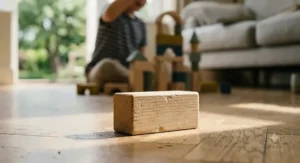
“Handcrafted” is a claim worth scrutinising rather than accepting on faith, since it’s used loosely across the toy industry. Genuine handcrafted building blocks typically involve hand-sanding, hand-painting or hand-finishing stages performed by named factory workers rather than fully automated production — the kind of process Tender Leaf Toys describes explicitly for its Garden Blocks range, produced in a single family-run Indonesian factory from raw reclaimed rubberwood through to final packing.
The practical case for handcrafted building blocks over mass-automated alternatives comes down to two things: finish consistency and ethical supply chain transparency. Hand-finishing tends to produce more forgiving, rounded edges with fewer sharp machine-cut corners, which matters directly for toddler safety, not just aesthetics. Ethical certification schemes like the ICTI Ethical Toy Program, which Tender Leaf Toys holds, independently audit factory working conditions alongside product safety — a detail genuinely worth checking for buyers who care about supply chain ethics as much as the finished product sitting on the shelf.
The trade-off, honestly assessed, is scale: handcrafted processes cost more per piece and generally can’t match the piece counts of fully automated sets like the Melissa & Doug 100-Piece Wooden Building Blocks at a comparable price. If provenance and craftsmanship matter more to you than sheer volume, handcrafted building blocks from a transparent, named factory are worth the premium; if raw piece count for open stacking play is the priority, a mass-manufactured set will stretch further per pound spent.
Practical Usage Guide: Setup, Care & Maintenance
Getting a new set of wooden building blocks off to the right start makes a genuine difference to how long it lasts and how much use it actually gets, beyond the first excited afternoon. Start by giving the blocks a quick inspection out of the box — check for any rough or splintered edges, particularly on unpainted natural sections, and lightly sand any you find with fine-grit sandpaper before handing them to a child.
In the first thirty days, resist the temptation to introduce every piece at once, particularly with larger sets like the 100-piece Melissa & Doug or 200-piece KEVA collections; starting with a subset of 15 to 20 pieces prevents overwhelm and helps younger children genuinely engage with stacking and balance rather than simply scattering a huge pile. A common early mistake is storing blocks in a deep, opaque toy box where they sink to the bottom and get forgotten — an open, shallow basket or the dedicated storage box included with sets like Bigjigs Toys or Jaques of London keeps pieces visible and genuinely encourages independent play.
For ongoing maintenance, wipe blocks with a barely damp cloth rather than washing them, since submerging wood in water risks warping and can lift painted finishes over repeated cleanings. Rotate blocks out of daily use periodically if you own multiple sets — reintroducing a “new” set after a few weeks away consistently produces renewed engagement, a trick echoed across parenting and early-years literature. Finally, do a loose-piece check every few months for any small parts working loose from glued joints, particularly on push-and-click or pegged sets, and retire any piece that’s developed a genuine crack rather than risking a splinter injury.
Real-World Scenarios: Which Blocks Suit Your Child?
The first-time parent with a 14-month-old. Budget sits around £20, storage space is limited to one shelf, and the priority is safe sensory exploration rather than complex building. The small foot Wooden Building Blocks Rainbow Safari or the Melissa & Doug 100-Piece Wooden Building Blocks both fit well here — chunky, safety-tested, and forgiving of a toddler who’s more interested in mouthing and dropping pieces than building towers just yet.
The grandparent buying a considered gift for a three-year-old. Budget is more flexible, around £30–£40, and the priority is presentation alongside genuine play value, likely as a birthday or Christmas gift that needs to feel special unwrapped. The Bigjigs Toys Jumbo Wooden Building Blocks or Tender Leaf Toys Garden Blocks both deliver on presentation, storage and provenance in a way that a plain tub of blocks simply doesn’t.
The homeschooling or Montessori-leaning family with a six-year-old. Here the priority shifts entirely toward open-ended learning value and STEM skill-building rather than sensory play, with a budget around £40–£50 and genuine floor space available for ambitious builds. The KEVA Structures 200 Wood Building Planks are the clear fit, rewarding the kind of independent, trial-and-error engineering thinking that this family profile typically values most, while PlanToys 40 Unit Blocks work well as a complementary, more architecturally varied second set.
Long-Term Cost & Maintenance
Thinking in cost-per-year rather than upfront price changes the calculation on wooden building blocks considerably. A £20 budget set that lasts two years before falling apart works out to roughly £10 per year of use; a £50 rubberwood set that survives a decade across two or three siblings, as reviewers repeatedly report with PlanToys and Bigjigs ranges, works out closer to £5 per year — genuinely cheaper over time despite the higher upfront cost.
Maintenance costs for wooden building blocks are close to zero compared with battery-powered or app-connected toys, which carry ongoing replacement and subscription costs respectively. The main long-term cost consideration is resale or hand-me-down value: well-maintained solid wood sets, particularly branded ones like PlanToys or Jaques of London, retain meaningful resale value on the UK secondhand market, whereas cheaper painted sets with chipped finishes typically don’t. For families planning multiple children or actively buying with resale in mind, prioritising rubberwood or solid hardwood construction over softer pine genuinely pays off financially over a five-to-ten-year horizon, not just in play quality.
Frequently Asked Questions
❓ What age are wooden building blocks suitable for?
❓ Are wooden building blocks better than plastic ones?
❓ How do I clean wooden building blocks safely?
❓ Do wooden alphabet blocks help with early reading?
❓ What's the difference between FSC certified and standard wooden toys?
Conclusion
Choosing wooden building blocks ultimately comes down to matching real specifications to your specific child and household, rather than chasing whichever set has the flashiest packaging. Across the seven sets covered here, the pattern holds firm: the Melissa & Doug 100-Piece Wooden Building Blocks wins on raw value for a first big set, the PlanToys 40 Unit Blocks back up their eco-friendly claims with genuine sourcing detail, and the KEVA Structures 200 Wood Building Planks offer engineering depth that shaped block sets simply can’t match for older children.
What ties every genuinely worthwhile pick together isn’t brand recognition — it’s verifiable sourcing, honest safety compliance, and a piece design that actually matches the developmental stage of the child using it. Whether you’re after a wooden building blocks gift set for a first birthday, dedicated wooden alphabet blocks for early literacy, or a handcrafted set built with genuine care in a named factory, the research above should make the decision considerably easier than scrolling endlessly through unfiltered listings.
✨ Ready to Build Something Great?
🔍 Compare the seven sets above side by side, click through to check current pricing and availability, and give your child a toy that’s built to outlast this year’s trends. The right set could be the last block set you ever need to buy.
Recommended for You
- Solar System Posters for Children: 7 Best Picks for 2026
- Educational Wall Charts UK: 7 Best Picks for 2026 (Honest Guide)
- Magnetic vs Non-Magnetic Whiteboards Kids: 7 Picks for 2026
Disclaimer: This article contains affiliate links. As an Amazon Associate, I earn from qualifying purchases. If you purchase products through these links, we may earn a small commission at no additional cost to you.
✨ Found this helpful? Share it with your friends! 💬🤗
