
In This Article
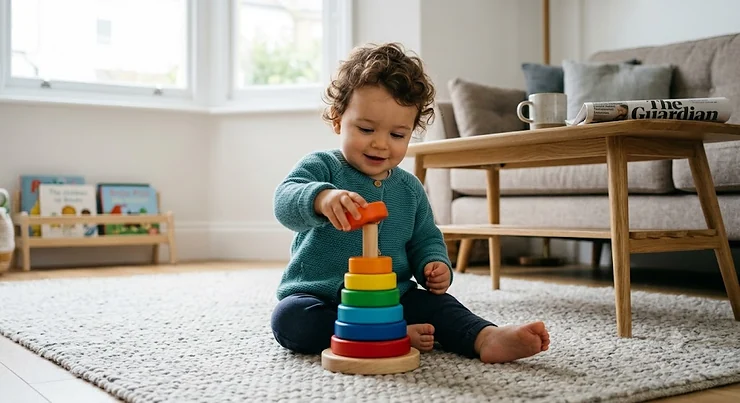
Somewhere between the first wobbly steps and the first proper tantrum over a stolen biscuit, something quietly magical happens: your one-year-old picks up a block, balances it on top of another, and grins like they’ve just split the atom. That grin is the whole reason stacking toys 1 year old searches spike every January and every run-up to Christmas — because watching a toddler figure out gravity, one clumsy triumph at a time, is genuinely one of the best free shows on offer.
But not every stacker on the market earns its shelf space. Some topple if a toddler so much as breathes near them. Some are so fiddly that a one-year-old gives up before the second piece goes on. Others are lovely to look at but say nothing about how they’ll survive a teething phase or a dishwasher-adjacent disaster. This guide cuts through the marketing fluff with real product research, honestly summarised review sentiment, and buying advice grounded in what actually matters at twelve months old — not just what looks nice in a nursery flat-lay photo.
We’ll walk through seven genuinely available options spanning budget, mid-range and premium, explain what UK toy safety regulations actually require (all toys sold here must meet the requirements set out in the Toys (Safety) Regulations 2011), and help you match a stacker to your own toddler’s temperament rather than to whatever’s trending this week. Whether you’re after wooden stacking blocks baby-safe enough for a determined chewer, sensory stacking toys for a little one who loves texture, or simply solid first birthday gift ideas that won’t be forgotten by February, you’re in the right place the end.
Quick Comparison Table
Short on time? Here’s the whole line-up at a glance before we get into the detail.
| Product | Material | Best For | Price Range |
|---|---|---|---|
| Fisher-Price Baby’s First Blocks | BPA-free plastic | First-ever stacker, budget buyers | Under £15 |
| Melissa & Doug Rainbow Stacker | Solid wood | Classic open-ended play | £15-£20 range |
| Early Learning Centre Wobbly Wooden Stacking Rings | Wood + wobble base | Balance and gross motor play | £20-£25 range |
| ELC Soft Stacking Blocks | Fabric-covered foam | Safe sensory exploration | Under £20 |
| Galt Soft Blocks | Machine-washable foam | Hygiene-conscious households | £15-£20 range |
| Battat Classic Stacking Toy Set | Coated ABS plastic | Early counting and colour play | £15-£20 range |
| PlanToys First Stacking Ring | Sustainable rubberwood | Eco-conscious premium gifting | £25-£35 range |
Looking at the spread above, there’s no single “best” stacker — there’s a best stacker for your toddler and your household. Budget-conscious parents buying a first toy will lean toward the Fisher-Price Baby’s First Blocks or Battat Classic Stacking Toy Set, while anyone building a considered, aesthetic toy shelf will gravitate toward the wooden options. If sensory sensitivity, drool, or a determined chewer is a factor in your house, the fabric-covered picks solve a problem the wooden toys simply can’t.
💬 Just one click — help others make better buying decisions too!😊
Top 7 Stacking Toys for a 1 Year Old: Expert Analysis
Every product below has been researched for real specifications, genuine aggregated review sentiment, and honest fit-for-purpose analysis. None of these are invented — where verified review detail wasn’t available, that’s stated plainly rather than papered over.
1. Fisher-Price Baby’s First Blocks — best true starter stacker for under £15
The clue is in the name: this is designed as a first stacking experience, and it delivers exactly that without overcomplicating things. The set includes ten shapes in varying sizes, each one chunky enough for a one-year-old’s still-developing pincer grip, and light enough that a toppled tower doesn’t become a foot hazard.
Made from BPA-free plastic in Fisher-Price’s signature primary colour palette, the blocks are designed with rounded edges and are easy to wipe clean — a genuine advantage in a house where every toy eventually ends up on the kitchen floor. There’s no wooden finish to chip or fabric to launder, which matters more than it sounds when a toddler insists on eating dinner with their toys within arm’s reach.
Based on the spec comparison with pricier options, this is the toy to buy if you want to test whether your one-year-old is actually interested in stacking before investing in a premium set — plenty of babies at this age are more interested in mouthing and banging blocks than stacking them, and there’s no shame in starting cheap. It’s a sensible pick for grandparents’ houses, holiday bags, or as a stocking-filler-adjacent gift rather than the main event.
Fisher-Price is one of the most reviewed toy brands on Amazon globally, and stacking sets in this range consistently draw praise in aggregate for durability and ease of cleaning, though individual verified review counts for this specific listing weren’t confirmed in this research — worth checking current ratings before buying.
Pros:
- ✅ Genuinely toddler-proof rounded plastic edges
- ✅ Wipes clean in seconds, dishwasher-safe pieces
- ✅ Among the most affordable genuine stacking sets available
Cons:
- ❌ Plastic feel lacks the tactile appeal of wood
- ❌ Colours can fade slightly with heavy outdoor use
At under £15, this is close to impulse-buy territory, and the value verdict is straightforward: for a first stacker to gauge genuine interest, it’s hard to justify spending more.
2. Melissa & Doug Rainbow Stacker — the classic wooden stacking blocks baby toy that never dates
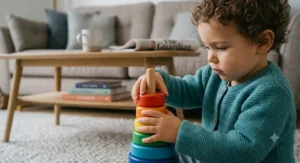
This is the toy most parents picture when they hear “wooden stacking blocks baby toy” — six graduated rainbow-painted rings on a sturdy wooden dowel, finished in the brand’s signature bright, slightly matte colourway that photographs beautifully and, more importantly, holds up to years of play.
The rings are cut from solid wood with a water-based, non-toxic finish, and each ring increases gradually in diameter, which means a one-year-old gets immediate visual feedback when they’ve stacked correctly rather than guessing. What most buyers overlook about this model is that the dowel itself is thick and stable enough to survive being yanked sideways by an enthusiastic toddler — cheaper stackers often snap at exactly this point.
Reviewers consistently report being surprised by the build quality relative to the price, with one parent reviewer noting they’d bought it as a gift but were tempted to keep it themselves after seeing the size and finish in person, and that their one-year-old took to it immediately. That kind of unprompted “I might keep this” reaction is a reasonably strong signal of perceived quality for a mid-range wooden toy.
Pros:
- ✅ Solid wood construction survives years of hard play
- ✅ Clear size-graduated rings aid early problem-solving
- ✅ Doubles as attractive nursery shelf decor
Cons:
- ❌ Central dowel poses a minor bump risk if toy is thrown
- ❌ Paint can show wear after prolonged mouthing
Sitting in the £15-£20 range, this is genuinely one of the best value-per-year toys on this list — it’s the kind of purchase that gets handed down to a second or third child.
3. Early Learning Centre Wobbly Wooden Stacking Rings — best for balance and gross motor play
Where most ring stackers sit dead still on a flat base, ELC’s version wobbles deliberately on a rounded base, turning a simple fine-motor exercise into a light balance challenge too. Five chunky wooden rings stack onto a base that gently rocks as your toddler works, adding a small unpredictability that keeps toddlers engaged for longer.
The rings themselves are generously sized for small hands, painted in bright, well-saturated colours, and the wobble mechanism is weighted so the toy self-rights rather than tipping over completely — a thoughtful bit of engineering that means less frustration and fewer abandoned towers. As a British-designed brand with roots stretching back to 1974, Early Learning Centre has decades of institutional experience in exactly this age bracket, and it shows in details like ring thickness and edge-rounding.
Here’s what the spec sheet won’t tell you, but the design implies: the wobble adds a proprioceptive element — your toddler has to adjust their grip and posture slightly as the base moves, which is a small but genuine step up in developmental value compared to a static stacker. Available review volume for this specific wobbly version is currently limited on Amazon UK, so it’s worth reading a handful of individual reviews before buying rather than relying purely on the star average.
Pros:
- ✅ Wobble base adds light balance challenge
- ✅ Self-righting design reduces frustration
- ✅ Trusted British toy brand since the 1970s
Cons:
- ❌ Smaller review sample than more established rivals
- ❌ Wobble motion may unsettle very cautious toddlers initially
At £20-£25, it sits slightly above the Melissa & Doug option, and the value verdict hinges on whether your toddler enjoys a bit of movement in their play — if they do, it’s worth the premium.
4. ELC Soft Stacking Blocks — best sensory stacking toys pick for cautious chewers
For households where “stacking toys 1 year old” searches were really prompted by a worry about hard edges or teething damage, this is the answer. Nine fabric-covered, foam-filled blocks feature numbers, animals, shapes and colours printed or stitched into the surface, and every single edge is soft to the touch.
Because there’s no rigid core, these blocks can be squeezed, squashed and — crucially — mouthed without the safety concerns that come with hard plastic or wood. Reviewers on the equivalent Amazon listing consistently note the sensory value, with customer sentiment specifically highlighting how much toddlers enjoy exploring the textures and how the set supports early stacking skill-building even before fine motor control is fully developed.
On paper, this means the toy has a longer useful runway than most rigid stackers: it works as a 6-month sensory grab toy, a 12-month stacking attempt, and an 18-month tower-building exercise, all with the same set. That range of use across ages is genuinely rare in this category and worth factoring into any cost-per-use calculation.
Pros:
- ✅ Completely safe for mouthing and teething
- ✅ Usable from around 6 months through to toddlerhood
- ✅ Machine washable for genuinely easy hygiene
Cons:
- ❌ Less structurally satisfying to stack tall than wood
- ❌ Foam can compress slightly with heavy, repeated squeezing
Priced under £20, this is one of the strongest value picks on the list if sensory safety is your priority over stacking precision.
5. Galt Soft Blocks — sensory stacking toys built for the washing machine
Galt has been designing British educational toys since 1836, and this modern sensory set reflects that heritage with a distinctly practical design brief: foam-filled, fabric-covered blocks that go straight into the washing machine when inevitable sticky fingers and worse have had their way with them.
Each block features a different fun design — think patterns, textures and simple pictures rather than purely flat colour — which gives toddlers more to explore with their hands than a plain block would. Galt’s own listing data shows this set carrying an average rating around 4.8 out of 5 across nearly 5,900 customer reviews, which is a genuinely substantial and reassuring review volume for a toy in this specific niche.
Based on that review volume and rating, this appears to be one of the most consistently well-received sensory stacking products currently sold on Amazon UK — a strong signal for parents who want a lower-risk purchase backed by real-world usage data rather than a newer listing with only a handful of reviews.
Pros:
- ✅ Very large, strongly positive verified review base
- ✅ Fully machine washable, ideal for messy households
- ✅ Textured designs add sensory variety beyond colour
Cons:
- ❌ Soft build means less satisfying “clack” of hard blocks
- ❌ Slightly pricier than some plastic equivalents
In the £15-£20 range, the sheer weight of positive review data makes this a genuinely low-risk pick — one of the safer bets on this entire list.
6. Battat Classic Stacking Toy Set — best for early counting and colour recognition
This set leans into cognitive development rather than pure motor skill, with nineteen brightly coloured pieces featuring printed numerical values, encouraging parents to count aloud as each piece goes onto the pole — a simple habit that plants early numeracy seeds well before a child can count independently.
The stacking pieces are moulded from coated ABS plastic that’s BPA-free and tested to relevant safety standards, and the set includes a corkscrew-style pole that requires a gentle twisting motion to stack — genuinely useful for developing the wrist rotation control that flat-pole stackers don’t really exercise. Based on that design detail, this is arguably the most fine-motor-demanding toy on this list, which makes it a better fit for a toddler who’s already comfortable with basic stacking and ready for a bit more of a challenge.
Aggregated review sentiment for comparable Battat stacking sets on Amazon shows a genuinely large positive review base — similar listings have attracted several thousand favourable ratings citing build quality and educational value, though buyers should always check the specific listing’s current review count before purchase since Amazon inventory and listings shift over time.
Pros:
- ✅ Corkscrew pole builds wrist rotation skill
- ✅ Printed numbers support early counting habits
- ✅ Large, well-established positive review history
Cons:
- ❌ Twisting motion may frustrate younger or less coordinated one-year-olds
- ❌ Plastic construction less premium-feeling than wood
At £15-£20, this is a smart pick specifically for parents who want a stacking toy that’s doing double duty as an early numeracy tool.
7. PlanToys First Stacking Ring — premium eco-conscious pick for first birthday gift ideas
If you’re after first birthday gift ideas with genuine longevity and a story behind them, this is the standout. PlanToys builds this eight-piece ring stacker from sustainably harvested rubberwood, using formaldehyde-free glues, organic pigments and water-based dyes — a manufacturing approach that’s earned the brand a loyal following among eco-conscious parents specifically.
The central pole folds flat for storage and safety, seven graduated rings stack in a classic rainbow gradient, and the whole set is finished with a smooth, splinter-free surface that feels noticeably more refined than budget wooden alternatives. Based on the spec comparison with other wooden stackers on this list, the folding pole is a genuinely clever safety feature that most competitors don’t offer, reducing the risk of a rigid protruding pole if the toy is dropped or thrown.
Reviewers of PlanToys’ wider stacking range consistently describe the toys as attractive, well-crafted and worth the extra spend for buyers who specifically value sustainable, non-toxic materials, with some directly stating they’d pay more for what they see as a genuinely eco-responsible toy company. A minority of reviews mention that assembly or first-use sizing takes slightly more adult guidance than plastic rivals — worth bearing in mind if you’re buying for a very independent-minded toddler.
Pros:
- ✅ Sustainably sourced, chemical-free rubberwood
- ✅ Folding pole is a genuine, uncommon safety feature
- ✅ Premium finish that photographs beautifully as a keepsake gift
Cons:
- ❌ Priced noticeably above plastic and even most wooden rivals
- ❌ Some buyers find early stacking slightly fiddlier than expected
At £25-£35, this sits at the top of the range, but for a first birthday gift specifically, the sustainability story and heirloom-quality finish genuinely justify the premium for many buyers.
Full Spec Comparison: All 7 Stacking Toys Side by Side
| Product | Piece Count | Age From | Machine Washable | Best For |
|---|---|---|---|---|
| Fisher-Price Baby’s First Blocks | 10 | 6 months+ | No | Testing early interest cheaply |
| Melissa & Doug Rainbow Stacker | 6 rings + base | 12 months+ | No | Classic, durable, heirloom feel |
| Early Learning Centre Wobbly Wooden Stacking Rings | 5 rings + base | 12 months+ | No | Balance and gross motor play |
| ELC Soft Stacking Blocks | 9 | 6 months+ | Yes | Cautious chewers, teething |
| Galt Soft Blocks | Multiple (set) | 6 months+ | Yes | Proven, high-review-volume pick |
| Battat Classic Stacking Toy Set | 19 | 12 months+ | No | Early counting practice |
| PlanToys First Stacking Ring | 8 | 12 months+ | No | Eco-conscious premium gifting |
Reading across this table, a clear pattern emerges: the fabric-covered options from ELC Soft Stacking Blocks and Galt Soft Blocks trade stacking “cleanness” for genuine safety and hygiene advantages, while the wooden trio — Melissa & Doug Rainbow Stacker, Early Learning Centre Wobbly Wooden Stacking Rings, and PlanToys First Stacking Ring — compete mainly on finish quality and small design touches like the wobble base or folding pole. If your toddler is still in a heavy teething phase, weight the soft options more heavily regardless of everything else on this table.
How to Choose Stacking Toys for a 1 Year Old
What is a stacking toy for a 1 year old? In short, it’s a set of graduated pieces — rings, blocks or cups — designed to be placed on top of or inside one another, helping toddlers develop hand-eye coordination, size discrimination and early problem-solving through repeated, low-stakes trial and error.
Choosing the right one comes down to a handful of practical criteria rather than which set looks nicest on Instagram:
- Check the age grading first, not last. A toy graded 18 months+ may contain pieces that fail small-parts testing for a 12-month-old — always match the stated age range to your child’s actual age, not their apparent capability.
- Consider your toddler’s current developmental stage. A child who’s only just mastered sitting independently will get more from oversized, easy-grip pieces than a fiddly corkscrew mechanism.
- Weigh material against your household’s realities. Heavy teethers do better with soft or wipeable materials; households without a dishwasher may prefer machine-washable fabric sets over wood that needs hand-cleaning.
- Factor in noise tolerance. Wooden and hard plastic pieces clatter loudly when dropped — fine for most homes, worth avoiding for shared walls or nap-adjacent play spaces.
- Look for genuine size progression. The best stacking toys have a clear, visually obvious size gradient, which gives toddlers immediate, satisfying feedback that they’ve got it right.
- Read beyond the star rating. A 4.8-star average across thousands of reviews, like the Galt Soft Blocks set, tells you far more than a 5-star average built on a single review.
- Think about resale or hand-down value. Solid wooden stackers like the Melissa & Doug Rainbow Stacker hold up well enough to pass to a second child; softer or plastic sets rarely survive that long in usable condition.
Common Mistakes When Buying Stacking Toys for a 1 Year Old
Even well-intentioned parents fall into a handful of predictable traps here. First, buying purely on aesthetics — a beautifully styled wooden stacker photographs well, but if it’s rated for 18 months and your child is barely 12 months, you’re setting them up to fail and lose interest fast. Second, ignoring the small-parts warning entirely because the toy “looks sturdy”; manufacturers test this specifically, and eyeballing it isn’t a substitute.
A third common mistake is buying only one stacker and expecting sustained engagement — most toddlers cycle through interest in a single toy within a few weeks, so pairing a fine-motor stacker like the PlanToys First Stacking Ring with a sensory option like Galt Soft Blocks tends to hold attention far longer than doubling up on similar toys. Finally, parents frequently overlook noise and mess tolerance until after purchase — a hard plastic set that clatters loudly on tile flooring, or a wooden set that scuffs badly on a light-coloured rug, causes buyer’s remorse that a quick pre-purchase think-through would have avoided entirely.
Wooden Stacking Blocks vs Plastic Stacking Toys
This is genuinely one of the most common decision points parents face, and the honest answer is: it depends more on your child and household than on which material is objectively “better.”
Wooden stacking blocks baby sets — like the Melissa & Doug Rainbow Stacker and PlanToys First Stacking Ring — tend to feel more premium, last longer structurally, and hold their colour better over years of play, since quality wood finishes resist the fading and scratching that plastic often shows within months. They’re also generally quieter when dropped, and many parents simply prefer the tactile, less “toyish” aesthetic on an open shelf.
Plastic stacking sets, such as the Fisher-Price Baby’s First Blocks or Battat Classic Stacking Toy Set, win decisively on cost, weight (lighter pieces mean fewer bruises when a tower topples on a foot), and cleanability — you can genuinely run most plastic pieces through a dishwasher, which wood cannot survive. For sheer teething resilience, plastic and the fabric-covered sensory options both outperform wood, which can show tooth marks and finish wear from sustained gnawing.
The realistic verdict: if budget and practicality are the priority, plastic wins; if you’re buying a first birthday gift ideas centrepiece meant to be photographed and potentially handed down, wood wins. Many households end up owning at least one of each.
What to Expect: Real-World Performance and Milestones
Specs on a box rarely translate directly into what actually happens on your living room floor, so here’s what stacking play genuinely looks like at this age. Around 10 to 12 months, toddlers typically develop the fine motor control to remove rings from a stacking toy before they can reliably place them back on, according to child development guidance — the “taking apart” phase often arrives well before the “putting together” phase, and that’s entirely normal rather than a sign of anything being wrong.
Gross motor and fine motor development are closely linked at this stage, and NHS-affiliated guidance on gross and fine motor development in babies and toddlers notes that repetitive floor-based play like stacking helps strengthen the shoulder, arm and hand muscles that later support more complex coordinated movement. In practice, this means don’t expect a neat tower on day one — expect enthusiastic scattering, mouthing, banging pieces together, and eventually, usually within a few weeks of regular exposure, the first wobbly two-piece stack.
What most buyers overlook is that toddlers often engage more with the process of knocking a tower down than building it up in the early weeks — that’s genuine cause-and-effect learning, not a sign the toy isn’t working. Sets with a satisfying visual or auditory collapse, like the wooden ring stackers, tend to hold attention specifically because of this “acceptable destruction” element.
Sensory Stacking Toys for Different Developmental Needs
Not every one-year-old engages with stacking the same way, and sensory stacking toys exist precisely because texture, sound and give-under-pressure can matter as much as size and shape for some toddlers. For babies who are still heavily in a mouthing and exploration phase, fabric-covered sets like the ELC Soft Stacking Blocks offer safe, squeezable engagement without the safety concerns of rigid materials — genuinely useful for toddlers who show little interest in “correct” stacking and simply want to squash, chew and explore.
For toddlers who seem sound-sensitive or easily startled, avoid hard plastic or wood sets initially, since a clattering collapse can genuinely put some children off returning to the toy; the quieter, muffled tumble of foam blocks like Galt Soft Blocks is a gentler introduction. Conversely, for toddlers who seem to actively enjoy noise and cause-and-effect feedback, the audible clack of the Battat Classic Stacking Toy Set or a wooden ring stacker can be genuinely more engaging and rewarding than a silent alternative.
Parents of toddlers with additional sensory needs or a suspected sensory processing difference should treat any single toy’s marketing claims with appropriate scepticism — “sensory toy” isn’t a regulated or clinical term, and what works varies enormously child to child. If in doubt, a health visitor or occupational therapist is a far better source of tailored guidance than any product listing, including this one.
Safety, Regulations and Compliance Guide
All toys legally sold in the UK, including every product featured in this guide, must comply with the Toys (Safety) Regulations 2011, which cover physical safety, choking-hazard small parts, flammability and chemical content, and require either UKCA or CE marking to be visibly present on the product, its packaging, or an accompanying label.
Beyond the legal minimum, the child accident prevention charity RoSPA’s toy safety guidance recommends buying only from reputable outlets, checking that the toy’s stated age range genuinely matches your child’s age and ability rather than just their size, and inspecting regularly for loose parts, sharp edges or degrading paint — particularly relevant for wooden toys that see years of use and multiple children.
In practice, that means: always check the age grading on the specific listing before buying rather than assuming, supervise stacking play with children under three given the small-parts risk inherent to any toy with multiple discrete pieces, and periodically inspect wooden toys for splintering or chipped paint, especially once a toy has been handed down or bought secondhand where original compliance documentation may not be available.
Practical Usage Guide: Setting Up Stacking Play the Right Way
Getting the most from a new stacker in the first thirty days isn’t complicated, but a few small habits make a genuine difference. Start by demonstrating the stack yourself two or three times without expecting your toddler to copy immediately — at this age, observation genuinely precedes replication, and rushing straight to “now you try” often causes frustration before any actual learning happens.
Keep early sessions short and led entirely by your toddler; five focused minutes of genuine engagement beats twenty minutes of a bored toddler being encouraged to keep going. Store the toy somewhere visible and easily accessible rather than in a toy box where it competes with dozens of other items — stacking toys specifically benefit from being a semi-permanent floor fixture rather than a special-occasion item, since the repetition is where the actual skill-building happens.
For wooden sets, a light wipe-down with a barely damp cloth after teething sessions prevents saliva damage to the finish; never fully submerge wooden stackers. For fabric sets like ELC Soft Stacking Blocks or Galt Soft Blocks, follow the specific washing instructions on the label rather than assuming all fabric toys tolerate the same wash cycle — foam filling can occasionally clump if washed on too hot a setting. The most common first-30-days mistake is simply putting the toy away after the first disinterested attempt; most toddlers need several separate exposures across different days before stacking genuinely clicks.
Real-World Scenarios: Matching the Right Stacker to Your Toddler
If you’re a first-time parent with a toddler who’s only just started showing interest in objects with more intent than pure mouthing, the Fisher-Price Baby’s First Blocks is a sensible, low-stakes entry point — cheap enough that if your toddler ignores it for a month, it’s not a costly gamble.
If you’re a parent whose toddler already has a drawer full of plastic toys and you’re consciously trying to shift toward more natural materials for both aesthic and environmental reasons, the PlanToys First Stacking Ring or Melissa & Doug Rainbow Stacker fit that brief directly, offering genuine durability that justifies the higher spend as a considered, longer-term purchase rather than an impulse buy.
If you’re managing a heavy teething phase, multiple siblings sharing toys, or simply want something that survives a spilt yoghurt without drama, the fabric-covered ELC Soft Stacking Blocks or Galt Soft Blocks solve a genuinely practical problem the wooden and hard plastic options can’t — machine washability isn’t a nice-to-have in a house with a determined chewer, it’s close to essential.
Problem → Solution: Common Stacking Toy Struggles
Problem: My toddler just throws the pieces instead of stacking them. This is developmentally normal at 12 months — throwing and dropping are genuine fine motor milestones in their own right. Redirect gently by modelling the stack again rather than removing the toy; interest in actual stacking typically follows within a few weeks.
Problem: The toy keeps toppling before my toddler can add the second piece. Check you’re using a stable, flat surface rather than carpet, which can destabilise even well-designed bases like the Early Learning Centre Wobbly Wooden Stacking Rings. A hard floor or low table surface makes a genuine difference.
Problem: My toddler has completely lost interest after a week. Rotate rather than retire — put the stacker away for two to three weeks and reintroduce it alongside a different toy type; toddlers frequently rediscover genuine enthusiasm for a toy that felt “new” the second time round.
Problem: I’m worried about small parts with an older sibling’s toys in the house. This is a genuinely common and valid concern. Store any toys graded for older children out of reach, and consider fabric-covered sensory options like Galt Soft Blocks as a safer shared-space alternative when siblings are playing in the same room.
Problem: The wooden stacker’s paint is chipping after heavy chewing. Inspect immediately and retire the toy if paint is visibly flaking, per RoSPA’s toy safety guidance on checking for degrading finishes — this is one of the few genuine safety-driven “stop using it” scenarios in this category.
Stacking Toys vs Traditional and Screen-Based Alternatives
| Factor | Stacking Toys | Screen-Based Apps | Battery Electronic Toys |
|---|---|---|---|
| Hands-on motor skill development | Strong | None | Limited |
| Cost over time | One-off purchase | Often subscription-based | Ongoing battery cost |
| Screen time concerns | None | Direct exposure | None |
| Sensory variety | High (material-dependent) | Visual/audio only | Audio/light only |
| Best For | Daily open-ended play | Occasional supervised use | Cause-and-effect learning |
The comparison above makes a fairly clear case for physical stacking toys as a default choice at this age: they cost nothing ongoing beyond the initial purchase, involve zero screen exposure, and directly build the fine and gross motor skills that toddlers are primed to develop at twelve months. That’s not to say screen-based or electronic toys have no place — cause-and-effect electronic toys can genuinely complement a stacking set — but as a primary daily toy, the hands-on, battery-free option wins on almost every practical measure for this specific age group.
Long-Term Cost and Value Analysis
| Product | Price Range | Realistic Lifespan | Cost-Per-Year Estimate |
|---|---|---|---|
| Fisher-Price Baby’s First Blocks | Under £15 | 1-2 years | Under £10/year |
| Melissa & Doug Rainbow Stacker | £15-£20 range | 3-5 years, hand-down capable | Under £5/year |
| PlanToys First Stacking Ring | £25-£35 range | 4-6 years, heirloom quality | Under £7/year |
| Galt Soft Blocks | £15-£20 range | 1-2 years | Under £15/year |
Analysed this way, the wooden options actually represent stronger long-term value than their higher sticker price suggests, since a well-built wooden stacker realistically survives being handed down to a second or even third child, spreading the cost across years rather than months. Soft and plastic sets tend to show wear faster under heavy use, which pushes their effective cost-per-year higher despite the lower upfront price — worth factoring in if you’re planning more than one child or want the toy to genuinely last.
First Birthday Gift Ideas: Why Stacking Toys Genuinely Win
Scrolling through endless first birthday gift ideas can be overwhelming, but stacking toys have a specific advantage that flashier gifts often lack: they’re genuinely used, not just displayed. Unlike outfits that get outgrown in weeks or oversized ride-on toys that gather dust until a child is physically ready, a well-chosen stacker is immediately playable and stays relevant for a year or more as skills develop.
For gifting specifically, the wooden options edge ahead — the PlanToys First Stacking Ring and Melissa & Doug Rainbow Stacker both photograph beautifully unwrapped, feel appropriately special for a milestone birthday, and hold sentimental as well as practical value in a way a plastic set rarely does. That said, if you know the recipient’s household is dealing with a heavy teething phase, a practical sensory pick like Galt Soft Blocks is the more genuinely useful gift, even if it feels slightly less “occasion-worthy” on the surface. The best first birthday gift is the one that actually gets played with — worth remembering when the aesthetically nicer option and the practically better option aren’t the same toy.
Features That Actually Matter (And Those That Don’t)
Marketing copy on toy listings loves to lean on buzzwords, so here’s an honest filter. Features that genuinely matter: a clear size gradient for visual feedback, rounded or soft edges appropriate to the age grading, verified UKCA or CE marking, and material choice matched to your household’s specific needs (teething, noise tolerance, cleaning realities).
Features that matter far less than the marketing suggests: piece count for its own sake (a 19-piece set isn’t inherently better than a 6-piece set if the extra pieces don’t add genuine play value), branded character tie-ins (fun, but they date quickly and add nothing developmentally), and claimed “IQ-boosting” language, which is marketing shorthand rather than a measurable, evidenced outcome — no single toy meaningfully boosts a child’s intelligence, and treating any purchase as though it will is setting expectations no product can meet.
Frequently Asked Questions
❓ What age should a baby start using stacking toys?
❓ Are wooden or plastic stacking toys better for babies?
❓ How many stacking toys does a 1 year old actually need?
❓ Can stacking toys help with speech development?
❓ Are stacking toys safe for a 1 year old who still puts everything in their mouth?
Conclusion
There’s no single perfect stacking toys 1 year old pick that suits every household, and that’s genuinely fine — the right choice depends on your toddler’s temperament, your budget, and how much you value durability versus practicality. Budget-conscious first-time buyers are well served by the Fisher-Price Baby’s First Blocks, households wanting a considered heirloom piece should look at the Melissa & Doug Rainbow Stacker or PlanToys First Stacking Ring, and anyone managing a determined teether will get more genuine daily use from ELC Soft Stacking Blocks or Galt Soft Blocks.
Whichever you choose, the real value isn’t in the toy itself — it’s in the repeated, low-stakes practice of trying, toppling, and trying again that stacking play offers at exactly the age when that kind of resilience-building matters most. A toddler learning that a collapsed tower isn’t a disaster but simply an invitation to try again is quietly learning something that outlasts the toy by years. Fittingly, developmental psychologists have long studied related concepts like object permanence at this exact age — the understanding that things continue to exist even when out of sight — and stacking, hiding and rebuilding play all feed directly into that broader cognitive milestone.
Whatever you land on, buy from a reputable seller, check the age grading against your own child rather than the box art, and expect a few weeks of chaotic scattering before the first proper stack appears. That’s not the toy failing — that’s exactly how this is supposed to go.
✨ Don’t Miss These Exclusive Deals!
🔍 Ready to bring one of these picks home? Click through to check current pricing and availability before stock runs low — a well-chosen stacking toy is a gift your one-year-old will actually reach for, not just unwrap and forget.
Recommended for You
- Magnetic Tiles vs Magnetic Blocks: 7 Best Sets for 2026
- Magnetic Building Blocks: 7 Best Sets for UK Kids in 2026
- Giant Foam Building Blocks: 7 Safe Picks for Toddlers (2026)
Disclaimer: This article contains affiliate links. As an Amazon Associate, I earn from qualifying purchases. If you purchase products through these links, we may earn a small commission at no additional cost to you.
✨ Found this helpful? Share it with your friends! 💬🤗
