
In This Article
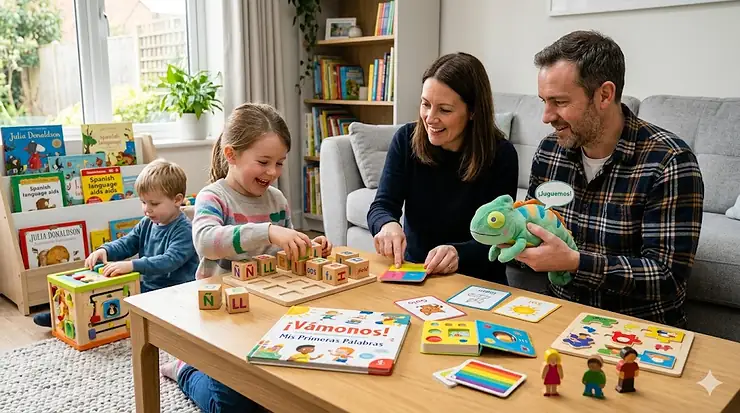
There’s a rather charming irony about Britain’s relationship with foreign languages. We holiday in Spain in droves, cheerfully order cervezas and point at menus with increasing confidence — and then come home and, well, stop. For most British children, Spanish starts at secondary school and arrives with all the excitement of a damp Monday morning PE lesson.
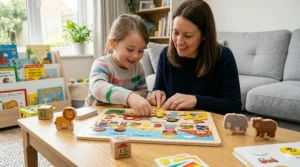
Spanish learning toys are changing that. Put simply, they are interactive, play-based tools — electronic books, bilingual flashcards, musical instruments, puzzle games and talking wall charts — designed to introduce children to Spanish vocabulary, pronunciation, and sentence structure before formal schooling even begins. The best ones turn hola, uno, dos, and tres into something a two-year-old will shout with genuine enthusiasm from the back seat of the car.
And it matters more than ever right now. Spanish is the world’s second most spoken native language, and the UK’s National Curriculum requires foreign language teaching from Key Stage 2 onwards — with Spanish being the most popular choice at GCSE. Children who get a running start at home don’t just cope better in school; they often genuinely enjoy it, which is no small thing. Research from the Encyclopedia on Early Childhood Development suggests that bilingual children demonstrate a marked advantage in controlled attention and problem-solving tasks compared to monolingual peers. Cognitive benefits aside, it’s also just rather good fun.
This guide covers seven real Spanish learning toys available on Amazon.co.uk right now, with honest commentary on who each one suits, what the specs actually mean in practice, and how to get the most out of them at home.
Quick Comparison: Top Spanish Learning Toys at a Glance
| Product | Best For | Age Range | Price Range | Amazon.co.uk |
|---|---|---|---|---|
| LeapFrog Learning Friends 100 Words Book | Toddler vocabulary immersion | 18 months–4 yrs | Under £20 | ✅ Prime eligible |
| LeapFrog Learn & Groove Color Play Drum | Musical & sensory learners | 6 months–3 yrs | Under £25 | ✅ Prime eligible |
| Interactive Bilingual Alphabet Wall Chart | Visual classroom-style learning | 2–6 yrs | Under £20 | ✅ Prime eligible |
| Talking Bilingual Flash Cards (224 Words) | Structured vocabulary practice | 3–7 yrs | Under £25 | ✅ Prime eligible |
| Snap in Spanish (Orchard Toys) | Game-based family learning | 4–8 yrs | Under £10 | ✅ Prime eligible |
| BrainBox Let’s Learn Spanish | Older kids & memory challenges | 6–10 yrs | £10–£20 | ✅ Available |
| Clementoni Bilingual Talking Dictionary | Comprehensive vocabulary tool | 5–10 yrs | £20–£40 | ✅ Available |
The pattern here is fairly clear: the younger the child, the more you want something tactile, musical, and frankly impossible to use incorrectly. Talking books and drums for toddlers; game-based cards and dictionaries for children who can already read and write. Budget-wise, you needn’t spend a fortune — several of the most effective options sit comfortably under £20, which is a relief when you remember the average British family home is already under siege from various plastic items of dubious educational value.
💬 Just one click — help others make better buying decisions too! 😊
✨ Don’t Miss These Exclusive Deals!
🔍 Take your child’s Spanish learning to the next level with these carefully selected toys. Click any highlighted product to check current pricing and availability on Amazon.co.uk — these picks will help you find exactly what your little linguist needs!
Top 7 Spanish Learning Toys: Expert Analysis
1. LeapFrog Learning Friends 100 Words Book (Model 601503)
Start here. If you’re buying your first Spanish learning toy for a toddler, this is the one that deserves pole position in the toy box — and I say that having seen plenty of bilingual books that promise the earth and deliver the linguistic equivalent of a shrug.
The LeapFrog 601503 is a touch-sensitive interactive book with over 100 age-appropriate words chosen by education specialists, all available in both English and Spanish via a simple language toggle switch. The pages are thin but surprisingly robust, and the touch sensitivity is genuinely impressive — the slightest press generates the word, a related sound effect, or a fun fact, depending on which of the three modes you’ve selected. Word categories span animals, food, colours, opposites, and everyday objects: the sort of vocabulary that actually comes up in a toddler’s daily life, rather than obscure nouns no one ever uses.
What makes this genuinely useful rather than merely entertaining is the bilingual framing. A child isn’t being asked to sit and “learn Spanish” — they’re pressing pictures of cats and hearing “cat… gato” in a cheerful voice. The repetition is relentless in the best possible way. Neuroscience research from the University of Washington Institute for Learning & Brain Sciences suggests that babies’ brains are uniquely receptive to second language sounds between the ages of 0 and 3 — so the earlier this goes in the toy box, the better.
UK parents in compact flats or terraced houses will appreciate that this is a quiet toy by nature — no drums, no flashing lights, no sound effects that induce parental despair at 7am. Requires 2 AA batteries. Prime eligible, typically arrives next day.
✅ Intuitive, requires zero adult setup once batteries are in
✅ Three learning modes keep it fresh over months of use
✅ UK-available model confirmed — same as international version
❌ Novelty can fade for older toddlers once all sounds are memorised
❌ No Spanish-only mode for more immersive practice
Around £15–£20 on Amazon.co.uk — outstanding value for what is genuinely one of the most parent-approved bilingual toys on the market.
2. LeapFrog Learn & Groove Color Play Drum (Bilingual English/Spanish)
Not every child learns through quiet contemplation of a picture book. Some learn by bashing things. This one’s for them — and it’s rather brilliant.
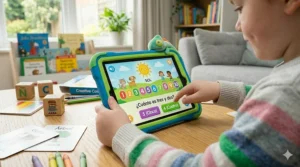
The Learn & Groove Color Play Drum teaches colours, opposites, counting and numbers in both English and Spanish through three different musical styles: classical, marching band, and salsa. The salsa setting, in particular, has an energy that no amount of sober vocab drilling could replicate. Children aged 6 months to around 3 years can interact with the coloured drum pads, each of which responds with bilingual audio and a burst of light. It’s multisensory in the proper sense: touch, sight, sound, and movement all engaged simultaneously — the kind of full-brain engagement that language acquisition researchers consistently flag as more effective than passive listening alone.
The practical upside for UK households is that this doubles as a musical toy, which justifies the shelf space far better than a single-purpose device. For families living in flats with downstairs neighbours, worth noting: the volume is adjustable, and at low settings it’s perfectly manageable. Connects to LeapFrog’s online learning path for tracking development milestones. Requires 3 AA batteries.
✅ Combines motor skill development with bilingual vocabulary
✅ Salsa musical mode introduces genuine cultural context
✅ Suitable from 6 months, meaning it gets significant use before the next birthday
❌ Battery consumption can be high with enthusiastic daily use
❌ The drum sound, even on low volume, carries through walls in terraced housing
Under £25 on Amazon.co.uk — well worth it as a dual-purpose musical and language toy.
3. Interactive Bilingual Alphabet Wall Chart (English & Spanish, Multiple Variants)
The wall chart category is one where Amazon.co.uk genuinely delivers. There are several competing models available — all broadly similar in function — and the best of them pack a surprising amount of teaching into a flat, A2-ish piece of printed card with embedded electronics.
Press a letter, hear its name and a corresponding word in both English and Spanish. Press an animal image, hear the animal name and sound. The better models include a piano mode (always a hit), a quiz mode for older children, and five interactive learning modes overall covering the alphabet, numbers 1–20, animal vocabulary, and basic colour recognition. For a child aged 2–6, this is essentially a classroom teaching aid scaled down for a bedroom wall.
The genius of the format is its passivity — unlike a tablet or handheld toy, a wall chart becomes part of the room’s furniture. Children return to it habitually without being directed to. What most UK parents overlook about this category is that the repetition comes for free: a child who walks past the chart every morning and presses a button out of habit is getting spaced-repetition language practice without anyone engineering a “learning session.”
Flat, lightweight, and easy to move between rooms or roll up for storage — a genuine asset in the smaller bedrooms typical of British homes. Requires 3 AA batteries. Multiple UK-compatible versions available; check the listing for UKCA marking confirmation.
✅ Passive, habit-forming exposure without screen time
✅ Slim and easy to store in a small bedroom or nursery
✅ Multiple interactive modes sustain interest across age ranges
❌ Sound quality on cheaper models can be tinny — check reviews for the specific variant
❌ Wall fixings are basic; BluTack works better on UK painted plaster
Under £20 on Amazon.co.uk — one of the most cost-effective bilingual tools in this guide.
4. Talking Bilingual Flash Cards — 224 Words (Various Brands)
A word in defence of flashcards: used badly, they’re the most tedious language tool imaginable. Used well — and these electronic talking versions make “well” considerably easier to achieve — they’re among the most effective vocabulary immersion tools available for the 3–7 age group.
These machine-card systems work by inserting double-sided illustrated cards into a reader unit, which then pronounces the word in English and Spanish with clear, natural-sounding audio. The 224-word sets cover categories including animals, food, colours, numbers, body parts, daily routines, and common objects — broad enough to feel genuinely comprehensive, focused enough not to overwhelm. For children at the pre-reading stage, the audio does all the heavy lifting; for those beginning to read, the printed word on the card adds a literacy layer.
The practical advantage over tablet-based apps — which is where most parents initially go — is the physical card format. Cards can be grouped by theme for a ten-minute focused session or spread across the floor for a matching game. They survive being dropped, slightly bent, and occasionally drooled on by younger siblings. The unit itself is compact, roughly the size of a thick paperback, and fits easily in a school bag for on-the-go practice. Prime delivery means these can arrive by the following day.
✅ Physical format is durable and screen-free
✅ Cards can be used as standalone visual aids beyond the electronic reader
✅ Natural-sounding audio pronunciation — not robotic
❌ Some brands have limited card sets; check 224-word variants specifically
❌ Small card parts unsuitable for children under 3
Under £25 on Amazon.co.uk — strong value for a structured vocabulary tool.
5. Orchard Toys Snap in Spanish
Orchard Toys is a British institution. Their games have been mainstays in UK classrooms and family game nights for decades, and Snap in Spanish deserves its place on this list for a simple reason: it makes language learning something the whole family actually wants to do, rather than something parents engineer with quiet desperation.
The format is classic snap with a bilingual twist — matching illustrated cards while calling out the Spanish word for each image. It sounds simple. It is simple. And simplicity, here, is a feature rather than a limitation. The game rewards speed and repetition, which means vocabulary gets drilled without anyone feeling drilled. Children absorb perro, gato, árbol, and manzana because they’re winning (or losing) a game, not completing an exercise.
This is one of the few Spanish learning toys in this guide that works well for primary school-aged children who already know the basics and need reinforcement rather than introduction. Teachers in the UK are increasingly building game-based language practice into KS2 classrooms — and having already played at home puts children in a noticeably more confident position. For families in a semi-detached in Birmingham or a village house in rural Suffolk alike, this is the toy that gets pulled out on rainy Saturday afternoons without anyone complaining.
✅ Genuinely fun — not just educational-fun, but actually fun
✅ Works for mixed-age family groups, siblings included
✅ Lightweight, compact, ideal for travel or a bag
❌ Not suitable for pre-readers without adult guidance
❌ Vocabulary range is limited compared to electronic alternatives
Under £10 on Amazon.co.uk — the best-value pick in this entire guide, and often Prime-eligible.
6. BrainBox Let’s Learn Spanish
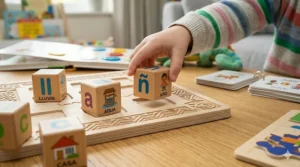
BrainBox is clever. The format challenges children to study an illustrated card for ten seconds, then answer questions about it from memory — the kind of retrieval practice that cognitive science consistently identifies as one of the most effective strategies for long-term retention. Apply that to Spanish vocabulary and you have something genuinely more sophisticated than most toys in this category.
Each card features a scene packed with labelled objects and characters engaging in actions, all captioned in Spanish. The questions prompt recall of specific words, colours, numbers, and phrases seen on the card. Children aged 6–10 get a genuine mental workout; competitive play between siblings or against parents adds real motivation. Unlike most flashcard systems, BrainBox rewards genuine understanding rather than rote sound-repetition — which is why it tends to be popular with parents who feel their child has outgrown the drum-and-wall-chart phase but isn’t quite ready for a formal language course.
What most parents overlook about this format is the re-playability. The cards rotate, questions vary, and the ten-second memory window creates a different experience every round. A child who plays twice a week for a school term will cover the full deck multiple times over. Compact box, no batteries, no screen — rather a nice change of pace in a category dominated by bleeping electronics.
✅ Retrieval-based learning is genuinely effective for retention
✅ Replayable, no batteries, no charging
✅ Suitable for children who’ve outgrown purely audio-based toys
❌ Requires a degree of reading ability — not ideal under 6
❌ Smaller vocabulary range than electronic alternatives
£10–£20 on Amazon.co.uk — a strong mid-range pick for primary school-aged children.
7. Clementoni Bilingual Talking Dictionary (English–Spanish)
Clementoni is a well-established European educational toy brand — Italian in origin, widely distributed across the UK, and a reliable presence on Amazon.co.uk. Their Bilingual Talking Dictionary sits at the premium end of this guide’s price range, and it earns its position.
At its core, this is a handheld electronic device with a built-in library of words, phrases, and themed categories across English and Spanish. Unlike a single-card reader, it’s self-contained: no cards to lose, no batteries to run out of in the first week (it uses USB-C charging, which is a genuine quality-of-life improvement over AA-gobbling alternatives). The vocabulary library runs to several hundred words across themes including school, food, nature, sport, the body, and everyday conversation. Older features include a pronunciation coach that records and plays back a child’s attempt at a Spanish word, comparing it to the native speaker model — surprisingly motivating for children aged 7–10 who are beginning to care about getting things right.
For UK buyers, it’s worth confirming the model number on Amazon.co.uk corresponds to the English–Spanish version rather than Spanish–Italian or Spanish–French variants, which also exist in the Clementoni range. UK plug compatibility is standard for the USB charging cable included.
✅ No consumable batteries — USB-C charging is far more practical
✅ Pronunciation feedback function is genuinely useful for older learners
✅ Comprehensive vocabulary depth suits children through late primary school
❌ Higher price point may not be justified for younger toddlers
❌ Check listing carefully for the correct English/Spanish language variant
£20–£40 on Amazon.co.uk — the premium choice, best suited to children aged 6 and above.
How to Get the Most Out of Spanish Learning Toys at Home
Buying the toy is the easy part. What separates families whose children actually pick up Spanish from those who find the talking drum gathering dust under the bed is how the toy is woven into daily life. Here are the approaches that work, based on how language acquisition research maps onto practical home routines.
Build habit, not sessions. The wall chart works precisely because it doesn’t require a “session.” A child who presses a button while brushing their teeth is getting spaced-repetition exposure without anyone declaring it educational. Replicate that logic with other toys: the flash cards live on the kitchen table, not in a box. The LeapFrog book lives on the sofa, not on a shelf.
Follow the child’s lead, especially with toddlers. If the drum is today’s obsession, run with it. Press the salsa mode, say the Spanish words aloud along with the toy, make it a shared experience. Research consistently shows that social interaction amplifies language acquisition in young children — hearing a word from a caregiver has more impact than hearing it from a device. You don’t need to speak fluent Spanish yourself; you just need to engage.
For older children, add context. A child learning manzana (apple) on a flash card will remember it far better if they also hear it at the fruit bowl, or spot it on a Spanish-language video they’re watching for fun. The toys introduce words; real-world context makes them stick. A brief family holiday to Spain, even a long weekend, is worth more than six months of flash cards — but the flash cards mean they’ll actually understand what they’re hearing when they get there.
For rainy British Saturdays — and there are many — the game-based options like Snap in Spanish and BrainBox are what you want. They keep everyone at the table, including the competitive older sibling who would otherwise be entirely disengaged.
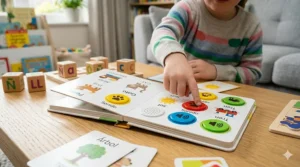
Who Should Buy What: Real UK Family Profiles
Choosing between these seven toys isn’t just about price — it’s about matching the product to the child, the household, and the learning context. Here are three scenarios from real British family life.
The London flat family with a toddler (18 months–3 years): Space is limited. Noise matters to neighbours. Budget is a consideration. Start with the LeapFrog Learning Friends 100 Words Book (under £20, quiet, compact) and add the Interactive Bilingual Wall Chart (slim, mounts easily) as a second purchase. Between them, you have audio vocabulary immersion and a passive visual aid — the two things that work best at this developmental stage.
The suburban Midlands family with a 4–7 year old starting school: The child can already read a little. The family wants something that supports what’s being introduced in KS2 Spanish at school. The Talking Bilingual Flash Cards (224 words) for structured vocabulary building, combined with Orchard Toys Snap in Spanish for family game nights, is a pairing that covers both individual practice and social reinforcement.
The rural household with an 8–10 year old who’s already had some Spanish at school: This child needs challenge, not nursery rhymes. BrainBox Let’s Learn Spanish for memory-based retrieval practice and the Clementoni Bilingual Talking Dictionary for pronunciation coaching and independent exploration — both are screen-free, compact, and sophisticated enough to hold a primary schooler’s interest.
How to Choose Spanish Learning Toys for Kids in the UK: 6 Key Criteria
Before browsing Amazon.co.uk, it helps to think clearly about what you actually need. Here’s a numbered framework worth working through.
- Age appropriateness first. The gap between 18 months and 7 years is enormous developmentally. Toys designed for toddlers (audio, touch, music) are genuinely counterproductive for older children, and vice versa. Check the age guidance, and if in doubt, buy slightly below the range rather than above.
- Audio quality matters enormously. The single biggest differentiator in this category is the quality and naturalness of the Spanish pronunciation. Robotic, synthesised audio teaches children to produce robotic, synthesised Spanish. Look for products where native speakers (or high-quality voice actors) have recorded the audio — this is usually mentioned in product descriptions or reviewable in Amazon.co.uk reviews.
- Battery life and charging. Given the UK’s damp, indoor-heavy winters — half the year, realistically — these toys get daily use from October to April. A toy that devours four AA batteries a week becomes an annoying running cost. USB rechargeable options like the Clementoni dictionary are more practical for sustained use.
- Physical durability. British children are, broadly speaking, enthusiastic with their belongings. Flash cards get bent. Toy drums get dropped. Wall charts get pressed with yoghurt-covered fingers. Assess the build quality before committing, and check Amazon.co.uk reviews specifically for durability comments from UK buyers.
- Vocabulary relevance. The best Spanish learning toys teach words children will actually hear — colours, numbers, animals, food, family members, common phrases. Be wary of products that prioritise obscure vocabulary for the sake of appearing comprehensive.
- Does it survive being ignored? The most effective bilingual toys in the long run are the ones that don’t require a dedicated learning session. Wall charts, snap card games, and interactive books that live openly in the room get used far more often than toys kept in boxes.
Common Mistakes When Buying Spanish Learning Toys in the UK
A few pitfalls that come up repeatedly when parents reflect on purchases that didn’t quite land.
Buying the US version of a product. Several bilingual toys sold on Amazon.com are not the same as those on Amazon.co.uk — they may have different model numbers, UK plug incompatibility, or in some cases are simply not listed for UK sale. Always purchase from Amazon.co.uk and confirm the product ships from UK warehouse stock for prompt Prime delivery.
Expecting fluency from a toy. No toy teaches fluency. What the best Spanish learning toys do is build phonological awareness, introduce vocabulary, and — crucially — create positive associations with the language. That last one is more valuable than any word list. A child who enjoys Spanish before secondary school is an entirely different learner to one who encounters it for the first time as a formal subject.
Buying for the wrong age. A toddler drum for a seven-year-old is, understandably, insulting. A BrainBox memory game for a two-year-old is baffling. Age matching matters more in this category than almost any other.
Underestimating the power of games. UK parents often gravitate towards “educational” toys that look like teaching aids and overlook games entirely. Snap in Spanish teaches vocabulary through play in a way that’s neurologically more effective than drilling — because motivation, enjoyment, and social context all increase retention. The House of Lords Library’s 2024 briefing on foreign language learning notes that student motivation is one of the biggest barriers to MFL uptake in English schools. Anything that builds a positive relationship with Spanish before age 11 is doing valuable work.
Spanish Learning Toys vs Traditional Classroom Learning
| Approach | Starts From | Vocabulary Depth | Motivation | UK Context |
|---|---|---|---|---|
| Spanish Learning Toys | Birth–toddler | Foundational 100–500 words | High (play-based) | Home/pre-school |
| Primary School MFL (KS2) | Age 7 | Structured, curriculum-led | Mixed | Required from KS2 |
| Private tuition | Any age | Variable | High | £30–£60/hr in UK |
| Language apps (e.g., Duolingo) | Age 4–5 (kids version) | Broad | High, then drops | Screen-based |
Toys and formal learning aren’t in competition — they’re complementary. The KS2 national curriculum requires foreign language teaching from age 7, with Spanish being the most popular MFL choice in English primary schools. Children who arrive at Year 3 with Spanish vocabulary already embedded — even just 50 words and a confident attitude — are measurably better positioned for everything that follows.
The comparison that favours toys most clearly is against private tuition, which in most UK cities costs upwards of £35 per hour. A £15 LeapFrog book used daily for a year delivers more combined exposure hours than several months of weekly tuition, at a fraction of the cost. The tuition wins on depth and interaction, of course — but for the foundational years, toys hold their own rather well.
From the table above, the clearest takeaway is that toys offer the earliest possible start at the lowest possible cost, with the highest natural motivation. Their limitation is vocabulary ceiling — at some point, a child needs structured grammar and conversational practice. But for ages 0–7, they’re unrivalled as the first contact point with the language.
✨ Don’t Miss These Exclusive Deals!
🔍 Every product in this guide is available on Amazon.co.uk. Click on any highlighted item to check current pricing, Prime delivery options, and real UK buyer reviews. Happy hunting — or as they say in Spain, ¡buena suerte!
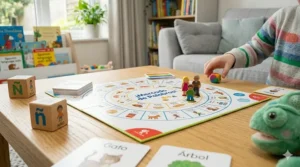
Frequently Asked Questions About Spanish Learning Toys in the UK
❓ At what age should my child start using Spanish learning toys?
❓ Are Spanish learning toys available with free delivery on Amazon.co.uk?
❓ Do Spanish learning toys comply with UK toy safety standards?
❓ Can a child learn Spanish from toys alone without speaking parents?
❓ Which Spanish learning toys are best for children who are already at KS2?
Conclusion: Start Now, Benefit for Years
The argument for Spanish learning toys is, at heart, a very simple one. The earlier a child hears a language — really hears it, in a context they enjoy — the more naturally it embeds. You don’t need to create a bilingual household. You don’t need to speak Spanish yourself. You need a toy that makes gato, uno, and ¿cómo estás? feel like normal, pleasant parts of a child’s world.
The seven products in this guide cover the full spectrum: from a soft-touch interactive book for toddlers just beginning to talk, to a pronunciation-coaching dictionary for ten-year-olds preparing to sit Spanish at GCSE. All are available on Amazon.co.uk, most are Prime eligible, and none will require remortgaging the house.
Start with whatever fits the age and budget. Then, perhaps, next time you’re in Spain, let the child do the ordering. It’s rather a nice feeling, all round.
✨ Ready to Buy? Browse the Full Range on Amazon.co.uk
🔍 Click any highlighted product in this guide to check current pricing and availability. Prime members enjoy free next-day delivery — perfect for birthdays, Christmas, or a perfectly ordinary Tuesday when you’ve decided today’s the day.
Recommended for You
- LeapReader vs Tag Reading System: 7 Best UK Picks (2026)
- Best Phonics Toys for 4 Year Olds: 7 Top UK Picks (2026)
- Letterland vs Jolly Phonics Toys: 7 Best UK Picks in 2026
Disclaimer: This article contains affiliate links. As an Amazon Associate, I earn from qualifying purchases. If you purchase products through these links, we may earn a small commission at no additional cost to you.
✨ Found this helpful? Share it with your mates! 💬🤗
