

In This Article
There’s a particular kind of magic in watching a child stop mid-conversation because they’ve just spotted Saturn’s rings on their bedroom wall for the hundredth time and still want to talk about it. Good solar system posters for children do more than fill blank wall space — they turn idle moments, bedtime, and homework breaks into small, repeated bursts of learning that genuinely stick.
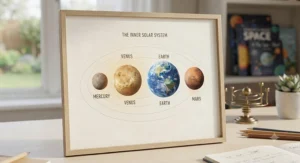
What makes a solar system poster actually work for a child, rather than just look nice? In short: clear, accurate labelling, an age-appropriate balance of colour and fact, and a physical format sturdy enough to survive years of sticky fingers, bedroom humidity, and the occasional toy thrown in its direction. This guide compares seven genuinely good options, drawing on real product specifications and aggregated customer feedback, and also covers how solar system posters fit alongside other classroom and bedroom staples like periodic table for kids charts and anatomy charts for children, since most families and teachers end up building a small collection of scientific visual references rather than buying just one.
We’ll also settle the laminated vs paper learning posters debate properly, since it matters more than most buyers expect, and look at how to use these as genuine educational room decoration rather than a poster that gets glanced at once and forgotten. As always with Amazon UK listings, treat any price you see as a snapshot — check current price before buying, since these fluctuate constantly.
Quick Comparison Table
| Poster | Best For | Format | Price Range |
|---|---|---|---|
| Daydream Education The Solar System Classroom Poster | Classrooms and serious home learners | A1 Laminated | £10–£18 range |
| SpriteGru Solar System Educational Teaching Poster Chart | Detail-rich bedroom display | Laminated | £8–£15 range |
| Schofield & Sims Our Solar System | Structured curriculum-style learning | Laminated | £6–£12 range |
| Outus 12 Pieces Solar System Educational Teaching Posters | Toddlers, multi-room use | Laminated (multi-pack) | £10–£16 range |
| Youngever Periodic Table Laminated Educational Poster | Early chemistry introduction | Laminated | £6–£12 range |
| Daydream Education Periodic Table Classroom Poster | Serious KS2–KS4 chemistry study | A1 Laminated | £10–£18 range |
| Daydream Education Body Organs Science Poster | Human body and anatomy learning | A1 Laminated | £10–£18 range |
Looking at the spread, laminated posters dominate this list for good reason — they’re what most parents and teachers actually end up buying once they’ve experienced a paper poster tear or fade within a term. Daydream Education‘s range appears three times here because it’s a genuinely well-established UK educational poster specialist, while Outus 12 Pieces Solar System Educational Teaching Posters stands out as the best-value option for anyone wanting several posters at once rather than a single large chart.
💬 Just one click — help others make better buying decisions too!😊
Top 7 Educational Posters for Children: Expert Analysis
1. Daydream Education The Solar System Classroom Poster — the UK classroom standard, built to last
The standout feature here is genuine curriculum pedigree: Daydream Education is the UK’s leading provider of educational posters for schools, and this A1-sized, laminated Solar System poster is designed specifically to help children understand the planets that make up our solar system, printed on heavy-duty 200gsm gloss paper for a bright, highly readable finish from across a classroom or bedroom.
Based on the spec comparison with smaller bedroom-focused posters, the A1 size (850mm x 594mm) is genuinely generous — large enough to remain legible from a child’s bed or the back of a classroom, which smaller A3 or A4 alternatives simply can’t match. Reviewers consistently describe the poster as informative and easy to read, with several specifically praising the good size, bold colours, and lamination quality, and one reviewer noting their daughter took it into school to support learning about the planets. What most buyers overlook about this poster is that it’s part of a coordinated planet and space poster range, so it pairs naturally with companion titles like The Earth, The Moon, and The Sun if a family or classroom wants a fuller solar system wall display over time.
Pros:
- ✅ Genuine UK educational publisher with curriculum-aligned content
- ✅ Large A1 laminated format, readable from across a room
- ✅ Part of a coordinated space and planets poster series
Cons:
- ❌ Larger size needs more wall space than bedroom-only posters
- ❌ Content pitched more toward school-age children than toddlers
At around £10–£18 in the range, the Daydream Education The Solar System Classroom Poster is the benchmark pick for anyone wanting a genuinely classroom-grade poster at home — check current price before buying, as stock and pricing shift regularly on Amazon UK.
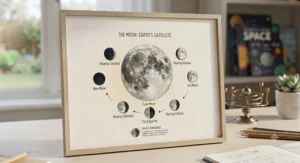
2. SpriteGru Solar System Educational Teaching Poster Chart — dense, detailed, and built for durability
The standout feature of the SpriteGru Solar System Educational Teaching Poster Chart is genuine information density — this poster includes all the dwarf planets alongside the eight main planets, plus figures like density, mass, and number of moons for each body, making it a poster that continues to reward closer reading well beyond a first glance.
Based on the spec sheet, the thick lamination is a meaningful upgrade over thinner alternatives — reviewers consistently describe the poster as a thick, sturdy laminated sheet that resists tearing and won’t get tatty on a wall over time, with several specifically noting it held up well even to enthusiastic handling from young children. What most buyers overlook is that the level of detail here suits an older or more astronomy-curious child better than a toddler — several reviewers, including a parent of an eight-year-old, describe children actively engaging with and even correcting or expanding on the facts presented, which speaks to genuine educational depth rather than surface-level decoration.
Pros:
- ✅ Includes dwarf planets and detailed scientific data per planet
- ✅ Thick, durable lamination that resists tearing
- ✅ Genuinely engages older, more curious children
Cons:
- ❌ Smaller print size makes some text less readable from a distance
- ❌ Denser information may be less suited to very young toddlers
In the £8–£15 range, the SpriteGru Solar System Educational Teaching Poster Chart is the pick for a family with a genuinely space-obsessed child who wants more than the basics.
3. Schofield & Sims Our Solar System — structured, fact-card style learning from a trusted UK publisher
The standout feature is educational structure: Schofield & Sims has published teaching guides and educational posters for over a century, and this laminated poster presents each planet alongside a dedicated “fact card” giving distance from the sun, diameter, mass, rotation time, orbit time, and number of moons — a genuinely structured approach rather than a loose collection of space facts.
On paper this means the poster functions almost like a reference table as much as a wall display, with additional diagrams explaining night and day, the moon’s relationship to Earth, and the alignment needed for an eclipse — genuinely going beyond a basic planet line-up. Reviewers describe the poster as beautiful and vibrant, with the lamination specifically praised for being spill-proof when children handle it, and one long-term reviewer noting their four-year-old carried the poster around the house and it held up to repeated handling. The most common critique, echoed across several reviews, is that Pluto isn’t included as a full planet (reflecting its 2006 reclassification), which occasionally surprises buyers expecting the nine-planet version many adults grew up with.
Pros:
- ✅ Structured fact-card format for each planet
- ✅ From an established, century-old UK educational publisher
- ✅ Durable, spill-proof lamination for handling by young children
Cons:
- ❌ Follows the current 8-planet classification, so Pluto isn’t a main planet
- ❌ Tightly rolled shipping can require patience to flatten fully
In the £6–£12 range, the Schofield & Sims Our Solar System poster suits families who want a genuinely structured, fact-driven reference rather than a purely decorative chart.
4. Outus 12 Pieces Solar System Educational Teaching Posters — the best-value multi-pack for toddlers and multi-room use
The standout feature is sheer flexibility: rather than one large poster, this set includes twelve smaller laminated posters covering space and planet themes, letting a family or classroom distribute learning content across several rooms or rotate different posters into view over time rather than committing one wall to a single fixed design.
Here’s what to weigh: at 10.6 x 14.1 inches per poster, individual pieces are considerably smaller than the A1 classroom posters on this list, which on paper means less fine detail per poster but genuinely better suits toddler bedrooms, playrooms, and multiple smaller display spaces where a single giant chart wouldn’t fit well. The laminated finish across all twelve pieces gives consistent durability regardless of which poster ends up in a higher-traffic area, and the lower per-poster cost makes this a genuinely practical choice for a nursery or reception classroom wanting varied visual content rather than one repeated image. Aggregated customer sentiment on multi-pack space posters in this category is generally positive on value and toddler engagement, with the main caveat being that buyers expecting one large statement piece should look at a dedicated single-poster option instead.
Pros:
- ✅ Excellent value across twelve separate laminated posters
- ✅ Flexible — spread across multiple rooms or display areas
- ✅ Well suited to toddlers and younger primary-age children
Cons:
- ❌ Individual posters are smaller with less fine detail than A1 charts
- ❌ Twelve separate pieces need more wall planning than a single poster
At £10–£16 for the full set, the Outus 12 Pieces Solar System Educational Teaching Posters collection delivers strong value for anyone furnishing more than one learning space.
5. Youngever Periodic Table Laminated Educational Poster — a genuinely approachable first chemistry chart
The standout feature of the Youngever Periodic Table Laminated Educational Poster is accessibility: rather than a dense, adult-oriented reference chart, this poster is specifically designed with input from preschool teachers to introduce the periodic table concept to younger children in an engaging, visually approachable way.
Based on the spec comparison with denser secondary-school chemistry charts, the PET film coating is a genuine practical upgrade — it wipes clean far more easily than cheaper PVC laminate and resists the staining that heavier classroom or kitchen-adjacent use can cause over time. What most buyers overlook about an early periodic table for kids poster is that the goal at this age isn’t memorising atomic numbers — it’s building visual familiarity with the idea that everything is made of elements, which this poster supports through its use of relatable icons and images alongside each element. Reviewers consistently praise the colours and clarity, with several specifically noting the extra information, labels, and icons make the periodic table more relatable and engaging than a plain reference chart, particularly for children showing early interest in science.
Pros:
- ✅ Designed specifically to be approachable for younger children
- ✅ Easy-to-wipe PET film coating, more durable than basic PVC lamination
- ✅ Icons and imagery make an abstract topic more relatable
Cons:
- ❌ Compact size limits fine detail compared with larger reference charts
- ❌ Some buyers wish a larger version were available
In the £6–£12 range, the Youngever Periodic Table Laminated Educational Poster is the natural next step once a child’s scientific curiosity moves beyond space and into chemistry.
6. Daydream Education Periodic Table Classroom Poster — the serious study companion for KS2 to KS4
The standout feature is genuine curriculum depth: this A1 laminated poster from Daydream Education is built for secondary school-level chemistry study, presenting the full periodic table with clarity suited to genuine revision use rather than early introduction alone, making it the natural pairing with the same publisher’s Solar System poster for a family building out a full scientific visual references wall.
On paper this means it suits an older child — typically upper primary through GCSE level — who needs a genuinely functional reference tool rather than a decorative first-glance chart. Aggregated reviews describe the poster as clear, easy to read, and well-constructed, with teachers specifically noting pupils find it eye-catching and engage with it during lessons. A minority of reviewers flag that the chart is missing certain less common elements, which is worth checking against a specific curriculum’s needs before buying, particularly for older students working toward exam-board-specific content.
Pros:
- ✅ Genuine secondary-school curriculum depth and clarity
- ✅ Large A1 laminated format, durable for repeated classroom use
- ✅ Pairs naturally with the same publisher’s other science posters
Cons:
- ❌ Better suited to older children than early years learners
- ❌ A small number of reviewers note certain elements are missing
At £10–£18 in the range, the Daydream Education Periodic Table Classroom Poster is the pick for a family or classroom serious about ongoing chemistry study rather than a first introduction.
7. Daydream Education Body Organs Science Poster — a genuinely clear anatomy charts for children starting point
The standout feature of the Daydream Education Body Organs Science Poster is clarity of purpose: rather than covering every human body system at once, this A1 laminated poster focuses specifically on helping children understand each human organ and its particular function, making it a genuinely digestible entry point into anatomy charts for children rather than an overwhelming, all-systems reference.
Based on the spec sheet, the same 850mm x 594mm large format and 200gsm gloss lamination used across the Daydream Education range applies here, meaning it shares the same readability-from-a-distance advantage and durability as the brand’s Solar System and Periodic Table posters — genuinely useful if a family or classroom is building a coordinated set. What most buyers overlook about anatomy posters for younger children is that organ function, rather than exhaustive labelling, is usually the more age-appropriate starting point — a child who understands broadly what the heart, lungs, and stomach do is better served than one facing a densely labelled full skeletal-muscular chart before they’re ready for it. As with other titles in this publisher’s range, the chart is designed with input from teaching consultants specifically to make science content memorable and engaging rather than purely encyclopaedic.
Pros:
- ✅ Focused specifically on organ function, genuinely age-appropriate
- ✅ Large, durable A1 laminated format matching the wider series
- ✅ Designed with teaching consultants for classroom-tested clarity
Cons:
- ❌ Doesn’t cover skeletal or muscular systems in the same poster
- ❌ Older students may eventually need a more detailed, separate chart
At £10–£18 in the range, the Daydream Education Body Organs Science Poster is a genuinely strong first anatomy chart before moving on to more detailed systems-specific posters later.
Practical Usage Guide: Displaying and Rotating Posters for Maximum Learning
Getting genuine value from a poster starts with placement. Position it somewhere a child’s eyes naturally land during downtime — beside a bed, opposite a reading chair, or on a playroom wall they pass daily — rather than behind furniture or in a rarely used corner, since repeated, low-effort exposure is what drives real fact reinforcement displays to work over time.
For the first 30 days, resist the urge to add every poster at once. Introducing one new poster every few weeks, rather than covering a wall in a single afternoon, keeps each one genuinely noticed rather than becoming background wallpaper a child stops seeing after the first week. A common early mistake is mounting a poster too high for a young child to point at or interact with — positioning key content at a child’s eye level, even if that means slightly lower than an adult would instinctively choose, meaningfully increases engagement. For maintenance, laminated posters need little beyond an occasional wipe with a damp cloth, while paper posters benefit from being kept away from direct sunlight, which causes fading considerably faster than most parents expect.
Real-World Scenarios: Matching Posters to the Child and Space
Consider three genuinely different situations. First, a toddler just beginning to show interest in space and science, in a small bedroom with limited wall space — for them, the Outus 12 Pieces Solar System Educational Teaching Posters set offers the flexibility to spread smaller, simpler content across the room without overwhelming a small child with one dense chart.
Second, a primary school-age child doing structured homework support at home, needing genuinely accurate, curriculum-relevant content they can reference while working — the Schofield & Sims Our Solar System poster’s fact-card structure and the Daydream Education The Solar System Classroom Poster‘s curriculum alignment both suit this need well, offering something closer to a working reference than pure decoration.
Third, a family or homeschool setting building a genuinely comprehensive scientific visual references wall covering multiple subjects — here, combining the Daydream Education The Solar System Classroom Poster, Daydream Education Periodic Table Classroom Poster, and Daydream Education Body Organs Science Poster creates a coordinated, consistently formatted set covering space, chemistry, and biology together, which tends to look and function better as a set than mixing wildly different poster styles and sizes.
Problem → Solution: Common Poster Issues
Problem: the poster keeps curling and won’t lie flat against the wall. This is common with tightly rolled shipping tubes. Solution: gently reverse-roll the poster in the opposite direction for a few minutes before mounting, and use stronger adhesive strips or tape at all four corners rather than just the top.
Problem: a paper poster has faded noticeably within a few months. This typically signals direct sunlight exposure. Solution: reposition away from a window, or choose a laminated version instead, since lamination genuinely slows UV-related fading compared with unprotected paper.
Problem: younger children are tearing or damaging the poster. Solution: choose a thickly laminated option, such as the SpriteGru Solar System Educational Teaching Poster Chart, which reviewers specifically note resists tearing even under enthusiastic handling.
Problem: a child has lost interest in a poster they used to love. This is normal after extended exposure to the same fixed image. Solution: rotate it to a different room, or introduce a companion poster covering a related but new topic, such as moving from solar system content to a periodic table for kids poster once initial space enthusiasm settles.
Problem: the poster is factually outdated (for example, showing Pluto as a full planet). Solution: check the publication or listing date before buying, and favour posters from established current publishers like Daydream Education or Schofield & Sims, which reflect the 2006 reclassification of Pluto as a dwarf planet.
How to Choose Educational Posters for Children
- Match content density to age. Toddlers benefit from simpler, image-heavy posters; school-age children engage better with denser, fact-rich charts like fact-card formats.
- Prioritise lamination for high-traffic or younger-child spaces. A laminated finish resists tearing, spills, and fading far better than plain paper in a bedroom or busy classroom.
- Check for current, accurate content. Look for recent publication dates and reputable educational publishers to avoid outdated classifications or errors.
- Consider size against available wall space. A1 posters suit classrooms and larger bedroom walls; smaller multi-pack posters suit toddler rooms or spaces with limited flat wall area.
- Think about curriculum relevance if supporting schoolwork. UK-published posters aligned with the National Curriculum tend to use terminology and structure that matches what a child is taught at school.
- Plan for a coordinated set rather than one-off purchases. Choosing posters from the same publisher and format (like the Daydream Education range) creates a more cohesive, expandable learning wall over time.
- Verify the finish type matches the room’s conditions. Damp bathroom-adjacent bedrooms or sunny rooms benefit more from lamination than a plain gloss paper finish.
Common Mistakes When Buying Learning Posters
The most frequent mistake is buying based on visual appeal alone without checking whether the content is genuinely age-appropriate — a densely labelled chart aimed at secondary school students can overwhelm rather than engage a much younger child, undermining the entire point of the purchase. A close second is choosing unlaminated paper posters for a young child’s bedroom purely to save a few pounds, then replacing them within months once tears or fading set in, which often costs more over time than buying laminated from the start.
Buyers also frequently underestimate how much size matters relative to viewing distance — a poster mounted across a room needs meaningfully larger text and imagery than one beside a reading chair, and a poster that looks perfect in a product photo can be disappointingly small once actually mounted on a real wall. Finally, many people buy a single, isolated poster without considering how it might later pair with companion titles, missing the chance to build a genuinely coordinated educational room decoration scheme like the multi-subject Daydream Education range offers.
Laminated vs Paper Learning Posters: The Full Breakdown
The laminated vs paper learning posters decision genuinely matters more than it might first appear, and it comes down to a trade-off between durability and cost.
| Factor | Laminated Poster | Paper (Unlaminated) Poster |
|---|---|---|
| Durability | High, resists tears and spills | Lower, tears and creases easily |
| Fade resistance | Better, coating slows UV damage | Weaker, fades faster in sunlight |
| Cleaning | Wipeable with a damp cloth | Cannot be wiped without damage |
| Typical cost | Slightly higher | Slightly lower |
| Best for | Young children, high-traffic rooms | Older children, low-handling display |
Looking at the comparison above, laminated posters win decisively for younger children and higher-traffic rooms, where the extra durability quickly justifies the modest cost difference, while plain paper posters remain a reasonable choice for an older child’s low-handling bedroom display or a temporary, budget-conscious purchase. In practice, most of the products on this list — including the Daydream Education range, SpriteGru Solar System Educational Teaching Poster Chart, and Schofield & Sims Our Solar System — lead with lamination precisely because it’s the safer long-term choice for genuine family use rather than a one-season decoration.
Periodic Table for Kids: What Makes a Good Chemistry Poster
A genuinely good periodic table for kids poster balances two competing needs: enough real chemistry content to be educationally honest, and enough visual simplicity to avoid overwhelming a child encountering the concept for the first time. The Royal Society of Chemistry’s education resources reflect this same principle at a professional level, offering both a detailed interactive version for deeper study and simplified formats designed specifically to make an abstract topic accessible.
For a first introduction, a poster like the Youngever Periodic Table Laminated Educational Poster — built around icons, colour, and relatable imagery rather than dense atomic data — tends to land better than a full reference chart. Once a child moves into upper primary or secondary school chemistry, a more comprehensive option like the Daydream Education Periodic Table Classroom Poster becomes genuinely useful as an active study and revision tool rather than just a wall decoration, mirroring the way many UK secondary chemistry classrooms use large, detailed periodic table wall charts as a constant visual reference throughout a course.
Anatomy Charts for Children: What to Look For
Good anatomy charts for children share a common thread: they prioritise function over exhaustive labelling, especially for younger age groups. A chart explaining broadly what the heart, lungs, and digestive system do — the approach taken by the Daydream Education Body Organs Science Poster — tends to build genuine understanding faster in a young child than a densely labelled full skeletal-muscular-nervous system chart that’s really designed for older students or genuine biology revision.
This mirrors how the National Curriculum’s primary science programme of study introduces human biology gradually across key stages, building from simple observations toward more detailed system-specific study as children progress through school. For families with children spanning different ages, it’s often more effective to buy a simpler organ-function poster for a younger child and a more detailed systems-specific chart later, rather than one dense poster expected to serve every age at once.
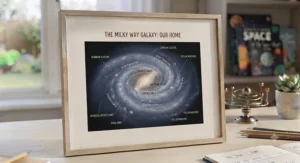
Educational Room Decoration and Fact Reinforcement Displays
Educational room decoration works best when it doesn’t try too hard to look like a classroom — the goal is a bedroom or playroom that still feels like a child’s own space, with learning content woven in rather than dominating every wall. Mixing a solar system poster with non-educational decor, rather than covering every surface in charts, tends to keep each poster feeling special rather than like unavoidable wallpaper.
The genuine educational logic behind fact reinforcement displays is well supported by research: a peer-reviewed study on visual teaching aids and children’s cognitive development found that well-designed visual aids meaningfully support children’s conceptual understanding, building on the broader principle that repeated, low-pressure visual exposure — glancing at a poster while falling asleep, for instance — reinforces facts far more effectively than a single lesson or reading session alone. This is precisely why a fixed wall poster often outperforms a book a child reads once and shelves: it’s there every day, doing quiet, repeated work in the background.
| Decoration Option | Educational Value | Visual Appeal | Typical Cost |
|---|---|---|---|
| Educational poster | High, ongoing fact exposure | Moderate to high | Low |
| Decorative wall art | Low | High | Moderate to high |
| Educational wallpaper/mural | High, but fixed content | High | High |
| Sticker sets | Moderate, temporary | Moderate | Low |
The comparison shows why posters remain the most practical middle ground: they deliver genuine educational value at a low cost while remaining easy to update or replace as a child’s interests develop, unlike a mural or wallpaper that’s expensive and difficult to change once a child moves on from dinosaurs to space to chemistry.
Long-Term Cost & Maintenance
Thinking about total cost of ownership matters even for something as inexpensive as a poster. A cheap, unlaminated paper poster that fades or tears within a year and needs replacing can end up costing more over several years than a single well-made laminated poster from an established publisher like Daydream Education or Schofield & Sims, which is genuinely built to survive years of display.
Maintenance is minimal but worth knowing: laminated posters can be wiped clean with a damp cloth if marked, while paper posters should be dusted gently rather than wiped, since moisture can cause visible damage. If a poster does eventually become outdated — reflecting new scientific reclassifications, for instance — replacing a single laminated poster from a coordinated range is usually cheaper and simpler than sourcing a completely new, differently formatted one.
Features That Actually Matter (And Those That Don’t)
Content accuracy and currency genuinely matter — an outdated or factually incorrect poster actively teaches a child something wrong, which is worse than no poster at all. Lamination quality genuinely matters for durability, and readable font size relative to a poster’s intended viewing distance genuinely matters, particularly for classroom or larger bedroom use. On the other hand, elaborate 3D or holographic poster effects are a genuine novelty but add little lasting educational value once the initial “wow” wears off, and generic marketing terms like “premium quality” without a specific material or lamination spec behind them tell you far less than checking the actual product description for gsm weight, lamination type, and dimensions.
Safety and Curriculum Alignment
On safety, mounting posters securely with appropriate adhesive or fixings matters more in a young child’s room than adults often consider — a poster or its mounting corners coming loose can present a minor choking or scratching hazard for very young children, so checking fixings periodically is a sensible habit. Positioning heavier framed posters (if choosing to frame rather than mount unframed) securely, well above a cot or low furniture a toddler might climb, is a similarly sensible precaution.
On curriculum alignment, UK-published posters that explicitly reference the National Curriculum science programmes of study — as Daydream Education‘s range does — tend to use consistent terminology and structure with what a child is actually taught in school, reducing the confusion that can arise from a poster using different classifications or emphasis than a child’s classroom lessons.
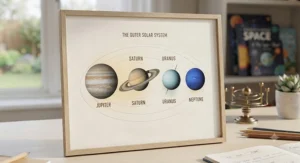
FAQ
❓ Are laminated or paper posters better for a child's bedroom?
❓ What age is appropriate for a periodic table poster?
❓ Do solar system posters need updating for accuracy?
❓ How many educational posters should a child's room have?
❓ Can anatomy charts for children include too much detail?
Conclusion
Choosing the right solar system posters for children comes down to matching content density and durability to your child’s age and how the poster will actually be used, whether that’s a first gentle introduction to space or a genuine curriculum-aligned study tool. The Daydream Education The Solar System Classroom Poster and SpriteGru Solar System Educational Teaching Poster Chart lead on detail and durability for school-age children, while the Outus 12 Pieces Solar System Educational Teaching Posters and Schofield & Sims Our Solar System suit younger learners and structured fact-based reference respectively. For families building a wider set of scientific visual references, the Youngever Periodic Table Laminated Educational Poster, Daydream Education Periodic Table Classroom Poster, and Daydream Education Body Organs Science Poster extend that same learning wall into chemistry and biology.
Whatever you choose, remember that a poster does its best work through quiet, daily repetition rather than a single dramatic unveiling — position it somewhere your child’s eyes naturally land, choose lamination for younger children, and check current pricing before you commit. Given time, a good poster genuinely earns its place on the wall.
✨ Don’t Miss These Exclusive Deals!
🔍 Take your child’s learning wall to the next level with these carefully selected picks. Click on any highlighted product above to check current pricing and availability on Amazon UK. The right poster can spark a lifelong love of science!
Recommended for You
- Magnetic vs Non-Magnetic Whiteboards Kids: 7 Picks for 2026
- Easel For 3 Year Old: 7 Best Picks Parents Trust in 2026
- Kumon vs School Zone Workbooks: 7 Picks Compared (2026)
Disclaimer: This article contains affiliate links. As an Amazon Associate, I earn from qualifying purchases. If you purchase products through these links, we may earn a small commission at no additional cost to you.
✨ Found this helpful? Share it with your friends! 💬🤗
