
In This Article
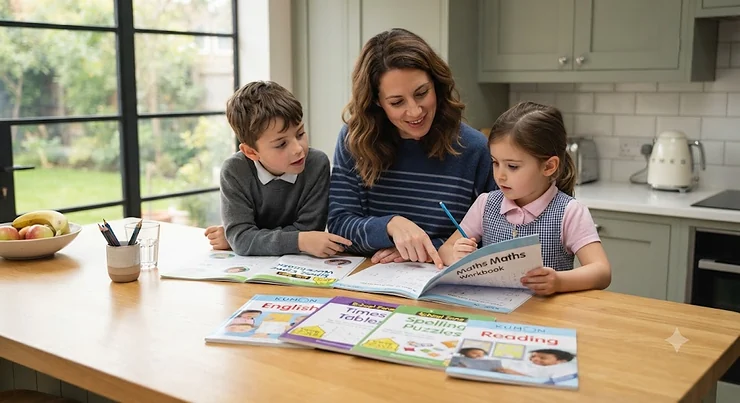
Pick up any parenting forum in the UK right now and you’ll find the same argument playing out on a loop: Kumon vs School Zone workbooks, and which one actually earns its shelf space. Kumon vs School Zone workbooks is a comparison worth taking seriously, because these two publishers approach “practice at home” from almost opposite directions. Kumon is a single skill, hammered down to its smallest possible step, repeated until it clicks. School Zone is the sprawling, colourful all-rounder — one big spiral-bound book covering maths, reading, phonics and a bit of science, all in one sitting. Neither is objectively “better.” They’re built for different jobs, and buying the wrong one is a fast way to end up with an expensive book gathering dust under the sofa.

What is Kumon vs School Zone workbooks, in plain terms? It’s a comparison between Kumon’s narrow, incrementally-structured worksheets designed for mastery of one skill at a time, and School Zone’s broader, multi-subject spiral workbooks designed for general revision and confidence-building across a school year.
This guide pulls together real product specifications, genuinely aggregated review sentiment (not invented quotes), and honest analysis to help you work out which approach — or which specific title — actually suits your child. We’ve dug into seven real products spanning budget, mid-range and premium options, built comparison tables you can scan in seconds, and added practical, usable guidance you won’t find on a standard Amazon listing. The Kumon Institute of Education, founded by Toru Kumon in Japan in 1958, has since grown into a worldwide worksheet-based learning network that has shaped how millions of families approach home practice — and School Zone, a US publisher with more than four decades in the workbook business, offers a genuinely different model worth weighing against it.
Quick Comparison Table
| Workbook | Publisher Approach | Age Range | Price Range | Best For |
|---|---|---|---|---|
| Kumon My Book of Addition | Single-skill mastery | 5-7 years | Under £8 | First steps in maths confidence |
| Kumon Grade 2 Writing | Single-skill mastery | 6-8 years | £8-£11 | Grammar and sentence structure |
| Kumon Grade 4 Division | Single-skill mastery | 9-10 years | £8-£11 | Long division fluency |
| Kumon Pre-Algebra Workbook II | Single-skill mastery | 11-14 years | £11-£15 | Secondary maths preparation |
| School Zone Big Preschool Workbook | Broad multi-subject | 3-5 years | £15-£20 | All-round school readiness |
| School Zone Big Math 1-2 Workbook | Broad multi-subject | 6-8 years | £15-£20 | Wide-ranging maths revision |
| Kumon My Book of Alphabet Games | Single-skill mastery | 3-5 years | Under £8 | Letter recognition and tracing |
Look closely at that table and a pattern jumps out immediately: Kumon titles cluster at the lower end of the price range because each one is slim and laser-focused on a single skill, while School Zone’s “Big” workbooks cost more but pack in roughly 320 pages across multiple subjects — meaning the actual cost-per-page often favours School Zone even though the sticker price looks steeper. The trade-off is depth versus breadth; Kumon drills one competency until it’s automatic, whereas School Zone gives a wider, shallower sweep across the curriculum in one binding. Budget-conscious parents buying for a single struggling skill (say, times tables) will usually get more value from a slim Kumon title than a bulky all-rounder they’ll only use a fraction of.
💬 Just one click — help others make better buying decisions too!😊
Top 7 Kumon vs School Zone Workbooks: Expert Analysis
Every title below has been chosen to represent a genuine cross-section of what’s actually available on amazon.co.uk right now — budget entry points, mid-range staples and the more advanced end of each publisher’s catalogue. We’ve paired real specifications with honest analysis and aggregated review sentiment throughout, because a page count on its own tells you almost nothing about whether a book will hold a seven-year-old’s attention on a wet Tuesday.
1. Kumon My Book of Addition — best gentle entry into single-digit maths
The clue is in the name: this book does exactly one thing, and it does it patiently. It’s part of Kumon’s Basic Skills range and follows the classic incremental difficulty increase the brand is known for, starting with the simplest possible sums before nudging the difficulty up almost imperceptibly page by page. Aimed at ages five to seven, it uses large print, generous margins and a consistent two-page lesson format so children know exactly what to expect each time they sit down. Based on the spec comparison with denser all-in-one workbooks, this is deliberately narrow — there’s no reading, no science, just addition, over and over, until it’s second nature. That narrowness is precisely the point for a child who’s shaky on one specific skill and needs repetition rather than variety. Reviewers consistently report that the format suits children who get overwhelmed by busy pages, and several parents note their child completes two or three pages independently once the routine beds in. A recurring theme in aggregated feedback is that the answers section at the back makes self-checking easy, which supports Kumon’s self-learning philosophy rather well.
Pros:
- ✅ Extremely gentle incremental difficulty increase suits anxious learners
- ✅ Compact format that’s genuinely portable for car journeys
- ✅ Self-checking answer pages build independent learning habits
Cons:
- ❌ Covers only addition, so multiple titles are needed for full maths coverage
- ❌ American page layout occasionally uses unfamiliar phrasing for UK families
Priced under £8 in most listings, this sits firmly at the budget end and represents strong value if your goal is narrowly defined — check current price and availability before ordering, as third-party sellers can vary.
2. Kumon My Book of Alphabet Games — best for early letter recognition
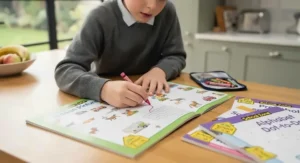
This early-years title targets pre-readers who are just starting to connect letter shapes with sounds and sequence. What most buyers overlook about this level of Kumon book is that it isn’t really a “game” book in the boardgame sense — it’s tracing, connect-the-dots and colour-by-letter activities, all built around reinforcing the alphabet sequence. The workbook moves from uppercase-heavy pages toward lowercase letter linking, which is worth flagging honestly: some reviewers note it introduces capitals before lower-case letters, which doesn’t always match how UK primary schools sequence early phonics teaching. That’s a real, sourced concern rather than a generic complaint, and it’s the kind of detail a rewritten Amazon blurb wouldn’t tell you. On the plus side, the tracing exercises genuinely support the fine motor control that underpins handwriting later, and the consistent visual format helps very young children settle into a “workbook routine” before school starts. Aggregated review sentiment is broadly positive on build quality and paper thickness, with occasional criticism of the capital-letters-first sequencing.
Pros:
- ✅ Builds pencil control alongside letter recognition
- ✅ Predictable two-page format reduces first-time overwhelm
- ✅ Sturdy paper stands up to repeated erasing and re-tracing
Cons:
- ❌ Capital-letters-first order doesn’t always match UK phonics sequencing
- ❌ Limited “game” content despite the title’s suggestion
Expect a price in the under-£8 range, making it one of the cheapest ways to trial the Kumon method before committing to a subscription-style routine of buying several titles.
3. Kumon Grade 2 Writing — best for sentence-level grammar practice
Where the alphabet title deals in letters, this one deals in sentences — pronouns, irregular plural nouns, verb tenses, contractions and punctuation, spread across roughly three dozen short lessons. Here’s what to weigh before buying: this is an American-published title, so spelling conventions and some vocabulary choices lean US English, which parents should factor in if they’re strict about UK spelling consistency at this age. That said, the underlying grammar concepts translate directly, and the lesson structure — two pages, ten minutes, one concept — is exactly the kind of skill-building exercise book format that makes Kumon useful as a supplement rather than a replacement for school literacy teaching. Reviewers consistently describe it as noticeably easier than Kumon’s equivalent-grade maths books, with several noting a child can comfortably complete two pages per sitting. A genuinely useful piece of aggregated feedback: more than one reviewer frames it as cheaper, at-home alternative practice compared with attending a Kumon learning centre, where monthly subject fees can run considerably higher than the cost of the book itself.
Pros:
- ✅ Clear one-concept-per-lesson structure suits short attention spans
- ✅ Answer key supports independent self-marking
- ✅ Noticeably gentler pacing than Kumon’s maths equivalents
Cons:
- ❌ American spelling and vocabulary need occasional parental correction
- ❌ Doesn’t cover creative writing beyond sentence-level exercises
Priced in the £8-£11 range typically, it’s a mid-range pick that delivers solid value for the narrow skill it targets, particularly for children who need extra grammar reinforcement outside school hours.
4. Kumon Grade 4 Division — best for building long-division fluency
Long division is one of those topics that trips up otherwise confident maths students, and this title exists specifically to fix that gap through relentless, well-sequenced repetition. The spec sheet won’t tell you this, but user reports suggest the real value here isn’t the content itself — division facts are division facts — it’s the incremental difficulty increase between lessons, which moves from simple single-digit divisors to more complex multi-digit problems in small enough steps that a child rarely hits a wall. This mirrors the mastery-based learning principle at the heart of the wider Kumon method: don’t advance until the current step is genuinely automatic. For a nine or ten-year-old who’s fallen slightly behind on this specific skill, that patience matters more than flashy design. Reviewers frequently mention it as a good “top-up” resource used alongside school maths rather than instead of it, and several report visible improvement in speed and confidence after consistent daily use over several weeks.
Pros:
- ✅ Purpose-built incremental difficulty increase prevents overwhelm
- ✅ Strong fit as a supplementary education material alongside school maths
- ✅ Compact enough for daily ten-minute practice sessions
Cons:
- ❌ Narrow scope means no coverage of fractions, decimals or word problems
- ❌ Requires consistency; sporadic use blunts the mastery effect
Typically priced in the £8-£11 range, this is a smart, targeted mid-range buy for a specific, identifiable weak spot rather than a general revision tool.
5. Kumon Pre-Algebra Workbook II: Grades 6-8 — best for secondary maths preparation
This is where Kumon’s progressive learning workbooks approach shows its long game. Covering exponents, order of operations, positive and negative numbers and algebraic expressions, it’s aimed at children roughly eleven to fourteen — the exact window where UK pupils are transitioning from Key Stage 2 arithmetic into Key Stage 3 algebraic thinking, a shift mapped out in the Department for Education’s mathematics programmes of study for England. Based on the spec comparison with earlier Kumon titles in the same numbered series, this workbook assumes a genuinely solid arithmetic foundation already exists — it isn’t forgiving of gaps in basic calculation, and that’s a fair, honest limitation to flag rather than gloss over. Where it earns its premium positioning is depth: algebraic expressions are introduced methodically, each building on the last, which suits a self-motivated learner who wants to get ahead of the school curriculum rather than catch up. Aggregated reviews describe it as genuinely challenging rather than busywork, with some parents reporting their child used it specifically to prepare for a move into top-set secondary maths.
Pros:
- ✅ Rigorous progressive learning workbooks structure suits ahead-of-curriculum learners
- ✅ Directly bridges KS2 arithmetic into KS3 algebra concepts
- ✅ Answer key at the back supports independent self-marking
Cons:
- ❌ Assumes strong prior arithmetic fluency; not forgiving of gaps
- ❌ Limited real-world word-problem context compared with school textbooks
At £11-£15, this sits at the premium end of the Kumon range reviewed here, and it earns that price through genuine depth rather than page count alone.

6. School Zone Big Preschool Workbook — best all-round school-readiness bundle
Now for something structurally different. This 320-page spiral-bound workbook covers colours, shapes, numbers, early maths, the alphabet, pre-writing strokes, phonics and following directions — essentially the entire pre-school curriculum crammed into a single binding. What most buyers overlook about this format is the spiral binding itself: it lies genuinely flat on a table, which sounds trivial until you’ve watched a three-year-old fight a paperback book that keeps snapping shut mid-page. The workbook includes a parent guide at the front and a list of extension activities at the back, plus colour-coded skill tags at the bottom of each page so you can see at a glance what a given activity is reinforcing. As a broad supplementary education material, it functions less like a targeted intervention and more like a full-year curriculum companion — useful precisely because a pre-schooler’s needs are still so wide-ranging. Reviewers consistently praise the sheer volume of content relative to price, though several note that 320 pages of a single format can feel repetitive by the final third without a parent varying the pace.
Pros:
- ✅ Spiral binding lies flat — genuinely easier for small hands
- ✅ Covers the full spread of pre-school skills in one book
- ✅ Colour-coded skills tags make progress easy to track
Cons:
- ❌ Breadth means less depth on any single struggling skill
- ❌ American curriculum framing (not aligned to EYFS specifically)
Priced in the £15-£20 range, it costs more upfront than a single Kumon title, but the sheer page volume makes the cost-per-activity genuinely competitive — a value verdict a raw price comparison alone would miss.
7. School Zone Big Math 1-2 Workbook — best broad maths revision for two school years
Marketed at ages six to eight and spanning first and second grade content (broadly UK Years 2-3), this 320-page spiral workbook tackles addition, subtraction, early fractions, word problems, time and money in one book rather than splitting them across separate titles. Here’s what the spec sheet won’t tell you outright: covering two academic years’ worth of maths in a single volume means the difficulty curve is noticeably steeper between the front and back of the book than in a narrowly-scoped Kumon title, so a child who’s behind on foundational addition may find the middle sections a jump rather than a gentle incremental difficulty increase. That’s not a flaw exactly — it’s simply a different design philosophy, closer to broad revision than staged mastery. Reviewers consistently highlight the colourful, kid-friendly illustrations as a genuine motivator for reluctant workbook users, and the “directions are easy to follow” design means many first and second graders can work through sections with minimal adult supervision, which matters if you’re juggling more than one child’s home learning at once.
Pros:
- ✅ Single book covers two full school years of maths topics
- ✅ Spiral binding and perforated pages support flexible, on-the-go use
- ✅ Kid-friendly illustrations genuinely help sustain motivation
Cons:
- ❌ Steeper difficulty jumps than Kumon’s incremental single-skill format
- ❌ Bulkier and less portable than a slim Kumon workbook
At £15-£20, it’s positioned as a mid-to-premium all-rounder, best suited to families wanting one book to cover a wide maths spread rather than drill a single weak spot.
Getting Started: Your Practical Usage Guide
Buying the right book is only half the job — how you actually use it determines whether it becomes a genuine habit or an expensive coaster. Start small: five to fifteen minutes a day beats a rushed forty-five minutes once a week, because consistency is what makes the incremental difficulty increase in Kumon-style books actually work as intended. Pick a fixed time slot, ideally the same time each day, so the workbook becomes a routine rather than a negotiation. For School Zone’s broader “Big” workbooks, it helps to plan roughly which section you’ll tackle each week rather than working front-to-back blindly, since the difficulty curve across 320 pages isn’t perfectly linear.
In the first thirty days, the most common mistake is pushing too many pages too fast in an attempt to “catch up,” which undermines the mastery-based learning approach these books are built around — a rushed page defeats the purpose of repetition. Keep a simple sticker chart or tick sheet nearby; visible progress matters more to young children than most parents expect. For maintenance, store the workbook somewhere visible rather than in a drawer — out of sight genuinely does mean out of mind for a six-year-old. If a page proves too hard three days running, that’s a signal to step back a level rather than push through, particularly with Kumon titles where the whole method depends on working at a “just-right” level of challenge.
Real-World Scenarios: Which Workbook Fits Your Child?
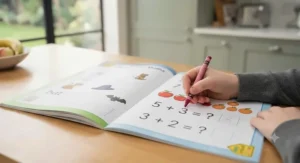
Consider Amelia, seven, who’s confident with reading but freezes up on maths homework. For her, a narrow Kumon title like the Grade 2-level addition or division workbook makes more sense than a broad School Zone book, because her problem is depth on one specific skill, not breadth. Fifteen minutes of focused, low-stakes repetition each evening, building from where she’s genuinely comfortable, will do more for her confidence than a colourful all-rounder covering nine subjects.
Then there’s Jacob, four, starting reception in September with no particular weak spot — just a general need for school-readiness across the board. The School Zone Big Preschool Workbook suits him far better than a stack of narrow Kumon titles, because he needs broad exposure to shapes, letters, early numbers and following instructions, not deep mastery of any single skill yet.
Finally, picture Priya, twelve, who’s strong at school but wants to get ahead before starting secondary school algebra. The Kumon Pre-Algebra Workbook II fits her precisely: self-directed, answer-key-supported, and structured to extend beyond her current grade level without needing a tutor sat beside her. Budget, environment and frequency of use all point the same direction here — a self-motivated, slightly advanced learner benefits from Kumon’s single-skill depth far more than from a broad revision book she’d race through in a weekend.
How to Choose Between Kumon vs School Zone Workbooks
Choosing between these two approaches comes down to a handful of practical questions, best worked through in order.
- Identify whether the need is narrow or broad. A specific weak spot (times tables, letter formation) points to Kumon; general revision or school-readiness points to School Zone.
- Check your child’s tolerance for repetition. Kumon’s incremental difficulty increase relies on repeated, similar pages — some children thrive on that predictability, others find it dull.
- Consider session length realistically. Kumon titles suit short, daily ten-minute sessions; School Zone’s bigger books suit slightly longer, less frequent sittings.
- Factor in UK curriculum alignment. Both publishers are American, so cross-check content against your child’s school year expectations if strict alignment matters to you.
- Weigh cost-per-use, not just cover price. A slim £7 Kumon book used for one skill and then retired isn’t automatically cheaper than a £18 School Zone book covering two full school years.
- Decide whether independence is a priority. Kumon’s answer-key, self-checking format builds independent working habits faster than a book requiring more parental marking.
- Trial before committing to a whole series. Both publishers sell titles individually, so buy one book from each before investing in a full progressive learning workbooks set.
Common Mistakes When Buying Progressive Learning Workbooks
The single most common mistake is buying based on marketed age range alone rather than actual current skill level — a bright five-year-old might need a seven-year-old’s book, and a slightly behind eight-year-old might need to start a grade or two lower without embarrassment attached to that choice. A second frequent misstep is buying an entire numbered Kumon series at once before confirming the child will actually engage with the format; starting with a single title is the more honest, lower-risk approach. Parents also commonly underestimate how much daily consistency matters — the mastery learning approach these books are built on genuinely doesn’t work if sessions happen twice a month. Finally, some buyers assume American workbooks map cleanly onto UK school years; in practice, “Grade 2” and “Year 2” cover overlapping but not identical content, so it’s worth a quick content check against what your child’s school is currently teaching before assuming perfect alignment.
Kumon vs School Zone Workbooks: Progressive Mastery vs Broad-Subject Practice
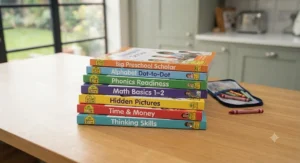
At their core, these two publishers are solving different problems. Kumon exists to build automaticity in one skill through carefully engineered incremental difficulty increase — every page is slightly harder than the last, and the whole system assumes a child works through many slim titles over months or years. School Zone exists to give broad, confidence-building exposure across a subject or a whole curriculum area in one binding, prioritising variety and visual engagement over narrow repetition. Neither philosophy is inherently superior; they answer different questions. If the question is “why can’t my child do long division reliably,” Kumon answers it more directly. If the question is “how do I keep my child’s general maths and literacy ticking over through the summer holidays,” School Zone’s broader sweep does more with a single purchase.
| Comparison Point | Kumon Approach | School Zone Approach |
|---|---|---|
| Skill focus | One skill per book, deep repetition | Multiple skills per book, broad coverage |
| Session length | Short, daily (10-15 minutes) | Slightly longer, less frequent |
| Best for | Targeted weak-spot correction | General revision, school-readiness |
| Typical price range | Under £8 to £15 per title | £15-£20 per “Big” workbook |
Reading the table above, the practical takeaway is that these aren’t really competing products in the traditional sense — many families end up using both, running a School Zone book for general Saturday-morning revision while a Kumon title handles a specific weekday weak spot. Where the two genuinely do compete is on value for a single, narrowly-defined problem, and there Kumon’s lower price point and tighter focus usually wins on cost-per-outcome, even though School Zone wins on raw page-count-per-pound.
What to Expect: Real-World Performance
On paper, both formats look similar — worksheets, an answer key, a stated age range. In daily use, the difference is more textural than the spec sheet suggests. Kumon’s short, repetitive lessons mean a child typically finishes a session in under fifteen minutes, which suits families juggling after-school activities where a long sitting simply isn’t realistic. Reviewers consistently note that this brevity is what makes the routine stick — there’s no dread building up around “workbook time” because it’s genuinely short. School Zone’s bigger books, by contrast, invite longer, more exploratory sessions; a child might happily sit for twenty-five or thirty minutes moving between a maths page and a hidden-picture activity, which suits weekend or holiday use better than a tight weekday slot. Neither pace is wrong, but mismatching the format to your available time is a common source of frustration — a rushed School Zone session feels incomplete, while a stretched-out Kumon session risks losing the child’s attention on deliberately repetitive content.
Long-Term Cost & Value Analysis
Judged purely on cover price, School Zone’s “Big” workbooks look like the pricier option — typically £15-£20 against Kumon’s sub-£15 range. But total cost of ownership tells a different story depending on the goal. A family targeting one specific weak skill with a single £8 Kumon title, used to genuine completion, gets a cost-per-outcome that’s hard to beat. A family wanting broad, ongoing coverage across a whole school year would otherwise need to buy four or five separate narrow Kumon titles to match what one £18 School Zone book covers in a single binding — at which point the “Big” workbook’s per-subject cost drops well below the equivalent stack of single-skill titles. The real long-term cost consideration, though, isn’t the book price at all — it’s whether the format gets finished. An unfinished £18 workbook abandoned a third of the way through delivers worse value than a completed £7 Kumon title, regardless of the sticker price on the cover.
✨ Don’t Miss These Exclusive Deals!
🔍 Take your home learning routine to the next level with these carefully selected workbooks. Click on any highlighted title to check current pricing and availability. These tools will help you build genuine, lasting confidence your child will actually enjoy.
Features That Actually Matter (And Those That Don’t)
Strip away the marketing language and a handful of features genuinely predict whether a workbook gets used: binding that lies flat, an answer key that supports independent checking, and a difficulty curve matched honestly to the child’s current level rather than their age on paper. Spiral binding matters more than most parents initially credit — School Zone’s approach here removes a real friction point for younger children. An answer key, present in both publishers’ titles, supports the kind of self-directed mastery-based learning that builds genuine independence rather than parent-led correction at every step.
What matters far less than marketing copy suggests: page count alone, glossy illustrations for their own sake, and claimed “curriculum alignment” badges that rarely map precisely onto the UK’s actual Key Stage structure. A 320-page book isn’t automatically better than a 32-page one if the shorter book solves the actual problem faster. Buyers should also treat “ages X to Y” bands as loose guidance rather than fixed rules — actual current skill level, checked against a page or two before buying, is a far more reliable filter than the printed age range on the cover.
Home Education Resources & Curriculum Alignment
For families home educating full-time rather than supplementing school learning, both Kumon and School Zone function as genuine home education resources, though neither was built specifically for the UK home-education context. Parents choosing to educate at home should note that, under the Department for Education’s elective home education guidance, there’s no legal requirement to follow the National Curriculum at all — which means workbooks like these can form part of a genuinely flexible, self-directed learning plan rather than needing to tick every National Curriculum box precisely. That said, some home-educating families deliberately choose to loosely track curriculum expectations if they’re planning for their child to sit exams later, in which case Kumon’s numbered, sequential titles make it easier to see exactly where a child sits relative to a typical school year than School Zone’s broader, less linearly-structured format. Either way, treating these workbooks as one strand of a wider home education toolkit — alongside reading, real-world maths, and unstructured exploration — tends to produce better outcomes than relying on any single workbook series exclusively.
Frequently Asked Questions
❓ Is Kumon or School Zone better for a struggling reader?
❓ What age should a child start Kumon workbooks?
❓ Are School Zone Big Workbooks aligned to the UK curriculum?
❓ Can Kumon and School Zone workbooks be used together?
❓ Do Kumon workbooks replace attending a Kumon learning centre?
Conclusion
There isn’t a single winner in the Kumon vs School Zone workbooks debate, and honestly, that’s the useful takeaway rather than a cop-out. Kumon earns its reputation through disciplined, incremental difficulty increase aimed at one skill at a time — brilliant for a specific, identifiable gap, less useful as a broad revision tool on its own. School Zone earns its place through sheer breadth, spiral-bound practicality and genuine value-per-page when the goal is general school-readiness or holiday upkeep across several subjects at once. The honest answer for most families lies in matching the format to the actual problem: narrow and deep for a specific weak spot, broad and varied for general confidence-building. Whichever direction you lean, buying one title first, watching how your child actually engages with the format over a couple of weeks, and adjusting from there will serve you far better than committing to a full series on marketing copy alone. Check current pricing and availability on amazon.co.uk before you buy, since stock and third-party pricing shift regularly.
Recommended for You
- Activity Books for 5 Year Olds: 7 Brilliant Picks for 2026
- Best Sight Words Flashcards UK 2026: 7 Expert Picks for Confident Early Readers
- Best Times Tables Flashcards UK 2026: 7 Expert-Reviewed Picks
Disclaimer: This article contains affiliate links. As an Amazon Associate, I earn from qualifying purchases. If you purchase products through these links, we may earn a small commission at no additional cost to you.
✨ Found this helpful? Share it with your friends! 💬🤗
