

In This Article
The age of 10 sits at a rather interesting crossroads in a child’s development. They’ve moved beyond the “mix everything together and see what happens” phase, yet they’re not quite ready for A-level chemistry. Science kits for 10 year olds bridge this gap brilliantly, offering structured experiments that feel like proper laboratory work without requiring a degree to supervise. According to research on science education, hands-on experimentation during this developmental stage significantly improves critical thinking skills and long-term engagement with STEM subjects.

What most parents overlook is that 10 year olds are developmentally primed for the scientific method. They can follow multi-step procedures, make predictions, record observations, and draw conclusions—all whilst feeling like they’re conducting “real” science rather than play. The best science kits capitalise on this by providing complete experiment sets that deliver genuine “aha” moments without the tedium of sourcing materials from three different shops.
In the UK, where STEM education has become a government priority, these kits offer a practical way to supplement the National Curriculum at home. They transform the dining table into a laboratory and turn curious questions into investigative adventures. The key is finding kits that balance educational value with genuine entertainment—because let’s be honest, if it feels too much like homework, it’ll gather dust faster than you can say “endothermic reaction.”
Quick Comparison: Top Science Kits at a Glance
| Kit | Experiments | Best For | Price Range | Age Suitability |
|---|---|---|---|---|
| UNGLINGA 150 Experiments | 150+ | Comprehensive learning | £25-£35 | 8-12 years |
| Thames & Kosmos Chemistry C500 | 28 quality experiments | Serious chemistry | £30-£40 | 10+ years |
| National Geographic Mega Science Lab | 45 experiments | All-round exploration | £35-£50 | 8-12 years |
| Doctor Jupiter Ultimate Kit | 100+ experiments | Value & variety | £20-£30 | 8-14 years |
| Galt Giant Science Lab | 30 experiments | UK curriculum alignment | £35-£45 | 6+ years |
| UNGLINGA 70 Lab Experiments | 70+ experiments | Mid-range choice | £20-£28 | 8-12 years |
| Galt Rainbow Lab | 12 crystal experiments | Specialised learning | £12-£18 | 5+ years |
💬 Just one click — help others make better buying decisions too! 😊
✨ Don’t Miss These Exclusive Deals!
🔍 Take your child’s scientific journey to the next level with these carefully selected products. Click on any highlighted item to check current pricing and availability on Amazon.co.uk. These picks will help you find exactly what you need!
Top 7 Science Kits for 10 Year Olds: Expert Analysis
1. UNGLINGA 150 Experiments Science Kit
If you’re looking for a kit that’ll keep a 10 year old occupied through the entire summer holidays—and possibly well into autumn—this comprehensive set deserves serious consideration. With over 150 experiments spanning chemistry, physics, and earth science, it’s essentially three kits in one box.
The standout feature is the breadth of topics covered: volcano eruptions (always a winner), crystal growing, colour-changing reactions, and even some rather clever physics demonstrations involving density and air pressure. The instruction manual is remarkably thorough, with step-by-step illustrations that don’t require parental translation. What’s particularly clever is how the experiments build on each other—early activities establish fundamental concepts that later experiments expand upon.
UK buyers should note this arrives with all necessary chemicals and equipment, though you’ll need to raid the kitchen for occasional household items like vinegar and food colouring. The protective goggles are proper safety equipment rather than toy specs, and the test tubes are actual glass (albeit small), which gives the whole endeavour a pleasingly authentic feel. In typical British weather, the crystal-growing experiments take slightly longer than the manual suggests—blame our damp climate—but that’s hardly a design flaw.
Customer feedback from UK reviewers consistently praises the value for money and the variety of experiments. One parent noted their daughter worked through 30 experiments in the first fortnight, which suggests genuine engagement rather than polite interest.
✅ Pros:
- Exceptional variety across multiple scientific disciplines
- Comprehensive instruction manual with clear illustrations
- Genuine lab equipment including glass test tubes
❌ Cons:
- Some experiments require common household items
- Crystal growing takes longer in damp British conditions
Price & Verdict: Available on Amazon.co.uk in the £25-£35 range, this represents outstanding value for families seeking comprehensive STEM learning. It’s particularly well-suited for curious 10 year olds who enjoy variety and aren’t content with just one type of experiment.

2. Thames & Kosmos Chemistry C500
For families who prefer quality over quantity, this German-engineered kit delivers 28 carefully designed chemistry experiments that emphasise proper laboratory technique. Thames & Kosmos have operated in the UK since 2012, and their understanding of British educational standards shows in the curriculum-aligned content.
The equipment quality immediately sets this apart from budget alternatives. The measuring cylinder has actual millilitre markings (metric, naturally), the test tubes are laboratory-grade, and the chemicals arrive in proper bottles with safety labels. The instruction booklet reads more like a miniature chemistry textbook, explaining not just how to perform experiments but why certain reactions occur. This educational depth makes it ideal for academically curious 10 year olds who ask “but why?” approximately 47 times per experiment.
What’s particularly valuable for UK families is the emphasis on safe chemical handling and proper experimental procedure—skills that directly translate to secondary school science lessons. The experiments progress logically from simple to complex, introducing concepts like pH indicators, crystallisation, and electrochemistry. Worth noting: this kit assumes adult supervision, particularly for experiments involving heat or strong acids/bases.
UK customer reviews frequently mention how well this prepares children for GCSE-level chemistry, with several parents noting their children referenced experiments from this kit during Year 7 science lessons. The consensus suggests it punches above its age recommendation, remaining engaging even for bright 11-12 year olds.
✅ Pros:
- Laboratory-quality equipment with proper measurements
- Excellent educational depth explaining chemical principles
- Direct alignment with UK National Curriculum
❌ Cons:
- Requires consistent adult supervision
- Fewer total experiments than budget alternatives
Price & Verdict: Priced around £30-£40 on Amazon.co.uk, this suits families prioritising educational rigour over entertainment value. It’s the kit to choose if you’re raising a future chemist rather than just entertaining a curious child.
3. National Geographic Mega Science Lab
National Geographic brings their characteristic exploration ethos to this diverse science kit featuring 45 experiments across multiple disciplines. What distinguishes this from generic chemistry sets is the inclusion of earth science and biology experiments alongside the standard fizzing reactions.
The kit includes materials for crystal growing, volcano building, and various chemical reactions, but also ventures into territory that most competitors ignore: there’s a section on rocks and minerals, another on simple biology demonstrations, and even some physics experiments. This interdisciplinary approach mirrors how science actually works in the real world—subjects blur together rather than existing in neat categories.
For UK families, the inclusion of a proper instruction manual with educational context is particularly valuable. Each experiment comes with background information explaining the science, making it suitable for independent learning by capable 10 year olds. The equipment quality sits comfortably in the mid-range: not quite laboratory-grade like Thames & Kosmos, but substantially better than the flimsiest budget kits.
One practical consideration for British homes: some experiments work best outdoors (the volcano, obviously), which means they’re weather-dependent. Summer’s the ideal time for volcano eruptions; attempting it in your living room during a February downpour is a decision you’ll regret exactly once.
Customer feedback from UK buyers particularly appreciates the educational booklet, with several reviewers noting it sparked broader interest in natural history and geology beyond just chemistry experiments.
✅ Pros:
- Multidisciplinary approach covering several scientific fields
- Educational booklet provides excellent context
- National Geographic branding supports their conservation work
❌ Cons:
- Some experiments best suited for outdoor use
- Slightly higher price point than pure chemistry kits
Price & Verdict: Available around £35-£50 on Amazon.co.uk, this works beautifully for children whose interests span multiple scientific disciplines. It’s particularly suited to families who enjoy nature walks and want to connect outdoor exploration with indoor experimentation.
4. Doctor Jupiter Ultimate Science Kit
This value-oriented option delivers over 100 experiments at a price point that won’t induce parental heart palpitations. Doctor Jupiter has carved out a niche in the affordable science kit market, and this comprehensive set demonstrates why they’ve gained popularity amongst UK families.
The experiment range covers all the classics: fizzing volcanoes, colour-changing liquids, slime creation (inevitable), and crystal growing. What’s clever is how they’ve packaged familiar experiments with some more unusual variations—there’s a floating egg experiment that brilliantly demonstrates density, and a colour separation activity using coffee filters that produces surprisingly pretty results.
Equipment quality represents the primary trade-off at this price point. The plastic is thinner than premium kits, the measuring tools less precise, and you’ll definitely need to supplement with household items. However, for families testing whether their 10 year old genuinely enjoys chemistry or just thinks they might, this low-risk investment makes considerable sense.
UK customer reviews consistently mention the clear instructions and good value, though several note the chemicals occasionally run out before completing all experiments—particularly popular ones that children repeat. The consensus suggests buying with realistic expectations about equipment quality rather than expecting laboratory-grade apparatus at budget prices.
✅ Pros:
- Excellent value with 100+ experiments under £30
- Clear instructions suitable for independent use
- Low-risk investment for testing interest levels
❌ Cons:
- Equipment quality below premium alternatives
- May require purchasing additional household items
Price & Verdict: In the £20-£30 range on Amazon.co.uk, this represents outstanding value for families unsure whether science kits will become a lasting interest or briefly entertained novelty. It’s the sensible choice before committing to more expensive options.
5. Galt Giant Science Lab
British brand Galt brings their 60+ years of educational toy experience to this comprehensive kit featuring 30 experiments aligned specifically with the UK National Curriculum. For parents who appreciate buying British when possible, this offers reassurance that someone actually understands what Year 5 and 6 students learn in science lessons.
The kit includes a miniature lab coat (always popular with 10 year olds who enjoy dressing the part), proper safety goggles, and equipment for experiments spanning chemistry, physics, and biology. What’s particularly thoughtful is how experiments connect to curriculum topics: there’s an experiment demonstrating states of matter, another exploring chemical reactions, and several investigating properties of materials—all topics that appear in Key Stage 2 science.
The instruction booklet deserves special mention for its educational approach. Rather than simply listing steps, it poses questions, encourages predictions, and prompts children to record observations systematically. This mirrors how science is actually taught in British schools, making it excellent preparation for secondary education.
UK customer reviews frequently praise the curriculum alignment and build quality, with several teachers mentioning they’ve purchased these for classroom use. The lab coat, whilst not essential for the experiments, apparently adds considerably to the sense of being a “real scientist”—never underestimate the motivational power of costume.
✅ Pros:
- Specifically aligned with UK National Curriculum
- Includes lab coat for authentic experience
- Created by established British educational toy company
❌ Cons:
- Fewer total experiments than some competitors
- Slightly higher price for the experiment count
Price & Verdict: Priced around £35-£45 on Amazon.co.uk, this suits families who value curriculum alignment and prefer supporting British educational toy manufacturers. It’s particularly appropriate for children approaching Year 6 SATs who could benefit from practical reinforcement of curriculum topics.
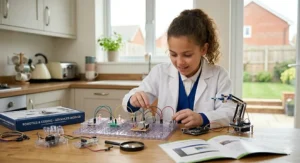
6. UNGLINGA 70 Lab Experiments Kit
This mid-range option from UNGLINGA offers 70+ experiments at a price point that balances affordability with reasonable equipment quality. It sits between their budget and premium offerings, making it suitable for families seeking better apparatus than basic kits without stretching to premium pricing.
The experiment selection focuses heavily on chemistry with some physics demonstrations, covering reactions, states of matter, acids and bases, and various colour-changing spectacles that never fail to impress 10 year olds. The instruction manual uses clear photography rather than illustrations, which some children find easier to follow.
Equipment quality represents a noticeable step up from the cheapest alternatives: the test tubes feel more substantial, the goggles provide better coverage, and the measuring tools offer adequate precision for the experiments included. You’ll still need occasional household items (baking soda features heavily), but the kit provides all specialist materials.
For UK buyers, delivery typically arrives quickly with Amazon Prime, and customer service from the UK-based seller responds promptly to questions. Several UK customer reviews mention using this successfully for home education, suggesting the experiments align well with Key Stage 2 and early Key Stage 3 science topics.
✅ Pros:
- Good balance of price and equipment quality
- Clear photographic instructions
- Suitable variety for sustained interest
❌ Cons:
- Less comprehensive than the 150-experiment version
- Fewer cross-disciplinary experiments than some competitors
Price & Verdict: Available around £20-£28 on Amazon.co.uk, this works well for families seeking a middle ground between budget and premium options. It’s the sensible choice for children who’ve enjoyed a basic kit and deserve an upgrade without necessitating a substantial investment.
7. Galt Rainbow Lab
This specialised kit takes a different approach, offering 12 crystal-growing experiments rather than attempting to cover every scientific topic. For children fascinated by geology, crystallography, or simply pretty colours, this focused approach delivers more satisfying results than generic kits’ token crystal experiment.
The experiments explore different crystal structures, growth patterns, and colour combinations, resulting in specimens children actually want to display rather than bin after completion. The instruction booklet explains the science of crystallisation in age-appropriate language, covering concepts like supersaturation and molecular structure without inducing glazed expressions.
What makes this particularly suitable for UK conditions is the realistic timeframes provided. Crystal growing requires patience—typically several days to a week—and the instructions account for British humidity levels affecting growth rates. This patience requirement actually serves an educational purpose, teaching children that some scientific processes can’t be rushed, however much you peer hopefully at the growing container every 20 minutes.
UK customer reviews consistently praise the quality of the results and the educational value, with several parents noting their children displayed finished crystals for months afterwards. The consensus suggests this works brilliantly as either a primary kit for crystal-obsessed children or a supplementary purchase for those who’ve exhausted other experiments.
✅ Pros:
- Specialist focus delivers superior results
- Educational content explains crystallography clearly
- Finished products worthy of display
❌ Cons:
- Limited to one scientific topic
- Requires patience (days to weeks per experiment)
Price & Verdict: Priced around £12-£18 on Amazon.co.uk, this represents excellent value for children with specific interest in crystals or geology. It’s an ideal supplementary kit or birthday present addition to a more comprehensive set.
How Science Kits Support the UK National Curriculum
The UK National Curriculum for science at Key Stage 2 (ages 7-11) emphasises working scientifically through practical enquiry. Quality science kits directly support this by providing structured opportunities to plan experiments, make predictions, conduct tests, record observations, and draw conclusions—precisely the skills assessed in Year 6 SATs.
What most parents don’t realise is that curriculum topics like “properties and changes of materials,” “forces,” and “Earth and space” can all be explored through home science kits. When children investigate how materials dissolve, change state, or react together, they’re not just playing—they’re building foundational knowledge that teachers will reference throughout secondary school chemistry and physics.
The beauty of quality kits is how they bridge the gap between abstract concepts and concrete understanding. Reading about chemical reactions in a textbook is one thing; watching a solution change colour because you’ve added an indicator is quite another. This experiential learning creates mental hooks that make formal education stick more effectively. Several teachers I’ve spoken with mention that children who regularly conduct experiments at home demonstrate notably stronger grasp of scientific method and experimental design.
For families supplementing home education, science kits provide curriculum-aligned content without requiring parents to possess chemistry degrees. The structured experiments offer clear learning outcomes whilst feeling more like entertainment than tutoring, which rather neatly solves the “I don’t want to do more schoolwork” objection that plagues well-intentioned educational activities.

Setting Up Your Home Laboratory: Practical Tips for British Families
Converting your dining table into a functional science workspace requires slightly more thought in the UK than in countries blessed with spacious homes and dedicated craft rooms. Most British houses don’t feature spare rooms awaiting transformation into laboratories, so we’re working with dining tables, kitchen worktops, or—if you’re particularly brave—bedroom desks.
Space and Surface Protection: Vinyl tablecloths from pound shops prove invaluable for protecting dining tables from inevitable spills. Chemical stains on your grandmother’s oak table create family incidents best avoided. Keep a roll of kitchen paper nearby, because 10 year olds and liquids maintain a complicated relationship involving frequent reunions on horizontal surfaces.
Storage Solutions: Those plastic storage boxes from Argos or The Range work brilliantly for organising science kit components. Label them clearly—”Acids and Bases,” “Crystal Growing,” “Physics Equipment”—because three months after purchase, you’ll have absolutely no recollection where the test tubes went. Under-bed storage works well for keeping equipment accessible without cluttering shared spaces.
Safety Considerations: Whilst these kits are designed for children, adult supervision remains essential for experiments involving heat, strong acids, or anything that fizzes enthusiastically. British building regulations mean most homes have smoke alarms, but you might want to open windows before conducting experiments that produce notable smells. Your neighbours will appreciate not being subjected to eau de rotten egg gas.
Weather Planning: Some experiments genuinely need outdoor space—volcanoes being the obvious example. British weather means you’ll need flexible scheduling rather than assuming you can simply “do it outside tomorrow.” Having a waterproof sheet for the garden or a large tray for messy indoor experiments prevents weather from derailing scientific enthusiasm.
Cleanup Protocol: Establishing a clear cleanup routine before starting experiments prevents the kitchen resembling a crime scene afterwards. This includes proper disposal of chemicals (check kit instructions), washing equipment thoroughly, and returning everything to labelled storage. Making this non-negotiable from the start saves considerable aggravation later.
Common Mistakes Parents Make When Buying Science Kits
Choosing Kits Based Solely on Experiment Count: That kit boasting 500 experiments? It’s counting “add water to different substances” as eight separate experiments. Focus on genuine variety in experiment types rather than impressive numbers. Fifteen quality, diverse experiments beat 100 variations on the same theme.
Ignoring Age Recommendations: Age recommendations exist for safety reasons, not marketing. Buying a 12+ kit for your 10 year old because they’re “quite clever” often results in experiments requiring techniques or supervision levels that frustrate everyone involved. Conversely, a 6+ kit for a 10 year old will bore them silly. Trust the age brackets—they’re genuinely useful.
Underestimating Space Requirements: That volcano experiment needs more room than you’d think, particularly when it erupts with unexpected enthusiasm. Before purchasing, consider where experiments will actually happen. Flat-dwellers with limited outdoor space might prefer kits focusing on tabletop chemistry over those requiring garden access.
Overlooking UK Compatibility: Some imported kits assume you have access to specific chemicals or equipment common in other countries but awkward to source in Britain. Checking customer reviews from UK buyers helps identify these issues before purchase rather than discovering you need obscure substances available only from specialist suppliers in Leeds.
Forgetting Ongoing Costs: Many kits require household items (baking soda, vinegar, food colouring) that you’ll need to replenish. Whilst individually cheap, these costs accumulate, particularly with enthusiastic children who want to repeat favourite experiments. Factor this into your budget rather than experiencing surprise when the fourth box of baking soda vanishes.
Buying During Peak Periods: Science kits get considerably more expensive approaching Christmas and throughout British Science Week (March). Shopping during quieter periods often yields better prices and wider selection. Amazon Prime Day (July) and Black Friday (November) typically offer genuine discounts worth waiting for.
Science Kits vs. Individual Experiments: What’s the Better Investment?
The eternal debate: comprehensive kit or piecemeal approach sourcing individual experiments? Both have merits depending on your specific circumstances and child’s engagement level.
Comprehensive Kits Suit: Children exploring general scientific interest rather than specific topics, families preferring convenient all-in-one solutions, parents without time to research and source individual experiments, situations where variety prevents boredom, households with multiple children who’ll use the kit sequentially.
Individual Experiments Work Better For: Children with specific, sustained interests (e.g., solely fascinated by crystals or electricity), families on tight budgets who can spread purchases over time, situations where space limits equipment storage, children who’ve completed comprehensive kits and want to dive deeper into favourite topics.
The hybrid approach—starting with a comprehensive kit, then supplementing with specialised experiments in topics that particularly engage your child—often delivers optimal results. This lets children explore broadly whilst developing deeper expertise in areas that genuinely fascinate them.
Cost analysis over a year typically favours comprehensive kits. A £30 kit providing 50 experiments costs 60p per experiment. Sourcing equivalent experiments individually, even carefully, rarely achieves better value once you factor in time, shipping costs, and occasional purchasing of unnecessary materials.
However, individual experiments often deliver superior depth. A £15 crystal-growing kit focused solely on crystallography provides more sophisticated exploration than a general kit’s token crystal experiment. For children who’ve identified specific interests, this depth justifies the higher per-experiment cost.

Encouraging Girls in STEM Through Science Kits
Despite considerable progress, girls remain underrepresented in STEM fields, a trend that begins during primary school years. The Science and Technology Committee identified this disparity as a priority concern requiring intervention from early education onwards.
Quality science kits offer valuable tools for challenging the subtle biases that discourage girls from scientific pursuits. The key lies in presentation and encouragement rather than kit selection itself—science is not inherently gendered, though marketing departments occasionally forget this.
Avoid Gendered Marketing Traps: Kits marketed specifically “for girls” often emphasise cosmetics (make your own lip balm!) whilst “general” kits assume male audiences. Choose kits based on scientific content rather than packaging colour. Chemistry remains chemistry regardless of whether the box is pink or blue.
Highlight Female Scientists: When conducting experiments, reference scientists like Rosalind Franklin, Marie Curie, or Dorothy Hodgkin. Normalising the concept that scientists come in all genders combats the persistent stereotype of science as male-dominated.
Encourage Systematic Investigation: Research suggests girls particularly value understanding why experiments work rather than merely observing that they work. Choose kits with strong educational components explaining scientific principles behind demonstrations.
Celebrate Different Engagement Styles: Some children prefer methodical, careful experimentation; others favour enthusiastic trial-and-error. Both approaches have scientific validity. Avoid reinforcing stereotypes by praising careful work as “good” and enthusiastic experimentation as “messy.”
Connect to Real-World Applications: Girls often engage more deeply when understanding practical applications. Discussing how crystal formation relates to medication development, or how pH indicators appear in environmental testing, adds context that increases relevance.
The goal is creating environments where scientific curiosity is encouraged and celebrated regardless of gender, where questions are valued, and where mistakes are framed as learning opportunities rather than failures. Quality science kits provide the tools; parental encouragement provides the permission to use them fearlessly.
Seasonal Considerations: Best Times to Buy Science Kits in the UK
British retail cycles create predictable patterns in science kit pricing and availability. Understanding these patterns saves money and frustration.
January Sales (Post-Christmas): Retailers clearing Christmas stock often discount science kits substantially. However, selection may be limited to whatever didn’t sell during December. Excellent for bargain hunters willing to accept limited choice.
March (British Science Week): Increased demand during British Science Week typically raises prices rather than lowering them. Schools often bulk-purchase for classroom use, further reducing stock. Consider buying before or after this period unless you specifically want to support the initiative.
Back to School (September): Retailers stock educational items heavily, creating good selection but variable pricing. Watch for deals as retailers compete for parental spending, particularly around last week of August and first week of September.
Amazon Prime Day (July): Genuine discounts often appear, though requiring sifting through inflated “deals” on products nobody wanted at full price. Setting price alerts on specific kits helps identify actual savings.
Black Friday/Cyber Monday (November): Increasingly popular in UK retail, these periods often yield genuine discounts on science kits. However, early December brings similar or better deals as retailers compete for Christmas spending.
Quiet Periods (February, May, October): These months see less promotional activity but often feature quietly reduced prices as retailers clear stock. Regularly checking prices during these periods occasionally reveals excellent deals without fanfare.
For families on budgets, purchasing science kits outside peak demand periods (avoiding December, March, and September) typically saves 15-25% compared to peak pricing. Setting price alerts through tools like CamelCamelCamel tracks Amazon price history and notifies you when target prices are reached.

Frequently Asked Questions
❓ Are science kits available on Amazon UK safe for 10 year olds to use independently?
❓ What's the difference between chemistry sets and complete science kits?
❓ Do UK science kits include all necessary materials or require additional purchases?
❓ How do I know if a science kit aligns with the UK National Curriculum?
❓ What's the typical delivery time for science kits on Amazon UK?
Conclusion: Choosing the Right Science Kit for Your 10 Year Old
Selecting the ideal science kit ultimately depends on your child’s specific interests, attention span, and prior experience with scientific experiments. The UNGLINGA 150 Experiments kit offers exceptional value and variety for children exploring broad scientific curiosity, whilst the Thames & Kosmos Chemistry C500 provides superior depth for budding chemists ready for more rigorous study.
For families prioritising UK curriculum alignment and supporting British educational toy manufacturers, the Galt Giant Science Lab delivers thoughtfully designed experiments that directly support classroom learning. Budget-conscious parents find the Doctor Jupiter Ultimate Kit offers impressive experiment counts without financial strain, accepting reasonable trade-offs in equipment quality.
What matters most isn’t selecting the “perfect” kit but rather choosing one that matches your child’s current engagement level and your family’s practical circumstances. A moderately priced kit that gets enthusiastically used delivers infinitely more value than a premium set that languishes in the cupboard because experiments proved too complex or time-consuming.
Remember that science kits serve as starting points rather than complete educational solutions. They work best when combined with parental encouragement, connection to real-world phenomena, and permission to make gloriously messy mistakes. The crystals that refuse to grow, the volcanoes that erupt too enthusiastically, and the experiments that produce unexpected colours all contribute to genuine scientific learning—which primarily involves discovering that nature doesn’t always cooperate with instructions, and that’s rather the point.
Whether you’re fostering the next Marie Curie or simply keeping curious hands busy during school holidays, quality science kits transform abstract concepts into concrete understanding. And in a world increasingly requiring scientific literacy, that transformation represents rather good value at any price.
Recommended for You
- Best Counting Toys for 5 Year Olds: Expert Guide for British Parents 2026
- Best Numberblocks Toys for Learning Maths UK 2026: Top 7 Picks
- Best Maths Games for 7 Year Olds UK – Top 7 Reviews 2026
Disclaimer: This article contains affiliate links. As an Amazon Associate, I earn from qualifying purchases. If you purchase products through these links, we may earn a small commission at no additional cost to you.
✨ Found this helpful? Share it with your mates! 💬🤗
