
In This Article
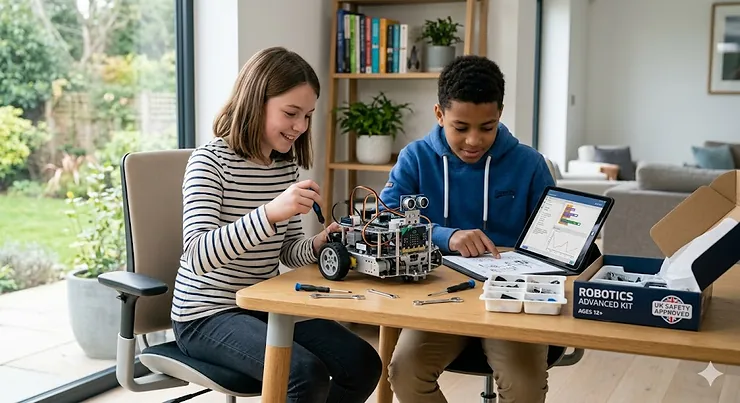
Twelve is rather a pivotal age. Your child’s outgrown the basic building blocks but isn’t quite ready for university-level engineering courses. Robot kits for 12 year olds bridge that gap brilliantly, offering hands-on experience with genuine programming languages, sensor integration, and mechanical design—the sort of skills that’ll serve them through GCSEs, A-levels, and beyond.
The UK government has recognised robotics as a priority sector for national innovation, with £52 million allocated to Robotics Adoption Hubs launching from mid-2026 to support automation across manufacturing, healthcare, and education. This national focus underscores why early exposure to robotics matters—today’s 12-year-old tinkering with an mBot2 could be tomorrow’s engineer shaping Britain’s industrial future.
What sets today’s robot kits apart from the toys of previous generations is their progression path. A decent kit starts with block-based coding (think Scratch or the BBC micro:bit’s MakeCode environment, used in schools across Britain) but doesn’t stop there. Within weeks, your 12-year-old could be writing Python or Arduino C++, controlling servo motors, interpreting ultrasonic sensor data, and troubleshooting their own code. That’s not play-acting at engineering; that’s actual engineering.
The UK market in 2026 offers exceptional variety, from budget-friendly solar-powered kits under £30 to sophisticated programmable platforms in the £300-£500 range. Whether your child’s keen on competitive robotics (VEX competitions run across Britain), autonomous navigation, or building their own AI-powered creations, there’s a kit that’ll match their ambition. This guide walks you through the seven best options available on Amazon.co.uk, with honest assessments of what works—and what doesn’t—in British homes.
Quick Comparison: Top Robot Kits at a Glance
| Robot Kit | Programming Language | Price Range (GBP) | Best For | Complexity Level |
|---|---|---|---|---|
| Makeblock mBot2 | Scratch, Python | £100-£150 | Python learners, IoT projects | Intermediate-Advanced |
| Elegoo UNO R3 Smart Car | Arduino C++ | £60-£90 | Arduino beginners, hands-on builders | Intermediate |
| Makeblock mBot Ranger | Scratch, Arduino | £120-£170 | All-terrain challenges, 3-in-1 builds | Intermediate |
| Sphero BOLT+ | JavaScript, Python, Blocks | £140-£180 | Screen-based learning, sensor exploration | Beginner-Intermediate |
| LEGO Mindstorms EV3 | LEGO, Python, Scratch | £300-£450 (used/resale) | LEGO enthusiasts, competition robotics | Advanced |
| VEX IQ Robotics Kit | VEXcode Blocks, Python | £200-£350 | Competition teams, collaborative projects | Advanced |
| Solar Robot Kit (12-in-1) | None (mechanical only) | £20-£35 | Green energy intro, screen-free STEM | Beginner |
Looking at this comparison, the Makeblock mBot2 offers the strongest value for British families seeking a Python progression path, whilst the Elegoo Smart Car delivers unbeatable hands-on Arduino experience for under £90. Budget buyers shouldn’t overlook solar kits—they’re limited, yes, but genuinely engaging for younger 12-year-olds or those just dipping a toe into robotics.
💬 Just one click — help others make better buying decisions too! 😊
Top 7 Robot Kits for 12 Year Olds: Expert Analysis
1. Makeblock mBot2 — Best for Python Progression
The Makeblock mBot2 represents a significant evolution from its predecessor, bringing genuine Python programming to the 12-year-old bracket without sacrificing accessibility. At its heart sits the CyberPi controller—essentially a compact computer with built-in sensors, Wi-Fi, and a colour screen—opening doors to IoT experiments, data logging, and even basic machine learning projects.
Assembly takes around 30-45 minutes for most 12-year-olds working independently. The metal construction feels reassuringly solid compared to plastic competitors, and the modular design means components won’t work loose after a few enthusiastic collisions with the skirting board. What genuinely impresses is the learning pathway: children start with mBlock’s visual programming (drag-and-drop blocks), then view the Python code those blocks generate, and gradually transition to writing Python directly. It’s scaffolded learning done properly.
The CyberPi’s built-in sensors include a gyroscope, accelerometer, microphone, and light sensor—more than enough for projects like a burglar alarm that texts you via Wi-Fi, a sound-activated light show, or a robot that navigates by detecting ambient light levels. UK buyers should note this works on 230V via USB charging, with robust UK Prime delivery typically arriving next-day.
Expert perspective: This kit suits 12-year-olds who’ve mastered block-based coding and want to tackle “real” programming. The Python environment isn’t dumbed down; it’s genuine Python 3.x with access to libraries. That means your child can write code today that’ll scale to Raspberry Pi projects, web development, or data science later. For families in compact British homes, the mBot2’s relatively small footprint (around 17 cm × 13 cm) is a practical advantage over bulkier competitors.
Customer feedback from UK buyers consistently praises the learning materials and build quality, though some note the Wi-Fi connectivity can be temperamental on certain routers. Independent UK consumer reviews on platforms like BBC Science Focus Magazine have highlighted Makeblock products for their educational value and robust construction, making them popular choices among British families seeking quality STEM tools.
Pros:
✅ Genuine Python programming with proper progression path
✅ CyberPi controller supports IoT and AI experiments
✅ Metal construction, robust for enthusiastic handling
Cons:
❌ Wi-Fi setup occasionally finicky on some UK routers
❌ Limited app-based challenges compared to competitors
Price & Value: In the £100-£150 range on Amazon.co.uk, typically around £130. That’s excellent value for a kit supporting this depth of programming. Worth checking for Prime delivery to avoid import delays on some third-party sellers.
2. Elegoo UNO R3 Smart Robot Car Kit — Best Arduino Experience Under £90
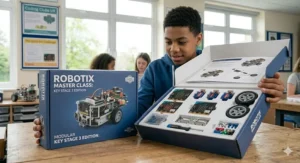
The Elegoo UNO R3 Smart Robot Car Kit delivers authentic Arduino development at a price that won’t make British parents wince. Unlike simplified coding interfaces, this uses the Arduino IDE—the same environment employed by engineering schools and professional makers worldwide. Your 12-year-old learns C++ programming whilst building a fully functional four-wheel robot car.
The kit includes 24 modules covering fundamentals: ultrasonic sensors for obstacle avoidance, infrared sensors for line-following, Bluetooth for app control, and even an FPV camera for first-person driving via smartphone. Assembly requires patience—expect 2-3 hours for the initial build—but that’s part of the educational value. Each screw teaches mechanical assembly; each wire connection reinforces circuit understanding.
What sets this apart is the comprehensive tutorial. Elegoo provides step-by-step lessons starting with “make an LED blink” and progressing to “autonomous maze navigation.” The tutorials explain why code works, not just what to copy. UK buyers appreciate that all components arrive together (no waiting for separate sensor packs), and the acrylic chassis, whilst showing fingerprints, proves surprisingly durable.
For British households: This kit teaches transferable skills. The Arduino platform powers everything from home automation to agricultural monitoring, meaning knowledge gained here has genuine real-world application. Storage is straightforward—the car disassembles for compact storage in a shoebox-sized space, ideal for British homes where spare room is limited.
UK customer reviews note occasional quality control variance (a loose wheel here, a scratched chassis there), but Elegoo’s customer service responds quickly with replacements. The bigger challenge is the learning curve: this isn’t plug-and-play. If your 12-year-old expects instant gratification, they’ll be disappointed. If they enjoy systematic problem-solving and don’t mind occasional frustration, they’ll thrive.
Pros:
✅ Genuine Arduino C++ programming, not simplified blocks
✅ 24 modules provide comprehensive sensor/electronics education
✅ Excellent value under £90 with all components included
Cons:
❌ Steep learning curve; requires patience and persistence
❌ Quality control varies; occasional component replacements needed
Price & Value: Around £60-£90 on Amazon.co.uk depending on sales. At the lower end, it’s frankly unbeatable for Arduino education. Prime-eligible sellers typically deliver next-day across most of Britain.
3. Makeblock mBot Ranger — Best for All-Terrain Adventures
The Makeblock mBot Ranger is the rugged elder sibling of the standard mBot, designed for 12-year-olds ready to tackle more complex mechanical and programming challenges. This 3-in-1 kit builds into a tank-treaded Land Raider, a self-balancing Nervous Bird (two-wheel robot), or a speedy three-wheel Dashing Raptor. Each configuration offers distinct programming challenges and mechanical lessons.
The tank tracks handle British gardens remarkably well—wet grass, gravel paths, even shallow puddles don’t faze it. That’s particularly valuable in our climate where a wheeled robot might slip on damp paving stones. The self-balancing mode teaches PID control (proportional-integral-derivative algorithms), which sounds intimidating but the mBlock software breaks it into understandable visual blocks before revealing the underlying maths.
Build time varies by configuration: the Land Raider assembles in roughly 30 minutes, whilst the Nervous Bird demands an hour plus calibration time. The included ultrasonic, light, and line-following sensors support autonomous navigation projects. UK buyers note the Ranger feels notably more substantial than entry-level kits—metal gears, robust motors, and a solid aluminium frame that’ll survive more than a few tumbles down the stairs.
British context: The Ranger suits families with outdoor space—a garden, local park, or even a reasonably sized living room. Watching it navigate autonomously around garden furniture or challenge itself on gravel paths adds a dimension that screen-based kits can’t match. The battery life (around 90 minutes continuous use) means you’re not constantly recharging mid-project.
Customer feedback from UK users praises the mechanical variety and outdoor capability, though some find the initial sensor calibration fiddly. A few note that younger 12-year-olds benefit from adult assistance during the first build, particularly for the self-balancing configuration which requires precise weight distribution.
Pros:
✅ Three distinct robot configurations teach different mechanical concepts
✅ Tank treads excel in British gardens and outdoor conditions
✅ Self-balancing mode introduces advanced PID control algorithms
Cons:
❌ Initial sensor calibration can be finicky
❌ Higher price point (£120-£170) than entry-level options
Price & Value: Typically £120-£170 on Amazon.co.uk. Given the three configurations and outdoor capability, that’s reasonable value for families wanting a kit with genuine longevity. Watch for Prime deals dropping it under £130.
4. Sphero BOLT+ — Best for Screen-Based, Sensor-Rich Learning
The Sphero BOLT+ takes a completely different approach: it’s a transparent robotic ball packed with sensors, LEDs, and a vivid LCD screen that displays animations, data, and messages in real-time. For 12-year-olds who think traditional robots look, well, traditional, the BOLT+ offers genuinely futuristic appeal.
Programming happens via the Sphero Edu app (iOS, Android, ChromeOS, or web browser) using Draw mode (trace a path), Blocks (visual programming), or JavaScript text coding. The progression is well-designed: a child can drive the BOLT+ manually for five minutes, then write a simple block program to make it patrol a square, then view the JavaScript equivalent and start modifying it. The LCD screen provides immediate feedback—you can watch sensor data stream past as the BOLT+ moves, which makes debugging far more intuitive.
The sensor suite is impressive: gyroscope, accelerometer, light sensor, motor encoders, and infrared communication (so multiple BOLT+ units can “talk” to each other). UK educators particularly value the cross-curricular potential—maths teachers use it for graphing distance-time relationships, science teachers for acceleration experiments, and art teachers for creating rolling paintings by dipping it in washable paint.
For British households: The BOLT+ is genuinely waterproof (IP67-rated), which matters when your 12-year-old decides to test its “swimming” capabilities in the garden pond or bathroom sink. The durable polycarbonate shell has survived countless kitchen-floor collisions in UK homes. Wireless charging is convenient, though the battery lasts around 4+ hours of intermittent use—plenty for a weekend of experimentation.
UK customer feedback notes the BOLT+ particularly engages children who don’t typically gravitate toward “building” projects. It’s less about mechanical assembly and more about logic, sensor interpretation, and creative programming. Some parents mention wishing for more structured lesson progression in the free app, though Sphero’s online resources fill that gap reasonably well.
Pros:
✅ Unique spherical design with LCD screen appeals to reluctant builders
✅ Waterproof and remarkably durable for enthusiastic experimentation
✅ Three programming levels (Draw, Blocks, JavaScript) suit progression
Cons:
❌ No mechanical building component; purely programming-focused
❌ Higher price (£140-£180) for what’s essentially a sophisticated ball
Price & Value: Around £140-£180 on Amazon.co.uk. That’s steep for the form factor, but UK schools widely use Sphero products, meaning there’s educational pedigree behind the price. Prime delivery typically available.
5. LEGO Mindstorms EV3 — Best for LEGO Enthusiasts (If You Can Find It)
The LEGO Mindstorms EV3 officially retired at the end of 2022, but used/resale units remain available on Amazon.co.uk and eBay, often in excellent condition. For 12-year-olds already invested in LEGO Technic, the EV3 represents the natural progression—combining familiar building techniques with sophisticated programming.
The EV3 Intelligent Brick runs LEGO’s proprietary software (block-based programming), but also supports Python via the ev3dev community project. That flexibility means the kit grows with your child’s ability. The modular design lets them build five pre-designed robots (humanoid, snake, scorpion, vehicle, and dog), then disassemble and create original designs using the 600+ pieces.
Sensors include colour detection, touch, ultrasonic (for distance measurement), and gyroscopic (for balance and orientation). Motors are precise and powerful. UK buyers in 2026 face a challenge: genuine new EV3 kits cost £300-£450 when available, often from resale markets or private sellers rather than direct retail. The alternative is LEGO’s current SPIKE Prime, aimed at schools but available to consumers at similar pricing.
British context: The EV3 integrates seamlessly with existing LEGO Technic collections, which many British families have accumulated over years. That compatibility extends the value significantly. Storage follows standard LEGO organisation—sort pieces into labelled boxes, and the kit occupies minimal space when disassembled. First Lego League competitions (FLL) run across the UK, providing a genuine competitive outlet for ambitious builders.
Customer feedback from UK users consistently praises build quality and software reliability, though some note the initial programming environment feels dated compared to modern block-based systems like Scratch or mBlock. The bigger issue is availability: buying used means no warranty, and ensuring all sensors work requires testing before purchase.
Pros:
✅ Seamless integration with existing LEGO Technic collections
✅ Supports both LEGO blocks and Python programming
✅ Access to FLL competitions and robust UK LEGO community
Cons:
❌ Officially discontinued; only available used/resale
❌ High price (£300-£450) for used units in good condition
Price & Value: £300-£450 for used kits in decent condition on Amazon.co.uk and eBay. That’s expensive for a discontinued product, but LEGO’s build quality means well-maintained units function like new. Alternatively, consider LEGO SPIKE Prime (around £300 new) for current support.
6. VEX IQ Robotics Kit — Best for Competition-Focused Teams
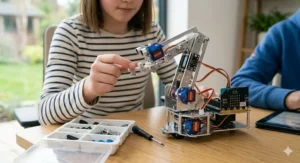
The VEX IQ Robotics Kit is the entry point to VEX Robotics Competitions, which run across Britain culminating in UK National Championships held annually at Telford International Centre. For 12-year-olds eyeing competitive robotics, this kit provides the foundation.
VEX IQ uses plastic snap-together pieces (no screws required), making assembly faster than metal-based kits like Makeblock. Don’t mistake ease of assembly for simplicity, though—the system supports complex mechanical designs including gearing, four-bar linkages, and differential drives. Programming happens via VEXcode Blocks (visual) or VEXcode Python, with comprehensive tutorials guiding progression.
The kit includes the VEX IQ Brain (the controller), touch sensors, colour sensors, gyroscope, distance sensors, and motors. UK teams note the Brain’s touchscreen interface makes programming adjustments during competitions straightforward—no laptop required for basic changes. Battery life (around 2 hours continuous use) suits practice sessions but requires spare batteries for competition days.
For British families: VEX IQ connects to a genuine community. Regional qualifying events run from September through February, with the UK National Championships typically in late February/early March. Participation teaches teamwork, documentation (the Engineering Notebook is judged alongside the robot), and presentation skills. Grants are occasionally available through the REC Foundation for UK school teams, reducing the financial barrier.
The challenge is cost. The base kit runs £200-£350 on Amazon.co.uk depending on configuration. Add competition registration fees (around £35-£75 per event), potential travel to regional competitions, and occasional replacement parts, and VEX becomes a meaningful financial commitment. For serious participants, though, the skills developed—particularly the engineering documentation and teamwork aspects—translate directly to university applications and STEM careers.
Pros:
✅ Direct pathway to VEX competitions across Britain
✅ Snap-together assembly faster than screw-based kits
✅ Touchscreen Brain simplifies on-the-fly programming adjustments
Cons:
❌ Expensive (£200-£350) plus ongoing competition costs
❌ Less suited for solo learning; designed for team environments
Price & Value: £200-£350 on Amazon.co.uk for full kits. For competitive teams, it’s justified. For casual solo builders, it’s probably overkill. Consider whether your 12-year-old has access to a school team or local club before investing.
7. Solar Robot Kit (12-in-1) — Best Budget Introduction to Green Energy
The Solar Robot Kit (12-in-1) offers the most affordable entry point—typically £20-£35 on Amazon.co.uk—with a focus on renewable energy and mechanical engineering rather than programming. The kit includes around 190 pieces that assemble into 12 different robots: walking, rolling, and even swimming configurations.
The electrical system is deliberately simple: one solar panel, one motor. When sunlight (or strong artificial light) hits the panel, the motor spins, and the robot moves. That’s it. There’s no programming, no sensors, no remote control. For budget-conscious families or 12-year-olds just beginning STEM exploration, that simplicity is rather the point—it focuses attention on mechanical design and energy conversion without overwhelming beginners.
Assembly ranges from straightforward (the basic car takes perhaps 20 minutes) to genuinely challenging (the walking beetle demands patience and precision, particularly with the gearbox). UK buyers should know this isn’t a rainy-day indoor project—British winter daylight often doesn’t provide sufficient solar power. You’ll need either a sunny window ledge or bright LED desk lamp to power the motor reliably.
British context: This kit teaches energy concepts aligned with Key Stage 3 Science curriculum—renewable vs non-renewable energy, energy transfer, and mechanical advantage through gearing. It’s screen-free, which some parents value as counterbalance to digital overload. The downside is limited replay value: once your 12-year-old has built the 12 configurations, there’s not much else to do unless they start modifying designs (which the kit does support, to be fair).
UK customer feedback splits between “brilliant value for introducing concepts” and “too limited to hold interest long-term.” The gearbox assembly frustrates some younger builders, and the solar dependency means cloudy British days leave the robot immobile. Still, for under £35, it’s difficult to argue with the value proposition.
Pros:
✅ Unbeatable price (£20-£35) for STEM introduction
✅ Screen-free, solar-powered aligns with green energy education
✅ 12 configurations teach mechanical variety
Cons:
❌ No programming or electronic control; purely mechanical
❌ Solar power unreliable in British winter light
Price & Value: Around £20-£35 on Amazon.co.uk, often with Prime delivery. For that price, it’s excellent value as an introductory or supplementary kit, though not sufficient as a sole robotics learning tool.
How to Choose the Right Robot Kit for Your 12-Year-Old in the UK
Choosing a robot kit isn’t about finding the “best” option—it’s about matching capabilities to your child’s interests, existing skills, and available resources. Here’s how to narrow the field systematically.
Start with Current Skill Level
Has your 12-year-old programmed before? If they’ve mastered Scratch, block-based coding will feel too basic within weeks. The Makeblock mBot2 or Elegoo Arduino Kit push them toward text-based programming (Python or C++) without requiring prior experience with those languages. Conversely, if this is their first exposure to robotics, jumping straight to Arduino C++ risks discouragement. The Sphero BOLT+ or Makeblock mBot (standard version) offer gentler onboarding.
Consider mechanical building experience too. Children comfortable with LEGO Technic or Meccano will breeze through most assembly instructions. Those new to mechanical building benefit from kits with clear visual guides and snap-together components like the VEX IQ.
Define the Primary Goal
Programming focus: Choose kits emphasising software over hardware. The Sphero BOLT+ maximises programming variety (Draw, Blocks, JavaScript) whilst minimising mechanical complexity.
Hands-on engineering: Opt for kits requiring assembly and offering mechanical variety. The Elegoo Arduino Kit or Makeblock mBot Ranger teach circuits, gearing, and sensor integration through direct manipulation.
Competition pathway: If your child wants to compete, VEX IQ provides the clearest route to organised competitions with UK National Championships and potential World Championship qualification.
Green energy education: The Solar Robot Kit is unmatched for teaching renewable energy concepts at minimal cost.
Assess Your British Home Environment
Indoor space: Compact British homes favour smaller robots. The mBot2 (17 cm × 13 cm) and Sphero BOLT+ (7.5 cm diameter) fit comfortably on desks or kitchen tables. Larger kits like the VEX IQ or mBot Ranger need more operating room.
Outdoor access: Got a garden? The mBot Ranger‘s tank treads handle British grass and gravel superbly. The Sphero BOLT+ is waterproof for garden experiments. No outdoor space? Stick to indoor-optimised designs.
Storage: British homes rarely have dedicated hobby rooms. Look for kits that disassemble compactly. LEGO-based systems store in standard LEGO organisers. The Elegoo Arduino Kit fits in a shoebox.
Budget Realistically in GBP
Under £50: Solar Robot Kit (£20-£35) provides basic introduction but limited longevity.
£50-£100: Elegoo Arduino Kit (£60-£90) delivers exceptional value for genuine Arduino learning.
£100-£200: Sweet spot for most families. The Makeblock mBot2 (£100-£150) or mBot Ranger (£120-£170) balance capability and cost.
£200+: Serious investment territory. VEX IQ (£200-£350) or LEGO Mindstorms EV3 (£300-£450 used) suit committed enthusiasts or competition-focused children.
Remember ongoing costs: batteries, replacement parts, competition fees (for VEX), or expansion packs (for Makeblock/LEGO). Factor these into your total budget.
Consider UK-Specific Factors
Voltage compatibility: All kits reviewed use USB charging or standard AA batteries, avoiding voltage conversion issues. Avoid US-exclusive products requiring 110V transformers.
Prime delivery: Prioritise Amazon.co.uk Prime-eligible sellers for next-day delivery and hassle-free returns under UK Consumer Rights Act 2015.
Community support: Check for UK user communities. The Makeblock forum has active British members. VEX competitions run across Britain. LEGO has robust UK support.
Weather resilience: British damp affects electronics. Look for kits with water-resistant components or protective cases. The Sphero BOLT+‘s IP67 rating is exceptional; others need care.
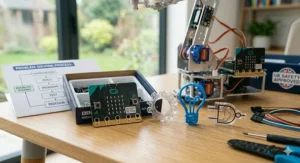
Common Mistakes When Buying Robot Kits for UK Teens
Mistake 1: Ignoring Programming Progression
Many parents buy kits based on current skill level without considering progression. A 12-year-old who’s mastered the included block-based challenges within a month faces a frustrating choice: stop using the kit or buy an entirely new one. Look for kits supporting multiple programming levels—ideally block-based and text-based (Python, JavaScript, C++). The mBot2‘s Scratch-to-Python pathway exemplifies good progression design.
Mistake 2: Overlooking UK Availability and Delivery Times
American-focused reviews recommend products that either don’t ship to Britain or incur hefty customs charges post-Brexit. Always verify Amazon.co.uk availability and read UK customer reviews specifically. Some sellers list products as “available” but actually dropship from US warehouses, adding weeks to delivery and potential import duties. Stick to Prime-eligible sellers with UK warehouse stock.
Mistake 3: Buying for Competition Without Community Access
VEX IQ kits look brilliant in isolation, but their value multiplies when your child joins a team. Buying the kit without checking whether a local school, club, or community group runs VEX programmes means your 12-year-old builds alone and never accesses the competition pathway the kit’s designed for. Before investing £250+, confirm competition opportunities exist within practical travel distance.
Mistake 4: Underestimating British Weather Impact
Solar-powered kits charm parents with their green credentials but depend on solar intensity that British winter simply doesn’t provide. Cloudy January afternoons won’t power the motor reliably, leaving the robot immobile for months. If purchasing solar kits, supplement with bright LED desk lamps or accept seasonal limitations.
Similarly, outdoor robots need weather resilience. The mBot Ranger handles damp grass; cheaper kits with exposed electronics short-circuit after one British drizzle. Check IP ratings and customer reviews mentioning outdoor UK use.
Mistake 5: Focusing Solely on Price Without Considering Longevity
The £25 basic kit seems like brilliant value until your 12-year-old exhausts its capabilities in three weeks. A £130 kit offering six months to a year of progressively challenging projects delivers better value-per-hour of engagement. Calculate cost against expected usage period, not just initial outlay.
Mistake 6: Overlooking UKCA/Safety Certification
Post-Brexit, products sold in Britain should carry UKCA marking (UK Conformity Assessed) rather than CE marking. Reputable sellers on Amazon.co.uk stock compliant products, but grey-market imports sometimes don’t. Check product listings for UK safety standards compliance, particularly for kits with motors, batteries, or electronics that could pose hazards if poorly manufactured.
Mistake 7: Buying Kits Requiring Unobtainable Replacement Parts
Some kits use proprietary components difficult to source in Britain. If a motor burns out or a sensor fails, can you order replacements from UK suppliers, or does shipping from China take six weeks? Makeblock, Sphero, and VEX all maintain UK distribution channels. Lesser-known brands may not. Read UK customer reviews mentioning part replacement experiences.
What to Expect: Real-World Performance in British Conditions
Robot kits behave differently in British homes than in controlled lab environments or American test videos. Here’s what actually happens when your 12-year-old opens the box on a damp Manchester Tuesday.
Assembly Reality Check
Marketing photos show gleaming robots assembled in 15 minutes. Reality for most 12-year-olds: 45 minutes to 2 hours for first builds, with occasional parental intervention for stubborn screws or confusing diagrams. The Elegoo Arduino Kit is particularly honest about this—its manual states “2-3 hours” and means it. The Sphero BOLT+ needs no assembly (it’s a sealed ball), which suits impatient children but denies the learning value of mechanical building.
British homes add challenges. Kitchen table assembly means clearing dinner debris first. Poor natural light in winter requires good desk lamps for reading tiny instruction diagrams. Carpeted floors mean dropped screws disappear into pile fibres, so a magnetic parts tray (not usually included) proves invaluable.
Programming Environment on British Computers
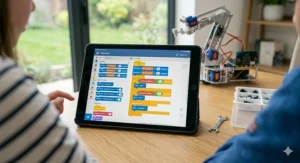
Most kits use browser-based or app-based programming, avoiding software installation headaches. The Makeblock mBot2 and Sphero BOLT+ work via web apps running in Chrome or Edge, meaning no compatibility issues with Windows, macOS, or even Chromebooks (increasingly common in British schools).
Arduino kits like the Elegoo require downloading the Arduino IDE—free but around 200 MB download. On British broadband (average 69 Mbps in 2026), that’s manageable, though rural areas with slower connections may wait 15-20 minutes.
Bluetooth connectivity occasionally frustrates. British homes often have 2.4 GHz Wi-Fi congestion from neighbours’ routers, baby monitors, and cordless phones. This interferes with Bluetooth pairing. The solution: turn off nearby 2.4 GHz devices during initial pairing, then it usually remains stable. The mBot2‘s Wi-Fi control sidesteps this by connecting to your home network directly.
Battery Life in British Use Patterns
Rechargeable lithium batteries (used in mBot2, Sphero BOLT+, VEX IQ) deliver 2-4 hours continuous use and recharge via USB. In practice, British kids use them in 20-40 minute sessions across several days, meaning one charge lasts a week. Recharge overnight via a standard UK USB plug (most kits include the cable but not the wall plug—use a phone charger).
AA battery kits (Elegoo, basic mBot) consume power faster. Four AA batteries last 90-120 minutes continuous use. Rechargeable AAs (Eneloop or similar) make economic sense—initial £15 investment in batteries and charger pays for itself within weeks compared to disposables.
British winter cold doesn’t significantly affect indoor battery performance, but leaving kits in unheated garages or sheds overnight in January can reduce lithium battery capacity temporarily.
Outdoor Performance in British Weather
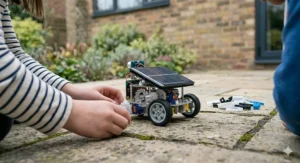
British gardens present unique challenges. Damp grass reduces traction for wheeled robots. The mBot Ranger‘s tank treads excel here, maintaining grip where wheels slip. Hard surfaces (patio slabs, gravel) work well for most robots, though light rain causes problems for non-waterproof electronics. The Sphero BOLT+‘s IP67 rating means genuine puddle-crossing capability, which delights children and terrifies parents.
Mud is the enemy. Even tiny amounts jamming into wheel axles or track mechanisms cause friction and motor strain. Establish a “wipe-down after outdoor use” routine or watch repair costs mount.
Autumn leaves surprisingly problematic—they jam in tracks and wheels, then decompose into sticky residue. Spring is ideal outdoor robotics season in Britain: dry enough for traction, mild enough for comfortable outdoor supervision.
Longevity: How Long Before They Outgrow It?
Entry-level kits (Solar Robot, basic mBot): 2-6 months before capable 12-year-olds exhaust challenges.
Intermediate kits (Elegoo Arduino, mBot2, Sphero BOLT+): 6-18 months, depending on how deep they explore programming. Python learners find the mBot2 engaging for a year or more.
Advanced/expandable kits (VEX IQ, LEGO Mindstorms): Potentially years, especially if connected to competitions or community projects. The modular nature means continual rebuilding with new challenges.
British children in competitive robotics (VEX or FLL) often use the same kit across multiple seasons, incrementally improving designs rather than replacing the entire kit.
Robot Kits vs Traditional STEM Toys: What 12-Year-Olds Actually Learn
Programming Logic and Debugging Skills
Traditional STEM toys (chemistry sets, telescope kits, crystal growing) teach observation and following procedures. Robot kits add computational thinking—breaking problems into logical steps, identifying patterns, and systematically debugging when things fail.
A 12-year-old programming the mBot2 to navigate a room learns to think like this: “The robot hit the wall. Why? Check the ultrasonic sensor code. Is the stop distance set correctly? Test the sensor separately. Ah—it stops at 15 cm, but the robot’s momentum carries it forward another 5 cm. Solution: increase stop distance to 20 cm.” That’s authentic problem-solving, not rote memorisation.
UK schools teach computing at Key Stage 3, aligning with STEM subjects integrated into the national curriculum for pupils aged 5-16. However, 90 minutes weekly rarely provides sufficient hands-on time. Home robot kits supplement this, offering unlimited experimentation time and immediate feedback loops that classroom environments struggle to match.
Mechanical and Electronic Literacy
Building a robot kit demystifies technology. Your 12-year-old learns motors aren’t magic—they’re electromagnets converting electrical energy to rotational force. Sensors aren’t black boxes—ultrasonic ones emit sound pulses and measure return time, just like bats navigating caves.
This literacy matters in modern Britain. Understanding servo motors means recognising them in car door locks. Knowing how ultrasonic sensors work means understanding parking assist systems. Learning circuit basics means being able to replace a faulty doorbell rather than calling an electrician for a £75 callout.
Traditional STEM toys often demonstrate single phenomena (volcano erupts, crystal forms). Robot kits integrate multiple systems—mechanical, electronic, computational—teaching how complex systems work together, which is closer to real-world engineering.
Resilience and Iterative Design
Chemistry sets follow linear instructions: add solution A to solution B, observe colour change, done. Robot projects rarely work first time. The ultrasonic sensor misreads distances. The line-following robot veers off course. The self-balancing code overshoots and faceplants.
This teaches resilience. British education increasingly values “growth mindset”—the belief that abilities develop through effort. Robotics forces this. Your 12-year-old will experience failure repeatedly, then learn to methodically test, adjust, and improve. That’s more valuable than any individual technical skill.
Parents report this unexpected benefit frequently: children who initially rage-quit after a failed programme learn, over months, to systematically debug. That transfers to schoolwork, sports, and social situations.
Tangible Achievement
Traditional STEM toys often result in consumable outcomes (the crystal dissolves, the chemical reaction ends). Robot kits create persistent, functional objects. Your 12-year-old builds a robot that patrols the hallway, guards their bedroom, or races through obstacle courses. They can demonstrate it to friends, improve it iteratively, and feel genuine pride in their creation.
This matters for engagement. A project that remains useful retains attention far longer than one-time experiments. UK children show their robots to visiting relatives, bring them to school for presentations, and enter them in local competitions—all reinforcing learning and maintaining momentum.
Long-Term Cost and Maintenance in the UK
Initial Investment vs Total Cost of Ownership
The sticker price is just the start. Here’s what British families actually spend:
Budget tier (£20-£50):
- Initial kit: £20-£35 (Solar Robot)
- Batteries: £8 for rechargeable AAs if needed
- Replacement parts: Minimal (solar kits have few moving parts)
- Total year-one cost: £25-£45
Mid-range tier (£50-£150):
- Initial kit: £80-£130 (Elegoo Arduino or mBot2)
- Batteries/charging cables: £10-£15 for rechargeable AAs or USB wall plugs
- Expansion packs (optional): £20-£40
- Replacement parts: £10-£20 (occasional motor or sensor)
- Total year-one cost: £100-£200
Premium tier (£200+):
- Initial kit: £200-£350 (VEX IQ)
- Competition registration: £35-£75 per event (if competing)
- Travel to competitions: £20-£100 depending on distance
- Replacement parts: £30-£60 annually
- Team expenses (if applicable): £50-£100
- Total year-one cost: £300-£650
Common Replacement Parts and UK Availability
Motors: £8-£15 each on Amazon.co.uk. Makeblock and VEX motors ship from UK warehouses (next-day delivery). Generic Arduino-compatible motors arrive in 2-5 days from UK suppliers. Avoid ultra-cheap Chinese direct sellers—6-week shipping negates cost savings.
Sensors: Ultrasonic sensors £3-£8, infrared £2-£5, gyroscopes £5-£12. Again, UK stock ships faster. Makeblock’s official UK distributor (often via Amazon.co.uk Marketplace) carries full sensor ranges.
Batteries: Rechargeable AA 4-pack £8-£12 (Eneloop or Energizer recommended). Lithium battery packs for mBot2/VEX £15-£25. Always buy from reputable sellers—counterfeit batteries are genuinely dangerous.
Structural parts: LEGO Mindstorms/Technic pieces available through LEGO’s UK Bricks & Pieces service or third-party sellers. VEX parts through official VEX Robotics stockists. Makeblock parts via their UK store or Amazon.co.uk.
Maintenance Requirements
Weekly: Wipe down after outdoor use, check for loose screws (vibration loosens them over time), inspect wires for fraying.
Monthly: Full clean including wheel axles and track mechanisms (British dust and grit accumulate). Test all sensors for accuracy. Charge/replace batteries if capacity drops.
Quarterly: Firmware updates (mBot2 and VEX systems occasionally release updates adding features). Re-calibrate sensors if behaviour becomes inconsistent.
Annually: Deep clean, replace worn parts (wheels, gears showing wear), reorganise storage boxes.
British parents report spending 30-60 minutes monthly on maintenance, less if the child takes ownership of care routines.
Insurance and Accidental Damage
Homeowner’s or renter’s insurance sometimes covers accidental damage to electronics under “contents” policies. Check your policy’s excess (often £100+). For sub-£150 kits, claiming rarely makes financial sense given excess costs. For premium kits (£300+), it might be worth confirming coverage.
Water damage from British bathrooms (the common testing ground for waterproof claims) usually isn’t covered unless the kit’s genuinely waterproof. The Sphero BOLT+ survives submersion; others don’t. Teach caution regardless.
Resale Value
British parents successfully resell robotics kits on eBay UK, Facebook Marketplace, and Gumroad. Expect to recoup:
- 40-50% of original price for well-maintained kits with original packaging
- 30-40% for complete kits without boxes
- 20-30% for incomplete kits (missing sensors or key parts)
LEGO Mindstorms holds value best—well-maintained EV3 kits still sell for £200-£300. VEX IQ similarly retains value due to ongoing competition demand. Generic Arduino kits lose value faster (abundant supply of new competitors).
Pro tip: Keep original boxes and instruction manuals. British buyers pay £15-£30 premium for boxed kits versus loose collections.
UK Regulations, Safety Standards & Legal Requirements
UKCA Marking and Post-Brexit Compliance
Since January 2021, products sold in Great Britain (England, Scotland, Wales) should carry UKCA (UK Conformity Assessed) marking rather than CE marking. Northern Ireland has different rules under the Northern Ireland Protocol—products there may carry CE marking. All robot kits reviewed from reputable Amazon.co.uk sellers comply with UKCA requirements.
What this means practically: buying from established sellers ensures compliance. Grey-market imports or direct purchases from non-UK websites might not have UKCA certification, technically making them illegal to sell in Britain (though enforcement primarily targets sellers, not buyers).
Electrical Safety Standards
Robot kits using USB charging (5V DC) fall under low-voltage regulations. Kits must include short-circuit protection and safe charging circuits. Reputable brands (Makeblock, Sphero, VEX) meet or exceed British Standards. Budget no-name brands occasionally cut corners—stick to recognised names for electronics safety.
Lithium batteries must comply with UN3480 transport regulations (relevant for shipping) and British Standard BS EN 62133 for battery safety. All reviewed kits meet these standards, but if purchasing from unknown sellers, verify battery compliance.
Age Ratings and Choking Hazards
UK law requires age-appropriate labelling under the Toys (Safety) Regulations 2011. Most robot kits are rated 8+ or 10+ due to small parts presenting choking hazards for younger children. The 12-year-old target demographic is safely above these limits, but if younger siblings are present, store small components (screws, sensors) securely.
Data Protection and Privacy (UK GDPR)
IoT-enabled kits like the mBot2 connect to Wi-Fi and can transmit data. Under UK GDPR (Data Protection Act 2018), companies must handle children’s data responsibly. Makeblock’s privacy policy states data collected (usage patterns, WiFi credentials) isn’t shared with third parties and is used solely for functionality. Parents should review privacy policies before connecting kits to home networks.
The Sphero BOLT+ app collects minimal data (device ID for pairing) but doesn’t require personal information for basic use. VEX software is COPPA-compliant (US children’s privacy law) and meets comparable UK standards.
Practical advice: create a guest Wi-Fi network for robot kits rather than giving them your primary network credentials. This limits potential security exposure if the device is compromised.
Competition Safety Requirements
VEX UK National Championships and FLL competitions enforce safety rules including mandatory eye protection (safety glasses must be worn near competition fields), robot weight limits (preventing dangerous momentum), and emergency stop requirements. The UK Parliament’s Select Committee on Science and Technology has examined robotics education in schools, emphasising the importance of preparing young people for an increasingly automated workforce whilst maintaining appropriate safety standards. If your 12-year-old competes, familiarise yourselves with competition-specific safety requirements published by organising bodies.
Wireless Transmission Regulations
Bluetooth and Wi-Fi in robot kits must comply with Ofcom regulations for the 2.4 GHz band. All reviewed kits use certified radio modules meeting UK requirements. Homemade radio-controlled systems or imported non-UK radio equipment might violate regulations—stick to commercial kits with proper certification.
FAQ: Robot Kits for 12 Year Olds in the UK
❓ Can my 12-year-old learn Python with robot kits available on Amazon UK?
❓ Are robot kits delivered quickly to addresses across the UK?
❓ Do I need to buy extra batteries for robot kits?
❓ Can my child use robot kits outdoors in British weather?
❓ Are there robotics competitions in the UK for 12-year-olds?
Conclusion: Choosing Your 12-Year-Old’s Robot Kit Journey
Robot kits for 12 year olds represent more than expensive toys—they’re genuine learning platforms teaching programming, engineering, and systematic problem-solving. The British market in 2026 offers exceptional variety, from budget-friendly solar kits under £30 to competition-grade systems exceeding £300.
For most British families, the Makeblock mBot2 (£100-£150) strikes the optimal balance: robust construction, genuine Python programming progression, and sufficient complexity to engage capable 12-year-olds for a year or more. It handles British homes well—compact enough for kitchen table use, expandable through add-on packs, and supported by active UK community forums.
Budget-conscious families should seriously consider the Elegoo UNO R3 Smart Car (£60-£90). It delivers authentic Arduino programming at a price that won’t strain household budgets. Yes, the learning curve is steeper, but patient children willing to work through challenges gain genuinely transferable skills.
For competition-minded children with access to school teams or local clubs, the VEX IQ Robotics Kit (£200-£350) provides the clearest pathway to organised competitions culminating in UK National Championships. The higher investment makes sense only if that competitive outlet exists.
The key isn’t finding the single “best” kit—it’s matching capabilities to your child’s interests, your family’s budget, and your British home environment. A £130 kit gathering dust in a cupboard delivers less value than a £60 kit used weekly for six months. Choose wisely, support their learning journey, and watch computational thinking skills develop that’ll serve them through GCSEs, A-levels, and far beyond.
Recommended for You
- Osmo Coding vs Cubetto Comparison: 7 Best UK Picks 2026
- 7 Best Coding Toys for 6 Year Olds UK 2026 – Screen-Free Fun
- Best Crystal Growing Kits UK 2026: 7 Top STEM Toys for Kids
Disclaimer: This article contains affiliate links. As an Amazon Associate, I earn from qualifying purchases. If you purchase products through these links, we may earn a small commission at no additional cost to you.
✨ Found this helpful? Share it with your mates! 💬🤗
