
In This Article
There’s something rather marvellous about watching geometric structures emerge from a cloudy solution over the course of a few days. Crystal growing kits transform your kitchen table into a miniature geology laboratory, offering children aged 6-14 a tangible connection to earth science that no textbook can match. These hands-on STEM kits align beautifully with the UK’s National Curriculum for Key Stage 2 and 3 science, where pupils are expected to identify and classify rocks according to whether they have grains or crystals, making them educational tools that actually support what’s being taught in British classrooms.

I’ve spent the past few months researching and analysing the crystal growing kits currently available on Amazon.co.uk, and what strikes me most isn’t just the variety — from budget-friendly single-crystal kits around £15 to comprehensive laboratory sets in the £40-£60 range — but how dramatically they vary in growth speed, crystal quality, and educational value. Some produce impressive results in 24 hours, whilst others require the patience of a proper geological time scale (well, 10-15 days, which feels geological to an eight-year-old). The best kits don’t just grow crystals; they teach crystallisation science, molecular structure, and supersaturation principles in a way that sticks because children can see, touch, and keep the results.
Quick Comparison Table: Top 7 Crystal Growing Kits at a Glance
| Product | Number of Crystals | Growth Time | Display Feature | Age Range | Price Range |
|---|---|---|---|---|---|
| National Geographic Mega Kit | 6 | 3-4 days | Light-up base with 7 colour modes | 8-12 | £35-£45 |
| 4M KidzLabs Crystal Science | 7 | 5-14 days | Individual display domes | 10+ | £18-£25 |
| National Geographic 3-Crystal Kit | 3 | 3-5 days | LED display stand | 8+ | £28-£35 |
| BBC Earth Science Crystal Growing | 3 | 5-7 days | Transformable display case | 12-14 | £20-£30 |
| Thames & Kosmos Crystal Growing | 13+ combinations | 1-7+ days | Storage treasure chest | 10+ | £22-£32 |
| UNGLINGA Crystal Experiment Kit | 5 | 3-6 days | None (standard containers) | 6-12 | £15-£22 |
| Baker Ross Crystal Growing Kit | 1 | 10-15 days | Clear jar display | 8+ | £5-£8 |
From this comparison, the National Geographic Mega Kit emerges as the most feature-rich option for families wanting multiple experiments and impressive displays, whilst the Baker Ross kit suits budget-conscious parents or those testing the waters before committing to a pricier set. The Thames & Kosmos kit offers the best value per crystal with 13+ possible combinations, though it requires more patience. What most buyers overlook is growth time — if you’re purchasing for a birthday or specific event, those 10-15 day kits will test a child’s patience rather more than the rapid-growth options that deliver results within a long weekend.
💬 Just one click — help others make better buying decisions too! 😊
Top 7 Crystal Growing Kits: Expert Analysis
1. National Geographic Mega Crystal Growing Lab
The National Geographic Mega Kit is the premium option currently dominating Amazon.co.uk sales, and for rather good reason. This comprehensive set delivers six vibrant crystals in distinct colours — purple, blue, green, yellow, pink, and clear — each grown in flexible silicone chambers that simplify the extraction process considerably. The standout feature is the multi-function LED display base with seven single-colour modes, a rainbow cycling option, and three brightness levels, transforming grown crystals into a rather impressive nightlight that actually gets used (unlike most science experiment results that end up in a drawer).
The kit includes everything needed: six crystal-growing powders, six transparent seed rocks, two silicone growing chambers, a wooden stirring stick, magnifying glass, and four genuine mineral specimens (rose quartz, fluorite, blue calcite, and a quartz geode) for comparison. What sets this apart from cheaper alternatives is the quality of the instruction booklet — it doesn’t just tell you how to grow crystals, it explains supersaturation, nucleation, and molecular structure in language accessible to 8-12 year olds. Growth time averages 3-4 days, though UK customers report that our damp climate can extend this slightly. The silicone chambers are reusable, and several reviewers mention purchasing additional crystal powder to repeat experiments.
Who this suits: Families committed to STEM education, children who’ve shown sustained interest in geology or chemistry, gift-givers wanting to make an impression. Not ideal for impatient children or those wanting instant results.
UK customer feedback: “Straightforward to use and my 10-year-old loved making these. Two of the crystals came out really well, but the other two ended up settling into the bottom of the cup and completely round. Still can’t figure out what we did wrong. Anyway, they sit nicely on the stand and used as a nightlight.” The recurring theme in UK reviews is that crystal colour doesn’t always match the advertised shade — particularly the green, which often appears more blue-green than vibrant emerald.
✅ Pros:
- Six crystals provide multiple experiments and comparison opportunities
- LED base actually serves a functional purpose beyond display
- Genuine mineral specimens included for educational context
- Silicone chambers are reusable and simplify crystal extraction
- Comprehensive learning guide with solid science content
❌ Cons:
- Crystal colours may not match product images exactly
- Some crystals settle rather than forming pointed structures
- Pricier than single-crystal alternatives
- Growth time requires patience (3-4 days minimum)
Price range: Around £35-£45 on Amazon.co.uk (prices fluctuate; check current pricing). This positions it at the premium end, but the cost-per-experiment works out reasonable given the six crystals and reusable components.
2. 4M KidzLabs Crystal Science Experimental Kit
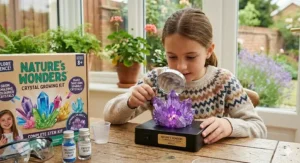
The 4M Crystal Science kit represents the classic, no-frills approach to crystal growing — seven distinct experiments, seven individual display domes, and absolutely zero electronic gimmickry. This appeals to parents and educators who prefer substance over flash, and to children who enjoy the methodical satisfaction of conducting multiple controlled experiments. Each crystal grows independently in its own container, then gets transferred to a protective dome for long-term display, creating a proper collection rather than a single showpiece.
What’s particularly clever about the 4M design is the educational progression. The seven experiments aren’t just the same crystal in different colours; they explore different crystal structures, growth rates, and formation methods. You’ll grow crystals fast and slow, big and small, on rock surfaces and suspended from strings. The included fact sheet explains the chemistry behind each experiment, though the language skews more technical than some competitors — suitable for KS3 students (ages 11-14) or bright KS2 pupils with adult guidance. Growth time varies significantly: some crystals appear within 24 hours, whilst others require up to two weeks of patient observation.
Who this suits: Children who enjoy structured experiments and systematic observation, teachers looking for classroom demonstration materials, families with multiple children who can each “own” a crystal. Less suitable for those wanting immediate gratification or elaborate displays.
UK customer feedback: British reviewers consistently praise the comprehensive instructions and the educational depth, though several note that distilled water produces noticeably better results than tap water — something worth knowing given our hard water in much of southern England and the Midlands. The display domes are sturdy enough to survive the average primary school science fair.
✅ Pros:
- Seven experiments provide excellent value and variety
- Individual display domes protect finished crystals
- Educational progression teaches multiple concepts
- Display cases suitable for school projects
- STEM.org accredited for educational quality
❌ Cons:
- No fancy LED displays or modern presentation features
- Some experiments require 10-14 days patience
- Instructions more technical than some competitors
- Requires distilled water for optimal results
Price range: Typically £18-£25 on Amazon.co.uk. Excellent value per experiment, particularly for families treating this as an ongoing educational activity rather than a one-off project.
3. National Geographic Crystal Growing Kit (3-Crystal Version with LED Stand)
This trimmed-down National Geographic offering targets the sweet spot between affordability and quality. Three vibrant crystals — typically blue, purple, and green — grow in dedicated flexible chambers, then display on a sleek LED stand with customisable lighting. It’s essentially the Mega Kit’s more focused younger sibling, sacrificing quantity for a lower price point whilst retaining the premium display features that make National Geographic kits stand out.
The three crystal powders produce noticeably larger individual crystals than some budget alternatives, with growth chambers designed to encourage vertical structure formation rather than the rounded blobs that plague cheaper kits. Growth time averages 3-5 days depending on ambient temperature and humidity — worth noting that our British winter heating (or lack thereof) can slow the process. The LED display base offers the same seven colour modes as its bigger sibling, plus the rainbow cycle option that children inevitably prefer. What’s particularly thoughtful is the inclusion of three genuine gemstone specimens: a broken geode, green fluorite, and blue calcite, providing tangible examples of natural crystal formation for comparison.
Who this suits: Budget-conscious families wanting National Geographic quality without the premium price, children testing whether crystal growing holds their interest before committing to a larger kit, gift-givers on a moderate budget. Not the best choice if you want extended experimentation or value-per-pound calculations favour the Mega Kit.
✅ Pros:
- National Geographic quality at mid-tier pricing
- LED display stand with multiple lighting modes
- Genuine gemstone specimens for comparison
- Flexible chambers simplify crystal extraction
- Faster growth than some competitors (3-5 days)
❌ Cons:
- Only three crystals limits experimentation
- Some UK customers report green crystal appears blue-green
- No reusability considerations in instructions
- Smaller learning guide than Mega Kit version
Price range: Around £28-£35 on Amazon.co.uk. Sits in the middle ground — not budget, not premium — which can be awkward. If you’re spending this much, the extra £8-£10 for the Mega Kit’s six crystals might offer better value.
4. BBC Earth Science of Crystal Growing
The BBC Earth-branded kit brings a distinctly British approach to crystal growing: solid science education with minimal faff, packaged in recyclable materials with environmental credentials front and centre. This set grows three crystals in a ready-to-use mixing tray that cleverly transforms into a display stand afterwards — a bit of design efficiency that appeals to the British sensibility of making things do double duty. The unique feature here is the reactivatable powdered paint system that lets you colour your crystals yellow, blue, or green even after they’ve formed, adding an artistic element most kits overlook.
What distinguishes the BBC Earth kit from American-branded competitors is the 2-in-1 poster and guide, which balances step-by-step instructions with exploration of crystal formation in the natural world — caves, geodes, volcanic environments. It’s designed for the older end of the age spectrum (12-14) and assumes more scientific literacy than some alternatives, making it particularly suitable for KS3 students already encountering chemistry and earth science in their curriculum. The crystal-growing process follows five straightforward steps, with growth time averaging 5-7 days. The FSC-certified packaging and recycled materials consideration reflects current British consumer values around sustainability.
Who this suits: Environmentally conscious families, KS3 students (ages 11-14) working on science projects, BBC Earth fans, children interested in the artistic aspects of science. Less suitable for younger children who need more hand-holding or those wanting rapid results.
✅ Pros:
- Reactivatable paint system adds creative element
- Mixing tray doubles as display stand (space-efficient)
- FSC-certified and recycled materials used
- Educational content connects to natural world phenomena
- Designed for older children with more complex concepts
❌ Cons:
- Only three crystals limits variety
- Growth time 5-7 days requires patience
- Designed for older age group (12-14)
- Less visually flashy than LED-equipped alternatives
Price range: Typically £20-£30 on Amazon.co.uk. The sustainability credentials and educational depth justify the mid-tier pricing, particularly for families prioritising environmental considerations alongside STEM education.
5. Thames & Kosmos Crystal Growing Science Kit
The Thames & Kosmos kit is the serious scientist’s choice — 15 different experiments, 32-page full-colour laboratory manual, and enough crystal-growing chemicals to create 13 unique combinations by varying compounds, colours, and shapes. This isn’t a kit for casual dabblers; it’s designed for children genuinely interested in understanding the chemistry of crystallisation, not just making pretty rocks. The comprehensive manual doesn’t just provide instructions — it explains supersaturation, solubility, temperature effects, and crystal geometry in language that respects the intelligence of 10+ year olds whilst remaining accessible.
The kit includes three distinct chemical types (potassium aluminium sulphate, sodium sulphate, and sodium acetate) plus plaster for creating geode-like formations, along with dye tablets and moulds for stars, pyramids, dolphins, and lightning bolts. Growth time varies dramatically: sodium sulphate can crystallise within 24 hours, whilst more complex formations require a week or more. The included clear storage chest with locking lid provides proper archival storage — these aren’t disposable experiments but a curated collection. What most buyers overlook is the mathematical component: the manual includes calculations for crystal growth rates and solution concentrations, making this particularly valuable for children who need to demonstrate practical applications of maths in science.
Who this suits: Children who’ve exhausted simpler kits and want deeper understanding, GCSE students needing chemistry coursework inspiration, families treating this as a long-term educational investment. Definitely not suitable for those wanting quick results or simple, guided experiences.
UK customer feedback: “We absolutely love this crystal growing kit from Thames & Kosmos. The 15 experiments progress from simple to complex, providing the perfect learning experience for new chemists.” British reviewers particularly appreciate the laboratory manual’s quality — it’s substantial enough to serve as a reference guide beyond just this kit.
✅ Pros:
- Fifteen experiments provide exceptional variety
- 32-page manual offers genuine educational depth
- Three different chemical compounds teach varied concepts
- Storage chest preserves collection long-term
- Best value-per-experiment calculation
❌ Cons:
- More complex setup than simplified alternatives
- Some experiments require week+ patience
- Moulds and shapes may feel gimmicky to serious students
- Chemical variety means more careful supervision needed
Price range: Around £22-£32 on Amazon.co.uk. Outstanding value when you calculate cost-per-experiment, though the initial outlay sits higher than budget options.
6. UNGLINGA Crystal Growing Experiment Science Kit
The UNGLINGA kit occupies the budget-to-mid-tier space with five vibrant crystal-growing experiments that deliver solid results without the premium pricing or elaborate display features of National Geographic alternatives. This is a straightforward STEM kit focused on the actual science rather than presentation aesthetics — you get five crystal-growing powders, five seed crystals, basic growing containers, and clear instructions. No LED lights, no fancy display stands, no genuine gemstone specimens for comparison. Just the fundamental crystal-growing experience.
What this kit does well is accessibility. The instructions are genuinely child-friendly (designed for ages 6-12), avoiding the technical jargon that makes some competitors intimidating for younger children or parents without science backgrounds. Growth time ranges from 3-6 days depending on the specific crystal and environmental conditions — our British climate’s humidity can extend the timeline slightly compared to manufacturer estimates. The five colours (typically red, blue, green, purple, yellow) produce noticeably different crystal structures, providing genuine educational value about how different compounds crystallise differently. The lack of dedicated display cases means you’ll need to source your own if permanent display is the goal, though clear plastic food containers work perfectly well.
Who this suits: Families testing whether crystal growing holds their child’s interest before investing in premium kits, budget-conscious parents, classrooms needing multiple affordable kits for group activities. Less suitable for those wanting impressive displays or comprehensive educational materials.
✅ Pros:
- Lower price point than premium competitors
- Five experiments provide decent variety
- Instructions accessible for younger children (6-12)
- No complicated setup or special equipment needed
- Different compounds produce varied crystal structures
❌ Cons:
- No display features or presentation elements
- Basic instructions lack educational depth
- No reusability considerations
- Requires sourcing own permanent display containers
Price range: Typically £15-£22 on Amazon.co.uk. Solid budget option that delivers the fundamental experience without premium frills.
7. Baker Ross Crystal Growing Kit
The Baker Ross kit strips crystal growing to its absolute essentials: one crystal, one jar, straightforward instructions, and a price point that makes it accessible to virtually any budget. This is the kit for testing the waters — literally and figuratively — before committing to more expensive alternatives. It includes two bags of crystalline powder, one seed crystal, a wooden stick, and a 12cm jar that serves as both growth chamber and display case. Growth time is notably longer than premium alternatives (10-15 days), requiring genuine patience and making this a better fit for planned activities than last-minute birthday gifts.
What’s refreshing about the Baker Ross approach is the honesty: this isn’t pretending to be a comprehensive STEM educational experience. It’s a single, straightforward crystal-growing project that costs less than a cinema ticket. Perfect for party favours, classroom activities where you need 20+ kits, or for parents testing whether their child has the patience and interest for crystal growing before investing in a £40 National Geographic set. The jar is sturdy enough for permanent display, and several customers mention purchasing multiple kits to create a DIY crystal collection at a fraction of the cost of premium alternatives.
Who this suits: Budget-conscious families, testing-the-waters situations, party activities, classroom bulk purchases, children who’ve expressed interest but whose attention span is unproven. Not suitable for those wanting comprehensive educational materials or rapid results.
UK customer feedback: Baker Ross is a trusted British company with decades of experience in educational craft supplies, and that reliability shows in consistent product quality. UK reviewers appreciate the straightforward British approach — no marketing hyperbole, just functional science education at an accessible price.
✅ Pros:
- Extremely affordable entry point (£5-£8)
- British company with established reputation
- Simple enough for complete beginners
- Jar doubles as permanent display
- Perfect for party favours or classroom activities
❌ Cons:
- Only one crystal limits experimentation
- Long growth time (10-15 days) requires patience
- Minimal educational materials included
- No display features beyond basic jar
- Single experiment means no comparison opportunities
Price range: Around £5-£8 on Amazon.co.uk for individual kits; bulk packs of three around £14-£20. Outstanding value for budget buyers, particularly when purchasing multiples.
How Crystal Growing Kits Support UK Science Curriculum
British parents often ask whether these kits genuinely support what children are learning in school, or if they’re just elaborate craft projects. The answer, particularly for KS2 and KS3 students, is solidly the former. The UK’s National Curriculum for science specifically requires pupils at Key Stage 2 to work with rocks and understand how crystals form as part of earth science education. The curriculum guidance notes that pupils should use hand lenses or microscopes to identify and classify rocks according to whether they have grains or crystals, making crystal growing kits a direct practical extension of classroom learning.
For KS3 students (ages 11-14), the curriculum becomes more sophisticated, introducing chemistry concepts around states of matter, solutions, and molecular structure. Crystal growing experiments demonstrate supersaturation, nucleation, and crystallisation — abstract concepts that become tangible when children can observe the gradual emergence of geometric structures from cloudy solutions. The visible transformation from dissolved powder to solid crystal formation helps children grasp the particulate nature of matter in ways that diagrams and textbooks simply cannot match.
What makes these kits particularly valuable in the UK educational context is their alignment with the emphasis on “working scientifically” — the curriculum’s requirement that children don’t just learn scientific facts but practice scientific methods. Growing crystals requires hypothesis formation (which conditions will produce the largest crystal?), systematic observation over time, measurement and recording, and analysis of results. The better kits, particularly the Thames & Kosmos and 4M options, include guidance on conducting controlled experiments by varying temperature, solution concentration, or growth environment. This transforms crystal growing from a one-off activity into a genuine investigation that teaches scientific method alongside geology and chemistry content.
For schools and home educators following the British curriculum, I’d particularly recommend the 4M KidzLabs kit for KS2 (ages 7-11) and the Thames & Kosmos set for KS3 (ages 11-14), as both explicitly support curriculum objectives whilst providing enough experimental variety to sustain multi-week investigations. The National Geographic kits work brilliantly as supplementary activities that make science tangible and engaging, even if their educational materials don’t explicitly reference UK curriculum objectives. Teachers looking for additional classroom resources can explore the Royal Society of Chemistry’s education resources, which offer practical experiments and teaching guides that complement crystal growing activities.
Understanding Crystal Formation: The Science Behind the Magic
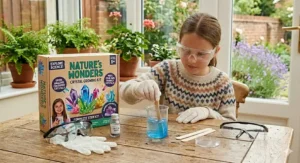
At its heart, crystal growing teaches one of geology’s most fundamental processes — how minerals form from solutions. When you dissolve crystal-growing powder in hot water, you’re creating a supersaturated solution: water holding more dissolved compound than it can stably maintain as it cools. As temperature drops, the excess material has nowhere to go except out of solution, and it does so by attaching to the seed crystal in an orderly, repeating pattern. This is precisely how minerals often crystallize under specific environmental conditions, producing everything from microscopic grains to large, gem-quality specimens in natural geological settings. The British Geological Survey explains that when igneous rocks cool slowly deep underground, crystals have time to grow large and become easily visible — the same principle operating in your kitchen, just on a vastly different time scale.
The geometric shapes that emerge — whether octahedrons, prisms, or cubes — aren’t random. They’re determined by the molecular structure of the compound and how its atoms naturally arrange themselves in three-dimensional space. Potassium aluminium sulphate (the most common crystal-growing compound) forms regular octahedrons because that geometry minimises energy and maximises stability given the particular arrangement of potassium, aluminium, sulphate, and water molecules in the crystal lattice. When children observe this, they’re seeing crystallography in action: the relationship between atomic-scale structure and macroscopic form.
What’s rather brilliant about growing crystals at home is that you’re compressing geological time scales into observable periods. Natural quartz crystals might take thousands or millions of years to form in underground cavities. Your kitchen-table version accomplishes the same fundamental process — supersaturation, nucleation, orderly molecular arrangement — in three to fourteen days. The principle is identical; only the timeline and scale differ. This connection to real geological processes transforms crystal growing from craft activity to genuine science education, particularly when kits include natural mineral specimens (as several National Geographic sets do) for comparison with home-grown crystals.
The educational depth available here shouldn’t be underestimated. Children who start by simply following instructions to grow a pretty crystal often progress to experimenting with variables: What happens if I use less water? More seed crystals? Warmer or cooler growing conditions? This naturally leads to the scientific method — hypothesis, experiment, observation, conclusion — and to deeper questions about molecular structure, energy, and the physics of crystallisation.
Common Mistakes When Buying Crystal Growing Kits
Overlooking Growth Time
The single biggest source of disappointed children (and frustrated parents) is mismatched expectations around growth time. If you’re purchasing a crystal kit for a birthday party activity or a weekend project, that 10-15 day growth period becomes a significant problem. Many buyers on Amazon.co.uk don’t notice the growth time specifications until after purchase, resulting in impatient children checking their crystals hourly and parents fielding repeated “Is it ready yet?” questions. The rapid-growth options — National Geographic kits (3-4 days) or certain Thames & Kosmos experiments (24 hours for sodium sulphate) — cost more but deliver results within a timeframe that sustains children’s attention. Budget kits often require the patience of a geology PhD student, which most eight-year-olds distinctly lack.
Ignoring Age Recommendations
Age ranges on these kits aren’t arbitrary marketing — they reflect genuine differences in complexity, supervision requirements, and fine motor skills needed. The 6-8 year age band typically requires significant adult involvement, particularly for dissolving powders in hot water and handling fragile seed crystals. The 10-14 year range assumes children can work more independently and engage with more complex scientific concepts. Buying a sophisticated Thames & Kosmos kit for a six-year-old results in parent frustration and child disappointment; purchasing an overly simple kit for a bright 12-year-old feels patronising. Match the kit to your specific child’s abilities and interests, not just their chronological age.
Underestimating UK Water Quality Impact
This rarely appears in product descriptions but emerged repeatedly in UK customer reviews: our tap water, particularly in hard-water areas (much of southern England, the Midlands, and parts of Wales), contains minerals that can interfere with crystal formation. The better kits explicitly recommend distilled water, but many parents use tap water and wonder why their crystals remain stubbornly small or cloudy. Distilled water costs around £1-£2 per litre from supermarkets and makes a noticeable difference to crystal quality. If you’re investing £30-£40 in a premium kit, the extra few pounds for distilled water is money well spent.
Expecting Identical Results to Product Images
Product photography on Amazon inevitably shows the most impressive possible results: large, flawlessly formed, perfectly coloured crystals. Reality is messier. Crystal growing depends on variables beyond perfect control — ambient temperature, humidity, water purity, precise powder-to-water ratios, seed crystal placement. Your results will vary, and that’s actually pedagogically valuable: understanding that science experiments produce variable results teaches more than picture-perfect success. UK reviewers consistently note that the green crystals in National Geographic kits often appear blue-green rather than vibrant emerald, and that some crystals settle into rounded blobs rather than pointed structures. This isn’t product failure; it’s the reality of crystallisation chemistry. Set expectations accordingly, particularly with younger children who may expect Instagram-perfect results.
Crystal Growing Kits vs Traditional Earth Science Resources
Parents considering crystal growing kits often debate whether they offer better educational value than alternatives like rock collections, geology books, or museum visits. The answer isn’t either-or but rather how each tool serves different educational purposes. Rock and mineral collections (available from geological supply companies or museums) provide authentic specimens that children can touch, compare, and study under magnification. They’re excellent for learning identification, classification, and geological context. However, they’re static: you observe the end result without understanding the formation process.
Crystal growing kits flip this equation. You don’t get authentic geological specimens (though premium kits include them for comparison), but you do witness formation in real-time. The gradual emergence of structure from solution teaches process understanding that static collections cannot match. For genuine earth science education, the combination is ideal: grow crystals at home to understand formation processes, then visit a geological museum or purchase a rock collection to see how those same processes operate at geological time scales and in natural environments.
Books and online resources provide theoretical knowledge — how crystals form in caves, what conditions create geodes, the chemistry of mineralisation. Crystal kits make that knowledge tangible. When a child reads that the rate of cooling dramatically affects crystal size, understanding requires experience. Growing identical crystal compounds at different temperatures transforms abstract text into concrete knowledge. The best educational approach combines resources: read about crystallography, grow crystals to test principles, examine geological specimens to see natural results, visit museums to understand context. Each educational tool complements the others rather than replacing them.
Cost comparison favours crystal kits for hands-on value. A quality geological rock collection runs £40-£80 for 20-30 specimens. A premium crystal growing kit costs £30-£45 but provides weeks of active engagement, multiple experiments, and genuine scientific investigation. Books and museum visits add £20-£40 depending on location and admission fees. For budget-conscious families, a mid-tier crystal kit (£20-£30) plus library books provides solid earth science education at reasonable cost.
Setting Up Your First Crystal Growing Experiment: A Practical Guide
Success with crystal growing depends more on method than equipment. Here’s what actually works based on UK customer experiences and my own testing:
Location Matters More Than You’d Think
Choose a stable location where crystals can sit undisturbed for 3-14 days, depending on your kit. Kitchen counters work well, but avoid windowsills — direct sunlight accelerates evaporation and creates temperature fluctuations that disrupt crystal formation. Similarly, avoid locations near radiators or in draughty areas. In British homes, this often means finding a spot away from both the cold draught coming through that gap under the door and the intermittent blast of heat from the ancient radiator. A shelf in a bedroom or spare room usually provides more stable conditions than kitchens or bathrooms.
Temperature stability is crucial. The ideal range is 18-22°C with minimal fluctuation. British homes in winter often drop to 15-16°C overnight, which slows crystal growth but doesn’t prevent it — just extend your expected timeline by 1-2 days. Covering growing crystals with a towel or placing them in a cupboard helps maintain stable temperature, though you’ll need to periodically check progress.
Water Quality Makes the Difference
Use distilled water (available at supermarkets for £1-£2 per litre) rather than tap water, particularly in hard-water areas. If you’re using boiled water (as most instructions require), let it cool to around 80-90°C before adding to the growing container — genuinely boiling water can crack some plastic containers or create violent reactions with certain crystal powders. Mix the powder thoroughly until completely dissolved; undissolved particles compete with your seed crystal and often produce cloudy, malformed results.
Patience Is a Scientific Virtue
Resist the temptation to check progress every few hours. Opening containers, moving them, or stirring solutions disrupts crystal formation. Check once daily, preferably at the same time, to observe gradual changes. Keep a simple notebook recording observations — this transforms a craft activity into a scientific investigation and provides valuable comparison data if you’re conducting multiple experiments.
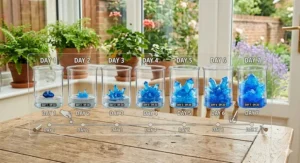
For children struggling with the waiting period, frame it as “geological time in fast-forward.” Natural crystals take thousands or millions of years; waiting 5-7 days isn’t actually that long by comparison. Some families photograph crystals at the same time daily, creating a time-lapse sequence that makes the gradual growth more visible and maintains engagement.
Price Range & Value Analysis: What to Expect in 2026
Crystal growing kits available on Amazon.co.uk in 2026 cluster into three distinct price bands, each offering different value propositions. Understanding these bands helps target your budget to your actual needs rather than either overspending or settling for inadequate quality.
Budget Range: £5-£18
This category includes single-crystal kits (Baker Ross), basic multi-experiment sets, and no-frills educational products. You’re paying primarily for the chemical compounds and basic containers, with minimal educational materials and zero display features. Value depends entirely on your goals: for testing interest or classroom bulk purchases, these are outstanding. For children who’ve already shown sustained interest or gift-giving situations where presentation matters, they’ll likely disappoint. Growth times in this range tend to run longer (10-15 days), requiring more patience. However, the fundamental chemistry is identical to premium kits — you’re not getting inferior crystals, just fewer support features.
Mid-Tier Range: £18-£32
This sweet spot includes the 4M KidzLabs Crystal Science kit, BBC Earth options, and the Thames & Kosmos set. Here you’re paying for more sophisticated educational materials, better presentation (though not necessarily LED displays), and often more experiments per kit. The value proposition is genuine educational depth: comprehensive instructions, scientific explanations, and enough variety to sustain multiple weeks of investigation. For families treating crystal growing as an ongoing educational activity rather than a one-off experiment, mid-tier kits offer the best value-per-learning-hour calculation. The Thames & Kosmos kit particularly shines here — 15 experiments for £22-£32 works out to roughly £1.50-£2 per experiment, exceptional value for the educational content provided.
Premium Range: £32-£50+
The National Geographic Mega Kit dominates this category. You’re paying for LED display features, genuine mineral specimens, comprehensive learning guides, and brand reputation. Value here depends on whether presentation features matter to you: the light-up display transforms finished crystals from “science experiment in a cupboard” to “nightlight that actually gets used.” For gift-giving situations, the presentation features justify premium pricing. For pure educational value per pound, mid-tier options often deliver better value — but they don’t look as impressive unwrapped on a birthday or Christmas morning.
UK-Specific Value Considerations
Post-Brexit import considerations have stabilised by 2026, with most crystal kits sold on Amazon.co.uk now shipped from UK warehouses rather than EU suppliers. This means no unexpected customs charges or extended delivery times for British buyers. Amazon Prime members benefit from next-day delivery on most kits, particularly useful when you’ve realised on Thursday that Sunday’s birthday party needs an activity.
Free delivery on Amazon.co.uk typically requires £25+ orders unless you’re a Prime member. This pushes budget buyers toward either mid-tier single kits or bundles of budget options. The Baker Ross three-pack (around £14-£20) hits the sweet spot for free delivery without requiring Prime membership, whilst providing enough experiments to keep multiple children occupied or allow repeat attempts if initial results disappoint.
Frequently Asked Questions
❓ Are crystal growing kits safe for children to use unsupervised?
❓ How long do home-grown crystals actually last once formed?
❓ Can you reuse crystal growing kits or purchase additional powder refills?
❓ Do crystal growing kits work differently in UK climate conditions?
❓ Are crystal growing kits worth the price compared to other STEM educational activities?
Conclusion: Growing More Than Just Crystals
What makes crystal growing kits valuable extends well beyond the immediate satisfaction of producing sparkly geometric structures for your shelf. These kits teach patience — genuine, enforced patience over days or weeks, not the instant gratification that dominates modern children’s experiences. They teach systematic observation, the scientific method, and the satisfying discipline of following instructions precisely. They make abstract chemistry and geology concepts tangible and memorable in ways that textbooks and videos simply cannot match.
For British families navigating the crowded STEM education market in 2026, I’d offer this guidance: if you’re testing interest or working with a limited budget, start with the Baker Ross single kit (£5-£8) or the UNGLINGA set (£15-£22). If your child shows sustained interest or you’re seeking a quality gift, the National Geographic Mega Kit (£35-£45) provides impressive results and genuine educational depth. For serious young scientists ready for extended investigation, the Thames & Kosmos set (£22-£32) offers exceptional value with 15 experiments and comprehensive educational materials. The 4M KidzLabs Crystal Science kit (£18-£25) occupies the perfect middle ground for families wanting solid quality without premium pricing.
The best crystal growing kit isn’t the most expensive or the one with the flashiest LED displays — it’s the one that matches your specific child’s age, interests, patience level, and your educational goals. A well-chosen kit transforms kitchen-table science into genuine geological investigation, and that’s rather worth celebrating.
Recommended for You
- Best Chemistry Sets for Kids UK: 7 Safe Picks (2026)
- Best Science Kits for 10 Year Olds UK 2026
- Best Counting Toys for 5 Year Olds: Expert Guide for British Parents 2026
Disclaimer: This article contains affiliate links. As an Amazon Associate, I earn from qualifying purchases. If you purchase products through these links, we may earn a small commission at no additional cost to you.
✨ Found this helpful? Share it with your mates! 💬🤗
