
In This Article
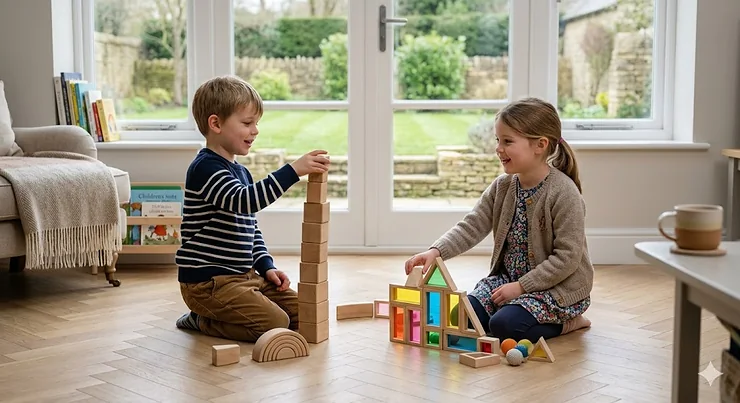
There’s a particular moment — you’ve probably witnessed it — when a child ignores the flashy, battery-operated thing that cost a fortune, and spends forty minutes arranging a handful of wooden arches into a “dragon’s cave.” That is not an accident. That is exactly what the best open-ended wooden toys are designed to provoke, and in 2026, two brands consistently rise to the top of every British nursery shortlist: Grimm’s and TickiT.
On the face of it, the comparison feels easy. Grimms vs Tickit wooden toys both use sustainably sourced beech wood, both are finished with non-toxic water-based colours, and both promise to support the kind of unstructured, child-led play that Waldorf-Steiner education philosophy has championed for over a century. Look closer, though, and the differences become genuinely interesting — and genuinely important if you’re deciding where to spend your money.
Grimm’s, founded in 1978 and headquartered in southern Germany, is the premium, heirloom-grade option: sculptural, architectural, the sort of toy that doubles as living room décor. TickiT, a British brand widely stocked in UK schools and nurseries, plays a different game entirely — more pieces, more shapes, lower price-per-item, and an almost obsessive focus on loose parts play. Both are available on Amazon.co.uk. Both deliver hours of imaginative play. But they are not interchangeable, and buying the wrong one for your child, your space, or your budget is an easy mistake to make.
This guide compares seven top products across both brands, unpacks what the specifications actually mean in practice, and helps you decide which brand — or which combination — belongs in your home.
Quick Comparison: Grimms vs TickiT at a Glance
| Feature | Grimm’s | TickiT |
|---|---|---|
| Origin | Germany (handcrafted) | UK brand, European manufacture |
| Primary material | Lime wood / basswood / birch | Beech wood |
| Colour finish | Deeply pigmented, matte glaze | Muted, natural-grain finish |
| Price tier | Premium (mid to high £££) | Mid-range (£ to ££) |
| Piece count per set | Lower (6–12 per rainbow set) | Higher (14–84 per set) |
| Best for | Heirloom play, structured building | Loose parts play, classroom/nursery |
| Age range | 10m+ (sensory), 1–8+ (building) | 10m+ through school age |
| UK school/nursery use | Common | Very common |
| Amazon.co.uk availability | ✅ Yes | ✅ Yes |
Reading the table: Grimm’s wins on aesthetics and architectural play; TickiT wins on versatility and value-per-piece. The real insight? Many UK families and educators buy from both — Grimm’s for the centrepiece rainbow, TickiT for the loose parts collection that surrounds it. It’s less of a rivalry and more of a rather good double act.
💬 Just one click — help others make better buying decisions too! 😊
✨ Don’t Miss These Exclusive Deals!
🔍 Take your child’s creative play to the next level with these carefully selected wooden toys. Click on any highlighted product below to check current pricing and availability on Amazon.co.uk. These picks will help you find exactly what your family needs!
Top 7 Grimms vs Tickit Wooden Toys: Expert Analysis
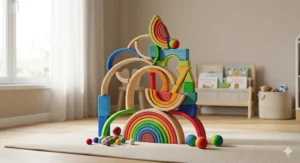
1. Grimm’s Large Rainbow Stacker (12-Piece)
The one that started the conversation. The Grimm’s Large Rainbow Stacker is twelve hand-cut lime wood arches, each dyed in a vibrant water-based colour glaze, nesting together into the iconic rainbow shape. The largest arch measures approximately 38 cm wide — substantial enough that it genuinely dominates a play space in the best possible way. What the spec sheet won’t tell you is how the finish feels: matte, almost velvety, nothing like the slick lacquer on cheaper imitations. Children notice this immediately, often before they’ve even started playing with it.
This is the open-ended toy gold standard. A toddler will spend months stacking and nesting, learning about size and sequence. By age three, the arches become tunnels, bridges, cradles for toys, the walls of a city. By six, it’s an engineering problem. The play genuinely evolves with the child, which is rather the point when you’re spending in the mid-to-upper £££ range.
UK buyers should note: colour transfer onto surfaces is an acknowledged Grimm’s characteristic, especially on new sets. A damp cloth sorts it immediately, and the stains are non-toxic — but cream carpets might want to keep their distance for the first few weeks.
UK reviewers consistently describe it as a toy their children return to daily, often well into school age. The word “heirloom” comes up rather a lot.
✅ Genuinely grows with the child from infancy to age 8+
✅ Exceptional build quality; survives years of enthusiastic play
✅ Aesthetic enough for families who care about their living space
❌ Significant investment — the price will make some budgets pause
❌ Initial colour transfer requires a watchful eye around soft furnishings
A premium choice that earns its price tag through longevity. Check current price on Amazon.co.uk.
2. Grimm’s Small Rainbow Stacker (6-Piece)
Consider the Small Rainbow Stacker the more accessible entry point into the Grimm’s universe — six arches rather than twelve, about half the footprint. At roughly 19 cm for the largest arch, it’s perfectly sized for little hands and compact British living rooms (and if you live in a terraced house in Leeds or a flat in Bristol, you’ll appreciate that “compact footprint” is not a trivial selling point).
What surprises people is how much you can do with six pieces. Younger children often find twelve arches slightly overwhelming at first; six is a more manageable invitation to play. The build quality is identical to the large version — the same matte colour glaze, the same tactile lime wood. Some families buy the small set first, then add the large set later, creating a combined 18-arch collection that opens up a whole new level of building possibility.
UK nurseries sometimes use the small version precisely because it stores neatly and travels well — teachers have been known to pop it into a bag for outdoor play on the relatively dry days Britain occasionally provides.
✅ More affordable entry point to the Grimm’s range
✅ Ideal for smaller spaces and younger children
✅ Pairs beautifully with the large stacker if budget allows
❌ Six pieces limits building complexity for older children
❌ Some buyers feel the price-to-piece ratio is steep compared to TickiT
A sensible starting point for families new to Grimm’s. Check current pricing on Amazon.co.uk.
3. Grimm’s Large Stepped Pyramid (Natural or Rainbow)
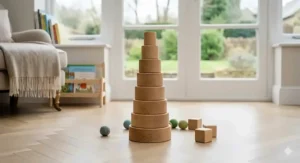
Less famous than the rainbow stacker but arguably more architecturally interesting, the Large Stepped Pyramid gives children a different kind of spatial problem to solve. Rather than simple nesting arches, the pyramid’s graduated steps — up to nine tiers, depending on the version — require a child to think about balance, proportion, and gravity. It’s the toy that quietly develops engineering instincts.
Available in natural (unpainted) and rainbow finishes, the natural version deserves particular mention: the unfinished basswood has an almost warm, soft smell that young children find genuinely calming, and there’s something refreshingly Scandi-minimal about it on a shelf. No dye, no colour transfer concerns, just beautiful wood.
For families who’ve already invested in a Grimm’s rainbow stacker, the stepped pyramid adds a completely different play dimension — vertical rather than lateral, precise rather than free-form. The pieces can also be combined with the rainbow arches for larger builds, which older children (and, frankly, quite a few adults) find quietly addictive.
UK families in smaller homes should note: the large version is genuinely large when built up. Make sure you have the floor space before ordering.
✅ Develops spatial reasoning and fine motor skills at a deeper level
✅ Natural version is particularly beautiful and dye-free
✅ Pairs perfectly with rainbow stackers for complex builds
❌ Less immediately obvious to young toddlers than the rainbow arches
❌ The “large” version takes up significant floor space
An excellent second Grimm’s purchase. Check Amazon.co.uk for current availability.
4. Grimm’s 36 Building Blocks — Rainbow Mosaic
If the rainbow stacker is Grimm’s showpiece, the 36 Building Blocks — Rainbow Mosaic is their workhorse. Thirty-six solid wooden cubes in eighteen different colours, these are blocks in their purest, most elemental form. No gimmicks, no shapes, no instructions — just thirty-six beautifully weighted, velvety-finished cubes and a child’s imagination.
The colour range here is remarkable: rather than the standard seven-colour rainbow, the mosaic palette introduces intermediate hues that let children explore colour gradients intuitively. For early years educators, this is a genuinely useful teaching tool for colour theory and sorting. For a toddler, it’s simply an irresistible pile of colourful things to stack, knock down, and stack again.
Practically speaking: each cube is approximately 3 cm — solid enough to stack stably, small enough for little hands to manage. The set stores neatly in a cotton bag (included), which is mildly wonderful in a world where toy storage is a constant battle. UK parents with limited storage in terraced houses and smaller flats will appreciate this more than they might expect.
✅ 36 pieces means serious building potential
✅ Cotton storage bag included — genuinely useful
✅ The mosaic colour range makes colour-learning naturally beautiful
❌ All one shape limits building variety compared to the TickiT super sets
❌ Not the most immediately eye-catching Grimm’s set for younger toddlers
A solid mid-range Grimm’s investment with strong replay value. Check current pricing on Amazon.co.uk.
5. TickiT Rainbow Wooden Super Set (84 Pieces, 12 Shapes)
And now we cross to the other side of the ring, where TickiT has built something genuinely extraordinary in the Rainbow Wooden Super Set. Eighty-four beech wood pieces across twelve different shapes — discs (6 cm diameter), spools (3.5 cm), cubes in two sizes, rings in three sizes, balls (5 cm), semispheres, figurines (10 cm), bowls (9.2 cm), and spinning tops — all in seven muted rainbow colours that let the natural wood grain show through.
Where Grimm’s offers sculptural drama, TickiT offers abundance. This is a loose parts playground in a bag — literally, as it comes with a cotton drawstring storage bag. The muted, calming colour palette deserves particular attention: unlike Grimm’s deeply saturated hues, TickiT’s softer tones are specifically designed to promote concentration rather than stimulation. Montessori and Steiner educators both advocate for this kind of restrained colour palette in play materials, and in practice, children do seem to engage with TickiT sets for longer, more focused periods.
The 84-piece count also means this scales beautifully for group play — excellent for siblings, brilliant for nursery and Reception classrooms. UK schools and early years settings have stocked TickiT for years precisely because the value-per-piece equation is so compelling. This set is available on Amazon.co.uk, typically Prime-eligible, which means it can be in your home tomorrow.
✅ Outstanding piece count and shape variety for the price
✅ Muted tones promote calm, focused play
✅ Supplied with cotton drawstring bag — easy storage for smaller homes
✅ Ideal for group play: siblings, nursery, playdates
❌ Smaller individual pieces — requires closer supervision for children under 3
❌ Less sculptural/aesthetic than Grimm’s; won’t win any shelf display awards
The best value loose-parts set on Amazon.co.uk by a considerable margin. Check current pricing.
6. TickiT Rainbow Wooden Rings (Set of 21, 3 Sizes)
The TickiT Rainbow Wooden Rings are a quieter purchase than the Super Set, but in many ways a smarter one for very young children. Twenty-one beech wood rings across three sizes (roughly 4.8 cm, 5.6 cm, and 7 cm diameter) in seven rainbow colours — simple, smooth, endlessly versatile.
What makes these particularly good for babies and toddlers from around 10 months is the tactile quality. Rings are one of the oldest heuristic play objects for a reason: children can grasp them, mouth them (the water-based paint is non-toxic and tested against saliva), thread them, stack them, and line them up. The three different sizes introduce early concepts of comparative scale in the most natural, unpressured way imaginable.
The rings also pair beautifully with a TickiT ring holder (sold separately) to create a sorting and stacking activity with a defined goal — useful for those moments when a child needs slightly more structure. UK parents will note that at the price point these sit at, they make a genuinely lovely and practical gift that won’t join the pile of ignored plastic on the landing. A sensible purchase; well worth considering.
✅ Perfect for babies 10m+ through to toddler age
✅ Saliva-tested, non-toxic paint — safe for mouthy babies
✅ Three sizes introduce size comparison naturally
❌ Less varied than the Super Set; could feel limited as children grow
❌ Ring holder purchased separately for the full experience
An excellent first TickiT purchase. Check current pricing on Amazon.co.uk.
7. TickiT Rainbow Wooden Bowls (Pack of 7)
The most underrated set in the entire comparison. Seven beech wood bowls — one in each rainbow colour — ranging from approximately 9 cm in diameter, with a satisfying gentle curve and a matte, lightly stained finish that showcases the grain beautifully.
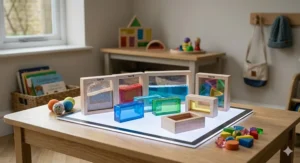
Why bowls? Because they do something none of the other pieces do: they create an enclosed space. A bowl is a container, which means a child can fill it, empty it, sort into it, use it as a “home” for small figurines, or simply nest the seven together by size. Combined with the loose parts from the Super Set, the bowls become sorting stations — a colour-coded organisation system that young children invent entirely themselves, which is exactly the developmental magic loose parts play is designed to trigger.
Research from the University of Cambridge’s Centre for Research on Play in Education, Development and Learning has demonstrated that loose parts play of this kind supports significant benefits for cognitive and social-emotional development. The TickiT bowls, used alongside any loose parts collection, are a practical implementation of that evidence.
UK parents in particular often use these bowls on a tuff tray (a popular flat play tray used in UK nurseries) — the set is sized perfectly for this kind of contained messy play activity, which works well indoors during the considerable number of British months when outside is simply not an option.
✅ Uniquely functional as containers and sorting vessels
✅ Gorgeous as standalone objects or combined with loose parts
✅ Perfect for tuff tray activities — very popular in UK early years settings
❌ Seven pieces may feel limited at this price for some buyers
❌ The bowl depth is shallow — not suitable for deep stacking
A quietly brilliant addition to any wooden toy collection. Check current pricing on Amazon.co.uk.
Getting the Most From Your Wooden Toy Investment: A Practical UK Guide
Buying the toys is, if anything, the easy part. Here’s what most UK parents discover only after the fact.
Rotation is the secret weapon. The single most effective way to extend the play life of any wooden toy collection — Grimm’s, TickiT, or both — is to keep only two or three sets accessible at a time and store the rest. Children return to rotated toys with fresh eyes and genuinely new ideas. In smaller British homes where storage is at a premium, this also solves the problem of play spaces that look perpetually chaotic.
Introduce loose parts on a tuff tray. TickiT sets, in particular, work best when they’re contained. A tuff tray (widely available on Amazon.co.uk for under £30) gives children a defined play boundary and makes clearing up infinitely more manageable. Place the bowls at the edges, scatter the rings and spools in the centre, and watch what happens. This setup is used in virtually every UK Montessori setting for good reason.
Care and maintenance in the British climate. Both Grimm’s and TickiT pieces are solid wood, which means they respond to moisture. Never leave them near a radiator (warping is real) and keep them away from genuinely damp storage — the kind of damp that lives in Victorian terraced house cupboards under the stairs. A quick wipe with a slightly damp cloth is all the cleaning either brand needs; avoid soaking or dishwashers.
New sets and colour transfer. Grimm’s products, in particular, can transfer dye onto surfaces and other pieces during the first few uses. This is expected, not a defect. Wipe new Grimm’s pieces with a damp cloth before first use, and perhaps avoid the cream linen sofa for the initial few sessions.
Which Brand Suits Which Child? Real UK Family Scenarios
The toddler in a London flat (12–24 months). Space is limited, budget matters, and you need a toy that can be packed away in a corner quickly. Start with the TickiT Rainbow Wooden Rings — small storage footprint, age-appropriate from 10 months, and easy to introduce in a small play space. Add the TickiT Bowls when the child shows interest in filling and emptying. Hold off on the Grimm’s large rainbow until you have more floor space (or a bigger flat).
The three-year-old in a suburban semi-detached (Manchester, Birmingham, Bristol). This is the Grimm’s Large Rainbow Stacker sweet spot. The child is old enough to engage with the architectural play the stacker enables, the family has a proper living room, and the rainbow will genuinely be used daily for the next three to five years. Combine with the TickiT Super Set for loose parts play that expands the Grimm’s universe considerably.
The Reception or Year 1 child who needs stimulation at home (5–6 years). The Grimm’s Large Stepped Pyramid and the TickiT Super Set used together. The pyramid provides an engineering challenge; the 84-piece TickiT set provides infinite story-world-building material. UK children of this age are also at the stage where they’ll start inventing elaborate games with rules — both of these sets scale beautifully into that territory.
The nursery or childminder looking to kit out a setting. TickiT, every time. The value-per-piece is unbeatable, the muted colour palette suits a professional setting, and the durability of beech wood means these sets survive the enthusiastic attention of multiple children over multiple years. The Super Set and the Rings are particularly popular in UK EYFS settings.

How to Choose Between Grimms and Tickit Wooden Toys in the UK: 5 Key Criteria
Choosing between these two brands is genuinely a matter of priorities, not quality. Here’s how to think it through clearly.
1. Budget and value-per-piece. Grimm’s is a premium product — you’re paying for German craftsmanship, the distinctive colour glaze, and the sculptural quality. TickiT offers significantly more pieces for your pound. If budget is a real constraint, TickiT delivers greater play variety per £ spent. If you’re investing in a toy meant to last a decade and live on display, Grimm’s justifies the premium.
2. Child’s age and developmental stage. Both brands begin at 10 months, but they play differently at different ages. Grimm’s arches are best appreciated by children who can engage with stacking and building — typically from around 18 months upward. TickiT’s smaller loose parts (rings, spools, discs) are wonderful from 10 months but require closer supervision. Check the age recommendations on each product listing.
3. Available space. Grimm’s is architectural; it works best when children have floor space to build. TickiT’s pieces are smaller and more contained — better suited to table-top play in compact spaces.
4. Play style — solitary or group. Grimm’s tends to inspire focused, solitary creative play. TickiT’s abundance of pieces scales better for group play: siblings sharing, nursery settings, or playdates.
5. Purpose — home or professional setting. For a home, either brand works beautifully. For a professional nursery, childminder, or school setting, TickiT’s durability-to-price ratio makes it the clearer choice.
Common Mistakes When Buying Wooden Toys in the UK
Buying based on aesthetics alone. Grimm’s rainbow stackers are, objectively, beautiful. They look wonderful on Instagram and even better on a shelf. But a child who is primarily interested in filling, sorting, and making small-world scenes may find 12 arches somewhat limiting — and in that case, the TickiT Super Set at a fraction of the price will provide far more joy.
Ignoring the age guidance. Both brands include pieces that carry choking hazard warnings for under-36 months. The TickiT Super Set, in particular, contains small spools and discs suitable for 10 months+ under supervision, but “under supervision” is doing a lot of work in that sentence. Read the product listings carefully before purchasing for very young children.
Assuming “wooden = indestructible.” High-quality wooden toys are exceptionally durable, but they’re not immune to damage. Sustained soaking will warp even the best beech wood; damp, unheated storage (common in older British homes) can cause pieces to swell or crack over time. Store them indoors, in dry conditions.
Missing UK toy safety standards. Both Grimm’s and TickiT products available through Amazon.co.uk carry CE or UKCA marking — the post-Brexit UK Conformity Assessed standard — and comply with EN 71 toy safety regulations, which the UK Government enforces through the Office for Product Safety and Standards. If purchasing from a third-party marketplace seller, always verify this marking is present on the product listing.
UK Safety Standards: What to Check Before You Buy
Toy safety in the UK sits under the Toys (Safety) Regulations 2011, enforced by the Office for Product Safety and Standards. Post-Brexit, products manufactured outside the UK and sold here must carry UKCA marking (or, in a transitional period, CE marking) to demonstrate compliance with EN 71 — the European toy safety standard covering physical safety, flammability, and chemical safety.
For wooden toys specifically, the most important standards are physical and mechanical safety (no sharp edges, no parts that can trap fingers) and chemical safety (paint and finishes must be non-toxic). Both Grimm’s and TickiT are very clear in their product listings about using water-based, non-toxic stains — verified to be safe in saliva contact, which is the realistic test for any toy in the hands of children under three.
If you’re buying from a smaller or unfamiliar seller on Amazon.co.uk’s third-party marketplace rather than from Amazon itself, it’s worth checking for UKCA or CE marking explicitly. The price may be tempting, but unverified wooden toy manufacturers have occasionally been found to use varnishes or dyes that don’t meet EN 71 chemical standards. When in doubt, stick to established brands and verified Amazon sellers.
FAQ
❓ Are Grimm's wooden toys worth the money for UK buyers?
❓ Where can I buy Grimms and TickiT wooden toys in the UK?
❓ What age are Grimm's rainbow stackers suitable for in the UK?
❓ Are TickiT wooden toys safe for babies under 12 months?
❓ Do Grimm's and TickiT toys meet UK UKCA safety standards?
Conclusion
Grimms vs Tickit wooden toys isn’t really a competition — it’s a conversation about what kind of play you want to invite into your home. Grimm’s offers something genuinely rare in the modern toy market: beauty, craft, and the kind of durability that means these pieces might outlast the children who first played with them. TickiT offers something equally rare: extraordinary value, abundance, and a loose parts philosophy backed by solid developmental research from institutions like the University of Cambridge’s Faculty of Education.
The most sensible approach for most UK families? Start with one Grimm’s centrepiece — the Large Rainbow Stacker is the obvious choice — and build a TickiT loose parts collection around it. The two brands complement each other far better than they compete, and the combined play possibilities are genuinely remarkable.
Both brands are available on Amazon.co.uk, Prime-eligible, and well within what UK families regularly spend on toys that last far less long and matter far less developmentally. That is worth sitting with for a moment.
✨ Don’t Miss These Exclusive Deals!
🔍 Ready to invest in open-ended play that grows with your child? Click on any highlighted product in this guide to check current pricing and availability on Amazon.co.uk. Free delivery available on orders over £25 — and Prime members get it next day.
Recommended for You
- 7 Best Hundred Board Montessori for UK Kids 2026
- Best Montessori Number Rods UK: Top 7 Picks Transform Learning 2026
- Best Colour Tablets Montessori UK: 7 Top Picks 2026
Disclaimer: This article contains affiliate links. As an Amazon Associate, I earn from qualifying purchases. If you purchase products through these links, we may earn a small commission at no additional cost to you.
✨ Found this helpful? Share it with your mates! 💬🤗
