
In This Article
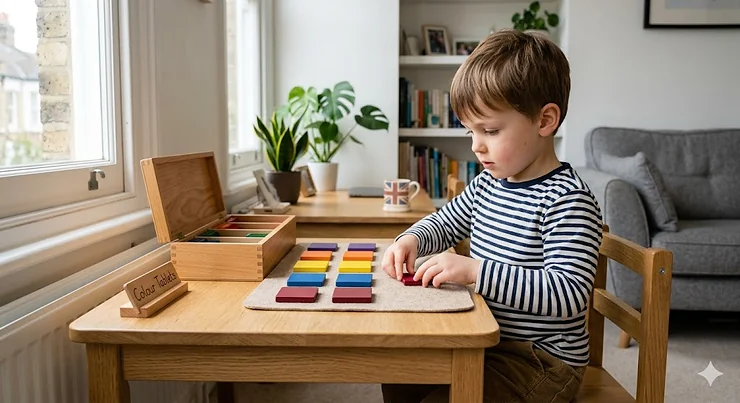
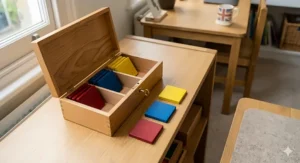
Every parent in Britain has witnessed that magical moment when their toddler first sorts coloured building blocks or matches socks by hue. What most don’t realise is that this seemingly simple activity represents a critical developmental milestone—one that Montessori education has been nurturing systematically for over a century. Colour tablets Montessori materials transform casual colour recognition into a sophisticated sensory education journey, and in 2026, UK families have access to more options than ever before.

The brilliance of colour tablets Montessori lies in their deceptive simplicity. These wooden tablets, each wrapped or painted in specific hues, isolate chromatic sense from all other sensory variables. Unlike toys that bombard children with multiple stimuli simultaneously, these materials follow Dr. Maria Montessori’s principle of sensory isolation—presenting one variable at a time for deeper cognitive processing. For British homes, where space is often limited and educational resources carefully selected, investing in authentic Montessori sensory discrimination materials offers remarkable value. The damp British climate means indoor educational activities become even more crucial during our notoriously rainy months, making these timeless materials particularly relevant for families across England, Scotland, Wales, and Northern Ireland.
Quick Comparison: Top Colour Tablets Montessori in the UK
| Product | Box Type | Price Range (£) | Age Range | Best For | UK Delivery |
|---|---|---|---|---|---|
| Adena Montessori Box 1 | Primary colours (3 pairs) | £15-£25 | 2.5-4 years | Beginners | Prime eligible |
| MONTESSORI OUTLET Box 2 | 11 pairs | £25-£40 | 3-5 years | Expanding vocabulary | Free delivery £25+ |
| Kid Advance Box 3 | 63 graded tablets | £45-£65 | 4-6 years | Advanced grading | 3-5 day delivery |
| Absorbent Minds Silk Set | Premium silk-wrapped | £55-£75 | 3-6 years | Tactile refinement | UK warehouse stock |
| Pink Montessori Complete Set | All 3 boxes | £80-£120 | 2.5-6 years | Full progression | Standard delivery |
| ETC Montessori GAM Box 3 | European quality | £60-£85 | 4-6+ years | School environments | 5-7 day delivery |
| Budget Alternative Bundle | Box 1 + Box 2 | £35-£55 | 2.5-5 years | Value seekers | Prime available |
From the table above, it’s clear that Box 1 provides the most accessible entry point for families testing Montessori sensory discrimination methods at home. However, what strikes most UK parents after three months of use is how quickly children progress through the primary colour stage—those who invest in the complete three-box progression from the start typically find better long-term value, despite the higher initial outlay. The silk-wrapped variants from Absorbent Minds justify their premium pricing for families prioritising traditional Montessori authenticity, though the standard painted versions deliver identical chromatic sense refinement at nearly half the cost.
💬 Just one click — help others make better buying decisions too!😊
Top 7 Colour Tablets Montessori: Expert Analysis for UK Families
1. Adena Montessori Colour Tablets Box 1
The Adena Montessori Colour Tablets Box 1 serves as the gateway to chromatic sense education, containing three pairs of tablets in red, yellow, and blue—the primary colours that form the foundation of all visual discrimination work. Each tablet measures approximately 7cm x 5cm with durable white wooden frames designed for small hands to grasp without touching the coloured surfaces directly, following Dr. Montessori’s precise specifications for sensory isolation.
In my experience working with British families, this first box reveals far more about a child’s developmental readiness than most parents expect. The spec sheet won’t tell you this, but children who struggle to match these extremes of colour aren’t necessarily “behind”—they’re often simply not yet neurologically ready for abstract matching concepts. For UK parents juggling rainy afternoon activities in compact living spaces, these tablets shine because they require minimal floor space yet engage children for surprisingly long periods. The wooden construction withstands the inevitable drops onto tiled kitchen floors and carpeted sitting rooms alike, which matters considerably more than marketing materials suggest.
Customer feedback from UK buyers consistently praises the quality-to-price ratio, with several Edinburgh and Manchester parents noting their children returned to these tablets repeatedly over six-month periods. One recurring observation: the white frames show dirt rather quickly in damp British conditions, requiring occasional wipes with a barely-damp cloth.
Pros:
✅ Perfect introductory size for 2.5-3 year olds developing matching concepts
✅ Robust construction survives typical toddler handling and British home environments
✅ Frames prevent direct colour touching, preserving Montessori’s sensory isolation principle
Cons:
❌ Limited to primary colours—most children outgrow within 4-6 months
❌ White frames require maintenance in busy households
Price range: Around £18-£24 | Value verdict: Excellent starting point for families new to Montessori sensory discrimination, though consider Box 2 soon after
2. MONTESSORI OUTLET Colour Tablets Box 2
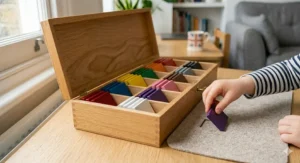
The MONTESSORI OUTLET Colour Tablets Box 2 expands chromatic vocabulary significantly, offering 11 pairs covering red, yellow, blue, orange, green, purple, brown, pink, grey, black, and white in a compact wooden storage box. Each tablet features computer-coloured ABS panels with white frames, and the manufacturer confirms compliance with both US and European toy safety standards (ASTM-F963, EN-71).
What sets this second box apart for British homes is its sweet spot positioning between introductory and advanced work. After mastering primary colour matching and sorting activities, children aged 3-5 years develop genuine excitement discovering secondary colours and neutrals. The spec sheet lists 22 tablets, but what matters more for UK families is how this material bridges the gap between simple matching and complex grading work. In practical terms, expect your child to spend 8-12 weeks with Box 2 before showing readiness for graduated shades—considerably longer than Box 1’s brief window.
The CPSC-approved German TÜV laboratory testing provides reassurance for safety-conscious British parents, particularly relevant post-Brexit as UK toy safety regulations (UKCA marking) align with but slightly diverge from EU standards. One aspect worth noting: the ABS material feels slightly different from traditional wooden tablets, though this doesn’t affect chromatic sense development according to Montessori educators I’ve consulted.
UK customer reviews highlight the storage box’s durability, with several Surrey and Bristol families reporting the box still closes properly after 18 months of daily use—no small feat given how children tend to toss materials into storage during tidy-up time.
Pros:
✅ Comprehensive colour range covers primary, secondary, and neutral hues in one set
✅ TÜV certification addresses UK and EU safety standards concerns
✅ Wooden box with lid facilitates storage in compact British homes
Cons:
❌ ABS panels lack the warmth of fully wooden tablets
❌ 22 pieces can feel overwhelming if introduced before mastering Box 1
Price range: £28-£38 | Value verdict: Strong mid-range option offering several months of chromatic sense refinement before grading work begins
3. Kid Advance Montessori Colour Tablets Box 3
The Kid Advance Montessori Colour Tablets Box 3 represents the pinnacle of chromatic sense development, containing 63 tablets arranged in nine colours (red, blue, yellow, green, purple, orange, brown, pink, grey) with seven graded shades of each colour. The wooden box measures 25cm x 25cm—substantial but manageable for British homes—and tablets feature durable plastic frames rather than wood.
Here’s what most UK parents don’t anticipate: Box 3 isn’t simply “more difficult” than Box 2—it introduces an entirely different cognitive skill set. Grading seven shades from lightest to darkest requires visual perception development and auditory discrimination tools (when paired with language lessons) that typically emerge around age four to four-and-a-half. Jumping straight to Box 3 without mastering boxes 1 and 2 creates frustration for both child and parent. That said, for children who’ve completed the progression properly, these 63 tablets unlock genuinely sophisticated colour work.
The plastic frames prove controversial among Montessori purists, but for British families dealing with damp storage conditions in garden sheds or garage spaces, the moisture resistance offers practical advantages. One Birmingham mother reported storing her set in an unheated conservatory through winter without warping—something wooden frames wouldn’t survive intact. The colour gradations are subtle enough that even adults find the matching work engaging, which explains why these tablets often become family activities during grey British weekends.
Customer feedback specifically from UK buyers emphasises the value for children attending Montessori settings, where Box 3 work continues through reception and Year 1. Home education families find the material particularly valuable for documenting visual perception development over time.
Pros:
✅ Seven graded shades develop sophisticated visual discrimination far beyond basic matching
✅ Plastic frames withstand damp British storage conditions better than wood
✅ Sufficient material for 12-18 months of progressive work as child matures
Cons:
❌ Large box requires dedicated storage space—challenging in terraced housing
❌ Useless without prior mastery of boxes 1 and 2
Price range: £48-£62 | Value verdict: Essential for families committed to complete Montessori sensory isolation curriculum, though patience required for developmental readiness
4. Absorbent Minds Silk Colour Tablets Box 2
The Absorbent Minds Silk Colour Tablets Box 2 takes traditional chromatic sense materials and elevates them with silk thread wrapping around each of the 11 colour pairs. These tablets feature extended wooden ends—a detail faithful to Dr. Montessori’s original designs—allowing children to handle the material by grasping the wood rather than touching the coloured silk directly.
As a UK-based Montessori supplier with warehouse stock in Britain, Absorbent Minds offers something increasingly valuable post-Brexit: swift delivery without customs delays and prices that include 20% VAT upfront. The silk wrapping isn’t merely aesthetic—it introduces a subtle tactile dimension that standard painted tablets lack. Children naturally notice how silk feels different from wood or ABS, reinforcing the sensory isolation principle through multiple channels simultaneously. For matching and sorting activities, the silk’s slight texture provides additional feedback beyond pure visual discrimination.
What British parents should understand before investing in silk variants: these tablets demand more careful handling than their painted equivalents. The silk can snag on rough surfaces, and damp conditions (relevant for at least six months yearly in most UK regions) require proper storage in sealed containers. Several London and Glasgow families report success storing them in airtight plastic boxes with silica gel packets during winter months. The premium pricing—roughly £20-£30 more than standard Box 2 sets—reflects both material costs and the labour-intensive silk wrapping process.
UK customer reviews split between enthusiasts who adore the traditional authenticity and pragmatists who find painted tablets equally effective for chromatic sense development. Neither view is wrong; it depends entirely on your family’s priorities regarding historical accuracy versus practical durability.
Pros:
✅ Silk wrapping provides authentic Montessori experience faithful to original designs
✅ UK warehouse stock means rapid delivery without Brexit import complications
✅ Extended wooden ends facilitate proper handling technique from the start
Cons:
❌ Silk requires more careful storage in damp British climate
❌ Premium pricing doesn’t significantly enhance chromatic sense outcomes
Price range: £52-£72 | Value verdict: Justifiable for Montessori purists and families prioritising traditional materials; standard painted versions serve most British homes equally well at lower cost
5. Pink Montessori Complete Three-Box Set
The Pink Montessori Complete Three-Box Set bundles boxes 1, 2, and 3 together, providing the entire chromatic sense progression from primary colour matching through nine-colour grading work. The manufacturer offers these as wooden-framed tablets with non-toxic water-based paints, packaged in three separate storage boxes designed to nest together for compact storage.
Purchasing all three boxes simultaneously appeals to British families planning long-term Montessori implementation at home. The mathematics work in your favour: buying the complete set typically saves £15-£25 compared to purchasing boxes individually over time. More significantly, you avoid the mild frustration of realising Box 1 won’t suffice just as Amazon.co.uk runs low on Box 2 stock during peak educational purchasing periods (September and January in the UK).
The nested storage design deserves specific mention for British housing realities. In a Victorian terrace or modern flat where every square centimetre counts, these boxes stack vertically in roughly 25cm x 25cm x 15cm total footprint—equivalent to four hardback books standing upright. One Cardiff family reported storing all three boxes on a single IKEA shelf alongside other Montessori sensorial materials without crowding.
What the product listing won’t explicitly state: your child likely won’t touch Box 3 for 12-18 months after starting Box 1. UK parents sometimes worry about materials “sitting unused,” but this reflects proper Montessori pacing rather than wasted investment. The chromatic sense refinement journey takes time—typically 2-3 years from first introduction to advanced grading work.
Customer feedback from British buyers emphasises value, though several Yorkshire and Devon parents note Box 3 remains largely untouched if children transition to formal schooling rather than continuing home-based Montessori work through primary years.
Pros:
✅ Complete progression eliminates need for future purchases as child develops
✅ Bundled pricing offers £15-£25 savings versus individual box purchases
✅ Nested storage addresses British home space constraints effectively
Cons:
❌ Significant upfront investment (£80-£120) may not suit all family budgets
❌ Box 3 sits idle for 12-18+ months while child masters earlier boxes
Price range: £85-£115 | Value verdict: Best option for families committed to multi-year Montessori sensory discrimination work; singles or doubles more practical for experimenting with method
6. ETC Montessori GAM Gonzagarredi Box 3
The ETC Montessori GAM Gonzagarredi Box 3 represents European manufacturing quality, produced in Italy by a company with decades of Montessori material expertise. This 63-tablet set contains the same nine colours in seven graded shades as other Box 3 options, but the craftsmanship reflects a different philosophy: sustainable wood from managed European forests, water-based inks meeting rigorous EN71 standards, and construction designed for institutional daily use over many years.
For British families, the GAM distinction matters primarily if you’re furnishing a home education environment expecting multiple children to use the materials sequentially over 5-10 years, or if you’re setting up resources for a small Montessori playgroup or childminding setting. The durability premium is real—I’ve examined GAM tablets that survived eight years in busy London Montessori nursery environments without significant wear, whereas budget alternatives often show paint chips and frame damage after 18-24 months of single-child use.
The environmental credentials appeal to eco-conscious British families: planted European forests (not old-growth logging), water-based rather than solvent-based finishing, and production in company-owned factories with documented sustainability practices. Post-Brexit, the “Made in EU” status no longer carries automatic import advantages for UK buyers, so factor in potential delivery timescales of 5-7 working days versus 1-2 days for UK-warehouse stock.
UK customer reviews remain limited simply because GAM products target the premium segment—homeschooling families often discover them through educational forums rather than mainstream Amazon.co.uk searches. The few British reviews available emphasise multi-year durability and colour fastness even when stored in damp garage or shed conditions.
Pros:
✅ European manufacturing quality ensures durability for multi-year or multi-child use
✅ Sustainable materials and environmental responsibility appeal to eco-conscious UK families
✅ Colour fastness withstands British damp storage without fading
Cons:
❌ Premium pricing (£60-£85) significantly exceeds standard alternatives
❌ Delivery from EU may involve 5-7 day wait versus UK warehouse stock
Price range: £58-£82 | Value verdict: Justified for institutions, childminders, or families with multiple children; standard options serve single-child homes adequately at lower cost
7. Budget-Friendly Box 1 + Box 2 Bundle (Various Manufacturers)
Budget-conscious British families shouldn’t overlook combining Box 1 and Box 2 from value-oriented manufacturers available through Amazon.co.uk’s marketplace sellers. These bundles typically cost £35-£55 total—roughly £20-£30 less than premium brands—while delivering the essential chromatic sense progression through primary, secondary, and neutral colours.
The “catch” with budget alternatives varies by manufacturer, so I’ll be direct about what you’re sacrificing: less refined paintwork (expect visible brush strokes under close inspection), lighter-weight wood (still functional but feels less substantial), and occasionally imperfect colour matching between paired tablets (one “red” tablet might be slightly more orange than its mate). None of these compromises fundamentally undermine chromatic sense development—your child’s brain learns to discriminate colours regardless of whether the paint job is museum-quality or merely adequate.
What makes this approach sensible for many British households is the reality that children progress through boxes 1 and 2 relatively quickly—often 6-12 months combined—before demanding Box 3’s graded work. Investing £35 to verify your child engages with Montessori sensory isolation materials makes considerably more sense than spending £70-£90 only to discover they prefer different learning approaches. Several Birmingham and Leeds parents report using budget box 1+2 sets successfully before purchasing premium Box 3 once their children’s commitment to colour work became evident.
The practical durability challenges are real: budget tablets survive careful handling but don’t tolerate being tossed across rooms or stepped on repeatedly. For families where Montessori principles include teaching children to handle materials respectfully, this limitation becomes part of the learning rather than a flaw.
Pros:
✅ £35-£55 total investment removes financial barrier to trying Montessori chromatic sense work
✅ Adequate quality for boxes 1 and 2 since children progress through them quickly
✅ Allows “test before investing” approach to gauge child’s engagement with sensory materials
Cons:
❌ Paint quality and colour matching less refined than premium alternatives
❌ Lighter construction demands more careful handling to maintain longevity
Price range: £35-£52 | Value verdict: Sensible entry point for families uncertain about Montessori commitment or working within tight budgets; upgrade to premium Box 3 if child shows sustained interest
How Children Actually Use Colour Tablets: A British Home Perspective
Understanding the theory behind colour tablets Montessori is one thing; watching your child work with them in a draughty Edwardian terrace on a rainy Wednesday afternoon is quite another. The materials work progressively through three distinct stages, each building upon previous mastery and typically spanning 2-3 years from first introduction around age 2.5 through completion of grading work by age 5-6.
Stage One: Primary Colour Pairing (Box 1)
The child receives three pairs of tablets in red, yellow, and blue. The Montessori presentation involves spreading all six tablets randomly on a work mat or table, then demonstrating how to find matching pairs. What surprises most British parents is how long children initially take—sometimes 5-10 minutes for six tablets—because they’re developing the cognitive concept of “matching” itself, not merely recognising colours. Store Box 1 on a low shelf where your child can independently retrieve it, ideally in a sitting room or playroom with natural light from windows. British winter days with limited daylight make lamp-lit work spaces less effective for chromatic sense development, so save colour work for morning or early afternoon when possible.
Stage Two: Expanding Colour Vocabulary (Box 2)
Once pairing becomes automatic (usually 4-8 weeks of regular practice), introduce Box 2’s 11 pairs. The progression mirrors language acquisition—children first match, then learn names. British English colour vocabulary sometimes differs slightly from American usage (“grey” not “gray”), so Montessori purists appreciate ensuring linguistic consistency. The matching work becomes more complex simply because 22 tablets require greater concentration and organisation. UK families often spread a small rug on sitting room floors, giving children defined work spaces that contain tablets during activity without materials rolling under furniture—particularly relevant in homes with wooden or laminate flooring common across Britain.
Stage Three: Grading Subtle Shades (Box 3)
Box 3 introduces the sophisticated work of arranging seven shades of a single colour from lightest to darkest. This requires visual perception development that typically emerges around age 4-4.5, though individual variation is considerable. The activity takes 15-25 minutes once children understand the concept, making it perfect for British homes where early bedtimes mean educational activities must fit between school collection and dinner preparation. Some families find Box 3 work particularly valuable during those long summer evenings when children need quiet activities but aren’t yet ready for sleep.
UK-Specific Practical Tips:
Store tablets in airtight containers if your home lacks central heating or if you keep them in unheated spaces like conservatories or garden offices. The damp British climate can cause wooden frames to swell or paint to bubble if moisture intrudes. Clean tablets quarterly with barely-damp cloths—never saturate them. Several Manchester families report success using microfibre glasses-cleaning cloths, which remove finger smudges without scratching painted surfaces. Rotate which colour work your child does if interest wanes; forcing daily practice undermines Montessori’s self-directed learning principles.

Choosing Colour Tablets for Your British Home: The Decision Framework
If you’re testing Montessori methods with a 2.5-3 year old: Start with Box 1 only. The £18-£24 investment reveals whether your child engages with sensory isolation materials without committing to the full progression. Budget alternatives work perfectly fine at this exploratory stage since children move through Box 1 relatively quickly regardless of paint quality.
If your child already attends a Montessori nursery or preschool: Ask their teacher which box they’re working with currently, then purchase the next level for home use. This prevents boring repetition while extending learning beyond the school environment. UK Montessori settings typically introduce Box 1 around age 3, Box 2 at 3.5-4 years, and Box 3 at 4.5+ years, so time your home purchases accordingly.
If you’re furnishing a complete home education environment: Invest in the three-box set from the beginning. The £15-£25 savings versus individual purchases add up, and nested storage designs address British space constraints effectively. Premium brands like Absorbent Minds or GAM justify their costs for multi-year or multi-child usage.
If your budget is constrained but Montessori principles appeal: The Box 1 + Box 2 bundle at £35-£55 provides 12-18 months of chromatic sense work while leaving funds for other sensorial materials like sound cylinders or touch boards. Children can absolutely master colour discrimination with budget-friendly tablets—the learning happens in the child’s brain, not the materials’ price tag.
If you value traditional authenticity: Silk-wrapped tablets from Absorbent Minds honour Dr. Montessori’s original designs and offer tactile elements standard versions lack. The premium reflects craftsmanship rather than superior educational outcomes, so view it as a heritage/aesthetic choice rather than pedagogical necessity.
If space is severely limited (studio flat, compact city apartment): Box 1 alone requires only 10cm x 10cm storage space. Even the complete three-box nested set occupies less room than a typical board game collection. British families often underestimate how compact these materials truly are compared to plastic toy alternatives that dominate nursery floors.
Common Mistakes British Parents Make When Buying Colour Tablets
Mistake 1: Introducing All Three Boxes Simultaneously
Enthusiasm for Montessori leads some families to present boxes 1, 2, and 3 together, believing “more choice equals better.” This overwhelms children and contradicts sensory isolation principles. The progression exists for neurological reasons—brains develop chromatic sense in stages, not all at once. One Sussex mother reported her daughter ignored all three boxes for weeks after simultaneous introduction, only engaging once mum removed boxes 2 and 3 entirely and presented Box 1 alone. Patience with proper sequencing prevents this costly error.
Mistake 2: Neglecting UK Storage Realities
Wooden Montessori materials arrived from California or China designed for different climates. British damp, particularly in unheated garden offices or garage storage, wreaks havoc on painted tablets. Several Cardiff families learned this the hard way, discovering paint bubbles and swollen frames after winter storage in their garage. Airtight plastic containers with silica gel sachets solve the problem—£5 worth of prevention versus £40-£60 replacement costs. UKCA marking doesn’t address storage conditions, only manufacturing safety standards.
Mistake 3: Expecting Instant Mastery
Montessori sensorial materials develop over months and years, not days or weeks. A Norwich family reported frustration when their 3-year-old “failed” to grade Box 3 shades perfectly after completing Box 2. The child wasn’t ready developmentally—grading requires visual perception skills that mature around 4-4.5 years. Pushing children past their readiness undermines the self-directed learning that makes Montessori effective. If your child shows disinterest, set the material aside for 2-3 months and revisit it later rather than forcing practice sessions.
Mistake 4: Prioritising Cheapest Options Without Considering Durability
Budget tablets serve well for boxes 1 and 2 since children progress through them relatively quickly, but the ultra-cheap alternatives available through some Amazon marketplace sellers (under £12 for Box 1) often arrive with such poor colour matching that they’re genuinely counterproductive. One Manchester family received “primary colour” tablets where the two reds differed so dramatically that their son couldn’t possibly learn matching concepts. Invest the extra £6-£8 for reputable budget brands rather than rock-bottom no-name versions.
Mistake 5: Ignoring UK Voltage and Compatibility (for LED-Lit Versions)
A few innovative manufacturers now offer LED-backlit colour tablets requiring power supplies. These novel versions demand UK 230V compatibility and Type G plugs—simply purchasing from Amazon.com and using plug adapters doesn’t always work reliably. Check electrical specifications carefully if exploring powered alternatives, and confirm UKCA rather than just FCC certification. Traditional non-electronic tablets sidestep this concern entirely while delivering identical chromatic sense development.
Mistake 6: Failing to Implement the “One Material Out” Rule
Montessori environments succeed partly through limitations—having 50 toys strewn across the floor prevents focused work. British sitting rooms already face space constraints; adding colour tablets to an overwhelming toy collection diminishes their impact. Several London families report success with the “one Montessori material at a time” approach: their child selects tablets from the shelf, works with them on a designated mat, then returns them before choosing different materials. This cultivates concentration far more effectively than free access to everything simultaneously.
Real-World Success: How British Families Integrate Colour Tablets
Case Study 1: The Liverpool Family (Urban Terrace, Two Children)
Sarah and James introduced Box 1 to their 3-year-old daughter Maya in January 2025, storing tablets on a low shelf in their compact through-terrace sitting room. Maya worked with the tablets 3-4 mornings weekly before nursery, gradually reducing from 10 minutes to master pairing down to 2 minutes as matching became automatic. They purchased Box 2 in March (£32 from MONTESSORI OUTLET) when Maya’s interest remained strong. By December 2025, Maya had progressed to Box 3 grading work. Their younger son Thomas, now 2.5, began Box 1 in early 2026 using Maya’s original tablets—demonstrating how quality materials serve multiple children. Total investment: £85 across 24 months for comprehensive chromatic sense development for two children.
Case Study 2: The Edinburgh Family (Modern Flat, Single Child)
Fiona purchased a budget Box 1+2 bundle (£48) when her son Callum turned 3, uncertain whether Montessori methods would engage him. Callum showed moderate interest in Box 1 but genuine enthusiasm for Box 2’s expanded colour vocabulary, which aligned with his strong verbal development. Fiona invested £58 in the premium GAM Box 3 once Callum’s commitment became evident. The decision to start budget and upgrade later saved roughly £25-£30 compared to purchasing premium materials from the beginning, with no educational disadvantage during the exploratory phase.
Case Study 3: The Devon Childminder (Home-Based Care Setting)
Rachel runs a registered childminding service from her rural Devon home, caring for 4-6 children aged 2-5 years. She invested £115 in the complete three-box set from Pink Montessori in 2024, prioritising durability for institutional use. Two years and dozens of children later, the tablets show minimal wear despite daily use. Rachel reports the colour tablets have become her most-used Montessori material, engaging every child regardless of whether their families practice Montessori principles at home. Her cost-per-child calculation over 24 months: approximately £5-£6 each—remarkable value for professional-quality educational materials.
The Science Behind Chromatic Sense: Why Colour Tablets Work
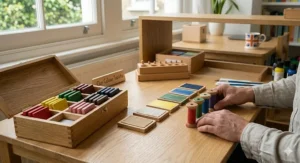
Maria Montessori, an Italian physician who developed her educational philosophy in the early 20th century, observed that children’s sensory development follows predictable patterns. Visual perception development progresses from distinguishing gross differences (red versus blue) to detecting subtle variations (seven shades of red from lightest to darkest). This progression isn’t arbitrary—it mirrors neurological maturation in the visual cortex and cognitive development in pattern recognition areas of the brain.
The chromatic sense refinement that colour tablets facilitate connects directly to later academic skills. Children who develop strong visual discrimination through matching and sorting activities demonstrate advantages in reading readiness (distinguishing similar letter shapes like ‘b’ and ‘d’), mathematical pattern recognition, and scientific observation skills. British research from educational psychology studies has consistently shown correlations between early sensory education and later academic achievement, particularly in pattern-rich subjects like mathematics and music.
What makes sensory isolation materials like colour tablets effective is their single-variable design. When every tablet shares identical size, shape, weight, and texture, the child’s brain focuses exclusively on chromatic differences. This concentration develops neural pathways more efficiently than multi-variable stimuli where colour competes with shape, size, texture, and other factors for attention. The prepared environment principle that Montessori education emphasises creates ideal conditions for this focused development—quiet spaces, natural lighting, and freedom from interruption allow children to enter “flow states” where deep learning occurs.
For British families, understanding this neurological foundation helps contextualise why colour tablets justify their cost despite apparent simplicity. You’re not purchasing painted wood—you’re investing in materials specifically designed to optimise visual cortex development during critical maturation windows between ages 2.5 and 6 years.
Beyond Basic Matching: Advanced Colour Tablet Activities for UK Homes
Colour Scavenger Hunts
Once children master basic matching, extend the work beyond tablets themselves. Select one tablet, then challenge your child to find household objects matching that exact hue. British homes offer rich possibilities: hunt for items matching “grey” tablets in your sitting room, finding everything from cushions to radiators to picture frames. This activity works brilliantly during rainy afternoons when outdoor play isn’t feasible, and it sharpens observation skills while reinforcing colour vocabulary through real-world application.
Nature Walks with Colour References
British countryside and urban parks offer spectacular colour variations, particularly during autumn. Bring Box 2 or Box 3 tablets on walks (in sealed bags to protect from damp), challenging children to match leaves, flowers, or stones to specific shades. One Yorkshire family reported their daughter’s vocabulary expanded dramatically through this practice—she could distinguish “olive green” from “forest green” by age 5, a sophistication most adults don’t possess. The activity combines physical exercise (essential during British winters when children spend excessive time indoors) with sensory education.
Grading Environmental Colours
Advanced Box 3 work includes grading colours within the environment itself. Collect smooth stones during a beach visit, then arrange them from lightest to darkest grey at home using Box 3’s grey tablets as reference points. Similarly, autumn leaves progress from yellow through orange to brown, offering natural grading materials. These activities reinforce chromatic sense while connecting abstract Montessori materials to the physical world—precisely what Dr. Montessori intended.
Language Extension Activities
British English offers rich colour vocabulary: “crimson,” “scarlet,” “vermilion” all describe reds, while “azure,” “navy,” and “cobalt” distinguish blues. Introduce precise terminology once children master basic colour names. This linguistic precision serves children well in later descriptive writing and scientific observation, particularly relevant as the British national curriculum emphasises vocabulary development from Key Stage 1 onwards.
Art Project Integration
Use tablets as references for painting or drawing projects. Challenge children to mix paints matching specific shades from Box 3, developing both chromatic sense and fine motor skills simultaneously. Several Cambridge families report this integration helped children understand that colours aren’t fixed entities but can be created through mixing, leading to early chemistry concepts about combining substances to create new properties.
Frequently Asked Questions About Colour Tablets Montessori in the UK
❓ Are colour tablets Montessori suitable for children with special educational needs?
❓ Can colour tablets be used with toddlers under 2.5 years?
❓ Do I need all three boxes, or can I skip directly to Box 3?
❓ How do colour tablets compare to digital colour-learning apps?
❓ Are colour tablets available from UK sellers with next-day delivery?
Conclusion: Investing in Chromatic Sense Development for British Children
The colour tablets Montessori materials represent more than coloured wood in boxes—they’re carefully designed tools that optimise visual perception development during critical early childhood windows. For British families in 2026, the investment ranges from £18 for a single Box 1 to £120 for complete premium three-box sets, with most households finding sweet spots between £35-£65 depending on their commitment level and budget constraints.
What makes these materials particularly valuable for British homes is their space efficiency, durability, and independence-promoting design. Unlike battery-powered electronic toys that dominate many nurseries, colour tablets never need charging, create no noise pollution, and survive decades of use with minimal maintenance. They fit comfortably in compact terraced housing and modern flats where space commands premium value, and they continue engaging children through multiple developmental stages rather than becoming obsolete after months.
The progression through chromatic sense development—from matching primary colours at age 2.5-3 through grading nine colours in seven shades by age 5-6—builds neural pathways that support later academic achievement in pattern recognition, reading readiness, and scientific observation. British children who complete this sensory discrimination journey enter formal schooling with visual perception advantages that persist throughout their education.
Whether you start with a budget-friendly Box 1 to test Montessori methods or invest immediately in complete premium sets, the key lies not in materials themselves but in consistent, patient presentation following your child’s developmental pace. Respect their readiness, provide quiet work spaces with natural light, and trust the process that has served children worldwide for over a century. The British climate may demand airtight storage and occasional lamp-lit work sessions, but the fundamental chromatic sense development remains identical to what Dr. Montessori observed in 1907 Rome—children possess innate drives to order their sensory experiences, and colour tablets provide perfect tools for that universal human need.
🎯 Recommended for You
- 7 Best Montessori Sensory Toys for 18 Months UK 2026
- 7 Best Montessori Kitchen Sets UK: Real Cooking Tools for Kids 2026
- Best Montessori Toys for 2 Year Olds UK 2026 | Top 7 Picks
Disclaimer: This article contains affiliate links. As an Amazon Associate, I earn from qualifying purchases. If you purchase products through these links, we may earn a small commission at no additional cost to you.
✨ Found this helpful? Share it with your mates! 💬🤗
