
In This Article
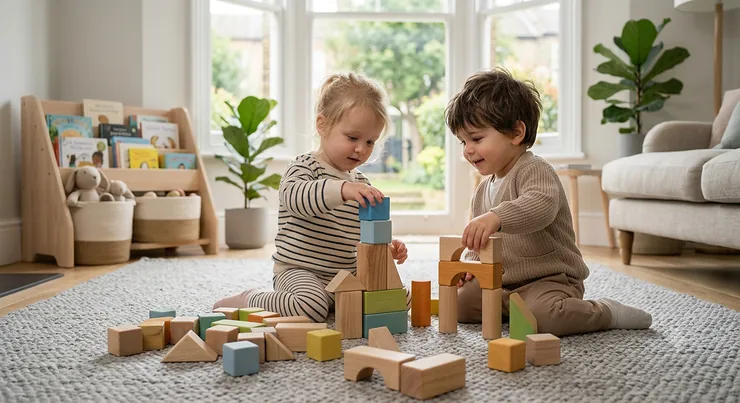
Somewhere in most British living rooms there’s a wicker basket, a battered cardboard box, or (if you’re lucky) a proper wooden crate that holds a small mountain of chunky, colourful cubes. That’s the quiet magic of wooden blocks for toddlers: no batteries, no app, no light-up nonsense — just wood, gravity, and a small person working out how the world stays upright. It sounds almost too simple to matter. It matters enormously.
Occupational therapists have been banging on about block play for decades, and for good reason: stacking, sorting, and knocking down blocks is one of the earliest, most accessible ways a child practises the hand control, patience, and problem-solving that later show up in things like handwriting and dressing themselves. The UK government’s early years fine motor skills guidance explains that this kind of hand and finger control underpins coordination skills more broadly — precisely the skillset a stack of wooden cubes is built to exercise.
This guide cuts through the noise. We’ve researched seven genuinely good wooden block sets available in the UK, from pocket-money-friendly starter tubs to heirloom-quality Montessori sets that’ll outlast the toddler years entirely. You’ll get honest analysis (not recycled marketing copy), real comparison data, and practical guidance for choosing wooden blocks for toddlers that actually get played with rather than gathering dust under the sofa. Whether you’re shopping for a first birthday, kitting out a playroom, or hunting specifically for montessori wooden building blocks or wooden blocks set for 1 year old options, you’re in the right place.
Quick Comparison Table
| Product | Piece Count | Best For | Price Range |
|---|---|---|---|
| Melissa & Doug 100 Wood Building Blocks | 100 | All-round value pick, ages 2+ | £20-£30 |
| Bigjigs Toys Tub of Wooden Building Bricks | 50 | Budget first set, ages 1+ | £15-£25 |
| Bigjigs Toys Wooden Peg Blocks | 24 | Montessori-style sorting, 1-2 years | £12-£20 |
| Bigjigs Toys Colourful Builders Blocks | 100 | Interlocking click-together play | £30-£40 |
| Hape Maple Wood Kids Building Blocks | 50 | Durable mid-range everyday set | £20-£30 |
| Tender Leaf Toys Garden Blocks | 25 | Themed imaginative play, 18m+ | £25-£35 |
| PlanToys 40 Unit Blocks | 40 | Premium open-ended Montessori set | £35-£50 |
Looking across the line-up, there’s a clear budget-to-premium spread: the Bigjigs Toys Wooden Peg Blocks anchor the affordable end for very young toddlers, while the PlanToys 40 Unit Blocks sit at the top for parents wanting sustainably made, Montessori-aligned pieces that double as neutral-toned nursery decor. Piece count isn’t everything, either — a 24-piece set aimed at 1-year-olds needs chunkier, safer pieces than a 100-piece set built for a confident 3-year-old, so match the set to the child’s actual stage rather than chasing the highest number on the box.
💬 Just one click — help others make better buying decisions too!😊
Top 7 Wooden Blocks for Toddlers: Expert Analysis
1. Melissa & Doug 100 Wood Building Blocks — best all-rounder for growing collections
The standout here is sheer variety: 100 pieces across nine shapes and four colours means a toddler never runs out of new combinations to try. This set is the one most British parents will recognise from nursery playrooms, and there’s a reason for that ubiquity.
Each block is precision-cut hardwood with a smooth, sanded finish and rounded edges, and the set includes cubes, cylinders, arches, half-circles, and prisms — enough shape variety that a child can graduate from basic stacking towers around 18-24 months into arches and bridges by age three or four. Real-world translation: this is a set that doesn’t get outgrown in six months; it simply gets used differently as skills develop.
Based on the shape range and the FSC-certified sourcing, this suits families who want one substantial set to cover the entire toddler-to-preschool window rather than buying replacements every year. It’s a particularly strong pick if you’re also searching for wooden blocks for 3 year old options, since the arch and prism shapes reward the more ambitious building attempts that three-year-olds start experimenting with.
Reviewers consistently report that the storage box is a genuine time-saver at tidy-up time, and that the paint holds up well against chewing and drool from the younger end of the age range. A recurring theme in aggregated feedback is that the box itself, while sturdy, isn’t always big enough to fit every piece back in once the lid seal loosens with repeated use.
Pros:
- ✅ Nine shapes give genuinely open-ended building options
- ✅ FSC-certified hardwood with smooth, child-safe edges
- ✅ Storage box included for easy tidy-up
Cons:
- ❌ Storage box lid can loosen with heavy daily use
- ❌ Smaller pieces need supervision for children under 2
In the £20-£30 range, this is difficult to beat on pieces-per-pound, and the value verdict is straightforward: for a first “proper” block set that will still be relevant at age four, it’s hard to look past it.
2. Bigjigs Toys Tub of Wooden Building Bricks — best budget starter set for 1-year-olds
What stands out immediately is the price-to-durability ratio; this is a genuinely affordable entry point from a British toy company with real manufacturing pedigree, not a throwaway supermarket set.
The 50-piece tub contains solid wood bricks that are deliberately lightweight and sized for smaller hands, with rounded edges and a smooth painted finish designed to survive being thrown, chewed, and sat on repeatedly. In practice, this means the set works as both a stacking toy for a 12-18 month old and a simple building set once fine motor control improves around 24 months.
This is the set to reach for if you’re specifically after a wooden blocks set for 1 year old and want to avoid overwhelming a young toddler with too many pieces at once; 50 is a manageable number that still allows for real towers without turning tidy-up into a 20-minute ordeal. Bigjigs has been producing wooden toys in the UK since 1985, and that institutional experience with EN71-compliant manufacturing shows in the consistency of the finish.
Aggregated customer sentiment is largely positive on build quality, though a genuine and recurring theme in reviews is that some of the smaller bricks in the mix feel too small for children under 18 months, and a handful of reviewers flagged this as a safety consideration worth checking against your own child’s stage rather than the stated age guidance alone.
Pros:
- ✅ Genuinely affordable entry point for first blocks
- ✅ Lightweight bricks sized for smaller toddler hands
- ✅ British-designed brand with 1985 manufacturing history
Cons:
- ❌ Some pieces run smaller than ideal for under-18-months
- ❌ 50 pieces limits complexity once a child is 3+
At around £15-£25, the value case is simple: it’s one of the cheapest genuine hardwood sets available, and what most buyers overlook is that “budget” here doesn’t mean flimsy — it means fewer pieces, not lower quality wood.
3. Bigjigs Toys Wooden Peg Blocks — best for hands-on Montessori sorting practice
The 24-piece peg-and-block sorting mechanic is the standout feature: rather than free stacking, a toddler matches coloured pegs of different sizes into holes on four wooden blocks, which is a distinctly different (and complementary) skill to tower-building.
Each of the four blocks contains five holes of graduated sizes, and the 20 pegs come in five each of red, blue, green, and yellow. What this means in practice is a toy that quietly teaches size discrimination and colour matching alongside the more obvious fine motor workout of pinching and posting small pegs — precisely the kind of graded challenge that Montessori-style materials are designed around.
This is the strongest pick on this list if you’re specifically hunting for montessori wooden building blocks in a genuinely toddler-appropriate size, since the pieces are scaled for little hands rather than shrunk-down adult tools. It suits sorting-obsessed toddlers particularly well, and works nicely as a calmer, tabletop alternative to the noisier business of knocking towers down.
A recurring note in real user feedback is that the pegs occasionally get mismatched to the wrong-sized holes during play, which some reviewers found added a nice extra puzzle-solving layer rather than being a flaw, while others found the manufacturer’s age guidance (which varies between “2 years+” on the packaging and “3 years+” in the technical details) slightly inconsistent.
Pros:
- ✅ Teaches size discrimination alongside colour recognition
- ✅ Compact 24-piece set is easy for toddlers to manage
- ✅ Smooth surfaces with no sharp edges or splinters
Cons:
- ❌ Age guidance is inconsistent between packaging and details
- ❌ Less suited to open-ended tower building than free blocks
At roughly £12-£20, this sits at the accessible end and earns its keep as a targeted skill-builder rather than a general free-play set — buy it alongside a stacking set rather than instead of one.
4. Bigjigs Toys Colourful Builders Blocks — best for interlocking, sturdier structures
The click-together mechanism is what separates this from a standard stacking set: the 100 pieces are cut to interlock firmly, meaning a toddler’s tower is genuinely harder to knock over by accident, which changes the play pattern in a meaningful way.
The set includes cubes, cylinders, rectangles, half-circles, and more, all painted in seven bright colours, and because pieces click rather than simply balance, children can build wider, more ambitious structures such as walls and simple houses without the frustration of constant collapse. Based on the interlocking design, this genuinely rewards slightly older toddlers whose grip strength is developing but whose patience for repeated toppling isn’t yet infinite.
The practical upshot for parents is fewer meltdowns over collapsed towers and a set that bridges nicely from purely toddler stacking into the beginnings of more deliberate construction play around age three. This makes it a sensible companion pick alongside the freer-form Melissa & Doug set above, since the two play styles genuinely differ rather than duplicating each other.
Reviewers frequently highlight that the wood varies subtly in tone between pieces, which several found charming rather than a defect, and note that the click-fit is firm enough to survive enthusiastic dismantling by younger siblings. A consistent complaint is that pieces occasionally arrive with slightly tight-fitting joints that loosen only after the first few weeks of play.
Pros:
- ✅ Click-together joints reduce accidental toppling
- ✅ Encourages more ambitious wall and house structures
- ✅ Wide colour range aids colour-recognition play
Cons:
- ❌ Some joints are stiff to click together at first
- ❌ Not ideal for children under 18 months still mastering grip
At around £30-£40, this sits mid-range, and the value verdict hinges on your child’s stage: if towers-that-fall-over cause daily distress, the extra spend on interlocking pieces earns its keep quickly.
5. Hape Maple Wood Kids Building Blocks — best durable everyday set for mixed ages
Hape’s standout feature is consistency: 50 brightly coloured maple wood pieces across a genuine variety of shapes, manufactured to a standard that’s held up well across the brand’s long track record in the European and UK wooden toy market.
The blocks are painted with non-toxic, child-safe paint and finished with rounded, sanded edges, and the canvas storage bag is a small but genuinely useful inclusion for families who need the set to travel between rooms, grandparents’ houses, or nursery bags. What this means practically is a set built for the realistic chaos of daily toddler life rather than showroom-display use.
This suits parents who want a dependable, mid-range set without researching a dozen niche brands — Hape has built its reputation on exactly this kind of unfussy reliability, and the maple wood construction gives it a satisfying weight and solidity that lighter pine sets sometimes lack. It’s a genuinely sensible middle-ground pick between the budget Bigjigs tub and the premium PlanToys set below.
Aggregated review sentiment consistently praises the smooth, splinter-free finish and the fact the paint doesn’t chip or flake with heavy use — a common complaint about cheaper unbranded sets. A repeated criticism is that the canvas storage bag, while handy, isn’t especially durable itself and can develop small tears within the first year of regular use.
Pros:
- ✅ Maple wood construction feels noticeably solid
- ✅ Non-toxic paint resists chipping with heavy play
- ✅ Canvas carry bag aids transport and storage
Cons:
- ❌ Carry bag fabric can tear with rough handling
- ❌ Shape variety is narrower than the 100-piece sets
In the £20-£30 bracket, the value proposition is straightforward reliability rather than any single standout feature, which is exactly what a lot of parents are actually looking for.
6. Tender Leaf Toys Garden Blocks — best themed set for imaginative role-play
The garden theme is the genuine standout: 25 push-and-click blocks decorated with nature illustrations turn straightforward stacking into a small imaginative world of flowers, bugs, and garden scenes, which is a different hook to the purely abstract shapes of most block sets.
Made from sustainably sourced rubber wood, the blocks use a push-and-click function that’s gentler and easier for smaller hands than firmer interlocking systems, while the illustrated surfaces double as a soft introduction to pattern and sequence recognition as toddlers match up garden scenes across pieces. In practice, this makes it less of a pure construction toy and more of a hybrid between blocks and a picture-matching game.
This is a strong pick for imaginative toddlers who respond better to storytelling props than blank cubes, and for families who want a British-designed brand with an explicit sustainability angle — Tender Leaf notes its toys are designed by its UK product team and manufactured to meet European and American safety standards. It works well as a bridge toy for toddlers who aren’t yet fully engaged by traditional block play but respond to characters and scenes.
Reviewers commonly note the illustrations hold up well against handling and don’t fade quickly, and that the smaller 25-piece count makes it a manageable size for younger toddlers to tidy away themselves. A recurring gripe is that the push-and-click connection is looser than firmer interlocking systems, so taller builds can topple more easily than with the Bigjigs click blocks above.
Pros:
- ✅ Illustrated garden theme supports imaginative play
- ✅ Sustainably sourced rubber wood construction
- ✅ Manageable 25-piece count for younger toddlers
Cons:
- ❌ Push-and-click joints are looser than firmer systems
- ❌ Smaller piece count limits complex building
At roughly £25-£35, this earns its place through theme and story appeal rather than raw building capability, so it’s best viewed as a complementary set rather than a family’s only block collection.
7. PlanToys 40 Unit Blocks — best premium, sustainably made Montessori set
The standout feature is the deliberate simplicity: 40 blocks across six classic architectural shapes, split between soft pastel-coloured pieces and natural unstained wood, designed explicitly around open-ended, Montessori-aligned play rather than themed decoration.
PlanToys blocks are made from rubberwood sourced from trees that have already finished producing latex, using a chemical-free kiln-drying process, formaldehyde-free glue, and water-based dyes — a materials story that goes noticeably further than most competitors on this list. What this means in practice is a set with genuinely lower off-gassing and chemical exposure risk, which matters more to some families than to others but is worth knowing about.
Based on the shape range (cylinders, pyramids, cuboids, and arches) and the muted, neutral palette, this suits families who want blocks that look as good on an open shelf as they do mid-tower, plus parents specifically seeking Montessori learning toys that emphasise unstructured exploration over character branding or bright primary colours. It’s a natural fit for open-ended play advocates who want a set that scales in complexity as a toddler’s building ambition grows.
Reviewers consistently praise the tactile, satisfying weight of the pieces and the muted pastel palette, with several noting their toddlers were drawn to sorting and counting the pieces before they were even building towers. A fair and recurring observation is that, at 40 pieces, dedicated block enthusiasts outgrow the set’s complexity faster than the 100-piece alternatives above.
Pros:
- ✅ Chemical-free, sustainably sourced rubberwood construction
- ✅ Neutral palette doubles as attractive nursery decor
- ✅ Classic architectural shapes support genuine open-ended building
Cons:
- ❌ 40 pieces limits scale compared with bigger sets
- ❌ Premium price point compared with budget alternatives
Sitting around £35-£50, this is the priciest set on the list, and the value verdict comes down to priorities: if sustainable materials and long-term aesthetic appeal matter as much as raw piece count, it earns its premium; if you want maximum building volume per pound, look to the Melissa & Doug or Bigjigs Colourful Builders sets instead.
Top 7 Products: Detailed Comparison
| Product | Age Range | Material | Standout Feature | Best For |
|---|---|---|---|---|
| Melissa & Doug 100 Wood Building Blocks | 2+ years | FSC hardwood | 9 shapes, 100 pieces | Best For: All-round growing collection |
| Bigjigs Toys Tub of Wooden Building Bricks | 1+ years | Solid wood | Lightweight, budget-friendly | Best For: First set for 1-year-olds |
| Bigjigs Toys Wooden Peg Blocks | 2-3 years | FSC wood | Size/colour sorting pegs | Best For: Montessori-style skill building |
| Bigjigs Toys Colourful Builders Blocks | 18m+ | Solid wood | Interlocking click joints | Best For: Sturdier, ambitious structures |
| Hape Maple Wood Kids Building Blocks | 12m+ | Maple wood | Durable non-toxic paint | Best For: Everyday reliable set |
| Tender Leaf Toys Garden Blocks | 18m+ | Rubber wood | Illustrated garden theme | Best For: Imaginative role-play |
| PlanToys 40 Unit Blocks | 2+ years | Rubberwood | Chemical-free, pastel finish | Best For: Sustainable premium play |
The spread here confirms a genuine pattern rather than marketing spin: piece count generally rises as price falls, while material story and design intentionality generally rise as price climbs. For most first-time buyers, the Melissa & Doug 100 Wood Building Blocks or Bigjigs Toys Tub of Wooden Building Bricks offer the strongest starting point, while families prioritising sustainability credentials should look straight to the PlanToys 40 Unit Blocks.
Benefits vs Traditional Alternatives
| Factor | Wooden Blocks | Plastic Building Bricks | Screen-Based Building Apps |
|---|---|---|---|
| Sensory feedback | Weighted, tactile, natural texture | Lightweight, uniform texture | None |
| Longevity | Years, often passed down | Cracks/discolours over time | Depends on device lifespan |
| Open-ended play value | Very high — no fixed outcome | Moderate — often kit-based | Low — guided by app design |
| Environmental footprint | Lower with FSC/sustainable sourcing | Higher, petroleum-based | Device manufacturing footprint |
| Fine motor engagement | High — real-world grip and balance | Moderate — snap-fit mechanics | Minimal — screen taps/swipes |
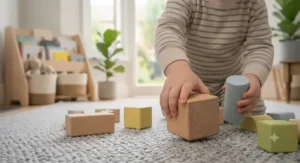
The comparison above makes the physical-versus-digital case fairly plainly: wooden blocks for toddlers win decisively on sensory feedback and open-ended play value precisely because there’s no “correct” way to use them, unlike an app that nudges a child toward a specific outcome. Where plastic bricks like interlocking systems hold their own is durability against very rough play and, for older children, the precision of complex kit-building — but for the toddler years specifically, the weighted, tactile nature of real wood tends to matter more than snap-fit precision.
Practical Usage Guide: Getting the Most From Your Wooden Blocks
Getting a new set of blocks right in the first few weeks makes a real difference to whether they become a daily favourite or a forgotten box. Start with fewer pieces than the full set for a very young toddler — tip out 10-15 blocks rather than the whole 100-piece tub, since an overwhelming pile can actually shut down play rather than encourage it. Introduce shapes gradually: let a child master simple cube stacking for a few weeks before introducing cylinders and arches, which require different balance judgements.
A quick monthly check is worth building into your routine: inspect painted surfaces for chipping (particularly on any set under two years old, where mouthing is still common), and run a hand over edges to catch any splintering on unvarnished wood pieces. For click-together sets, a light wipe with a barely damp cloth keeps joints from getting sticky with food residue, but avoid soaking wooden pieces, since standing water can warp grain over time.
One of the most common early mistakes is treating blocks purely as a stacking toy and stopping there. Reintroducing the set every few months with a new “challenge” — build the tallest tower, sort by colour, build a bridge two blocks can pass under — keeps engagement high well beyond the first fortnight of novelty. Storage matters too: a low, open basket that a toddler can access independently encourages self-directed play far more than a lidded box on a high shelf.
Real-World Scenarios: Matching Blocks to Your Toddler
Consider three common family situations. First, a parent of an 18-month-old in a small flat with limited storage: the Bigjigs Toys Tub of Wooden Building Bricks or Bigjigs Toys Wooden Peg Blocks make sense here — compact piece counts, budget-friendly, and genuinely appropriate for a toddler still mastering basic grip and release.
Second, a family with a 3-year-old who’s outgrown basic stacking and is asking for “proper building”: the Melissa & Doug 100 Wood Building Blocks or Bigjigs Toys Colourful Builders Blocks suit this stage well, since the wider shape range and (in the case of the click blocks) interlocking stability support more ambitious structures without constant collapse-related frustration.
Third, parents furnishing a shared playroom for siblings aged 1 and 4, where durability and long-term value matter more than any single feature: the Hape Maple Wood Kids Building Blocks offers dependable middle-ground durability across both ages, while the PlanToys 40 Unit Blocks rewards households who’ll keep the set as a long-term shelf fixture rather than a phase-specific toy. In each scenario, matching the set to the child’s actual developmental stage — not just their chronological age on the box — produces far better long-term engagement than chasing the biggest piece count available.
How to Choose Wooden Blocks for Toddlers
Choosing well comes down to a handful of genuinely important criteria rather than an overwhelming checklist.
- Check the age guidance against piece size, not just the number printed on the box. A “2+” set with pieces under 3cm can still pose a choking risk for a young two-year-old who mouths toys; measure against the standard choke-hazard test if you’re unsure.
- Prioritise rounded, sanded edges over sharp geometric precision. Blocks that look architecturally striking but have crisp 90-degree edges are less forgiving when a toddler inevitably gets whacked by a falling tower.
- Look for FSC certification or an explicit sustainable-sourcing statement. This is as much about paint and glue quality as environmental credentials — sustainably certified brands tend to be more transparent about non-toxic finishes too.
- Match piece count to the child’s current attention span, not their eventual potential. A 100-piece set can overwhelm an 18-month-old; a 24-piece set can bore a determined four-year-old within a fortnight.
- Weigh interlocking versus free-stacking mechanics against your child’s patience level. Interlocking blocks reduce toppling frustration but require more grip strength to click together in the first place.
- Consider storage realistically. A set that comes with a genuinely sturdy box or bag gets tidied away far more reliably than loose pieces in an overflowing basket.
- Verify UKCA or CE marking on the packaging before buying. Under current GB product marking rules, businesses can choose either the CE marking or the UKCA marking when placing toys on the market in Great Britain, so either marking (correctly applied) indicates the toy has been through the required safety assessment.
✨ Don’t Miss These Exclusive Deals!
🔍 Take your playroom to the next level with these carefully selected wooden block sets. Click on any highlighted item to check current pricing and availability. These timeless toys will help you create authentic learning moments your family will love!
Common Mistakes When Buying Wooden Blocks
The most frequent mistake is over-buying on piece count for the child’s actual age. A well-meaning grandparent gifting a 150-piece premium set to a 14-month-old often ends up with a toy that spends most of its life half-used, simply because that many pieces exceeds what a toddler that age can meaningfully organise or attend to.
A second common misstep is ignoring shape variety in favour of raw quantity. Fifty identical cubes teach stacking, but they don’t teach the balance and spatial reasoning that arches, cylinders, and prisms introduce — variety matters more than volume for skill development. A third mistake is choosing painted sets without checking the paint’s certification status; while all UK-sold toys must meet chemical safety requirements under the Toys (Safety) Regulations, some imported unbranded sets sold through third-party online marketplaces have patchier compliance records than established brands.
Finally, many parents underestimate storage as a purchase factor and end up with blocks permanently scattered across the floor. A set without a genuinely functional storage solution often gets played with less over time, not more, simply because tidy-up becomes a battle every single evening.
Wooden Blocks vs Plastic Building Bricks: A Detailed Comparison
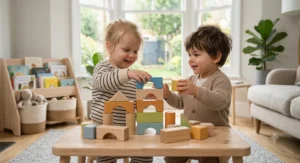
The wooden-versus-plastic debate isn’t really about which is “better” in the abstract — it’s about which suits your child’s current stage and your household’s priorities. Wooden blocks generally win for toddlers under three specifically because the weight and grain-textured surface give more honest sensory feedback: a child learns genuinely useful information about balance and gravity from a real wood block sliding off a stack in a way that a feather-light plastic brick simply doesn’t replicate.
Plastic interlocking bricks, on the other hand, tend to pull ahead once a child moves past pure toddlerhood into more deliberate construction play around age four or five, where the mechanical precision of snap-fit connections supports more complex, planned builds. For the specific toddler window this guide focuses on, though, open-ended wooden sets consistently outperform plastic on the qualities that matter most at that developmental stage: tactile richness, genuine open-endedness, and — for many parents — a materials story that feels better aligned with reducing single-use plastic in the home. Cost-wise, wooden sets and mid-range plastic brick sets land in broadly similar price brackets, so the decision more often comes down to sensory and sustainability priorities than budget alone.
What to Expect: Real-World Performance
On paper, a stack of identically shaped cubes sounds like it might get boring fast. In practice, block play tends to evolve in fairly predictable stages that make the “boring” concern largely unfounded. Around 12-18 months, expect simple two-to-three block towers and plenty of enthusiastic knocking-down — this is completely normal and is, in fact, the primary way toddlers learn cause and effect at this stage.
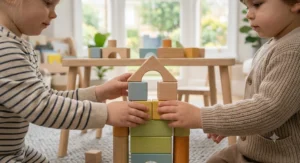
By 2-3 years, most children start sorting by colour or shape spontaneously and attempt taller, more ambitious towers, often narrating what they’re building even if the structure bears little resemblance to the stated goal. By age three to four, expect genuine representational building — houses, garages, “castles” — alongside the beginnings of cooperative play if there’s a sibling or friend involved, where blocks get shared out and structures become joint projects. Reviewers across multiple brands note that engagement dips briefly around the “I’ve mastered basic stacking” plateau before picking back up once a child discovers combining shapes for bridges and arches, which is a useful thing to know if your toddler suddenly seems to lose interest for a week or two.
Montessori Learning Toys and Open-Ended Play: Why It Matters
The terms montessori wooden building blocks and open-ended play get used a lot in toy marketing, sometimes loosely. The genuine underlying principle is straightforward: materials with no single “correct” outcome allow a child to set their own goals, work at their own pace, and repeat an activity as many times as internal motivation demands, rather than chasing an external reward or a pre-defined “win” state.
This matters practically because it shifts the adult’s role from director to observer. Rather than showing a toddler how to build a specific tower, open-ended block play invites the child to experiment, fail, adjust, and try again — the exact iterative process that underpins problem-solving skills later in school. Sets like the PlanToys 40 Unit Blocks or the plain end of the Melissa & Doug range lean hardest into this philosophy through their deliberately simple, unbranded shapes, while more themed or interlocking sets (like the Tender Leaf Garden Blocks or Bigjigs Colourful Builders) sit closer to guided or narrative play — both are valuable, but they’re not interchangeable, and a well-rounded toy collection often benefits from a mix of both.
Fine Motor Skill Development: What the Research Actually Says
It’s worth being precise about what block play does and doesn’t do. It won’t teach a toddler to talk or walk faster. What it reliably does support is the small-muscle control in the hands and fingers that underpins later skills like holding a pencil, using cutlery, and doing up buttons. BBC Tiny Happy People, developed with NHS child development experts, offers a wealth of age-banded activity ideas that reinforce exactly this kind of hands-on skill building alongside block play.
The mechanism with blocks is fairly intuitive once you watch a toddler at play: picking up a cube requires a controlled pincer or palmar grasp, placing it precisely on top of another block requires releasing that grip at exactly the right moment without knocking the structure over, and repeating this dozens of times in a single play session builds genuine muscle memory. What the spec sheet won’t tell you, but developmental guidance consistently notes, is that this kind of repetitive, self-directed practice tends to be more effective for skill-building than adult-led drilling, simply because a motivated child repeats the action far more times than they would under instruction.
Safety, Regulations, and Compliance Guide
Every wooden block set sold in Great Britain must comply with the Toys (Safety) Regulations 2011, which set essential requirements covering physical properties, choking hazards, flammability, and chemical limits for toys intended for children under 14. As explained in gov.uk’s guidance on placing UKCA or CE marked products on the market, businesses currently have the flexibility to use either the CE marking or the UKCA marking to place goods on the market in Great Britain, so don’t be alarmed if a well-established European or American brand still carries a CE mark rather than UKCA — both are currently valid routes to compliance for the GB market.
Practically, that means checking for a visible UKCA or CE mark on the packaging, confirmed age guidance printed clearly, and (for painted sets) a note confirming non-toxic, child-safe paints and lacquers. For very young toddlers specifically, apply the small-parts test at home regardless of stated age guidance: if a piece fits inside a standard toilet roll tube, treat it as a potential choking risk and supervise closely. Always dispose of any packaging plastic immediately and inspect second-hand or hand-me-down block sets for splintering, since older sets predating current regulations may not meet today’s safety standards.
Long-Term Cost and Maintenance
Wooden blocks are, in cost-per-year-of-use terms, one of the better-value toy categories a family can buy into. A £25-£40 set that sees regular play from age one through four — and often gets handed down to a younger sibling or passed on entirely — works out to genuinely low pence-per-play-session over its lifetime, especially compared with trend-driven plastic toys that fall out of favour within a single season.
Maintenance costs are close to zero: an occasional damp-cloth wipe, checking for splinters every few months, and storing away from direct radiator heat (which can warp or crack wood over time) is essentially the full care routine. The main long-term cost consideration is replacement paint or touch-ups if a set gets heavy daily wear over several years, though most of the brands featured here use finishes durable enough that this rarely becomes necessary before the child naturally moves on to other toys.
Buyer’s Decision Framework
If your toddler is under 18 months and this is their first block set, choose a smaller, budget-friendly option like the Bigjigs Toys Tub of Wooden Building Bricks, because grip control and attention span don’t yet support large piece counts.
If your toddler is 2-3 years old and building confidently, choose a larger, varied-shape set like the Melissa & Doug 100 Wood Building Blocks, because shape variety at this stage directly supports the leap from stacking to representational building.
If tower-toppling causes daily frustration, choose an interlocking set like the Bigjigs Toys Colourful Builders Blocks, because the mechanical stability reduces collapse-related meltdowns.
If sustainability credentials and long-term aesthetic value matter most, choose the PlanToys 40 Unit Blocks, because the sourcing and finish are built for genuine longevity and shelf appeal beyond the toddler years.
If imaginative, story-led play is your toddler’s preference over abstract construction, choose the Tender Leaf Toys Garden Blocks, because the illustrated theme gives play a narrative hook that plain blocks don’t offer.
Features That Actually Matter (And Those That Don’t)
Genuinely important: rounded edges, non-toxic certified paint, verified UKCA/CE marking, and piece size appropriate to your child’s current stage rather than the box’s stated age range. These directly affect safety and daily usability.
Largely marketing noise: exact piece counts above roughly 60-80 (most toddlers won’t meaningfully use more at once), elaborate branded packaging, and claims of “IQ-boosting” or similarly overstated developmental promises. Blocks support fine motor and spatial skills well, but no toy set delivers the dramatic cognitive leaps that some marketing copy implies — the value comes from repeated, engaged play over time, not from any single design feature.
Wooden Blocks for Different Toddler Stages and Audiences
For a 1-year-old just starting out, prioritise fewer, larger, lighter pieces — the Bigjigs Toys Tub of Wooden Building Bricks or Wooden Peg Blocks suit this stage, since oversized, simple shapes are easier for developing grip strength to manage safely.
For a toddler between 2 and 3, a set with genuine shape variety supports the jump from basic stacking to early representational building; the Melissa & Doug or Hape sets both suit this middle stage well, offering enough complexity without overwhelming piece counts.
For a confident 3-year-old (or older) pushing into ambitious builds, larger sets with interlocking stability or wide shape ranges — the Bigjigs Colourful Builders Blocks or the full Melissa & Doug range — give room to grow into genuinely complex constructions like bridges, garages, and multi-storey towers.
FAQ
❓ What age are wooden blocks suitable for?
❓ Are wooden blocks better than plastic blocks for toddlers?
❓ How many wooden blocks does a toddler need?
❓ Do Montessori wooden blocks need to be a specific brand?
❓ Are wooden blocks safe for babies who still put toys in their mouths?
Conclusion
Wooden blocks for toddlers remain one of the few toy categories that genuinely earn their reputation rather than relying on clever marketing. Across the seven sets reviewed here, the pattern holds up consistently: budget options like the Bigjigs Toys Tub of Wooden Building Bricks and Wooden Peg Blocks give younger toddlers an accessible, appropriately scaled introduction, mid-range picks like the Melissa & Doug 100 Wood Building Blocks and Hape Maple Wood Kids Building Blocks offer dependable everyday value across a wider age span, and premium sets like the PlanToys 40 Unit Blocks reward families prioritising sustainable materials and long-term aesthetic appeal.
The right choice ultimately comes down to your child’s current stage rather than any single “best” set in the abstract — a 100-piece box that overwhelms an 18-month-old becomes exactly right for the same child eighteen months later. Whatever you choose, the underlying value proposition holds: open-ended, screen-free play that quietly builds the fine motor foundations for skills that show up years down the line, all from a box of shaped wood.
Recommended for You
- Wooden Building Blocks: 7 Best Sets for UK Families in 2026
- Solar System Posters for Children: 7 Best Picks for 2026
- Educational Wall Charts UK: 7 Best Picks for 2026 (Honest Guide)
Disclaimer: This article contains affiliate links. As an Amazon Associate, I earn from qualifying purchases. If you purchase products through these links, we may earn a small commission at no additional cost to you.
✨ Found this helpful? Share it with your friends! 💬🤗
