
In This Article
Somewhere between the fridge magnets and the school reading folder, most British households eventually acquire a poster. Educational wall charts have quietly become one of those parenting staples nobody warns you about — like glitter, or the sudden need for three different sizes of school jumper. One minute you’re wondering why your Year 3 child freezes at “7 times 8,” and the next you’re scrolling Amazon at 11pm trying to work out whether an A3 alphabet poster is actually big enough to read from across a bedroom.
Here’s the short version: educational wall charts are printed visual reference posters — covering subjects like times tables, the alphabet, the periodic table or world geography — designed to be displayed on a wall for repeated, low-effort learning through everyday glances rather than sit-down study sessions. That “little and often” exposure is precisely why teachers have hung them in classrooms for decades, and why parents are increasingly putting them up at home too.
This guide digs into seven real, currently available charts sold in the UK, compares them honestly (including where they fall short), and walks through the genuinely useful stuff — how to pick sizes, where to hang them, and which subjects actually benefit from a poster versus an app. Prices are given as ranges rather than exact figures, since Amazon pricing shifts constantly; always check the current price before buying. This article also contains affiliate links, and we’ve flagged that clearly further down.
Whether you’re kitting out a home-school corner, decorating a classroom, or just trying to get times tables to finally stick, there’s a decent chance one of the seven charts below is the missing piece.
Quick Comparison Table
| Chart | Size | Subject | Best For |
|---|---|---|---|
| Daydream Education Times Tables Poster | A1 (594 × 850mm) | Maths | Classrooms & family kitchens |
| Large Times Tables Poster (OpenDyslexic) | A1 (594 × 841mm) | Maths | Dyslexic learners |
| Sumbox Multiplication Square Poster | A3 (297 × 420mm) | Maths | Small bedrooms, tight budgets |
| Daydream Education The Alphabet Poster | C2 (458 × 648mm) | Early Years literacy | Preschool & Reception |
| Daydream Education Periodic Table (Set of 2) | A1 (850 × 594mm) | Science | GCSE revision |
| DayDream Education Map of the UK Poster | A1 (850 × 594mm) | Geography | Primary & secondary geography |
| Daydream Education Verb Tenses Poster | A1 (850 × 594mm) | English grammar | KS2/KS3 English |
Looking at the spread here, the pattern is pretty clear: A1 dominates anything meant to be read from across a room, while A3 and smaller sizes suit close-up, personal reference use like a bedside chart or a fridge door. Notice too that six of these seven come from the same UK poster specialist, Daydream Education — that’s not favouritism on our part, it’s simply that they’ve cornered a huge chunk of the school-supplier market, which says something about consistency of quality. If you’re outfitting more than one subject, buying a couple of sizes to compare in person before committing to a full set isn’t a bad idea.
💬 Just one click — help others make better buying decisions too!😊
Top 7 Educational Wall Charts: Expert Analysis
1. Daydream Education Times Tables Poster — the classroom-standard all-rounder
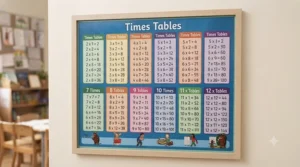
If you’ve set foot in a British primary school in the last decade, there’s a fair chance you’ve walked past this exact poster without realising it. The Daydream Education Times Tables Poster comes in an A1 size measuring 594mm x 850mm, printed on gloss paper (with a laminated version also available), and it’s designed specifically around the KS1 and KS2 curriculum rather than a generic “maths chart” template. That distinction matters more than it sounds — a poster built around what Year 3 and Year 4 pupils are actually expected to know lines up neatly with what’s coming home in their homework book.
At this size, the grid is genuinely legible from several metres away, which is the whole point of a wall chart rather than a worksheet: it’s meant to be glanced at repeatedly, not studied up close. Daydream Education describes itself as having supplied over five million resources to more than 50,000 classrooms, and while we can’t independently verify that exact figure, the sheer ubiquity of their posters in UK schools lends some real credibility to the claim. Reviewers on this poster consistently note that the bright, high-contrast colour blocks make individual rows easy to track with a finger — useful for younger children who lose their place easily on a busy grid.
Who is it for? Families wanting a genuinely classroom-grade chart at home, or teachers refreshing a maths corner without reinventing the wheel. It’s not the most stylish poster on this list — the design leans functional over decorative — but function is exactly what a times tables chart needs to deliver.
Pros:
- ✅ Full A1 size readable from across a room
- ✅ Curriculum-aligned specifically to KS1/KS2 maths
- ✅ Laminated version available for durability
Cons:
- ❌ Bold, busy design won’t suit minimalist décor
- ❌ Non-laminated gloss version marks more easily
Expect this poster to sit in the £8-£16 range depending on whether you choose the laminated or standard finish — a small outlay for a resource that’ll likely still be on the wall in three years’ time, making it solid value per year of use.
2. Large Times Tables Poster (OpenDyslexic) — the accessibility-first option
This one deserves more attention than it gets. The Large Times Tables Poster (OpenDyslexic) is an A1-sized chart (roughly 594mm x 841mm) that lists every times table from 1×1 up to 12×12 written out in full, using the OpenDyslexic typeface — a font specifically engineered with heavier bottom-weighted letterforms to reduce the letter-flipping and line-skipping that dyslexic readers commonly experience.
What most buyers overlook about this poster is that dyslexia doesn’t just affect reading words — it frequently affects numeral recognition too, and a standard grid-based times tables chart (rows and columns of bare digits) can be genuinely hard to track for a child who struggles with visual sequencing. Writing tables out in full sentences (“Four times four is sixteen”) rather than as a bare grid gives an additional verbal anchor alongside the visual one, which lines up with what cognitive scientists call dual coding — pairing verbal and visual information so the brain has two separate retrieval pathways rather than one, a principle explored in detail by Nottingham Trent University’s teaching research.
A verified customer review on this exact listing states plainly that it’s “particularly good for dyslexics” — a small but genuine data point rather than a manufactured one. If your child has a diagnosed or suspected specific learning difficulty, this is worth prioritising over the more common grid-style posters.
Pros:
- ✅ OpenDyslexic font aids dyslexic readers specifically
- ✅ Full written-out tables, not just bare number grids
- ✅ Large A1 size for wall or classroom use
Cons:
- ❌ Less scannable at a glance than a grid format
- ❌ Niche design won’t appeal to all learning styles
Pricing typically sits in the £10-£18 range. For a family managing dyslexia support, the value here isn’t really about the poster itself — it’s the reduced friction every single time your child looks at it.
3. Sumbox Multiplication Square Poster — the budget bedroom pick
The Sumbox Multiplication Square Poster is a laminated A3 chart (297mm x 420mm) showing the times tables from 1 to 12 in a classic multiplication square layout, finished with a glossy, wipe-clean laminate. It’s smaller than the two A1 posters above, and that’s really the whole trade-off in a nutshell: less wall real estate needed, lower price, but less readable from a distance.
Based on the spec comparison with the A1 options, this poster is clearly built for close-range, personal reference — think bedside wall, fridge door, or a small home-school desk — rather than a classroom feature wall. Aggregated customer feedback is broadly positive on learning value, with dozens of reviewers specifically praising how it helps children revise and reinforce tables they’re learning at school. Clarity also scores well, with reviewers noting the text is easy to read close-up. That said, it’s worth being upfront: a number of buyers have reported the poster arriving smaller than they expected, and a handful have flagged it as feeling pricey for its size — a fair criticism given how compact A3 actually is compared to a full-size wall poster.
Pros:
- ✅ Compact size ideal for small bedrooms
- ✅ Laminated, wipe-clean finish for durability
- ✅ Strong aggregated reviews for learning value
Cons:
- ❌ Some buyers report it’s smaller than expected
- ❌ A few reviewers consider it pricey for the size
Expect a price in the £6-£12 range. If wall space is tight or you want something that travels easily between rooms, this is the pragmatic choice — just measure your intended spot before ordering so the size doesn’t catch you out.
4. Daydream Education The Alphabet Poster — the early years staple
Aimed squarely at Early Years and Reception classrooms, the Daydream Education The Alphabet Poster is printed at C2 size (458mm x 648mm) on 170gsm gloss paper that’s FSC-certified, meaning the paper stock is sourced from responsibly managed forests — a small but genuine sustainability credential worth noting for eco-conscious households.
Here’s what the spec sheet won’t spell out directly: C2 sits between A3 and A2 in physical dimensions, which puts it in a genuine sweet spot for a toddler or Reception-age child’s eye line — big enough to read from a few feet away, but not so oversized it dominates a small bedroom wall the way an A1 poster would. For families debating alphabet poster size more broadly (more on that later in this guide), this is a useful middle-ground data point: bigger isn’t automatically better once you factor in where a three-year-old is actually going to be standing.
Reviewers of Daydream Education’s classroom range consistently highlight the bright, high-contrast colour illustrations paired with each letter, which supports letter-sound association — a foundational pre-reading skill. As with the rest of the brand’s range, the informational content is designed by people with a teaching background rather than a generic graphic design template, which shows in how the letters are ordered and sized for legibility.
Pros:
- ✅ C2 size balances visibility and wall space well
- ✅ FSC-certified sustainable paper stock
- ✅ Bright letter-illustration pairing aids recall
Cons:
- ❌ Not laminated as standard, so less spill-resistant
- ❌ Single-subject focus means you’ll likely buy more posters
Typical pricing falls in the £7-£13 range. For a first alphabet poster in a nursery or playroom, it’s a genuinely solid starting point rather than an impulse buy you’ll regret.
5. Daydream Education Periodic Table Classroom Posters (Set of 2) — the GCSE science investment
Stepping up to secondary-level content, the Daydream Education Periodic Table Classroom Posters (Set of 2) pairs two A1 laminated posters (850mm x 594mm each): a standard periodic table and a companion poster breaking down the groups and their chemical properties in more depth. Daydream Education states the content is kept current with the latest confirmed elements, which matters more than it sounds — periodic tables genuinely do get updated as new elements are officially named, and an outdated wallchart missing a confirmed element is a minor but real problem for GCSE-level accuracy.
What most buyers overlook about a two-poster science set like this is that pairing a reference chart with an explanatory one does more pedagogical heavy lifting than either poster alone. The main table gives the at-a-glance lookup; the groups poster gives the “why” — why metals cluster on the left, why the noble gases barely react. That’s a meaningfully different function from a single all-in-one poster trying to cram both jobs onto one sheet. For deeper subject support beyond the poster itself, the Royal Society of Chemistry’s education resources offer free supplementary teaching material that pairs well with a physical wallchart like this one.
Being laminated as standard (unlike several others on this list), it’s genuinely built for the wear and tear of a shared classroom or a well-used home study space, wiping clean of felt-tip and highlighter marks without much fuss.
Pros:
- ✅ Two complementary posters cover lookup and explanation
- ✅ Laminated as standard for classroom durability
- ✅ Content kept current with newly named elements
Cons:
- ❌ Higher price point than single-poster options
- ❌ Overkill for pre-GCSE age groups
At around £16-£26 for the pair, this sits at the premium end of the list — but for a household with a GCSE science student, the cost-per-use over two years of revision makes it one of the stronger value cases here, not despite the higher price but because of how long it earns its keep.
6. DayDream Education Map of the United Kingdom Poster — the geography reference chart
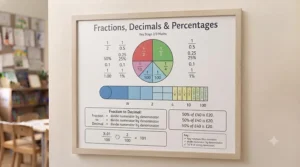
The DayDream Education Map of the United Kingdom Poster is another A1 chart (850mm x 594mm), available in both gloss and laminated finishes, laying out the UK’s countries, major cities, capitals and key geographical features in a clean, classroom-legible format. It’s a genuinely practical companion for the KS2 geography curriculum, where pupils are expected to name and locate counties, cities and physical features closer to home before moving on to wider world geography.
Based on aggregated customer feedback, this poster performs a slightly unexpected secondary role: several reviewers, including at least one secondary-school English teacher, mention using it to give context to English literature set in specific parts of the UK — pinning down exactly where a novel or a Shakespeare play is geographically rooted. That’s a nice illustration of the “transformation” idea running through this whole guide: a chart bought for one subject quietly earning its keep in another.
Reviewers do flag that it’s a little pricier than they expected relative to a simple printed map, though most agree it does the job well once it’s up. The layout prioritises clarity over decorative flourish, which is exactly what you want from a reference chart rather than a piece of wall art.
Pros:
- ✅ Clear labelling of counties, cities and capitals
- ✅ Doubles as useful context for English literature
- ✅ Laminated option for long-term durability
Cons:
- ❌ A few reviewers find it pricier than expected
- ❌ Design is functional rather than decorative
Pricing generally sits around £10-£18 depending on finish. For any household or classroom covering British geography, history or literature, this earns a spot on the wall well beyond a single term.
7. Daydream Education Verb Tenses Poster — the grammar reference chart
Rounding out the list is the Daydream Education Verb Tenses Poster, another A1 gloss-paper chart (850mm x 594mm) from Daydream Education’s English Grammar range, giving a structured overview of verb tenses alongside example sentences showing when each tense is actually used in practice.
Here’s the practical interpretation worth flagging: grammar posters are frequently the most skipped subject in a home poster collection, because tenses feel abstract compared to a times table or a map. But the spec here is specifically built to counter that — pairing each tense with a worked example sentence transforms an abstract grammatical category into something a child can pattern-match against their own writing. That’s the kind of detail that separates a genuinely useful reference chart from a poster that just states facts without context.
Reviewers of Daydream Education’s English range consistently note the visual clarity of the layout, with colour-blocked sections making it easy to distinguish past, present and future tense groupings at a glance — a good example of the colour-coding principle covered in more depth later in this guide. It pairs particularly well with the brand’s separate Punctuation and Nouns posters if you’re building out a full home English corner.
Pros:
- ✅ Example sentences make tenses concrete, not abstract
- ✅ Colour-blocked layout aids quick visual grouping
- ✅ Complements other posters in the same English range
Cons:
- ❌ Best suited to KS2+ rather than early readers
- ❌ Standalone gloss finish, not laminated by default
Expect a price around £8-£15. Grammar rarely gets the glamorous poster treatment, but this one manages to make verb tenses feel less like a chore and more like a quick-reference cheat sheet.
Practical Usage Guide: Making the Most of Your Reference Materials Display
Buying the right chart is only half the job — where and how you display it changes how much actual learning happens. As a reference materials display, a wall chart only earns its keep if it’s positioned somewhere it gets looked at repeatedly and without effort, not tucked behind a door or above a wardrobe where nobody’s eyeline ever lands.
For younger children, hang charts at their standing eye height, not yours — a poster mounted for an adult’s sightline might as well be invisible to a four-year-old. For older children doing homework, position reference charts directly in the sightline of their desk, so a glance upward answers a question instead of triggering a full stop-and-search. Kitchens and hallways work brilliantly for high-traffic charts like times tables or the alphabet, since children pass them dozens of times a day without any deliberate “study session” being scheduled.
On maintenance: laminated posters wipe clean with a damp cloth and mild detergent, but avoid abrasive cleaners which can dull the gloss finish over time. Non-laminated gloss paper posters are more vulnerable to humidity and direct sunlight, both of which cause fading and curling at the edges — a bathroom or a south-facing conservatory wall is a poor long-term home for an unlaminated chart. A common first-30-days mistake is using standard sticky tack on painted walls, which can pull plaster or paint away on removal; museum putty or removable poster strips are a gentler alternative that still holds A1-sized posters securely. Finally, rotate charts every school term where possible — a chart a child has stopped noticing has effectively stopped teaching.
Real-World Scenarios: Matching Wall Charts to Your Family
Rather than a generic “it depends,” here are three realistic profiles that map fairly cleanly onto specific charts from this list.
If you’re a parent of a Year 3 child who’s just started prepping for the statutory Multiplication Tables Check, the Daydream Education Times Tables Poster or the Large Times Tables Poster (OpenDyslexic) (if dyslexia is a factor) belong somewhere your child passes daily — a kitchen or hallway wall works better than a bedroom, since repetition without a deliberate study session is the whole strategy here.
If you’re setting up a compact home-school corner in a flat with limited wall space, budget-friendly, smaller-format charts like the Sumbox Multiplication Square Poster make more sense than committing an entire A1-sized wall to a single subject — you can fit two or three A3 charts in the space one A1 poster would need.
If you’re a parent of a GCSE student juggling triple science revision, the Daydream Education Periodic Table Classroom Posters (Set of 2) earns its higher price tag specifically because of frequency of use — a poster glanced at daily across two years of GCSE study works out to pennies per look by the time exams roll around, which is a genuinely different value equation to a poster a toddler outgrows within a year.
Common Problems With Wall Charts (And How to Fix Them)
A handful of issues come up again and again in aggregated customer feedback across this category, and most have straightforward fixes.
Problem: the poster looks too small once it’s actually on the wall. This is the single most common complaint across A3-sized charts specifically. The fix is simple but easy to skip: measure the intended wall space and stand back to the child’s typical viewing distance before ordering, rather than judging size from a product photo alone.
Problem: unlaminated posters curl or fade within months. Direct sunlight and humidity are the usual culprits. Moving the poster to an interior wall, or choosing a laminated version where one’s available, solves this outright.
Problem: a child stops noticing a chart after a few weeks. Novelty wears off fast for anyone, adults included. Rotating charts termly, or moving an existing poster to a new spot in the house, resets that “invisible wallpaper” effect surprisingly well.
Problem: tape or adhesive damages paintwork on removal. Swap standard sticky tack for removable poster strips or museum putty, both of which release cleanly from painted plaster.
Problem: a poster is pitched at the wrong age or key stage. Cross-check the poster’s stated curriculum stage against your child’s actual year group before buying — a periodic table poster aimed at GCSE content will mostly wash over a Year 2 pupil, however nice it looks on the wall.
How to Choose Educational Wall Charts: 7 Expert Criteria
Choosing the right chart isn’t complicated once you break it into a handful of concrete questions.
- Match the size to the viewing distance. A1 for anything read from across a room; A3 or smaller for close-range, personal reference like a bedside wall.
- Check curriculum alignment. Posters built around a specific key stage (like KS1/KS2 times tables) map more directly onto homework than generic “maths facts” charts.
- Decide whether lamination matters for the location. Kitchens, playrooms and shared classrooms benefit hugely from a wipe-clean laminated finish; a quiet bedroom wall may not need it.
- Consider accessibility needs specifically. A dyslexia-friendly font, as seen on the OpenDyslexic times tables poster, can make a genuine practical difference for some learners.
- Weigh cost against expected years of use. A pricier laminated set that lasts through an entire GCSE course often works out better value than a cheaper poster replaced twice.
- Think about colour coding. Charts that group related information by colour (tenses, times tables, element groups) tend to aid faster visual recall — more on why below.
- Plan for rotation, not permanence. Buying two or three cheaper charts to rotate through the year often teaches more than one expensive poster left up indefinitely.
Alphabet Poster A3 vs A2 Size: Which Should You Choose?
This is one of the most common sizing questions parents run into, and it genuinely comes down to two factors: viewing distance and available wall space.
A3 (297mm x 420mm) is the more compact option — roughly the size of a large magazine page. It suits close-range use: a bedside wall, a small home-school desk, or a nursery corner where a toddler is standing within a metre or two of the poster. The trade-off is legibility from further away; text and illustrations sized for A3 start to lose clarity once viewed from across a bedroom or classroom.
A2 (420mm x 594mm) roughly doubles the surface area of A3, and this extra size translates directly into readability from a genuine distance — useful for a classroom feature wall, a playroom, or any shared space where several children might be looking at the poster from different spots in the room simultaneously. Many alphabet posters, including Daydream Education’s C2-sized option covered above (which sits close to A2 territory), lean into this larger format specifically because early-years classrooms need posters visible from well across the room, not just up close.
As a rule of thumb: choose A3 for a single child’s personal space with limited wall room, and A2 (or similar larger formats) for shared or classroom-style spaces where several children need to read it simultaneously from varying distances. If you’re genuinely torn, note that A2 costs more but rarely needs replacing for size reasons later — a common regret among parents who buy A3 for a growing playroom is discovering within a year that the poster’s simply too small for the space.
Colour-Coded Information Charts: Why Colour Coding Boosts Recall
Several of the charts on this list — the times tables posters, the verb tenses chart, the periodic table set — lean heavily on colour-coded information rather than plain black-and-white text, and that’s a deliberate design choice grounded in genuine learning research rather than just decoration.
Colour coding works by giving the brain an additional retrieval cue beyond the raw text or numbers themselves. When verb tenses are grouped by colour block, or times tables are shaded by number family, a child doesn’t just remember “the answer” — they remember roughly where on the poster it sat and what colour surrounded it, creating a secondary visual anchor that supports faster recall under pressure, such as during a timed test like the Multiplication Tables Check. This aligns closely with the dual coding principle covered earlier in this guide, where pairing verbal information with a distinct visual element creates two separate memory pathways instead of one.
The important caveat, and one worth flagging honestly: colour coding only helps when it’s consistent and meaningful, not decorative for its own sake. A poster using seven random colours purely for visual appeal, with no logical grouping behind the choices, doesn’t deliver the same cognitive benefit as one where colour maps directly onto categories — the “6, 7, 8, 9 and 12 times tables are hardest” grouping used in the official Multiplication Tables Check is a good real-world example of colour or grouping being used with actual pedagogical intent, as outlined in the official government guidance on the check.
Visual Learning Aids and At-a-Glance Learning Tools: What the Cognitive Science Says
It’s worth being honest about something here: “visual learner” as a fixed personality trait — the old idea that some children learn best visually and others verbally or physically — isn’t well supported by rigorous research, and several UK academic reviews have pushed back on treating it as gospel. What is well supported is that presenting the same information through both a verbal and a visual channel simultaneously tends to help most learners, regardless of their supposed “style,” because it reduces the cognitive load of holding information in a single mental format.
That’s really the honest case for at-a-glance learning tools like wall charts: they’re not magic for a specific type of child, they’re a low-friction way of delivering repeated, incidental exposure to information that would otherwise require a deliberate sit-down session. A child glancing at a times tables poster while eating breakfast isn’t “studying” in any formal sense, but the repeated, low-pressure exposure does genuine cognitive work over weeks and months — the same principle behind why supermarket queues and waiting rooms are packed with informational posters nobody consciously chooses to read, yet somehow absorb anyway.
Where visual aids genuinely underperform is when the information is too dense or poorly organised — a chart crammed with every possible fact about a subject becomes visual noise rather than an at-a-glance tool. The better posters on this list (the periodic table set, the colour-coded grammar chart) succeed specifically because they prioritise a handful of clearly organised facts over exhaustive detail, leaving deeper study to books, apps or classroom teaching.
Educational Wall Charts vs Digital Learning Apps
It’s a fair question in 2026: with times tables apps, interactive periodic tables and geography quizzes all available on a tablet, do physical wall charts still earn their place?
The honest answer is that they serve genuinely different functions rather than competing directly. Apps excel at active, deliberate practice — timed quizzes, adaptive difficulty, instant feedback on wrong answers. A wall chart can’t do any of that; it’s a static, passive resource. But that passivity is precisely its strength in a different context: a chart requires zero setup, no login, no screen time allowance, and it delivers incidental, repeated exposure throughout the day without anyone deciding to “do some learning” at all. A tablet app demands a session; a wall chart just sits there working quietly in the background of ordinary life.
The strongest households in our research typically use both, not one instead of the other — an app for focused, active practice sessions, and a wall chart for the ambient, low-effort reinforcement that happens between those sessions. If you’re choosing only one due to budget or screen-time concerns, a wall chart has the edge for very young children, where screen-time guidance already limits app use, and for any subject (grammar, geography, the periodic table) where a quick visual reference matters more than active drilling.
Educational Wall Charts for Different Audiences: Toddlers to GCSE Students
For toddlers and preschoolers (ages 2-4), simple, high-contrast alphabet and number posters work best — the Daydream Education The Alphabet Poster or a multi-pack like the Grandisk alphabet set suit this stage well, focusing on letter-sound and letter-shape recognition rather than dense information.
For Key Stage 1 and 2 pupils (ages 5-11), curriculum-specific charts pay off most, particularly around the Year 4 Multiplication Tables Check — the Daydream Education Times Tables Poster and DayDream Education Map of the United Kingdom Poster both map directly onto what’s actually taught in these year groups, per the national curriculum mathematics guidance.
For Key Stage 3 and GCSE students (ages 11-16), denser reference charts earn their keep, particularly for revision — the Daydream Education Periodic Table Classroom Posters (Set of 2) and Daydream Education Verb Tenses Poster both suit this stage, where a quick glance can jog memory during independent revision far faster than searching through a textbook.
For learners with dyslexia or other specific learning differences, purpose-built accessibility charts like the Large Times Tables Poster (OpenDyslexic) deserve priority over generic options, since the font and layout differences genuinely reduce friction rather than being a cosmetic variation.
Long-Term Cost & Maintenance: Are Laminated Wall Charts Worth It?
Laminated charts typically cost a few pounds more than their non-laminated equivalents, but the cost-per-year calculation usually favours lamination once you factor in durability. A non-laminated gloss poster in a busy kitchen or classroom might show visible wear, fading or tearing within a year; a laminated equivalent in the same spot can realistically last three to five years with an occasional wipe-down.
Run the maths on the Daydream Education Periodic Table Classroom Posters (Set of 2): at roughly £20 for the pair, laminated and durable enough to survive two full years of GCSE revision, that works out to under £10 a year — a genuinely trivial cost for a resource used almost daily during exam season. Compare that to a non-laminated poster needing replacement after a single messy year, and the laminated option, despite its higher upfront price, wins clearly on total cost of ownership.
The maintenance itself is minimal regardless: a damp cloth for laminated posters, careful positioning away from direct sunlight and damp walls for non-laminated ones, and mindful adhesive choice to protect your paintwork on removal, as covered in the usage guide above.
Common Mistakes When Buying Educational Wall Charts
The most frequent mistake is buying based on the product thumbnail image alone rather than checking the actual listed dimensions — a poster that looks impressively large in a zoomed-in photo can turn out to be A4-sized in reality, a complaint that shows up repeatedly in aggregated reviews across this category.
A second common mistake is buying content pitched at the wrong key stage, assuming “educational” automatically means “age-appropriate” — a periodic table poster genuinely won’t mean much to a five-year-old, while an alphabet poster will bore a Year 6 pupil within days.
A third mistake is over-hanging a single wall with too many posters at once, which paradoxically reduces how much attention any individual chart gets — visual overload dilutes focus rather than multiplying learning, so rotating two or three charts through the year tends to outperform hanging six simultaneously.
Finally, skipping the lamination question for high-traffic spots is a mistake many buyers only recognise in hindsight, once a kitchen-wall poster has already curled at the corners from steam and humidity.
Frequently Asked Questions
❓ What size wall chart is best for a classroom?
❓ Do laminated posters really last longer?
❓ Are educational wall charts actually effective for learning?
❓ What age is best to start using alphabet posters?
❓ How do I stop a wall poster damaging my paint when removed?
Conclusion
Educational wall charts aren’t flashy, and they’ll never trend on social media the way a new learning app might. But there’s something quietly effective about a resource that requires no charging, no login, and no scheduled “learning time” to still be doing its job every single day. Across the seven charts covered here, the honest takeaway is that size and lamination matter more than most buyers initially assume, curriculum alignment beats generic content every time, and colour-coded, dual-coded design genuinely earns its place rather than being decorative fluff.
Whether you’re supporting a Year 4 child through the Multiplication Tables Check with the Daydream Education Times Tables Poster, easing a dyslexic learner’s frustration with the Large Times Tables Poster (OpenDyslexic), or gearing a GCSE student up for exam season with the Daydream Education Periodic Table Classroom Posters (Set of 2), the right chart is really about matching the poster to the actual person looking at it — their age, their room, their specific learning needs — rather than chasing the single “best” option in the abstract.
✨ Ready to Brighten Up Your Learning Space?
🔍 Take a closer look at any of the charts above to check current pricing and availability. A well-placed poster today could be the thing that finally makes times tables — or the alphabet, or the periodic table — click for good.
Recommended for You
- Magnetic vs Non-Magnetic Whiteboards Kids: 7 Picks for 2026
- Easel For 3 Year Old: 7 Best Picks Parents Trust in 2026
- Kumon vs School Zone Workbooks: 7 Picks Compared (2026)
Disclaimer: This article contains affiliate links. As an Amazon Associate, I earn from qualifying purchases. If you purchase products through these links, we may earn a small commission at no additional cost to you.
✨ Found this helpful? Share it with your friends! 💬🤗
